


A Thai law firm for foreigners since 2006. 5,000+ client matters. Thai lawyer of record: Wichuda Atthamethakon, LL.M., Thai Bar Licence 3149/2556. English, Thai and French. We answer within 24 hours.
Reviewed by ThaiLawOnline, a licensed Thai law firm practising in Thailand since 2006. Thai lawyer of record: Wichuda Atthamethakon, LL.M., Thai Bar Licence 3149/2556.
Last updated on
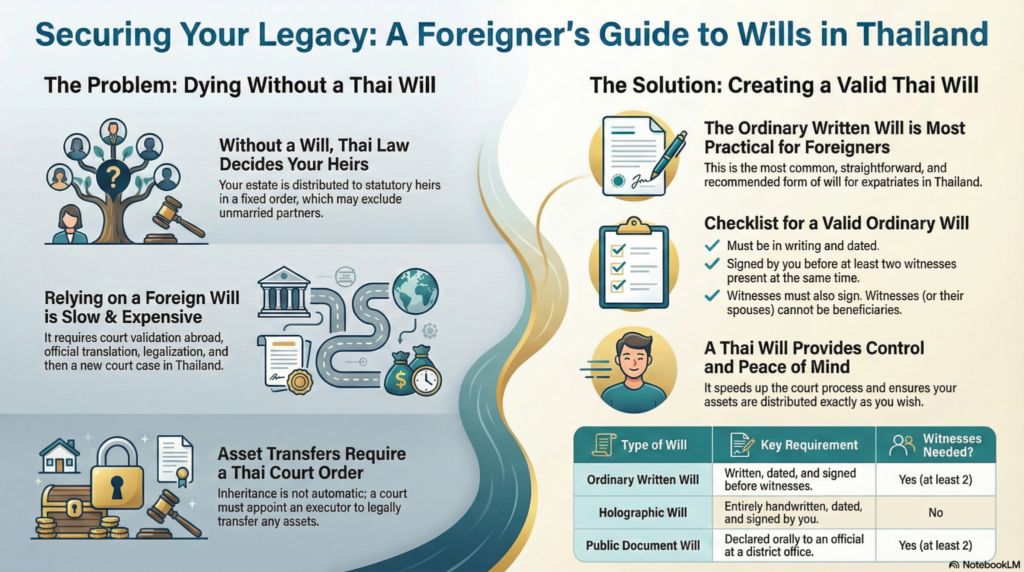
Short answer: any foreigner can make a legally valid will in Thailand. The most common form must be in writing, dated, and signed by the testator in front of two witnesses who also sign (Civil and Commercial Code, Section 1656). A bilingual, lawyer-drafted Thai will is a fixed 3,900 THB, or you can prepare one yourself from our free bilingual Thai will template. A Thai will covering your Thai assets spares your family months of cross-border probate.
Free downloads: bilingual sample will (PDF) and the signing guide for Last Wills and Living Wills (PDF, English then Thai). No email required.
Last reviewed: 31 August 2026. Sections 1652, 1653, 1655, 1656, 1657, 1658, 1660, 1661, 1663, 1666, 1667, 1670, 1686, 1705 and 1629 of the Civil and Commercial Code, together with Sections 9, 19 and 20 on majority and on signatures, were each read against the Thai text in our own annotated Code. The fees quoted on this page are the firm’s own published fees; the probate timetable and district-office practice described below are practice rather than Code provisions and were not verified against a statute.
Table of Contents
New in 2026: since 24 March 2026 the Ministerial Regulation on the Making of Wills or Declarations Concerning Inheritance B.E. 2569 has governed wills made at the district office, replacing the regulation that had stood since B.E. 2503. You may now file at any district or khet office in the country. The Department of Provincial Administration says so in its own operating manual, which instructs officers that an applicant for a public document will (clause 5(1)) or a secret document will (clause 4) “shall file the application on form Phor.Kor. 1 at any District Office or Khet Office”. Your registered address no longer decides where you go. See what changed.
One limit worth knowing before you rely on it. The same manual tells district chiefs they can only look a will up in the central database if it was made through the computer system, which has run since 1 September 2009. For a district office will made before that date, an heir or executor has to apply at the office where it was actually made. The office also checks capacity on the spot: the testator must have completed 15 years and not be adjudged incompetent or of unsound mind, the two or more witnesses must be of full legal capacity and not of unsound mind, quasi-incompetent, deaf, dumb or blind in both eyes, and any executor named must additionally not be bankrupt. An interpreter is provided where the testator or a witness cannot communicate in Thai.
Your Thai Will, prepared around your instructions
Our individual Last Will drafting service costs 3,900 THB and includes Thai and English wording, personalised provisions, and written signing instructions in both languages. The first draft is usually ready within three to five working days after payment and receipt of all required information. This is the drafting period, not a promise that review, revisions, and signing will all be completed within the same period.
Coming soon: Thai-only Last Will, 2,500 THB per person. We plan to start this service in two to three weeks from 6 October 2026, around 20 to 27 October. The document will be in Thai only, without an English version. Our bilingual Thai-English service remains available at 3,900 THB. Contact us to confirm availability, required information and the delivery timetable before paying.
- Last Will and Testament, drafted by our lawyers฿3,900Personalised Thai-English Last Will drafting with written signing instructions. First draft usually within three to five working days after payment and complete information. Review the draft and request corrections before signing.See what is included
- Last Will and Living Will bundle฿5,000Your Last Will and your advance medical directive, drafted together. Saves 800 baht against buying them separately.See what is included
- International Estate Will, assets in more than one country฿15,000For clients who own assets in Thailand and abroad. Includes a consultation on how your Thai will interacts with your foreign estate, and written coordination notes for your lawyer at home.See what is included
What happens after I receive the draft?
Check every name, identification number, address, asset description, beneficiary’s share, and executor appointment. Confirm that the document reflects your wishes and tell us about corrections before signing.
We provide written signing instructions with the final documents. Read those instructions before arranging the signing. If your intended signing date changes, contact us before proceeding.
To begin, use our Will drafting service. Have your identification, current address, beneficiary and executor details, and instructions for your Thai assets ready.
Not sure which one fits? Book a 2,000 baht consultation and we credit it against your fee if you go ahead.
Key Takeaways about Last Wills in Thailand
- Age & Capacity Rules: Anyone aged 15 and older who is mentally capable can make a Thai will. Witnesses must be adults, competent, and cannot benefit from the will.
- Five forms, not three: Thai law recognises five, and under Section 1705 a will that fits none of them is void. They are the ordinary witnessed will (Section 1656), the holographic will written entirely by hand (Section 1657), the public document will made at the district office (Section 1658), the secret document will (Section 1660), and the oral will in special circumstances (Section 1663). The witnessed written form is the one most expats use.
- Formalities matter: A typical written will must include the date and state it is your “Last Will.” You must sign it in front of two witnesses who also sign right away. It is best if the will is in Thai, with an English version for clarity. Minor mistakes can void the document.
- What happens without a will: If you die without a will, Thai law decides who gets your property. The order is: descendants → parents → full-blood siblings → half-blood siblings → grandparents → uncles and aunts. The surviving spouse shares depending on who else is alive.
- Why create a draft of a Thai Last Will now: A clear and well-made Thai Will can save your family time, stress, and money. It speeds up the probate process, lets you choose your executor, and helps protect mixed-nationality families from complications. It also avoids the delays and costs of translating or legalizing a foreign Will in Thailand. At ThaiLawOnline, our Will services are affordable and designed with your peace of mind in mind. Take the step to protect the people you love.
This article is written by Mr. Sebastien H. Brousseau, LL.B., B.Sc., Bar of Quebec, 30 years in law and 20 years practising in Thailand. ThaiLawOnline has drafted hundreds of Thai wills since 2006, and not one has ever been invalidated by a Thai court. Co-written by Khun Wichuda Atthamethakon, Thai lawyer and notary.
Understanding Last Wills in Thailand
What is a Last Will in Thailand?
The Thai Last Will and Testament follows the Civil and Commercial Code of Thailand. This code explains how to create and execute wills in the country. A will is a legal document. In it, a person called the testator shares their wishes. This is about how to distribute their assets in Thailand after they die.
Unless rare exceptions, a valid will must be in writing and dated when it is made. The testator must sign it in front of at least two witnesses. These witnesses must also sign their names. This ensures that the will is executed according to the legal standards set by the Thai legal system.
Key Differences Between a Thai Last Will and Testament and Other Forms
Thai last wills differ from other forms of wills in several ways. In some jurisdictions, oral wills or holographic wills (handwritten by the testator but not witnessed) may be recognized. Thai Law specifies different forms of Wills and to be valid, they must follow the law. It underscores the importance of understanding the specific legal requirements for wills in Thailand.
Why Is Making a Will in Thailand Important?
Drafting a last will in Thailand is crucial for several reasons. First, it gives clear information about how your assets in Thailand will be shared. This helps reduce possible disputes among heirs. If you do not have a valid Thai last will, inheritance law will decide how your estate is shared. This may not match what you want.
A well-written will can speed up the probate process. This helps settle your estate quickly and without delays. Hiring a good law firm can help you create a will that shows your wishes and meets Thai laws.
A Last Will and Testament in Thailand can do many things for you: ·
- Gives you peace of mind and protection
- Divides the Estate (specifically) or gives all your assets to someone (general)
- Appoints Administrator of your Estate (Executors)
- Makes gifts of money (pecuniary legacies) or items (chattels)
- Includes specific people (i.e. step-children)
- Excludes specific people (i.e. spouse/partner, family members)
- Protects loved ones inheritance
- Elects Guardians for underage Children (Section 1586 CCC)
Any person who is 15 years old or older can write a valid Last Will in Thailand. This is stated in clause 25 of the CCCT.
What Makes a Will Valid in Thailand?
Four things, and each one is a separate provision of the Civil and Commercial Code.
- It must take one of the five prescribed forms. Section 1655 allows a will to be made only in a form set out in that Chapter, and Section 1705 makes a will or a clause void if it is contrary to Sections 1652, 1653, 1656, 1657, 1658, 1660, 1661 or 1663. There is no residual category for a document that is nearly a will.
- You must be old enough and capable. Under Section 1703 a will made by a person who has not completed fifteen years of age is void. Under Section 1704 a will made by someone the court has adjudged incompetent is void, and a will made by someone alleged to be of unsound mind but not so adjudged can be annulled only if it is proved that the testator was actually of unsound mind when it was made.
- Your witnesses must qualify. Section 1670 disqualifies three groups: people who have not reached majority, people of unsound mind or whom the court has adjudged quasi-incompetent, and people who are deaf, or dumb, or blind in both eyes. Note also Section 1666: the usual rule allowing a mark or thumbprint in place of a signature does not apply to witnesses signing under Sections 1656, 1658 and 1660, so your witnesses have to actually sign.
- Your witnesses must not inherit. Under Section 1653 the writer of a will, and any witness to it, cannot be a beneficiary under it, and the same bar applies to the spouse of the writer or witness. The gift fails; the rest of the will stands. This is the single most common defect in wills that expats prepare themselves.
The witness age trap: it is not twenty
Most English guides say a will witness in Thailand must be at least twenty. That is a reasonable guess and it is not what the Code says. Section 1670(1) is a test of legal majority, not of age. Majority is reached at twenty under Section 19, but Section 20 also makes a minor sui juris on marriage, provided the marriage complies with Section 1448. Since Section 1448 was replaced by the Civil and Commercial Code Amendment Act (No. 24) B.E. 2567, in force on 23 January 2025, marriage requires both parties to have completed eighteen years. A married eighteen-year-old is therefore of full legal capacity and is a lawful witness to your will. An unmarried nineteen-year-old is not.
How to Write a Will in Thailand: Step by Step
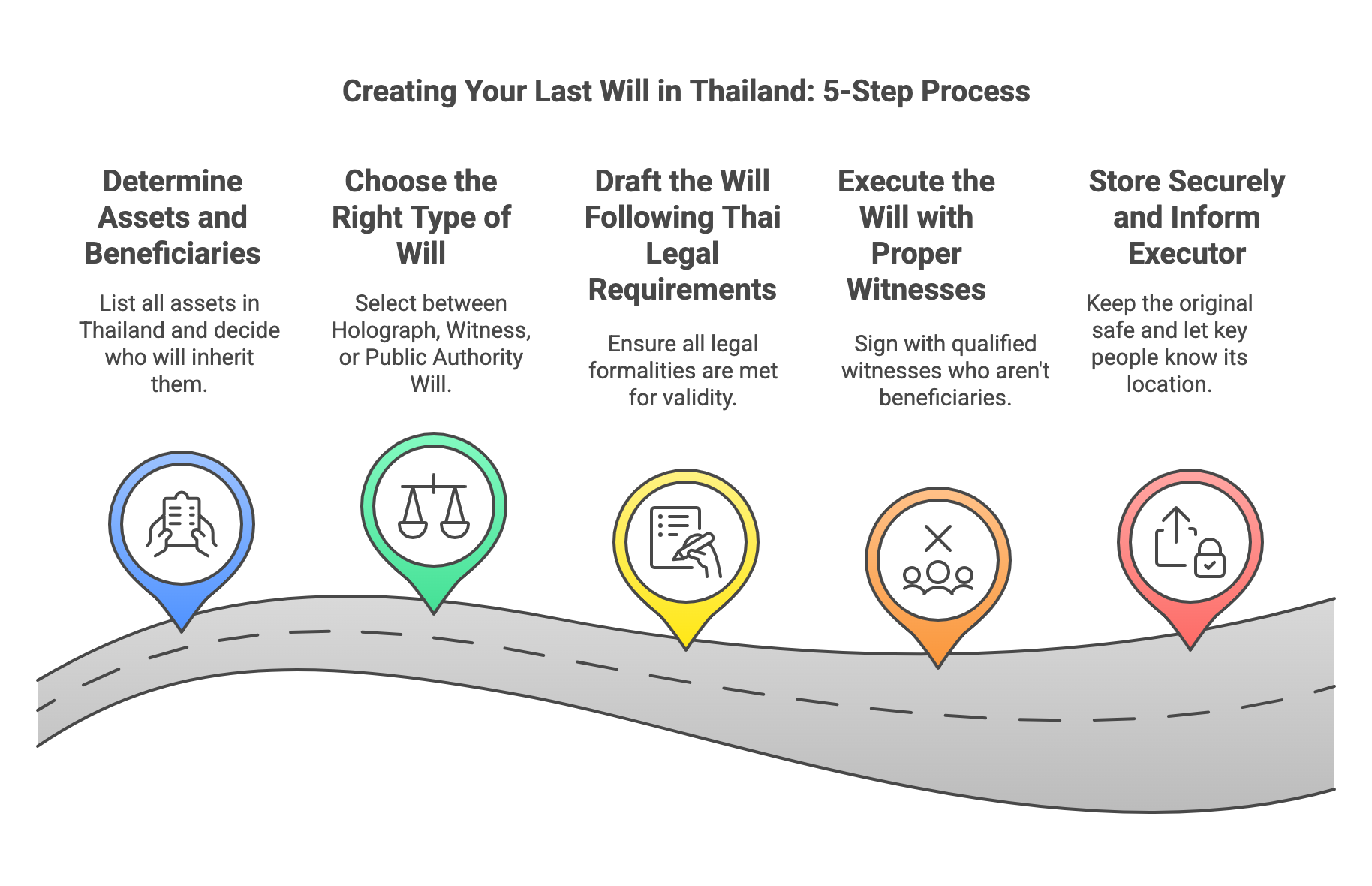
To write a valid will in Thailand, put it in writing, date it, and sign it in front of at least two witnesses who are present at the same time and sign it then and there (Civil and Commercial Code, Section 1656). The one exception is a will you write entirely in your own hand, including the date and your signature, which needs no witnesses (Section 1657). Any later erasure, addition or change is valid only if it is made with the same formalities. In practice, work through these six steps:
- List your Thai assets. Bank accounts, a condominium unit, vehicles, company shares, insurance policies, leases and usufructs.
- Choose your heirs and their shares. Name every beneficiary precisely (full name, passport or ID number, relationship) and name alternates in case an heir dies first.
- Appoint an executor. The court formally appoints the estate administrator, but the person you name in the will is normally the person the court appoints.
- Have it drafted in English and Thai. Thai courts work in Thai. A bilingual will avoids a translation fight after your death.
- Sign in front of two witnesses. You and both witnesses sign the same document, at the same time, in the same place (Section 1656). Never use a beneficiary, or a beneficiary’s spouse, as a witness: that gift is void (Section 1653).
- Store it where it will be found. A will nobody can produce is a will that does not exist. See our secure storage service (1,000 THB, unlimited time).
Hiring a law firm like ThaiLawOnline can give you helpful advice. They can make sure your document meets all legal rules. Remember that we have experience and we only ask 3,900 baht, a fraction of other law firms. Many law firms in Thailand still ask 10,000 or 20,000 baht or more. We learned to use technology and stream our work. This helps us offer better prices without lowering quality.
Get Your Thai Will: Three Ways
There is no single right way to make a will in Thailand. Pick the one that matches your estate.
Whichever route you choose, the signing rules are identical, and they are where most wills fail. Read the common mistakes before you sign anything.
Key Requirements for a Valid Last Will in Thailand?
In Thailand, a valid will must be in writing. It should also be dated and signed by the testator. The signing must happen in front of witnesses. Most law firms will use the presence of two witnesses who also sign their names.
Can Foreigners Draft a Will in Thailand?
Yes, foreigners can draft a will in Thailand to cover their assets located in the country. Foreigners should make a separate will for their Thai assets. This will be different from their will in their home country. Doing this can help avoid problems during probate. Hiring a law firm that knows international estate planning can help make sure the will meets Thai laws and the person’s wishes. Good lawyers can do more than write great documents; they can assist in drafting last will and testament to ensure your wishes are honored. They can help you save on taxes. They can also give advice about children and other important matters. This includes funerals and what a “Thailand Living Will” is.
Common Mistakes to Avoid When Making a Last Will in Thailand
Many people make mistakes when writing a last will in Thailand. These mistakes can cause disputes or even make the will invalid. One common issue is not following Thai legal requirements. This includes not signing the will in front of two witnesses who are not beneficiaries.
Another mistake is using unclear wording, which can cause confusion and legal battles. Many people also forget to update their will after major life changes like marriage, divorce, or acquiring new assets. Some expats assume foreign inheritance laws apply, but Thai law governs assets in Thailand.
Another error is not appointing a reliable executor, which can lead to delays or complications. Lastly, skipping legal advice can result in a poorly drafted will that does not meet Thai legal standards. Avoiding these mistakes ensures your assets are properly managed and your wishes are followed.
Role of a Law Firm in Drafting a Last Will in Thailand
A law firm plays a pivotal role in drafting a Thai last will and testament. Legal experts in family law and estate planning can give you helpful advice. They can guide you on how to structure your will to meet your goals. They will make sure your will follows the Thai Civil and Commercial Code. It will clearly state your wishes about choosing heirs and sharing your assets. A law firm can help you update or revoke a will if your situation or plans change.
The Five Types of Wills Under Thai Law
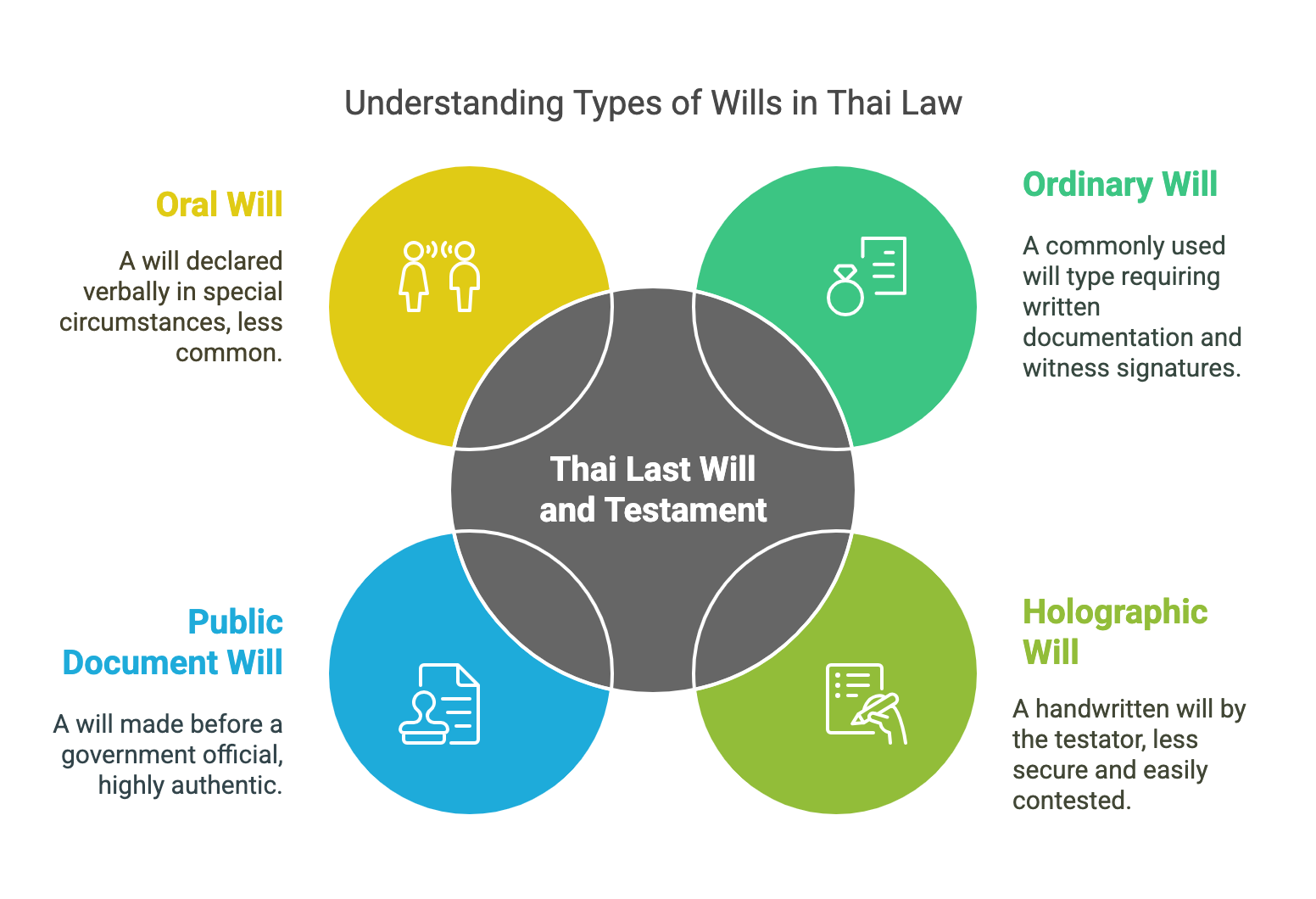
Thai law recognises five forms of will. For a foreigner, the choice is almost always the ordinary written will, but the other four matter when circumstances are unusual.
Ordinary Will (พินัยกรรมแบบธรรมดา)
This is the most common form. It requires the will to be in writing, dated, and signed by the testator. The testator must sign in front of at least two witnesses. These witnesses must also sign to confirm the testator’s signature (Civil and Commercial Code, Section 1656). Warning: Wills have specific rules that must be followed. If these rules are not respected, the document may be declared void.
Holographic Will (พินัยกรรมแบบเขียนเองทั้งฉบับ)
This form needs the whole document. It must include the date and signature. The testator must handwrite it (Civil and Commercial Code, Section 1657). It does not need witnesses. This is the weakest form of Last Will in Thailand and can be contested in Court more easily.
Public Document Will (พินัยกรรมแบบเอกสารมหาชน)
This will is made at a local public office. The testator shares their wishes in Thai with a public officer. The officer then writes it down. The official must read it back to the testator and witnesses, who then sign (Civil and Commercial Code, Section 1658). These three types of Wills (Holographic, ordinary and public documents) likely come from the old Civil Law. This law distinguishes between an authentic act, a semi-authentic act, and a non-authentic act. Therefore, it would be considered as the most difficult Will to contest. As of 24 March 2026, the Ministerial Regulation on Wills B.E. 2569 standardises how these public (district-office) wills are made nationwide: you may now register at any amphur or Bangkok khet office (not only your house-registration district), officers use the standard forms annexed to the regulation, with identity checks and a recorded inquiry where the testator’s age or sanity is in doubt, you may ask to take the original away with you, in which case the office retains a certified duplicate instead, and the official fee is 250 baht for a public will made at the district office, or 500 baht if the officer makes it away from the office; 250 baht for a secret will; 100 baht for a disinheritance declaration; and 50 baht for each duplicate. This is a procedural reform only, it does not change who inherits, and it does not affect an ordinary written will (Section 1656) or a handwritten holographic will (Section 1657) made privately.
Secret Document Will (พินัยกรรมแบบเอกสารลับ)
This is the form most English guides leave out, and it is the one to use when you want the district office involved but do not want anyone reading the contents while you are alive. Under Section 1660 you sign the will, seal it, and sign again across the seal. You then produce the sealed envelope to the district officer and at least two other witnesses and declare to all of them that it is your will. If you did not write the whole of it yourself, you must also state the name and domicile of the person who did. The district officer records your declaration and the date on the envelope and affixes the official seal, and then the officer, you and the witnesses all sign the envelope.
Section 1661 covers a testator who is deaf and dumb or otherwise unable to speak: instead of the spoken declaration, that person writes on the envelope, in front of the district officer and the witnesses, a statement that the sealed will is their own, and the officer certifies on the envelope that this was done. Under Section 1662 the district officer may not disclose a public document or secret document will to anyone during your lifetime, and must deliver it back to you whenever you ask.
Oral Will (พินัยกรรมแบบด้วยวาจา)
Allowed only in special circumstances in which no other form is possible, such as imminent danger of death, an epidemic or a war. The governing provision is Section 1663, not the whole run of Sections 1655 to 1672. You must declare the terms before at least two witnesses present at the same time and place, and those two must then present themselves to the district officer without delay and state what you ordered, together with the date, the place and the special circumstances. The officer records what they say and the two witnesses sign.
An oral will expires, and this is the part people miss. Under Section 1664 it ceases to be valid one month after the testator again becomes able to make a will in one of the other forms. So if you recover, the oral will lapses a month later and you must make a proper one inside that window.
Some prenuptial or marriage agreement may also include a clause in case of death. Wills can always be changed, at all times, which means that if such is your desire, you may draft up a new one.
When you name heirs in your Thai will, it is important to clearly identify each beneficiary. You should also specify what part of the estate they will receive. You can distribute your assets as you wish, as long as you follow the laws about heir rights. It is a good idea to explain any conditions related to the inheritance. Also, mention alternate beneficiaries if the main heir passes away before you. Consulting with a law firm can provide clarity on how best to appoint heirs and structure your will to reflect your intentions.
Inheritance and assets distribution under Thai Law
Who Can Be an Heir Under Thai Inheritance Laws
In Thailand, a person can inherit in two ways after someone dies. They can be named in a Last Will, called a ‘legatee.’ Or, they can inherit automatically under Thai law. The second type is called a statutory heir, and we’ll explain that more below.
Understanding the Six Classes of Statutory Heirs
No matter how much property you own, you want it to go to the right people after you die. In Thailand as in most countries, “When a person dies, their Estate devolves on the heirs.” In Thailand, if someone dies without a Will, the state decides who gets the deceased’s estate. (Statutory heirs) (Section 1603 CCC).
In Thailand, there are six classes of statutory heirs. Each class has the right to inherit in a specific order. This is outlined in section 1629 of the Civil and Commercial Code (CCC)
- Descendants
- Parents
- Brothers and Sisters of full blood
- Brothers and Sisters of half blood
- Grandfathers and Grandmothers
- Uncles and Aunts
The surviving spouse is also a statutory heir (Section 1635 CCC). It must be a legal and registered marriage. These classes include descendants, parents, full-blood siblings, half-blood siblings, grandparents, and uncles and aunts, as well as the legal spouse.
A Last Will in Thailand lets you choose your heirs (“legatees”) and clearly outlines your last wishes. It avoids family disputes.. If you do not make a Will, the law in Thailand will instead determine who inherits your property. A proper drafted Last Will is a guarantee that your wishes will be respected. It will also make settling your succession that much easier.
What Happens to Your Assets in Thailand After Death?
In some countries, it is possible to have a “Pay on death clause”. It means that you notify your bank that in case of death, you want a person to get automatically the balance of your account. Do note that this is not possible in Thailand. Thai banks want you to get a court decision. This is needed to appoint an executor if there is more than 100,000 baht in a bank account.
The probate process in Thailand is about legally confirming a deceased person’s will. It also involves managing their estate. It is actually “not” a real probate but more a process to appoint an executor by the Court. The court appoints an executor, known as the “administrator of estate” in Civil Law. This person manages the estate, pays off debts, and gives the remaining assets to the rightful heirs. The probate process can be long and complicated. However, having a valid last will in Thailand can make it much easier. It is approximately 3 months in Court but it can be longer if some people contest the process.
If a person dies in Thailand without a will, their assets are shared based on Thai inheritance law. This means that legal heirs will automatically inherit the estate as per the effect according to the law. They will do so in the order set by the Civil and Commercial Code. While this provides a clear framework for asset distribution, it may not align with the deceased’s personal wishes. Therefore, drafting a will is crucial to ensure that your estate is managed and distributed as you desire.
Executors play a vital role in Thai estate planning by overseeing the administration of the deceased’s estate. An executor is chosen in a will. They must follow the testator’s wishes. Their job includes paying debts and giving assets to the heirs. It is important to choose a reliable and trustworthy person or group for this role. They must handle the legal requirements and manage the estate well. A law firm can help you choose a good executor. They can also support you during the probate process. We made a text about “What happens when a foreigner dies in Thailand” that explains a little more.
How Can Foreigners Inherit Land in Thailand?
Under Thai law, foreigners can inherit land, but owning it is a different matter. If a foreigner is named as an heir. either in a Last Will or under the law, they can legally inherit land according to the Land Code (See section 93 and following in the unofficial English translation published by the Office of the Council of State, which is provided for information only and carries no legal authority; the Thai text in the Royal Gazette governs). However, the Land Department will not allow them to register ownership of most types of land. A foreigner may acquire Thai land only under a treaty or the Land Code, and only with the Minister of Interior’s permission (Land Code, section 86). A foreign statutory heir may be permitted to acquire inherited land within the limits of section 87 (section 93). Without that permission, the heir must dispose of the land within the period set by the Director-General of the Land Department, which is not less than 180 days and not more than one year; otherwise the Director-General may dispose of it (section 94). There is no statutory ‘right to sell’ and no vague ‘reasonable time’. Houses and condominium units follow different rules. Other assets, like houses or condos, can be inherited more easily, depending on the situation.
Managing your Thai Will
How to Update or Revoke a Thai Last Will?
To update or revoke a last will in Thailand, you must create a new will that explicitly states the revocation of all previous wills. Alternatively, a formal revocation document can be created and similarly witnessed. It is wise to talk to a law firm. This will help make sure that any updates or changes are legal. They will also ensure that these changes match your current wishes.
For expatriates and foreigners residing in Thailand, additional considerations may arise due to the interplay of international laws and local regulations. Getting help from legal professionals can help make sure your final wishes are respected. This brings peace of mind to you and your loved ones.
Section 1667 lets a Thai national who makes a will in another country use either the form prescribed by the law of the country where it is made, or the form prescribed by Thai law. On its own terms it does not give a foreigner that choice, and it is often cited as though it did.
What applies to everyone is Section 1655: a will may be made only in one of the forms this chapter prescribes. A will drawn up abroad that meets one of those Thai forms is therefore on solid ground here. A foreign will can still be accepted by a Thai court and a Thai will is not strictly compulsory, but the difficulty is practical rather than legal, as this page explains further down.
If you own assets in another country, your Will for those assets must usually follow the laws of your home country. Domicile and Residence can have different meanings according to some jurisdictions. It is possible to be resident in one country and domiciled in another. If you were born in a foreign country, to change your domicile to Thai obviously involves you moving to Thailand.
If you are updating your Wills, be careful not to accidentally cancel one you want to keep. Send an electronic copy of your Last Will to the person who has your foreign Will. Ask them to confirm if your old Will in your original country is still valid, if that is what you want.
If you make a Last Will in Thailand, it should be in Thai language but it is not a requirement. A good law firm should provide you with a bilingual Will. This way, you can understand the content without needing a future translation. A translation Thai to English will cost you between around 500 baht per page. Some other languages could be more expensive (Scandinavian, Japanese, etc.). In Thailand, to notarize a Last Will is not a requirement. A public notary does not add extra security to a Thai Last Will and Testament. This is different from places like France or Quebec. We do offer notarial services and we could ask extra money for that. But it is not necessary.
Foreigners can’t normally own land in Thailand. If a foreigner inherits land as a statutory heir, the ministry will allow the alien to inherit the land. Foreigners have not less than 180 days or no more than one year to transfer the land to a Thai national. (See clauses 93 to 96 of the Land Code).
You may appoint a person or the administrator of your Estate to arrange your funerals. Every client is different: cremation? Buried?However, most do not to mention anything. (so the executor will decide)
Bear in mind that your foreign Estate may be liable to Inheritance Tax in your country. Thailand has had an inheritance tax since 1 February 2016. It does not fall on the estate as a whole. It falls on each heir, and only where what that heir receives from one deceased person adds up to more than 100 million baht, counted after deducting the debts that come with the inheritance (section 12 of the Inheritance Tax Act). Only the excess above 100 million baht is taxed, at 10%, or at 5% where the heir is an ascendant or a descendant of the deceased (section 16). What a spouse inherits from the deceased is outside the Act altogether (section 3(2)).
It is common in western countries to have a clause avoiding the transfer to an heir unless this person survives you by 30 days. That is made to avoids double inheritance tax. We explain Thai inheritance tax in this article.
Many rules in Thailand are not exactly the same as in your country. This is why you must be careful if you don’t want your will to be void.
- Do you know a witness to a Will can’t be a beneficiary? (Clause 1653 CCC)
- Do you know that the name of the writer of a Will (if it is not the testator) must sign his name and add the statement that he is the writer? (Clause 1671 CCC)
- Did you know you can appoint a “controller of property”? This is useful if you want to give property to a minor. You can do this if you don’t want the parents, guardians, or custodians to manage it (Sections 1686 and following CCC)
- Etc.
A good lawyer can explain all of this to you and advise you on what you can and cannot do. It is not inexpensive to make a Last Will, and it protects you and gives you peace of mind. Some Bangkok law firms charge well over 20,000 baht for this service. Ours costs considerably less, and the documents are thorough and professional. We keep upgrading their quality and follow new developments under Thai and international law.
Additional Provisions to Consider in a Last Will in Thailand. Do note that society and law evolve and using old templates might not serve you well. For a very low price, you can have a Last Will in Thailand adapted to your situation. It can include:
- Digital Assets. In the modern age, it’s increasingly important to include clauses related to digital assets. Also social media accounts, digital currencies, and online accounts.
- Healthcare Directive. This is what we called a Living Will in Thailand. This is not typically included in a Last will in Thailand. Indicating a separate healthcare directive or living will document could be helpful information for the executor and family members.
- Guardianship: If there are minor children or dependents involved, specifying guardianship preferences is crucial.
- Pet Care: For many, pets are considered part of the family. Specifying arrangements for the care of pets can be an important addition.
- Memorial Instructions: These wishes are not legally binding. However, they can help guide family members during a tough time.
- Severability Clause: This clause means that if one part of the will is invalid, the rest still works.
Secure Will Storage Services in Thailand
District-office wills and private will storage serve different purposes. Foreign nationals are not excluded from making a public-document or secret-document will at an amphur or khet office. The formalities and the 2026 district-office procedure are explained above. For a privately signed will, keep the original safe and tell your executor where to obtain it. ThaiLawOnline offers storage of the original for 1,000 baht; ask us to confirm the deposit, retrieval and release arrangements before handing over your documents.
We are a well-known law firm and a Thai company. We are not just one person. Your Will is safe with us, no matter how staff or management changes over the years. If you are an expat in Thailand or have assets here, our storage service offers you and your loved ones peace of mind. You can rest easy knowing that when the time comes, your Will can be retrieved and respected, just as you intended.
How Much Does a Will Cost in Thailand? (2026 Fees)
A bilingual Thai-English Last Will costs 3,900 THB for one person. Thai-only drafting at 2,500 THB per person is planned for around 20 to 27 October 2026; confirm availability before payment. These are separate drafting options.
A Living Will costs 1,900 THB on its own. A bilingual Last Will and Living Will together cost 5,000 THB for one person. Storage of your signed original is a separate, one-time charge of 1,000 THB, with no annual storage charge.
| Service | Fixed fee | What it covers |
|---|---|---|
| Last Will, Thai only, coming soon | 2,500 THB per person | Thai drafting without an English version. Planned launch around 20 to 27 October 2026. Confirm availability and delivery timetable before payment. |
| Last Will, bilingual English and Thai | 3,900 THB | Personalised clauses, heirs and shares, executor, guardianship provisions, signing checklist |
| Living Will (advance medical directive), on its own | 1,900 THB | Advance refusal of burdensome treatment, comfort-care instructions, witness wording compliant with the 2010 Regulation |
| Living Will added to a Last Will order | 1,100 THB | Same document, discounted when ordered together |
| Last Will and Living Will together | 5,000 THB | Both documents, one signing session |
| Secure will storage | 1,000 THB | Unlimited storage of the original, retrievable by your executor |
| Paid consultation, complex estates | 2,000 THB | Company shares, cross-border assets, contested family situations |
Full breakdown on our will cost page for 2026, and every published fee on the legal fees page.
Comprehensive estate planning solution in Thailand
Last Will & Living Will in Thailand (complete package)
If you already plan to prepare a Last Will, consider adding a Living Will Thailand at the same time. A Living Will (advance medical directive) states your wishes for medical care if you lose capacity. Your Last Will tells how to distribute your estate. Together, they create a stronger estate-planning strategy. This strategy protects your assets and healthcare choices in every province of Thailand.
Why combine them?
- One signing session, two critical documents. Save time and reduce paperwork while ensuring every scenario is covered.
- Lower cost. Add a Living Will for only 1,100 baht extra when ordered with your Last Will, a discount from our standalone rate.
- No uncertainty for your family. Loved ones know exactly how to manage your treatment and your property, which minimises conflict and delays in probate.
- Better tax and probate planning. When doctors honour your Living Will, medical costs do not drain the estate, leaving more for your heirs.
- One point of advice, us, speaking Thai and English, explaining you everything from A to Z for low fees.
What is included?
| Service Item | Details |
|---|---|
| Last Will (English-Thai) | Personalised clauses, heirs list, guardianship provisions, signing checklist |
| Living Will in Thailand (English-Thai) | Advance refusal of burdensome treatment, comfort-care instructions, witness language compliant with the 2010 Regulation |
| Practical Guide for signature | Step-by-step instructions on signing, storing, and notifying hospitals and family |
| Legal Support | Email support for minor adjustments |
| Total Combo Price Last Will + Living Will |
Last Will standard fee (3,900) + 1,100 baht (Living Will) for a combined price of 5,000 baht. |
Ready to secure everything in one go?
Click here to contact us or call us at 087-225-1340. Let ThaiLawOnline create a seamless estate-planning package that respects your healthcare wishes and protects your loved ones.
Making a Will in Thailand: FAQ
What are the essential steps in drafting a last will in Thailand?
Creating a last will in Thailand involves a few important steps. First, identify your assets. Next, decide who will be your beneficiaries. Then, appoint an executor to manage your estate. Finally, make sure the will follows Thai law, including section 1656 of the civil code. Consulting with property lawyers or a law firm like ThaiLawOnline can provide guidance.
Why is it important to have a Thailand last will and testament?
Having a will in Thailand is important. It helps distribute your estate as you want. It provides legal clarity and helps prevent disputes among heirs over property in Thailand.
Who must sign the last will drawn in Thailand?
The signature of the testator is required on the last will drawn in Thailand to ensure its validity. The testator must be 15 yo or older. When the form chosen requests witnesses, the witnesses must sign too.
Can foreign nationals draft a last will and testament in Thailand for their property in the land of smiles?
Yes, foreign nationals can draft a last will and testament for their property in Thailand. It is a good idea to talk to local property lawyers or law firms in Thailand. They can help you follow local laws. A foreigner can ALSO receive properties from a Last Will in Thailand, even land. It is complex because you need authorization under articles 86 and following of the land code. However, you can inherit the property. If you are not allowed to keep it, you can transfer it to someone else or sell it and keep the proceeds of the sale.
What happens if there is no last will and testament?
If there is no will in Thailand, the estate will be divided by the civil code rules. This might not align with the deceased’s wishes, highlighting the importance of making a last will in Thailand.
How can ThaiLawOnline assist in drafting a Thailand last will and testament?
ThaiLawOnline offers comprehensive services for drafting a last will in Thailand. They provide expert advice, ensuring the document is legally sound and meets all requirements under Thai law.
Can a Thailand last will and testament include assets outside Thailand?
A Thailand last will and testament can include assets from other countries. It is best to get legal advice. This helps address any international legal issues. It also ensures the will is recognized in other places.
What common mistakes should be avoided when making a last will in Thailand?
Common mistakes include not updating the will, leaving out assets, and not following legal rules. This includes the testator’s signature and others.
How much does it cost to make a will in Thailand?
Our bilingual Thai-English Last Will costs 3,900 THB for one person. Thai-only drafting at 2,500 THB per person is planned for around 20 to 27 October 2026, without an English version. Confirm availability before paying. A Living Will costs 1,900 THB separately, or 5,000 THB together with a bilingual Last Will. Original-document storage is a separate, one-time charge of 1,000 THB. See the fee table.
Can I write my own will in Thailand without a lawyer?
Yes. Thai law allows a holographic will under Section 1657: you write the entire document by hand, date it, and sign it. No witnesses are needed. It is legally valid, and it is also the weakest form of will in Thai practice. It fails when the handwriting is disputed, when the date is missing, when the wording is ambiguous, or when nobody can find it. Our Supreme Court research shows handwriting and signing defects, not unfair distributions, are what actually void wills. If you write your own, at minimum have it reviewed.
Does a Thai will need to be notarized?
No. Thai law does not require notarisation of a will. What it requires is the correct signing formality: for an ordinary will, your signature in front of two witnesses who sign as well (Section 1656). Notarisation is sometimes useful for a separate purpose, such as proving your signature to a foreign bank or a foreign court, and our notarial services attorney can do that. But a will is not invalid for lack of a notary.
Is my foreign will valid in Thailand?
Often yes. Which country’s law decides whether your foreign will is valid is settled by Thailand’s Act on Conflict of Laws B.E. 2481, and Thai courts do apply it to foreign estates (see, for example, Supreme Court decision 4027/2545, on the powers of the administrator of a British national’s estate). Note that Civil and Commercial Code Section 1667, often cited on this point, is about Thai nationals making a will abroad, not foreigners. The problem is practical, not legal: the foreign will has to be produced, translated, legalised, and proved to a Thai court before the estate can be distributed, which routinely adds months and legal fees. A short separate Thai will covering only your Thai assets avoids all of that. See which country’s law governs which asset. See probate of a foreign will in Thailand.
Do I need both a Thai will and a will in my home country?
Usually yes, and they must be drafted to work together. The standard trap is the revocation clause: a later will at home saying “I revoke all previous wills” can wipe out your Thai will without anyone intending it. Each will should be expressly limited in scope, so the Thai will covers your Thai assets and the home-country will covers everything else, with each acknowledging the other. Full analysis: do you need a Thai will and a will at home.
Can my Thai wife, husband or partner be a witness to my will?
Not if they inherit under it. Section 1653 makes a gift to a witness, or to the spouse of a witness, void, even though the rest of the will stands. This is the single most common defect we see in wills that expats prepared themselves: the beneficiary spouse signs as a witness, and the gift to that spouse fails. Use two neutral witnesses aged 20 or over who receive nothing under the will.
Does the 2,500 THB Will include an English version, and when will the service start?
No. The 2,500 THB service will provide Thai-only drafting for one person. We plan to launch around 20 to 27 October 2026, two to three weeks from our 6 October announcement. Confirm availability before paying. Bilingual Thai-English drafting remains available at 3,900 THB.
Testimonials
-
The experience was exceptional
I recently had the privilege of working with Sebastien and his team of experts, and I must say, the experience was exceptional. From the moment I shared my inputs, they swiftly transformed them into a comprehensive Last and Living Will. Even though my case was somewhat unorthodox and involved additional legal complexities, Sebastien’s team demonstrated remarkable agility.
(…)
In summary, if you’re seeking a team that combines expertise, efficiency, and personalized service, look no further than Sebastien and his remarkable group of professionals. Highly recommended!
-
I’m both impressed with his attention to detail and delighted with the cost
Sebastien drew up will for me today. It was far more complicated than normal as it had to cover guardianship of a minor and appoint a controller of property to look after the child’s financial interests. As usual when Sebastien does some legal work for me, I’m both impressed with his attention to detail and delighted with the cost.
-
Excellent service! Quick and reliable process especially for English clients.
Excellent service! Quick and reliable process especially for English clients. I am Canadian and had no problem whatsoever with the communications, and detail to the document. Very refreshing considering most things for foreigners are very complicated here!
This firm makes the process a breeze, I mean easy-peasy! And, you can’t beat the cost!!
Highly recommended!
-
Very attractive prices and quality service in Thai and English language
We had 2 wills drawn up with thaiLawOnline, we are very satisfied with the service provided. Very attractive prices and quality service in Thai and English language (Sebastien can also speak French).
Get Started: Secure Your Legacy in Thailand
A Last Will is too important for generic, AI-generated, or copy-paste forms. Our Last Will templates are drafted and maintained by Thai lawyers, and for complex estates our lawyers also provide full custom drafting and review. Ensure your final wishes are legally binding, clearly drafted to your needs, and provide peace of mind for your loved ones.
Fixed fee service: 3,900 THB, bilingual English and Thai.
Hundreds of wills drafted since 2006, and not one has ever been invalidated by a Thai court. Every clause is checked against our database of more than 84,000 Thai Supreme Court decisions.
We have a simple refund policy. You can get a full refund within 7 days of receiving your order if you are not happy with our service.
Other links
- Last Will in Thailand by the Amphur at the Bureau of Regional Administration (Thai language)
- Free signing guide for Last Wills and Living Wills: witnesses, presence, signatures and storage (PDF, 2026)
- Inheritance for Foreigners in Thailand : Full Guide by ThaiLawOnline
- Thai will template: free bilingual sample and clause-by-clause walkthrough
- Thai will and foreign will: which law applies, and the revocation trap
- Updated Regulation for Public Wills from 2026
How much does a Thai will cost? A bilingual Last Will is a fixed 3,900 THB, a living will 1,900 THB. See the full will cost breakdown (2026) or all our fixed fees on the legal fees page.
What the Thai Supreme Court Says About Last Wills
Statutes tell you how a will should be made. The Supreme Court of Thailand (ศาลฎีกา) tells you how wills actually fail. We analyzed more than 75 Supreme Court (Dika) decisions on wills and succession from our in-house database of more than 77,000 Supreme Court decisions spanning 1936 to 2026: and eight rules decide most disputes:
- The one-sitting rule kills more wills than forgery does. The testator and both witnesses must sign together, in one ceremony. A will signed in instalments is void and can never be ratified afterwards (Dika 997/2549; Dika 11034/2553).
- Witnesses must sign, never thumbprint. The testator may sign by thumbprint before two certifying witnesses, but a witness who thumbprints does not count at all (Dika 359/2521; Dika 4136/2529).
- A beneficiary, or a beneficiary’s spouse, who witnesses the will loses the gift (Dika 4001/2545). Being present in the room is fine (Dika 5404/2533); signing is fatal.
- A typed will can never be a holographic will. Section 1657 demands the testator’s handwriting throughout, though in 2024 the Court upheld handwritten dispositions on a printed form (Dika 4044/2567; contrast Dika 2102/2551).
- You cannot revoke a will by letter. Only a new will, physical destruction, or transfer of the property revokes a will (Dika 6981/2545), and without an express revocation clause, an old will survives wherever it does not conflict with the new one (Dika 2832-2833/2558).
- A married testator can only give away half. A will reaches only the testator’s own share of marital property, whatever it says (Dika 899-900/2509).
- Deathbed wills invite destruction. Courts void wills made by gravely ill testators under a beneficiary’s control (Dika 574-575/2567, decided 2024), while a doctor’s certificate of sound mind dated near the signing has saved wills outright (Dika 6522/2561).
- Your executor cannot keep the estate, and the one-year deadline will not protect them. An administrator who registers estate land in her own name has not distributed it, so the heirs can still demand their shares under Section 1748 after the one-year limit in Section 1754 has run, and the heir who ended up with the land by gift had to return it to the estate, with most of the money from a part he had sold (Dika 284/2569, decided 2026). Choose your executor as carefully as your heirs.
We published the full stories, including why your foreign heirs can inherit Thai land (Dika 7200/2540), the new 2026 district-office rules, and why trusts are void in Thai wills (Section 1686), in 10 Thai Supreme Court decisions every foreigner making a will should know. To our knowledge it is the only case-law resource of its kind in English, drawn from our own database of Supreme Court judgments. Every will we draft is checked against this case law, not just the Civil and Commercial Code. That is the difference between a template and legal work.
Our fees for a Thai will
| Service | Fixed fee | What is included | Timeline |
|---|---|---|---|
| Last Will and Testament | 3,900 THB 5,000 THB Last Will + Living Will together | Bilingual Thai and English will, drafted by a lawyer to comply with Thai inheritance law. 5,000 THB if taken together with a Living Will. | 3 to 5 business days |
| Will safekeeping at our office | 1,000 THB | Your signed original held at the firm, retrievable by your administrator. | Immediate |
Government disbursements are charged at cost unless the service says they are included.
Book a consultation Answer within 24 hours EN · FR · TH
These fees come from one source and are the same everywhere on this site. See all our fees.
Key terms used in this guide
- Will: A document directing how your estate is distributed after you die.
- Testator: The person who makes the will.
- Holographic will: A will written out entirely by hand by the testator, under Section 1657 of the Civil and Commercial Code.
- Estate administrator: The person appointed to gather in the estate and distribute it, also called the executor.
- Statutory heir: A relative entitled to inherit under Section 1629 where there is no valid will.
Try it yourself first, free
You do not have to book anything to get started. These run in your browser, and you only pay us if you decide you want a lawyer involved.
Legal Document Maker Gold members
Ten bilingual documents from a guided questionnaire, in the firm's own wording.
Open the toolLiving Will Generator Free
Build a bilingual advance directive for Thailand under s.12 of the National Health Act.
Open the toolAsk our AI assistant Free
Trained on Thai law and 77,000+ Supreme Court decisions. Ask anything, free.
Expat Legal Health Check Free
Ten minutes on your property, family, visa and will. You get a written report naming the exact gaps and what each one costs to fix.
Take the Legal Health CheckThai Law Updates, free by email
Plain-English updates on Thai law changes that affect foreigners: property, visas, marriage, business and wills. One short email a month from a firm practicing since 2006. No spam, unsubscribe anytime.