


Reviewed by ThaiLawOnline, a licensed Thai law firm practising in Thailand since 2006. Thai lawyer of record: Wichuda Atthamethakon, LL.M., Thai Bar Licence 3149/2556.
Last updated on
Written by Mr. Sébastien Brousseau, LL.B., B.Sc. Sebastien is a Canadian lawyer living in Bangkok. He has worked under Thai law since 2006 with extensive knowledge about Thai property laws. He has been managing law firms in Thailand since 2006. With extensive experience in Thai property law, Sebastien emphasizes that Khai Fak transactions can be risky, as sellers often lose their property if they fail to redeem it within the contractual period, making it a common legal trap for those in financial distress. He strongly advises that anyone considering a sale with a right of redemption seek legal consultation to fully understand the risks and ensure fair terms. Full Profile | LinkedIn.
Last reviewed: 25 September 2026. Read in Thai against the Civil and Commercial Code, sections 456, 491, 492, 494 to 496, 499 and 500, and the Act on the Protection of People Entering into Sales with Right of Redemption of Agricultural Land or Residences B.E. 2562, sections 6 to 8, 10 to 12, 17 and 18. Fees and tax from the Department of Lands public service manual, which reproduces Ministerial Regulation No. 47 (B.E. 2541) under the Land Code, clause 2(7). Not verified in this review: the interest rates said to be seen in practice, and whether the temporary 2026 residential fee reduction extends to this kind of registration. Re-read on 5 October 2026 against that stamp: every statement matches the sections listed; no change made. Re-checked on 10 October 2026: the Department of Lands circular Mor Tor 0515.1/Wor 14504 of 30 June 2026 and its enclosure read in Thai; clause 7.1 excludes sale with right of redemption from the residential fee reduction, which the fee paragraph now says. The interest rates seen in practice remain unverified.
A sale with right of redemption, called “Kaifak” (ขายฝาก) in Thai, can be made over land, buildings or movable property. It is essential to understand its legal effect before signing, because ownership passes to the buyer at once. This article explains how it works under Thai law.
Table of Contents
What is a normal “Sale of Personal Property”
The sale of personal property refers to the transfer of ownership and possession of movable assets from one party to another in exchange for the price of the sale. Examples of personal property include vehicles, furniture, electronics, jewelry, and more. Personal property transactions are governed by specific laws to ensure fairness and protect the rights of all parties involved.
The primary source of law governing the “sale with the right of redemption” in Thailand is the Civil and Commercial Code, sections 491 to 502 (the text is in our annotated Civil and Commercial Code), and it applies to movable and immovable property alike (section 491). For immovable property the redemption period may not exceed 10 years, and for movable property 3 years, under section 494. A longer period stated in the contract is reduced to that maximum. It is often used by people who cannot borrow from a bank and turn instead to private lenders, some of them loan sharks charging very high interest. The law caps what the seller can be made to pay back: if the agreed redemption price is higher than the real sale price plus 15% a year, the seller may redeem for the real price plus 15% a year (section 499). Agreements at 3% to 5% a month are still seen, and the cap is what a court will apply.
Farmland and homes: the 2019 protection Act. Where an individual sells agricultural land or a home on these terms, the Act on the Protection of People Entering into Sales with Right of Redemption of Agricultural Land or Residences B.E. 2562 (2019) applies on top of the Code, and any term that contradicts it is void (section 6). The sale must be in writing and registered or it is void (section 7). The redemption period cannot be shorter than one year or longer than ten (section 10). The redemption price may not exceed the equivalent of 15% a year (section 8). Until the right to redeem expires, the seller keeps possession of the land or home and its fruits without paying anything to the buyer (section 12). Three to six months before the redemption date the buyer must write to the seller by registered mail with the date, the amount and a copy of the contract; if the buyer does not, the seller gets six more months to redeem (section 17). The seller may pay the buyer or deposit the redemption money at the Deposit Office or at the Land Office that registered the sale, and ownership returns from the moment of payment or deposit (section 18), and disputes are consumer cases (section 11).
What Are Sales with Rights of Redemption?
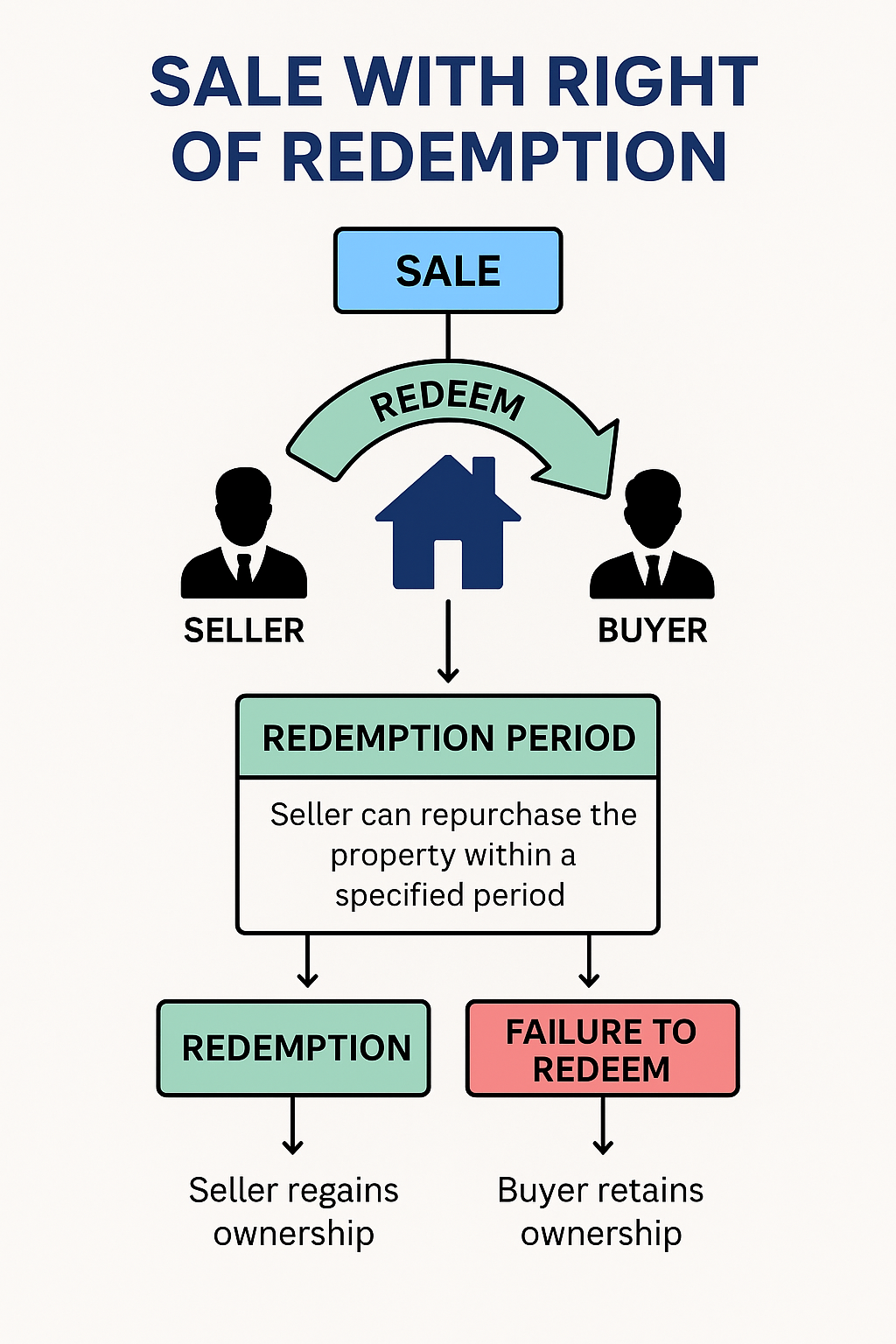
Rights of redemption refer to the legal rights kept by a party who has sold property, movable or immovable, on these terms: he or she has the option to repurchase or redeem it within a specified period. These rights provide a safety net for individuals or businesses who may have experienced temporary financial difficulties and wish to regain ownership of their assets.
Understanding the Implications of Sales with Rights of Redemption
Sale with rights of redemption has several implications for both the seller and the buyer. It is crucial for all parties involved to be aware of these implications and their legal ramifications concerning the price of redemption.
- Seller’s Perspective
From the perspective of the seller, selling personal property with rights of redemption allows them to obtain immediate financial relief while still maintaining the possibility of reclaiming their assets in the future. However, sellers must carefully consider the terms and conditions of the redemption rights, including the timeframe and any associated costs.
- Buyer’s Perspective on the ownership of the property and the risks involved in the transaction.
Buyers of personal property with rights of redemption may benefit from acquiring assets at a lower price. However, buyers must also consider the risks involved, as the seller may exercise their right to redeem the property. Ultimately leading to the loss of the purchased property if the seller exercises their right to redeem. It is essential for buyers to conduct thorough due diligence and fully understand the price of the sale and the terms of redemption. It could be risky to get involved in sales with rights of redemption, especially concerning the period of redemption.

Legal Requirements for Sales with Rights of Redemption in Thailand
Thai law sets the following requirements, most of them in the Civil and Commercial Code:
- Form: a sale of land or a building, a ship of five tons or more, a floating house or a beast of burden must be made in writing and registered with the competent official, or it is void. A sale of other movable property at 20,000 baht or more cannot be enforced in court unless there is written evidence signed by the party to be held liable, a deposit, or part payment (section 456).
- Terms and Conditions: The agreement should clearly outline the terms and conditions of the redemption rights, including the timeframe, process, and any associated costs.
- Redemption price: the parties agree it, but it may not exceed the real sale price plus 15% a year (section 499), and the seller also repays the buyer’s costs of the sale (section 500).
- Notice Requirements: For farmland and homes sold by an individual, the notice duty is on the buyer, not the seller: three to six months before the redemption date the buyer must notify the seller in writing, and if the buyer fails to, the seller has six extra months to redeem (2019 Act, section 17).
- Timeframe: the redemption period may not exceed 10 years for immovable property or 3 years for movable property, counted from the sale, and a longer agreed period is cut down to that limit (sections 494 and 495). It may be extended by an agreement evidenced in writing and signed by the buyer, within the same limit; for registered property, an extension that is not itself registered cannot be raised against a third party who later acquired and registered in good faith and for value (section 496).
- Recordkeeping: It is essential to maintain proper records of the transaction, including the agreement and any relevant correspondence.
Benefits and Risks : Sales of Rights of Redemption are Dangerous
Engaging in a sale with rights of redemption can provide various benefits and risks for both parties, especially regarding the redemption price. It is important to weigh these factors carefully before entering into such transactions.
Benefits:
- Flexibility: The seller retains the flexibility to regain possession of their property within the agreed timeframe.
- Financial Relief: The seller can obtain immediate financial relief by selling their assets while still having the option to repurchase.
- Lower Purchase Price: Buyers may have the opportunity to purchase personal property at a lower price compared to the market value.
Risks of Sales with Rights of Redemption
- Loss of Property: The seller loses the property for good if it is not redeemed in time. Ownership passed to the buyer at the sale (section 491), so there is no foreclosure and no court sale, unlike a mortgage.
- Uncertain Future: Sellers may face uncertainty regarding their ability to repurchase the property within the redemption period.
- Legal Complications: Failure to comply with legal requirements or properly document the transaction can lead to legal complications and disputes.
It is important to note that a sale of land or a building with a right of redemption must be made in writing and registered with the competent official at the Land Office, or it is void, between the parties as well as against everyone else (section 456). The Land Office registration fee is 2% of the officially appraised value, whatever price the contract states (Ministerial Regulation No. 47 (B.E. 2541), clause 2(7)(ก)). Registering a mortgage costs 1% of the amount secured, capped at 200,000 baht (clause 2(7)(ฉ)). The temporary 2026 cut in registration fees for homes, to 0.01%, does not help here: the Department of Lands’ implementing circular lists sale with right of redemption among the registrations that get no reduction, and the reduced mortgage fee applies only to a mortgage registered together with a qualifying purchase (circular Mor Tor 0515.1/Wor 14504 of 30 June 2026, enclosure clauses 7.1 and 7.2). For specific business tax, the Department of Lands treats a sale with right of redemption as a sale, so that tax can apply on the same terms as an ordinary sale.
Understanding the legal implications of sale with rights of redemption in personal property transactions is crucial. While these transactions offer potential benefits, they also come with inherent risks. It is highly recommended to consult with legal professionals to ensure compliance with relevant laws and to safeguard the interests of all parties involved. By fully understanding the implications and complying with legal requirements, individuals and businesses can navigate personal property transactions with confidence and minimize potential disputes.
FAQs about Kaifak in Thailand
What is a sale with the right of redemption?
A sale with the right of redemption is a contract of sale whereby the ownership of the property sold passes to the buyer, but the original owner, often the borrower, retains the right to redeem or reclaim the property within a specified period, known as the period of redemption.
How does the period of redemption work?
The period of redemption is the time frame in which the original owner can exercise the right of redemption to reclaim the property sold. This period is typically agreed upon at the time of sale and can vary depending on the terms of the contract of sale.
What happens if the borrower cannot exercise the right of redemption?
If the borrower cannot exercise the right of redemption within the specified period, the buyer retains full ownership of the property sold, and the original owner loses their right to reclaim it. No court process is involved, because ownership already passed to the buyer at the sale; that is what makes this riskier for the seller than a mortgage, which the creditor has to enforce through the court.
What is the real danger and pitfall associated with sales with rights of redemption?
The real danger and pitfall lie in the possibility that the original owner may not be able to fulfill the conditions necessary to exercise the right of redemption, such as repayment of the real price of the sale, within the period of redemption, resulting in a permanent loss of property or of a right.
Can the right of redemption be waived?
A seller can simply choose not to redeem, and a sale agreed from the start without any right to redeem is an ordinary sale. For farmland and homes sold by an individual, however, a term that takes away the protections of the 2019 Act is void (section 6), so the seller cannot be made to give them up in the contract.
What is the role of khay fah in sales with rights of redemption?
Khai fak, also written khay fah, is simply the Thai name for a sale with right of redemption under section 491 of the Civil and Commercial Code. It is not a clause within the contract; it is the contract itself.
How is the price of redemption determined?
The price of redemption is typically the real price of the sale, which may include the original sale price plus any additional costs or interest agreed upon in the contract, but the law caps it at the real sale price plus 15% a year (section 499, and section 8 of the 2019 Act for farmland and homes). The seller also repays the registration fees the buyer paid for the sale, and bears the costs of the redemption itself (section 500).
What should parties consider before entering into a sale with the right of redemption?
Parties should carefully consider the terms of the contract of sale, including the period of redemption, repayment obligations, and any statutory conditions that may affect their ability to exercise the right of redemption. Seeking legal advice from experts, like the founding partner of ThaiLawOnline, is recommended.
Where can I get more information about sales with rights of redemption?
For more information or specific legal advice regarding sales with rights of redemption, you can contact us at ThaiLawOnline where our team of experts, including our founding partner, can provide guidance tailored to your needs.al property transactions with confidence and minimize potential disputes.
Links
Thai Law Updates, free by email
Plain-English updates on Thai law changes that affect foreigners: property, visas, marriage, business and wills. One short email a month from a firm practicing since 2006. No spam, unsubscribe anytime.