


Reviewed by Wichuda Atthamethakon, LL.M., Thai Bar Licence 3149/2556, for ThaiLawOnline, a Thai law firm acting for foreigners since 2006.
Update log
- 3 November 2026: Added the statute box with Thai, English and French text and checked the page against the official text
You paid the reservation fee. You picked the unit. Then the sales office called: the foreign quota is full. This page is for that moment. It sets out the five legal options a foreign buyer has in Thailand when a condo’s 49% foreign quota is exhausted. They’re ranked from lowest risk to highest, with the statute behind each one.
Short answer. When the foreign quota is full, the Land Office will not register the unit in your name (Condominium Act B.E. 2522, Section 19 quater). You have five options. (1) Walk away and recover your reservation fee. (2) Move to a unit or building that still has quota. (3) Register a 30-year lease. (4) Buy in a Thai spouse’s name. (5) Buy through a real Thai-majority company. Options 1 and 2 are low risk. Option 3 is medium. Options 4 and 5 carry real legal and financial exposure. Nothing else on offer (joint ownership with a Thai, “30+30+30” leases, a promised 75% quota) actually works.
We’ve handled this call many times while advising foreign clients in Thailand since 2006. The buyer is usually a few days into a transaction and under pressure to “just sign the lease version”. Don’t. Read this first. It takes ten minutes, and it can save you from paying for a unit you never legally own.
Last reviewed: 26 September 2026. Sections 19 to 19 septem and 67 of the Condominium Act were read in the Thai text of the Department of Lands’ consolidated copy, and clauses 1 to 5 of the Contract Committee’s 2024 condominium reservation notification in its Thai text. The 15-day and 45-day refund periods come from the notification’s annexed standard form, which we did not re-read in this review. Enforcement reports, market practice and the indicative costs are practice experience, not law.
Why the Foreign Quota Is Full and What That Means for Your Transaction
The 49% rule in one paragraph
Section 19 bis of the Condominium Act B.E. 2522 caps foreign ownership at 49% of the total floor area of all units in a building. Not 49% of the units. Floor area. A building with 100 identical units can have 49 foreign-owned units. A building where foreigners bought all the big penthouses may hit the cap at 35 units.
The quota is checked at every transfer. Section 19 ter requires a foreign buyer to present proof of eligibility (usually the Foreign Exchange Transaction form for money brought into Thailand). Section 19 quater then tells the Land Office official to check the foreign ratio. If your unit would push the building over 49%, the official refuses to register. There’s no discretion and no appeal to the developer’s goodwill.
Statutory basis: Condominium Act B.E. 2522 (as amended by Act No. 4, B.E. 2551), Sections 19, 19 bis, 19 ter and 19 quater. Section 19(5) is the ground most foreign buyers rely on: an alien who brings foreign currency into the Kingdom to pay for the unit.
The law behind this page
English
Section 19 bis Condominium Act B.E. 2522
Full text
In each condominium, the units held in ownership by the aliens or juristic persons specified in section 19 must not, taken together, exceed 49 percent of the area of all the units in that condominium at the time the application to register the condominium under section 6 is made.
ThaiLawOnline translation
Section 19 quater Condominium Act B.E. 2522
Full text
When the competent official has received the documents and evidence under section 19 ter and, having examined them, finds that they are correct under section 19 ter, and that the ratio of ownership of units in the condominium by aliens or juristic persons under section 19, counting both those who already hold ownership and those applying to take the transfer, does not exceed the ratio prescribed in section 19 bis, the competent official shall register the rights and juristic acts relating to the unit under Chapter 4 for the alien or juristic person applying to take the transfer.
ThaiLawOnline translation
Section 19 ter Condominium Act B.E. 2522
Full text
On a transfer of ownership of a condominium unit to an alien or juristic person specified in section 19, the applicant for the transfer shall notify the competent official of the names of the aliens or juristic persons specified in section 19, together with the proportion of unit area that those aliens or juristic persons already hold in ownership, and the alien or juristic person applying to receive the transfer shall also produce the following evidence to the competent official: (1) an alien specified in section 19 (1) must produce evidence of having been permitted to reside in the Kingdom under the law on immigration; (2) an alien specified in section 19 (2) must produce evidence of having been permitted to enter the Kingdom under the law on investment promotion; (3) a juristic person specified in section 19 (3) must produce evidence of registration as a juristic person under Thai law; (4) a juristic person specified in section 19 (4) must produce evidence of having received an investment promotion certificate under the law on investment promotion; (5) an alien or juristic person under section 19 (5) must produce evidence of bringing foreign currency into the Kingdom, or evidence of withdrawing money from a baht account of a person residing outside the country or from a foreign currency deposit account, in an amount not less than the price of the unit to be purchased.
ThaiLawOnline translation
Section 19 Condominium Act B.E. 2522
Full text
Aliens and juristic persons deemed by law to be aliens may hold ownership of condominium units if they are the following aliens and juristic persons: (1) an alien permitted to reside in the Kingdom under the law on immigration; (2) an alien permitted to enter the Kingdom under the law on investment promotion; (3) a juristic person specified in sections 97 and 98 of the Land Code that is registered as a juristic person under Thai law; (4) a juristic person that is an alien under Announcement of the Revolutionary Council No. 281 dated 24 November B.E. 2515 and has received an investment promotion certificate under the law on investment promotion; (5) an alien, or a juristic person deemed by law to be an alien, who brings foreign currency into the Kingdom, or withdraws money from a baht account of a person residing outside the country, or withdraws money from a foreign currency deposit account.
ThaiLawOnline translation
Section 378
Full text
Unless otherwise agreed, earnest shall be dealt with as follows: (1) it shall be returned, or applied as part payment, upon performance; (2) it shall be forfeited if the party who gave the earnest fails to perform, or if performance becomes impossible owing to a circumstance for which that party is responsible, or if the contract is rescinded through the fault of that party; (3) it shall be returned if the party who received the earnest fails to perform, or if performance becomes impossible owing to a circumstance for which that party is responsible.
ThaiLawOnline translation
Section 540
An ordinary fixed-term lease of immovable property is limited to 30 years. Section 540 permits renewal for up to 30 years from renewal. A lease made for a longer term is reduced to 30 years.
Full text
Immovable property may not be let for a period exceeding thirty years. If a contract has been made for a longer period, that period shall be reduced to thirty years. The period of hire referred to above may, on its expiry, be renewed, but the renewal must not exceed thirty years from the date of renewal.
ThaiLawOnline translation
Section 19 septies Condominium Act B.E. 2522
Full text
An alien or a juristic person deemed by law to be an alien, other than those specified in section 19, who acquires a condominium unit by inheritance as a statutory heir or as a legatee, or by any other means, as the case may be, must notify the competent official in writing within sixty days from the date of acquiring ownership of the condominium unit, and must dispose of the condominium unit within a period not exceeding one year from the date of acquiring ownership of the condominium unit. If the unit is not disposed of within that period, section 19 quinquies, paragraph four, shall apply mutatis mutandis.
ThaiLawOnline translation
Section 67 Condominium Act B.E. 2522
Full text
Any person who holds ownership of a condominium unit as owner on behalf of an alien or a juristic person deemed by law to be an alien, whether or not such alien or juristic person is entitled to hold ownership of a condominium unit under this Act, shall be liable to imprisonment for a term not exceeding two years or a fine not exceeding twenty thousand baht, or both, and section 19 quinquies, paragraph four, shall apply mutatis mutandis.
ThaiLawOnline translation
ไทย
มาตรา 19 ทวิ พระราชบัญญัติอาคารชุด พ.ศ. 2522
ข้อความเต็ม
อาคารชุดแต่ละอาคารชุดจะมีคนต่างด้าวหรือนิติบุคคลตามที่ระบุไว้ในมาตรา ๑๙ ถือกรรมสิทธิ์ในห้องชุดได้เมื่อรวมกันแล้วต้องไม่เกินอัตราร้อยละสี่สิบเก้าของเนื้อที่ของห้องชุดทั้งหมดในอาคารชุดนั้นในขณะที่ขอจดทะเบียนอาคารชุดตามมาตรา ๖
ตรงตามข้อความในราชกิจจานุเบกษา / สำนักงานคณะกรรมการกฤษฎีกา (Verbatim from the Royal Gazette / Office of the Council of State)
มาตรา 19 จัตวา พระราชบัญญัติอาคารชุด พ.ศ. 2522
ข้อความเต็ม
เมื่อพนักงานเจ้าหน้าที่ได้รับเอกสารและหลักฐานตามมาตรา ๑๙ ตรี และตรวจสอบแล้วเห็นว่าเป็นเอกสารและหลักฐานที่ถูกต้องตามมาตรา ๑๙ ตรี และอัตราส่วนการถือกรรมสิทธิ์ในห้องชุดของคนต่างด้าวหรือนิติบุคคลตามมาตรา ๑๙ ทั้งผู้ที่ถือกรรมสิทธิ์อยู่แล้วและผู้ที่ขอรับโอนไม่เกินอัตราที่กำหนดไว้ในมาตรา ๑๙ ทวิ ให้พนักงานเจ้าหน้าที่ดำเนินการจดทะเบียนสิทธิและนิติกรรมเกี่ยวกับห้องชุดตามหมวด ๔ ให้แก่คนต่างด้าวหรือนิติบุคคลผู้ขอรับโอนนั้น
ตรงตามข้อความในราชกิจจานุเบกษา / สำนักงานคณะกรรมการกฤษฎีกา (Verbatim from the Royal Gazette / Office of the Council of State)
มาตรา 19 ตรี พระราชบัญญัติอาคารชุด พ.ศ. 2522
ข้อความเต็ม
การโอนกรรมสิทธิ์ในห้องชุดให้แก่คนต่างด้าวหรือนิติบุคคลตามที่ระบุไว้ในมาตรา ๑๙ ให้ผู้ขอโอนกรรมสิทธิ์ในห้องชุดแจ้งรายชื่อคนต่างด้าวหรือนิติบุคคลตามที่ระบุไว้ในมาตรา ๑๙ พร้อมทั้งอัตราส่วนเนื้อที่ของห้องชุดที่คนต่างด้าวหรือนิติบุคคลดังกล่าวถือกรรมสิทธิ์อยู่แล้วต่อพนักงานเจ้าหน้าที่ และให้คนต่างด้าวหรือนิติบุคคลผู้ขอรับโอนกรรมสิทธิ์ในห้องชุดแสดงหลักฐานดังต่อไปนี้ต่อพนักงานเจ้าหน้าที่ด้วย (๑) สำหรับคนต่างด้าวตามที่ระบุไว้ในมาตรา ๑๙ (๑) ต้องแสดงหลักฐานการเป็นผู้ได้รับอนุญาตให้มีถิ่นที่อยู่ในราชอาณาจักรตามกฎหมายว่าด้วยคนเข้าเมือง (๒) สำหรับคนต่างด้าวตามที่ระบุไว้ในมาตรา ๑๙ (๒) ต้องแสดงหลักฐานการเป็นผู้ได้รับอนุญาตให้เข้ามาในราชอาณาจักรตามกฎหมายว่าด้วยการส่งเสริมการลงทุน (๓) สำหรับนิติบุคคลตามที่ระบุไว้ในมาตรา ๑๙ (๓) ต้องแสดงหลักฐานการจดทะเบียนเป็นนิติบุคคลตามกฎหมายไทย (๔) สำหรับนิติบุคคลตามที่ระบุไว้ในมาตรา ๑๙ (๔) ต้องแสดงหลักฐานการเป็นผู้ได้รับบัตรส่งเสริมการลงทุนตามกฎหมายว่าด้วยการส่งเสริมการลงทุน (๕) สำหรับคนต่างด้าวและนิติบุคคลตามมาตรา ๑๙ (๕) ต้องแสดงหลักฐานการนำเงินตราต่างประเทศเข้ามาในราชอาณาจักรหรือหลักฐานการถอนเงินจากบัญชีเงินบาทของบุคคลที่มีถิ่นที่อยู่นอกประเทศหรือถอนเงินจากบัญชีเงินฝากเงินตราต่างประเทศในจำนวนไม่น้อยกว่าค่าห้องชุดที่จะซื้อ
ตรงตามข้อความในราชกิจจานุเบกษา / สำนักงานคณะกรรมการกฤษฎีกา (Verbatim from the Royal Gazette / Office of the Council of State)
มาตรา 19 พระราชบัญญัติอาคารชุด พ.ศ. 2522
ข้อความเต็ม
คนต่างด้าวและนิติบุคคลซึ่งกฎหมายถือว่าเป็นคนต่างด้าว อาจถือกรรมสิทธิ์ในห้องชุดได้ ถ้าเป็นคนต่างด้าวและนิติบุคคลดังต่อไปนี้ (๑) คนต่างด้าวซึ่งได้รับอนุญาตให้มีถิ่นที่อยู่ในราชอาณาจักรตามกฎหมายว่าด้วยคนเข้าเมือง (๒) คนต่างด้าวซึ่งได้รับอนุญาตให้เข้ามาในราชอาณาจักรตามกฎหมายว่าด้วยการส่งเสริมการลงทุน (๓) นิติบุคคลตามที่กำหนดไว้ในมาตรา ๙๗ และมาตรา ๙๘ แห่งประมวลกฎหมายที่ดิน ซึ่งจดทะเบียนเป็นนิติบุคคลตามกฎหมายไทย (๔) นิติบุคคลซึ่งเป็นคนต่างด้าวตามประกาศของคณะปฏิวัติ ฉบับที่ ๒๘๑ ลงวันที่ ๒๔ พฤศจิกายน พ.ศ. ๒๕๑๕ และได้รับบัตรส่งเสริมการลงทุนตามกฎหมายว่าด้วยการส่งเสริมการลงทุน (๕) คนต่างด้าวหรือนิติบุคคลที่กฎหมายถือว่าเป็นคนต่างด้าวซึ่งนำเงินตราต่างประเทศเข้ามาในราชอาณาจักรหรือถอนเงินจากบัญชีเงินบาทของบุคคลที่มีถิ่นที่อยู่นอกประเทศหรือถอนเงินจากบัญชีเงินฝากเงินตราต่างประเทศ
ตรงตามข้อความในราชกิจจานุเบกษา / สำนักงานคณะกรรมการกฤษฎีกา (Verbatim from the Royal Gazette / Office of the Council of State)
มาตรา 378
ข้อความเต็ม
มัดจำนั้น ถ้ามิได้ตกลงกันไว้เป็นอย่างอื่น ท่านให้เป็นไปดังจะกล่าวต่อไปนี้ คือ(๑) ให้ส่งคืน หรือจัดเอาเป็นการใช้เงินบางส่วนในเมื่อชำระหนี้(๒) ให้ริบ ถ้าฝ่ายที่วางมัดจำละเลยไม่ชำระหนี้ หรือการชำระหนี้ตกเป็นพ้นวิสัยเพราะพฤติการณ์อันใดอันหนึ่งซึ่งฝ่ายนั้นต้องรับผิดชอบ หรือถ้ามีการเลิกสัญญาเพราะความผิดของฝ่ายนั้น(๓) ให้ส่งคืน ถ้าฝ่ายที่รับมัดจำละเลยไม่ชำระหนี้ หรือการชำระหนี้ตกเป็นพ้นวิสัยเพราะพฤติการณ์อันใดอันหนึ่งซึ่งฝ่ายนี้ต้องรับผิดชอบ
ตรงตามข้อความในราชกิจจานุเบกษา / สำนักงานคณะกรรมการกฤษฎีกา (Verbatim from the Royal Gazette / Office of the Council of State)
มาตรา 540
ข้อความเต็ม
อันอสังหาริมทรัพย์ ท่านห้ามมิให้เช่ากันเป็นกำหนดเวลาเกินกว่าสามสิบปี ถ้าได้ทำสัญญากันไว้เป็นกำหนดเวลานานกว่านั้น ท่านก็ให้ลดลงมาเป็นสามสิบปี อนึ่ง กำหนดเวลาเช่าดังกล่าวมานี้ เมื่อสิ้นลงแล้วจะต่อสัญญาอีกก็ได้ แต่ต้องอย่าให้เกินสามสิบปีนับแต่วันต่อสัญญา
ตรงตามข้อความในราชกิจจานุเบกษา / สำนักงานคณะกรรมการกฤษฎีกา (Verbatim from the Royal Gazette / Office of the Council of State)
มาตรา 19 สัตต พระราชบัญญัติอาคารชุด พ.ศ. 2522
ข้อความเต็ม
คนต่างด้าวหรือนิติบุคคลซึ่งกฎหมายถือว่าเป็นคนต่างด้าวนอกจากที่ระบุไว้ในมาตรา ๑๙ ได้มาซึ่งห้องชุดโดยได้รับมรดกในฐานะเป็นทายาทโดยธรรม หรือผู้รับพินัยกรรมหรือโดยประการอื่น แล้วแต่กรณี ต้องแจ้งเป็นหนังสือให้พนักงานเจ้าหน้าที่ทราบภายในกำหนดเวลาหกสิบวันนับแต่วันที่ได้มาซึ่งกรรมสิทธิ์ในห้องชุด และต้องจำหน่ายห้องชุดนั้นภายในกำหนดเวลาไม่เกินหนึ่งปีนับแต่วันที่ได้มาซึ่งกรรมสิทธิ์ในห้องชุด ถ้าไม่จำหน่ายภายในกำหนดเวลาดังกล่าว ให้นำความในมาตรา ๑๙ เบญจ วรรคสี่ มาใช้บังคับโดยอนุโลม
ตรงตามข้อความในราชกิจจานุเบกษา / สำนักงานคณะกรรมการกฤษฎีกา (Verbatim from the Royal Gazette / Office of the Council of State)
มาตรา 67 พระราชบัญญัติอาคารชุด พ.ศ. 2522
ข้อความเต็ม
บุคคลใดถือกรรมสิทธิ์ในห้องชุดในฐานะเป็นเจ้าของแทนคนต่างด้าวหรือนิติบุคคลซึ่งกฎหมายถือว่าเป็นคนต่างด้าว ไม่ว่าคนต่างด้าวหรือนิติบุคคลดังกล่าวจะมีสิทธิถือกรรมสิทธิ์ในห้องชุดตามพระราชบัญญัตินี้หรือไม่ก็ตาม ต้องระวางโทษจำคุกไม่เกินสองปี หรือปรับไม่เกินสองหมื่นบาท หรือทั้งจำทั้งปรับ และให้นำบทบัญญัติในมาตรา ๑๙ เบญจ วรรคสี่ มาใช้บังคับโดยอนุโลม
ตรงตามข้อความในราชกิจจานุเบกษา / สำนักงานคณะกรรมการกฤษฎีกา (Verbatim from the Royal Gazette / Office of the Council of State)
Français
Article 19 bis Condominium Act B.E. 2522
Dans chaque immeuble en copropriété, les lots détenus par les étrangers ou personnes morales de l'article 19 ne peuvent excéder au total 49 % de la superficie de tous les lots, calculée au moment de la demande d'enregistrement prévue à l'article 6.
résumé non officiel
Article 19 quater Condominium Act B.E. 2522
Si les documents de l'article 19 ter sont conformes et que la quote-part étrangère (détenteurs actuels et cessionnaire) ne dépasse pas le plafond de l'article 19 bis, le fonctionnaire compétent enregistre les droits et actes juridiques sur le lot au profit de l'étranger ou de la personne morale cessionnaire.
résumé non officiel
Article 19 ter Condominium Act B.E. 2522
Lors du transfert à un étranger ou une personne morale visés à l'article 19, le demandeur déclare à l'agent compétent la liste des détenteurs visés et leur quote-part de superficie; l'acquéreur prouve sa qualité ou, pour l'article 19 (5), l'origine de fonds au moins égaux au prix du lot.
résumé non officiel
Article 19 Condominium Act B.E. 2522
Peuvent posséder un lot: étrangers autorisés à résider; étrangers admis via la promotion des investissements; personnes morales des articles 97 et 98 du Code foncier enregistrées en Thaïlande; personnes morales étrangères promues; étrangers ou personnes morales étrangères finançant par devises importées, compte en bahts de non-résident ou compte en devises.
résumé non officiel
Article 378
Sauf convention contraire, les arrhes sont (1) restituées ou imputées sur le paiement à l'exécution, (2) perdues en cas d'inexécution du versant, d'impossibilité due à une circonstance dont il répond, ou de résolution par sa faute, (3) restituées en cas d'inexécution du bénéficiaire ou de pareille impossibilité dont il répond.
résumé non officiel
Article 540
Un immeuble ne peut être donné à bail pour une durée excédant trente ans. Si le contrat a été conclu pour une durée plus longue, celle-ci est réduite à trente ans. La durée du bail ci-dessus mentionnée peut, à son expiration, être renouvelée, mais sans excéder trente ans à compter du jour du renouvellement.
résumé non officiel
Article 19 septies Condominium Act B.E. 2522
L'étranger ou la personne morale réputée étrangère, hors article 19, qui acquiert un lot par succession légale, legs ou autrement doit le notifier par écrit au fonctionnaire compétent sous 60 jours et le céder dans un an; à défaut, l'article 19 quinquies, alinéa 4, s'applique.
résumé non officiel
Article 67 Condominium Act B.E. 2522
Quiconque détient un lot comme propriétaire pour le compte d'un étranger ou d'une personne morale réputée étrangère, que celui-ci ait ou non droit à la propriété, encourt deux ans d'emprisonnement au plus et/ou 20 000 bahts d'amende au plus; l'article 19 quinquies, alinéa 4, s'applique.
résumé non officiel
Supreme Court decisions
Sources
- Condominium Act B.E. 2522, retrieved 31 October 2026
- Civil and Commercial Code, Office of the Council of State, retrieved 31 October 2026
- deka.supremecourt.or.th, Supreme Court of Thailand decisions database (copy held in our library), retrieved 19 February 2026
How buyers end up here
Three patterns cover almost every case we see.
The first is the popular new project. The developer sells foreign quota fast, and the last foreign units go before the sales team updates their spreadsheet. You reserved a unit that was already gone.
The second is the resale where nobody checked. The seller is Thai and the agent assumed the unit was “in Thai quota”. Nobody asked the juristic person office whether the foreign side of the building was already full. A Thai seller’s unit does not come with foreign quota attached. Quota belongs to the building, not the unit.
The third is the building that is technically over quota. This happens when the juristic person’s records are stale or when the Land Office used a different floor-area figure. In that case you can’t buy freehold at all until units move back to Thai hands.
What you must do in the next 48 hours
Get the foreign quota position in writing from the condominium juristic person, not from the sales office. Ask for the letter the juristic person issues for transfers. It states the foreign-owned area as of that date. Compare the remaining quota with the floor area of your unit. If adding your unit would take foreign ownership above 49%, the Land Office will not register the transfer. Then read the five options below before you sign anything new.
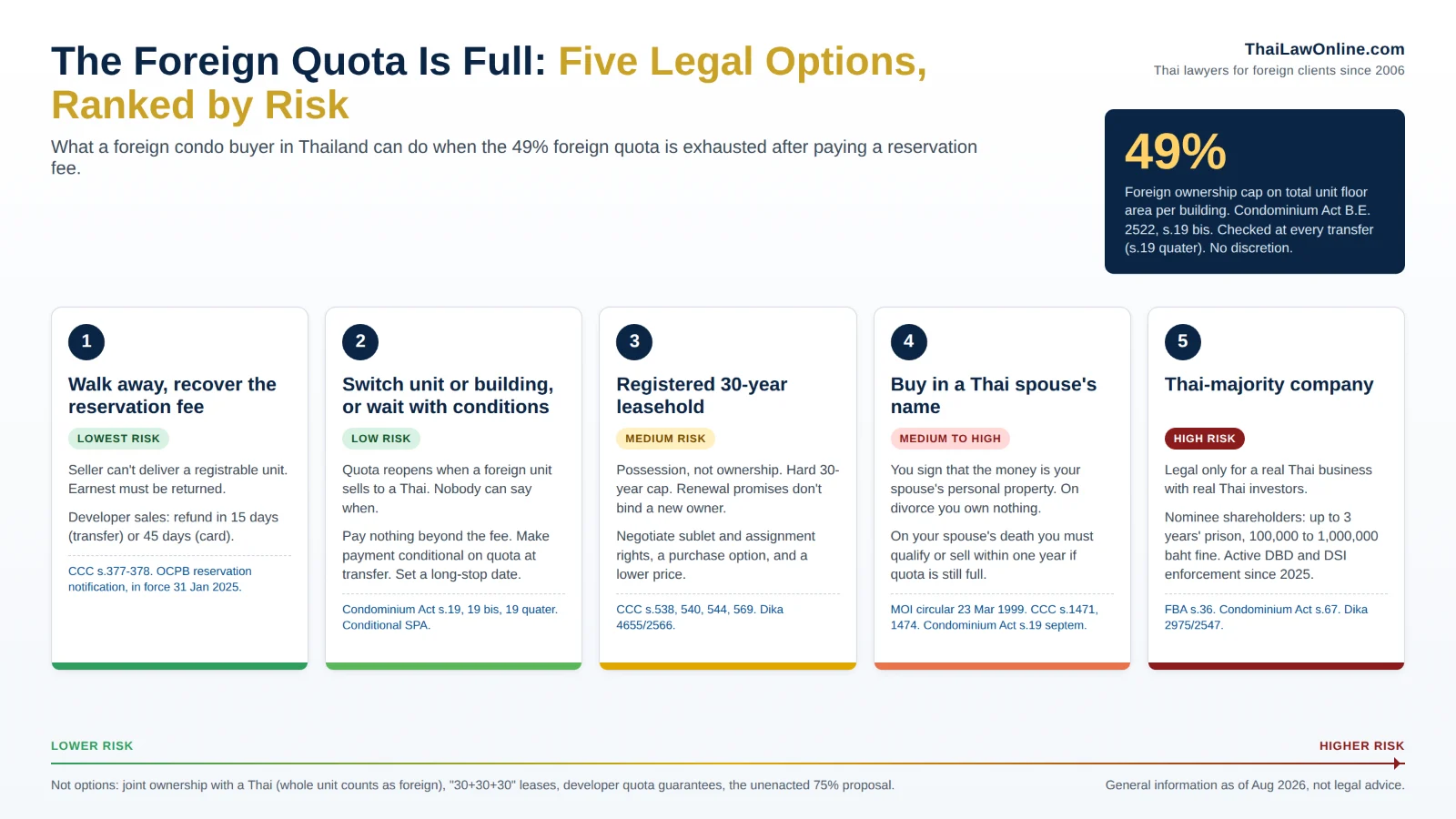
Table of Contents
Option 1: Walk Away and Recover Your Reservation Fee Lowest risk
This is the cleanest exit. It’s also the one buyers underuse, because the sales office presents the lease as the only alternative. It isn’t.
Your legal footing under the Civil and Commercial Code
A reservation fee is usually treated as earnest money. Section 377 of the Civil and Commercial Code makes earnest evidence that a contract was concluded. Section 378 then splits the outcomes. If the buyer defaults, the earnest is forfeited. If performance becomes impossible because of something the seller is responsible for, the earnest must be returned.
If the seller promised a foreign freehold transfer, but the unit cannot be registered because the quota is unavailable, Section 378 supports return of the earnest money when the seller cannot perform for a reason for which the seller is responsible. The contract wording and what each party knew still matter. In our experience, a letter citing the section and attaching the juristic person’s quota letter often produces a refund without court proceedings.
Developer sales: the OCPB reservation rules since 31 January 2025
If you reserved directly from a developer, you have a second layer of protection. The Contract Committee of the Office of the Consumer Protection Board made condominium reservation sales a contract-controlled business. The notification was published on 3 October 2024 and took effect on 31 January 2025.
Under those rules, the reservation contract may not let a developer keep any part of the fee unless the buyer is in breach (clause 5(4) of the notification). If the developer is the one who can’t perform, refunds are due within 15 days for cash or bank transfer. Credit card payments must be refunded within 45 days. A full quota is not the buyer’s fault.
Two limits. The notification covers business operators selling by reservation. It doesn’t cover a private resale from an individual owner. And it doesn’t name “foreign quota” as a termination ground, so you’ll pair it with Section 378 and the developer’s own representations about foreign eligibility.
Private resales and agents
Resale deposits sit under the Code alone. Check what you signed. Did the reservation form say the unit was available to a foreign buyer? Did the listing say “foreign quota”? Then you have a misrepresentation point as well as Section 378. If the form says nothing about foreign eligibility and you never asked, the argument gets harder. Even then, most sellers return the deposit rather than litigate over a sale that can never close.
Risk assessment: Low relative to proceeding with a defective purchase. Many claims settle after a written demand, but a disputed refund can require an OCPB complaint or court proceedings. Do not assume recovery will take only a few weeks.
Option 2: Move to a Unit or Building With Quota Left Low risk
Still want this project or this neighbourhood? The second option keeps your deal alive without changing its legal nature. You stay a freehold buyer. You just change the unit.
Swapping units inside the same project
Large developers often hold back some foreign quota for later phases or for unsold stock. Ask, in writing, whether any unit remains in foreign quota and whether your reservation fee can be transferred to it. Get the juristic person’s quota letter for the new unit before you agree. Don’t accept the sales team’s verbal “yes, that one is fine”.
Waiting for quota to reopen, safely
Quota is not static. It frees up every time a foreign-owned unit is sold to a Thai national or a company that qualifies as Thai for condominium ownership. In mature buildings that happens a few times a year. In a new building where every foreign unit was just bought by an investor, it may not happen for years.
Waiting is fine only if the paperwork protects you. Three points matter:
- Your sale and purchase agreement must make your payment obligations conditional on foreign quota being available at the transfer date. If quota isn’t available, the contract ends and all payments come back. This is a condition precedent, a concept common-law buyers already know.
- Don’t pay more than the reservation fee while you wait. Instalments paid against a unit you may never register leave you with an unsecured claim against the seller.
- Set a long-stop date. If quota hasn’t reopened by that date, you get your money back and walk.
Some developers offer a “quota waiting list”. Unless its terms are incorporated into a binding contract, priority on the list is a courtesy, not a legal right. Treat an informal list as a hope, not a plan.
Changing building
Quota shortages are concentrated in a small number of buildings that market heavily to foreigners. The building across the street often has 20% foreign ownership and no shortage at all. If your goal is a home rather than that specific tower, this is the fastest way back to a freehold title. Our guide to buying a condominium in Thailand covers the full due diligence sequence.
Risk assessment: Low, provided the new unit’s quota is confirmed by the juristic person and any waiting arrangement is conditional. You end up where you wanted to be: a foreigner with a registered title.
Option 3: Register a 30-Year Leasehold on the Unit Medium risk
This is the option every sales office offers first, because it lets them keep the sale. It is legal. It is also a completely different product from what you reserved. You need to understand what you’re giving up.
What a leasehold condo actually is
A lease is a contract, not ownership. Section 540 of the Civil and Commercial Code caps a lease of immovable property at 30 years. Section 538 requires a lease over three years to be registered at the Land Office, otherwise it’s only enforceable for three years. A registered lease does not consume foreign quota because the Thai owner stays on the title.
For a Canadian or American reader, the closest analogy is a long-term ground lease rather than a condominium title. You have exclusive possession for a term. You don’t own the asset. When the term ends, the unit goes back to the owner.
The renewal problem after Supreme Court Decision No. 4655/2566
Developers and sellers love to say “30 years plus two renewals”. That wording does not create a registered 90-year lease. In Decision No. 4655/2566, the parties signed a 30-year lease and two further 30-year extensions on the same day, and the tenant paid for all 90 years at the outset. The Supreme Court held that the extensions were void because the arrangement was intended to evade the 30-year limit in Section 540. The decision does not say every renewal promise is automatically void, but any promise remains contractual and should not be treated as a property right binding a later owner.
The practical result is simple. Value the lease at 30 years. If the seller adds renewal language, do not price it as a registered right to another 60 years. Our article on the 90-year lease myth in Thailand explains why “30+30+30” fails.
What to negotiate instead
A leasehold can be a sensible choice for a retiree. It suits someone who wants a home for life and doesn’t care about resale. It’s a poor choice for an investor. If you go this route, the lease must be registered. It should also include:
- A right to sublet and to assign the lease without the owner’s consent. Section 544 of the Code otherwise prevents subletting or transfer of the lease unless the agreement permits it.
- Clear wording acknowledging that the registered lease survives a transfer under Section 569. Do not assume that separate personal promises by the original owner will bind a later buyer.
- A written option to buy the unit freehold if foreign quota becomes available during the term, with a fixed price or formula and clear transfer mechanics.
- A reduced price. A 30-year lease is worth less than freehold. In our experience the market discount is real, and so is the resale difficulty. Don’t pay the freehold price for a lease.
Money in, money out
A lease payment made in one lump sum is still rent in law. There’s no FET requirement because you aren’t registering ownership. But when you leave Thailand, remitting the proceeds of an assigned lease can be harder than remitting a freehold sale. Banks look for the original inward remittance record. Keep every document. Our FET form guide explains the paper trail.
Risk assessment: Medium. The structure is legal and registered. The risks are commercial: no ownership, a hard 30-year horizon, lower resale value, and renewal language that creates no registered right to another term. Acceptable for a long-term residence, questionable as an investment.
Option 4: Buy in Your Thai Spouse’s Name Medium to high risk
If you’re married to a Thai national, your spouse can buy the unit in the Thai quota. It’s lawful. It’s also a decision about your marriage and your estate, not just about property. You can also buy in your Thai partner’s name if you are not married, and register a right for yourself over the unit, such as a usufruct, a lease, a mortgage or a sap-ing-sith.
The Land Office declaration
The Land Department Regulations on Ownership of Condominium Units by Foreigners and Foreign Juristic Persons B.E. 2547, particularly clauses 20 and 21, govern this situation. A Thai national married to a foreigner can register a condominium unit in the Thai spouse’s sole name. For the unit to stay in the Thai quota, both spouses confirm that all money used is the Thai spouse’s personal property (sin suan tua), not marital property (sin somros).
Read that again. You are signing a document that says the money was never yours in a marital sense. The Land Office relies on it. So will a divorce court, at least as a starting point.
Divorce: what the declaration does to you
Section 1474 of the Civil and Commercial Code normally presumes that property acquired during marriage is marital property. Here, however, the joint declaration records that the purchase money is the Thai spouse’s personal property, and the Land Department regulation treats the resulting unit as personal property under Section 1472. If the marriage ends, the foreign spouse has no registered share in the unit. Any separate contractual claim would depend on its own facts and cannot be treated as ownership of the condominium.
Death: the inheritance quota trap
This is the risk buyers never see coming. If your Thai spouse dies and you inherit the unit as a foreigner who does not qualify under Section 19, you must notify the Land Office within 60 days and dispose of the unit within one year (Section 19 septem). A foreign heir who does qualify must still notify within 60 days and, within one year, dispose of whatever would take the building over the foreign quota (Section 19 quinque). If the required sale is not completed, the Director-General of the Land Department has power to dispose of the unit.
A Last will and Testament in Thailand helps with succession but does not create quota. Our guide on inheriting property in Thailand as a foreign heir sets out the timeline.
Ways to reduce the exposure
Your spouse can grant you a registered usufruct or a registered 30-year lease. A usufruct is a real right to possess, use and enjoy the unit; a lease gives contractual possession for its registered term. Section 1417 of the Code governs usufruct. Neither makes you the owner or overrides the quota rule on inheritance, but either can protect continued occupation after separation or the owner’s death, subject to its terms. Couples should also read our page on the legal consequences of marriage in Thailand before signing.
Risk assessment: Medium to high. Fully legal, but you hold no title, the divorce outcome is against you by design, and the inheritance rule can force a sale. Suitable only for a stable marriage where the foreign spouse accepts these consequences with open eyes.
Option 5: Buy Through a Thai-Majority Company High risk
The last option is the one that gets foreigners prosecuted. We list it because it’s legal in one narrow form and because you’ll be offered it. We rank it last because most versions sold to foreign buyers are not legal at all.
The narrow legal version
A Thai limited company can buy in the Thai quota only if it is not regarded as foreign under Sections 97 and 98 of the Land Code. The test is not simply a “51% Thai shares” label; the capital structure and, where applicable, the number and status of shareholders also matter. The lawful version has genuine Thai shareholders who paid for their shares, exercise their rights and hold them for their own benefit. The company must also have a lawful corporate purpose for acquiring the unit.
The nominee version and why it’s a crime
The version usually offered to a foreign buyer is different. Thai “shareholders” hold the majority on paper, paid nothing and act only on the foreigner’s instructions. Those facts point to a nominee arrangement. Preference shares, shareholder loans and share-transfer documents are not unlawful by themselves. The offence arises when Thai shareholders hold shares on another person’s behalf to evade the law.
Section 67 of the Condominium Act punishes anyone who holds a unit on behalf of a foreigner or foreign juristic person, whether or not that foreign person would otherwise qualify to own a unit. The penalty is up to two years’ imprisonment, a fine of up to 20,000 baht, or both.
Section 36 of the Foreign Business Act B.E. 2542 also applies when a Thai nominee helps a foreigner evade restrictions on a business governed by that Act. Section 36 punishes both the Thai participant and the foreigner who consents, with imprisonment of up to three years, a fine of 100,000 to 1,000,000 baht, or both. A daily fine of 10,000 to 50,000 baht applies for failure to comply with the resulting court order.
Enforcement in 2025 and 2026
This is no longer a theoretical risk. The Department of Business Development has long screened companies with foreign participation for nominee indicators, and enforcement intensified in 2025 and 2026. Thai shareholders may be asked where their share capital came from, and bank statements may be checked. The Department of Special Investigation and the Anti-Money Laundering Office have joined operations in Phuket, Koh Samui, Koh Pha-ngan and Hua Hin. Company records are cross-checked against land and condominium registrations. Our tracker of nominee crackdowns in Thailand and the court cases behind them is updated as cases are reported. Our page on Thai nominee shareholders explains the verification now applied at registration.
Registrars and investigators look beyond the shareholder list to the source of funds and the parties’ conduct. A company whose Thai shareholders never paid for their shares and merely follow a foreigner’s instructions faces serious nominee risk. Preference voting rights or a foreign director do not, by themselves, prove a nominee arrangement; the full economic relationship matters.
The cost even if nobody investigates
A company must file audited accounts every year and hold shareholder meetings. If it lets a shareholder or director live there for free, the Revenue Department can assess income on an arm’s-length basis; the resulting corporate tax depends on the company’s full accounts. A company buying in the Thai quota does not rely on Section 19(5) FET evidence. When you sell, the buyer must either buy the shares, inheriting the company’s compliance history, or buy the unit from the company. An asset sale produces corporate tax consequences and withholding. Every step costs money and creates records that a later investigator can read.
Risk assessment: High. Lawful only for a genuine Thai company whose Thai shareholders invest and act for their own benefit. For a foreign individual who simply wants a home, the nominee version is a criminal structure that can end in forced sale, fines and imprisonment. We don’t set these up, and we advise clients to unwind them.
Comparison Table: Five Options When the Foreign Quota Is Full
| Option | Legal basis | What you get | Main risk | Exit and resale | Risk rank |
|---|---|---|---|---|---|
| 1. Walk away, recover fee | CCC s.377-378; OCPB reservation notification (in force 31 Jan 2025) for developer sales | Your money back | Delay, possible letter before action | Not applicable | Lowest |
| 2. Switch unit or building, or wait with a conditional contract | Condominium Act s.19, 19 bis, 19 quater; contract conditions | Freehold title in your own name | Waiting may take years; only safe if payments are conditional | Normal resale in foreign or Thai quota | Low |
| 3. Registered 30-year lease | CCC s.538, 540, 544, 569; Dika 4655/2566 | Exclusive possession for 30 years | No ownership; no registered right to automatic renewals; declining value | Assignment of the remaining term, harder to sell | Medium |
| 4. Thai spouse’s name | Land Department condominium regulations B.E. 2547, clauses 20-21; CCC s.1472, 1474; Condominium Act s.19 quinque and s.19 septem | Family home in Thai quota | No registered ownership for the foreign spouse; forced sale within one year on the Thai spouse’s death if the foreign heir cannot retain it | Spouse sells in Thai quota | Medium to high |
| 5. Thai company | Land Code s.97-98; Condominium Act s.19 bis and s.67; FBA s.36 where its business restrictions are evaded | Qualifying Thai company owns unit in Thai quota | Holding for a foreigner violates s.67; active DBD and DSI enforcement; annual costs | Share sale or asset sale, both taxed and scrutinised | High |
What Is Not an Option (Even Though Someone Will Suggest It)
“Just co-own it with a Thai friend”
Land Office practice treats a unit with any foreign co-owner as a foreign-owned unit. The whole floor area counts against the 49% cap, not your half. Co-ownership doesn’t create quota. It also gives a friend a registered interest in your home.
“The quota will be 75% soon”
In 2024 the cabinet asked the Ministry of Interior to study raising the cap to 75% and extending leases to 99 years. The idea met strong political resistance. As of August 2026 no amending Act has been passed. Section 19 bis still says 49%. Never buy on the assumption that the law will change in your favour. If it does, you can benefit later.
“The developer guarantees foreign quota at transfer”
A developer can’t guarantee what the Land Office will register. It can only promise to refund you if registration fails. Make sure the contract says exactly that, with a date and an amount. Our off-plan condo guide explains how to draft the refund clause.
“Get an Elite or LTR visa, then the rules are different”
No visa changes the quota. Section 19 lists who may own, and most foreign buyers qualify through the foreign-currency route in Section 19(5), not because of their visa. Section 19 bis caps how much all qualifying foreigners may own together. An Elite or LTR visa does nothing about a full building.
Step-by-Step: What to Do This Week
- Get the quota letter. Ask the condominium juristic person for its foreign ownership certificate. Keep the sales office out of it.
- Freeze payments. Don’t pay the contract deposit or any instalment until the quota position is resolved in writing.
- Re-read your reservation form. Look for any statement about foreign eligibility, the sale contract deadline, and refund terms. Photograph it.
- Send a written notice. State that the unit can’t be registered to you and cite Section 378 of the Code. Ask for the fee back, or for a transfer to a unit in foreign quota. Give a deadline.
- Decide with numbers. If you consider a lease, ask for the price as a lease and compare it to the freehold price. If you consider your spouse’s name, price in the divorce and inheritance risks honestly.
- Have the replacement contract reviewed before signing. A lease, a conditional purchase agreement or a spousal purchase each need different clauses. Our flat-fee property packages start at THB 19,900 for a condominium purchase and include the contract review.
Costs and Fees to Expect
| Item | Typical cost | Notes |
|---|---|---|
| Foreign quota certificate from juristic person | Free to THB 1,000 | Usually issued with the debt-free letter at transfer |
| Lawyer’s letter to recover reservation fee | From THB 2,000 (one-hour consultation) to a flat-fee package | Most refunds are settled without court |
| Registration of a 30-year lease | 1% registration fee plus 0.1% stamp duty on the total rent | Payable at the Land Office; negotiate who pays |
| Freehold transfer (when quota is available) | 2% transfer fee plus withholding tax and, where applicable, specific business tax or stamp duty | See our condo buying guide for the full breakdown |
| Usufruct from a Thai spouse | THB 100 per unit if registered without compensation; if compensated, 2% registration fee plus 0.5% stamp duty on the compensation | A lease is charged separately under the lease rates above |
| Thai company (setup and annual compliance) | Setup from THB 30,000; annual audit and filings from THB 25,000 | Costs continue every year; nominee version is unlawful |
Figures are indicative as of August 2026. Government fees change by ministerial regulation, and reduced transfer fees are sometimes offered for lower-value units.
Before you rely on anyone’s word about the quota, the Title Deed Check (4,900 THB) pulls the Land Office record for the unit and tells you whether it sits in the foreign or the Thai quota.
Frequently Asked Questions About a Full Foreign Quota
What happens if the foreign quota is full when I buy a condo in Thailand?
The Land Office will refuse to register the unit in your name. Section 19 quater of the Condominium Act only allows registration if foreign ownership stays within 49% of the total unit area. You must switch to another unit, take a registered lease, or buy through a qualified Thai person or company.
Can I get my reservation fee back if the foreign quota is full?
Often yes. If the seller knew or should have known the quota was full, the sale can’t be performed as promised. Section 378 of the Civil and Commercial Code requires earnest money to be returned when performance becomes impossible because of a circumstance for which the receiving party is responsible. For developer sales since 31 January 2025, the OCPB reservation rules also limit forfeiture to cases where the buyer is at fault.
Does the foreign quota ever open up again?
Yes. Quota frees up whenever a foreign-owned unit is sold to a Thai national or a company that qualifies as Thai for condominium ownership. Nobody can predict when that will happen in a given building. Waiting is only safe if your contract makes payment conditional on quota being available at transfer.
Is a 30-year leasehold condo a good alternative to freehold?
It’s a legal alternative, not an equivalent one. A registered lease gives you up to 30 years of possession under Section 540 of the Civil and Commercial Code. A renewal promise does not create a registered 90-year lease or bind a new owner. In Decision No. 4655/2566, the Supreme Court voided two pre-agreed 30-year extensions where the parties had paid for all 90 years at the outset to avoid Section 540.
Can my Thai spouse buy the condo in the Thai quota instead?
Yes, but the unit becomes your spouse’s separate property. The Land Office will ask both of you to confirm the money is your spouse’s personal property. On divorce you have no ownership claim. On your spouse’s death, Sections 19 quinque and 19 septem govern whether you may retain the unit or must sell it within one year, depending on your qualification under Section 19 and the available quota. You can also ask your spouse to register a usufruct or another right for you over the unit.
Can I use a Thai company to buy a condo when the foreign quota is full?
Only if it is a genuine Thai company that is not regarded as foreign under the Land Code, and its Thai shareholders paid for their shares and act for their own benefit. Section 67 of the Condominium Act criminalises holding a unit on behalf of a foreigner. Section 36 of the Foreign Business Act also applies where nominees help a foreigner evade that Act’s restrictions on business. The Department of Business Development scrutinises the source of Thai shareholders’ funds in risk cases.
Has Thailand raised the foreign condo quota to 75%?
No. The cabinet asked the Interior Ministry to study a 75% quota and 99-year leases in 2024. As of August 2026 no amendment has been enacted. The 49% cap in Section 19 bis of the Condominium Act still applies.
If I co-own a condo with a Thai friend, does only my half count against the foreign quota?
No. In Land Office practice a unit with any foreign co-owner is treated as foreign-owned. The whole floor area counts against the 49% quota. Co-ownership doesn’t solve a full quota.
How ThaiLawOnline Can Help
We’ve been advising foreign clients in Thailand since 2006, in English, French and Thai. When the quota is full, we do three things fast. We confirm the real quota position with the juristic person. We seek recovery of your reservation fee or move it to a unit you can own. And we review any replacement lease or conditional contract before you sign.
Start with a one-hour consultation for THB 2,000, or choose a flat-fee condominium package from THB 19,900. You can also contact a Thai lawyer directly, or browse our Thai property law services.
Key Takeaways
- A full foreign quota means the Land Office will not register the unit to you. The 49% cap in Section 19 bis of the Condominium Act is applied at every transfer, with no discretion.
- Your lowest-risk moves are to recover the reservation fee or to move to a unit that still has quota. Section 378 of the Civil and Commercial Code and the OCPB reservation rules for developer sales back the refund.
- A registered 30-year lease is legal but is a different product. Value it at 30 years. Decision No. 4655/2566 voided two prepaid 30-year extensions designed to evade the statutory limit; renewal wording does not create a registered 90-year right.
- Buying in a Thai spouse’s name puts the unit outside your reach on divorce. After the Thai spouse’s death, Sections 19 quinque and 19 septem may require the foreign heir to sell within one year, depending on the heir’s qualification and the available quota.
- A Thai company can hold the unit in the Thai quota only when it is not regarded as foreign under the Land Code and its Thai shareholders invest and act for their own benefit. Holding the unit for a foreigner is an offence under Section 67 of the Condominium Act. Section 36 of the Foreign Business Act also applies where the arrangement evades restrictions under that Act.
- Joint ownership with a Thai, “30+30+30” leases, developer quota guarantees and the 75% proposal do not solve the problem.
This article is general information about Thai law as of August 2026. It is not legal advice for your transaction. Statutory references are to the Condominium Act B.E. 2522 as amended, the Civil and Commercial Code, and the Foreign Business Act B.E. 2542. Court decisions are cited by Supreme Court (Dika) number and Buddhist Era year. Fees and enforcement practice change. Speak to a licensed Thai lawyer before you sign or pay.
Thai Law Updates, free by email
Plain-English updates on Thai law changes that affect foreigners: property, visas, marriage, business and wills. One short email a month from a firm practicing since 2006. No spam, unsubscribe anytime.