


Reviewed by ThaiLawOnline, a licensed Thai law firm practising in Thailand since 2006. Thai lawyer of record: Wichuda Atthamethakon, LL.M., Thai Bar Licence 3149/2556.
Last updated on
The provisions cited throughout this page, Land Code sections 86 to 96, are reproduced in full in Chapter 8 of the Thai Land Code: limitation of foreigners’ right in land. For how inheritance sits alongside the other routes a foreigner might use, see our overview of whether a foreigner can buy land in Thailand.
LAWYER-DRAFTED TEMPLATE · ฿990
Land & House Sale and Purchase Agreement (Bilingual English & Thai)
Deposit with the double-return rule, clean-title warranties including road access, the tax split, and the foreign-buyer clause registering your lease, superficies or usufruct on the same transfer day. Word + PDF, updated August 2026. สัญญาจะซื้อจะขายที่ดินพร้อมสิ่งปลูกสร้าง
Inheriting land is a special case of the general position explained in our guide to inheritance law in Thailand.
Last reviewed: 27 September 2026. Supreme Court Decisions 5825/2539, 2752/2543, 6089/2558, 8195/2561, 301/2538 and 1180/2563 were read in the Thai text, and sections 4, 11 and 12 of the Property-Based Rights Act B.E. 2562. On 30 September 2026 the 96 bis conditions were re-read in the Thai text of the Land Code (section 96 bis): the holding period is at least three years, not five, and the permitted areas are those the section lists. On 12 October 2026 the IEAT and EEC conditions were re-read in Thai (IEAT Act section 44, EEC Act sections 49 and 50): industrial estate land is held by permission, its disposal duty follows a cessation or transfer of the business, and the EEC rule is a different one.
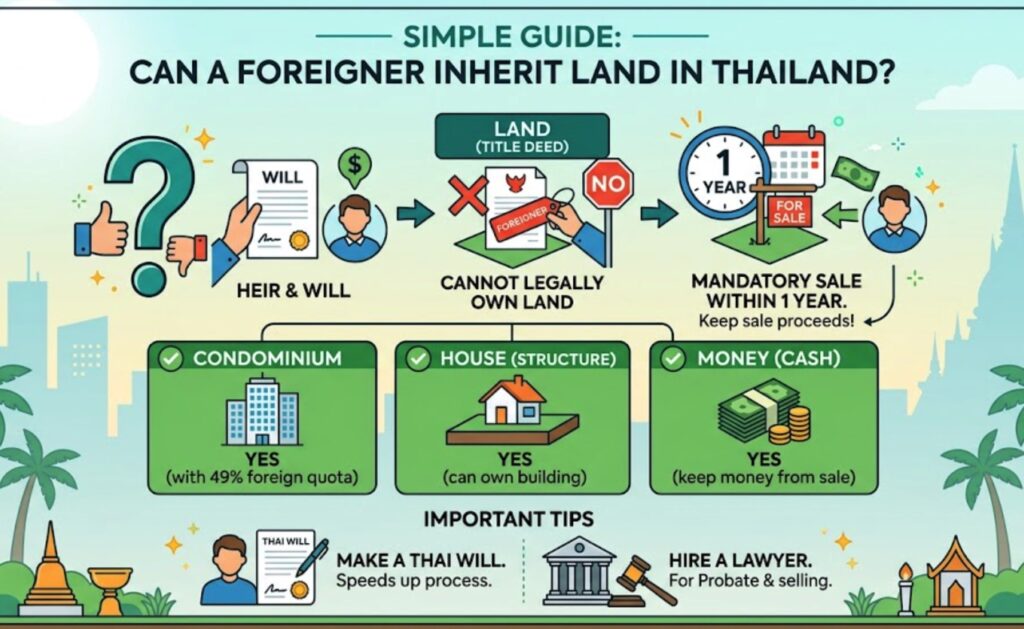
The short answer: a foreigner can receive land in Thailand through inheritance. In most cases, they cannot keep it.
Thai law generally requires the foreign heir to sell the land within the period set by the Land Department. The proceeds belong to the heir. The land itself does not.
There are exceptions. Five statutory pathways allow foreigners to hold land or owner-like rights in Thailand. Most expatriates do not qualify for any of them. But a complete analysis requires knowing they exist.
This guide explains the baseline rule, lists every exception with its statutory basis, cites the relevant Supreme Court decisions, and tells you what to do if you are a foreign heir facing this situation right now.
The Baseline Rule: Why Foreigners Cannot Own Land in Thailand
The starting point is Section 86 of the Land Code Act, B.E. 2497 (1954):
The only route to foreign land ownership under Section 86 is a bilateral treaty. Thailand has not had such a treaty in force since 1970. The last one was terminated over 55 years ago. No replacement exists.
The Thai-US Treaty of Amity and Economic Relations is sometimes raised by American clients. It grants broad business rights to US nationals in Thailand. It does not grant the right to own land.
So the baseline rule is real. Most foreigners cannot own land in Thailand. That rule does not change the moment you inherit. When a foreign heir appears in a Thai estate containing land, Section 86 is the first issue.
But the baseline rule has exceptions. They are narrow. They have strict conditions. They are worth knowing.
Exceptions: When a Foreigner Can Hold Land Rights in Thailand
Five statutory pathways allow foreigners to hold land or land-adjacent rights in Thailand. The first is the most significant for foreign residents and foreign heirs. The others are tied to specific investment activities or business structures.
ทรัพย์อิงสิทธิ (Sap Ing Sith), Property-Based Rights Act B.E. 2562 (2019)
This is the most significant development in Thai property law for foreigners in decades. The Property-Based Rights Act (พระราชบัญญัติทรัพย์อิงสิทธิ พ.ศ. 2562) was published in the Royal Gazette on 30 April 2019 (vol. 136, part 56 Kor, p. 97) and came into force 180 days after publication. It creates an entirely new category of property right, separate from ownership.
A Sap Ing Sith right gives the holder owner-like powers over a specific plot of land for up to 30 years. The right is registered at the Land Department against a chanote title deed (nor sor 4 jor). For land, only chanote land qualifies; a Sap Ing Sith can also be created over a condominium unit (section 4). Section 11 of the Act gives the holder the rights and duties of an owner, except the right to recover the property and to stop unlawful interference, which stay with the owner; Section 12 allows the right to be transferred and mortgaged.
Crucially for inheritance purposes: Section 12 of the Act states that a Sap Ing Sith right can pass through the estate of the deceased holder. A foreigner who holds a Sap Ing Sith right can leave it to their heirs. The heir, including a foreign heir, receives the right. The Section 94 disposal obligation does not apply.
This is not full ownership. The right has a 30-year maximum term. But within that term, a foreign heir has real, registered, inheritable rights over Thai land. This is the closest thing to land ownership a foreigner can currently hold under Thai statute.
Source: Royal Gazette, 30 April 2019.
The 40 Million Baht Route, Section 96bis, Land Code
Section 96bis was added to the Land Code to allow qualifying foreigners to hold up to 1 rai of land for residential purposes. The conditions are strict and cumulative:
The foreigner must invest at least 40 million baht in approved instruments. These include Thai government bonds, Bank of Thailand bonds, bonds issued by state financial institutions, or investment in a BOI-promoted business. Section 96bis itself requires the investment to be maintained for at least three years; the ministerial regulation sets the detail. The land must be used exclusively for residential purposes. It must lie within Bangkok, Pattaya City, a municipality, or an area zoned residential under the town-planning law. Approval of the Minister of Interior is required.
This is an acquisition right, not a free-standing inheritance right. Section 96bis is designed around a living investor who qualifies and applies. What happens when that investor dies, and whether the Section 96bis right survives to their heirs, is not clearly established. One published legal source we reviewed suggests the right does not pass automatically through the estate. A Thai property lawyer should confirm the current position before you rely on Section 96bis rights surviving death.
BOI Promoted Businesses, Investment Promotion Act B.E. 2520 (1977), Section 27
A foreigner or foreign company holding a Board of Investment promotion certificate can own land in Thailand. Section 27 of the Investment Promotion Act (พระราชบัญญัติส่งเสริมการลงทุน พ.ศ. 2520) lets the BOI Board permit a promoted person to own land for the promoted activity, in the amount the Board thinks fit; if an alien promoted person ceases or transfers the business, the land must be sold within one year, failing which the Director-General of Lands sells it. Factory land, office land for a promoted business, these can be owned by a foreigner with a valid BOI promotion certificate.
This is a business right, not a personal property right. The right to own land under Section 27 is tied to the BOI promotion and the promoted activity. If the foreign investor dies, the business asset does not automatically become personal inheritance in the same way as other property. The legal structure of the promoted entity, company, partnership, individual, governs what happens. For estate planning with BOI assets, specialist advice is essential.
Industrial Estates, IEAT Act B.E. 2522 (1979), Section 44
Foreign operators in zones administered by the Industrial Estate Authority of Thailand (IEAT) may be permitted to own land within those industrial estates, in the area the IEAT Board thinks fit. Section 44 of the Industrial Estate Authority of Thailand Act (พระราชบัญญัติการนิคมอุตสาหกรรมแห่งประเทศไทย พ.ศ. 2522) is the source of that permission.
There is a condition: if a foreign operator ceases or transfers the business, the land must be disposed of to the IEAT or to the transferee of the business within three years of ceasing or transferring it, failing which the Director-General of the Department of Lands disposes of it. This is a use-conditional ownership right. It is real land ownership while the business operates, but it is not permanent ownership divorced from the business activity.
For inheritance: if a foreign operator dies and the business ceases, the three-year disposal clock starts. The heirs receive the proceeds of the sale, not the land itself. If the business continues (for example, through a corporate structure that survives the individual), the estate question is more complex and requires specific advice.
Source: Industrial Estate Authority of Thailand Act.
Eastern Economic Corridor, EEC Act B.E. 2561 (2018), Section 49
The Eastern Economic Corridor Act (พระราชบัญญัติเขตพัฒนาพิเศษภาคตะวันออก พ.ศ. 2561) creates a special zone covering parts of Chonburi, Rayong, and Chachoengsao. Section 49 contains a confirmed statutory exception.
Section 49 grants a juristic person (company) operating in an EEC Special Promotion Zone that qualifies as an alien under the Land Code the right to own land within that zone for its permitted business operations, without needing Land Code permission. The same section exempts EEC-promoted foreign juristic persons from the Condominium Act foreign ownership quota for condo units used in the business.
The disposal condition differs from the IEAT Act: under Section 50, if the operator holds land but does not operate within three years, or stops operating, the land must be sold within one year of notification by the EEC Office, failing which the Office sells it and returns the net proceeds. The land area limits and qualifying criteria are set by the EEC Policy Committee with Cabinet approval, capped at what the BOI Act or IEAT Act allow.
Critical limitation: Section 49 applies to juristic persons, companies, not to individual natural persons. An individual foreigner, however wealthy or however strong their EEC investment, does not get a personal land ownership right under Section 49. The right belongs to the corporate entity. For inheritance, what matters is the corporate structure holding the EEC-promoted business, not the individual investor’s personal estate.
Source: EEC Act B.E. 2561, Section 49.
Section 93 of the Land Code: The Inheritance Provision
The Land Code has a specific section on inheritance by foreigners. Section 93 reads:
On its face, this looks like a path to foreign ownership of inherited land. In practice, it is a dead letter.
Section 93 was written for one scenario: a foreigner who inherited land from another foreigner who legally owned land under a treaty (Section 86). With no active treaty, no foreigner legally owns land under Section 86 today. The chain that Section 93 requires does not exist.
Even if a foreign heir applied to the Minister of Interior for permission, no Minister can lawfully grant it. There is no treaty that would authorise the permission. The Land Department’s practice and multiple legal commentators confirm this position.
A foreigner married to a Thai national who dies leaving land behind is a statutory heir under Section 1629 of the Civil and Commercial Code. That is clear. Being a statutory heir does not make Section 93 work. The marriage creates the inheritance right. It does not create a treaty.
Section 94: What Happens to the Land
Section 94 of the Land Code governs what must happen to land that a foreigner holds without lawful permission:
This is the operative provision for foreign heirs. The foreign heir has between 180 days and one year to sell the land. The Director-General of the Land Department sets the specific deadline. The heir keeps the money from the sale.
If the heir does not sell in time, the Director-General can sell the land. The heir still receives the proceeds. But the heir loses control of the sale process and the sale price achieved may be lower than a voluntary sale.
What the Supreme Court Has Said
There are multiple Supreme Court (Dika) decisions on this exact issue. Three decades of case law show a consistent pattern.
Facts: A foreigner (นายซงเล้ง) could not hold title to land. He put it in the name of his child (the defendant). When he died, his other child (the plaintiff) sued for a share of the inheritance.
Issue: The Court of Appeal had ruled the acquisition was void under Section 86. So the plaintiff had no right to sue.
Supreme Court held: Even though the acquisition was not lawful under Section 86, it was not completely void. The foreigner still retained the right under Section 94 to dispose of the land. As long as he had not sold it, the land remained his property. When he died, it became part of his estate. The statutory heir could sue for a share of that estate.
Relevant laws: Land Code Sections 86 and 94; Civil and Commercial Code Section 150; Civil Procedure Code Section 55.
Facts: A Chinese national (นายอุดม) bought land and registered it in the name of his minor child (the defendant). He later made a will leaving the land equally to his three children. The defendant, as estate administrator, refused to divide it.
Supreme Court held: The foreigner acquired the land unlawfully under Section 86. But the acquisition was not without legal effect. He retained the right under Section 94 to dispose of the land. Until disposed of, the land was his property. He could therefore make a will bequeathing it. The will was valid. The estate was divisible among heirs.
Key principle confirmed: A foreigner can make a Thai will that covers land held in Thailand, even if that holding was not lawful under Section 86. Until it is disposed of, land a foreigner held unlawfully remains his property and he may leave it by will; the Court upheld division of the land itself among the will’s heirs.
Facts: A Chinese national (นายคี้ แซ่ล้อ) purchased 22 plots of land and registered them in the defendant’s name. He later married the plaintiff (his second wife) and had children. After he obtained Thai citizenship in 1988 and died in 2003, his widow (as estate administrator) sued to recover the 22 plots from the defendant (his child from a first relationship).
Court of Appeal: Dismissed the claim.
Supreme Court held: The land was still the deceased foreigner’s property at the time of death. The nominee arrangement was unlawful under Section 86. But it was not void in the sense of stripping all rights. Section 94 preserved the right to dispose of the land. That right passed to the estate. The estate administrator had standing to sue and to have the land transferred into the estate for disposal under Section 94. The proceeds would then be divided among the heirs.
Judicial panel: วีระวัฒน์ ปวราจารย์, เมทินี ชโลธร, ณัฏฐชัย ไวยภาษจีรกุล.
Relevant laws: Land Code Sections 86 and 94.
Facts: Land was acquired by a foreigner during the period when they were still an alien. A prior case had already ordered the land disposed of under Sections 94 and 96 of the Land Code. The foreigner (or estate) would receive money from the sale in lieu of ownership.
Supreme Court confirmed: When land is ordered sold under Section 94, the foreigner (or their estate) receives the sale proceeds. They do not receive the land itself. The court judgment replaces the need for the foreigner’s signature on the transfer documents.
Held: The Land Code restrictions apply to land as a geographical asset. They do not apply to buildings constructed on land. Foreigners can own a building erected on land they do not own. This principle is relevant to inheritance: a foreign heir may inherit and keep the house while being required to sell the land underneath it.
The judgment’s own words: the forced sale under Section 94 covers only the land, not the buildings, because aliens are not barred from owning buildings (Supreme Court Decision 301/2538, read in the Thai text).
Facts: A Chinese national (นาย ล.) lived in Thailand with a Thai common-law partner (นางเตียง) and had ten acknowledged children. He died on 2 October 1999. One child was appointed estate administrator and brought proceedings to transfer land, held by a sibling, into the estate for disposal under Section 94 and division of proceeds.
Supreme Court held: The land was estate property and must be sold under Section 94. The Court added a precise clarification: the fact that land passes to heirs through inheritance is not itself a disposal within the meaning of Section 94. Receiving the land through inheritance does not satisfy or discharge the obligation to sell. The disposal obligation that existed while the foreigner was alive passes through the estate and falls on the estate administrator and heirs.
Key holding (Thai): “กรณีที่ดินพิพาทตกทอดแก่ทายาทโดยทางมรดกนั้นถือไม่ได้ว่าเป็นการจำหน่ายที่ดินตามเจตนารมณ์ประมวลกฎหมายที่ดิน มาตรา 94”
Judicial panel: วัฒนา วิทยกุล, สราวุธ ศิริภาณุรักษ์, สุรพล เอี่ยมอธิคม.
Relevant laws: Land Code Sections 86 and 94; Civil and Commercial Code Sections 1336, 1360, 1600, 1754.
These decisions span four decades and point in one direction. A foreigner’s unlawful acquisition of land, or inheritance of it, is not treated as nothing. The right to dispose of the land and receive the proceeds is a real, enforceable right that passes through the estate to heirs. Decision 1180/2563 adds an important practical point: receiving the land through inheritance does not satisfy the Section 94 disposal obligation. It transfers that obligation to the estate administrator.
The Specific Case of a Foreign Spouse
The most common scenario in our practice is a Thai-foreign couple. The Thai spouse owns land. The Thai spouse dies. The foreign spouse wants to know what happens.
The foreign spouse is a statutory heir. Under Section 1629 of the Civil and Commercial Code, the surviving spouse inherits alongside the deceased’s other statutory heirs (children and parents, who share together, then the later classes). The share depends on which class of heirs is present. Section 1635 governs the spouse’s share in each case.
So the foreign spouse has a valid inheritance right. What they inherit is the right to receive the proceeds of the land sale. Not the land itself.
Here is how it plays out in practice:
- The Thai spouse dies. The estate is opened through the probate process in the Thai courts.
- An estate administrator is appointed (often the foreign spouse or another heir).
- The land is identified as part of the estate. The Land Department is notified.
- The Director-General sets a disposal period (180 days to one year).
- The land is sold. The foreign heir receives their share of the proceeds.
One practical issue: the land that the Thai spouse owned may have been purchased under the 1999 Ministry of Interior instrument. Under that instrument (Most Urgent Letter Mor.Thor 0710/Wor.792, dated 23 March 1999), a Thai national married to a foreigner can buy land. We cite it by its document number and not from its text: it is not held in any database we can search, so search that number on dol.go.th for the wording. But both spouses must sign a declaration at the Land Office confirming that the money used was the Thai spouse’s personal property (sin suan tua), not marital property (sin somros). See our guide to on the confirmation letter in Thailand.
That declaration matters for inheritance. It established the land as solely the Thai spouse’s personal asset. The foreign spouse has no pre-existing co-ownership claim. The inheritance right is the only basis for the foreign spouse’s entitlement. And that entitlement comes with the Section 94 obligation to sell.
Land vs. Condo vs. House: A Comparison
Foreign heirs face different rules depending on what kind of property they are inheriting. This table summarises the main categories.
| Property Type | Can Foreign Heir Register Ownership? | Time Limit to Act | Notification Required? | Outcome if No Action |
|---|---|---|---|---|
| Land (chanote, NS3, NS3K) | No (unless exception applies) | 180 days to 1 year (set by Director-General) | Yes (notify Land Office) | Director-General sells the land |
| Sap Ing Sith right (ทรัพย์อิงสิทธิ) | Yes, inheritable under Section 12 of the Act | No forced disposal | Register the inheritance at Land Office | Right continues for remaining term (max 30 years) |
| Condominium unit (qualified foreigner) | Yes, within 49% foreign quota | No forced sale if quota available | Notify Land Office within 60 days | Must sell if quota is full |
| Condominium unit (unqualified foreigner) | No | 1 year from acquisition | Notify in writing within 60 days | Director-General sells the unit |
| House / building on land | Yes (building only, per SC Decision 301/2538) | No time limit on the building | No | Foreigner keeps the building; must sell the land |
| Lease (no succession clause) | N/A (lease ends on lessee’s death) | N/A | No | Lease terminates automatically |
| Usufruct | N/A (personal right, not inheritable) | N/A | No | Usufruct expires on holder’s death |
The condominium rules come from Sections 19 quinquies and 19 septem of the Condominium Act. A foreign heir who falls within one of the Section 19 categories keeps an inherited unit within the 49% quota and must sell only units over it (Section 19 quinquies). The statute does not exclude the foreign-currency category, Section 19(5), from this, but Land Offices read the Section 19 ter(5) evidence rule, which is framed around a purchase, as requiring the heir to qualify in his own right, and in practice most expats cannot. A foreign heir outside Section 19 falls under Section 19 septem: notify the Land Office in writing within 60 days of acquisition, and dispose of the unit within one year.
What About Leases and Usufructs?
Leasehold
A lease in Thailand is not a property right. It is a personal contractual right under the Hire of Property provisions of the Civil and Commercial Code. A lease is tied to the person of the lessee. When the lessee dies, the lease ends.
The only exception is a lease that contains a specific succession clause. With such a clause, the heir can step into the lessee’s position. But this right does not automatically bind any successor of the lessor. Even with a succession clause, the heir’s rights are contractual, not registered property rights.
If you combined a land lease with a registered superficies (the right to own structures on land), the superficies can survive the lessee’s death and may be inheritable. That combination offers better long-term security than a lease alone. See our guide to Thai property law for more detail on superficies and lease structures.
Usufruct
A usufruct gives the holder the right to use and enjoy another person’s land for a specified period or for life. It is registered at the Land Office and binds future owners of the land.
But it is a personal right. It does not pass to heirs. When the usufruct holder dies, the right ends. The land reverts to the bare owner free of the usufruct. This is confirmed by Sections 1417 to 1428 of the Civil and Commercial Code.
Many foreigners hold usufructs over land registered in their Thai spouse’s name. When the foreigner dies, the usufruct ends. When the Thai spouse dies, the land (free of the usufruct) enters the estate. The foreign heir then faces the Section 94 obligation.
What About a Thai Last Will?
A foreigner who holds land in Thailand, even unlawfully, in a nominee arrangement, can make a Thai last will and testament that covers that land. Supreme Court Decision No. 2752/2543 confirms this directly.
The will does not change the rule. The land must still be sold under Section 94. But the will determines who receives the proceeds. Without a valid Thai will, the proceeds are distributed according to the statutory heir rules under the Civil and Commercial Code. With a will, the deceased can direct the proceeds to chosen beneficiaries, including foreign beneficiaries who are not in the statutory heir classes.
A Thai will covering land should be drafted in Thailand by a Thai lawyer. Thai courts apply Thai law to succession of immovable property located in Thailand. See our guide to Thai last will and testament for the formal requirements under the Civil and Commercial Code.
Nominee Arrangements: A Word of Warning
The Supreme Court cases above (particularly 5825/2539, 2752/2543, and 6089/2558) all involved foreigners who held land through Thai nominees. The foreigner paid for the land. A Thai person held the title. This is a nominee arrangement.
Those cases confirmed that the arrangement has some legal effect for inheritance purposes. The foreigner’s estate retains the Section 94 right to proceeds. But this should not be read as an endorsement of nominee structures. They are illegal, and the Land Code splits the liability across three sections. Section 113 catches the nominee: any person who acquires land as the agent (ตัวแทน) of an alien, or of a juristic person treated as an alien under Section 97 or Section 98, is liable to a fine not exceeding 20,000 baht or imprisonment not exceeding two years, or both. Section 111 catches the foreigner, with the same penalty, for a breach of Section 86. And Section 112 catches the company, with a fine of up to 50,000 baht where a juristic person acquires land in breach of the Code.
The cases resolved inheritance disputes that arose from arrangements already in place. They did not legalise the original arrangement. Legal alternatives exist, including Sap Ing Sith, condominium purchase, and superficies arrangements. Use them.
Practical Checklist for Foreign Heirs
If you are a foreign heir dealing with Thai land in an estate, here is what needs to happen:
- Apply for estate administration. Get a Thai court order appointing an estate administrator. This is required before the Land Office will act on any transfer.
- Check if an exception applies. Did the deceased hold a Sap Ing Sith right? A BOI promotion? An IEAT industrial estate land right? If yes, different rules apply and you may not face the Section 94 disposal obligation.
- Identify all land assets. Obtain the title documents (chanote, NS3, etc.) and check the Land Office records. Confirm which plots are in the estate and what type of title they carry.
- Notify the Land Department. The estate administrator must notify the Land Office that the heir is a foreigner and that the land must be disposed of under Section 94.
- Engage a licensed real estate agent or lawyer. The sale must be completed within the period set by the Director-General. Start immediately. One year is not as long as it sounds once probate and land administration are factored in.
- Transfer the sale proceeds. Once the land is sold, the proceeds are distributed to heirs according to the will or the statutory rules. The foreign heir receives their share in cash.
- Handle the building separately. If there is a house on the land, get legal advice on separating the house title from the land title. The foreign heir can keep the house even after selling the land (per Supreme Court Decision 301/2538).
Frequently Asked Questions
Can a foreigner inherit land in Thailand?
In most cases, a foreigner can receive land as an inheritance but cannot register title in their name. They must sell the land within the period set by the Director-General of the Land Department (between 180 days and one year) and keep the proceeds. Narrow exceptions exist, including Sap Ing Sith rights, BOI land, and industrial estate land, where different rules apply.
Are there exceptions that allow foreigners to own land in Thailand?
Yes. Five statutory exceptions exist: the Property-Based Rights Act (Sap Ing Sith, 2019), Section 96bis of the Land Code (40 million baht investment route), Section 27 of the Investment Promotion Act (BOI land), Section 44 of the IEAT Act (industrial estate land), and the Eastern Economic Corridor Act for EEC-promoted investors. Each is narrow. Most expatriates do not qualify for any of them.
What is Sap Ing Sith and can a foreigner inherit it?
ทรัพย์อิงสิทธิ (Sap Ing Sith) is a registered property right created by the Property-Based Rights Act B.E. 2562 (2019). It gives the holder owner-like powers over a specific plot of chanote land for up to 30 years. Section 12 of the Act explicitly states the right is inheritable. A foreign heir who inherits a Sap Ing Sith right is not subject to the Section 94 disposal obligation. This is the closest thing to land ownership currently available to foreigners in Thailand.
What happens if a foreigner does not sell inherited land in time?
Under Section 94 of the Land Code, the Director-General of the Land Department fixes a period of between 180 days and one year for the heir to sell, and if the heir does not sell within it, the Director-General has the power to sell the land on the heir’s behalf. The foreign heir still receives the sale proceeds. But they lose control over the sale process and the price achieved.
Can a foreigner married to a Thai person inherit their spouse’s land?
Yes. A foreign spouse is a statutory heir under Section 1629 of the Civil and Commercial Code. They inherit, but they cannot register ownership. They must sell the land within the prescribed period and keep the proceeds.
Can a foreigner inherit a condominium unit in Thailand?
It depends on their status. Only a foreign heir with permanent residence under Section 19(1), or admitted under the investment promotion law under Section 19(2), may keep an inherited unit, and then only within the 49% foreign quota. Qualifying under Section 19(5) by bringing foreign currency into Thailand lets you buy a unit but does not let you keep an inherited one. Any other foreign heir must notify the Land Office in writing within 60 days of acquisition and dispose of the unit within one year under Section 19 septem, failing which the Director-General of the Land Department may sell it.
What does Section 93 of the Land Code say about foreign heirs?
Section 93 says that a foreigner may inherit land as a statutory heir with permission from the Minister of Interior. In practice, no Minister can grant this permission today. The permission requires a bilateral treaty, and the last such treaty expired in 1970. No treaty is currently in force.
Can a foreigner own a house or building on inherited land?
Yes. The Land Code restrictions apply to the land itself, not to structures on it. The Thai Supreme Court confirmed in Decision No. 301/2538 (1995) that foreigners can own a building on land. A foreign heir can therefore keep the house while selling the land underneath it.
Does a usufruct pass to heirs when the holder dies?
No. A usufruct is a personal right under Thai law. It expires automatically on the death of the holder. It cannot be inherited by anyone. This is confirmed by Sections 1417 to 1428 of the Civil and Commercial Code.
Does making a will at the district office help a foreign heir?
Not with the land problem, no. The Ministerial Regulation on the Making of Wills B.E. 2569 has been in force since 24 March 2026 and replaced the 1960 rules: a public will can now be made at any amphur or Bangkok khet office rather than only the one holding your house registration, the fee is 250 baht (it was 50) and a duplicate counterpart of the will is 50 baht (it was 10), with two witnesses present and signing in front of the officer.
That reform is procedural. Registering a will at a government office does not give a foreign heir a right the Land Code withholds, and an officer who records your will is not granting permission to hold land. Section 93 and the disposal rule in Section 94, set out above, apply exactly as before. A Thai will is still worth making, because it names your heirs and your administrator clearly and shortens the court process, but it settles who takes the estate, not whether a foreigner may keep the land in it.
Key Takeaways
- The baseline rule is that foreigners cannot own land in Thailand. But there are five statutory exceptions, and most foreigners do not qualify for any of them.
- The most significant exception for individual foreigners is the Property-Based Rights Act B.E. 2562 (2019), which creates Sap Ing Sith rights: registered, transferable, and explicitly inheritable for up to 30 years on chanote land.
- Section 93 of the Land Code allows foreign inheritance in theory. In practice it is inoperative. No treaty exists that would activate it.
- Section 94 is the operative provision for most foreign heirs. Sell the land within the period set by the Director-General (180 days to 1 year) and keep the proceeds.
- The Supreme Court has confirmed in multiple decisions (5825/2539, 2752/2543, 6089/2558) that land held by a foreigner, even unlawfully, forms part of the estate on death and can be disposed of for the benefit of heirs.
- Foreigners can own buildings. They cannot own the land those buildings sit on. A foreign heir can keep a house while being required to sell the land.
- Condominium units are different. Qualified foreign heirs can register ownership within the 49% quota. Unqualified foreign heirs must sell within one year.
- A usufruct dies with the holder and cannot be inherited. A Sap Ing Sith right can be inherited. Plan accordingly.
- A valid Thai will determines who receives the sale proceeds. Without a will, the statutory heir rules apply.
- Nominee structures are illegal. Use lawful alternatives. Act promptly on inherited land, the disposal window is shorter than it looks once probate is factored in.
How ThaiLawOnline Can Help
We have been practising Thai property law and Thai family law since 2006. Inheritance cases involving foreign heirs and Thai land are a regular part of our work.
We can advise on the probate process, assist with estate administration, and manage the land disposal to protect the heir’s financial interest. We also advise on structuring property holdings before death, including Sap Ing Sith arrangements and Thai wills, to reduce the complications that arise afterwards.
If you are dealing with a Thai estate that includes land and a foreign beneficiary, contact us for a consultation.
ThaiLawOnline provides expert Thai legal services to expatriates, foreign investors, and international families. With 20 years of practice in Thailand, our team covers property law, family law, succession, and business law. This article is for informational purposes only and does not constitute legal advice. Laws can change. Consult a qualified Thai lawyer for advice specific to your situation.
Links: Department of Lands in Thailand
Land is the hardest asset for a foreign heir to receive, which is exactly why the instructions must be unambiguous. Read our guide to making a will in Thailand before you decide how to leave Thai property to anyone.
A foreign heir keeps a condominium only if the building quota allows it. Quota checks are part of our condo purchase and transfer service, and a Thai will makes the estate far faster.
Thai Law Updates, free by email
Plain-English updates on Thai law changes that affect foreigners: property, visas, marriage, business and wills. One short email a month from a firm practicing since 2006. No spam, unsubscribe anytime.
About the author
Written and reviewed by Sébastien Brousseau, LL.B., B.Sc., founder of ThaiLawOnline, working in Thai law since 2006 and living in Thailand since 2004. He also writes about life in Thailand at sebastienbrousseau.com. Connect on LinkedIn or contact the firm.