


Reviewed by ThaiLawOnline, a licensed Thai law firm practising in Thailand since 2006. Thai lawyer of record: Wichuda Atthamethakon, LL.M., Thai Bar Licence 3149/2556.
Last updated on
Abortion law in Thailand has undergone its most significant overhaul in decades. For foreign residents, business travelers, and long-term tourists, understanding the new rules is important. This knowledge helps with personal choices. It also supports partners, friends, or employees facing an unplanned pregnancy and thinking about ending it. This article looks at legal changes. It explains when the new rules apply. It also describes penalties that still exist. Finally, it outlines the practical steps needed to access legal services, including medical, financial, and administrative aspects.
The offence and its exceptions are part of the Penal Code framework summarised in our guide to criminal law in Thailand.
Under the 2021-2022 changes, abortion on request is now legal up to 12 weeks. Between 12 and 20 weeks, it is legal after mandatory counseling. After 20 weeks, it is only allowed for certain medical or legal reasons. These changes align Thailand with a regional trend toward broader reproductive rights while retaining penalties for unlawful procedures.
The law makes no distinction by nationality, and it requires no ultrasound. Section 301 of the Penal Code speaks of “any woman” and section 305 of “a woman”, so a foreign resident or a visitor stands in exactly the same position as a Thai woman: the same twelve and twenty week limits, and the same protection from prosecution where the conditions are met. What differs for a foreigner is practical, not legal, and is covered below: cost, insurance and the language spoken at the facility. The Penal Code also prescribes no test. It fixes the limits by the age of the pregnancy, so a clinic has to establish that age before it acts, and an ultrasound is the ordinary way of doing it. The scan is clinical practice, not a statutory condition.
Table of Contents
1. Historical and Legal Context of Abortion Law in Thailand
1.1 From Criminalisation to Constitutional Challenge
Thailand’s 1957 Penal Code (Sections 301-305) made abortion illegal. It allowed exceptions for a woman’s health or in cases of rape. Women could face up to three years in prison. Providers could be punished with up to five years. Decades of grassroots advocacy, unsafe-clinic scandals, and maternal-mortality data kept the issue alive. In 2005, the Medical Council made a rule. This rule said that “health” includes mental health. This change slightly expanded the legal reasons for ending a pregnancy.
1.2 Constitutional Court Ruling in 2020
On February 19, 2020, the Constitutional Court made a decision related to abortion law in Thailand. They ruled that Section 301 was against women’s rights. This included the right to life and control over their bodies. They ordered changes to be made within 360 days. Crucially, the Court told Parliament to adopt a balanced scheme protecting both fetal life and women’s liberty.
1.3 Penal Code Amendment No. 28 (2021)
Effective 7 February 2021, the amendment rewrote Section 301:
- Abortion ≤12 weeks is outside section 301 altogether. The section turns on gestational age alone, so the woman commits no offence under it whoever performed the abortion and wherever it took place. A medical practitioner is what section 305 requires in order to exempt the person who performs the abortion from sections 301 and 302; it is not a condition of the woman being outside section 301.
- Abortion >12 weeks without legal grounds still incurs a reduced penalty, up to six months’ jail and/or a fine of 10,000 baht.
Section 305 sets out five grounds on which a medical practitioner acting under the rules of the Medical Council commits no offence: risk to the physical or mental health of the woman; a substantial risk, or reasonable medical grounds to believe, that the child would be born with an abnormality amounting to grave disability; a pregnancy confirmed by the woman to result from a sexual offence; a pregnancy of not more than twelve weeks where she confirms her intention to end it; and a pregnancy of more than twelve but not more than twenty weeks where she confirms her intention after examination and options counselling.
1.4 Public Health Regulation (2022) related to Abortion Law in Thailand
On September 26, 2022, the Ministry of Public Health published a rule. This rule allows abortion 12-20 weeks after counseling by a qualified team. Women can choose any registered facility for care. Doctors can refuse to participate for personal reasons but must give a referral.
2. Current Legal Framework at a Glance
| Gestational age | Legal status of abortion in Thailand varies significantly based on the circumstances outlined in the criminal code. | Conditions & paperwork | Remaining penalties |
| 0-12 weeks | Legal on request | Consent form (Section 305 (4)); national ID/passport; ultrasound to date pregnancy | None if done by licensed provider |
| 12-20 weeks | Legal after counselling | “Options counselling” note, physician sign-off, facility report to Department of Health | None if criteria met |
| >20 weeks | Legal only if | Serious risk to a woman’s physical or mental health. Grave fetal anomaly. Pregnancy from a sexual offense (no police report needed) | Getting an abortion outside these rules is still a crime. A woman can face up to 6 months in jail or a fine of up to 10,000 baht. The provider commits an offence under Section 302 and is liable to imprisonment not exceeding five years, or a fine not exceeding 100,000 baht, or both. That rises to seven years where the woman suffers other grievous bodily harm, and to ten years with a fine not exceeding 200,000 baht where she dies |
| Unlicensed provider, or a provider acting outside the Section 305 grounds | Illegal for the provider | n/a | The provider is liable under Section 302. Section 301 makes the woman herself liable only where the pregnancy exceeds twelve weeks, so ending a pregnancy of twelve weeks or less, including with pills obtained online, is not an offence by her under Section 301 whoever supplied them |
Sources: Penal Code ss. 301-305
3. Accessing Safe and Legal Services
3.1 Authorised Facilities
Thailand’s Department of Health keeps a rolling registry of hospitals and clinics that provide abortions. Numbers have grown from 76 (2021) to 180 (2023), covering 57 provinces.
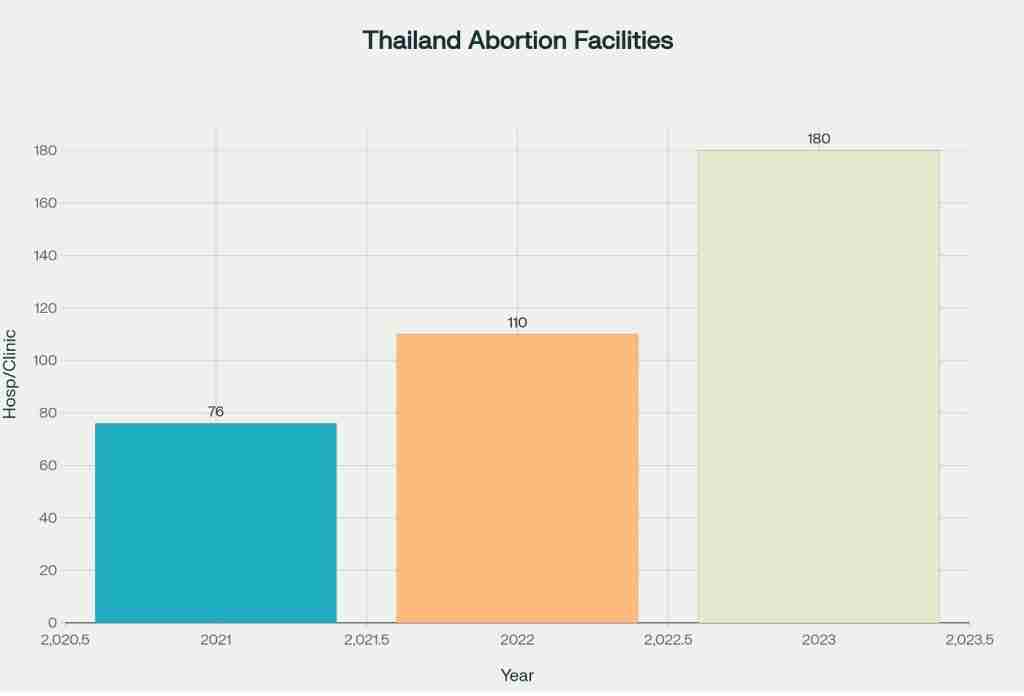
Figure 2 Expansion of authorised safe abortion service points in Thailand (2021-2023)
3.2 Referral Networks and Hotlines
- RSA (Referral System for Safe Abortion) aims to improve abortion access in Thailand.a network of volunteer doctors. It includes online self-triage, telemedicine (“RSA Prompt”), and in-clinic referrals for legal abortion services.
- Hotline 1663, daily 09:00-21:00, offering multilingual counselling and facility booking.
3.3 Insurance Coverage
- Universal Coverage Scheme (gold card) and NHSO pay for medical or surgical abortion within legal limits, including mifepristone-misoprostol regimens.
- Social Security Office (SSO) confirmed in 2025 that insured workers can get abortions for free at registered providers. They will also reimburse referral costs.
- Private expat insurance: most policies exclude elective abortion; check clauses for “pregnancy termination” or “complications of pregnancy.”
3.4 Typical Care Pathway (≤12 weeks)
- Call hotline 1663 or register via RSA Online.
- Ultrasound, Rhesus testing, consent form.
- Choice of medical abortion (pills, often home-use) or MVA vacuum aspiration.
- Follow-up call or visit at one week; free contraception counselling.
4. Obligations and Rights of Medical Practitioners
- Must be licensed under the Medical Profession Act 1982 and adhere to 2005 Medical Council criteria.
- May refuse on conscience but must refer to a willing colleague or facility (MoPH circular 2022).
- Must file anonymized case data to the Department of Health within 30 days, no police notification required.
- Failure to comply risks professional discipline and criminal liability under Sections 302-303.
5. Penalties Still in Force
| Offender | Unlawful act | Maximum jail | Maximum fine |
| Woman | Ending her own pregnancy, or allowing another to end it, where the pregnancy exceeds twelve weeks (Section 301). The licence of the provider and the site are not elements of this offence | 6 months | 10,000 THB |
| Provider with consent | Ends a pregnancy with the consent of the woman, outside Section 305 (Section 302) | 5 years; 7 years if other grievous bodily harm; 10 years if the woman dies | 100,000 THB; 140,000 THB if other grievous bodily harm; 200,000 THB if the woman dies |
| Provider without consent | Ends a pregnancy without the consent of the woman (Section 303) | 7 years; 1 to 10 years if other grievous bodily harm; 5 to 20 years if the woman dies | 140,000 THB; 20,000 to 200,000 THB if other grievous bodily harm; 100,000 to 400,000 THB if the woman dies |
| Attempt | Woman, or a provider acting with her consent | Not punishable (Section 304), at any gestational age | None |
6. Practical Tips for Expats
- Documentation: bring passport, visa copy, and local address; hospitals record nationality for NHSO or cash billing.
- Language: major urban facilities offer English-speaking staff; smaller provincial hospitals may require a Thai interpreter.
- Costs (private): 8,000-18,000 THB for medical abortion; 15,000-25,000 THB for MVA; add 2,000-3,000 THB for ultrasound and labs.
- Emergency care: If you are bleeding heavily, use more than 2 pads per hour for 2 hours. If you have a fever over 38 °C, go to the ER right away. Public hospitals must treat you.
- Privacy: Hospitals must keep records private under the Personal Data Protection Act 2019. Employers cannot see medical files without written consent.
7. Social and Ethical Landscape
Public attitudes remain mixed. Buddhist teachings emphasize non-harm, and some clinicians frame abortion as negative karma. Yet surveys show majority support for the 20-week reform, especially among urban women and medical students. Civil society groups, such as “Abortion 4G,” are still working for full decriminalization of abortion in Thailand. This is specifically for cases after 20 weeks. Student-led rallies are also part of this effort.
8. Frequently Asked Questions about abortion law in Thailand
What are the current abortion laws in Thailand?
Abortion law in Thailand was changed by the Penal Code Amendment Act (No. 28), which followed a Constitutional Court ruling that Section 301 as it then stood was unconstitutional. The ruling did not itself legalise anything; the amendment did. Under Section 305 a pregnancy of not more than twelve weeks may be ended on request by the woman, by a medical practitioner acting under the rules of the Medical Council, and one of more than twelve but not more than twenty weeks after examination and options counselling. Section 301 makes the woman liable only where the pregnancy exceeds twelve weeks.
What are the conditions for an elective abortion in Thailand?
Under Section 305 an abortion on request is available only where the pregnancy is not more than twelve weeks. Between twelve and twenty weeks it is lawful after examination and options counselling by a medical practitioner and other professionals. Beyond twenty weeks it is lawful only on one of the other Section 305 grounds: risk to the physical or mental health of the woman, a substantial risk that the child would be born with a grave disability, or a pregnancy resulting from a sexual offence. The law was changed to enhance reproductive health rights and ensure that women have access to safe procedures.
What does the Thai Medical Council say about abortion rights?
The Thai Medical Council supports safe abortion services. They stress that health professionals should be ready to perform abortions legally. This support fits with the larger pro-choice movement in Thailand. It promotes women’s rights to decide about their pregnancies
What is the process for obtaining a referral for a safe abortion in Thailand?
To get a referral for a safe abortion in Thailand, people must first talk to a doctor. This professional will give guidance on the steps needed. They will also refer patients to authorized facilities for abortions. This ensures that the law is followed and the health of the pregnant woman is protected.
What role does the National Health Security Office play in abortion services?
The National Health Security Office runs the Universal Coverage scheme (the gold card), which pays for a medical or surgical abortion within the legal limits at a registered facility. It funds the service; it does not police the Penal Code, which is a matter for the police and the courts.
How does Thai culture view abortion?
In Thailand, views on abortion vary widely due to the country’s diverse cultural and religious landscape. Approximately 95% of the population identifies as Buddhist, which influences public opinion on reproductive health. Some people oppose abortion because of their religious beliefs. However, a growing pro-choice movement supports women’s rights and safe access to abortion.
What are the implications of the abortion law changes for women under 15 years of age?
A girl aged fifteen or under who is pregnant by someone she is not married to is, in law, pregnant as a result of a sexual offence: section 277 of the Penal Code punishes sexual intercourse with a child not over fifteen whether or not the child consents. Section 305(3) therefore lets a medical practitioner end the pregnancy, at any gestational age, once she confirms to the doctor that it resulted from a sexual offence, and within twelve weeks she may also simply ask (section 305(4)). She commits no offence herself within those limits. A doctor or the 1663 hotline is the place to start.
9. Outlook
Thailand’s abortion reform is incremental rather than revolutionary. Penalties persist, especially for later-term or self-managed abortions, and geographic gaps in service remain. The move to a health-service model is a big change. It is backed by state insurance, telemedicine, and clearer guidelines for professionals. This shift is very different from the strict rules of the last century.
For expats, the key point is that you can now have a safe and legal abortion up to 20 weeks. This is possible if you follow the correct steps and get care from approved providers. Staying informed and acting promptly are vital, as the law’s protections narrow sharply after the 20-week threshold.
Conclusion
The 2021-2022 changes made abortion a regulated medical service instead of a crime. This applies up to 20 weeks. The state is now responsible for access and safety. While moral debates go on, the practical impact is clear. Women, including foreign residents, now have a legal way to end an unintended pregnancy early. This process includes counseling and post-care support. Future advocacy will likely aim to remove leftover penalties and increase provider participation. For now, Thailand’s framework is one of the most progressive models for reproductive rights in Southeast Asia, even if it is not perfect.
Last reviewed: 5 September 2026. Penal Code sections 301, 302, 303, 304 and 305 were read in Thai and in English for this review, in the text as amended, and every penalty figure and section attribution on this page was checked against them. Nine statements were corrected. The largest were the provider penalty, which the page gave as ten years under sections 301 to 302 when section 302 sets five years and reserves ten for the case where the woman dies; the fine for ending a pregnancy without consent, given as 40,000 baht where section 303 sets 140,000 at its first tier, 20,000 to 200,000 where grievous bodily harm follows and 100,000 to 400,000 where the woman dies, and the corresponding tiers of 140,000 and 200,000 under section 302; and the statement that an abortion on request is available up to twenty weeks, which contradicted this page’s own introduction and section 305, under which a request alone reaches twelve weeks and the twelve to twenty week window requires examination and options counselling. The page also treated a self-managed abortion as an offence by the woman at any gestational age; section 301 makes her liable only where the pregnancy exceeds twelve weeks. What this review does not cover, said rather than implied. The commencement date of the Penal Code Amendment Act (No. 28), the date and terms of the Constitutional Court ruling, the 2022 Ministry of Public Health notification made under section 305 (5) and the year of the Medical Council rules are all stated on this page and none of them could be verified from our own sources; the amending Act and that notification are absent from our corpus. The service-point counts, the RSA network and hotline, the insurance position and the private cost ranges are practice and programme facts, not law, and were not re-verified.
Thai Law Updates, free by email
Plain-English updates on Thai law changes that affect foreigners: property, visas, marriage, business and wills. One short email a month from a firm practicing since 2006. No spam, unsubscribe anytime.