


Reviewed by ThaiLawOnline, a licensed Thai law firm practising in Thailand since 2006. Thai lawyer of record: Wichuda Atthamethakon, LL.M., Thai Bar Licence 3149/2556.
Last updated on
DBD filing becomes fully online on 1 November 2026
From 1 November 2026, every application concerning a partnership or private limited company must be submitted through DBD Biz Regist. Paper walk-in filing will end for incorporations and later registrations, including changes to directors or signing authority, registered office, capital and objects, plus dissolution and liquidation. This is an official filing-procedure change, not a change to the substantive company or foreign-ownership rules. See the official DBD announcement and the DBD Biz Regist portal.
Company registration is one part of starting a business in Thailand. Before filing, settle the business activity, lawful ownership, management, premises and funding. Then identify the licences, tax registrations and work permissions needed before trading.
ThaiLawOnline assists foreign founders with this sequence. The aim is to register a company suited to the proposed operation, with the remaining obligations clear from the start.
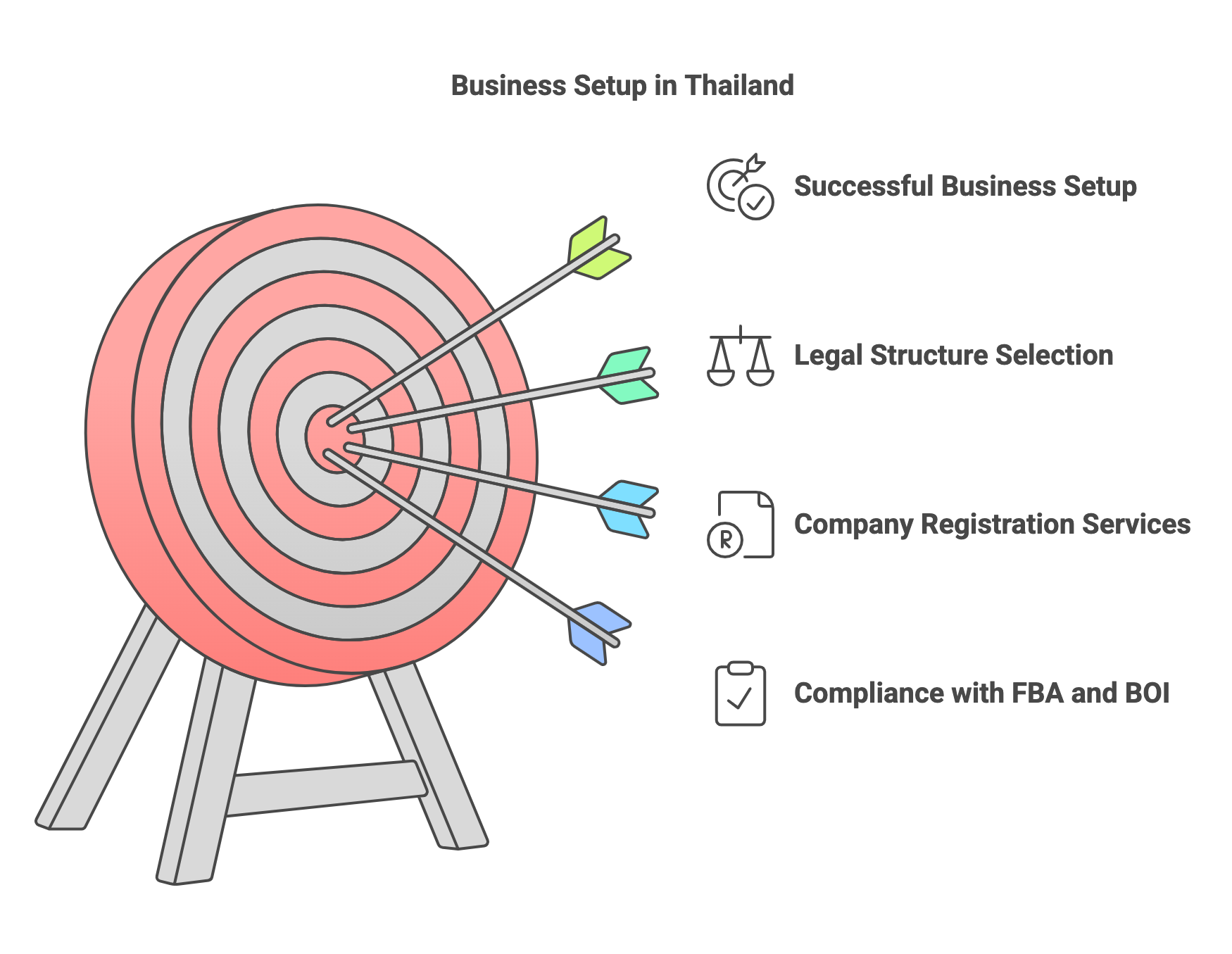
Start with the activity and ownership
Describe what the company will sell, who will pay, where the work will be performed and who will perform it. “Consulting” or “online business” is often too broad to assess the relevant rules. Include planned activities as well as the first service you intend to offer.
Review the Foreign Business Act and any sector-specific restrictions before agreeing the shareholding. Full foreign ownership is available in some circumstances; other activities require an appropriate licence, certificate or different lawful structure. The company’s registration certificate does not replace those permissions.
Thai shareholders must be genuine investors. A package supplying name-only shareholders creates a legal problem, not a solution. Record the contributions, responsibilities, voting arrangements and exit terms honestly. Since 1 August 2026, DBD Order No. 2/2569 requires evidence of this on incorporation whenever a foreigner holds less than 50 percent of the capital, or an alien director signs for a company with no foreign shareholder: an investment explanation letter, a bank statement from each Thai shareholder’s paying account covering the three months before payment, and a statement from the director’s receiving account showing every shareholder’s payment. BOI promotion and treaty routes require their own eligibility review. Our guide to foreign ownership of a Thai company under the Foreign Business Act compares the majority-Thai, BOI, Treaty of Amity and licence routes.
Agree management and funding
Identify the directors and signing authority. Decide which transactions require joint signatures or shareholder approval, and how deadlock will be handled. These arrangements should match the company documents and any shareholders’ agreement.
Separate share capital from loans advanced by founders. Keep evidence of payments and record the repayment terms of any loan. Do not choose capital figures solely because someone says they are standard; the business, licensing and immigration requirements need to be considered together.
Check the registered office before paying
The address must be supported by the required records and the right to use the premises. DBD Order No. 4/2568, effective 1 January 2026, requires checks against civil-registration address records. Where five or more partnerships or companies are already registered at the premises, additional consent and evidence of the right to use the address are required.
This is an evidence requirement, rather than a blanket ban on virtual offices. Ask an office provider whether the necessary consent and supporting records will be supplied. Also check the premises separately for VAT registration, work-authorisation and sector-licensing purposes.
Prepare the registration file
The precise documents depend on the structure and the registrar’s requirements. The initial file usually needs:
- Proposed company names and a clear description of the activities.
- Shareholders’ and directors’ identity and address details.
- The proposed share allocation, capital and signing authority.
- Registered-office details and evidence supporting use of the premises.
- Any required evidence of investment funds and activity-specific approvals.
Review the completed forms before signing. Names, passport details, addresses and share figures should agree throughout. Keep copies of the filed documents and the resulting registration records. Our company registration guide provides further detail.
Plan what happens after incorporation
Arrange the company’s accounting and filing calendar from the beginning. Assess tax registration, invoicing, withholding obligations and VAT treatment for the business. Opening a bank account also involves the bank’s document and identity checks; registration does not guarantee an account.
Review visas and work authorisation before a foreign founder starts operational work. Ownership, a directorship and permission to work are separate questions. Do not base the operating plan on an assumption that being unpaid removes the need for a review.
Before hiring, prepare suitable contracts and employment policies. Before buying branding or launching a product, assess trademark protection and ownership of work produced by contractors. The company’s registered name is not a substitute for trademark clearance.
Our company registration fee
| Service | Fixed fee | What is included | Timeline |
|---|---|---|---|
| Thai company registration | 45,000 THB | Complete formation service, all inclusive: the government DBD registration fees are covered by the 45,000 THB fee. | 14 to 21 business days |
Government disbursements are charged at cost unless the service says they are included.
Book a consultation Answer within 24 to 48 hours EN · FR · TH
Our registration fee is 45,000 THB and includes the Department of Business Development registration fees. A work permit application is 15,000 THB. BOI applications and Foreign Business Licences are quoted individually according to the proposed activity and structure.
Consultations are 2,000 THB per hour. Ask the written estimate to identify the scope, exclusions, documents needed and expected sequence. A company registration deadline should not be confused with the date every licence or work permission will be ready.
Send us the business plan in plain language
Explain the product or service, target customers, shareholders’ nationalities, intended staff, premises, budget and proposed start date. Flag any lease, investment agreement or other commitment already signed. Book a consultation before committing to a structure.
Last reviewed: 30 September 2026. Checked against the Royal Gazette text of DBD Order No. 4/2568 (clauses 1 and 2, in force 1 January 2026) and the primary text of DBD Order No. 2/2569 (clauses 2 and 3, in force 1 August 2026), which was added. The rest of this page is process guidance, not a statement of statute.
Further business guidance
Use our business law overview for the legal framework, confidentiality agreement guide for sensitive commercial discussions, and loan agreement guide for documented funding. Sector rules deserve separate attention for franchises, trading companies and short-term accommodation.
Thai Law Updates, free by email
Plain-English updates on Thai law changes that affect foreigners: property, visas, marriage, business and wills. One short email a month from a firm practicing since 2006. No spam, unsubscribe anytime.