


Reviewed by Wichuda Atthamethakon, LL.M., Thai Bar Licence 3149/2556, for ThaiLawOnline, a Thai law firm acting for foreigners since 2006.
Update log
- 3 November 2026: Added the statute box with Thai, English and French text and checked the page against the official text
DBD filing becomes fully online on 1 November 2026
From 1 November 2026, every application concerning a partnership or private limited company must be submitted through DBD Biz Regist. Paper walk-in filing will end for incorporations and later registrations, including changes to directors or signing authority, registered office, capital and objects, plus dissolution and liquidation. This is an official filing-procedure change, not a change to the substantive company or foreign-ownership rules. See the official DBD announcement and the DBD Biz Regist portal.
2026 changed the rules. If you’ve been thinking about setting up a company in Thailand as a foreigner, or if you already have one, the changes that came into force on January 1, 2026 affect you directly.
Table of Contents
This guide is about what changed in 2026 and how to stay compliant. For the standard registration service, fees and timelines, see business setup and company registration in Thailand.
Last reviewed: 3 September 2026. Sections 4, 8 and 36 of the Foreign Business Act B.E. 2542 were read in the Thai original: section 4 defines when a company registered in Thailand counts as a foreigner, section 8 sets out the three schedules of restricted businesses, and section 36 sets the penalty for holding shares on a foreigner’s behalf. Our fixed fee for company registration and what it covers were confirmed against the firm’s own fee record on the same date. The proposal to allow asset seizure for nominee violations was re-checked and is still a proposal; that was established from legal reporting rather than from a register of Acts, so treat it as a status note and not as a citation. The registration process, detection system and timeline figures on this page are practice guidance and were not re-verified against a primary source in this review. Re-read on 5 October 2026: the penalty list now states section 36 as the Act does (no director disqualification or dissolution, and no doubling); an annual “beneficial owner declaration” with a 500,000 baht fine, for which we found no instrument, was replaced by the annual shareholder list under Civil and Commercial Code section 1139; the later DBD announcement extends online-only filing to every partnership and private limited company application from 1 November 2026; a Treaty of Amity company still needs a Foreign Business Certificate.
For comparison: our own fixed fee is THB 45,000 all-inclusive: it covers the government registration fees, the company stamp, translation of the main documents and advice on the preferred shareholding structure, which the cheaper quotes above usually bill separately. Some firms charge up to THB 75,000 for the same package.
The Department of Business Development moved new-company registration online on 1 July 2026. From 1 November 2026, the online-only rule expands to every application concerning partnerships and private limited companies, including amendments, director and signing-authority changes, registered-office changes, capital and object changes, dissolution and liquidation. Read the official DBD announcement. Thai shareholders in companies with foreign involvement must also prove their capital contributions with three months of bank statements. The nominee offence itself is unchanged, and asset seizure remains a proposal.
None of this is a reason to panic. But it is a reason to get your structure right before you register, and to audit your existing company if you set it up some years ago.
We’ve been advising foreign investors on Thai business law for 20 years. This guide explains what changed, what your legal options are, and what the right structure looks like for your situation.
Understanding the Foreign Business Act: The Starting Point
The Foreign Business Act B.E. 2542 (1999) (the “FBA”) is the law that governs what foreigners can and cannot do in business in Thailand. Every foreign investor needs to understand it before they do anything else.
Under the FBA, a “foreigner” is anyone who is not a Thai national. A company is classified as “foreign” if 50% or more of its shares are held by non-Thai nationals or foreign companies.
The FBA divides restricted business activities into three schedules:
- Schedule 1 (Absolute prohibitions): Foreigners may never engage in these businesses, regardless of license or structure. Examples include newspaper publication, rice farming, forestry, and land trading.
- Schedule 2 (National interest restrictions): Foreigners may apply for Cabinet approval to operate. Includes activities related to Thai culture, history, and natural resources.
- Schedule 3 (Competitive balance): The most commercially relevant list. Includes service businesses such as accounting, law, architecture, retail, and wholesale trade. A Foreign Business License (FBL) from the DBD is required. This process takes 3 to 4 months.
The practical result: most foreigners wanting to run a business in Thailand are limited to 49% ownership under the standard Thai limited company structure. Thai shareholders must hold the majority.
This is where the nominee problem begins.
The law behind this page
English
Section 4 Foreign Business Act B.E. 2542
Full text
In this Act: "alien" means: (1) a natural person who does not have Thai nationality; (2) a juristic person not registered in Thailand; (3) a juristic person registered in Thailand and having the following characteristics: (a) a juristic person in which shares representing half or more of its capital are held by persons under (1) or (2), or a juristic person in which persons under (1) or (2) have invested a value of half or more of its total capital; (b) a limited partnership or registered ordinary partnership whose managing partner or manager is a person under (1); (4) a juristic person registered in Thailand in which shares representing half or more of its capital are held by persons under (1), (2) or (3), or in which persons under (1), (2) or (3) have invested a value of half or more of its total capital. For the purposes of this definition, shares of a limited company for which bearer share certificates are issued are deemed to be shares of an alien, unless otherwise prescribed in a Ministerial Regulation. "capital" means the registered capital of a limited company, the paid-up capital of a public limited company, or the money contributed as shares by partners or members to a partnership or juristic person; "minimum capital" means the capital of an alien where the alien is a juristic person registered in Thailand, and, where the alien is a juristic person not registered in Thailand or a natural person, the foreign currency the alien brings in for use on commencing business in Thailand; "business" means engaging in agriculture, industry, handicraft, commerce, services or other activities, for trade; "licence" means a licence to operate a business; "licensee" means an alien who has received a licence; "certificate" means a certificate to operate a business; "certificate holder" means an alien who has received a certificate; "Committee" means the Foreign Business Committee; "competent official" means a person appointed by the Minister to act under this Act; "Registrar" means a person appointed by the Minister as Registrar of Foreign Business Operations; "Director General" means the Director General of the Department of Business Development; "Minister" means the Minister in charge of this Act.
ThaiLawOnline translation
Section 8 Foreign Business Act B.E. 2542
Full text
Subject to sections 6, 7, 10 and 12: (1) An alien shall not operate a business that aliens are not permitted to carry on for special reasons, as specified in List One. (2) An alien shall not operate a business relating to the safety or security of the country, a business affecting art and culture, customs and folk handicrafts, or a business affecting natural resources or the environment, as specified in List Two, unless permitted by the Minister with the approval of the Council of Ministers. (3) An alien shall not operate a business in which Thai nationals are not yet ready to compete with aliens, as specified in List Three, unless permitted by the Director-General with the consent of the Committee.
ThaiLawOnline translation
Section 36 Foreign Business Act B.E. 2542
Full text
A person of Thai nationality or a juristic person that is not an alien under this Act who assists or supports, or joins in operating, a business of an alien that is a business specified in the Lists annexed to this Act, where that alien has not been permitted to operate that business, or who joins in operating a business of an alien while representing it as being their business alone, or who holds shares on behalf of an alien in a partnership, limited company or any juristic person so that the alien may operate a business by evading or violating the provisions of this Act, and likewise an alien who consents to a person of Thai nationality or a juristic person that is not an alien under this Act doing such an act, shall be liable to imprisonment not exceeding 3 years, or a fine from 100,000 baht to 1,000,000 baht, or both, and the court shall order the assistance or support to cease, or the joint operation of the business to cease, or the shareholding or partnership to cease, as the case may be. A person who fails to comply with the court's order shall be liable to a fine of 10,000 baht to 50,000 baht per day for as long as the violation continues.
ThaiLawOnline translation
Section 12 Foreign Business Act B.E. 2542
Full text
Where a business of an alien that has received investment promotion under the law on investment promotion, or has received written permission to carry on industry or export trade under the law on the Industrial Estate Authority of Thailand or under another law, is a business listed in List Two or List Three annexed to this Act, the alien shall notify the Director-General in order to request a certificate. Once the Director-General or a competent official assigned by the Director-General has verified the correctness of the investment promotion certificate or the permit, the Director-General shall issue the certificate promptly, but not later than 30 days from the date of receiving notification of the grant of the investment promotion certificate or the permit, as the case may be. In this case the alien is exempt from the application of this Act, except sections 21, 22, 39, 40 and 42, for the whole period during which the business has received investment promotion or permission to carry on industry or export trade, as the case may be. The issue of a certificate under paragraph 1 shall be in accordance with the rules and procedures prescribed by the Director-General.
ThaiLawOnline translation
Section 10 Foreign Business Act B.E. 2542
Full text
Sections 5, 8, 15, 17 and 18 do not apply to an alien who carries on a business listed in the annexes to this Act with special temporary permission from the Government of the Kingdom of Thailand. An alien who carries on a business listed in the annexes to this Act under a treaty to which Thailand is a party or has an obligation shall be exempt from the application of the sections specified in the first paragraph, and shall be subject to the provisions and conditions of that treaty, which may include granting Thai persons and Thai enterprises reciprocal rights to carry on business in the alien's country of nationality.
ThaiLawOnline translation
Section 1097Amended on 7 February 2023
English translation of this section is being verified. The Thai text is authoritative.
Section 1111/1Amended on 26 July 2008
Full text
On the formation of a company, where all of the following steps are completed on the same day as the promoters make the memorandum of association, the directors may apply to register the memorandum and to register the company together on that same day: (1) subscribers have been found for the whole of the shares the company is to register; (2) a statutory meeting has been held to consider the matters under Section 1108, attended by the promoters and all the subscribers, and the promoters and all the subscribers have approved the business of that meeting; (3) the promoters have handed over the whole of the business to the directors; (4) the directors have called on the subscribers to pay for their shares under Section 1110 paragraph two, and payment has been completed.
ThaiLawOnline translation
Section 1139
English translation of this section is being verified. The Thai text is authoritative.
ไทย
มาตรา 4 พระราชบัญญัติการประกอบธุรกิจของคนต่างด้าว พ.ศ. 2542
ข้อความเต็ม
ในพระราชบัญญัตินี้ “คนต่างด้าว” หมายความว่า (๑) บุคคลธรรมดาซึ่งไม่มีสัญชาติไทย (๒) นิติบุคคลซึ่งไม่ได้จดทะเบียนในประเทศไทย (๓) นิติบุคคลซึ่งจดทะเบียนในประเทศไทย และมีลักษณะดังต่อไปนี้ (ก) นิติบุคคลซึ่งมีหุ้นอันเป็นทุนตั้งแต่กึ่งหนึ่งของนิติบุคคลนั้นถือโดยบุคคลตาม (๑) หรือ (๒) หรือนิติบุคคลซึ่งมีบุคคลตาม (๑) หรือ (๒) ลงทุนมีมูลค่าตั้งแต่กึ่งหนึ่งของทุนทั้งหมดในนิติบุคคลนั้น (ข) ห้างหุ้นส่วนจำกัดหรือห้างหุ้นส่วนสามัญที่จดทะเบียน ซึ่งหุ้นส่วนผู้จัดการหรือผู้จัดการเป็นบุคคลตาม (๑) (๔) นิติบุคคลซึ่งจดทะเบียนในประเทศไทย ซึ่งมีหุ้นอันเป็นทุนตั้งแต่กึ่งหนึ่งของนิติบุคคลนั้นถือโดยบุคคลตาม (๑) (๒) หรือ (๓) หรือนิติบุคคลซึ่งมีบุคคลตาม (๑) (๒) หรือ (๓) ลงทุน มีมูลค่าตั้งแต่กึ่งหนึ่งของทุนทั้งหมดในนิติบุคคลนั้น เพื่อประโยชน์แห่งคำนิยามนี้ให้ถือว่าหุ้นของบริษัทจำกัดที่มีใบหุ้นชนิดออกให้แก่ผู้ถือเป็นหุ้นของคนต่างด้าว เว้นแต่จะได้มีกฎกระทรวงกำหนดไว้เป็นอย่างอื่น “ทุน” หมายความว่า ทุนจดทะเบียนของบริษัทจำกัด หรือทุนชำระแล้วของบริษัทมหาชนจำกัด หรือเงินที่ผู้เป็นหุ้นส่วนหรือสมาชิกนำมาลงหุ้นในห้างหุ้นส่วนหรือนิติบุคคลนั้น “ทุนขั้นต่ำ” หมายความว่า ทุนของคนต่างด้าวในกรณีที่คนต่างด้าวเป็นนิติบุคคลซึ่งจดทะเบียนในประเทศไทย และในกรณีที่คนต่างด้าวเป็นนิติบุคคลซึ่งไม่ได้จดทะเบียนในประเทศไทยหรือเป็นบุคคลธรรมดาให้หมายถึงเงินตราต่างประเทศที่คนต่างด้าวนำมาใช้เมื่อเริ่มต้นประกอบธุรกิจในประเทศไทย “ธุรกิจ” หมายความว่า การประกอบกิจการในทางเกษตรกรรม อุตสาหกรรม หัตถกรรม พาณิชยกรรม การบริการ หรือกิจการอย่างอื่น อันเป็นการค้า “ใบอนุญาต” หมายความว่า ใบอนุญาตประกอบธุรกิจ “ผู้รับใบอนุญาต” หมายความว่า คนต่างด้าวที่ได้รับใบอนุญาต “หนังสือรับรอง” หมายความว่า หนังสือรับรองการประกอบธุรกิจ “ผู้รับหนังสือรับรอง” หมายความว่า คนต่างด้าวที่ได้รับหนังสือรับรอง “คณะกรรมการ” หมายความว่า คณะกรรมการการประกอบธุรกิจของคนต่างด้าว “พนักงานเจ้าหน้าที่” หมายความว่า ผู้ซึ่งรัฐมนตรีแต่งตั้งให้ปฏิบัติการตามพระราชบัญญัตินี้ “นายทะเบียน” หมายความว่า ผู้ซึ่งรัฐมนตรีแต่งตั้งให้เป็นนายทะเบียนการประกอบธุรกิจของคนต่างด้าว “อธิบดี” หมายความว่า อธิบดีกรมพัฒนาธุรกิจการค้า* “รัฐมนตรี” หมายความว่า รัฐมนตรีผู้รักษาการตามพระราชบัญญัตินี้
ตรงตามข้อความในราชกิจจานุเบกษา / สำนักงานคณะกรรมการกฤษฎีกา (Verbatim from the Royal Gazette / Office of the Council of State)
มาตรา 8 พระราชบัญญัติการประกอบธุรกิจของคนต่างด้าว พ.ศ. 2542
ข้อความเต็ม
ภายใต้บังคับมาตรา ๖ มาตรา ๗ มาตรา ๑๐ และมาตรา ๑๒ (๑) ห้ามมิให้คนต่างด้าวประกอบธุรกิจที่ไม่อนุญาตให้คนต่างด้าวประกอบกิจการด้วยเหตุผลพิเศษตามที่กำหนดไว้ในบัญชีหนึ่ง (๒) ห้ามมิให้คนต่างด้าวประกอบธุรกิจที่เกี่ยวกับความปลอดภัยหรือความมั่นคงของประเทศ ธุรกิจที่มีผลกระทบต่อศิลปวัฒนธรรม จารีตประเพณี และหัตถกรรมพื้นบ้าน หรือธุรกิจที่มีผลกระทบต่อทรัพยากรธรรมชาติหรือสิ่งแวดล้อม ตามที่กำหนดไว้ในบัญชีสอง เว้นแต่จะได้รับอนุญาตจากรัฐมนตรีโดยการอนุมัติของคณะรัฐมนตรี (๓) ห้ามมิให้คนต่างด้าวประกอบธุรกิจที่คนไทยยังไม่มีความพร้อมที่จะแข่งขันในการประกอบกิจการกับคนต่างด้าว ตามที่กำหนดไว้ในบัญชีสาม เว้นแต่จะได้รับอนุญาตจากอธิบดีโดยความเห็นชอบของคณะกรรมการ
ตรงตามข้อความในราชกิจจานุเบกษา / สำนักงานคณะกรรมการกฤษฎีกา (Verbatim from the Royal Gazette / Office of the Council of State)
มาตรา 36 พระราชบัญญัติการประกอบธุรกิจของคนต่างด้าว พ.ศ. 2542
ข้อความเต็ม
ผู้มีสัญชาติไทยหรือนิติบุคคลที่มิใช่คนต่างด้าวตามพระราชบัญญัตินี้ ให้ความช่วยเหลือหรือสนับสนุนหรือร่วมประกอบธุรกิจของคนต่างด้าว อันเป็นธุรกิจที่กำหนดไว้ในบัญชีท้ายพระราชบัญญัตินี้ โดยคนต่างด้าวนั้นมิได้รับอนุญาตให้ประกอบธุรกิจดังกล่าว หรือร่วมประกอบธุรกิจของคนต่างด้าวโดยแสดงออกว่าเป็นธุรกิจของตนแต่ผู้เดียวหรือถือหุ้นแทนคนต่างด้าวในห้างหุ้นส่วนหรือบริษัทจำกัด หรือนิติบุคคลใด ๆ เพื่อให้คนต่างด้าวประกอบธุรกิจโดยหลีกเลี่ยงหรือฝ่าฝืนบทบัญญัติแห่งพระราชบัญญัตินี้ รวมทั้งคนต่างด้าวซึ่งยินยอมให้ผู้มีสัญชาติไทยหรือนิติบุคคลที่มิใช่คนต่างด้าวตามพระราชบัญญัตินี้กระทำการดังกล่าว ต้องระวางโทษจำคุกไม่เกินสามปี หรือปรับตั้งแต่หนึ่งแสนบาทถึงหนึ่งล้านบาท หรือทั้งจำทั้งปรับ และให้ศาลสั่งให้เลิกการให้ความช่วยเหลือหรือสนับสนุน หรือสั่งให้เลิกการร่วมประกอบธุรกิจ หรือสั่งให้เลิกการถือหุ้น หรือการเป็นหุ้นส่วนนั้นเสีย แล้วแต่กรณี หากฝ่าฝืนไม่ปฏิบัติตามคำสั่งศาลต้องระวางโทษปรับวันละหนึ่งหมื่นบาทถึงห้าหมื่นบาทตลอดเวลาที่ยังฝ่าฝืนอยู่
ตรงตามข้อความในราชกิจจานุเบกษา / สำนักงานคณะกรรมการกฤษฎีกา (Verbatim from the Royal Gazette / Office of the Council of State)
มาตรา 12 พระราชบัญญัติการประกอบธุรกิจของคนต่างด้าว พ.ศ. 2542
ข้อความเต็ม
ในกรณีที่ธุรกิจของคนต่างด้าวซึ่งได้รับการส่งเสริมการลงทุนตามกฎหมายว่าด้วยการส่งเสริมการลงทุน หรือได้รับอนุญาตเป็นหนังสือให้ประกอบอุตสาหกรรมหรือประกอบการค้าเพื่อส่งออกตามกฎหมายว่าด้วยการนิคมอุตสาหกรรมแห่งประเทศไทยหรือตามกฎหมายอื่น เป็นธุรกิจตามบัญชีสองหรือบัญชีสามท้ายพระราชบัญญัตินี้ ให้คนต่างด้าวดังกล่าวแจ้งต่ออธิบดีเพื่อขอหนังสือรับรอง เมื่ออธิบดีหรือพนักงานเจ้าหน้าที่ที่ได้รับมอบหมายตรวจสอบความถูกต้องของบัตรส่งเสริมการลงทุนหรือหนังสืออนุญาตดังกล่าวแล้ว ให้อธิบดีออกหนังสือรับรองโดยเร็ว แต่ต้องไม่เกินสามสิบวันนับแต่วันที่ได้รับแจ้งการได้รับบัตรส่งเสริมการลงทุนหรือหนังสืออนุญาต แล้วแต่กรณี ในกรณีนี้ให้คนต่างด้าวดังกล่าวนั้น ได้รับยกเว้นจากการบังคับใช้พระราชบัญญัตินี้ เว้นแต่มาตรา ๒๑ มาตรา ๒๒ มาตรา ๓๙ มาตรา ๔๐ และมาตรา ๔๒ ตลอดระยะเวลาที่ธุรกิจนั้นได้รับการส่งเสริมการลงทุนหรือได้รับอนุญาตให้ประกอบอุตสาหกรรมหรือประกอบการค้าเพื่อส่งออก แล้วแต่กรณี การออกหนังสือรับรองตามวรรคหนึ่ง ให้เป็นไปตามหลักเกณฑ์และวิธีการที่อธิบดีกำหนด
ตรงตามข้อความในราชกิจจานุเบกษา / สำนักงานคณะกรรมการกฤษฎีกา (Verbatim from the Royal Gazette / Office of the Council of State)
มาตรา 10 พระราชบัญญัติการประกอบธุรกิจของคนต่างด้าว พ.ศ. 2542
ข้อความเต็ม
บทบัญญัติมาตรา ๕ มาตรา ๘ มาตรา ๑๕ มาตรา ๑๗ และมาตรา ๑๘ ไม่ใช้บังคับแก่คนต่างด้าวที่ประกอบธุรกิจตามบัญชีท้ายพระราชบัญญัตินี้โดยได้รับอนุญาตจากรัฐบาลแห่งราชอาณาจักรไทยเป็นการเฉพาะกาล คนต่างด้าวที่ประกอบธุรกิจตามบัญชีท้ายพระราชบัญญัตินี้โดยสนธิสัญญาที่ประเทศไทยเป็นภาคีหรือมีความผูกพันตามพันธกรณี ให้ได้รับยกเว้นจากการบังคับใช้บทบัญญัติแห่งมาตราต่าง ๆ ตามที่กำหนดไว้ในวรรคหนึ่ง และให้เป็นไปตามบทบัญญัติและเงื่อนไขของสนธิสัญญานั้น ซึ่งอาจรวมถึงการให้สิทธิคนไทยและวิสาหกิจของคนไทยเข้าไปประกอบธุรกิจในประเทศสัญชาติของคนต่างด้าวนั้นเป็นการต่างตอบแทนด้วย
ตรงตามข้อความในราชกิจจานุเบกษา / สำนักงานคณะกรรมการกฤษฎีกา (Verbatim from the Royal Gazette / Office of the Council of State)
มาตรา 1097แก้ไขเมื่อ 7 กุมภาพันธ์ 2566
ข้อความเต็ม
บุคคลใด ๆ ตั้งแต่สองคนขึ้นไปจะเริ่มก่อการและตั้งเป็นบริษัทจำกัดก็ได้ โดยเข้าชื่อกันทำหนังสือบริคณห์สนธิ และกระทำการอย่างอื่นตามบทบัญญัติแห่งประมวลกฎหมายนี้
ตรงตามข้อความในราชกิจจานุเบกษา / สำนักงานคณะกรรมการกฤษฎีกา (Verbatim from the Royal Gazette / Office of the Council of State)
มาตรา 1111/1แก้ไขเมื่อ 26 กรกฎาคม 2551
ข้อความเต็ม
ในการจัดตั้งบริษัท ถ้าได้ดำเนินการครบทุกขั้นตอนดังต่อไปนี้ภายในวันเดียวกับวันที่ผู้เริ่มก่อการจัดทำหนังสือบริคณห์สนธิ กรรมการจะขอจดทะเบียนหนังสือบริคณห์สนธิ และจดทะเบียนบริษัทไปพร้อมกันภายในวันเดียวกันก็ได้ (๑) จัดให้มีผู้เข้าชื่อซื้อหุ้นครบตามจำนวนหุ้นทั้งหมดที่บริษัทจะจดทะเบียน (๒) ประชุมจัดตั้งบริษัทเพื่อพิจารณากิจการต่าง ๆ ตามมาตรา ๑๑๐๘ โดยมีผู้เริ่มก่อการและผู้เข้าชื่อซื้อหุ้นทุกคนเข้าร่วมประชุม และผู้เริ่มก่อการและผู้เข้าชื่อซื้อหุ้นทุกคนให้ความเห็นชอบในกิจการที่ได้ประชุมกันนั้น (๓) ผู้เริ่มก่อการได้มอบกิจการทั้งปวงให้แก่กรรมการ (๔) กรรมการได้เรียกให้ผู้เข้าชื่อซื้อหุ้นใช้เงินค่าหุ้นตามมาตรา ๑๑๑๐ วรรคสอง และเงินค่าหุ้นดังกล่าวได้ใช้เสร็จแล้ว
ตรงตามข้อความในราชกิจจานุเบกษา / สำนักงานคณะกรรมการกฤษฎีกา (Verbatim from the Royal Gazette / Office of the Council of State)
มาตรา 1139
ข้อความเต็ม
สมุดทะเบียนผู้ถือหุ้นเริ่มแต่วันจดทะเบียนบริษัทนั้นให้รักษาไว้ ณ สำนักงานของบริษัทแห่งที่ได้บอกทะเบียนไว้ สมุดทะเบียนนี้ให้เปิดให้แก่ผู้ถือหุ้นทั้งหลายดูได้ในระหว่างเวลาทำการโดยไม่เรียกค่าธรรมเนียมอย่างหนึ่งอย่างใด แต่กรรมการจะจำกัดเวลาลงไว้อย่างไรพอสมควรก็ได้ หากไม่น้อยกว่าวันละสองชั่วโมง ให้เป็นหน้าที่ของกรรมการที่จะส่งสำเนาบัญชีรายชื่อผู้ที่ยังคงเป็นผู้ถือหุ้นอยู่ทั้งหมดในเวลาที่ประชุม และรายชื่อผู้ที่ขาดจากเป็นผู้ถือหุ้นจำเดิมแต่วันประชุมสามัญครั้งที่แล้วมานั้น ไปยังนายทะเบียนอย่างน้อยปีละครั้ง และมิให้ช้ากว่าวันที่สิบสี่นับแต่การประชุมสามัญ บัญชีรายชื่อนี้ให้มีรายการบรรดาที่ระบุไว้ในมาตราก่อนนั้นทุกประการ
ตรงตามข้อความในราชกิจจานุเบกษา / สำนักงานคณะกรรมการกฤษฎีกา (Verbatim from the Royal Gazette / Office of the Council of State)
Français
Article 4 Foreign Business Act B.E. 2542
Est étrangère la personne physique sans nationalité thaïlandaise, la personne morale non enregistrée en Thaïlande, ou celle enregistrée dont des étrangers détiennent au moins la moitié du capital ou, pour une société de personnes, dont le gérant est une personne physique étrangère. L'article définit notamment capital et activité commerciale.
résumé non officiel
Article 8 Foreign Business Act B.E. 2542
Sous réserve des articles 6, 7, 10 et 12, l'étranger ne peut exercer les activités de la liste un; celles de la liste deux exigent l'autorisation du ministre avec l'approbation du Conseil des ministres; celles de la liste trois, l'autorisation du directeur général avec l'accord du Comité.
résumé non officiel
Article 36 Foreign Business Act B.E. 2542
Le Thaïlandais ou la personne morale non étrangère, prête-nom ou aidant un étranger non autorisé pour une activité des listes, et l'étranger consentant, encourent jusqu'à 3 ans de prison et/ou 100 000 à 1 000 000 bahts. Cessation ordonnée, sous peine de 10 000 à 50 000 bahts par jour.
résumé non officiel
Article 12 Foreign Business Act B.E. 2542
L'étranger dont l'activité des listes 2 ou 3 bénéficie d'une promotion des investissements ou d'un permis industriel ou d'exportation demande au Directeur général un certificat, délivré sous 30 jours; il est alors exempté de la loi, sauf les articles 21, 22, 39, 40 et 42, pendant cet avantage.
résumé non officiel
Article 10 Foreign Business Act B.E. 2542
Les articles 5, 8, 15, 17 et 18 ne s'appliquent pas à l'étranger autorisé spécialement à titre temporaire par le gouvernement, ni à celui opérant sous un traité auquel la Thaïlande est liée, lequel s'applique alors et peut prévoir la réciprocité.
résumé non officiel
Article 1097Modifié le 7 février 2023
Deux personnes ou plus peuvent fonder une société à responsabilité limitée en signant ensemble un mémorandum d'association et en accomplissant les autres actes prévus par le Code.
résumé non officiel
Article 1111/1Modifié le 26 juillet 2008
Si, le jour même de l'établissement du mémorandum, toutes les actions sont souscrites, tous fondateurs et souscripteurs assistent à l'assemblée constitutive et approuvent ses décisions, l'activité est remise aux administrateurs et les paiements appelés (article 1110, alinéa 2) sont effectués, ceux-ci peuvent enregistrer mémorandum et société ensemble ce jour-là.
résumé non officiel
Article 1139
Le registre des actionnaires, tenu dès l'immatriculation au siège, leur est consultable gratuitement aux heures ouvrables (l'accès peut être raisonnablement limité, mais au moins deux heures par jour). Au moins une fois par an, sous quatorze jours après l'assemblée ordinaire, les administrateurs transmettent au registraire la liste des actionnaires à l'assemblée et des sortants depuis la précédente, selon l'article précédent.
résumé non officiel
Supreme Court decisions
- 5457/2560 (2017): Sham Loan Hiding a Business Bought Through Thai Nominee Shareholders: Void, and the Money Irrecoverable
Sources
- Foreign Business Act B.E. 2542, retrieved 31 October 2026
- Civil and Commercial Code, Office of the Council of State, retrieved 31 October 2026
- deka.supremecourt.or.th, Supreme Court of Thailand decisions database (copy held in our library), retrieved 19 February 2026
Nominee Shareholders: Why the Old Approach Is Now a Serious Risk
HIGH RISK 2026
For years, a common workaround was to put Thai nominees on the shareholder register. The foreigner would hold 49%, and the remaining 51% would go to Thai nationals who had no real financial stake and no real voting control. Power of attorney documents, undated share transfer forms, and voting agreements would effectively give the foreigner full control.
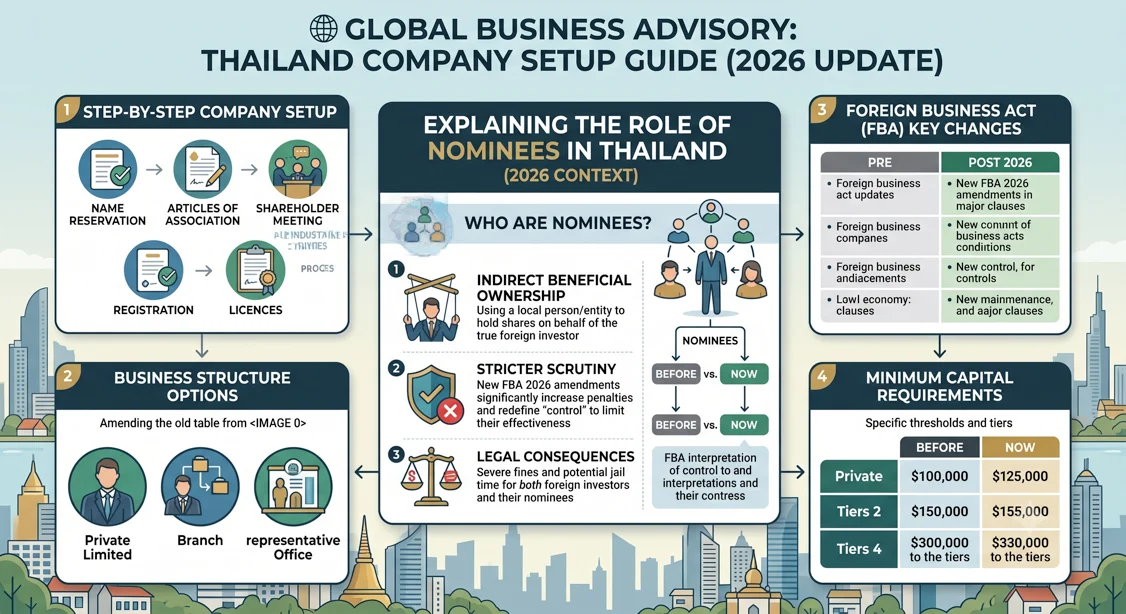
This structure violates Section 36 of the FBA. It always did. But enforcement was inconsistent, and many investors considered it a calculated risk.
That calculus has changed sharply in 2026.
What the 2026 Enforcement Changes Mean
1. IBAS: The AI Nominee Detection System. Since October 2025, the DBD operates the Intelligence Business Analytic System (IBAS). This AI platform cross-references the corporate registry against government databases, bank records, social security filings, and immigration data. It flags companies showing statistical indicators of nominee ownership.
2. The 3-Month Bank Statement Rule, now under Order 2/2569 (in force 1 August 2026). Where aliens hold less than 50% of the capital, or a company with no alien shareholder has an alien authorised director, registration requires each Thai shareholder to provide three months of personal bank statements covering the period before the payment date. The statements must show a withdrawal or transfer matching the exact share subscription amount and date. This began under Central Registrar Order 2/2568 on 1 January 2026, but that order and Order 1/2569 were both repealed by Central Registrar Order 2/2569, signed 15 July 2026 and in force since 1 August 2026. Order 2/2569 is the instrument that applies today, and it asks for two documents the earlier regime did not.
3. Amendments that admit a foreigner, and what replaced the April 2026 rule. Order 1/2569, issued 16 March 2026 and in force 1 April 2026, required in-person verification at the DBD for any amendment admitting a foreigner as a partner or as a director with signing power. That order was repealed on 1 August 2026 by Order 2/2569, so it is no longer the rule and you should disregard guidance that still states it. What replaced it is a document: clause 4 of Order 2/2569 requires an Investment Confirmation Letter on the annexed form for exactly those amendments. That is a different form from the Investment Explanation Letter in the next paragraph, which belongs to establishment, and the two are easy to confuse.
Do not read the repeal as the end of identity checking. The Department’s own published channel list states that identity verification cannot be delegated by anybody, Thai or foreign, so the check survives the order that carried it. What we cannot tell you from any instrument is whether a person must still attend a DBD office or whether verifying inside the DBD e-Service app now satisfies it, because Order 1/2569’s text is not published anywhere we can read it. Ask the office handling your filing before you book travel.
4. What Order 2/2569 added (1 August 2026). Two further documents now accompany the filing. The first is a statement for the receiving account, and note whose account that is: it belongs to the managing partner or director, not to the company, and it must evidence money arriving from every partner or shareholder. The second is a signed Investment Explanation Letter, a prescribed form annexed to the Order, tracing the flow of funds from each Thai shareholder into that account transfer by transfer. It stays on the registrar’s file.
The Order also catches a case most foreign investors do not expect. It applies where an alien holds less than half the capital, and equally where there is no alien shareholder at all but an alien authorised director can bind the company. Structuring around the shareholding alone does not take you outside it.
One thing the Order does not do is worth stating plainly, because a good deal of commentary gets it wrong. It prescribes the documents that must accompany an application and attaches no rejection or referral consequence of its own. Reports that the registrar rejects filings describe practice at the counter, not anything the Order says. The primary text is published by the DBD as a scanned PDF of Order 2/2569.
The Penalties
- Criminal fines for the foreign investor and the Thai nominees
- Imprisonment of up to three years, or a fine of 100,000 to 1,000,000 baht, or both, for the Thai nominee and for the foreigner (FBA section 36)
- A court order to end the shareholding or joint business, with a daily fine of 10,000 to 50,000 baht while it is defied
- Proposed asset seizure for nominee violations (still a proposal, not law, checked September 2026)
Clear legal position: Using Thai nationals as nominee shareholders to circumvent the Foreign Business Act is a criminal offence under Section 36 of the FBA. The DBD’s AI system is actively looking for these structures.
Legal Pathways to Foreign Business Ownership in Thailand
| Structure | Max Foreign Ownership | Timeline | Best For |
|---|---|---|---|
| Standard Thai Ltd. Company | 49% | 2-4 weeks | Genuine Thai partnerships |
| BOI Promoted Company | 100% | 60-90 days | Tech, manufacturing, digital, healthcare, clean energy |
| US Treaty of Amity | 100% (US only) | 3-6 months | US citizens and US-incorporated companies |
| Foreign Business License (FBL) | 100% | 3-4 months | Schedule 3 service businesses |
| Regional Operating Headquarters | 100% | Varies | Multinationals managing Asia-Pacific from Thailand |
BOI Promotion: The Cleanest Route for Most Foreign Investors
BOI promotion is the most commercially attractive option for the right business. The benefits are substantial, the legal standing is unambiguous, and the range of qualifying activities has expanded significantly in recent years.
What You Get with BOI Promotion
- 100% foreign ownership, fully legal, without FBA restrictions
- Corporate income tax exemptions of up to 13 years
- Import duty exemptions on machinery and raw materials
- Land ownership rights for the promoted activity
- Streamlined work permit processing for foreign staff
- No requirement for a Foreign Business License
Who Qualifies in 2026
- Digital technology, software development, data centers, cloud services, and AI platforms
- Advanced manufacturing, automation, and robotics
- Electric vehicles and clean energy
- Medical devices, biotechnology, and healthcare services
- Smart agriculture and food technology
- Logistics and distribution (with conditions)
- Quantum computing, generative AI, and advanced robotics
Pure retail, trading, and most service businesses do not qualify for BOI promotion.
The US-Thailand Treaty of Amity: An Underused Option for American Investors
The US-Thailand Treaty of Amity and Economic Relations (signed 1966, in effect 1968) allows US citizens and US-incorporated companies to own up to 100% of a Thai business in most sectors. It does not bypass the Foreign Business Act: the company still needs a Foreign Business Certificate from the DBD before it operates.
Who Qualifies
- US citizens (individual ownership)
- Companies incorporated in the United States with majority US ownership
Excluded Sectors
- Communications and telecommunications
- Domestic transportation (land, air, and water)
- Banking, financial services, and securities trading
- Exploitation of natural resources
- Domestic trade in agricultural products
- Land ownership
The Standard Thai Limited Company: Still a Valid Option
The 49%/51% structure works fine when the Thai shareholders are genuine business partners with real capital, real decision-making roles, and genuine skin in the game. What the 2026 rules demand is that the Thai majority ownership be real, documented by three months of bank statements showing the source of their investment.
How to Register a Thai Company in 2026: The New Online Process
NEW 2026
New private limited companies have been registered only through DBD Biz Regist since 1 July 2026. From 1 November 2026, every application concerning a partnership or private limited company must use the same platform. Paper walk-in filing will also end for later amendments, changes to directors or signing authority, registered office, capital and objects, and for dissolution and liquidation registrations. See the official DBD announcement, the DBD Biz Regist portal, and our detailed company-registration guide.
- Name reservation: Check name availability and reserve online. Approval takes 1 to 3 business days.
- Statutory meeting: At least 2 promoters must convene (reduced from 3 by the Civil and Commercial Code Amendment (No. 23) B.E. 2565, in force since 7 February 2023) and approve the memorandum of association. Video conference with digital signatures accepted.
- Registration submission: Upload the memorandum of association, articles of association, shareholder/director list, and bank statements for Thai shareholders in foreign-involved companies.
- DBD review and approval: Standard applications approved within 5 to 7 business days.
- Tax registration: Register for VAT at the Revenue Department if annual revenue will exceed THB 1.8 million.
- Work permit and visa processing: THB 2 million paid-up capital required per foreign employee, maximum 10 foreign employees.
The 3-Month Bank Statement Requirement in Practice
For each Thai shareholder in a company with foreign involvement, the bank statement must cover the three months before the payment date and show a specific withdrawal or transfer matching the share subscription amount and date. Statements where money appeared in a lump sum one week before registration will be questioned.
2026 FBA Compliance Checklist
- Thai shareholders’ capital contributions documented by 3 months of personal bank statements
- No power of attorney documents giving the foreigner control over Thai shareholders’ voting rights
- No undated share transfer agreements held by the foreigner
- Thai shareholders appear in meeting minutes and directors’ records with actual involvement
- Annual list of shareholders sent to the DBD within 14 days of the annual general meeting (Civil and Commercial Code section 1139)
- Company registered via DBD Biz Regist platform (if incorporated after 1 July 2026)
- Any amendment admitting a foreign partner (partnership) or a foreign authorised director (company) supported by an Investment Confirmation Letter under clause 4 of Order 2/2569 (in force 1 August 2026)
- Paid-up capital meets the THB 2 million per foreign employee requirement
- Business activity covered by FBL, BOI, or Treaty of Amity if in a restricted FBA schedule
- Business address registered correctly under the 2026 DBD address registration rules
Costs and Timelines at a Glance
| Item | Approximate Cost | Timeline |
|---|---|---|
| Thai limited company registration (fees at other firms, often excluding government fees and translations) | THB 15,000 to THB 75,000 | 2-4 weeks |
| BOI application preparation and filing | THB 40,000 to THB 120,000 | 60-90 days for approval |
| US Treaty of Amity certification | THB 30,000 to THB 80,000 | 3-6 months |
| Foreign Business License application | THB 50,000 to THB 150,000 | 3-4 months |
| Work permit (per foreign employee, per year) | THB 3,000 to THB 3,750 | 7 business days |
| Nominee restructuring advice | Contact us for a quote | Case dependent |
On minimum capital: There’s no universal minimum paid-up capital for a Thai limited company in most sectors. But remember the work permit rule: you need THB 2 million in paid-up capital per foreign employee. If you plan to hire two foreign staff, you need at least THB 4 million paid up.
If You Already Have a Company in Thailand: What to Do Now
Step 1: Audit your shareholder structure. Who actually owns the shares? Is their capital documented? Do they play any real role in the company?
Step 2: Assess your business activity. Does your current activity fall under a restricted FBA schedule? Do you have an FBL, BOI promotion, or Treaty of Amity certification?
Step 3: Get a restructuring plan. If you need to restructure, do it proactively. The DBD’s IBAS system is running 24 hours a day. A voluntary restructuring before a DBD inquiry will always result in a better outcome than a forced one.
Frequently Asked Questions
Can a foreigner own 100% of a company in Thailand?
Yes, but only through specific legal channels. BOI-promoted companies can be 100% foreign-owned in eligible sectors. US citizens and US-incorporated companies can own 100% through the Treaty of Amity. Otherwise 49% is the usual ceiling in practice, because at half or more foreign shareholding the company is itself a foreigner under section 4 and needs permission for the businesses the Act lists.
Are Thai nominee shareholders legal in 2026?
No. Using Thai nationals as nominee shareholders to bypass the Foreign Business Act is illegal under Section 36 of the FBA. The DBD’s IBAS system actively detects nominee structures.
What changed for Thailand company registration in 2026?
New companies have been registered only through DBD Biz Regist since 1 July 2026. From 1 November 2026, every application concerning a partnership or private limited company must be filed online, including amendments, director and signing-authority changes, registered-office changes, capital and object changes, dissolution and liquidation. Thai shareholders in foreign-involved companies must also provide three months of bank statements showing genuine capital contributions.
What is the Foreign Business Act (FBA) in Thailand?
The Foreign Business Act B.E. 2542 (1999) restricts foreigners from operating in certain business sectors in Thailand. It does not cap foreign shareholding directly: section 4 treats a company registered in Thailand as a foreigner once non-Thais hold half or more of its capital shares, and section 8 then restricts a foreigner from the businesses listed across its three schedules.
How long does it take to register a company in Thailand in 2026?
It depends on who is in the company rather than on the platform. Section 1111/1 of the Civil and Commercial Code lets the memorandum and the company be registered on the same day the promoters sign it, on four conditions. A company with a foreign shareholder or a foreign authorised director takes longer, because Order 2/2569 requires the Investment Explanation Letter and three months of bank statements to be uploaded with the application, so allow 2 to 4 weeks. BOI promotion takes 60 to 90 days. A Foreign Business License takes 3 to 4 months.
What is the BOI in Thailand and how does it help foreign investors?
The Board of Investment (BOI) promotes investment in priority industries. BOI-promoted companies enjoy 100% foreign ownership, corporate income tax exemptions of up to 13 years, import duty exemptions, and land rights.
Who qualifies for the US-Thailand Treaty of Amity?
US citizens and companies incorporated in the United States with majority US ownership. The treaty allows 100% US ownership in most business sectors. Excluded sectors include communications, domestic transportation, banking, natural resource exploitation, and domestic trade in agricultural products.
Need Help Structuring Your Thai Company?
Whether you’re starting fresh or cleaning up an existing structure, our licensed Thai business lawyers can advise on the right approach for your situation.
Key Takeaways
- The Foreign Business Act does not cap foreign shareholding. A company with half or more foreign capital is itself a foreigner under section 4 and needs permission for the businesses the Act lists, which is why most foreign investors stay at 49%. Nominee shareholders are illegal under Section 36 and are now actively detected by the DBD’s IBAS AI system.
- Three legal routes to 100% foreign ownership: BOI promotion, US Treaty of Amity, and Foreign Business License.
- New companies have been online-only through DBD Biz Regist since 1 July 2026. From 1 November 2026, all partnership and private limited-company application types must be filed through the platform. Thai shareholders must also back their share subscriptions with three months of personal bank statements where Order 2/2569 applies.
- Since 1 August 2026, adding a foreign authorised director to a company, or a foreign partner to a partnership, requires an Investment Confirmation Letter under clause 4 of Order 2/2569. The in-person verification rule of 1 April 2026 went with Order 1/2569, which that order repealed.
- The company must send the DBD its list of shareholders every year, within 14 days of the annual general meeting (section 1139 of the Civil and Commercial Code).
- If your existing company uses nominees, get legal advice now.
- BOI promotion is the best option for technology, digital, manufacturing, healthcare, and clean energy businesses.
Legal disclaimer: This article provides general information about Thai business law and registration procedures. It does not constitute legal advice. Laws and regulations change. Always consult a licensed Thai lawyer before making decisions about company structure in Thailand.
How much does company registration cost? See the full company registration cost breakdown (2026), legal fees, government fees and timelines, or all our fixed fees on the legal fees page.
Thai Law Updates, free by email
Plain-English updates on Thai law changes that affect foreigners: property, visas, marriage, business and wills. One short email a month from a firm practicing since 2006. No spam, unsubscribe anytime.