


Reviewed by Wichuda Atthamethakon, LL.M., Thai Bar Licence 3149/2556, for ThaiLawOnline, a Thai law firm acting for foreigners since 2006.
Last updated on
You want to terminate an employee in Thailand. Maybe the role is gone. Maybe the trust is gone. Either way, the next steps decide whether this ends quietly or lands in the Labour Court.
Thai law lets you end employment without giving a reason. But it makes you pay for that freedom. Notice, severance and final pay all come due. And if you get the paperwork wrong, a judge can add compensation on top.
This guide walks you through the process. It covers notice, severance, the cases where you owe no severance, and the termination letter. We’ve handled these disputes for both employers and employees for over 30 years. So we’ll also tell you where employers usually trip.
What the Labour Protection Act actually says
The main statute is the Labour Protection Act B.E. 2541 (1998), as amended by the Labour Protection Act (No. 7) B.E. 2562 (2019). It applies to almost every private employer. Government bodies and state enterprises sit outside it.
Section 118 defines termination broadly. It covers a dismissal letter. It also covers refusing to let someone work while you stop paying them. Retirement at an age you set counts too.
Think of it this way. In the US you can fire at will. Thailand is closer to a “pay to exit” system. You can usually end the job. You can’t skip the bill.
Can you terminate an employee in Thailand without a reason?
Yes. You don’t have to give a reason to end employment. But there are two catches.
First, an employee with 120 days of service or more is owed severance if you have no Section 119 ground. Second, a court can still call the dismissal unfair. Section 49 of the Labour Court Establishment and Procedure Act B.E. 2522 (1979) lets the court order reinstatement or award compensation.
Thai law doesn’t define “unfair.” The court decides case by case. In our experience, the weaker your paper trail, the more a judge leans toward the employee.
Notice period in Thailand
Section 17 of the Labour Protection Act sets the notice rule. You give written notice on or before any pay date. It takes effect on the next pay date. For a monthly-paid employee, that is roughly one pay cycle.
The law caps the notice you must give at three months. Your contract may promise more. If it does, you must honour it.
You can pay wages in place of notice. Many employers do. It’s cleaner when you want the person out of the building today. For more detail, see our page on the notice period and pay in lieu.
Notice isn’t required at all when you dismiss for a Section 119 ground.
How much severance do you owe?
Severance depends on years of service. Section 118 sets six tiers. An employee with less than 120 days gets nothing.
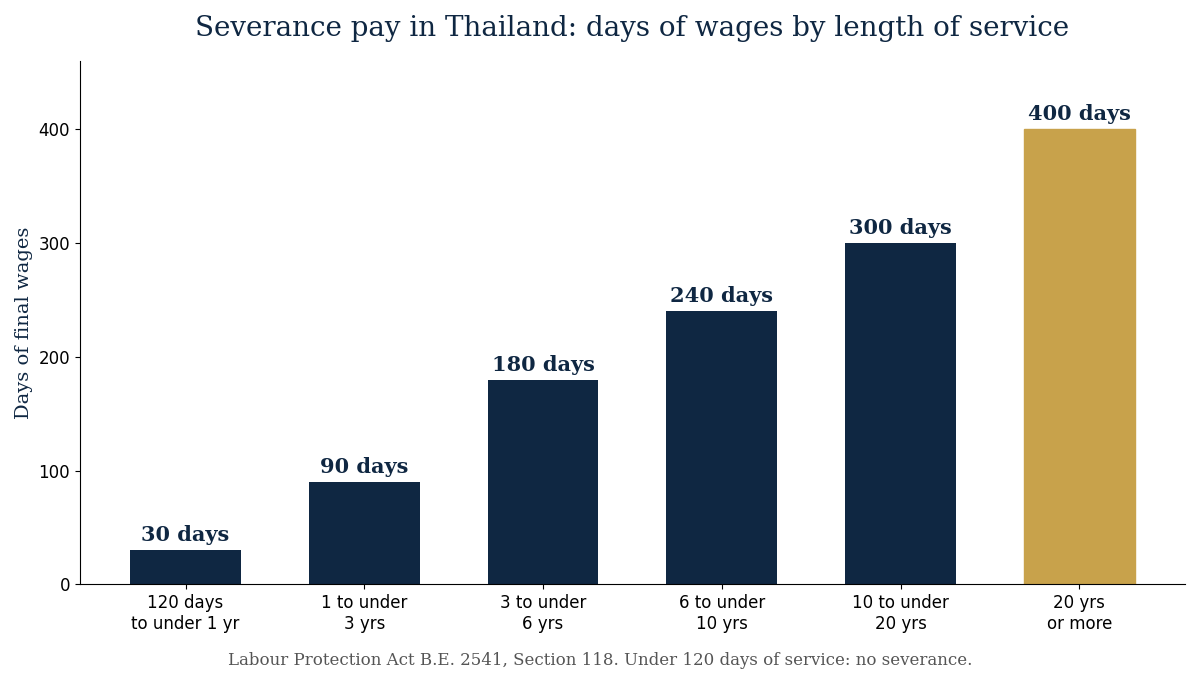
| Length of service | Severance (days of final wages) |
|---|---|
| Under 120 days | None |
| 120 days to under 1 year | 30 days |
| 1 year to under 3 years | 90 days |
| 3 years to under 6 years | 180 days |
| 6 years to under 10 years | 240 days |
| 10 years to under 20 years | 300 days |
| 20 years or more | 400 days |
A worked example
Say an employee earns THB 50,000 a month and has worked for you four years. For a monthly-paid employee, the daily rate is the monthly wage divided by 30. That’s about THB 1,667.
Four years falls in the 180-day tier. So severance is about THB 300,000. Add notice pay if you don’t give notice, and pay for unused annual leave.
Wages here mean basic pay plus fixed regular payments. Overtime, irregular bonuses and expense reimbursements generally don’t count.
When you owe no severance: Section 119
Section 119 lists the grounds that let you dismiss without notice or severance. There are six.
- The employee acts dishonestly in their duties, or intentionally commits a criminal offence against you.
- The employee intentionally causes you damage.
- The employee negligently causes you serious damage.
- The employee breaks lawful work rules or orders after a written warning.
- The employee is absent for three consecutive working days without a justifiable reason.
- The employee is sentenced to imprisonment by a final court judgment.
Two practical points. A written warning isn’t needed for serious cases. And a warning stays valid for one year from the offence.
Here’s where employers get burned. A verbal warning doesn’t count. Neither does a vague “you must improve.” The warning should name the rule broken and say that repeating it can lead to dismissal.
You also must state the ground in the termination letter, or tell the employee when you dismiss. If you don’t, you may lose the right to rely on that ground later.
Special cases: relocation and restructuring
Section 120 covers an employer who moves the business. If the employee won’t relocate, they may end the contract and claim special severance of at least 50 percent of the ordinary Section 118 amount. Section 121 covers dismissals caused by new machinery or technology. You must notify the Labour Inspector and the affected employees 60 days ahead, or pay 60 days’ wages in lieu. That comes on top of ordinary severance.
If you’re restructuring, take advice first. The court looks hard at whether the cause was genuine.
Step-by-step: how to fire an employee in Thailand
- Check the contract and work rules. Some set procedures, like an investigation committee. Ignoring your own rules is a classic route to an unfair dismissal finding.
- Pick the ground. Is it a Section 119 cause, or a no-fault dismissal with severance?
- Gather evidence. Keep warnings, emails and attendance records.
- Issue the termination letter. State the date, the ground and the payments due.
- Give notice or pay in lieu. Skip this only for a Section 119 ground.
- Pay everything on time. Final payments are due within three days of termination. Late payment carries 15 percent annual interest.
- Handle the work permit and visa. A foreign employee’s job-based stay ends with the job. Report the termination and tell the employee early, so they can arrange their next status. See our work permit guide.
Unfair dismissal in Thailand: what the court looks at
An employee can sue even if you paid severance. The court may order reinstatement. If the parties can’t work together, it sets compensation instead.
The judge considers the reason for dismissal, how you carried it out, the employee’s age, years of service and likelihood of finding new work. Pay already made beyond the legal minimum also counts.
The Labour Court process is faster than ordinary civil litigation. But it’s still costly and slow for both sides. Most disputes settle.
Resignation, settlement and the waiver trap
A mutual separation agreement is often the safest exit. The employee gets a package. You get a release of claims. Done properly, it avoids a trial.
But don’t use pressure. A resignation signed under duress can be treated as a dismissal. And waiving severance in advance is risky. Read our page on the severance pay waiver in Thailand before you ask anyone to sign.
A well-drafted employment agreement also helps. If you want to restrict competition after the employee leaves, check the rules on a non-compete clause in Thailand.
Common pitfalls
- Dismissing for “misconduct” with no written warning on file.
- Forgetting unused annual leave in the final payment.
- Naming no ground in the termination letter.
- Forcing a resignation, then relying on it in court.
- Ignoring the foreign employee’s visa timeline.
- Copying your home country’s “at will” practice.
Frequently asked questions
Can I terminate an employee in Thailand without giving a reason?
Yes, but you must give notice and pay severance if the employee has served 120 days or more. A court can still find the dismissal unfair.
How much severance must I pay in Thailand?
It runs from 30 days of final wages for 120 days to under one year, up to 400 days for 20 years or more. Under 120 days, none is owed.
What is the notice period in Thailand?
Give written notice on or before a pay date, effective on the next pay date. You can pay in lieu of notice, and your contract may require longer.
When can I dismiss without severance?
Only for the six Section 119 grounds, such as dishonesty, intentional damage or three days’ unexcused absence. Most rule-breaking cases need a prior written warning.
How long is a written warning valid in Thailand?
A written warning is valid for one year from the date of the offence. After that, you can’t rely on it to dismiss without severance.
What happens to a foreign employee’s visa when I terminate them?
Their job-based stay ends with the job. You must report the termination, and the employee should arrange a new status quickly.
How ThaiLawOnline can help
We draft termination letters, review warnings, calculate payments and negotiate settlements. We also defend employers in the Labour Court. Start with our overview of Thai labour law and employee rights in Thailand, then contact a Thai lawyer before you hand anyone a letter.
Key takeaways
- You can end employment without a reason, but you pay notice and severance.
- Severance runs from 30 to 400 days of wages under Section 118.
- Section 119 lets you skip severance for six specific grounds.
- Warnings must be written. They last one year.
- State the ground in the termination letter. Pay within three days.
- A court can still award compensation for unfair dismissal.
This article is general information, not legal advice for your situation.
Thai Law Updates, free by email
Plain-English updates on Thai law changes that affect foreigners: property, visas, marriage, business and wills. One short email a month from a firm practicing since 2006. No spam, unsubscribe anytime.