


Reviewed by Wichuda Atthamethakon, LL.M., Thai Bar Licence 3149/2556, for ThaiLawOnline, a Thai law firm acting for foreigners since 2006.
Update log
- 4 November 2026: Added the statute box with Thai, English and French text and checked the page against the official text
Quick answer. A Thai prenuptial agreement may have effect outside Thailand, but its treatment abroad depends on the law of the country where the dispute is heard and that country’s conflict-of-laws rules. Registration at a Thai Amphur makes the agreement comply with the formal requirements of Thai Civil and Commercial Code section 1466, but it does not automatically satisfy foreign requirements concerning legal advice, financial disclosure, voluntariness, timing, form or fairness. Our full guide: prenuptial agreement in Thailand.
Thai law remains particularly important for rights in immovable property situated in Thailand. However, a foreign divorce court may still take the value of Thai property into account or make personal orders between the spouses concerning foreign assets. For couples with substantial assets in Thailand and another country, the safer structure is usually two coordinated agreements prepared for the relevant jurisdictions rather than expecting one Thai document to work everywhere.
Most articles answer the opposite question: whether a foreign prenup holds up in a Thai court. Our main prenuptial agreement guide covers that, and our guide to Thai divorce recognition abroad answers the sibling question for the divorce itself. This page answers the question your own lawyer at home will actually ask: what does your Thai document do in front of a judge who has never read the Civil and Commercial Code?
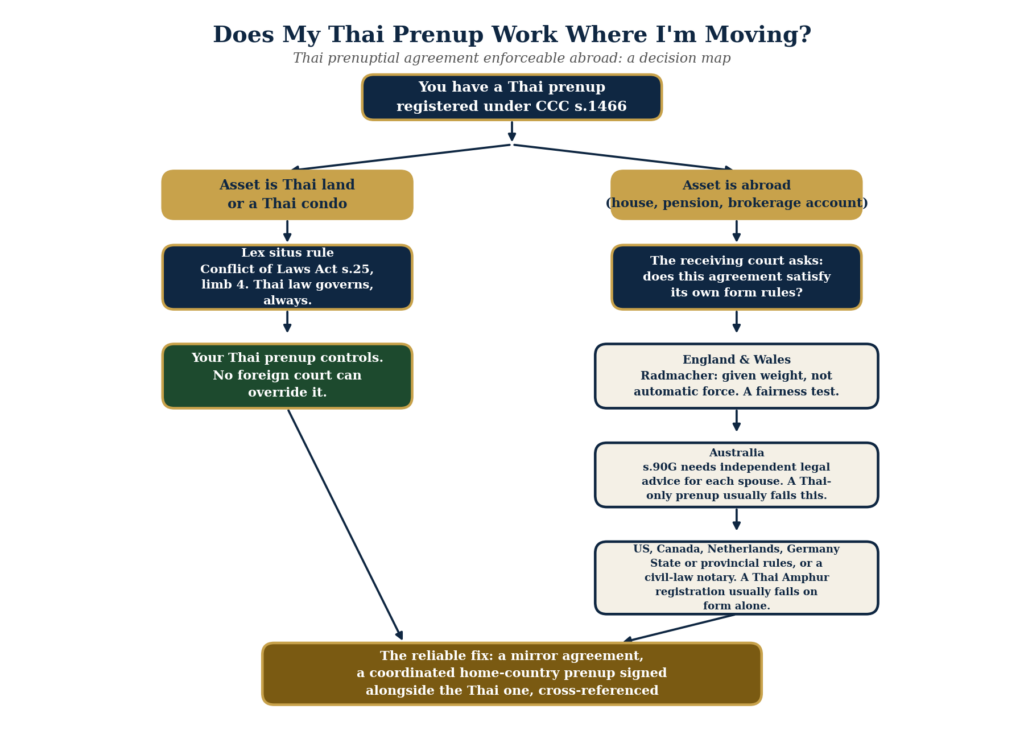
Table of Contents
The short answer, by country
| Country | General position | Main issue for a Thai prenup |
|---|---|---|
| England & Wales | Nuptial agreements are not automatically contractually binding, but courts may give them decisive weight. | The court considers whether the agreement was entered into freely, whether both parties understood its implications, and whether it would be fair to hold them to it. |
| United States | State-specific. There is no single US rule. States use their own statutes and case law, with some adopting versions of the UPAA or UPMAA. | Voluntariness, disclosure, waiver, timing and access to independent legal advice vary by state. A Thai prenup should therefore be reviewed under the law of the relevant state. |
| Australia | A Thai prenup is not automatically an Australian binding financial agreement. | An Australian pre-marriage financial agreement must satisfy sections 90B and 90G of the Family Law Act 1975, including specific drafting and independent legal advice requirements. Limited statutory provisions may save some formal defects. |
| Canada | Province-specific. There is no single Canadian rule for prenuptial agreements. | Ontario and British Columbia recognise written domestic agreements subject to statutory safeguards. Quebec has materially different requirements, including notarial form for a marriage contract. |
| Netherlands & Germany | The answer depends on private international law as well as domestic formal requirements. | For many international marriages from 29 January 2019, EU Regulation 2016/1103 determines applicable law and formal validity. A Thai agreement does not automatically fail merely because it was not executed as a Dutch or German notarial deed. |
There is no universal test for whether a Thai prenup “travels.” A court first applies its own rules on jurisdiction, applicable law and recognition before deciding what effect to give the Thai agreement.
Common-law courts tend to ask whether the process was fair: advice, disclosure, time to consider, pressure. Civil-law Europe looks first at applicable law and formal validity, where notaries play a large domestic role. Thailand’s Amphur registration proves the Thai formalities were met and records nothing on those points, which is the practical reason a Thai-only prenup can travel badly.
What Thailand’s Conflict of Laws Act says
When a Thai court deals with an international marriage or prenuptial agreement, the Act on Conflict of Laws B.E. 2481 (1938) determines which country’s law the Thai court should apply.
Section 21 deals with the general relationship between spouses. It refers first to their common national law and, using language dating from 1938, contains a fallback based on the husband’s nationality.
Section 22 concerns matrimonial property where there is no ante-nuptial agreement. Where the spouses have different nationalities, the section refers to the husband’s national law, while rights concerning immovable property are governed by the law of the place where the property is situated.
Section 23 provides that a later change of nationality does not alter the effects governed by sections 21 and 22.
Section 24 deals specifically with capacity to enter into an ante-nuptial agreement. Each party’s capacity is governed by the law of his or her nationality.
Section 25 deals with the essential elements and effects of an ante-nuptial agreement. If the parties have the same nationality, their common national law applies. If they have different nationalities, the Act looks first to the law they intended, expressly or implicitly, and otherwise to the law of their first matrimonial domicile. For immovable property, the law of the place where the property is situated applies.
These are Thai choice-of-law rules. They tell a Thai court how to deal with an international marriage. They do not require a court in England, Australia, Canada, Germany or the United States to apply Thai law. A foreign court applies its own private-international-law rules.
The law behind this page
English
Section 25 Act on Conflict of Laws B.E. 2481
Full text
If the parties to a prenuptial agreement have the same nationality, its substance and effects are governed by their common national law. If they do not have the same nationality, its substance and effects are governed by the law to which the parties intended, or may be presumed to have intended, to submit. If there is no such intention, they are governed by the law of the country where the spouses first established their domicile after the marriage. However, as regards immovable property, the law of the place where the property is situated applies.
ThaiLawOnline translation
Section 1465Amended on 23 January 2025
Where the spouses made no special agreement about property before the marriage, this Chapter governs the property relations between them. Separately, a clause in a prenuptial agreement is void if it is contrary to public order or to the good morals of the people, or if it provides that the property relations between the spouses are to be governed by the law of another country.
Full text
If the spouses have not made a special agreement concerning property before marriage, the property relations between the spouses shall be governed by the provisions of this Chapter. Any clause in a prenuptial agreement that is contrary to public order or the good morals of the people, or that provides for the law of another country to govern that property, is void.
ThaiLawOnline translation
Section 1466
A prenup must be recorded at marriage registration, or be a written agreement signed by both spouses and at least two witnesses, attached to the marriage register with the attachment noted at that registration. Failure to comply makes the prenup void.
Full text
A prenuptial agreement is void unless either: (a) the terms agreed as the prenuptial agreement are entered in the marriage register at the time the marriage is registered; or (b) it is made in writing, signed by the spouses and by at least two witnesses, and annexed to the marriage register, and an entry stating that the agreement is annexed is made in the marriage register at the time the marriage is registered.
ThaiLawOnline translation
Section 24 Act on Conflict of Laws B.E. 2481
Full text
With respect to property between husband and wife, if a contract is made before marriage, the capacity to make the contract shall be governed by the law of the nationality of each contracting party.
ThaiLawOnline translation
Section 22 Act on Conflict of Laws B.E. 2481
Full text
If there is no prenuptial agreement, property between husband and wife is governed by the law of their nationality. If husband and wife are of different nationalities, property between them is governed by the law of the husband's nationality. However, property between husband and wife, as regards immovable property, is governed by the law of the place where the property is situated.
ThaiLawOnline translation
Section 1469Amended on 23 January 2025
Either spouse is entitled to avoid a property agreement made with the other spouse during marriage, while the marriage continues or within one year after it ends. Rights acquired by third parties acting in good faith are protected.
Full text
Any agreement concerning property which the spouses have made with each other during the time they are spouses may be avoided by either of them at any time while they are spouses, or within one year from the day on which they ceased to be spouses; but this does not affect the rights of third persons who have acted in good faith.
ThaiLawOnline translation
Section 21 Act on Conflict of Laws B.E. 2481
Full text
If the spouses have the same nationality, or if the wife has acquired the nationality of the husband by the marriage, the relations between husband and wife shall be governed by the law of the common nationality of the spouses. In the case where the wife has not acquired the nationality of the husband by the marriage, the relations between husband and wife shall be governed by the law of the nationality of the husband.
ThaiLawOnline translation
ไทย
มาตรา 25 พระราชบัญญัติว่าด้วยการขัดกันแห่งกฎหมาย พุทธศักราช 2481
ข้อความเต็ม
ถ้าคู่สัญญามีสัญชาติอันเดียวกัน สิ่งซึ่งเป็นสาระสำคัญและผลแห่งสัญญาก่อนสมรส ให้เป็นไปตามกฎหมายสัญชาติอันร่วมกันแห่งคู่สัญญา ถ้าคู่สัญญาไม่มีสัญชาติอันเดียวกัน สิ่งซึ่งเป็นสาระสำคัญและผลแห่งสัญญาก่อนสมรสเช่นว่านั้น ให้เป็นไปตามกฎหมายซึ่งคู่สัญญาเจตนา หรือพึงสันนิษฐานได้ว่าได้มีเจตนาที่จะยอมอยู่ใต้บังคับแห่งกฎหมายนั้น ถ้าไม่มีเจตนาเช่นว่านี้ ให้เป็นไปตามกฎหมายแห่งประเทศที่คู่สมรสตั้งภูมิลำเนาครั้งแรกหลังจากการสมรส อย่างไรก็ดี ในส่วนที่เกี่ยวกับอสังหาริมทรัพย์ ให้เป็นไปตามกฎหมายแห่งถิ่นที่ทรัพย์สินนั้นตั้งอยู่
ตรงตามข้อความในราชกิจจานุเบกษา / สำนักงานคณะกรรมการกฤษฎีกา (Verbatim from the Royal Gazette / Office of the Council of State)
มาตรา 1465แก้ไขเมื่อ 23 มกราคม 2568
ข้อความเต็ม
ถ้าคู่สมรสมิได้ทำสัญญากันไว้ในเรื่องทรัพย์สินเป็นพิเศษก่อนสมรส ความสัมพันธ์ระหว่างคู่สมรสในเรื่องทรัพย์สินนั้น ให้บังคับตามบทบัญญัติในหมวดนี้ ถ้าข้อความใดในสัญญาก่อนสมรสขัดต่อความสงบเรียบร้อยหรือศีลธรรมอันดีของประชาชน หรือระบุให้ใช้กฎหมายประเทศอื่นบังคับเรื่องทรัพย์สินนั้น ข้อความนั้น ๆ เป็นโมฆะ
ตรงตามข้อความในราชกิจจานุเบกษา / สำนักงานคณะกรรมการกฤษฎีกา (Verbatim from the Royal Gazette / Office of the Council of State)
มาตรา 1466
ข้อความเต็ม
สัญญาก่อนสมรสเป็นโมฆะ ถ้ามิได้จดแจ้งข้อตกลงกันเป็นสัญญาก่อนสมรสนั้นไว้ในทะเบียนสมรสพร้อมกับการจดทะเบียนสมรส หรือมิได้ทำเป็นหนังสือลงลายมือชื่อคู่สมรสและพยานอย่างน้อยสองคนแนบไว้ท้ายทะเบียนสมรส และได้จดไว้ในทะเบียนสมรสพร้อมกับการจดทะเบียนสมรสว่าได้มีสัญญานั้นแนบไว้
ตรงตามข้อความในราชกิจจานุเบกษา / สำนักงานคณะกรรมการกฤษฎีกา (Verbatim from the Royal Gazette / Office of the Council of State)
มาตรา 24 พระราชบัญญัติว่าด้วยการขัดกันแห่งกฎหมาย พุทธศักราช 2481
ข้อความเต็ม
ในส่วนที่เกี่ยวกับทรัพย์สินระหว่างสามีภริยา ถ้าทำสัญญาก่อนสมรส ความสามารถที่จะทำสัญญาให้เป็นไปตามกฎหมายสัญชาติแห่งคู่สัญญาแต่ละฝ่าย
ตรงตามข้อความในราชกิจจานุเบกษา / สำนักงานคณะกรรมการกฤษฎีกา (Verbatim from the Royal Gazette / Office of the Council of State)
มาตรา 22 พระราชบัญญัติว่าด้วยการขัดกันแห่งกฎหมาย พุทธศักราช 2481
ข้อความเต็ม
ถ้ามิได้มีสัญญาก่อนสมรส ทรัพย์สินระหว่างสามีภริยาให้เป็นไปตามกฎหมายสัญชาติ ถ้าสามีและภริยามีสัญชาติแตกต่างกัน ทรัพย์สินระหว่างสามีภริยาให้เป็นไปตามกฎหมายสัญชาติแห่งสามี อย่างไรก็ดี ทรัพย์สินระหว่างสามีภริยา ในส่วนที่เกี่ยวกับอสังหาริมทรัพย์ให้เป็นไปตามกฎหมายแห่งถิ่นที่ทรัพย์สินนั้นตั้งอยู่
ตรงตามข้อความในราชกิจจานุเบกษา / สำนักงานคณะกรรมการกฤษฎีกา (Verbatim from the Royal Gazette / Office of the Council of State)
มาตรา 1469แก้ไขเมื่อ 23 มกราคม 2568
ข้อความเต็ม
สัญญาที่เกี่ยวกับทรัพย์สินใดที่คู่สมรสได้ทำไว้ต่อกันในระหว่างเป็นคู่สมรสกันนั้น ฝ่ายใดฝ่ายหนึ่งจะบอกล้างเสียในเวลาใดที่เป็นคู่สมรสกันอยู่หรือภายในกำหนดหนึ่งปีนับแต่วันที่ขาดจากการเป็นคู่สมรสกันก็ได้ แต่ไม่กระทบกระเทือนถึงสิทธิของบุคคลภายนอกผู้ทำการโดยสุจริต
ตรงตามข้อความในราชกิจจานุเบกษา / สำนักงานคณะกรรมการกฤษฎีกา (Verbatim from the Royal Gazette / Office of the Council of State)
มาตรา 21 พระราชบัญญัติว่าด้วยการขัดกันแห่งกฎหมาย พุทธศักราช 2481
ข้อความเต็ม
ถ้าคู่สมรสมีสัญชาติอันเดียวกัน หรือถ้าภริยาได้มาซึ่งสัญชาติแห่งสามีโดยการสมรส ความสัมพันธ์ระหว่างสามีภริยา ให้เป็นไปตามกฎหมายสัญชาติอันร่วมกันแห่งคู่สมรส ในกรณีที่ภริยามิได้ได้มาซึ่งสัญชาติแห่งสามีโดยการสมรส ความสัมพันธ์ระหว่างสามีภริยา ให้เป็นไปตามกฎหมายสัญชาติแห่งสามี
ตรงตามข้อความในราชกิจจานุเบกษา / สำนักงานคณะกรรมการกฤษฎีกา (Verbatim from the Royal Gazette / Office of the Council of State)
Français
Article 25 Act on Conflict of Laws B.E. 2481
Le fond et les effets du contrat de mariage suivent la loi nationale commune; à défaut, la loi choisie, expressément ou présumée; à défaut, la loi du premier domicile conjugal. Pour les immeubles, s'applique la loi du lieu de leur situation.
résumé non officiel
Article 1465Modifié le 23 janvier 2025
Si les époux n'ont pas conclu, avant le mariage, de convention particulière relative à leurs biens, les rapports patrimoniaux entre époux sont régis par les dispositions du présent chapitre. Toute clause d'un contrat de mariage contraire à l'ordre public ou aux bonnes moeurs, ou prévoyant que la loi d'un autre pays régira ces biens, est nulle.
résumé non officiel
Article 1466
Le contrat de mariage est nul, à moins que les stipulations convenues à titre de contrat de mariage n'aient été inscrites au registre des mariages lors de l'enregistrement du mariage, ou qu'il n'ait été établi par écrit, signé par les époux et par au moins deux témoins, annexé au registre des mariages, et que mention de cette annexe n'ait été portée au registre des mariages lors de l'enregistrement du mariage.
résumé non officiel
Article 24 Act on Conflict of Laws B.E. 2481
En matière de biens entre époux, la capacité de conclure un contrat avant le mariage est régie par la loi nationale de chacune des parties.
résumé non officiel
Article 22 Act on Conflict of Laws B.E. 2481
Sans contrat de mariage, les biens des époux suivent leur loi nationale; si leurs nationalités diffèrent, la loi nationale du mari. Pour les immeubles, s'applique la loi du lieu de leur situation.
résumé non officiel
Article 1469Modifié le 23 janvier 2025
Tout contrat portant sur des biens que les époux ont conclu entre eux pendant le mariage peut être annulé par l'un ou l'autre d'entre eux à tout moment tant qu'ils demeurent époux, ou dans le délai d'un an à compter du jour où ils ont cessé d'être époux ; toutefois, cette annulation ne porte pas atteinte aux droits des tiers qui ont agi de bonne foi.
résumé non officiel
Article 21 Act on Conflict of Laws B.E. 2481
Les rapports entre époux sont régis par leur loi nationale commune s'ils ont la même nationalité ou si l'épouse a acquis celle du mari par le mariage. Si l'épouse n'a pas acquis la nationalité du mari par le mariage, ces rapports sont régis par la loi nationale du mari.
résumé non officiel
Supreme Court decisions
- 6711/2537 (1994): Prenuptial Agreement and Immovable Property
- 186/2565 (2022): Land Given by One Spouse to the Other Without 'Sin Somros' Designation Becomes the Recipient's Separate Property
- 3122/2564 (2021): Commercial Leasehold Acquired by a Spouse During Marriage is Presumed Sin Somros Under Section 1474 paragraph two
Sources
- Act on Conflict of Laws B.E. 2481, retrieved 31 October 2026
- Civil and Commercial Code, Office of the Council of State, retrieved 31 October 2026
- deka.supremecourt.or.th, Supreme Court of Thailand decisions database (copy held in our library), retrieved 19 February 2026
The rule that scares clients, and what it actually says
Clients hear that a foreign-law clause voids their prenup and assume the whole document collapses. It does not.
CCC section 1465, paragraph 2 states that any clause contrary to public order or good morals, or providing that a foreign country’s law governs the property, is void. The sanction falls on the offending clause, not on the agreement around it. A foreign-law clause is severed. The rest of the document stands, a defect to fix rather than a reason to start over.
The contradiction in the advice you have been reading
Read enough competitor pages on this topic and you will find both of these claims, sometimes on the same site: foreign-law clauses in a Thai prenup are void, and couples should include a choice-of-law clause naming which country’s law governs their property. Nobody flags that these cannot both be unqualified advice. The reconciliation runs in layers.
First, Thai mandatory rules remain important for immovable property situated in Thailand. Section 25 applies the law of the situs to immovable property when a Thai court conducts its choice-of-law analysis.
Second, a Thai prenuptial agreement subject to Civil and Commercial Code section 1465 cannot validly provide that foreign law governs the spouses’ property relations. A clause attempting to do so is void under section 1465 paragraph 2.
Third, a foreign court does not obtain its applicable law from Thailand’s section 25. It applies its own conflict-of-laws rules. Depending on the country, those rules may lead to Thai law, local law or another applicable law.
For international couples, the practical solution is often to prepare coordinated agreements for the jurisdictions where significant assets or future divorce proceedings are realistically expected. These are sometimes described as coordinated or “mirror” agreements, although that expression is not a formal legal category.
Your Thai condo and your London flat do not necessarily follow the same rules
For proprietary rights in immovable property, the law of the place where the property is situated is extremely important. Ownership and registration of a Thai condominium therefore remain matters of Thai property law, while title to a flat in England is governed by English law.
That does not mean a divorce court outside Thailand must ignore Thai property. An English court, for example, may take foreign property into account when dividing matrimonial assets and may make personal orders between the spouses concerning property situated abroad, even though the court cannot simply rewrite the Thai land or condominium register.
The better question is therefore not whether a Thai prenup “covers” a foreign house. The question is what effect the court hearing the dispute will give the agreement and what orders that court has jurisdiction to make concerning the spouses.
England and Wales: what Radmacher means for a document signed in Bangkok
The leading English authority is Radmacher v Granatino [2010] UKSC 42, decided 8 to 1 with Lady Hale dissenting. The Supreme Court held that a court should give effect to a nuptial agreement freely entered into by each party with a full appreciation of its implications, unless it would be unfair in the circumstances to hold them to it.
Two facts matter more to a Thai prenup holder than the headline rule. The agreement was signed abroad, before a German notary, not in England, and the court upheld it even though Mr Granatino had no independent legal advice and no financial disclosure before signing. An English court can give a foreign-executed agreement real weight even when it looks procedurally thin by English standards. That is the most encouraging authority available to a Thai prenup holder moving to England, and few Thai firms cite it.
Encouraging is not certain. The fairness test still applies, and independent advice on each side strengthens your position considerably.
Australia: why a Thai prenup is not automatically an Australian financial agreement
Australia has detailed statutory requirements for binding financial agreements. A pre-marriage agreement must satisfy section 90B of the Family Law Act 1975 and must be expressed to be made under that provision. Section 90G then imposes further requirements, including independent legal advice concerning the effect of the agreement and its advantages and disadvantages.
Section 90G also contains a limited mechanism under which certain failures concerning legal advice and lawyer statements do not necessarily make an agreement non-binding if the statutory conditions for relief are satisfied.
A normal Thai prenuptial agreement registered at an Amphur is therefore not, merely because of that registration, an Australian binding financial agreement. A couple with substantial Australian connections should normally have a separate Australian agreement prepared under Australian law.
The United States: UPAA, UPMAA, and why the answer is your state’s
Which rules apply depends on the state whose law governs the agreement and the forum’s own choice-of-law rules, not simply on where the spouses happen to live when the marriage ends. States also modify the uniform acts considerably.
California, for example, has its own statutory requirements concerning voluntariness, financial disclosure or waiver, access to independent counsel and timing before execution. Other states use different tests. A Thai prenup that was drafted solely around Thai requirements should therefore be reviewed under the law of the relevant US state rather than treated as automatically enforceable or unenforceable throughout the United States.
The Netherlands and Germany: private international law comes first
The Netherlands and Germany have strong domestic formal requirements for matrimonial property agreements, including important roles for civil-law notaries. However, an international Thai prenup cannot be analysed solely by asking whether it was signed before a Dutch or German notary.
Both countries participate in EU Regulation 2016/1103 on matrimonial property regimes. For spouses who marry or choose the law applicable to their matrimonial property regime on or after 29 January 2019, the Regulation contains rules governing applicable law and the formal validity of matrimonial property agreements.
Article 25 requires a matrimonial property agreement to be in writing, dated and signed, but additional formal requirements depend on factors including the spouses’ habitual residence and the law applicable to their matrimonial property regime.
The result is fact-specific. A Thai prenup does not automatically become invalid in Germany or the Netherlands merely because it was registered at a Thai Amphur rather than executed as a local notarial deed. The spouses’ residence, marriage date, chosen or applicable law and the terms of the agreement must first be examined under the relevant European and domestic rules.
The mirror structure, step by step
Lawyers on both sides call this the mirror agreement, and the sequence matters as much as the wording.
- Draft both documents together. Each lawyer should see the other’s draft before either is signed, so the two documents describe the same asset split without contradicting each other.
- Complete the Thai prenup before the marriage and register it correctly. The terms must be agreed before marriage, but Civil and Commercial Code section 1466 requires the prenuptial agreement to be entered in or attached to the Marriage Register at the time the marriage itself is registered.
- Cross-reference explicitly. Each document should name the other, state that Thai-situated assets fall under the Thai instrument and everything else under the home-country one, and avoid any clause importing foreign law into the Thai document.
- Use independent lawyers where the relevant foreign law requires or strongly favours it. Australia has specific independent-advice requirements. England & Wales treats independent advice as important evidence of informed consent, while US and Canadian requirements vary by state or province. Civil-law jurisdictions follow different formal systems.
- Make proper financial disclosure where relevant. Disclosure is particularly important in common-law jurisdictions, but the precise requirement and whether disclosure may be waived depend on the applicable law. Do not describe financial disclosure as a universal prerequisite in every jurisdiction.
- Already married? Section 1469 is materially weaker. An agreement concerning property made between spouses during marriage may be avoided by either spouse at any time while the marriage continues, or within one year after they cease to be spouses. Rights acquired by third parties acting in good faith are protected.
Why a Thai prenup still matters
For a marriage registered in Thailand, couples who want a Thai prenuptial agreement governed by the Civil and Commercial Code must comply with section 1466 when the marriage is registered.
A foreign prenuptial agreement connected with a foreign marriage presents a different question. Its treatment in Thailand may involve sections 24 and 25 of the Conflict of Laws Act, Thai mandatory rules and, for immovable property, the law of the place where the property is situated.
For a couple who expects to own significant assets in Thailand, preparing a Thai-compliant prenup remains the clearest way to record the intended matrimonial property arrangement for use in Thailand. A foreign agreement should not automatically be assumed either to replace the Thai document or to be completely ineffective here.
Costs and sequence
Drafting both documents together costs more than drafting one, and it should: two lawyers, two jurisdictions, and a cross-reference step that has to be right the first time. Our prenuptial agreement guide sets out the current fixed fee and turnaround for the Thai side. Bring your home-country lawyer in early rather than after the Thai document is signed, because cross-referencing works better when both drafts exist together.
A remaining issue after Thailand’s Marriage Equality Act
Thailand’s Marriage Equality amendments came into force on 23 January 2025 and replaced gender-specific terminology throughout many provisions of Book V of the Civil and Commercial Code.
The separate Act on Conflict of Laws B.E. 2481 (1938) still contains old terminology referring to “husband” and “wife,” including nationality-based rules in sections 21 and 22. Section 67 of the amending Act deems references in other laws to “husband” and “wife” to include spouses registered under the amended Code, but its second paragraph excludes provisions that treat husband and wife differently, which is what the nationality-of-the-husband fallbacks in sections 21 and 22 do.
This creates a genuine interpretation issue for some mixed-nationality same-sex marriages. Until legislation or authoritative case law clarifies the interaction between the two statutes, the safer position is to describe the issue as unresolved rather than assume that the old husband-based fallback automatically transfers to one spouse or that sections 24 and 25 completely resolve the problem.
Frequently asked questions
Is my Thai prenup valid in the UK?
Not automatically, but under Radmacher v Granatino an English court can give it decisive weight if it was entered freely, with each side understanding its effect, and enforcing it would not be unfair.
Can I sign two prenuptial agreements?
Yes, and for couples with significant assets in Thailand and another country it is often the safer structure: a Thai prenup made under the Civil and Commercial Code, and a separate agreement made under the law of the other country. The Thai one must be agreed before marriage and, under section 1466, entered in or attached to the Marriage Register when the marriage is registered.
Which one wins if they contradict?
They should never contradict, since drafting them together and cross-referencing them is the entire point. A Thai court applies the law of the place where immovable property is situated to Thai land and buildings (Conflict of Laws Act section 25), whatever the foreign document says, and a foreign court applies its own conflict-of-laws rules.
Does my Thai prenup cover my pension at home?
Do not assume so. Section 25’s specific lex situs rule concerns immovable property, not pensions. Rights in a foreign pension or retirement plan depend on the law governing the plan, the matrimonial property law applied by the court hearing the dispute and the terms of the relevant agreement. A foreign agreement should address important pension rights expressly.
We already married in Thailand. Is it too late?
You can no longer create a prenuptial agreement after the marriage has been registered. Spouses may enter into agreements concerning property during marriage, but section 1469 gives either spouse the right to avoid such an agreement at any time while they remain married or within one year after the marriage ends, subject to the protection of third parties acting in good faith. This makes a post-marriage property agreement materially weaker than a properly registered prenup.
Does a Thai prenup need to be notarised for use abroad?
Thailand does not require notarisation for a section 1466 registration to be valid at home. Abroad, it depends on the forum. In the Netherlands or Germany, for marriages covered by EU Regulation 2016/1103, the agreement must at least be written, dated and signed, and further formal requirements depend on the spouses’ habitual residence and the applicable law, so an Amphur registration is neither automatically sufficient nor automatically invalid there. Have it checked by a lawyer in that country.
Do we each need our own lawyer?
Not under Thai section 1466 merely to register a Thai prenup. Foreign requirements differ. Australia imposes specific independent legal advice requirements for binding financial agreements. Independent advice is also important in England & Wales and in many Canadian and US cases, but the precise rule varies by jurisdiction. Germany and the Netherlands follow a different statutory and notarial framework. There is no sound rule saying that every spouse needs two lawyers in every country.
Will an English court even look at a Thai document?
Yes. English courts have applied the Radmacher principle to agreements executed under other legal systems, weighing the fairness of the process and the outcome, not where it was signed.
Does the Thai prenup have to be translated and legalised?
For use before a foreign authority or court, a certified translation may be required, together with whatever authentication procedure the receiving country requires. Thailand acceded to the Hague Apostille Convention on 30 June 2026, but the Convention enters into force for Thailand on 28 February 2027. Until then, the existing legalisation procedures continue to matter. After that date, apostilles should simplify authentication for documents used between Thailand and other Convention countries, subject to the Convention’s application between the countries concerned.
This page describes the law reviewed as of 30 August 2026. Foreign treatment of prenuptial agreements depends heavily on the forum, applicable conflict-of-laws rules, the date and place of the marriage, habitual residence and the wording and execution of the particular agreement.
Last reviewed: 28 September 2026. Read in Thai: Act on Conflict of Laws B.E. 2481 sections 21 to 25 and Civil and Commercial Code sections 1465, 1466 and 1469 (current text after Act No. 24). Apostille dates checked against the HCCH status table (accession 30 June 2026, in force for Thailand 28 February 2027). The English, Australian, US, Canadian and EU positions are summaries of foreign law, not Thai law, and should be confirmed by a lawyer in that country.
Thai Law Updates, free by email
Plain-English updates on Thai law changes that affect foreigners: property, visas, marriage, business and wills. One short email a month from a firm practicing since 2006. No spam, unsubscribe anytime.