


ตรวจสอบโดย ThaiLawOnline สำนักงานกฎหมายไทยที่ได้รับใบอนุญาตและดำเนินกิจการในประเทศไทยตั้งแต่ปี พ.ศ. 2549 ทนายความผู้รับผิดชอบสำนวน: Wichuda Atthamethakon, น.ม., ใบอนุญาตให้เป็นทนายความ เลขที่ 3149/2556.
ปรับปรุงล่าสุดเมื่อ
คำตอบรวดเร็ว. ตามกฎหมายไทย สัญญาก่อนสมรส may have effect outside Thailand, but its treatment abroad depends on the law of the country where the dispute is heard and that country’s conflict-of-laws rules. Registration at a Thai Amphur makes the agreement comply with the formal requirements of Thai ประมวลกฎหมายแพ่งและพาณิชย์ section 1466, but it does not automatically satisfy foreign requirements concerning legal advice, financial disclosure, voluntariness, timing, form or fairness.
Thai law remains particularly important for rights in immovable property situated in Thailand. However, a foreign divorce court may still take the value of Thai property into account or make personal orders between the spouses concerning foreign assets. For couples with substantial assets in Thailand and another country, the safer structure is usually two coordinated agreements prepared for the relevant jurisdictions rather than expecting one Thai document to work everywhere.
Most articles answer the opposite question: whether a ต่างประเทศ prenup holds up in a Thai court. Our main prenuptial agreement guide covers that, and our guide to Thai divorce recognition abroad answers the sibling question for the divorce itself. This page answers the question your own lawyer at home will actually ask: what does your Thai document do in front of a judge who has never read the Civil and Commercial Code?
สารบัญ
คำตอบสั้นๆ ตามประเทศ
| ประเทศ | General position | Main issue for a Thai prenup |
|---|---|---|
| England & Wales | Nuptial agreements are not automatically contractually binding, but courts may give them decisive weight. | The court considers whether the agreement was entered into freely, whether both parties understood its implications, and whether it would be fair to hold them to it. |
| สหรัฐอเมริกา | State-specific. There is no single US rule. States use their own statutes and case law, with some adopting versions of the UPAA or UPMAA. | Voluntariness, disclosure, waiver, timing and access to independent legal advice vary by state. A Thai prenup should therefore be reviewed under the law of the relevant state. |
| ออสเตรเลีย | A Thai prenup is not automatically an Australian binding financial agreement. | An Australian pre-marriage financial agreement must satisfy sections 90B and 90G of the Family Law Act 1975, including specific drafting and independent legal advice requirements. Limited statutory provisions may save some formal defects. |
| แคนาดา | Province-specific. There is no single Canadian rule for prenuptial agreements. | Ontario and British Columbia recognise written domestic agreements subject to statutory safeguards. Quebec has materially different requirements, including notarial form for a marriage contract. |
| Netherlands & Germany | The answer depends on private international law as well as domestic formal requirements. | For many international marriages from 29 January 2019, EU Regulation 2016/1103 determines applicable law and formal validity. A Thai agreement does not automatically fail merely because it was not executed as a Dutch or German notarial deed. |
There is no universal test for whether a Thai prenup “travels.” A court first applies its own rules on jurisdiction, applicable law and recognition before deciding what effect to give the Thai agreement.
Common-law courts tend to ask whether the process was fair: advice, disclosure, time to consider, pressure. Civil-law Europe looks first at applicable law and formal validity, where notaries play a large domestic role. Thailand’s อัมพูร์ registration proves the Thai formalities were met and records nothing on those points, which is the practical reason a Thai-only prenup can travel badly.
What Thailand’s Conflict of Laws Act says
When a Thai court deals with an international marriage or prenuptial agreement, the Act on Conflict of Laws B.E. 2481 (1938) determines which country’s law the Thai court should apply.
มาตรา 21 deals with the general relationship between spouses. It refers first to their common national law and, using language dating from 1938, contains a fallback based on the husband’s nationality.
มาตรา 22 concerns matrimonial property where there is no ante-nuptial agreement. Where the spouses have different nationalities, the section refers to the husband’s national law, while rights concerning immovable property are governed by the law of the place where the property is situated.
มาตรา 23 provides that a later change of nationality does not alter the effects governed by sections 21 and 22.
มาตรา 24 deals specifically with capacity to enter into an ante-nuptial agreement. Each party’s capacity is governed by the law of his or her nationality.
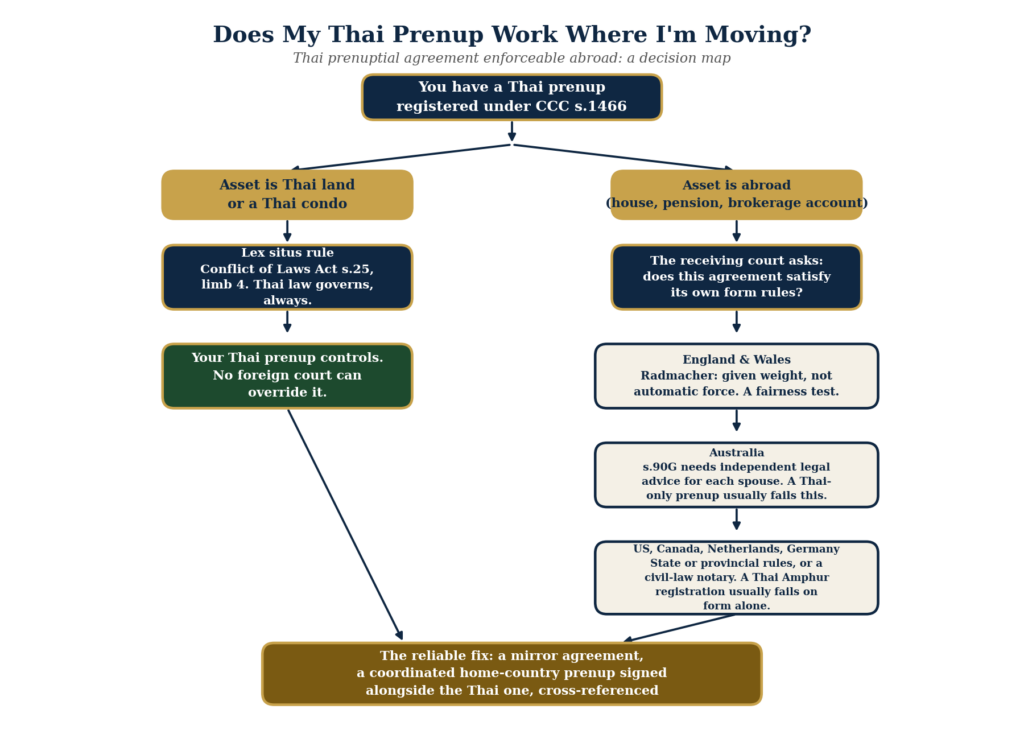
มาตรา 25 deals with the essential elements and effects of an ante-nuptial agreement. If the parties have the same nationality, their common national law applies. If they have different nationalities, the Act looks first to the law they intended, expressly or implicitly, and otherwise to the law of their first matrimonial domicile. For immovable property, the law of the place where the property is situated applies.
These are Thai choice-of-law rules. They tell a Thai court how to deal with an international marriage. They do not require a court in England, Australia, Canada, Germany or the United States to apply Thai law. A foreign court applies its own private-international-law rules.
กฎที่ทำให้ลูกค้ากลัว และสิ่งที่มันจริง ๆ แล้วระบุไว้
Clients hear that a foreign-law clause voids their prenup and assume the whole document collapses. It does not.
CCC section 1465, paragraph 2 states that any clause contrary to public order or ศีลธรรมอันดีของประชาชน, or providing that a foreign country’s law governs the property, is void. The sanction falls on the offending clause, not on the agreement around it. A foreign-law clause is severed. The rest of the document stands, a defect to fix rather than a reason to start over.
ความขัดแย้งในคำแนะนำที่คุณได้อ่านมา
Read enough competitor pages on this topic and you will find both of these claims, sometimes on the same site: foreign-law clauses in a Thai prenup are void, and couples should include a choice-of-law clause naming which country’s law governs their property. Nobody flags that these cannot both be unqualified advice. The reconciliation runs in layers.
First, Thai mandatory rules remain important for immovable property situated in Thailand. Section 25 applies the law of the situs to immovable property when a Thai court conducts its choice-of-law analysis.
Second, a Thai prenuptial agreement subject to Civil and Commercial Code section 1465 cannot validly provide that foreign law governs the spouses’ property relations. A clause attempting to do so is void under section 1465 paragraph 2.
Third, a foreign court does not obtain its applicable law from Thailand’s section 25. It applies its own conflict-of-laws rules. Depending on the country, those rules may lead to Thai law, local law or another applicable law.
For international couples, the practical solution is often to prepare coordinated agreements for the jurisdictions where significant assets or future divorce proceedings are realistically expected. These are sometimes described as coordinated or “mirror” agreements, although that expression is not a formal legal category.
คอนโดของคุณในประเทศไทยและอพาร์ตเมนต์ของคุณในลอนดอนอาจไม่จำเป็นต้องมีกฎระเบียบที่เหมือนกันทั้งหมด
For proprietary rights in immovable property, the law of the place where the property is situated is extremely important. Ownership and registration of a Thai condominium therefore remain matters of Thai property law, while title to a flat in England is governed by English law.
That does not mean a divorce court outside Thailand must ignore Thai property. An English court, for example, may take foreign property into account when dividing matrimonial assets and may make personal orders between the spouses concerning property situated abroad, even though the court cannot simply rewrite the Thai land or condominium register.
The better question is therefore not whether a Thai prenup “covers” a foreign house. The question is what effect the court hearing the dispute will give the agreement and what orders that court has jurisdiction to make concerning the spouses.
อังกฤษและเวลส์: ความหมายของราดมาเชอร์สำหรับเอกสารที่ลงนามที่กรุงเทพฯ
The leading English authority is Radmacher v Granatino [2010] UKSC 42, decided 8 to 1 with Lady Hale dissenting. The ศาลฎีกา held that a court should give effect to a nuptial agreement freely entered into by each party with a full appreciation of its implications, unless it would be unfair in the circumstances to hold them to it.
Two facts matter more to a Thai prenup holder than the headline rule. The agreement was signed abroad, before a German notary, not in England, and the court upheld it even though Mr Granatino had no independent legal advice and no financial disclosure before signing. An English court can give a foreign-executed agreement real weight even when it looks procedurally thin by English standards. That is the most encouraging authority available to a Thai prenup holder moving to England, and few Thai firms cite it.
Encouraging is not certain. The fairness test still applies, and independent advice on each side strengthens your position considerably.
ออสเตรเลีย: ทำไมข้อตกลงสมรสแบบไทยจึงไม่ถือเป็นข้อตกลงทางการเงินแบบออสเตรเลียโดยอัตโนมัติ
Australia has detailed statutory requirements for binding financial agreements. A pre-marriage agreement must satisfy section 90B of the Family Law Act 1975 and must be expressed to be made under that provision. Section 90G then imposes further requirements, including independent legal advice concerning the effect of the agreement and its advantages and disadvantages.
Section 90G also contains a limited mechanism under which certain failures concerning legal advice and lawyer statements do not necessarily make an agreement non-binding if the statutory conditions for relief are satisfied.
A normal Thai prenuptial agreement registered at an Amphur is therefore not, merely because of that registration, an Australian binding financial agreement. A couple with substantial Australian connections should normally have a separate Australian agreement prepared under Australian law.
The United States: UPAA, UPMAA, and why the answer is your state’s
Which rules apply depends on the state whose law governs the agreement and the forum’s own choice-of-law rules, not simply on where the spouses happen to live when the marriage ends. States also modify the uniform acts considerably.
California, for example, has its own statutory requirements concerning voluntariness, financial disclosure or waiver, access to independent counsel and timing before execution. Other states use different tests. A Thai prenup that was drafted solely around Thai requirements should therefore be reviewed under the law of the relevant US state rather than treated as automatically enforceable or unenforceable throughout the United States.
เนเธอร์แลนด์และเยอรมนี: กฎหมายระหว่างประเทศส่วนบุคคลเป็นสิ่งสำคัญที่สุด
The Netherlands and Germany have strong domestic formal requirements for matrimonial property agreements, including important roles for civil-law notaries. However, an international Thai prenup cannot be analysed solely by asking whether it was signed before a Dutch or German notary.
Both countries participate in EU Regulation 2016/1103 on matrimonial property regimes. For spouses who marry or choose the law applicable to their matrimonial property regime on or after 29 January 2019, the Regulation contains rules governing applicable law and the formal validity of matrimonial property agreements.
Article 25 requires a matrimonial property agreement to be in writing, dated and signed, but additional formal requirements depend on factors including the spouses’ habitual residence and the law applicable to their matrimonial property regime.
The result is fact-specific. A Thai prenup does not automatically become invalid in Germany or the Netherlands merely because it was registered at a Thai Amphur rather than executed as a local notarial deed. The spouses’ residence, marriage date, chosen or applicable law and the terms of the agreement must first be examined under the relevant European and domestic rules.
โครงสร้างกระจกอย่างละขั้นตอน
Lawyers on both sides call this the mirror agreement, and the sequence matters as much as the wording.
- Draft both documents together. Each lawyer should see the other’s draft before either is signed, so the two documents describe the same asset split without contradicting each other.
- Complete the Thai prenup before the marriage and register it correctly. The terms must be agreed before marriage, but Civil and Commercial Code section 1466 requires the prenuptial agreement to be entered in or attached to the Marriage Register at the time the marriage itself is registered.
- Cross-reference explicitly. Each document should name the other, state that Thai-situated assets fall under the Thai instrument and everything else under the home-country one, and avoid any clause importing foreign law into the Thai document.
- Use independent lawyers where the relevant foreign law requires or strongly favours it. Australia has specific independent-advice requirements. England & Wales treats independent advice as important evidence of informed consent, while US and Canadian requirements vary by state or province. Civil-law jurisdictions follow different formal systems.
- Make proper financial disclosure where relevant. Disclosure is particularly important in common-law jurisdictions, but the precise requirement and whether disclosure may be waived depend on the applicable law. Do not describe financial disclosure as a universal prerequisite in every jurisdiction.
- Already married? Section 1469 is materially weaker. An agreement concerning property made between spouses during marriage may be avoided by either spouse at any time while the marriage continues, or within one year after they cease to be spouses. Rights acquired by third parties acting in โดยสุจริต are protected.
ทำไมข้อตกลงก่อนแต่งงานของชาวไทยจึงยังสำคัญ
For a marriage registered in Thailand, couples who want a Thai prenuptial agreement governed by the Civil and Commercial Code must comply with section 1466 when the marriage is registered.
A foreign prenuptial agreement connected with a foreign marriage presents a different question. Its treatment in Thailand may involve sections 24 and 25 of the Conflict of Laws Act, Thai mandatory rules and, for immovable property, the law of the place where the property is situated.
For a couple who expects to own significant assets in Thailand, preparing a Thai-compliant prenup remains the clearest way to record the intended matrimonial property arrangement for use in Thailand. A foreign agreement should not automatically be assumed either to replace the Thai document or to be completely ineffective here.
ค่าใช้จ่ายและลำดับการดำเนินการ
Drafting both documents together costs more than drafting one, and it should: two lawyers, two jurisdictions, and a cross-reference step that has to be right the first time. Our คู่มือข้อตกลงก่อนสมรส sets out the current fixed fee and turnaround for the Thai side. Bring your home-country lawyer in early rather than after the Thai document is signed, because cross-referencing works better when both drafts exist together.
A remaining issue after Thailand’s Marriage Equality Act
Thailand’s Marriage Equality amendments came into force on 23 January 2025 and replaced gender-specific terminology throughout many provisions of Book V of the Civil and Commercial Code.
The separate Act on Conflict of Laws B.E. 2481 (1938) still contains old terminology referring to “husband” and “wife,” including nationality-based rules in sections 21 and 22. We have not identified a corresponding amendment expressly modernising those provisions.
This creates a genuine interpretation issue for some mixed-nationality same-sex marriages. Until legislation or authoritative case law clarifies the interaction between the two statutes, the safer position is to describe the issue as unresolved rather than assume that the old husband-based fallback automatically transfers to one spouse or that sections 24 and 25 completely resolve the problem.
คำถามที่พบบ่อย
ข้อตกลงสมรสแบบไทยของฉันมีผลใช้ได้ในสหราชอาณาจักรหรือไม่
ไม่โดยอัตโนมัติ แต่ภายใต้คำพิพากษา Radmacher v Granatino ศาลอังกฤษสามารถให้ความสำคัญอย่างยิ่งแก่คำฟ้องนี้ได้ หากคำฟ้องดังกล่าวถูกยื่นโดยอิสระ โดยทั้งสองฝ่ายเข้าใจถึงผลกระทบของคำฟ้องดังกล่าว และการบังคับใช้คำฟ้องดังกล่าวจะไม่เป็นสิ่งที่ผิดกฎหมาย.
ฉันสามารถลงนามในข้อตกลงก่อนแต่งงานได้หรือไม่
ใช่ และสำหรับคู่สมรสที่มีทรัพย์สินจำนวนมากทั้งในประเทศไทยและอีกประเทศหนึ่ง นี่มักเป็นโครงสร้างที่ปลอดภัยกว่า: สัญญาก่อนสมรสของไทยที่ทำตามประมวลกฎหมายแพ่งและพาณิชย์ และข้อตกลงแยกอีกฉบับที่ทำตามกฎหมายของอีกประเทศหนึ่ง ฉบับของไทยต้องทำก่อนสมรส และตามมาตรา 1466 ต้องจดแจ้งไว้ในทะเบียนสมรสหรือแนบท้ายทะเบียนสมรสในขณะจดทะเบียนสมรส.
ถ้าพวกเขาขัดแย้งกันแล้วใครจะชนะ?
เอกสารทั้งสองฉบับไม่ควรขัดแย้งกันเลย เพราะการร่างไปพร้อมกันและอ้างอิงถึงกันคือจุดประสงค์ทั้งหมด ศาลไทยใช้กฎหมายแห่งถิ่นที่อสังหาริมทรัพย์ตั้งอยู่บังคับแก่ที่ดินและอาคารในประเทศไทย (มาตรา 25 แห่งพระราชบัญญัติว่าด้วยการขัดกันแห่งกฎหมาย) ไม่ว่าเอกสารต่างประเทศจะระบุไว้อย่างไร และศาลต่างประเทศจะใช้หลักกฎหมายขัดกันของตนเอง.
ข้อตกลงสมรสแบบไทยของฉันจะคุ้มครองเงินบำนาญของฉันที่บ้านหรือไม่
Do not assume so. Section 25’s specific lex situs rule concerns immovable property, not pensions. Rights in a foreign pension or retirement plan depend on the law governing the plan, the matrimonial property law applied by the court hearing the dispute and the terms of the relevant agreement. A foreign agreement should address important pension rights expressly.
เราแต่งงานกันแล้วที่ไทยแล้ว มันสายเกินไปหรือเปล่า?
คุณไม่สามารถสร้างข้อตกลงก่อนแต่งงานได้อีกหลังจากที่การสมรสได้รับการจดทะเบียนแล้ว คู่สมรสสามารถทำข้อตกลงเกี่ยวกับทรัพย์สินระหว่างการสมรสได้ แต่มาตรา 1469 อนุญาตให้คู่สมรสฝ่ายใดฝ่ายหนึ่งมีสิทธิที่จะเลิกข้อตกลงดังกล่าวได้ทุกเมื่อในขณะที่ยังคงอยู่ในการสมรส หรือภายในหนึ่งปีหลังจากที่การสมรสสิ้นสุดลง โดยต้องคำนึงถึงการคุ้มครองของบุคคลที่สามที่กระทำด้วยเจตนาดี ข้อตกลงทรัพย์สินหลังสมรส มีผลทางกฎหมายที่อ่อนแอกว่าข้อตกลงสมรสฉบับลงนามอย่างถูกต้องตามกฎหมาย.
ต้องมีการลงนามอำนวยความสะดวกของทนายความในแบบฟอร์มสัญญาแต่งงานของไทยหรือไม่ เพื่อใช้ในต่างประเทศ?
Thailand does not require notarisation for a section 1466 registration to be valid at home. Abroad, it depends on the forum. In the Netherlands or Germany, for marriages covered by EU Regulation 2016/1103, the agreement must at least be written, dated and signed, and further formal requirements depend on the spouses’ habitual residence and the applicable law, so an Amphur registration is neither automatically sufficient nor automatically invalid there. Have it checked by a lawyer in that country.
เราทุกคนจำเป็นต้องมีทนายความคนเดียวหรือไม่
ไม่ใช่ตามมาตรา 1466 ของกฎหมายไทยเพื่อจดทะเบียนสมรสแบบไทยเท่านั้น ข้อกำหนดสำหรับชาวต่างชาติแตกต่างกัน ออสเตรเลียกำหนดข้อกำหนดเฉพาะสำหรับการให้คำปรึกษาทางกฎหมายอิสระสำหรับข้อตกลงทางการเงินที่มีผลผูกพัน โดยคำปรึกษาอิสระก็มีความสำคัญในประเทศอังกฤษและเวลส์ และในหลายกรณีในแคนาดาและสหรัฐอเมริกาเช่นกัน แต่กฎระเบียบที่แน่นอนจะแตกต่างกันไปตามเขตอำนาจทางกฎหมาย เยอรมนีและเนเธอร์แลนด์ใช้กรอบกฎหมายและระบบบันทึกข้อความที่แตกต่างกัน ไม่มีการกำหนดกฎเกณฑ์ที่ชัดเจนว่าคู่สมรสทุกคนต้องมีทนายความสองคนในทุกประเทศ.
ศาลอังกฤษจะรับรองเอกสารภาษาไทยหรือไม่?
ใช่. ศาลของประเทศอังกฤษได้ใช้หลักการของ Radmacher ในการพิจารณาข้อตกลงที่ทำขึ้นภายใต้ระบบกฎหมายอื่น โดยพิจารณาถึงความยุติธรรมของกระบวนการและผลลัพธ์ ไม่ใช่ที่ที่ข้อตกลงนั้นถูกลงนาม.
ต้องแปลและจดทะเบียนสมรสตามกฎหมายหรือไม่?
For use before a foreign authority or court, a certified translation may be required, together with whatever authentication procedure the receiving country requires. Thailand acceded to the Hague Apostille Convention on 30 June 2026, but the Convention enters into force for Thailand on 28 February 2027. Until then, the existing legalisation procedures continue to matter. After that date, apostilles should simplify authentication for documents used between Thailand and other Convention countries, subject to the Convention’s application between the countries concerned.
This page describes the law reviewed as of 30 August 2026. Foreign treatment of prenuptial agreements depends heavily on the forum, applicable conflict-of-laws rules, the date and place of the marriage, habitual residence and the wording and execution of the particular agreement.
Last reviewed: 28 September 2026. Read in Thai: Act on Conflict of Laws B.E. 2481 sections 21 to 25 and Civil and Commercial Code sections 1465, 1466 and 1469 (current text after Act No. 24). Apostille dates checked against the HCCH status table (accession 30 June 2026, in force for Thailand 28 February 2027). The English, Australian, US, Canadian and EU positions are summaries of foreign law, not Thai law, and should be confirmed by a lawyer in that country.
ข่าวสารกฎหมายไทย ฟรีทางอีเมล
อัปเดตข่าวสารกฎหมายไทยในภาษาเข้าใจง่าย ที่ส่งผลกระทบต่อชาวต่างชาติ: อสังหาริมทรัพย์, วีซ่า, การสมรส, ธุรกิจ และพินัยกรรม จดหมายข่าวสั้นเพียงฉบับเดียวต่อเดือน จากสำนักงานกฎหมายที่ดำเนินงานมาตั้งแต่ปี 2549 ไม่มีการส่งสแปม ยกเลิกรับได้ทุกเมื่อ.