


Reviewed by ThaiLawOnline, a licensed Thai law firm practising in Thailand since 2006. Thai lawyer of record: Wichuda Atthamethakon, LL.M., Thai Bar Licence 3149/2556.
Last updated on
When you live in Thailand as an expatriate, it’s important to know how the Thai police handle questioning. This knowledge can help you protect your rights and avoid harming your legal position. Whether you have a simple question or serious criminal charges, it is important to know the rules. Understanding your rights and the role of translators is essential for every foreigner living in the Kingdom.
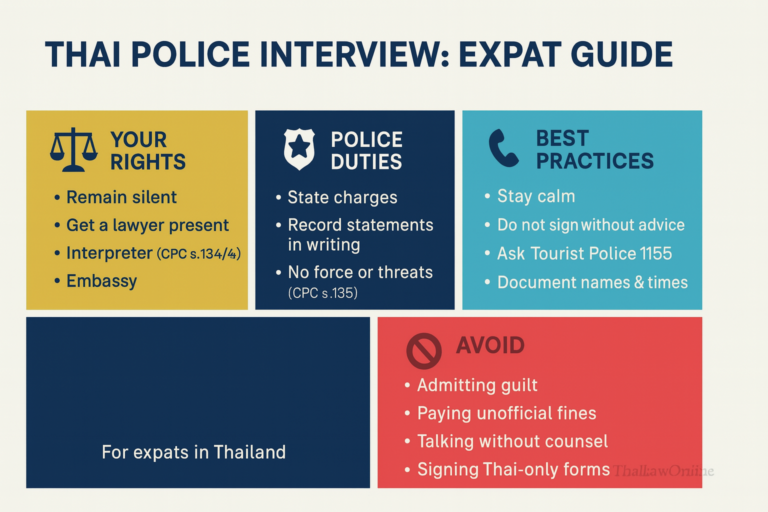
Table of Contents
Understanding Thai Police Interview Procedures
The Legal Framework Governing Police Questioning
Thai police interviews operate under the Criminal Procedure Code B.E. 2477 (1934), which establishes specific procedural requirements that differ significantly from Western legal systems. Unlike countries with Miranda rights, Thailand has its own framework for protecting suspect rights during questioning.
Under Section 134 of the Criminal Procedure Code, you will meet with an inquiry official. They will gather basic information from you. This includes your name, nationality, age, profession, and address. Most importantly, they must tell you the facts about the alleged offense. They also need to formally notify you of the charges.
Police can legally detain suspects for up to 48 hours without charge for initial questioning. If the investigation cannot finish in this time, authorities must take you to court. They will ask for more time to keep you detained. This detention period specifically excludes travel time to bring you to the police station or court.
For immigration, Police operate under the Immigration Act B.E. 2522 (1979) and not just CPC. Rights to silence/counsel still apply, but overstay can lead to immediate deportation without full CPC protections.
| Topic | TL;DR | What to do now | Pro tips |
|---|---|---|---|
| Rights in a Thai police interview | You may remain silent, request a lawyer, and ask for an interpreter. | State you’ll answer after legal advice; ask if you’re a witness or suspect. | Keep it respectful; anything said can go into the written record. |
| Lawyer present | You can have a lawyer before and during questioning. | Call counsel and wait; don’t proceed until they arrive. | A lawyer ensures the caution is given and your words are recorded accurately. |
| Signing statements | Don’t sign what you don’t understand. | Get an interpreter; read line-by-line; correct errors; initial each page; get a copy. | Strike blank spaces and add your own clarifying lines before signing. |
| Detention timeline | Post-arrest, court appearance is generally required within a short period (~48h). (See in FAQs for more details) | Ask if attendance is voluntary; request counsel and interpreter in custody. | Weekends/holidays/travel time may affect timing; keep notes of events. |
| Police summons (หมายเรียก) | Ignoring a valid summons can lead to a warrant. | Confirm status (witness vs. suspect); schedule; attend with a lawyer. | Bring ID and supporting documents; be on time and prepared. |
| Foreigners & consular help | You can ask the police to notify your embassy and request an interpreter. | Call your embassy; ask for a list of English-speaking lawyers. | Ensure all documents you sign are translated or read back in your language. |
| Searches, drug tests, fingerprints | Ask the legal basis/warrant for searches or tests. | If unsure, pause and call your lawyer; document what is requested. | Consent (if given) should be explicit and limited in scope. |
| Practical prep | Come prepared and calm. | Bring ID/passport, lawyer details, and interpreter if needed. | Avoid social media posts; get everything important in writing. |
Key takeaways for all expatriates in Thailand:
- Exercise your rights immediately and clearly, don’t assume police will fully explain them
- Never rely solely on police-provided translation, bring your own qualified interpreter when possible
- Maintain relationships with qualified legal counsel before you need them
- Stay informed about your embassy’s consular services and keep their contact information readily available
- Document interactions and secure witnesses whenever possible
Keep in mind that Thai authorities usually treat foreign nationals fairly. However, it is your responsibility to protect your rights. By knowing the system and getting ready, you can handle police interviews. This will help protect your legal rights and personal interests.
How Statements Are Collected
A critical difference from many Western systems is that the law does not require the inquiry officer’s questioning of an adult suspect to be recorded on audio or video. What goes on the file is the written statement, which can later be used as evidence in court, so there may be no objective record of what was actually said. The separate duty in section 22 of the Prevention and Suppression of Torture and Enforced Disappearance Act B.E. 2565 covers the arrest itself: officials must keep a continuous audio-visual record from the arrest until the person is handed to the inquiry officer or released.
When taking your statement, police must follow specific procedures outlined in Section 134/4 of the Criminal Procedure Code. They are required to inform you of two fundamental rights before questioning begins:
- The right to give or refuse a statement, with a warning that anything you say may be used against you in court
- The right to have counsel or any trusted person attend your examination
If you choose to give a statement, it must be accurately recorded. If you refuse, this refusal must also be noted in writing. Crucially, any statement obtained without proper notification of these rights cannot be used as evidence to prove guilt.
Prohibited Police Conduct
Section 135 of the Criminal Procedure Code explicitly prohibits inquiry officials from engaging in coercive tactics. Police cannot make promises, threaten, defraud, torture, or use force to induce testimony. The Aranyaprathet case shows the risk is real: in 2024 the Department of Special Investigation charged eight Aranyaprathet police officers over the torture of a man into falsely confessing to his wife’s murder, with misconduct in office, coercion, unlawful detention and offences under the Anti-Torture Act. Section 135 itself creates no offence; it is the rule that makes such a statement inadmissible.
Even with legal protections, expatriates should be aware that some people might still use psychological pressure tactics. This can happen even if those tactics are against Thai law. Officers might make false promises like “help me, and I’ll help you” or misrepresent evidence strength to encourage confessions.
The Critical Role of Translators and Interpreters
Legal Requirements for Language Assistance
Section 13 of the Criminal Procedure Code mandates that all court proceedings be conducted in Thai language. When suspects cannot speak or understand Thai adequately, authorities must provide interpretation services. In criminal cases, inquiry officials, prosecutors, or courts must quickly arrange for an interpreter when there are language barriers.
The law says interpreters must take an oath. They must promise to do their job honestly. They should not add or leave out anything in the translation or interpretation. However, a significant gap exists in Thai law regarding interpreter qualifications. Violations can lead to perjury charges.
The Reality of Translation Quality
Despite legal requirements, the Criminal Procedure Code sets no minimum qualification for an interpreter. The Office of the Judiciary does keep a register of certified court interpreters, but nothing obliges the police to use one at the inquiry stage. This creates serious risks, as demonstrated in recent cases where mistranslations by unqualified individuals led to criminal prosecutions based on faulty linguistic analysis.
Recent initiatives have begun addressing language barriers. Five police stations, including Suvarnabhumi Airport and Thong Lor, now have bilingual police report forms. These forms are in Thai and English. This change came after the British Embassy shared concerns about communication issues. However, these remain pilot programs limited to specific locations.
For expatriates, the lesson is clear: never rely solely on police-provided translation services. The lack of qualification standards can lead to problems. You may end up depending on someone who does not have the skills for legal translation. This can be especially important during critical moments in a criminal case.
Bringing Your Own Interpreter
While courts must provide interpreters for criminal cases, you have the right to bring your own qualified interpreter. This is strongly recommended for several reasons:
- Specialized criminal law terminology: Legal interpreters with criminal case experience understand the nuances of legal language that general translators might miss
- Consistency: Your interpreter can work with your legal team throughout the entire process
- Quality assurance: Professional interpreters certified by organizations like SEAProTI have undergone training and operate under professional standards
Even if you are just a witness and not accused, it is a good idea to bring your own interpreter. Witnesses don’t have the same right to legal counsel, but they can have interpreters present to ensure accurate communication.
Protecting Your Rights During Questioning
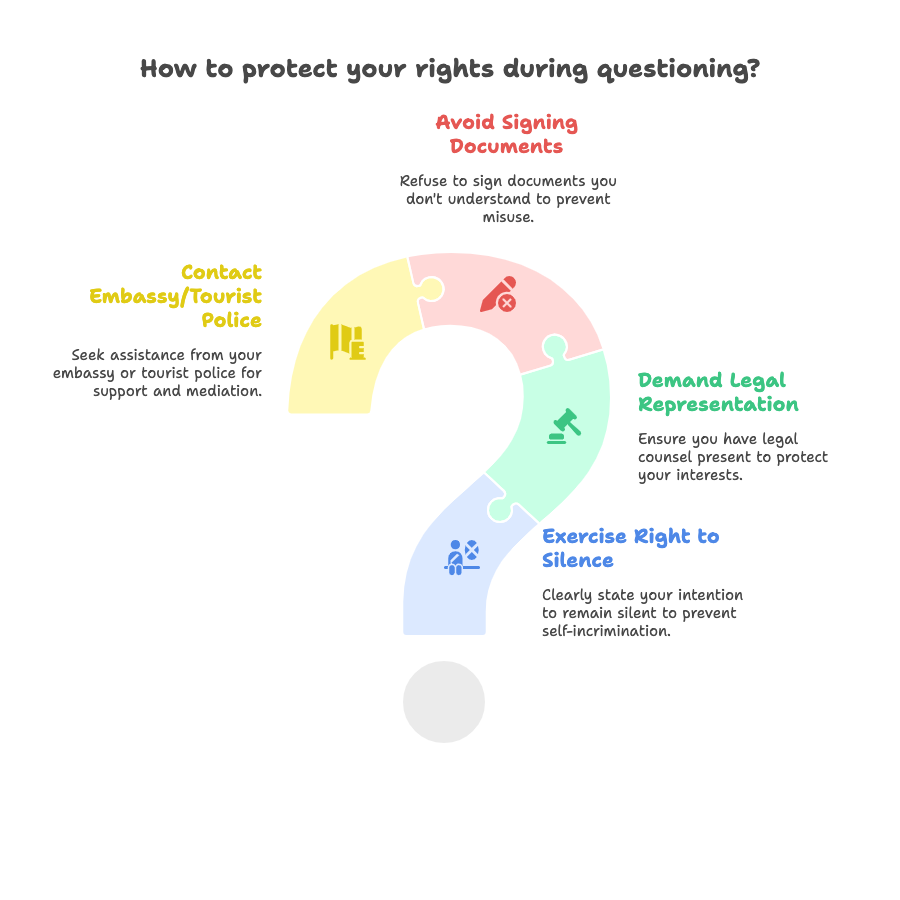
Exercise Your Right to Remain Silent Immediately
Your constitutional right to remain silent under Thai law must be clearly communicated to police. Thai police do not have to read a standard warning like Miranda warnings. However, they must tell you about this right.
The key is being explicit. Recent legal cases show that staying quiet is not enough. You should say, “I wish to exercise my right to remain silent” in a way the officers can understand. Your silence will be noted in the police file, but this cannot be used against you.
Demand Legal Representation Before Any Questioning
Section 134/3 guarantees your right to have counsel or a trusted person present during examination. Section 134/1 sets when the state must provide one. Where the offence carries the death penalty, or the suspect is 18 or under on the day of the charge, the inquiry officer must ask whether you have a lawyer and, if not, the state must appoint one. Where the offence carries imprisonment, the officer must ask before questioning, and the state appoints a lawyer if you have none and want one. Anything you say before these steps and the section 134/4 warning cannot be used to prove your guilt.
However, court-appointed lawyers often do not have experience with foreign defendants and may not speak English. This can make your passport issues more complicated. They frequently provide minimal consultation and make decisions without significant client input. For this reason, hiring your own bilingual criminal lawyer experienced with expatriate cases is strongly recommended.
Never Sign Documents You Don’t Understand
One of the most dangerous mistakes expatriates make is signing Thai-language documents without proper legal review. Even if police provide verbal translations, these may be inaccurate or incomplete. Any document you sign can be used as evidence against you.
Your criminal lawyer should review all documents before you sign them. If police pressure you to sign immediately, politely but firmly request time for legal consultation. Remember that you’re not required to cooperate with requests that could incriminate you in an investigative interview.
As an expatriate, cultural differences can add layers of complexity to police interactions. Thai society values respect and hierarchy, so always remain polite and avoid confrontation, even when asserting your rights. Phrases like “I respectfully request my lawyer” can help de-escalate situations. Many expats, especially those married to Thai partners or running businesses, feel extra stress from family or work. Remember, asking for help early shows strength, not weakness.
Contact Your Embassy and Request Tourist Police
As a foreign national, you have the right to contact your embassy or consulate. While diplomatic staff cannot interfere with legal proceedings, they can:
- Notify your family of the arrest
- Provide lists of qualified local attorneys
- Ensure you’re not being discriminated against under Thai law
- Monitor your treatment in detention, especially regarding your visa status.
Additionally, calling the Tourist Police at 1155 can provide English-speaking assistance for less serious matters. Tourist Police units exist in major destinations and include expat volunteers who can help mediate situations.
Document Everything and Secure Witnesses
If possible, try to have witnesses present during any police interaction. While this isn’t always feasible during formal interrogations, having independent observers during initial contact can be valuable. If you’re being questioned in public or during a traffic stop, you can ask bystanders to observe and record what occurs.
Keep detailed records of:
- Names and badge numbers of officers involved
- Exact times and locations of interactions
- What questions were asked and how you responded during the interview technique.
- Any promises or threats made by police
- Whether proper rights notifications were given
Common Scenarios and Practical Responses
Traffic Stops and Minor Violations
For routine traffic violations, many expatriates encounter pressure to pay “tea money” (unofficial fines) on the spot. Refusing may lead to being taken to a police station for processing. However, this is often better than being part of corruption within the Royal Thai Police.
Best practices for traffic stops in Bangkok:
- Remain polite and provide identification when requested
- Don’t admit guilt or sign anything immediately
- If the situation seems serious, request Tourist Police assistance
- Consider paying official fines rather than informal payments
Serious Criminal Investigations
For allegations involving drugs, assault, fraud, or other serious crimes, the stakes are much higher. Police may attempt to convince you to plead guilty in exchange for reduced sentences. Thailand has no plea-bargaining system. A confession can earn a reduction of up to half the sentence as a mitigating factor under section 78 of the Criminal Code, but that is the court’s discretion, not a deal with the police, so take advice before admitting anything.
Critical actions for serious allegations:
- Invoke right to silence immediately and maintain it consistently
- Demand legal counsel before answering any questions
- Contact your embassy as soon as possible
- Never agree to searches without warrants
- Don’t discuss your case with cellmates or other detainees at the Royal Thai Police station.
Immigration-Related Questioning
Immigration Police handle overstay violations and related matters differently from criminal police. However, the same fundamental rights apply. Be particularly cautious about signing voluntary departure agreements or other immigration documents without understanding their full implications.
Working Effectively with Your Legal Team
Choosing the Right Criminal Lawyer
When selecting legal representation, prioritize lawyers with:
- Specific experience with foreign defendants in criminal cases
- Bilingual capabilities in your native language and Thai
- Understanding of cultural differences between Thai and Western legal systems
- Established relationships with courts and prosecutors in your jurisdiction
Avoid lawyers who:
- Promise guaranteed outcomes
- Suggest paying bribes to officials
- Show limited interest in consulting with you about case strategy during the investigative interview.
- Cannot explain Thai legal procedures in understandable terms.
The Importance of Early Legal Intervention
The burden of proof is on the prosecution: under section 227 of the Criminal Procedure Code the court may not convict unless it is sure that the offence was committed and that the accused committed it, and any reasonable doubt goes to the accused. What is different is that Thai criminal procedure gives the defence far less pre-trial disclosure than common-law systems, which is why early legal intervention matters.
Your lawyer can:
- Ensure proper procedures are followed during investigation
- Challenge illegally obtained evidence
- Negotiate with prosecutors before charges are filed in Bangkok.
- Prepare stronger defense strategies when they understand the case from the beginning
Understanding Plea Negotiations
Thailand’s legal system encourages guilty pleas through sentence reductions. There is no plea bargain with the police or the prosecutor: a confession is a mitigating factor the court may weigh under section 78 of the Criminal Code. Ensure your lawyer explains all options and consequences before you decide whether to plead guilty.
Illustrative Scenarios
Consider John, a 45-year-old Canadian teacher in Bangkok accused of a minor assault during a bar dispute. By invoking his right to silence and demanding a lawyer, he avoided a coerced confession. His bilingual interpreter caught a translation error in the statement, leading to dropped charges.
In contrast, Maria, a 60-year-old retiree facing immigration overstay questioning, signed documents without review, resulting in unnecessary fines. These anonymized examples highlight why preparation is key, contact us at ThaiLawOnline for similar support tailored to your situation.
Last reviewed: 27 September 2026. Criminal Procedure Code sections 13, 87, 134/1, 134/3, 134/4 and 227 and Criminal Code section 78 were read in Thai; section 22 of the Anti-Torture Act in the Wikisource English translation. Not re-checked: the bilingual police-form pilot, interpreter-certification claims, the Tourist Police details and the illustrative client stories.
Faqs about Police Interviews in Thailand
What are my rights during a police interview in Thailand? (rights to silence, legal counsel, interpreter)
In Thailand, you usually have the right to stay silent. You also have the right to talk to a lawyer. If you don’t speak Thai, you have the right to a qualified interpreter. You may politely state that you will answer questions only after legal advice. If you’re a foreign national, you can request consular notification and assistance. Keep communication respectful. Ask the investigating officer (IO) if you are a witness or a suspect. Remember, anything you say can be written down. This is often called a “confession statement” or record of interview.
Can I have a lawyer present during police questioning in Thailand? (bring counsel to the station)
Yes. You can bring a lawyer to the police station and ask to consult privately before and during questioning. If officers want to proceed without counsel, you may decline to answer until your lawyer arrives. A lawyer makes sure your statement shows your true words. They ensure any “police caution” is given correctly. They also make sure no pressure is used. If you need assistance finding counsel, you may contact ThaiLawOnline for guidance or representation.
Do I have to sign the police statement? What if I don’t understand Thai?
Never sign anything you don’t fully understand. Ask for an interpreter and for the officer to read the statement aloud, line by line. Request corrections for any errors, strike through blank spaces, and initial each page. You can add your own clarifying sentences before signing. Ask for a copy of the signed statement immediately. Signing is important in Thai practice. Your “record of interview (ROI)” is often seen as strong evidence. So, take time to review it carefully.
How long can police detain me in Thailand before court? (custodial interrogation & detention timeline)
If you are arrested, the police usually must take you to court within a short time. This is often about 48 hours, not counting travel time, weekends, and holidays. After that, they need permission from a judge to keep you in jail. During any custodial interrogation, you can ask for a lawyer and an interpreter. You can also refuse non-essential questions and mention any health concerns. Voluntary attendance for interview is different, your cooperation doesn’t waive your rights. After that the court can extend custody under section 87 of the Criminal Procedure Code: once, for up to 7 days, where the offence carries no more than six months; in periods of up to 12 days totalling 48 days where the maximum is under ten years; and in periods of up to 12 days totalling 84 days where it is ten years or more.
I received a police summons (หมายเรียก). What happens if I ignore it?
A summons is a formal request to attend for questioning as a witness or suspect. If you ignore a valid summons without a good reason, the police can take action. They may seek an arrest warrant. The best way is to contact the station. Confirm if you are a witness or a suspect. Then, schedule a time. Attend with a lawyer and an interpreter. Bring identification and any documents that support your version of events.
I’m a foreigner, can I call my embassy? What about translators and consular rights?
Yes. Under international consular-assistance norms, you can request that your embassy or consulate be notified. You can ask for a certified interpreter in your language. This interpreter can help you during the entire interview. They can also assist with any documents you need to sign. Keep embassy phone numbers handy. They can give you a list of English-speaking lawyers. In urgent cases, they can contact the station for you.
Can police make me take a drug test, give fingerprints, or search my phone?
Police may ask for procedures like fingerprinting, photographing, or a urine drug test in some investigations. You can ask what authority they have and if refusing has legal consequences. For searches of your phone or home, ask to see a warrant or the legal basis, search and seizure rules apply. If you consent, consent should be explicit and limited in scope. When in doubt, pause, call your lawyer, and document what is requested
Practical tips for interviews at a Thai police station
- Bring a lawyer, passport/ID, and a Thai-language interpreter if needed.
- Stay calm and respectful with Royal Thai Police, Cyber Crime, or Tourist Police officers.
- Before answering, confirm: “Am I a witness or a suspect?” and “Is this a voluntary interview?”
- For written statements: read slowly, request corrections, add your own notes, and get copies.
- Avoid discussing the case on social media; let your counsel handle communications.
- If bail, charge sheets, or release conditions are discussed, ask for everything in writing and have your lawyer review.
Post-Interview Steps and Follow-Up
Once the police interview concludes, your actions can significantly impact your case. If you’ve been released, immediately consult your lawyer to review the statement and any evidence collected. Request a copy of all documents from the police station, under Thai law, you’re entitled to this for your records.
If charges are filed, prepare for the next stages: the prosecutor’s review and potential court appearance. Document any follow-up communications with authorities, and avoid discussing the case publicly to prevent complications. For expats on visas, notify immigration authorities if required, as criminal matters can affect your stay in Thailand.
Remember, getting help from a legal team like ours at ThaiLawOnline can challenge wrong procedures. We can also negotiate solutions before trial. Protecting your rights doesn’t end at the station door, stay proactive to safeguard your future in the Kingdom.
Conclusion: Preparation and Prevention
Understanding Thai police interview procedures is not just about what to do if you are arrested. It is also about being ready to protect your rights in any interaction with the police. The combination of language barriers, cultural differences, and procedural variations from Western legal systems creates unique challenges for expatriates.
The Thai legal system protects suspects. However, these protections work best when you know how to use them correctly. Knowing your rights and having good legal help are your best defenses in Thailand’s justice system. This is true whether you are facing routine questioning or serious criminal charges.
LINKS:
Thai Law Updates, free by email
Plain-English updates on Thai law changes that affect foreigners: property, visas, marriage, business and wills. One short email a month from a firm practicing since 2006. No spam, unsubscribe anytime.