


Reviewed by ThaiLawOnline, a licensed Thai law firm practising in Thailand since 2006. Thai lawyer of record: Wichuda Atthamethakon, LL.M., Thai Bar Licence 3149/2556.
Last updated on
Marriage in Thailand carries significant legal implications for both spouses, affecting everything from property rights to financial responsibilities and inheritance matters. Understanding the consequences of marriage in Thailand is essential for both Thai citizens and foreign nationals seeking to marry in the country. These consequences of marriage in Thailand can significantly affect various aspects of life.
For how these consequences fit alongside divorce, custody and succession, start from our guide to family law in Thailand.
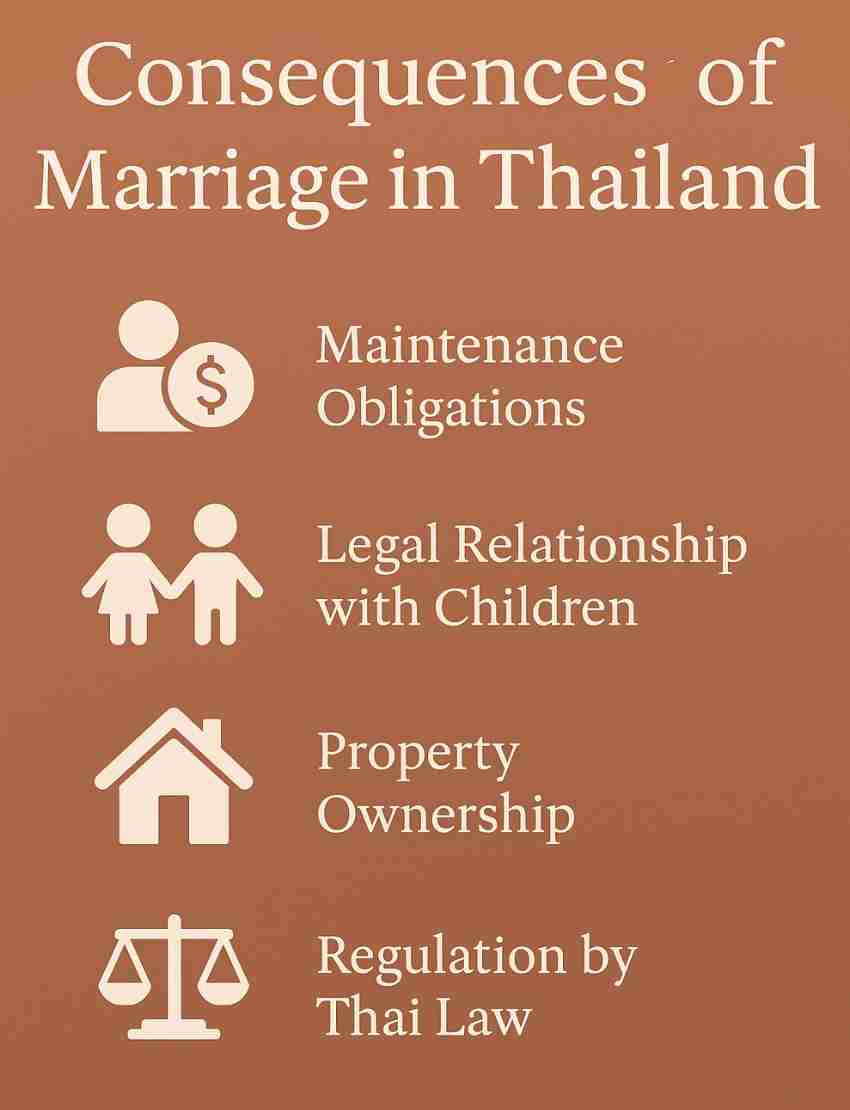
Table of Contents
Key Legal Consequences of Marriage in Thailand
When you get married in Thailand, important rights and duties come into play. These are mainly found in the Thai Civil and Commercial Code. These include:
- Mutual obligation of support and maintenance: Both spouses have a legal responsibility to financially support each other.
- Property ownership: Marital property (Sin Somros) created during the marriage is jointly owned.
- Relationship to children: Legal parentage, custody rights, and responsibilities are clearly defined by Thailand law.
- Inheritance rights: A surviving spouse is a statutory heir. A valid will affects distribution of the deceased’s estate; a prenuptial agreement governs matrimonial property and does not replace a will or automatically remove the spouse’s inheritance rights.
Personal vs. Marital Property in Thailand
It’s also crucial to distinguish clearly between personal and marital property to understand the legal consequences of marriage in Thailand:
| Personal Property (Sin Suan Tua) | Marital Property (Sin Somros) |
|---|---|
| Owned before marriage | Acquired during marriage |
| Personal-use items | Gifts declared marital |
| Property acquired through inheritance or gift | Income from personal property |
| Khongman (engagement gifts) | Jointly purchased assets |
To keep clear boundaries between these two types of property, think about making a prenuptial agreement. Also, keep detailed records each year. Khongman and sin sod are governed separately and are not marital property at all: see sin sod and khongman explained. For assets bought before registration, see our guide to cohabitation and co-ownership before marriage.
What Your Spouse Can and Cannot Do With Marital Property
Marriage in Thailand does more than pool assets, it constrains what each spouse may do with them unilaterally. Many couples do not discover these constraints until one of them is relied upon.
Acts requiring both spouses’ consent
CCC section 1476 requires spouses to manage marital property (sin somros) jointly, or with the other spouse’s consent, in eight cases:
- sale, exchange, sale with a right of redemption, letting out on hire-purchase, mortgage, release of mortgage, or transfer of the right of mortgage, of immovable property or mortgageable movable property;
- creating, or extinguishing in whole or in part, a servitude, right of habitation, right of superficies, usufruct, or a charge over immovable property;
- letting out immovable property for more than three years;
- lending money;
- making a gratuitous gift, except a gift for charitable purposes, for social purposes, or in accordance with moral obligation, which is proportionate to the family’s station in life;
- making a compromise;
- submitting a dispute to arbitration;
- putting up property as a guarantee or security with an official or the court.
Anything not on this list, either spouse may do alone without the other’s consent.
Section 1476/1 allows spouses to vary this regime, in whole or in part, but only through a prenuptial agreement made under sections 1465 and 1466. Whatever the agreement does not cover stays governed by section 1476.
Since the Marriage Equality Act (CCC Amendment Act No. 24, B.E. 2567, in force 23 January 2025), these provisions refer to คู่สมรส (spouses) rather than husband and wife, and apply equally to same-sex marriages registered in Thailand.
What happens if your spouse ignores this
Section 1480 allows the other spouse to apply to the court to revoke the transaction, unless they have ratified it, or the third party acted both in good faith and for value. A gift fails the “for value” limb by definition, which makes gifts the most vulnerable category.
The right does not last indefinitely. It is barred one year after the spouse learns of the grounds for revocation, and ten years after the transaction in any event.
The Supreme Court added a further consequence in Decision 139/2569: because the transaction remains valid until revoked, interest on money recovered runs only from the date of the judgment, not from the date of the transfer.
For the full remedy and the practical steps, see Separation of Assets for a Divorce in Thailand.
Spouse benefits: current entitlement and proposed alignment
Registered spouses of every gender qualify for Social Security survivor benefits on the same legal basis, subject to the conditions for the particular benefit. The Government’s August 2026 guidance covers death assistance, funeral expenses and the old-age lump sum. Keep the marriage certificate and beneficiary designation records current. Read the official Social Security guidance.
A separate Cabinet decision on 18 August 2026 approved in principle draft state-enterprise rules aligning spouse terminology for compensation, medical care and funeral benefits. Cabinet approval alone does not establish commencement. Before making a claim, check the final instrument and the employer’s applicable scheme. Read the Cabinet announcement.
Important Considerations for Foreign Spouses
Foreign nationals marrying Thai citizens should understand several important points about the marriage register and void marriages.
- Land bought during the marriage must be registered in the Thai spouse’s name, because the foreign spouse cannot own land (Land Code section 86); a condominium unit can be registered in the foreign spouse’s own name within the foreign quota.
- Prenuptial agreements are legally enforceable if compliant with Thai laws and morals.
Legal Requirements for Marriage in Thailand
Who may marry. Both parties must have completed their eighteenth year, although a court may permit an earlier marriage where there is appropriate cause (Civil and Commercial Code section 1448). That age has been 18 for everyone, and the section has been gender neutral, since the Marriage Equality Act took effect on 23 January 2025. Neither party may already have a spouse (section 1452), both must declare their consent openly before the registrar (section 1458), and a marriage exists only once it is registered (section 1457).
To marry legally in Thailand, especially as a foreigner, you must:
- Obtain an Affirmation of Marital Status from your embassy.
- Translate and certify this document at the Thai Ministry of Foreign Affairs.
- Provide valid passports, Thai ID, and Tabien Baan (for Thai nationals and their Thai spouse).
- Register your marriage officially at a local Amphur (district office).
FAQ: Common Questions About Consequences of Marriage in Thailand
Is a traditional Buddhist ceremony legally valid?
No, only officially registered marriages are legally valid in Thailand.
Is same-sex marriage recognized?
Yes, Thailand legally recognizes same-sex marriages since 2025.
What is Khongman?
Khongman is an engagement gift given by the betrothing party to the betrothed party, symbolizing a valid engagement under Thai law.
How do we divorce in Thailand?
Divorce can be either by mutual consent at an Amphur or contested in court.
Does having a prenuptial agreement raise red flags?
Not necessarily; a prenuptial agreement clearly defines asset management and is considered prudent financial planning rather than mistrust.
How does a prenuptial agreement in Thailand affect marriage?
How does a prenuptial agreement in Thailand affect marriage?
A prenuptial agreement in Thailand can significantly influence the legal consequences of family and marriage. It helps couples define their rights about assets gained during the marriage. This can prevent disputes if they divorce. It is advisable to consult a lawyer in Thailand to ensure the agreement complies with local laws.
What is the registration of marriage in Thailand?
The registration of marriage in Thailand is a legal process that formalizes the union between the parties. It requires both parties to apply for registration of marriage at the local registrar in the marriage register. This process makes sure the marriage is recognized by Thai law. It can affect the legal rights and duties of both spouses.
What happens if the registration of marriage is not completed?
If the marriage is not registered, there is no marriage in Thai law at all, because under Section 1457 a marriage exists only once it is registered. This can cause problems with the legal status of the relationship. It includes issues about inheritance and rights to assets gained during the marriage.
Are there specific conditions of marriage in Thailand?
Yes, there are specific rules for marriage in Thailand. These include the legal age to marry, both people must want to marry, and they must not have any previous marriage commitments. It is important to understand these conditions to ensure a valid marriage.
Can a marriage to a Thai citizen have different legal implications?
Yes, marrying a Thai citizen can have different legal implications due to the laws governing marriage in Thailand. Foreigners may need to meet extra requirements. This includes getting a marriage certificate translated into Thai. They might also need help from a Thai diplomat or consular officer if they marry outside Thailand.
How does divorce in Thailand impact marriage assets?
Divorce in Thailand can significantly impact the division of assets acquired during the marriage. Under Section 1533 of the Civil and Commercial Code the marital property (sin somros) is divided equally between the spouses, while each keeps their personal property (sin suan tua). A registered prenuptial agreement can change what falls into each category
Last reviewed: 27 September 2026. Civil and Commercial Code sections 1448, 1452, 1457, 1458, 1471, 1474, 1476, 1476/1, 1480 and 1533 were read in Thai. Supreme Court Decision 139/2569 is summarised from its own reviewed page; the August 2026 Social Security guidance and Cabinet decision were not re-read here. Re-read on 5 October 2026 against that stamp; no change made.
Why You Should Consult a Lawyer
Marriage and family laws in Thailand involve complexities, especially for expatriates. Professional legal advice ensures that you fully understand your rights and obligations and protects your interests long-term. This includes making prenuptial agreements in Thailand, registering marriages, and understanding Thai family law. Their expertise is invaluable in ensuring compliance with local regulations and protecting the rights of both spouses.
Ready to Protect Your Future?
Contact ThaiLawOnline today for personalized advice and assistance on marriage registration, prenuptial agreements, property protection, or family law questions. We’re here to help you make informed decisions confidently regarding your Thai marriage.
Links:
Thai Law Updates, free by email
Plain-English updates on Thai law changes that affect foreigners: property, visas, marriage, business and wills. One short email a month from a firm practicing since 2006. No spam, unsubscribe anytime.