


Reviewed by ThaiLawOnline, a licensed Thai law firm practising in Thailand since 2006. Thai lawyer of record: Wichuda Atthamethakon, LL.M., Thai Bar Licence 3149/2556.
Last updated on
An employment agreement is a legally binding contract that defines the terms and conditions of the working relationship between an employer and an employee in Thailand. Under the Labour Protection Act B.E. 2541 (1998), all employment contracts must meet minimum standards covering wages, working hours, leave entitlements, and termination rights, whether the agreement is written or verbal.
A written agreement protects both parties. It reduces the risk of disputes, clarifies obligations from day one, and ensures compliance with Thai labour law. The templates below are drafted by registered Thai lawyers and are included with Silver membership and above. They have been used by employers, foreign business owners, and expats across Thailand.
Table of Contents
8 Key Clauses Every Thai Employment Agreement Needs
A well-drafted employment contract in Thailand must clearly address the following eight areas to be legally sound and practically useful:
- Parties’ Information: Full legal names, nationalities, and addresses of both employer and employee, clearly identifying both parties.
- Position and Duties: Precise job title, scope of work, reporting line, and performance expectations.
- Duration of Employment: Whether the contract is open-ended or fixed-term, including start date and (if applicable) end date. Fixed-term contracts in Thailand carry different termination rules.
- Compensation and Benefits: Base salary, payment schedule, bonuses, health insurance, provident fund, annual leave, sick leave, and all allowances. Must comply with minimum wage regulations. From 1 October 2026, if the employer has ten or more employees, the contract should also authorise the monthly deduction for the Employee Welfare Fund (0.25 percent of wages, matched by the employer), unless the employer has a provident fund covering every employee.
- Working Hours and Holidays: Regular hours (at most 8 hours a day and 48 a week, or 7 and 42 for hazardous work, under section 23 of the Labour Protection Act), break times, weekend arrangements, Thai public holidays, and overtime rates (at least 1.5 times the hourly rate on a working day and 3 times for overtime on a holiday, sections 61 and 63).
- Confidentiality and Non-Disclosure: Protection of trade secrets, client data, and proprietary information during and after employment.
- Termination Conditions: Required notice periods (written notice of at least one pay period under section 17), the grounds for dismissal without notice or severance in section 119, and severance pay entitlements under Thai law.
- Dispute Resolution: Disputes under an individual employment contract are heard by the Thai Labour Court, which must first try to settle the case by conciliation (section 38 of the Act on the Establishment of the Labour Court and Labour Court Procedure B.E. 2522). An employee owed money under the Labour Protection Act can also file a claim with a labour inspector (section 123). The Labour Relations Act B.E. 2518 governs collective demands over employment conditions, not a dispute under one employee’s contract.
Employment Agreement Templates for Thailand
All templates are included with Silver membership and above. Word (.doc / .docx) files download directly to your device. On iPhone they appear in Files, on Mac in Downloads. Customise them by adding or removing clauses to suit your industry, company size, and role.
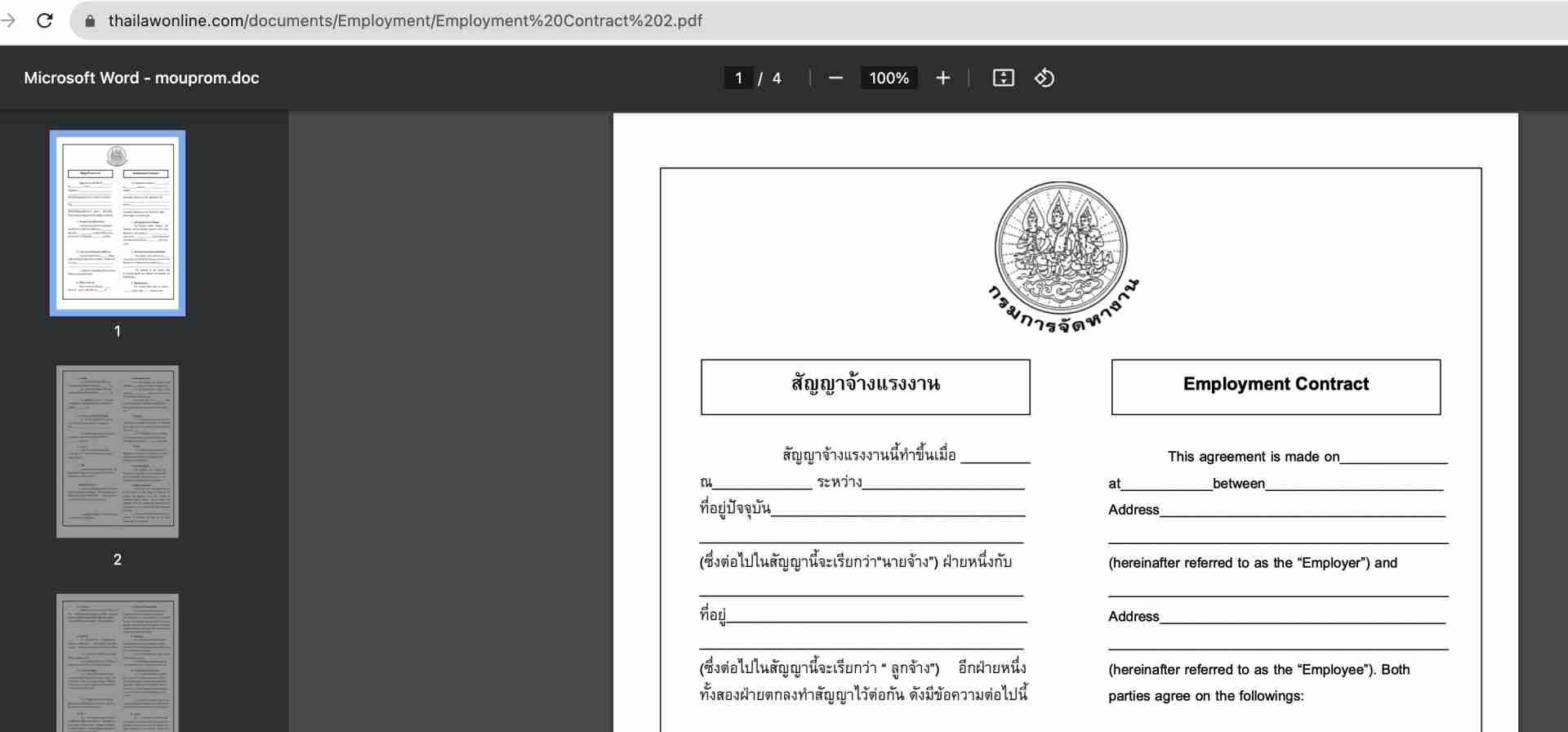
- Join Silver · สมัคร SilverBuy the Employment Pack ฿1,290 · ซื้อครั้งเดียว฿1,290 one-off · ครั้งเดียวThese templates download free for Silver members & above · ดาวน์โหลดฟรีสำหรับสมาชิก Silver ขึ้นไปThe Employment Pack is the fuller three-document set: employment contract, written warning and termination letter, bilingual Thai and English. Instant download after payment (Word + print-ready PDF). Pay by PayPal or card through PayPal, or by Thai bank transfer. · ดาวน์โหลดทันทีหลังชำระเงิน(Word · 4 pages), Short bilingual contract for straightforward employment. Commonly used by small businesses and for formally employing a spouse within a company.
- (Word · 3 pages), Concise bilingual agreement suitable for part-time or domestic employment arrangements.
- (Word · 3 pages), Formatted to meet the Thai Department of Employment’s requirements for work permit applications. Bilingual Thai/English format, accepted by immigration officers.
Complex Employment Contracts for Thailand
- (Word · 9 pages), Comprehensive bilingual contract including non-compete, non-solicitation, confidentiality, and intellectual property clauses. Ideal for senior staff, managers, or roles involving sensitive business information.
Last reviewed: 25 September 2026, in two passes (17 and 25 September). Labour Protection Act B.E. 2541 sections 5, 17, 17/1, 23, 61, 63, 118, 119, 123, 130 and 131, Labour Court Act B.E. 2522 section 38, Labour Relations Act B.E. 2518 section 13, Unfair Contract Terms Act B.E. 2540 section 5 and Civil Procedure Code section 46 were each read in the Thai text. The template descriptions and the Department of Employment’s document practice were not reviewed against an instrument. Re-read on 5 October 2026 against that stamp: no statement contradicts the sections listed, and the Employee Welfare Fund start date (1 October 2026) and 0.25 percent rate agree with this site’s reviewed labour-law guide; no change made. Still unverified: the template descriptions and the Department of Employment’s document practice.
Frequently Asked Questions about Employment Agreements in Thailand
Is a written employment agreement required by law in Thailand?
Thai law does not require employment agreements to be in writing, but the Labour Protection Act B.E. 2541 (1998) mandates certain minimum terms regardless. A written contract is strongly recommended, it provides clear evidence of agreed terms and protects both employer and employee in case of a dispute before the Labour Court.
Does a Thai employment agreement need to be in Thai?
There is no legal requirement for the contract to be in Thai, but any agreement submitted for a work permit application is handled by Thai officials, so have a Thai version ready. Court proceedings are conducted in Thai, and a court orders a party relying on a document in another language to file a certified Thai translation (Civil Procedure Code section 46), so a bilingual or Thai-language contract is strongly advisable. All downloadable templates above are bilingual Thai/English.
What notice period is required under Thai labour law?
Under section 17 of the Labour Protection Act, either party to an open-ended contract, including a probation contract, can end it by giving written notice at or before a wage payment date, taking effect on the next payment date. No more than three months of notice is ever required. With a monthly salary that is at least one full pay period, so notice given just after a payday runs for almost two months. The employer, but not the employee, may instead pay wages up to that date and end the employment at once (section 17/1). No notice is needed for a dismissal for one of the serious causes in section 119. A fixed-term contract ends on its end date without notice, but severance is still due when it ends unless it is a written contract for a specific project, occasional or seasonal work of no more than two years (section 118).
Can I include a non-compete clause in a Thai employment contract?
Yes. Non-compete clauses can be enforced in Thailand if they are reasonable in scope, duration and geographic area. Under section 5 of the Unfair Contract Terms Act B.E. 2540, a restriction on working that burdens the employee more than could normally be expected is enforceable only as far as is fair and reasonable. The court weighs its area and duration, the employee’s ability to work in another way or for someone else, and both sides’ legitimate interests, so a clause that would keep the employee out of any work can be cut down or not enforced. The Complex Employment Agreement template above includes a standard non-compete clause drafted to withstand Thai court scrutiny.
What employment documents are required for a Thai work permit?
A work permit application requires, among other documents, a signed employment agreement specifying the position, salary, and employment duration. The agreement must be between the employer in Thailand and the foreign national. Our template is formatted to meet these requirements exactly.
How much severance pay is required under Thai law?
Severance pay under the Labour Protection Act depends on length of service: 30 days (120 days to under 1 year) · 90 days (1-3 years) · 180 days (3-6 years) · 240 days (6-10 years) · 300 days (10-20 years) · 400 days (20+ years). Severance is not payable when an employee is dismissed for cause under Section 119 of the Labour Protection Act. A contract clause waiving severance is void; only a release signed after the employment has ended can settle it, as explained in our guide to severance pay waivers in Thailand.
Additional Resources
- Thai Labour Law, Complete Guide for Employers
- Work Permit in Thailand, Complete Guide (2026)
- Minimum Wage in Thailand (2025-2026)
- Self-Sponsoring Your Work Permit in Thailand
Need a customised employment agreement drafted by a licensed Thai lawyer? Book a consultation with our bilingual legal team, available in English, Thai, and French.
Try it yourself first, free
You do not have to book anything to get started. These run in your browser, and you only pay us if you decide you want a lawyer involved.
Legal Document Maker Gold members
Ten bilingual documents from a guided questionnaire, in the firm's own wording.
Open the toolAsk our AI assistant Free
Trained on Thai law and 77,000+ Supreme Court decisions. Ask anything, free.
Thai Law Updates, free by email
Plain-English updates on Thai law changes that affect foreigners: property, visas, marriage, business and wills. One short email a month from a firm practicing since 2006. No spam, unsubscribe anytime.