


Reviewed by ThaiLawOnline, a licensed Thai law firm practising in Thailand since 2006. Thai lawyer of record: Wichuda Atthamethakon, LL.M., Thai Bar Licence 3149/2556.
Last updated on
Starting a business in Thailand can help you get a work permit. This is a good way to work legally and stay long-term. As a foreign entrepreneur, you can self-sponsor through your own Thai company. This gives you full control over your career. It also ensures you follow Thai labor and immigration laws.
Self-sponsoring requires a company behind it, which is covered in our guide to setting up a business in Thailand.
This comprehensive guide covers every aspect of self-sponsoring your work permit through company formation, from initial capital requirements to ongoing compliance obligations. If you are starting a new business, it’s important to understand self-sponsorship. This is especially true if you are transitioning from being an employee to an entrepreneur. This is important for running a successful business in Thailand.
Table of Contents
Understanding Self-Sponsorship Requirements
Self-sponsoring a work permit means starting a Thai limited company. This company must meet all legal rules to hire foreign workers. You can then use this company to sponsor your own work permit as a director or employee. This approach is very different from being sponsored by an employer. You must make sure your company meets strict capital, staffing, and operational requirements.
Essential Company Requirements for Work Permit Sponsorship
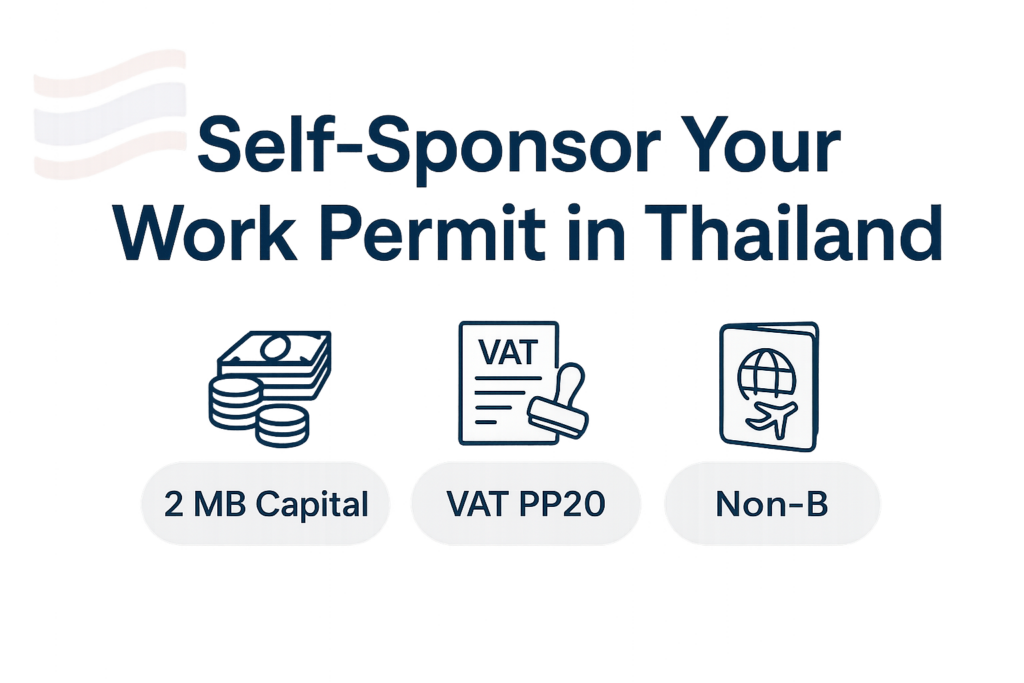
Your Thai company must satisfy several mandatory criteria before it can sponsor any foreign worker, including yourself. The most critical requirement is maintaining 2 million THB in fully paid-up registered capital per foreign work permit. This capital must be deposited into the company’s bank account and properly documented in the company’s financial records. However, the full amount is not required by law.
The 4:1 staffing ratio represents another fundamental requirement
Your company will need four full-time Thai nationals for each foreigner, but the requirement does not come from the work permit rules. It is an Immigration condition, item 2.1(5) of the criteria table annexed to Immigration Bureau Order 12/2568 of 23 January 2025, and it is applied to the one-year extension of stay rather than to the permit itself. The permit is sized by capital: the Department of Employment regulation of B.E. 2547 allows one foreigner per 2,000,000 baht of paid-up registered capital and sets no headcount ratio for a company at all, with its headcount route capped at three reserved for employers who are natural persons. In practice you need both, because a year in Thailand on this basis means a permit and an extension. Items 2.1(6) and 2.1(7) of the same table, not item 2.1(5) itself, relax the ratio to one Thai employee per foreigner. Item (6) excuses the 2,000,000 baht of capital and the financial statements for exactly three structures: a representative office, a regional office and a multinational branch office. A startup gets to one to one through the other limb of item 2.1, the one for the eighteen targeted industries and for startups certified by DEPA or the National Innovation Agency, and there the one-to-one ratio applies to a startup only once five years have passed since the company was registered, alongside its own conditions of 50,000 baht a month for the foreign employee and 1,000,000 baht of registered capital. Employees need to be registered in Thailand’s Social Security system.
- They must be registered for at least three months.
- After that, they can apply for the work permit.
This requirement ensures meaningful contribution to local employment while supporting the policy objectives of Thailand’s foreign worker regulations. If the applicant is married to a Thai national, with the marriage lawfully registered and the couple living together, clause 5(3) of the Department of Employment Regulation on criteria for considering permission for aliens to work B.E. 2547 halves the capital to 1,000,000 baht per permit. It does not halve the four Thai employees for a company: that ratio is Immigration’s, Immigration Bureau Order 12/2568 has no halved version, and the two-employee figure exists only in clause 6 of the regulation, for an employer who is a natural person. A foreigner married to a Thai usually extends on the marriage ground instead, which carries no Thai-employee ratio. That regulation was made under the Alien Employment Act, which the Emergency Decree on Managing the Work of Aliens B.E. 2560 repealed, and it continues to apply so far as it is not inconsistent with the Decree and until rules issued under the Decree replace it.
VAT registration becomes mandatory when employing foreign workers
Your company normally needs to get a VAT certificate (Por Por 20). You must also keep up with current VAT filings. This shows that your business is active and follows tax rules. Monthly VAT submissions must be filed by the 15th of each following month, creating ongoing administrative obligations. VAT is normally required if a company earns more than 1.8 million baht per year in sales.
Permanent office space verification is required for all work permit applications
Immigration and labor officers can do spot checks at your business address. You need a real office space and proper documents from the property owner to confirm your business operations.
Capital Requirements and Exemptions
The usual capital requirement of 2 million THB can drop to 1 million THB. This 1 million applies if the foreign work permit holder is married to a Thai citizen. This 50% reduction only applies to the spouse’s work permit. Any other foreign employees need the full 2 million THB capital for each permit.
Two limits on this route are worth knowing before you budget. The capital route is capped at ten foreigners, whatever the capital, unless the employer meets one of four tests: corporate income tax of at least 3 million THB paid in the past year, exports bringing in at least 30 million THB of foreign currency in the past year, a tourism business bringing at least 5,000 foreign visitors in the past year, or at least 100 Thai employees. The 3 million THB figure you will see quoted elsewhere is a different route: it applies where the employer is a juristic person registered abroad and operating in Thailand on funds brought in from outside, at one permit per 3 million THB. These figures come from the Department of Employment Regulation on criteria for considering permission for aliens to work B.E. 2547, clause 5. That regulation was made under the Alien Employment Act, which the Emergency Decree on Managing the Work of Aliens B.E. 2560 repealed, and it continues to apply so far as it is not inconsistent with the Decree and until rules issued under the Decree replace it.
Companies with registered capital exceeding 5 million THB face stricter verification requirements
These businesses must deposit the full capital amount within 15 days of starting up. They also need to give bank certificates to the Department of Business Development. This adds extra compliance requirements for larger companies.
BOI-promoted companies enjoy significant exemptions from standard work permit requirements
These businesses do not have to follow the 4:1 Thai employee rule. They can get faster processing at the One-Stop Service Center. However, they must meet their own minimum investment needs, which usually start at 1 million THB. You can read our article here about how to apply to the BOI.
Step-by-Step Company Formation Process
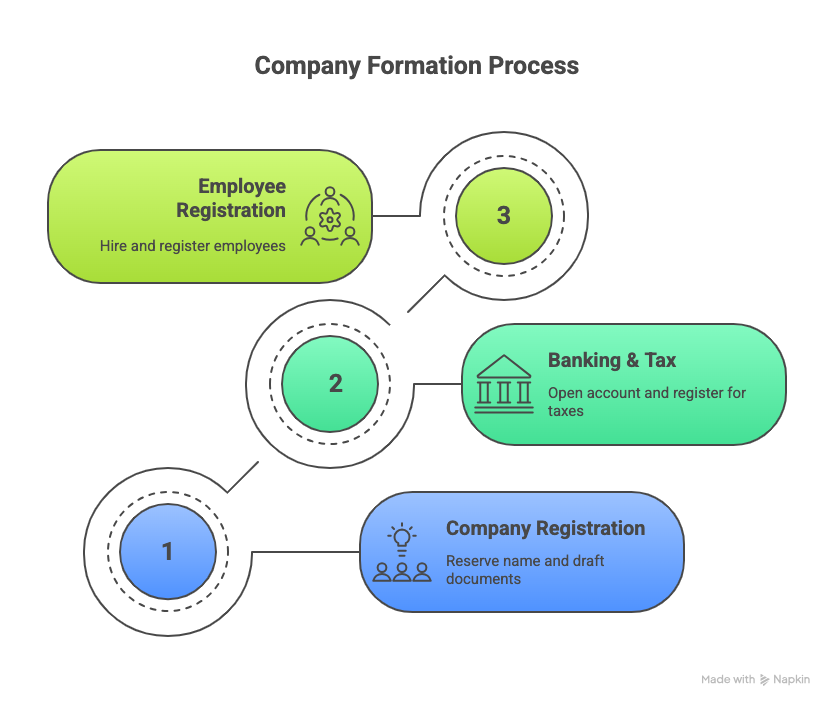
Phase 1: Company Registration and Setup
Company name reservation initiates the formation process. Reserve your desired company name through the Department of Business Development’s online platform, typically completed within 2 business days. Choose a name that reflects your business activities while avoiding restricted terms or existing registrations.
Memorandum and Articles of Association must be drafted and notarized. These documents define your company’s objectives, share structure, and operational framework. Include comprehensive business objectives to allow future expansion while ensuring compliance with the Foreign Business Act restrictions.
Shareholder structure requires careful consideration. Thai companies need at least two shareholders. Thai nationals must own at least 51% of the shares, unless there are treaty exemptions. Foreign shareholders provide passport copies and may require notarization of documents from their home country. If the company has over 50% foreign shares, it may need a foreign business license to operate.
Statutory meeting and incorporation filing complete the registration process. Directors must attend the statutory meeting where shares are allocated and management structure is established. The company registration must be filed within 90 days of this meeting to maintain validity.
Phase 2: Banking and Tax Registration
Corporate bank account opening requires director presence. At least one company director must go to the bank to open the corporate account. Thai banks do not allow online applications for business accounts. Foreign directors usually need valid long-term visas or work permits to get account approval. However, some banks may help with new company formation.
Tax ID and VAT registration must be completed within 60 days of incorporation. Apply for a corporate tax ID at the Revenue Department. Then, register for VAT if you hire foreign workers or expect annual revenue over 1.8 million THB.
Capital deposit verification ensures compliance. Transfer the required paid-up capital to your corporate bank account and obtain proper documentation. This capital can be used for real business activities. It also keeps the minimum balance needed for work permits. Do note that again, there is no need to transfer the full capital of the company. Accountants and law firm will explain you what is required by law.
Phase 3: Employee Registration and Social Security
Thai employee hiring must precede work permit applications. Recruit and formally employ four Thai nationals with proper employment contracts and salary structures meeting minimum wage requirements. These employees must register with Social Security. They need to contribute for at least three months before applying for a foreign work permit.
Social Security Office registration is mandatory within 30 days of hiring the first employee. Register your company as an employer and enroll all employees in the social security system. Both the employer and employee contribute 5% of the monthly salary. This is capped at 875 THB each month for salaries over 17,500 THB, the ceiling in force since 1 January 2026.
Work Permit Application Process
Documentation Requirements
Company documentation forms the foundation of work permit applications. Required corporate documents include business registration certificate, shareholder list, VAT certificate and recent filings, social security payment records, and corporate income tax submissions. All documents must bear the company seal and authorized director signatures.
Personal documentation requirements are comprehensive. Foreign applicants must provide copies of their passports. They also need to submit educational certificates. An employment contract or a directorship appointment is required. A curriculum vitae should detail relevant experience. Recent photographs are needed too. These photos must meet specific size requirements of 3×4 cm and be taken within the last six months.
Medical certificate requirements ensure health compliance. Obtain a medical examination from a qualified Thai physician within 30 days of work permit application. The examination screens for six prohibited conditions: leprosy, tuberculosis, elephantiasis, drug addiction, chronic alcoholism, and third-stage syphilis. Cost typically ranges from 500-900 THB including required blood tests and chest X-rays.
Application Submission and Processing
Labor Department submission initiates the approval process. Submit applications to the Ministry of Labor office in Bangkok or provincial Department of Employment offices elsewhere. Processing usually takes 7 to 10 business days in Bangkok. However, provincial offices may take longer. This depends on their workload and how complete the documents are.
Processing fees are structured by permit duration. Application fees include a 100 THB fee for submission. There are also permit fees. The fees are 750 THB for up to 3 months, 1,500 THB for 3 to 6 months, or 3,000 THB for 6 months to 1 year. Most business owners select the one-year option for maximum convenience and value.
Personal appearance for permit collection was historically required but recent changes allow alternative collection methods. Starting in August 2025, you can collect work permits in several ways. You can use authorized representatives, postal delivery, or other methods set by the Department of Employment. This change offers more flexibility for busy entrepreneurs.
Visa Coordination and Extensions
Non-Immigrant B Visa Requirements
Initial visa application typically occurs outside Thailand. You can apply for a Non-Immigrant B visa now online since January 2025. You can do this in your home country or in nearby countries. You will need to submit company documents, employment contracts, and personal documents, which for some nationalities includes a criminal record check in Thailand. Processing generally takes 5 working days with fees around 80 USD. Do note that some countries will forbid non-residents or non-citizens to apply in their country.
In-country visa conversion is possible under specific circumstances. Foreign nationals in Thailand on tourist or other visas can change to Non-Immigrant B status. They must go to the Immigration Bureau in Bangkok. They need to have at least 15 days left on their current stay. They also must meet all document requirements. Do note that it is extremely difficult to “change” a visa inside Thailand and there. isa lot of documents to provide. Very often, traveling abroad is easier and faster.
Annual Visa Extensions
One-year visa extensions require active work permit status. After obtaining your work permit, apply for annual visa extensions at local Immigration offices. These extensions are tied to your employment status and work permit validity, creating interdependent renewal cycles.
Minimum salary requirements vary by nationality. Immigration authorities set minimum salary requirements for visa extensions based on nationality. Some Southeast Asian and African nationals pay 25,000 THB per month. Citizens of Canada, Japan, United States and European nationals typically require 50,000 THB monthly earnings. If married to a Thai and under non-o visa, the salary can be lower.
Company performance documentation supports extension applications. Immigration officers may ask for proof of company revenue. This revenue should be enough to pay foreign employee salaries. They may also need audited financial statements. Additionally, proof of ongoing Thai employee registration and social security contributions is required.
Financial Considerations and Ongoing Costs
Initial Setup Investment
Company formation costs typically range from 50,000-80,000 THB for standard structures. This includes government registration fees. There are also extra expenses for company seals, bank account setup, and courier services.
Additional capital requirements for work permit eligibility significantly increase initial investment. A Thai-registered company that needs work permits must have 2 million THB of paid-up registered capital for each permit. This is a large upfront investment that must be kept during the business operation. The 3 million THB figure applies to a different case, where the employer is a juristic person registered abroad and operating in Thailand on funds brought in from outside, which is how a Treaty of Amity branch is often set up.
Professional service fees for comprehensive setup packages range from 100,000-500,000 THB depending on complexity, foreign ownership structure, and additional licensing requirements. International consultancy firms may charge USD 4,000-40,000 for complete formation and compliance packages.
Annual Operational Expenses
Accounting and audit requirements create ongoing professional service costs. Monthly bookkeeping starts at 5,000 THB. The cost depends on how many transactions you have. Mandatory annual audits for limited companies cost between 20,000 and 50,000 THB. These services are essential for maintaining corporate compliance and supporting visa renewals.
Tax obligations include corporate income tax at 20% and VAT at 7%. The reduced small and medium enterprise rates require two tests to be met together, and missing the second is a common and expensive surprise: paid-up capital of no more than 5 million THB on the last day of the accounting period, and revenue from sales and services of no more than 30 million THB in that same period. A company that meets both pays nothing on the first 300,000 THB of net profit, 15% between 300,000 and 3,000,000 THB, and 20% above that. A company that meets only the capital test pays 20% on everything.
Employee costs encompass salaries, social security contributions, and benefits. Four Thai employees earning minimum wage have monthly salary costs of about 44,000-60,000 THB. This amount varies by location. There are also social security contributions of 5% from both the employer and the employee. Minimum wage in Thailand was raised in 2025.
Alternative Structures and Special Programs
BOI Promotion Benefits
Board of Investment promotion offers substantial advantages for qualifying businesses. BOI companies do not have to follow the 4:1 Thai employee rule, though the BOI applies its own criteria under Office of the BOI Announcement No. Por. 8/2568, including minimum incomes by position and at least 70% Thai staff in a manufacturing project with more than 100 employees. They get faster work permit processing at One-Stop Service Centers. Their permits can last up to four years. They also have easier family visa procedures for dependents.
Eligible industries include technology, innovation, and targeted S-Curve sectors. The BOI prioritizes businesses in automotive, electronics, digital technology, biotechnology, renewable energy, and advanced manufacturing that contribute to Thailand’s economic development goals.
Smart Visa Programs
Smart Visa categories target specific professional and investor profiles. Smart T (Talent) visas need a monthly income of 100,000 THB. They also require skills in specific industries. Smart I (Investor) visas require a minimum investment of 20 million THB in technology companies. Alternatively, you can invest 5 million THB in startups.
Smart visa holders can work without traditional work permits in approved activities, eliminating many standard compliance requirements while providing up to 4-year validity periods. These programs specifically target high-value foreign professionals and investors contributing to Thailand’s innovation ecosystem.
Long-Term Residency Options
LTR visa programs provide alternative pathways for qualified individuals. The Work from Thailand category lets digital nomads and remote workers get digital work permits. There are no traditional capital and employee requirements. However, strict income and employment rules do apply.
Destination Thailand Visa (DTV) serves digital nomads and remote workers with less stringent requirements than traditional business visas. However, these programs target specific demographics and may not suit all business formation objectives. And remember, the DTV can not provide a work permit. People under a DTV can only work remotely and are exempt of work permits.
Compliance and Risk Management
Ongoing Legal Obligations
Annual general meetings and statutory filings are mandatory. Thai companies must hold annual meetings for shareholders. They need to file balance sheets and accounts with the Department of Business Development. They also must keep proper corporate records. Failure to meet these requirements can result in company suspension or dissolution.
Work permit renewals require continued compliance with all original requirements. Annual permit renewals necessitate proof of maintained capital levels, Thai employee registration, current VAT filings, and company operational evidence. Changes in job duties, location, or employer details require separate applications and fees.
Tax compliance obligations extend beyond basic corporate filings. Companies need to keep accurate accounting records. They must submit monthly VAT returns. They also need to file annual corporate income tax returns. Additionally, they must manage personal income tax for foreign employees. Professional accounting services are typically essential for ongoing compliance.
Common Pitfalls and Risk Mitigation
Nominee arrangements and artificial structures violate Thai law. Using Thai nationals as nominee shareholders or creating artificial business structures is illegal in Thailand. Using them to circumvent foreign ownership restrictions can result in criminal penalties, dissolution of the company, and deportation. Ensure all business arrangements are legitimate and commercially reasonable.
Work permit violations carry real consequences. For the foreign worker, section 101 of the Emergency Decree on Managing the Work of Aliens sets a fine of 5,000 to 50,000 baht and removal from the Kingdom once it is paid, with no prison term. A separate provision, section 64/1, then bars that person from holding a work permit until two years have passed since the penalty was served. The employer’s offence is section 102: a fine of 10,000 to 100,000 baht for each alien employed, and only on a repeat offence does it carry imprisonment of up to a year, a fine of 50,000 to 200,000 baht per alien, and a three-year ban on employing foreigners. Working without valid permits, exceeding authorized job descriptions, or continuing work after permit expiration can result in criminal prosecution and permanent exclusion from Thailand. Maintain strict compliance with permit terms and renewal deadlines.
Capital maintenance requirements are subject to ongoing scrutiny. Immigration and labor officials may verify capital deposits, business operations, and employee registrations at any time. Ensure sustained compliance with all financial and operational requirements throughout your business operations.
Strategic Considerations for Success
Self-sponsoring your work permit through Thai company formation represents a significant commitment requiring careful planning, substantial capital investment, and ongoing compliance management. Success depends on establishing legitimate business operations that meet both legal requirements and commercial viability standards.
Choose business activities carefully to ensure long-term sustainability. Select company objectives that align with your professional expertise while providing genuine business opportunities in the Thai market. Avoid businesses restricted under the Foreign Business Act unless obtaining appropriate licenses or operating under treaty exemptions.
Develop realistic financial projections that account for all mandatory costs. Beyond initial setup expenses, budget for ongoing employee salaries, professional services, tax obligations, and permit renewal fees. Ensure adequate working capital for business operations while maintaining required capital levels for work permit compliance.
Establish proper corporate governance and operational procedures from the beginning. Implement genuine business activities, maintain proper accounting records, conduct regular board meetings, and ensure all employees perform legitimate functions. These practices not only ensure legal compliance but also support long-term business success and potential expansion opportunities.
FAQS about Self-Sponsoring Your Work Permit in Thailand as a Business Owner
How does self-sponsorship for a Thailand work permit through company formation actually work?
Self-sponsorship means you set up a Thai limited company. This company must meet all legal requirements to hire foreigners. You can then use this company to sponsor your own work permit as a director or employee. To operate in Thailand, you need several things. First, you must have paid-up registered capital in your company bank account. You also need a compliant shareholder structure. Your business must have active operations and a permanent office address. Additionally, you must register for tax and VAT. You will need four full-time Thai staff for each foreigner, which Immigration checks at the extension of stay rather than the Department of Employment at the permit. Once you have all this, you can file at the Department of Employment. You will also need to coordinate your Non-Immigrant “B” visa and annual extensions with Immigration. This creates a legal way to work and stay long-term in Thailand.
What is the 2,000,000 THB paid-up capital rule (and when is it 1,000,000 THB) for a self-sponsored work permit in Thailand?
The standard threshold is 2,000,000 THB in fully paid-up registered capital for each foreign work permit. This amount must be verified by bank deposit and corporate records. If the permit holder is married to a Thai citizen, the amount can be reduced to 1,000,000 THB. This reduction only applies to that spouse’s permit. Companies with more than 5,000,000 THB in registered capital have stricter rules. They must deposit the full amount within 15 days. They also need to file bank certificates with the Department of Business Development. However, BOI-promoted companies have their own investment rules. They often do not follow the usual headcount ratio.
Do I really need four Thai employees before applying, what does the 4:1 staffing ratio involve?
Yes, but it is an Immigration rule rather than a work permit rule, and standard companies meet it for the one-year extension of stay: four Thai nationals for each foreigner, under item 2.1(5) of the table annexed to Immigration Bureau Order 12/2568. You also need to enroll them with the Social Security Office. They must contribute for at least three months before you apply. These employees need proper contracts and wages that meet local minimums. Their ongoing SSO contributions are checked during renewals. This ensures they are real employees and not just nominal hires.
Which registrations and premises evidence are mandatory, VAT (Por Por 20), tax ID, and a real office address?
After you incorporate, you will get a corporate tax ID. If you hire foreigners or exceed 1.8M THB in sales, you must register for VAT. You also need to keep your monthly PP30 filings current by the 15th of the next month. Many companies also manage routine withholding tax (PND 1/3/53) along with VAT. A verified, permanent office is important. Officers may check the site. So, have a proper lease and landlord documents. Use your company seal and signage. Make sure you have utilities that show active business operations at your registered address.
Which visa do I need, Non-Immigrant B vs BOI, Smart Visa, or LTR/DTV, and how do extensions work for entrepreneurs?
Most self-sponsored founders begin with a Non-Immigrant “B” visa. They get this visa at a Thai embassy or through in-country conversion. They then extend it each year at Immigration. This extension is based on an active work permit and a minimum salary by nationality. They also need valid VAT, SSO, and tax compliance. Additionally, they must show that the company can pay salaries. Visas and permits renew together. Alternatives include BOI promotion, which offers ratio exemptions and One-Stop Service Center processing. There are also Smart Visa categories, like Smart T/I, which can last up to 4 years. This visa does not require a traditional work permit for approved activities. Additionally, there are Long-Term Resident or Destination Thailand Visa programs. These programs are designed for specific groups, such as high-income professionals or remote workers.
What are the real costs, timelines, and common pitfalls of self-sponsorship in Thailand for foreign entrepreneurs?
Founders should plan for government fees and legal costs for incorporation. They need 2 million THB of paid-up registered capital for each permit, or 3 million where the employer is a juristic person registered abroad operating on funds brought in from outside. Monthly bookkeeping, annual audits, payroll, SSO, and VAT compliance are also necessary. They should budget for four Thai salaries and Immigration and Employment fees for initial issuance and renewals. Remember, corporate income tax is usually 20%, and VAT is 7%. There may be relief available for SMEs. The biggest risks include using nominee shareholders, which is illegal. Other risks are failing the 4:1 and capital maintenance checks. Missing PP30 or withholding filings is also a concern. Not having a real office can be a problem too. To avoid refusals and blacklisting, focus on strategic planning. Keep documented banking trails and clean DBD and revenue records. Make sure job scopes align with the Foreign Business Act. This will help support long-term business success.
The self-sponsorship route provides unparalleled control over your professional destiny in Thailand while creating genuine business opportunities. Starting your own company in Thailand can be successful. To do this, you need good planning, enough money, and expert help. This can help you get a work permit and achieve long-term success in the market.
Last reviewed: 14 September 2026. The capital and staffing figures were read in Thai against clause 5 of the Department of Employment Regulation on criteria for considering permission for aliens to work B.E. 2547: clause 5(3) for the 2 million THB of paid-up registered capital per permit, the halving where the applicant has a lawfully registered Thai spouse, the ceiling of ten foreigners and its four exceptions, and the separate 3 million THB route for an employer registered abroad operating on funds brought in from outside; and clause 6(3) for one foreigner per four Thai employees, capped at three and halved for a Thai spouse, which applies where the employer is a natural person rather than a company. A correction was made on 20 September 2026: the clause number given here was wrong and the cap was stated as though it reached a company limited. The repeal of the Alien Employment Act B.E. 2551 and the saving of existing subordinate legislation were read from sections 3 and 145 of the Emergency Decree on Managing the Work of Aliens B.E. 2560. Not verified in this review: the cost estimates, the processing timelines, the Social Security and VAT administrative steps, the BOI, Smart Visa and LTR sections, and the visa extension criteria, which are set by the Immigration Bureau and not by the work permit rules above.
Thai Law Updates, free by email
Plain-English updates on Thai law changes that affect foreigners: property, visas, marriage, business and wills. One short email a month from a firm practicing since 2006. No spam, unsubscribe anytime.