


Reviewed by ThaiLawOnline, a licensed Thai law firm practising in Thailand since 2006. Thai lawyer of record: Wichuda Atthamethakon, LL.M., Thai Bar Licence 3149/2556.
Last updated on
Thai Social Security provides healthcare and cash benefits according to your insured status and contribution record. Employees, former employees and eligible self-employed people belong to different schemes. Check which scheme applies before relying on a benefit.
The administrator is the Social Security Office (SSO) (สำนักงานประกันสังคม), under the Ministry of Labour. French explanatory name: Bureau de la sécurité sociale. Use the SSO’s e-Self Service portal or contact the responsible SSO office to check your insured status and contribution record. Before asking about a benefit, identify your scheme and the months paid; the answer depends on your own record. Employment rights and an SSO benefit claim are separate issues, covered together in our Thai labour law guide.
The Section 33 contribution ceiling increased to 17,500 THB per month from 1 January 2026. Contribution ceilings and benefit calculations are separate questions: a higher ceiling does not increase every payment immediately.
Targeted review: 21 September 2026. This update covers Section 40 packages, old-age benefit distinctions, foreign-income remittances and related FAQs. Earlier statutory and case-law reviews are recorded below.
Table of Contents
How Does Social Security Work in Thailand?
Thailand’s Social Security system is administered by the Social Security Office (SSO), operating under the Ministry of Labour. It functions as a mandatory safety net: contributions are collected from employees, employers, and the government, then pooled into the Social Security Fund. The Fund pays out benefits covering healthcare, cash replacement during illness or unemployment, maternity support, disability, old-age pensions, and death benefits.
The governing law is the Social Security Act B.E. 2533 (พระราชบัญญัติประกันสังคม พ.ศ. 2533), which has been amended several times since its enactment in 1990. The system covers virtually all private-sector employees in Thailand, regardless of nationality. If you hold a valid work permit and are employed by a Thai company, you are in the system.
The SSO operates separately from the Workmen’s Compensation Fund, which covers work-related injuries. We explain the difference further below.
Who Must Register and Contribute?
Section 33, Employees (Mandatory)
Every employee aged not below fifteen and not over sixty, working for an employer with one or more workers, is automatically an insured person under Section 33 of the Social Security Act. Someone who is already insured and then turns sixty stays insured while they remain employed by any employer covered by the Act (Section 33 paragraph two), but a first job started after sixty does not bring you into Section 33. This includes foreign nationals with a valid Non-Immigrant B visa and work permit. The employer must register the employee with the SSO within 30 days of hiring.
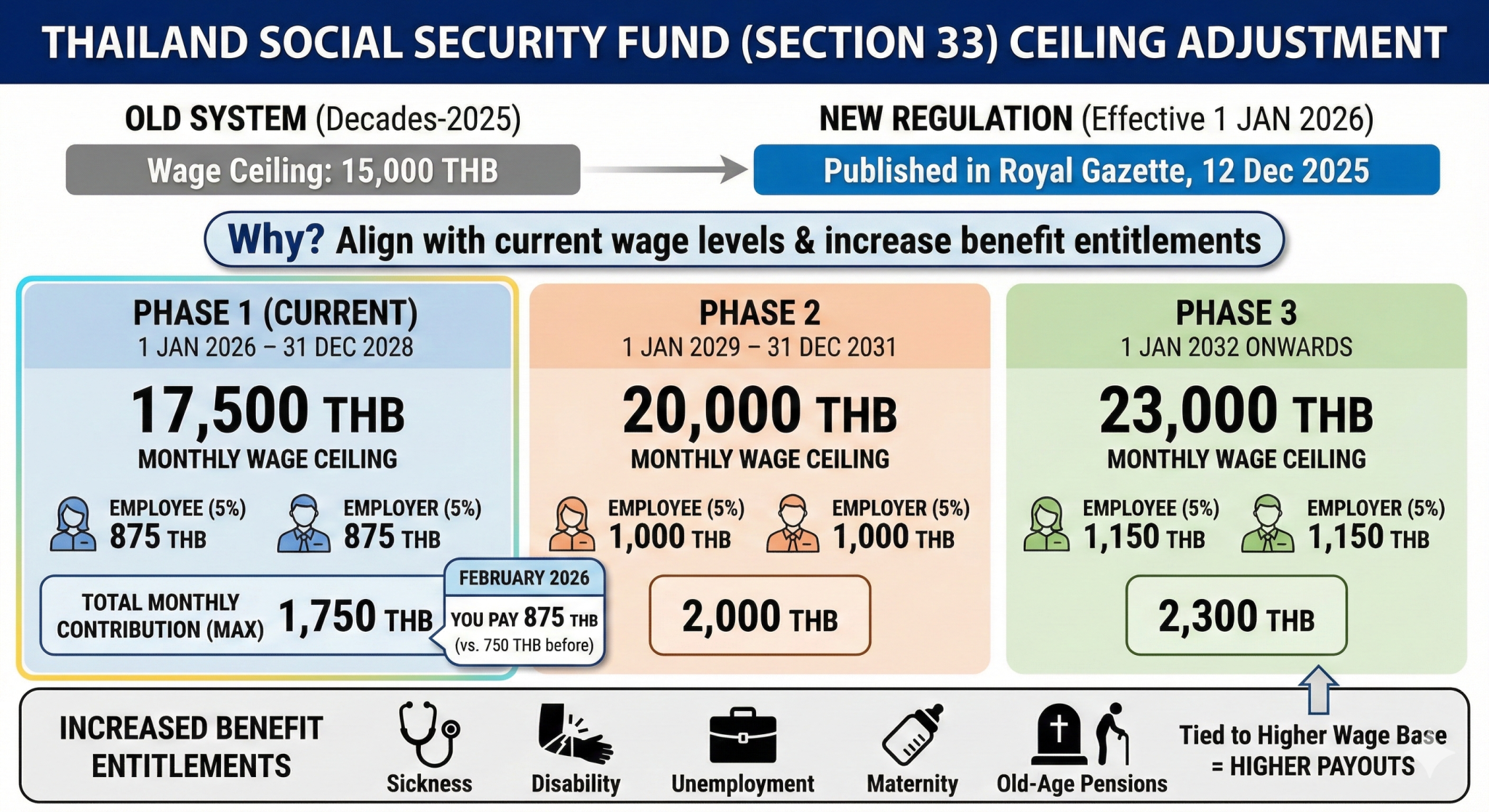
Contributions are shared three ways: the employee pays 5% of monthly wages, the employer pays 5%, and the government contributes an additional percentage. For 2026, the contribution base has been raised to a maximum of 17,500 THB per month (up from 15,000 THB), meaning the maximum monthly contribution is 875 THB each for employee and employer.
Contributions are calculated on the “wages” as defined under Section 5 of the Act, meaning money paid as compensation for work during normal hours, including pay during holidays and leave. The Supreme Court has clarified what does and does not count as “wages” for this purpose (see our Supreme Court section below).
Thailand Social Security for Expats and Foreign Workers
Social Security for Expats and Foreigners in Thailand Expats working in Thailand must join social security under Section 33 if employed. Retirement visas like O-A often exclude work permits, limiting eligibility. There is no US-Thailand social security totalization agreement, so US Social Security credits and Thai contributions are not combined. A separate US-Thailand double taxation treaty governs how pension income is taxed. Section 39 continuation depends on eligibility, a timely application and maintaining insured status; coverage is not an unconditional lifetime entitlement. Many expats use Thailand social security as low-cost health insurance. Check visa interactions to avoid gaps in coverage.
Section 39, Voluntary Continuation After Leaving Employment
If you leave your job but remain in Thailand, you do not have to lose your SSO coverage. Section 39 lets a former Section 33 member continue voluntarily, but on two conditions the six-month window is often quoted without: you must have paid contributions for not less than twelve months, and your insured status must have ended under Section 38 (2), that is by ceasing to be an employee. If both hold, you express your intention to the SSO within six months of your insured status ending.
The normal Section 39 contribution is 432 THB per month, calculated at 9% of a 4,800-THB base, subject to any applicable temporary reduction. Coverage includes sickness or injury, maternity, disability, death, child allowance and old-age benefits. Unemployment benefit is excluded. Each benefit has its own qualifying conditions.
Section 39 continuation requires a timely application and the qualifying contribution history. Missing the usual six-month application period does not justify saying the person is barred permanently in every future circumstance. Ask SSO about the applicable extension provisions and any later qualifying Section 33 employment.
Section 40, Self-Employed and Freelancers
Section 40 is voluntary and has separate eligibility rules. Applicants must be outside Sections 33 and 39 and meet the age and other conditions, including the nationality or qualifying non-national identity-card requirement. Thai nationality is not the only qualifying category: specified holders of Thai-issued non-national identity cards also qualify. An ordinary foreign passport or LTR visa alone does not establish eligibility. Check eligibility with the Social Security Office (hotline 1506) before applying.
- Package 1 (70 THB/month): Cash benefits for injury or sickness, disability and death.
- Package 2 (100 THB/month): The same benefit categories as Package 1, plus an old-age lump sum.
- Package 3 (300 THB/month): Injury or sickness, disability, death, an old-age lump sum and child allowance, subject to the package rules. This is not the monthly pension available under Sections 33 and 39.
Section 40 cash benefits do not replace healthcare coverage. Compare the benefits, eligibility and effect on accrued old-age rights before leaving Section 39. The cheapest contribution is not necessarily the best choice.
A visa category alone does not decide Social Security eligibility. Section 33 concerns covered employment; Section 39 concerns qualifying former employees; Section 40 has its own applicant qualifications. Confirm the relevant scheme separately from immigration and work-authorisation requirements.
Who Is Exempt?
Section 4 lists who the Social Security Act does not apply to: government officials and permanent employees of central, regional and local government agencies; students and nursing students employed by the school, medical establishment, college or university they attend; employees of foreign governments and of international organisations; and anyone else prescribed by Royal Decree. The third of those matters most to readers of this page: if you work for an embassy or an intergovernmental body in Thailand, you are outside the scheme by statute. However, the Supreme Court ruled in Decision No. 875/2548 that government nurses working after hours for a private hospital are considered employees of that private hospital for SSO purposes. The Section 4 exemption applies only while performing official government duties, not when moonlighting privately.
What Benefits Does Social Security Provide?
1. Sickness and Injury Benefits (Sections 62-64)
For a qualifying non-work-related illness or injury, medical care follows the SSO hospital and treatment rules. Sickness income replacement is separate: 50% of the prescribed wage base, normally up to 90 days per illness and 180 days per calendar year. Payment does not overlap with the period during which you remain entitled to sick-leave wages from your employer. The contribution test is at least three months within the preceding fifteen months.
Qualifying chronic illness has a separate maximum of 365 days under the applicable rules. Obtain the medical evidence and SSO assessment; reaching 180 days does not create an automatic extension for every illness.
2. Maternity Benefits (Sections 65-68) in the Social Security in Thailand
For eligible Section 33 and 39 members, the childbirth payment is 15,000 THB per delivery, with no limit on the number of delivery claims. The qualifying contribution period is at least five months within the preceding fifteen months. Prenatal-care reimbursement is separate, up to 1,500 THB under the prescribed stages. The insured mother’s maternity income-replacement benefit is another payment with its own limits; do not apply that payment’s two-claim limit to the childbirth payment. Official maternity and child-allowance guidance.
3. Disability Benefits (Sections 69-72)
For non-work-related disability, Section 71 distinguishes the assessed categories. For disability outside the severe category, the rate and duration follow the prescribed Medical Committee rules, subject to a ceiling of 50% of the Section 57 wage base. Severe disability meeting the statutory criteria carries 50% of that base for life. Do not assume every non-severe case receives 50% indefinitely. Medical treatment, rehabilitation and qualifying contribution conditions require separate checks.
4. Death Benefits (Sections 73 and 73/1)
When an insured person dies, the SSO pays funeral expenses (ค่าทำศพ) of 50,000 THB plus a survivor grant (เงินสงเคราะห์) as a lump sum based on contribution history. You need at least one month of contributions within the six months before death.
The Supreme Court has established an important rule about who qualifies for death benefits. In Decision No. 8889/2547, a worker on extended sick leave whose employer stopped deducting contributions died without having at least one month of contributions within the six months before death. The surviving spouse was denied death benefits under Section 73. This highlights that gaps in contributions, even during legitimate sick leave, can eliminate benefit eligibility for your dependents.
Different Social Security benefits have different recipients. Do not assume the person who receives funeral expenses also receives the old-age lump sum. Older decisions interpreting “person” and “heir” must be read against the wording applicable when the entitlement arose, including the later amendments to Section 77 quater.
Funeral expenses and the separate death-assistance payment are different benefits, and the Act can pay them to different people. Section 73(1) sets 100 times the highest daily minimum wage only as a floor for the funeral payment; the amount paid is the flat 50,000 THB fixed by ministerial regulation, not a figure you calculate yourself. Check the recipient and contribution conditions with SSO.
5. Child Allowance (Sections 74 to 75 quater)
Eligible Section 33 and 39 members receive child allowance of 1,000 THB per child per month, for up to three qualifying children from birth until age six. The contribution test is at least twelve months within the preceding thirty-six months. Check the child’s legal status and the other entitlement conditions.
6. Old-Age Benefits (Sections 76 to 77 quarter) for Social Security in Thailand
For the ordinary Section 33/39 pension route, you must be at least 55, have at least 180 contribution months and have ended insured status. Leaving employment does not end Section 39 status if you continue in that scheme. The existing pension formula uses 20% of the average contribution wage over the final 60 months, plus 1.5 percentage points for each complete 12 months beyond 180. For an ordinary old-age lump sum, fewer than 12 contribution months and 12 to 179 months are treated differently: the former uses the insured person’s old-age contributions; the latter includes the employer’s old-age contributions and prescribed returns. This is not a refund of every Social Security contribution. See the Ministry of Labour benefit guide. The special departing-foreign-worker route is discussed below.
The Supreme Court held in Decision No. 9484/2559 that the right to an old-age payment arises in the month insured status ends, not in the month you get round to claiming it, and that this is what fixes the rate of return paid on a lump sum. That claimant left work in December 2551, when the published rate was 6.30 per cent a year. The SSO issued a new notification in January 2552 cutting the rate to 0.10 per cent, and he applied in February 2552, after it. The Court held the earlier rate was already his and ordered the SSO to pay the shortfall of 5,526.31 THB with interest. If you stop work near a year end, record the date your insured status ended.
The current Section 77 quater is wider than the older three-category rule. It includes a person designated in writing to receive the old-age lump sum, alongside the statutory family categories. Where none of those primary beneficiaries exists, the section provides successive fallback classes: full siblings, half siblings, grandparents, then uncles and aunts. The statutory conditions, exclusions and shares still apply. Do not use Decision No. 7328/2551 as a statement of today’s complete beneficiary list. Keep the specific SSO beneficiary designation and family-status documents current. Official guidance on survivor benefits.
7. Unemployment Benefits (Sections 78 to 79/1)
For a qualifying termination, unemployment benefit is 60% of the applicable wage base, for up to 180 days per calendar year, under the Ministerial Regulation on unemployment benefit (No. 2) B.E. 2568, in force from 28 June 2025. Resignation or expiry of a fixed-term contract follows the separate 30% rate for up to 90 days. Section 78 requires at least six months of contributions within the fifteen months before the unemployment, registration with the state employment office and reporting at least once a month, and it excludes a person dismissed for dishonesty, a deliberate crime against the employer, serious breach of work rules or seven consecutive working days of unexcused absence. Benefit runs from the eighth day of unemployment (Section 79). Ministerial Regulation (No. 2) B.E. 2568, Royal Gazette vol. 142 part 44 Kor, 27 June 2025.
Phased Wage Ceiling Increases Table:
| Year | Wage Ceiling (THB) | Max Contribution (THB) |
|---|---|---|
| 2026 | 17,500 | 875 |
| 2029 | 20,000 | 1,000 |
| 2032 | 23,000 | 1,150 |
Thailand Social Security Benefit Calculator Examples 2026
2026 Thailand Social Security Benefit Calculations and Examples With the new wage ceiling at 17,500 THB. Starting January 2026, maximum contributions are 875 THB each from employee and employer.
- Unemployment benefit: A qualifying termination uses 60% of the wage base assessed under the SSO rules, for up to 180 days per calendar year. Ask SSO to calculate the payment from the contribution record; do not equate the latest salary automatically with the benefit base.
- Sickness Benefit Example: 50% wage for 90 days max per illness. Use SSO online tools for personalized estimates. Phased increases: 20,000 THB in 2029, 23,000 THB in 2032. Calculate your benefits via the SSO website.
Can I Use a Private Hospital with Social Security in Thailand?
Routine SSO treatment uses your designated hospital or its referral network, which includes participating private hospitals. The SSO electronic-service guidance allows the ordinary annual hospital change between 16 December and 31 March, with a separate route during the year for qualifying moves of home or workplace across provinces. Check the available hospital and conditions before requesting a change. See the SSO electronic-service portal.
However, the Supreme Court has addressed what happens in emergencies. In Decision No. 6934/2546, the Court ruled that when a patient’s condition is life-threatening and the designated hospital cannot provide adequate treatment, transferring to a non-designated hospital is a “reasonable necessity” under Section 59. You do not lose your SSO rights by seeking emergency care elsewhere, and the SSO must reimburse the costs. What it reimburses is bounded rather than open. That patient recovered 231,268 THB, being the expenses actually and necessarily incurred within 72 hours of her first treatment, which was the cap set by the SSO notification then in force, so check the current notification before assuming a large private bill is covered in full.
But there are limits. In Decision No. 8094/2560, the Court ruled that choosing a non-designated hospital simply because you prefer that hospital or are familiar with its doctors, when your designated hospital was closer and available, does not qualify as “reasonable necessity.” That patient was denied reimbursement. The practical rule: in a genuine emergency, go to the nearest hospital and your rights are protected. For non-emergency situations, always use your designated hospital or request a formal referral.
Does Social Security in Thailand Cover Dental Treatment?
Dental benefits changed from 1 May 2026. Basic extraction, fillings and scaling at private hospitals or clinics retain a 900-THB annual allowance. Wisdom-tooth surgery has a separate allowance, up to 1,500 THB per tooth for a simple procedure or 2,500 THB for a complex procedure. Dentures and qualifying implant-supported treatment have separate conditions and limits. Contracted public-hospital rules differ. Confirm the provider and benefit before treatment. Official dental-benefit update.
What About the 2026 Wage Ceiling Increase?
Effective 1 January 2026, the statutory wage ceiling for SSO contributions increased from 15,000 THB to 17,500 THB per month, so the maximum monthly contribution rises from 750 THB to 875 THB each for employee and employer. The instrument is the Ministerial Regulation prescribing the minimum and maximum wages used as the base for calculating the contributions of insured persons under Section 33, B.E. 2568, signed by the Minister of Labour on 11 December 2025 and published in the Government Gazette on 12 December 2025, volume 142 part 81 Kor, page 5. It is made under sections 7 and 46 of the Social Security Act B.E. 2533, and it repealed Ministerial Regulation No. 7 (B.E. 2538), which had held the ceiling at 15,000 THB since 1995.
The same regulation also sets a minimum base of 1,650 THB a month, so an employee earning less than that still contributes 5 percent of 1,650, which is about 83 THB.
Employers must update their payroll systems to deduct from the new ceiling. The two later steps are not proposals: the same regulation fixes them now, at 20,000 THB from 1 January 2029 to 31 December 2031 and 23,000 THB from 1 January 2032, each with the same 1,650 THB floor. Nothing further has to be passed for those to take effect.
Employee Welfare Fund, New Mandatory Scheme in 2026
In addition to the wage ceiling increase, employers now contribute to the Employee Welfare Fund (กองทุนสงเคราะห์ลูกจ้าง). It was originally scheduled for October 2025, was postponed, and collection started on 1 October 2026. The EWF sits in the Labour Protection Act, not the Social Security Act. Under Section 130, employees of a business with ten or more employees become members, unless the employer runs a provident fund under the Provident Fund Act or an approved welfare scheme. Under Section 131 the employer deducts the employee’s savings from wages and adds an equal employer contribution, capped by the Act at 5 percent of wages; the announced rates are 0.25 percent each from 1 October 2026 and 0.5 percent each from 1 October 2031. Combined with the SSO ceiling increase, businesses face two statutory cost increases in 2026.
If you are setting up a company in Thailand or managing payroll for an existing business, update your workforce cost projections for 2026-2027 to account for both increases. For guidance on your employer tax obligations related to these contributions, see our guide on personal income tax in Thailand and tax ID registration.
Can I Opt Out of Social Security in Thailand?
No. Contributions are mandatory for all employees covered under Section 33. Having private insurance does not exempt you or your employer from SSO contributions. The two systems run in parallel, private insurance is supplementary, not a substitute for the statutory scheme.
What Is the Difference Between Social Security and the Workmen’s Compensation Fund?
Many expats and employers confuse two separate systems that run in parallel. The Social Security Fund, governed by the Social Security Act B.E. 2533, covers non-work-related injury, illness, maternity, death, old-age, and unemployment. Contributions are shared between employee (5%), employer (5%), and the government.
The Workmen’s Compensation Fund (WCF), governed by the Workmen’s Compensation Act B.E. 2537 (พ.ร.บ.เงินทดแทน พ.ศ. 2537, amended in 2018), covers work-related injury, illness, disability, and death only. The employer pays 100% of the WCF contribution, ranging from 0.2% to 1.0% of payroll depending on industry risk. Employees pay nothing toward the WCF.
In practice: if an employee breaks their leg at home on a weekend, the SSO covers treatment. If the same employee breaks their leg at the factory during working hours, the Workmen’s Compensation Fund covers it. Both systems run simultaneously, and the employer must register and contribute to both. If you are involved in a workplace accident, the legal framework that applies depends entirely on whether the injury occurred during work or outside of it.
Can I Claim Social Security AND Sue the Person Who Injured Me?
Yes. The Supreme Court addressed this directly in Decision No. 963/2539, a landmark case. If you are injured by a third party, for example, in a traffic accident, you have two separate rights: you can claim benefits from the Social Security Fund, and you can also sue the person who caused your injury for damages under civil liability rules. These are independent legal rights, and the Court named their two sources: Section 54 of the Act and Section 420 of the Civil and Commercial Code. The claimant in that case still recovered nothing from the Fund. He and his mother had signed a form at the private hospital electing not to use his social security rights, so that the driver who hit him would pay for a higher standard of care. The Court held that choice was his to make and was not contrary to public order, so it bound him, and once he had taken 140,000 THB from the driver and put it towards the hospital bill he could not claim the same medical costs from the Fund a second time. His claim was dismissed.
Decision No. 963/2539 must be read in its historical context and against later amendments. Section 54/1, added in 2015, states that claiming benefits under the Act does not extinguish rights under other laws. Do not treat an old case summary as a general rule that every current waiver of SSO benefits is binding. Review the actual settlement and statutory rights before signing.
What Can I Do If Social Security Denies My Claim?
Thai law provides a structured appeals process under Sections 85-87 of the Social Security Act.
First, you must file a written appeal to the Appeals Committee (คณะกรรมการอุทธรณ์) within 30 days of receiving the SSO’s decision (Section 85). The Committee reviews the case and issues its own decision. If you disagree with the Committee’s ruling, you may file a case with the Labour Court within 30 days of receiving the written decision (Section 87). If you miss this deadline, the Committee’s decision becomes final.
The deadline for an initial benefit claim under Section 56 is two years from the date the entitlement arises, and it has been two years since the Social Security Act (No. 4) B.E. 2558 replaced the section, Royal Gazette volume 132 part 53 Kor, 22 June 2015. Before that it was one year. Missing it is still not an absolute bar: Section 56 paragraph two now says in terms that a late applicant may state the reasons and the necessity for filing late, and the Secretary-General shall accept the application if those reasons are sufficient. That is the same protection the Supreme Court read into the old section in Decision No. 895/2547, when it held the deadline to be a procedural timeline rather than a rigid cutoff, now written into the Act itself. Decision No. 8630/2550 goes further. A worker who left his job at 60 and applied for his old-age lump sum more than a year later was told he was out of time. The Supreme Court held that the one-year period in Section 56 paragraph one was only there to press claimants to act promptly and was never a provision that cut off the right, so he kept the money. The SSO had argued that the former Section 84 bis, which let a person outside Thailand or facing necessity apply to extend the Section 56 deadline, was the only relief available to a late claimant; the Court rejected that as well, holding that Section 84 bis was equally not a provision that cut off the rights of an employee. Note that the extension route has since changed. The same amending Act repealed Section 84 bis and replaced it with Section 84/1, which covers only Sections 39, 45, 47 and 47 bis. Section 56 is no longer extendable that way, and being outside Thailand is no longer a listed ground; the route is now Section 56 paragraph two itself.
For expats dealing with this process: if the SSO sends the Appeals Committee’s decision by registered mail to multiple addresses, the Supreme Court has ruled (Decision No. 6925/2557) that the 30-day clock starts from the later delivery date. Where a period is counted in days, Civil and Commercial Code Section 193/3 excludes the first day, so the clock starts the day after receipt. If you are unsure about the timeline, consult with a lawyer before the deadline expires.
What Counts as “Wages” for Contribution Calculations?
Section 5 of the Social Security Act defines “wages” (ค่าจ้าง) as money paid by the employer as compensation for work during normal working hours, including pay during holidays and leave. However, not every payment to an employee qualifies.
The Supreme Court has provided important clarifications. In Decision No. 8245/2560, the Court held that service charges, tip pooling collected from hotel and restaurant customers and distributed to employees, are not “wages” under Section 5. The employer acts merely as an intermediary; these payments are not compensation for normal working hours. Employers should not include pooled service charges when calculating SSO contributions.
Similarly, in Decision No. 8093/2560, a “seat allowance” (ค่านั่งเครื่อง) paid to cashiers, which could be reduced for misconduct, was ruled to be an incentive payment, not wages. It fell outside the Section 5 definition.
For employers: an incorrect classification of payments can trigger penalties during an SSO audit. If you operate in the hospitality or retail sector, review your payroll categories carefully against these rulings.
How Do I Claim Benefits When Leaving Thailand?
If you leave Thailand permanently and your insured status ends, you may be entitled to a lump-sum old-age payment (บำเหน็จชราภาพ) under Section 77 bis. Its third paragraph is written for exactly this situation: where the insured status of a person who does not have Thai nationality is terminated and that person does not wish to remain in Thailand, the superannuation gratuity is payable whether or not the 180 months of contributions have been reached. The 180-month threshold in Section 76 governs the monthly pension, not this lump sum. How much you receive depends on how long you contributed, which is set by Ministerial Regulation rather than by the Act.
Before leaving Thailand, ask the SSO office handling your record to confirm the departure-based claim route, required evidence and payment arrangements. Prepare your passport, contribution record, employment-end documents and account details for that check. Obtain the current application checklist and keep proof of submission. Do not rely on a universal processing time or assume every claim requires an in-person visit before departure.
Do not discard a claim merely because your employment was short. Nor does reaching 180 contribution months automatically exclude the special lump-sum route for a non-Thai insured person whose status has ended and who does not wish to remain in Thailand. Section 77 bis paragraph three expressly addresses that situation, subject to ministerial rules. Request a written assessment before choosing between continued coverage and a departure claim. See the 2015 amending Act, Section 36.
Can I Receive My Home Country’s Pension in Thailand?
This is a separate question from Thai Social Security. If you are a US citizen receiving Social Security benefits from the United States, your payments generally continue while you live in Thailand, most retirees keep their US bank account and access funds via international transfer or ATM withdrawal. However, US Medicare does not cover healthcare in Thailand. You will need separate health insurance or pay out of pocket. Delaying a remittance until a later year does not by itself exempt foreign income earned from 1 January 2024 while Thai tax resident. Under Revenue Department Orders Por. 161/2566 and 162/2566, assessable income within the rule is considered in the year brought into Thailand, subject to applicable exemptions and treaty relief. Income earned before 2024 is outside this revised interpretation. Pension type and the relevant tax treaty require separate review. See the Revenue Department guidance and our personal income tax guide.
Do not assume Thai contribution periods count towards a pension in another country. Confirm an agreement in force with both administrations. The United States has no totalization agreement with Thailand on the SSA’s current country list. A double taxation treaty does not combine pension contribution records.
Supreme Court Decisions on Social Security in Thailand
ThaiLawOnline maintains a legal database of over 77,000 Supreme Court (ศาลฎีกา) decisions. Our database contains 94 decisions that directly cite the Social Security Act B.E. 2533, and over 200 that discuss social security issues more broadly. Below is a summary of the key rulings organized by topic. No other legal guide for foreigners in Thailand provides this level of case law analysis.
On the Definition of Wages (Section 5)
Decision No. 8245/2560 established that pooled service charges in the hospitality industry are not wages for SSO contribution purposes. Decision No. 8093/2560 ruled similarly for performance-linked “seat allowances” paid to cashiers. Both decisions confirm that the Section 5 definition is narrower than the colloquial meaning of “pay” only compensation for work during normal hours counts.
On Tort Claims vs. SSO Benefits
Decision No. 963/2539 is a historical decision about Social Security and a third-party injury claim. Read it with the current Act, including Section 54/1 introduced in 2015. It should not be used as a blanket statement that signing any waiver today extinguishes statutory SSO rights.
On Emergency Hospital Transfers (Section 59)
Decision No. 6934/2546 held that life-threatening emergencies justify treatment at a non-designated hospital, and the SSO must reimburse. Decision No. 8094/2560 limited this to genuine emergencies, personal preference does not qualify.
On Filing Deadlines (Sections 56 and 84/1)
Decisions No. 895/2547, 783/2550 and 8630/2550 establish that the filing deadline is procedural rather than a rigid bar. Decision No. 895/2547 framed it as a question of reasonable cause and sent the case back to the Labour Court to find whether the delay was excusable. Decisions No. 783/2550 and 8630/2550 went further, holding that the period was there only to press claimants to act promptly and did not cut off the right at all, and both late claimants kept their old-age lump sums. None of the three rested on the former Section 84 bis; in Decision No. 8630/2550 it was the SSO that invoked it, arguing it was the only relief open to a late claimant, and the Court rejected that. All three predate the 2015 amendment and have to be read with it. The deadline they were construing was one year and is now two, and Section 84 bis has been repealed and replaced by Section 84/1, which reaches only Sections 39, 45, 47 and 47 bis: being abroad is no longer a listed ground for extending a benefit claim. What survives, and is now written into Section 56 paragraph two rather than read into it, is that a late applicant who shows sufficient reasons and necessity must have the application accepted.
On the Appeals Process (Sections 85 and 87)
Decision No. 6925/2557 establishes that when the SSO posts the same Appeals Committee decision to two addresses, once to your house registration and once to the workplace you gave as your contact, the 30-day window runs from the later delivery, because a period that decides whether a claim is lost is read in favour of the person who stands to lose it (Civil and Commercial Code Section 11). Decision No. 8787/2550 is the warning on the other side, and it is not a later-delivery case. There the SSO posted the decision once, to the address on the house registration, and a nephew signed for it. That counted as receipt by the insured person himself, the 30 days ran from that day, and because he sued late the Appeals Committee decision became final under Section 87 paragraph three. An award of 36,000 THB already made in his favour was set aside, and his explanation that the letter was never passed on did not save it. Decision No. 7366/2558 settles who you sue: a person whose insured status has been cancelled may sue the SSO itself, because the decision of its Appeals Committee is an order made inside the SSO. That claimant still lost on the facts. He worked for a family company with no supervision, no working rules, no time records and full authority to act alone, so there was no relationship of employer and employee and no insured status under Section 33 to restore, although contributions had been paid and accepted for years. The test is the reality of control.
On Death Benefits and Heir Definitions (Sections 73 and 77 quater)
The beneficiary discussion in Decisions No. 7328/2551 and 776/2553 predates the 2015 amendment. Those decisions must not be used to exclude today’s written nominee or fallback relatives without applying the amended Section 77 quater. Contribution conditions remain a separate question from who receives a benefit. Read the Ministry of Labour’s published translation of the 2015 amending Act alongside the current SSO guidance.
On Coverage Scope (Section 4)
Decision No. 875/2548 held that government employees working privately after hours are not exempt from SSO coverage for that private employment. The employer must register them and pay contributions.
🚨 Key Update: The 2026 Contribution Cap Increase for Social Security in Thailand
For over 30 years, the salary cap for calculating contributions was fixed at 15,000 THB. This kept premiums low but also limited the payouts for pensions and unemployment.
Effective January 1, 2026, social security in Thailand raised the wage ceiling to better reflect current economic realities. This increase is being rolled out in three phases:
| Phase | Years Effective | New Salary Cap | Max Monthly Contribution (Employee) | Max Monthly Contribution (Employer) |
| Phase 1 | 2026-2028 | 17,500 THB | 875 THB | 875 THB |
| Phase 2 | 2029-2031 | 20,000 THB | 1,000 THB | 1,000 THB |
| Phase 3 | 2032 Onwards | 23,000 THB | 1,150 THB | 1,150 THB |
Self-employed individuals also have a pathway to participate in Social Security in Thailand under Section 40.
Employer Compliance & Registration
For HR managers and business owners, 2026 brings stricter compliance and new calculation tables.
Registration Deadlines
• New Employees: Must be registered with the SSO (Form Sor Por Sor 1-03, สปส. 1-03) within 30 days of starting work.
• Resignations: Must be reported within the 15th of the following month.
Remittance and Penalties
• Due Date: Contributions (both SSO and EWF) must be remitted by the 15th of the following month.
• Late Penalties:
◦ Social Security: 2% per month surcharge on unpaid contributions.
◦ Employee Welfare Fund: 5% per month surcharge. This is a severe penalty designed to force compliance.
Where Employers Stand Now (October 2026)
Both 2026 changes are now in force. The Section 33 ceiling of 17,500 THB has applied since 1 January 2026 (maximum 875 THB each from employee and employer). Employee Welfare Fund collection started on 1 October 2026 at 0.25 percent of wages from the employee and 0.25 percent from the employer, a rate that runs to 30 September 2031.
October 2026 is the first Employee Welfare Fund month. The deductions and the employer contribution for October wages must be remitted by 15 November 2026. The 15th falls on a Sunday, so plan to pay by Friday 13 November 2026 as an internal deadline. Late or incomplete payment attracts a surcharge of 5 percent a month.
For registration, exemptions (provident fund or approved welfare scheme) and the remittance steps, use our Employee Welfare Fund employer checklist.
What this means for you:
- If you earn less than 15,000 THB: No change. You still pay 5% of your salary.
- If you earn 17,500 THB or more: Your monthly deduction increases from 750 THB to 875 THB. In return, your cash benefits (like maternity, unemployment, and pension base) will increase.
Impact on Benefits
This increase in contributions directly correlates to an increase in benefits. Since the “average salary” for payouts is higher, cash benefits for sickness, maternity, and unemployment will increase too.
Sickness and unemployment use different rates and conditions. The qualifying termination rate is 60%, while resignation or fixed-term expiry uses 30%; the sickness income-replacement rate is 50%. Do not use a shared 8,750-THB cap for sickness and unemployment. The payable amount depends on the wage base and contribution history required for the particular benefit.
Pension reform: the Cabinet approved the CARE draft in principle on 14 July 2026. The Ministry of Labour’s 11 September notice still described legal steps as ongoing. Treat the proposed formula and proposed lump-sum changes as pending until the enacted text and commencement date are confirmed. Cabinet approval alone does not change an insured person’s entitlement. See the government explanation of the draft.
SSO App and Digital Tools for Thailand Social Security
Using SSO Digital Tools for Thailand Social Security Manage your Thailand social security with the SSO e-Service portal and mobile app. Check contributions, change hospitals, or file claims online. Appeals Process: File within 30 days to the SSO committee. If denied, escalate to Labor Court. Download forms like Sor Por Sor 1-03 (สปส. 1-03) from sso.go.th.
FAQs about Social Security in Thailand
How does Social Security in Thailand work and what does the SSO actually do?
The SSO administers contribution-funded benefits. Section 33 covers qualifying employees and provides seven benefit categories. Section 39 continues six categories for eligible former employees, excluding unemployment. Section 40 offers separate cash-benefit packages for eligible applicants and does not itself provide medical-treatment coverage. The benefit and contribution conditions differ between schemes.
How do I register, check my contributions, change my hospital, or file a claim with the SSO?
Employers must register employees with the SSO within 30 days of hiring. Workers can check their contributions, update personal information, and submit claims using the SSO e-Service and mobile app. Members have a main hospital assigned to them. They can change this hospital during certain times. To do this, they need to submit a request online or visit a provincial SSO office. Most claims require some basic documents. These include the insured person’s ID or work permit. You will also need medical certificates, termination letters, and bank details. If your employer does not register you or pay contributions, report it to the SSO. You may also want to get advice from ThaiLawOnline for your specific case.
Is Social Security in Thailand Mandatory for Expats?
Foreign nationality alone does not exempt an employee from Section 33. Covered employment, age and statutory exclusions determine registration; a particular visa label is not the whole test. Former employees should check Section 39 separately. Section 40 has nationality and specified non-national identity-card qualifications, so an ordinary foreign passport alone does not qualify.
Can I use Social Security at private hospitals?
Routine treatment normally uses your designated SSO hospital or its referral arrangements, including participating private hospitals. Emergency care follows separate conditions and reimbursement limits. Choosing another private hospital for convenience does not establish entitlement to reimbursement.
Does Social Security cover dental treatment?
Yes. From 1 May 2026, the private-provider allowance for basic extraction, fillings and scaling remains 900 THB per year, but wisdom-tooth surgery has a separate allowance of up to 1,500 or 2,500 THB per tooth depending on complexity. Dentures, qualifying implants and contracted public-hospital treatment have separate rules. Confirm eligibility and payment arrangements before treatment.
What Social Security options apply to freelancers?
First check eligibility rather than choosing a package solely by price. Section 40 is voluntary and is open to Thai nationals and specified qualifying non-national identity-card holders who meet the other conditions. Package 1 covers injury or sickness, disability and death; Package 2 adds an old-age lump sum; Package 3 also includes child allowance. Section 40 does not itself pay medical-treatment bills.
Is the 2026 wage ceiling increase mandatory?
Yes. It is a statutory change. Employers need to be careful about deductions. Starting January 1, 2026, they should deduct 5% from 17,500 THB for high earners. If they continue to deduct 5% from 15,000 THB, they will be under-deducting. They will be responsible for the difference and may face penalties.
Can I opt out of Social Security if I have private insurance?
No. If you are a formal employee under Section 33, contribution is mandatory by law. Private insurance is considered a supplementary benefit, not a replacement.
Final Thoughts on Social Security in Thailand
The Social Security system in Thailand is undergoing its most significant modernization in decades. The 2026 reforms include raising the wage ceiling and starting the Employee Welfare Fund. These changes aim to give better financial security to older workers.
For expats, staying enrolled (even voluntarily under Section 39) ensures cheap access to healthcare and accumulates pension rights. For employers, it is important to update payroll systems. This will help avoid the high 5% monthly surcharge under the new Welfare Fund. Both changes are now in force: the 17,500 THB ceiling since 1 January 2026 and Employee Welfare Fund collection since 1 October 2026, with the first remittance, for October wages, due by 15 November 2026. Our employer checklist sets out each step.
Last reviewed: 30 September 2026. Read in Thai: the Social Security Act B.E. 2533 as consolidated to Act No. 4 B.E. 2558 (ss.4, 5, 33, 34, 38, 39, 44, 46, 47, 49, 54, 54/1, 56, 57, 59, 62 to 79/1, 84/1, 85, 87), Act No. 4 s.36, the 2568 wage-base regulation, and Labour Protection Act ss.130 and 131. Benefit amounts fixed by ministerial regulation or notification (childbirth, child allowance, funeral, unemployment rates, dental, hospital-change window) are taken from government announcements rather than the regulations themselves; the CARE pension draft is reported, not read in a primary. The EWF start date, contribution rates and remittance deadline follow the Royal Decree on the start of collection B.E. 2568, the Ministerial Regulation on contribution rates B.E. 2568 and the Fund Committee’s remittance regulation B.E. 2567, read in Thai from the Royal Gazette for our employer checklist. Updated 13 October 2026: the out-of-date 2026 preparation plan was replaced with the position now in force.
Review history: statutory-reference review recorded on 3 September 2026; case-citation review recorded on 20 September 2026. The benefit and FAQ corrections dated 21 September are identified at the top of this guide.
A judgment applies the law and notification rates relevant to its facts. Read older cases with later amendments and the current benefit rules before using a historical payment figure for a new claim.
Thai Law Updates, free by email
Plain-English updates on Thai law changes that affect foreigners: property, visas, marriage, business and wills. One short email a month from a firm practicing since 2006. No spam, unsubscribe anytime.