


Reviewed by Wichuda Atthamethakon, LL.M., Thai Bar Licence 3149/2556, for ThaiLawOnline, a Thai law firm acting for foreigners since 2006.
Update log
- 4 November 2026: Added the statute box with Thai, English and French text and checked the page against the official text
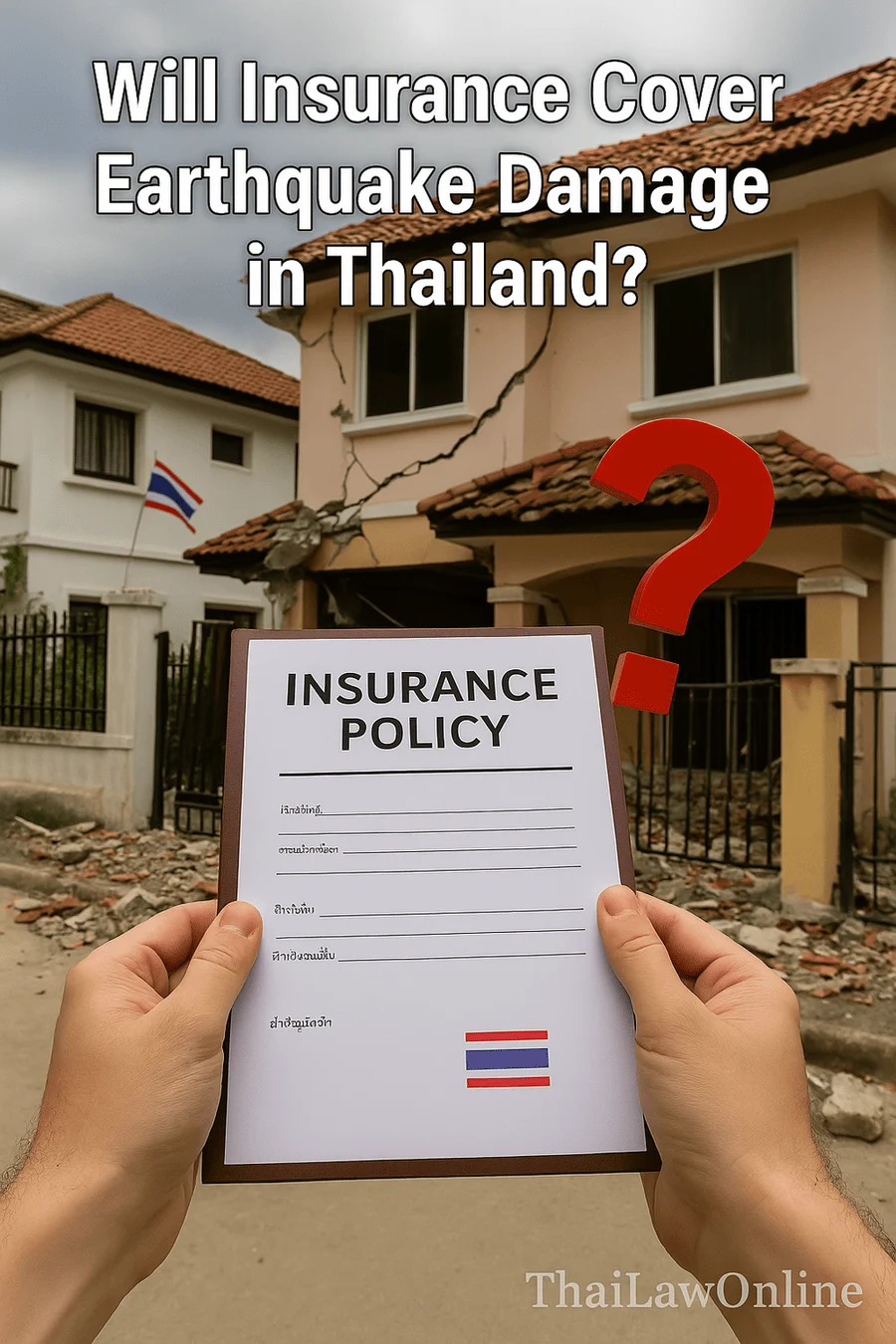
Earthquakes are natural disasters that can cause significant devastation, particularly in regions prone to seismic activity. Myanmar and Thailand, two neighboring countries in Southeast Asia, have experienced their share of earthquakes over the years. As such, understanding whether insurance pays for damages from earthquakes in Thailand is crucial for residents and businesses.
Table of Contents
Last reviewed: 27 September 2026. The insurance points follow statements by the Office of Insurance Commission and the Thai General Insurance Association after the 28 March 2025 earthquake, as reported by ThaiPublica on 30 March 2025. Casualty figures and building details are from news reports.
This article delves into the likelihood of earthquakes in Thailand and Myanmar, how earthquake insurance functions in these countries, and the impacts of recent seismic events, particularly focusing on the March 28, 2025, earthquake in Bangkok. Additionally, we will explore how insurance does indeed pay for damages from earthquakes in Thailand, addressing the essential question: do insurance pay for damages from earthquakes in Thailand? This is an important topic that this article will address in detail. We will also examine the various insurance policies available and clarify how insurance pays for damages from earthquakes in Thailand.
What is the likelihood of an earthquake in Thailand and Myanmar?
The historical data on earthquakes in Thailand and Myanmar shows a pattern of seismic activity that has affected both countries. Thailand has experienced several minor to moderate earthquakes over the years, with the northern provinces being more prone to tremors due to their proximity to major fault lines. Myanmar, on the other hand, sits on the Sagaing Fault, one of the most active seismic zones in the region. Notably, the 7.7 magnitude earthquake in Myanmar on March 28, 2025, rocked both Myanmar and neighboring Thailand, causing significant damage and reminding residents of the ever-present threat.
The geological conditions of Myanmar and Thailand significantly influence the frequency and intensity of earthquakes. Myanmar’s location along the Sagaing Fault and other tectonic plate boundaries makes it particularly susceptible to earthquakes, which can lead to severe incidents like the one that affected Mandalay. The rock formations and fault lines in these areas can generate powerful earthquakes, posing a constant threat to the region, particularly in places like Mandalay. In Thailand, while the seismic activity is less frequent, the country still experiences tremors, particularly in the northern provinces, due to its proximity to Myanmar’s seismically active zones.
Seismologists continue to study the tectonic movements in Myanmar and Thailand to predict future trends in seismic activity. While predicting the exact timing and magnitude of earthquakes remains challenging, historical patterns and current geological assessments suggest that both countries should remain prepared for future seismic events. The magnitude 7.7 earthquake of March 2025, centred in Myanmar but felt strongly in Bangkok, serves as a stark reminder of the potential for powerful earthquakes in the region, particularly after the Myanmar earthquake that caused significant damage. Continuous monitoring and research are essential to better understand and predict these natural phenomena, especially in light of the recent Myanmar earthquake.
How does earthquake insurance work in Thailand and Myanmar?
Earthquake insurance in Thailand and Myanmar typically covers a range of damages resulting from seismic activity. These policies often compensate for structural damage to residential and commercial properties, including high-rise buildings that may collapse during a quake. Coverage may also extend to personal belongings damaged within the property. However, the specifics of coverage can vary between insurance providers, and it’s crucial for policyholders to thoroughly understand the terms of their insurance agreements. In Thailand, the standard residential fire policy approved by the Office of Insurance Commission (OIC) already covers catastrophic natural perils, earthquake included, but only up to 20,000 THB a year; more cover can be bought as an add-on. A condominium’s juristic person usually insures the structure and common property, often under an industrial all-risk policy, so ask the building manager what that policy covers.
While earthquake insurance offers financial protection against certain damages, there are often exclusions and limitations within these policies. Common exclusions may include damage to land, such as soil liquefaction, or pre-existing structural weaknesses not caused by the earthquake. Additionally, insurance policies may have deductibles that require policyholders to cover a portion of the repair costs. It’s essential for individuals and businesses to carefully review their insurance policies to understand what is and isn’t covered, ensuring they are adequately protected.
Filing an insurance claim after an earthquake involves several steps. Policyholders should first document all damages by taking photographs and making an inventory of affected items. Contacting the insurance provider promptly is crucial to initiating the claims process. The insurer will likely send an adjuster to assess the damage and determine the appropriate compensation. It’s important for claimants to keep records of all communications and expenses related to repairs to facilitate a smoother claims process following an earthquake.
The law behind this page
English
Section 861
Insurance, definition.
Full text
A contract of insurance is a contract by which one person agrees to pay compensation, or a sum of money, in the event of a loss occurring, or on some other future event specified in the contract, and by which another person agrees to pay a sum of money called the premium.
ThaiLawOnline translation
Section 867
An insurance contract is not enforceable unless evidenced in writing signed by the party liable or their agent. The insurer must also deliver an insurance policy conforming to the contract.
Full text
A contract of insurance cannot be enforced by action unless there is some written evidence of it signed by the party liable or by his agent. One copy of an insurance policy, the contents of which conform to the contract, must be delivered to the insured. The policy must be signed by the insurer and must contain the following particulars: (1) the subject matter insured; (2) the risks against which the insurer insures; (3) the value of the insurable interest, if fixed; (4) the sum insured; (5) the amount of the premium and the method of payment; (6) where the contract is for a fixed term, the times at which it begins and ends; (7) the name or trade name of the insurer; (8) the name or trade name of the insured; (9) the name of the beneficiary, if any; (10) the date of the contract of insurance; (11) the place and date of the making of the policy.
ThaiLawOnline translation
Section 29 Non-Life Insurance Act B.E. 2535
Full text
An insurance policy issued by a company to an insured must be in the form and wording approved by the registrar; this includes documents accompanying or attached to the insurance policy. With respect to the form and wording approved under paragraph 1, the registrar may, when the registrar considers it appropriate or at the request of a company, order that the form or wording be amended, changed, supplemented or cancelled, in part or in whole. Where a company issues an insurance policy that differs from the form or wording approved by the registrar under paragraph 1 or 2, the insured or the beneficiary under the insurance policy has the right to choose to hold the company liable to perform either according to the policy form or wording issued by the company or according to the form or wording approved by the registrar. However the insured or the beneficiary exercises this right, and whether or not it is exercised, the company is not thereby released from an offence under this Act. Where a company issues an insurance policy using a form or wording not approved by the registrar under paragraph 1 or 2, the insured may choose either to hold the company liable under that insurance policy or to terminate the insurance contract and have the company refund all premiums paid to the company. However the insured exercises this right, and whether or not it is exercised, the company is not thereby released from an offence under this Act.
ThaiLawOnline translation
Section 877
Full text
The insurer must pay compensation as follows: (1) for the actual amount of the loss; (2) for damage caused to the property insured by reasonable measures taken to avert the loss; (3) for all reasonable expenses incurred to preserve the property insured from loss. The actual loss is valued at the place and time where the loss occurred. The sum insured is presumed to be the correct measure for that valuation. Compensation may not exceed the sum insured.
ThaiLawOnline translation
Section 879
Full text
The insurer is not liable where the loss, or the other event specified in the contract, has been caused by the dishonesty or gross negligence of the insured or of the beneficiary. The insurer is not liable for a loss which is the direct consequence of an inherent defect in the subject matter insured, unless otherwise agreed.
ThaiLawOnline translation
Section 881
Full text
Where a loss occurs through a risk insured against, the insured or the beneficiary must, on becoming aware of it, notify the insurer without delay. Where the preceding paragraph is not complied with, the insurer may claim compensation for any damage resulting from the failure, unless the other party proves that compliance was impossible.
ThaiLawOnline translation
Section 882
Full text
No action to recover compensation may be brought after two years from the date of the loss. No action to recover payment or repayment of premiums may be brought after two years from the date on which the right to that payment or repayment fell due.
ThaiLawOnline translation
Section 36/1 Non-Life Insurance Act B.E. 2535
Full text
Where there is a complaint concerning insurance, the payment of compensation, or the payment of money or any other benefit under an insurance policy, the Registrar may arrange for the complaint to be considered and may conduct mediation.
ThaiLawOnline translation
ไทย
มาตรา 861
ข้อความเต็ม
อันว่าสัญญาประกันภัยนั้น คือสัญญาซึ่งบุคคลคนหนึ่งตกลงจะใช้ค่าสินไหมทดแทน หรือใช้เงินจำนวนหนึ่งให้ในกรณีวินาศภัยหากมีขึ้น หรือในเหตุอย่างอื่นในอนาคตดังได้ระบุไว้ในสัญญา และในการนี้บุคคลอีกคนหนึ่งตกลงจะส่งเงินซึ่งเรียกว่า เบี้ยประกันภัย
ข้อความจากฐานข้อมูลประมวลกฎหมายของเรา โปรดตรวจสอบกับข้อความทางการ (Thai text from our annotated code. Check it against the official text.)
มาตรา 867
ข้อความเต็ม
อันสัญญาประกันภัยนั้น ถ้ามิได้มีหลักฐานเป็นหนังสืออย่างใดอย่างหนึ่งลงลายมือชื่อฝ่ายที่ต้องรับผิดหรือลายมือชื่อตัวแทนของฝ่ายนั้นเป็นสำคัญ ท่านว่าจะฟ้องร้องให้บังคับคดีหาได้ไม่ให้ส่งมอบกรมธรรม์ประกันภัยอันมีเนื้อความต้องตามสัญญานั้นแก่ผู้เอาประกันภัยฉบับหนึ่งกรมธรรม์ประกันภัย ต้องลงลายมือชื่อของผู้รับประกันภัย และมีรายการดังต่อไปนี้(๑) วัตถุที่เอาประกันภัย(๒) ภัยใดซึ่งผู้รับประกันภัยรับเสี่ยง(๓) ราคาแห่งมูลประกันภัย ถ้าหากได้กำหนดกันไว้(๔) จำนวนเงินซึ่งเอาประกันภัย(๕) จำนวนเบี้ยประกันภัย และวิธีส่งเบี้ยประกันภัย(๖) ถ้าหากสัญญาประกันภัยมีกำหนดเวลา ต้องลงเวลาเริ่มต้นและเวลาสิ้นสุดไว้ด้วย(๗) ชื่อหรือยี่ห้อของผู้รับประกันภัย(๘) ชื่อหรือยี่ห้อของผู้เอาประกันภัย(๙) ชื่อของผู้รับประโยชน์ ถ้าจะพึงมี(๑๐) วันทำสัญญาประกันภัย(๑๑) สถานที่และวันที่ได้ทำกรมธรรม์ประกันภัย
ตรงตามข้อความในราชกิจจานุเบกษา / สำนักงานคณะกรรมการกฤษฎีกา (Verbatim from the Royal Gazette / Office of the Council of State)
มาตรา 29 พระราชบัญญัติประกันวินาศภัย พ.ศ. 2535
ข้อความเต็ม
กรมธรรม์ประกันภัยที่บริษัทออกให้แก่ผู้เอาประกันภัย ต้องเป็นไปตามแบบและข้อความที่นายทะเบียนได้ให้ความเห็นชอบ ทั้งนี้ รวมทั้งเอกสารประกอบหรือแนบท้ายกรมธรรม์ประกันภัยด้วย แบบและข้อความที่นายทะเบียนได้ให้ความเห็นชอบไว้แล้วตามวรรคหนึ่ง เมื่อนายทะเบียนเห็นสมควรหรือเมื่อบริษัทร้องขอ นายทะเบียนจะสั่งให้แก้ไขเปลี่ยนแปลงเพิ่มเติมหรือยกเลิกแบบ หรือข้อความนั้นบางส่วนหรือทั้งหมดก็ได้ ในกรณีที่บริษัทออกกรมธรรม์ประกันภัยแตกต่างไปจากแบบหรือข้อความที่นายทะเบียนได้ให้ความเห็นชอบตามวรรคหนึ่งหรือวรรคสอง ผู้เอาประกันภัยหรือผู้รับประโยชน์ตามกรมธรรม์ประกันภัยมีสิทธิเลือกให้บริษัทต้องรับผิดในการชำระหนี้ตามแบบกรมธรรม์ประกันภัยหรือข้อความที่บริษัทออกให้นั้น หรือตามแบบหรือข้อความที่นายทะเบียนได้ให้ความเห็นชอบไว้แล้วก็ได้ และไม่ว่าผู้เอาประกันภัยหรือผู้รับประโยชน์ตามกรมธรรม์ประกันภัยจะใช้สิทธิดังกล่าวนี้ประการใดหรือไม่ ย่อมไม่เป็นเหตุให้บริษัทพ้นความผิดที่บัญญัติไว้ในพระราชบัญญัตินี้ ในกรณีที่บริษัทออกกรมธรรม์ประกันภัยโดยใช้แบบหรือข้อความที่นายทะเบียนมิได้ให้ความเห็นชอบตามวรรคหนึ่งหรือวรรคสอง ผู้เอาประกันภัยจะเลือกให้บริษัทต้องรับผิดตามกรมธรรม์ประกันภัยนั้น หรือจะบอกเลิกสัญญาประกันภัยนั้นเสียและให้บริษัทคืนเบี้ยประกันภัยทั้งสิ้นที่ได้ชำระไว้แล้วแก่บริษัทก็ได้ และไม่ว่าผู้เอาประกันภัยจะใช้สิทธิดังกล่าวนี้ประการใด หรือไม่ ย่อมไม่เป็นเหตุให้บริษัทพ้นความผิดที่บัญญัติไว้ในพระราชบัญญัตินี้
ตรงตามข้อความในราชกิจจานุเบกษา / สำนักงานคณะกรรมการกฤษฎีกา (Verbatim from the Royal Gazette / Office of the Council of State)
มาตรา 877
ข้อความเต็ม
ผู้รับประกันภัยจำต้องใช้ค่าสินไหมทดแทนดังจะกล่าวต่อไปนี้ คือ(๑) เพื่อจำนวนวินาศภัยอันแท้จริง(๒) เพื่อความบุบสลายอันเกิดแก่ทรัพย์สินซึ่งได้เอาประกันภัยไว้เพราะได้จัดการตามสมควรเพื่อป้องปัดความวินาศภัย(๓) เพื่อบรรดาค่าใช้จ่ายอันสมควรซึ่งได้เสียไปเพื่อรักษาทรัพย์สินซึ่งเอาประกันภัยไว้นั้นมิให้วินาศอันจำนวนวินาศจริงนั้น ท่านให้ตีราคา ณ สถานที่และในเวลาซึ่งเหตุวินาศภัยนั้นได้เกิดขึ้น อนึ่ง จำนวนเงินซึ่งได้เอาประกันภัยไว้นั้น ท่านให้สันนิษฐานไว้ก่อนว่าเป็นหลักประมาณอันถูกต้องในการตีราคาเช่นว่านั้นท่านห้ามมิให้คิดค่าสินไหมทดแทนเกินไปกว่าจำนวนเงินซึ่งเอาประกันภัยไว้
ตรงตามข้อความในราชกิจจานุเบกษา / สำนักงานคณะกรรมการกฤษฎีกา (Verbatim from the Royal Gazette / Office of the Council of State)
มาตรา 879
ข้อความเต็ม
ผู้รับประกันภัยไม่ต้องรับผิดในเมื่อความวินาศภัยหรือเหตุอื่นซึ่งได้ระบุไว้ในสัญญานั้นได้เกิดขึ้นเพราะความทุจริต หรือความประมาทเลินเล่ออย่างร้ายแรงของผู้เอาประกันภัยหรือผู้รับประโยชน์ผู้รับประกันภัยไม่ต้องรับผิดในความวินาศภัยอันเป็นผลโดยตรงมาแต่ความไม่สมประกอบในเนื้อแห่งวัตถุที่เอาประกันภัย เว้นแต่จะได้ตกลงกันเป็นอย่างอื่น
ตรงตามข้อความในราชกิจจานุเบกษา / สำนักงานคณะกรรมการกฤษฎีกา (Verbatim from the Royal Gazette / Office of the Council of State)
มาตรา 881
ข้อความเต็ม
ถ้าความวินาศเกิดขึ้นเพราะภัยมีขึ้นดังผู้รับประกันภัยตกลงประกันภัยไว้ไซร้ เมื่อผู้เอาประกันภัยหรือผู้รับประโยชน์ทราบความวินาศนั้นแล้ว ต้องบอกกล่าวแก่ผู้รับประกันภัยโดยไม่ชักช้าถ้ามิได้ปฏิบัติตามบทบัญญัติที่กล่าวมาในวรรคก่อน ผู้รับประกันภัยอาจเรียกร้องค่าสินไหมทดแทนเพื่อความเสียหายอย่างใด ๆ อันเกิดแต่การนั้นได้ เว้นแต่อีกฝ่ายหนึ่งจะพิสูจน์ได้ว่าไม่สามารถที่จะปฏิบัติได้
ตรงตามข้อความในราชกิจจานุเบกษา / สำนักงานคณะกรรมการกฤษฎีกา (Verbatim from the Royal Gazette / Office of the Council of State)
มาตรา 882
ข้อความเต็ม
ในการเรียกให้ใช้ค่าสินไหมทดแทน ท่านห้ามมิให้ฟ้องคดีเมื่อพ้นกำหนดสองปีนับแต่วันวินาศภัยในการเรียกให้ใช้หรือให้คืนเบี้ยประกันภัย ท่านห้ามมิให้ฟ้องคดีเมื่อพ้นเวลาสองปีนับแต่วันซึ่งสิทธิจะเรียกให้ใช้หรือคืนเบี้ยประกันภัยถึงกำหนด
ตรงตามข้อความในราชกิจจานุเบกษา / สำนักงานคณะกรรมการกฤษฎีกา (Verbatim from the Royal Gazette / Office of the Council of State)
มาตรา 36/1 พระราชบัญญัติประกันวินาศภัย พ.ศ. 2535
ข้อความเต็ม
ในกรณีที่มีการร้องเรียนเกี่ยวกับการประกันภัย การจ่ายค่าสินไหมทดแทน การชดใช้เงินหรือประโยชน์อื่นใดตามกรมธรรม์ประกันภัย นายทะเบียนอาจจัดให้มีการพิจารณาข้อร้องเรียนและดำเนินการไกล่เกลี่ยได้
ตรงตามข้อความในราชกิจจานุเบกษา / สำนักงานคณะกรรมการกฤษฎีกา (Verbatim from the Royal Gazette / Office of the Council of State)
Français
Article 861
Le contrat d'assurance est le contrat par lequel une personne s'engage à verser une indemnité ou une somme en cas de sinistre ou d'un autre événement futur prévu au contrat, et une autre personne s'engage à payer une somme appelée prime.
résumé non officiel
Article 867
Sans écrit signé de l'obligé ou de son mandataire, le contrat d'assurance n'est pas exécutoire en justice. L'assuré doit recevoir une police conforme, signée par l'assureur, indiquant: objet, risques, valeur assurable éventuelle, somme assurée, prime et paiement, durée éventuelle, assureur, assuré, bénéficiaire éventuel, date du contrat, lieu et date d'émission.
résumé non officiel
Article 29 Non-Life Insurance Act B.E. 2535
La police doit suivre le modèle approuvé par le registraire, qui peut le modifier ou l'annuler. En cas de police divergente, l'assuré ou le bénéficiaire choisit la version applicable; si le modèle n'est pas approuvé, l'assuré peut aussi résilier et récupérer les primes. La société reste pénalement responsable.
résumé non officiel
Article 877
L'assureur doit indemniser : (1) le montant réel du sinistre ; (2) les dommages causés aux biens assurés par les mesures raisonnables prises pour prévenir le sinistre ; (3) les dépenses raisonnables engagées pour préserver les biens assurés du sinistre. Le sinistre s'évalue au lieu et au moment où il s'est produit. La somme assurée est présumée constituer une base d'évaluation exacte. L'indemnité ne peut excéder la somme assurée.
résumé non officiel
Article 879
L'assureur n'est pas responsable lorsque le sinistre ou tout autre événement prévu au contrat résulte de la fraude ou de la négligence grave du preneur d'assurance ou du bénéficiaire. Il ne répond pas non plus du sinistre résultant directement d'un vice propre de la chose assurée, sauf convention contraire.
résumé non officiel
Article 881
Lorsque survient un sinistre dû à un risque couvert, le preneur d'assurance ou le bénéficiaire qui en a connaissance doit en aviser l'assureur sans délai. À défaut, l'assureur peut réclamer réparation de tout préjudice qui en résulte, à moins que l'autre partie ne prouve qu'il lui était impossible de s'y conformer.
résumé non officiel
Article 882
L'action en paiement de l'indemnité se prescrit par deux ans à compter du sinistre. L'action en paiement ou en restitution de la prime se prescrit par deux ans à compter de son exigibilité.
résumé non officiel
Article 36/1 Non-Life Insurance Act B.E. 2535
En cas de réclamation relative à l'assurance, au versement d'une indemnité, ou au paiement d'une somme ou de tout autre avantage prévu par une police d'assurance, le Registraire peut faire examiner la réclamation et procéder à une médiation.
résumé non officiel
Sources
- Civil and Commercial Code, Office of the Council of State, retrieved 31 October 2026
- Non-Life Insurance Act B.E. 2535, retrieved 2 November 2026
What were the impacts of the March 28, 2025, earthquake in Bangkok?
The 28 March 2025 magnitude 7.7 earthquake struck Myanmar, on the Sagaing Fault, with its epicentre near Sagaing and Mandalay at a shallow depth of about 10 kilometres. The epicentre was not in Bangkok. The rupture was large and shallow enough that the shaking travelled more than 1,000 kilometres and was felt strongly across Thailand, including in Bangkok, where the soft marine clay under the city amplifies long-period waves and makes tall buildings sway. That is why a distant Myanmar earthquake was felt in Bangkok high-rises and at street level in places such as Chatuchak Market.
In Bangkok the most serious consequence was the collapse of a 30-storey tower under construction for the State Audit Office in the Chatuchak area, which killed dozens of workers. Other buildings in the city were damaged and had to be inspected, but the widespread structural failure was in Myanmar, near the epicentre. The Bangkok collapse prompted a review of building standards and construction supervision rather than proving that the earthquake originated in Thailand.
The great majority of the deaths were in Myanmar, close to the epicentre. In Thailand the loss of life was concentrated at the State Audit Office construction site in Bangkok. Figures changed while rescue operations continued, and readers should rely on official Thai and Myanmar sources for final numbers. Thai and international aid organisations mobilised quickly to assist those affected in both countries.
How does the government respond to earthquakes in Myanmar and Thailand?
In the wake of an earthquake, the governments of Myanmar and Thailand implement a series of emergency measures to ensure public safety and facilitate recovery, particularly after the 7.7 magnitude earthquake rocked the region. These measures often include the deployment of emergency services, the establishment of temporary shelters, and the dissemination of vital information through official channels. Both countries have emergency response plans designed to coordinate efforts between local authorities, military units, and international aid organizations.
During a state of emergency following an earthquake, evacuation protocols are activated to ensure the safety of affected populations. Evacuation efforts focus on moving people from high-risk areas, such as those near the epicenter or locations with a high likelihood of building collapse. Authorities may establish designated evacuation routes and centers where evacuees can receive shelter and medical care. Communication is key, with government and media outlets providing updates and instructions to facilitate orderly evacuations.
International aid organizations play a crucial role in the aftermath of earthquakes in Myanmar and Thailand. These organisations, including United Nations agencies, the Red Cross and Red Crescent movement and international NGOs, work alongside local authorities to provide humanitarian assistance, medical care and shelter to affected communities. Their involvement is particularly vital in large-scale disasters where national resources may be overwhelmed. The collaboration between local and international entities ensures a more effective and comprehensive response to the needs of earthquake victims.
What steps can residents take to prepare for future earthquakes?
Residents in earthquake-prone areas like Myanmar and Thailand can take proactive steps to strengthen their homes against seismic activity. Retrofitting buildings to meet modern earthquake-resistant standards can significantly reduce the risk of damage. This may involve reinforcing walls, securing heavy furniture, and ensuring that structures are anchored to their foundations. Consulting with structural engineers can provide homeowners with tailored solutions to enhance their properties’ resilience to earthquakes.
Having an emergency preparedness kit is vital for surviving the immediate aftermath of an earthquake. Essential items to include are water, non-perishable food, a first-aid kit, flashlights, batteries, and a portable radio. Personal documents, medications, and cash should also be part of the kit. Regularly updating and maintaining the kit ensures that individuals and families are ready to cope with the disruptions caused by an earthquake.
Staying informed about earthquake risks and warnings is crucial for residents of Myanmar and Thailand. Engaging with local government alerts, subscribing to seismic activity monitoring services, and participating in community preparedness programs can enhance awareness. Additionally, education on the signs of an impending earthquake and understanding the appropriate safety measures can empower individuals to respond effectively when a quake occurs. By staying informed, residents can better protect themselves and their families from the dangers posed by earthquakes.
Faqs about Insurance Paying for Damages from Earthquake in Thailand
Does insurance cover damages from earthquakes in Thailand?
Partly. The standard residential fire policy approved by the Office of Insurance Commission covers catastrophic natural perils, earthquake included, but only up to 20,000 THB a year. Insurers sell additional earthquake cover as an add-on, and commercial, all-risk and construction policies depend on their own wording. It is important to check with your provider to know if you are covered for damages caused by events like the 7.7 magnitude earthquake that rocked Myanmar and neighboring Thailand.
How can I ensure my condominium in Thailand is protected against earthquake damages?
Your own residential fire policy covers earthquake damage only up to 20,000 THB a year, so consider buying additional earthquake coverage. The condominium juristic person usually insures the structure and common property, often under an industrial all-risk policy. Additional cover can be added to ensure protection against damages seen after an earthquake like the one that rocked Myanmar.
What should I do if I need to evacuate my building due to an earthquake in Thailand?
If you need to evacuate due to an earthquake, follow local emergency procedures. Make sure you have an emergency kit ready, and move to open spaces away from buildings that could collapse, as was the case with the building under construction that collapsed after a strong earthquake.
Are there any recent examples of earthquake damage in Thailand or nearby regions?
Yes, a notable event was the 7.7 magnitude earthquake that rocked Myanmar and was felt across Thailand, including areas like Chatuchak. Buildings were damaged, and people had to be evacuated, highlighting the importance of earthquake coverage
What steps should be taken if damage is reported after an earthquake?
After an earthquake, report any damages to your insurance provider as soon as possible. Document the damage with photos and detailed descriptions to support your claim. The Office of Insurance Commission’s hotline, 1186, and the Thai General Insurance Association can provide additional guidance on claims.
How did the March 28 earthquake impact Thailand?
The earthquake of 28 March 2025 struck Myanmar on the Sagaing Fault and was felt across neighbouring countries, including Thailand. In Bangkok it caused evacuations of high-rise buildings and the collapse of a tower under construction for the State Audit Office. The epicentre was in Myanmar, not in Thailand.
Who are some key figures involved in earthquake response in the region?
In Thailand the relevant bodies are the Department of Disaster Prevention and Mitigation, the Bangkok Metropolitan Administration and, for insurance questions, the Thai General Insurance Association. In Myanmar the response is coordinated by the national authorities together with United Nations agencies and international relief organisations.
What should I do if I am trapped under a building after an earthquake?
If trapped, try to remain calm and signal for help using a whistle or tapping on pipes. Avoid shouting to conserve energy. Rescue teams are trained to find those trapped under debris, as was the unfortunate case for some victims caused by an earthquake.
How does the Thai General Insurance Association assist during an earthquake?
The Thai General Insurance Association provides information on available insurance policies and coverage options for earthquake-related damages. They also guide policyholders on the claims process following an earthquake, particularly after the 7.7 magnitude earthquake that caused extensive damage.
Links
Thai Law Updates, free by email
Plain-English updates on Thai law changes that affect foreigners: property, visas, marriage, business and wills. One short email a month from a firm practicing since 2006. No spam, unsubscribe anytime.