


Reviewed by ThaiLawOnline, a licensed Thai law firm practising in Thailand since 2006. Thai lawyer of record: Wichuda Atthamethakon, LL.M., Thai Bar Licence 3149/2556.
Last updated on
Updated 14 August 2026. You won your case abroad. The money, the company, or the land sits in Thailand. What happens next depends entirely on which piece of paper you are holding. A foreign court judgment cannot be enforced in Thailand and sends you back to the start of a fresh trial. A foreign arbitral award can be enforced, through a court petition, on a three-year clock. This guide covers both routes, what each costs, how long each takes, and the clause you should have written before any of this happened.
Table of Contents
The short answer
Thai law draws a hard line between a judgment handed down by a foreign court and an award handed down by an arbitral tribunal. The line decides everything that follows.
| Foreign court judgment | Foreign arbitral award | |
|---|---|---|
| Enforceable directly in Thailand | No | Yes, on conditions |
| What you file | A fresh civil action on the original claim | A petition to enforce the award |
| Governing law | No statute. Supreme Court practice only | Arbitration Act B.E. 2545 (2002), sections 41 to 45 |
| Deadline to start | The Thai prescription period for the underlying claim | Three years from the date the award became enforceable |
| Can the Thai court reopen the merits | Yes, completely | No. It reviews procedure and public policy |
| Realistic timeline | 12 to 24 months at first instance, longer on appeal | Months, if unopposed. Longer if the debtor resists |
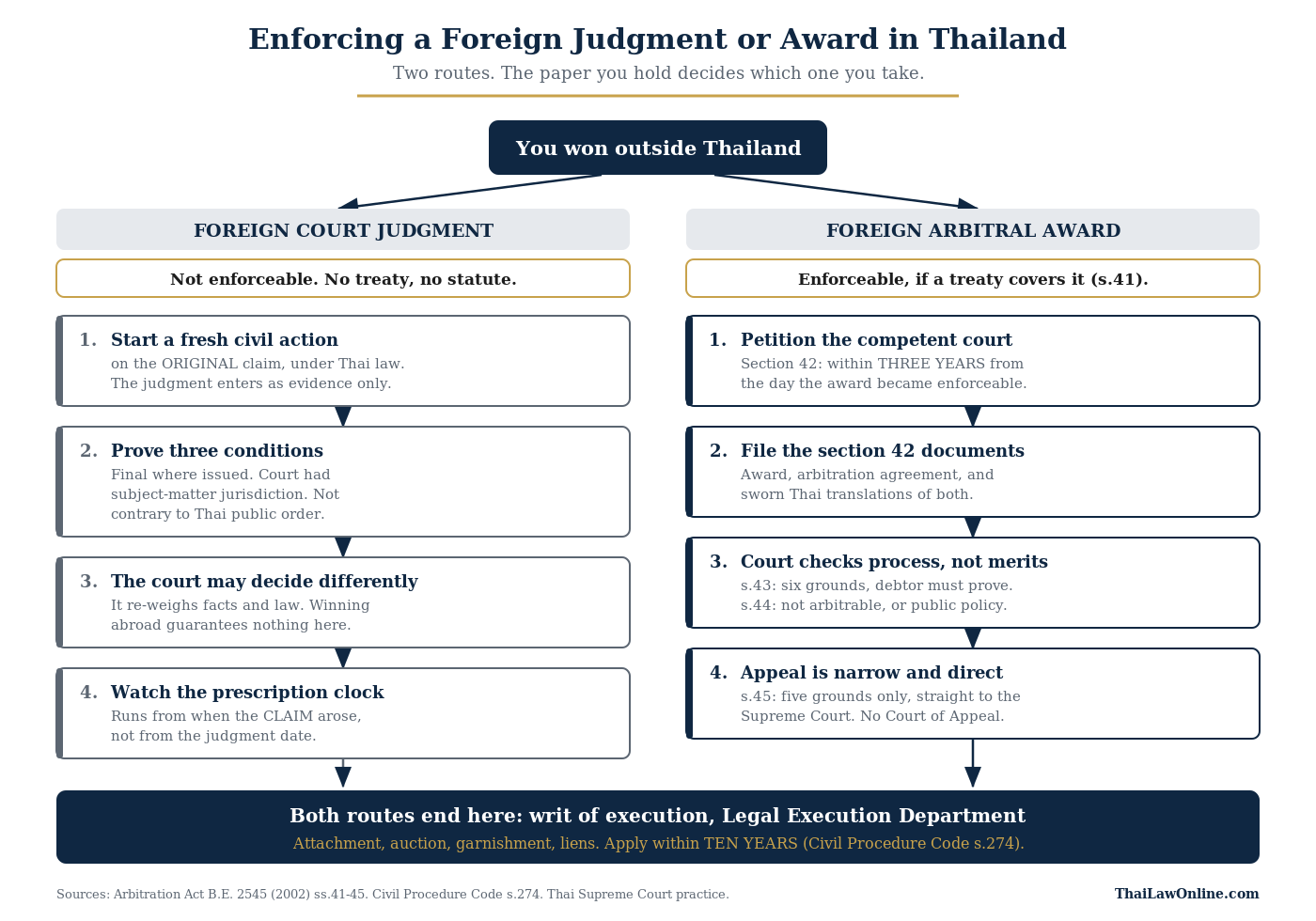
Why Thailand does not enforce foreign court judgments
No Thai statute provides for the recognition or enforcement of foreign court judgments. Thailand has signed no bilateral judgment-enforcement treaty, and it is not a contracting party to the 2019 Hague Judgments Convention, which as of 2026 binds the European Union, the United Kingdom, Ukraine, Uruguay, Albania, Andorra and Montenegro.
Nothing fills the gap. The consequence is blunt. Inside Thailand, your foreign judgment is not a judgment at all. It is a document.
What actually happens when you bring a foreign judgment to Thailand
You file a fresh action on the original claim
To reach a Thai debtor’s assets, the creditor starts a new civil case in a Thai court on the underlying cause of action: the unpaid invoice, the breached contract, the loan that was never repaid. You plead it under Thai law and you prove it again from the beginning. The foreign judgment goes into the file as evidence of what happened, not as an order the Thai court has to obey.
Three conditions before the judgment counts as evidence
Thai Supreme Court practice sets three conditions before a foreign judgment is admissible in Thai proceedings:
- the judgment is final in the country that issued it, meaning no appeal is pending and none can still be brought;
- it came from a court with subject-matter jurisdiction;
- it does not contravene public order or the good morals of the Thai people.
Judgments on the merits, after proper notice and a real chance to defend, carry weight. Default judgments and rulings decided on procedural technicalities carry much less, because the Thai court can see that nobody tested the facts.
Evidence is not authority
Satisfy all three conditions and the Thai court still owes you nothing. It weighs the foreign judgment alongside the rest of the evidence, applies Thai law to the claim, and can reach a different result on the same facts. Foreign counsel routinely underestimates this. Winning in London does not mean winning in Bangkok. It means arriving in Bangkok with good evidence.
The prescription trap
This is the risk that costs people the entire claim, and no competing English-language page mentions it.
Because the Thai action runs on the underlying claim, the relevant Thai prescription period is the one attached to that claim. Under the Civil and Commercial Code the default is ten years from the date the claim arose (section 193/30), but many commercial and trade claims fall under much shorter periods. A creditor who spent four years litigating in New York may land in Thailand holding a fresh judgment on a claim that expired here while the foreign case was running.
Section 193/32 gives a ten-year prescription to a claim established by a final judgment, and creditors reach for it. Whether a Thai court will apply it to a foreign judgment, given that Thai law does not treat a foreign judgment as establishing anything, is not settled in the published sources. Do not build a recovery plan on it. Get Thai advice on the prescription position before the foreign case ends, not after.
Foreign arbitral awards: the route that works
Arbitration is a different world. Thailand acceded to the New York Convention on 21 December 1959, and it came into force here on 20 March 1960. The Arbitration Act B.E. 2545 (2002), amended by the Arbitration Act (No. 2) B.E. 2562 (2019), follows the UNCITRAL Model Law.
Section 41: the treaty gate
Section 41 makes an award binding on the parties whichever country produced it. Its second paragraph is the sentence that matters most to a foreign creditor: an award made abroad is enforceable by a Thai court only if it is subject to an international convention, treaty or agreement to which Thailand is a party, and only to the extent Thailand has agreed to be bound. Enforcement is conditional, not automatic. In practice the New York Convention is the gate almost every foreign award walks through.
Section 42: three years, and what you file
Section 42 carries both halves of the filing step. The party seeking enforcement applies to the competent court within three years from the day the award became enforceable. The same section lists the documents:
- the original arbitral award or a certified copy;
- the original arbitration agreement or a certified copy;
- a Thai translation of both, by a translator sworn before a court or before an official or person authorised to administer oaths, or certified by an official authorised to certify translations or by a Thai diplomatic or consular officer in the country where the award or the arbitration agreement was made.
The translation requirement quietly sinks timelines. Sworn translation of a long award takes weeks, and a translation the court rejects sends you back to the start. Budget for it early. Our notes on legal interpreters in Thai courtrooms and on notarisation and legalisation cover what Thai courts accept.
Sections 43 and 44: when the court can refuse
Section 43 lists six grounds, and the burden sits on the party resisting enforcement, who has to prove them: incapacity of a party; an arbitration agreement not binding under the law the parties chose or, failing a choice, under the law of the country where the award was made; lack of proper notice of the tribunal’s appointment or of the proceedings; an award that goes beyond the scope of the agreement; a tribunal or a procedure that departed from what the parties agreed; and an award not yet binding, or set aside or suspended where it was made.
Section 44 lets the court dismiss the application on its own assessment, on two grounds: the dispute is not capable of settlement by arbitration under Thai law, or enforcement would be contrary to public policy.
Read together these mirror Article V of the New York Convention. The court checks the process, not the reasoning. A losing party who simply disagrees with the tribunal has nothing to argue.
Section 45: appeal goes straight to the Supreme Court
Section 45 bars appeals against a court order under the Act except on five grounds: recognition or enforcement is contrary to public policy; the order or judgment is contrary to a provision of law concerning public policy; the order or judgment does not match the award; a judge dissented; or the order concerns interim protective measures under section 16. The appeal goes to the Supreme Court, or to the Supreme Administrative Court where the case started there, skipping the Court of Appeal entirely. That is unusual, and worth knowing before you plan a timeline. Compare the ordinary route in our guide to Supreme Court appeals in Thailand.
Setting aside and refusing enforcement are not the same thing
Readers conflate these constantly, and every competing page lets them.
Setting aside runs under section 40. A party asks the court to annul an award, within 90 days of receiving it. Succeed and the award is destroyed for everyone.
Refusing enforcement runs under sections 43 and 44. The court declines to lend its machinery to this enforcement attempt. The award survives and the creditor can still try to enforce it in another country where the debtor holds assets.
Different applications, different sections, different deadlines, different consequences. Getting the label wrong loses time you may not have.
Public policy in Thai practice, and the Hopewell warning
Here is the part other pages leave out.
Thai courts have read “public policy” under sections 40 and 44 more expansively than courts in comparable New York Convention jurisdictions read Article V(2)(b), and the gap widens when the award runs against a state entity. Thai academic writing has criticised the pattern as excessive judicial intervention. If your counterparty is a Thai ministry, a state enterprise, or a concession grantor, price that risk in.
The Hopewell dispute shows the reach. A Thai Arbitration Institute tribunal awarded Hopewell roughly THB 11.8 billion against the Ministry of Transport and the State Railway of Thailand in 2008 over the terminated Bangkok elevated road and rail concession. The Central Administrative Court annulled the award in March 2014 on prescription grounds, treating prescription as a matter of public policy. The Supreme Administrative Court reinstated the award on 22 April 2019, refusing to apply a 1999 prescription period retroactively to a 1998 termination. Constitutional Court Ruling No. 5/2564 of 17 March 2021 reopened the question, a retrial was granted, and on 18 September 2023 the Central Administrative Court held the claim time-barred under section 51 of the Administrative Courts Act. Reporting since indicates no payout has been made and further appeal has been raised.
Thirty years from concession to whatever this now is. The lesson is not that Thai enforcement fails. Commercial awards between private parties are enforced routinely. The lesson is that public policy in Thailand is a live door, and it opens widest against the state.
What the Supreme Court has actually done with that door
Decision 5560 to 5563/2562 is the one to read first, because it says what the standard is. The Court held that neither the Arbitration Act nor any other statute defines public order or the good morals of the people, so the court has to exercise judgment case by case, against the circumstances of the dispute and the values of the time. What it must weigh is the protection of the public benefit, public services and the direct interests of the public at large, and not the private interests of the party that lost. If your objection is really that the award went against you, this is the decision that says so.
Decision 6292/2561 shows the door opening only part of the way, which is the outcome most creditors should expect. The parties had chosen Thai law in a share purchase agreement, and the tribunal awarded compound interest, interest upon interest. The Court held that this offends section 224 paragraph two of the Civil and Commercial Code and so met the public policy test, and it refused enforcement of that part of the award only. The rest stood and the debtors remained liable on simple interest. A public policy objection does not have to destroy an award to be worth making, and it does not destroy one just because it succeeds.
Decisions 13570/2556 and 7635/2562 both turn on prescription, and they are the reason the Hopewell pattern is not a one-off. In 13570/2556 the tribunal miscalculated a limitation period because the claimant had typed the wrong year on its own claim form, and the Court set the award aside: enforcing an award that got prescription wrong would itself offend public order. In 7635/2562 the Court found that the lower court had answered the wrong question, asking whether the award was contrary to law instead of whether enforcing it would be contrary to public order; it decided the point itself, fixed the date of loss for a stolen vehicle at the day the theft was reported rather than the day the car was handed over, and set the award aside. Thai courts will look at how a tribunal reached a limitation date, through the public policy gate.
Decision 840/2561 is the warning for anyone enforcing against Thai real estate. The applicant was a limited company registered in the British Virgin Islands, so a foreign juristic person and an alien under clause 3 of Revolutionary Council Announcement No. 281 of 24 November 2515 (1972). A juristic person in that position can hold a condominium unit only if it fits one of the categories in section 19 of the Condominium Act B.E. 2522, and the category the Court applied to it, section 19(4), requires a BOI investment promotion certificate. It did not have one, and both sides knew it, so the Court held the purchase agreement void under section 150 of the Civil and Commercial Code. The award ordering the developer to refund the price therefore ran against section 411, which bars recovery of what was paid to perform an act prohibited by law, and the Court refused enforcement of the award under section 44. The buyer’s award produced nothing. Check that the asset can lawfully be held by the entity you are enforcing for.
After the order: the writ of execution
An enforcement order is permission, not payment. If the debtor still does not pay, you take the judgment to the Legal Execution Department (กรมบังคับคดี) of the Ministry of Justice, which has offices nationwide. It can attach and auction movable and immovable property, garnish bank accounts, salaries and receivables, and register liens over land.
Section 274 of the Civil Procedure Code requires execution to be applied for within ten years from the date of the judgment or order (where the case went on appeal, in practice the judgment of the last court to rule on that debtor). Applications filed after that are dismissed without anyone looking at the merits. Older sources cite section 271, the pre-2017 numbering, so check which edition you are reading.
So a foreign award holder runs two clocks in sequence: three years to petition for enforcement, then ten years to execute. Miss either and the award becomes a souvenir.
What it costs and how long it takes
Thai court filing fees are public and computable. For a monetary claim the fee is 2% of the amount claimed, capped at THB 200,000 for claims up to THB 50 million, with a further 0.1% on the excess above THB 50 million, plus about THB 1,000 for court delivery costs. The fee is paid on filing.
A worked example. You hold a US judgment for THB 30 million against a Thai company. There is no shortcut: you file fresh in Thailand. Court fee at 2% is THB 600,000, capped down to THB 200,000. Add sworn translation of the foreign judgment and the contract file, Thai counsel, and 12 to 24 months to first-instance judgment, longer if the defendant appeals. Then, on winning, up to ten years to execute.
The same THB 30 million as an arbitral award is a petition under section 42, decided on documents, usually inside a year unless the debtor mounts a section 43 challenge. That difference is the whole argument for the next section. If the debt itself is the problem rather than the forum, our debt collection service in Thailand is often the faster first move, and what to know before you go to court in Thailand covers what litigating here actually involves.
The exception: foreign divorce and family status
Family status escapes all of this, and the confusion it causes is unnecessary.
A foreign divorce judgment is not enforced through the courts. It is recorded administratively. Translate it into Thai, legalise it through the Department of Consular Affairs at the Ministry of Foreign Affairs, then present it to a district office, which can record the change in the family status register on form Kor Ror 22. Recording is not automatic and the registrar has discretion, but it does not involve re-litigating your divorce. People who have read that “Thailand does not recognise foreign judgments” often assume their divorce is void here. It is not. See divorce in Thailand with a foreign marriage.
Write the clause that prevents all of this
Everything above is a post-mortem. The cure costs ten lines at signature.
If you contract with a Thai counterparty and you may one day need to collect, choose arbitration over a foreign court. A foreign court judgment buys you a fresh trial in Thailand. An arbitral award buys you a petition. Then name, in the clause itself:
- the institution, by its full name: the Thai Arbitration Institute (TAI), the Thailand Arbitration Center (THAC), SIAC, HKIAC or the ICC;
- the seat, which fixes which courts supervise the arbitration;
- the language, because Thai-language proceedings change your cost base entirely;
- the governing law. The 2019 amendment (sections 23/1 to 23/6 of the Arbitration Act) lets the parties appoint foreign arbitrators and foreign representatives in arbitrations held in Thailand, with a certificate from the arbitral institution supporting their visa and work permit, so the governing law no longer decides whether your foreign counsel can act;
- the number of arbitrators, one for smaller disputes, three when the sums justify it;
- an escalation step, requiring negotiation or mediation before either side files.
Put it in the agreements that carry real money: loan agreements, promissory notes, NDAs and employment agreements. If you are still at the structuring stage, business setup in Thailand and the Foreign Business Act set out who you will be contracting as.
Frequently asked questions
Can a US court judgment be enforced in Thailand?
No. There is no treaty and no statute. You file a fresh civil action in a Thai court on the original claim, and the US judgment goes in as evidence, provided it is final, came from a court with subject-matter jurisdiction, and does not offend Thai public order or good morals.
Is an arbitration award from Singapore or London enforceable in Thailand?
Yes. Both are New York Convention seats, so section 41 paragraph 2 is satisfied. You petition a competent Thai court under section 42 with the award, the arbitration agreement and certified Thai translations.
How long do I have to enforce an arbitral award in Thailand?
Three years from the date the award became enforceable, under section 42. After you obtain the enforcement order, a second clock starts: ten years to apply for a writ of execution under section 274 of the Civil Procedure Code.
What documents do I need to file to enforce a foreign award?
The original award or a certified copy, the original arbitration agreement or a certified copy, and Thai translations of both, sworn before the court or certified by an authorised official or a Thai embassy or consulate in the country where the award was made.
Can a Thai court refuse to enforce an award, and on what grounds?
Yes. Section 43 lists six grounds the resisting party must prove, including incapacity, an invalid arbitration agreement, lack of proper notice, an award beyond the scope of the agreement, an irregular tribunal or procedure, and an award already set aside where it was made. Section 44 adds two the court applies itself: the dispute is not arbitrable under Thai law, or enforcement would be contrary to public policy.
Can I appeal if the Thai court refuses enforcement?
Only on the five grounds in section 45, and the appeal goes directly to the Supreme Court or the Supreme Administrative Court rather than through the Court of Appeal.
How much does it cost to sue in Thailand to enforce a foreign judgment?
The court filing fee is 2% of the claim, capped at THB 200,000 for claims up to THB 50 million, with 0.1% on any excess, plus roughly THB 1,000 in delivery costs. Translation and counsel are on top, and first-instance proceedings typically run 12 to 24 months.
Does Thailand recognise my foreign divorce?
It can, administratively. Translate and legalise the divorce judgment, then ask a district office to record it in the family status register on form Kor Ror 22. The registrar has discretion, but no court case is required.
Is arbitration or a Thai court jurisdiction clause better in a contract with a Thai company?
For a foreign party expecting to enforce against Thai assets, arbitration at a New York Convention seat is usually stronger, because the award is enforceable by petition while a foreign court judgment is not enforceable at all. A Thai court clause can make sense where the counterparty and every asset are Thai and the sums are modest.
My foreign judgment is five years old. Is it too late?
Possibly, and the answer turns on the original claim rather than on the judgment. Because the Thai case runs on the underlying cause of action, the Thai prescription period is measured from when that claim arose. Have Thai counsel check the position before you spend anything further.
How ThaiLawOnline can help
We have advised foreign clients on Thai law since 2006. If you are holding a judgment or an award and the assets are here, we will tell you plainly whether it is worth pursuing before you commit to fees: which route applies, what the prescription position looks like, what enforcement will cost, and what the debtor is likely to argue. If you are still at the contract stage, the arbitration clause is a short conversation that can save you a second trial. Start with our overview of dispute resolution in Thailand, then get in touch.
Last reviewed: 28 September 2026. Read in Thai: Arbitration Act B.E. 2545 as amended to 2562, sections 23/1 to 23/6 and 40 to 45; Supreme Court Decisions 5560-5563/2562, 6292/2561, 13570/2556, 7635/2562 and 840/2561, each to its disposition. Hopewell dates checked against Thai and English press reports and Constitutional Court Ruling 5/2564. The three conditions for admitting a foreign judgment, court fee figures, timelines and the list of Hague Judgments Convention parties are practice points not re-verified in this review.
Thai Law Updates, free by email
Plain-English updates on Thai law changes that affect foreigners: property, visas, marriage, business and wills. One short email a month from a firm practicing since 2006. No spam, unsubscribe anytime.