


Reviewed by ThaiLawOnline, a licensed Thai law firm practising in Thailand since 2006. Thai lawyer of record: Wichuda Atthamethakon, LL.M., Thai Bar Licence 3149/2556.
Last updated on
Thailand’s legal landscape offers multiple pathways for resolving disputes, each with distinct advantages, costs, and timeframes. For expatriates and businesses in the Kingdom, it is important to understand the differences between Alternative Dispute Resolution (ADR) and traditional litigation. This is especially true for ADR in Thailand. This knowledge helps them make better decisions when conflicts happen. This analysis looks at the different ways to resolve disputes in Thailand. It offers practical insights into how effective these methods are, their costs, and which types of disputes they suit best.
Where a matter is criminal rather than civil, our overview of criminal law in Thailand explains the route it takes.
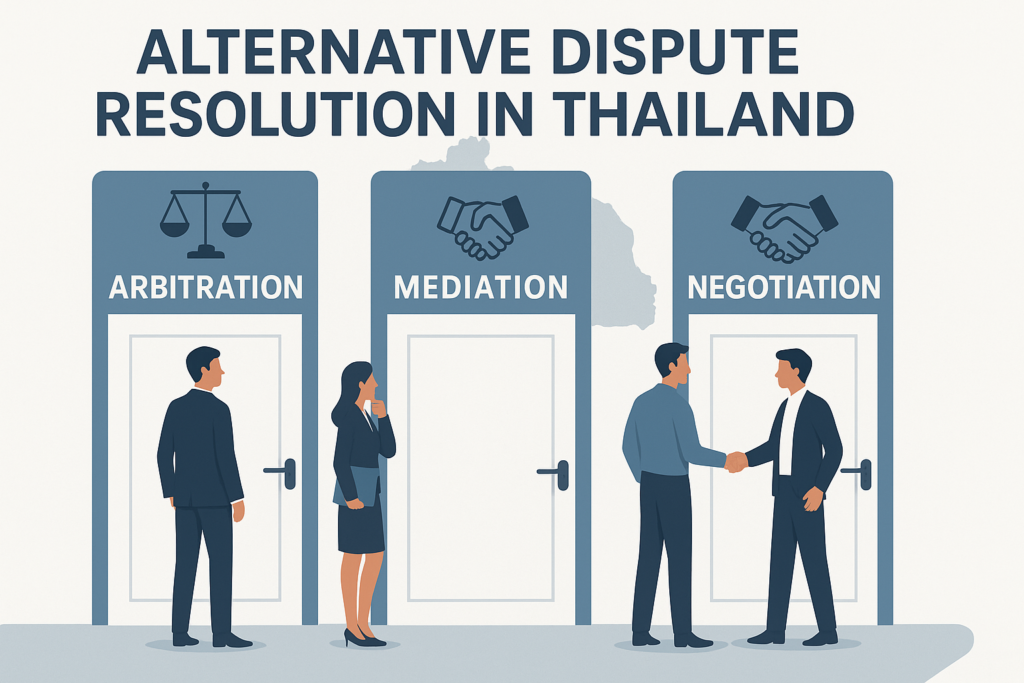
Table of Contents
Understanding Thailand’s Dispute Resolution Framework
Thailand has evolved into a sophisticated jurisdiction for dispute resolution, combining traditional court systems with modern alternative mechanisms. The country’s approach reflects both its civil law heritage and contemporary international best practices. The legal framework includes several laws. These Arbitration Act B.E. 2545 (2002), amended by Act No. 2 B.E. 2562 (2019), and the Civil Procedure Code, which govern arbitration proceedings in Thailand. The Dispute Mediation Act B.E. 2562 (2019) and the Civil Procedure Code set the rules for resolving disputes in Thailand. Together, they create a complete system for resolving commercial and civil disputes.
The Thai government has promoted ADR methods. This is part of larger judicial reforms. These reforms aim to reduce court backlogs and offer better ways to resolve disputes. This policy change shows that traditional lawsuits can be detailed. However, they may not always provide quick, cheap, and private solutions for people.
The Three-Tier Court System
Thailand operates a three-tier court system consisting of Courts of First Instance, Courts of Appeal, and the Supreme Court (Dika Court). The Courts of First Instance include general civil courts and special courts. These special courts are the Intellectual Property and International Trade Court, Labor Courts and the Bankruptcy Court. The Administrative Courts are a separate court system, outside the Courts of Justice.
For civil disputes, a plaint goes to the court for the area where the defendant is domiciled or where the cause of action arose, whether or not the defendant is domiciled in Thailand (Civil Procedure Code, section 4). However, certain types of disputes must be filed in specialized courts. For example, the IP&IT Court deals with intellectual property disputes. Labor Courts handle employment disputes.
The court system has undergone significant reforms in recent years. The Judicial Regulation on Timeframes for Court Cases B.E. 2566 (2023) sets clear time limits for court proceedings. These limits range from six months to one year for Courts of First Instance. The exact timeframe depends on how complex the case is.
Alternative Dispute Resolution Methods in Thailand
Arbitration is the most developed form of ADR in Thailand. It is governed by the Arbitration Act B.E. 2545 (2002). The Arbitration Act B.E. 2545 (2002) largely reflects the UNCITRAL Model Law on International Commercial Arbitration (1985). This process involves submitting disputes to one or more neutral arbitrators who render binding decisions called arbitral awards.
Thailand hosts several prominent arbitration institutions. The Thailand Arbitration Center (THAC) serves as a leading regional hub, offering comprehensive arbitration and mediation services. The Thai Arbitration Institute (TAI), operating under the Office of the Judiciary, provides alternative institutional support. Additionally, the Thai Commercial Arbitration Committee of the Board of Trade offers services primarily for domestic commercial disputes.
The arbitration process in Thailand offers significant flexibility. Parties can choose their arbitrators, determine procedural rules, select the language of proceedings, and decide the seat of arbitration. This flexibility makes arbitration particularly attractive for international disputes involving Thai parties.
To use arbitration for resolving disputes, parties must add an arbitration clause to their contracts. They can also agree to arbitration after a dispute happens, which may involve drafting an arbitration agreement. A well-drafted arbitration clause should specify the institutional rules, number of arbitrators, seat of arbitration, and governing law.
Thailand has been a party to the New York Convention since it acceded in 1959. This gives important benefits for enforcing foreign arbitral awards. Foreign court judgments are not directly enforceable in Thailand because there are no bilateral enforcement treaties. However, foreign arbitral awards from Convention countries can be enforced in Thai courts.
What that means in practice, and what to file, is covered in our guide to enforcing a foreign judgment or arbitral award in Thailand: an award goes to the court by petition within three years, while a foreign court judgment has to be re-litigated from the beginning.
To enforce an arbitral award, you must file an application with the right court. You have three years from when the award becomes enforceable. The court’s review focuses on procedural compliance rather than re-examining the merits of the case. Thai courts generally maintain a pro-enforcement stance, refusing enforcement only on limited grounds such as procedural irregularities or a conflict with public order or good morals.
Mediation: The Collaborative Approach
Mediation has gained significant traction in Thailand as a cost-effective and relationship-preserving dispute resolution method. The Dispute Mediation Act B.E. 2562 (2019) sets rules for mediation. It covers mediation outside the courts: a mediator acting under it must have completed an approved training course and be registered (Sections 3 and 10). Mediation inside a court case is not governed by this Act.
The Thai Mediation Center is part of the Alternative Dispute Resolution Office. The Mediation Office under the Office of the Judiciary manages the Thai Mediation Center. It has been praised by international organizations for promoting informal dispute resolution. It runs mediation programs for both court cases and private disputes. Mediation can happen at different times. It can take place before a lawsuit is filed, during a trial, or as part of a court-ordered settlement.
Thai courts strongly encourage mediation, particularly in family law, employment, and commercial disputes. A court may try to mediate a settlement at any stage of a civil case (Civil Procedure Code section 20) and may appoint conciliators to do it (section 20 bis), and judges routinely refer cases to mediation before the trial proper. Many courts have added mediation to their case management processes. Court-annexed mediation settles a substantial share of the cases sent to it.
The mediation process typically begins when one party requests mediation and the other party agrees to participate. The mediator, acting as a neutral facilitator, helps parties explore settlement options without imposing decisions. Under the Dispute Mediation Act, the mediator must keep the process confidential (Section 12), and what happens in the mediation, such as a party’s willingness to mediate, its proposals and admissions, and documents prepared for the mediation, cannot be used as evidence in later court or arbitration proceedings except to enforce the settlement. Evidence that exists independently of the mediation stays usable (Section 29).
Mediation settlements, once reached, become legally binding agreements enforceable through court proceedings if necessary. The process typically concludes within weeks or months, compared to the years often required for litigation.
Conciliation includes parts of mediation and arbitration. It involves a neutral conciliator who helps with discussions. The conciliator can also give non-binding suggestions for settling the issue. Conciliation is less common than mediation or arbitration. It offers a middle ground for parties. It gives more guidance than mediation but avoids the finality of arbitration.
Thai law sees conciliation as a valid way to resolve disputes. It works well in business conflicts. Parties gain from expert advice on industry practices and standards.
Traditional Litigation in Thailand
The Litigation Process in Thailand often intersects with arbitration in Thailand as an alternative dispute resolution method.
Civil litigation in Thailand follows established procedures under the Civil Procedure Code. The process starts by filing a complaint with the right court. Then, the defendant is served. The defendant has 15 to 30 days to respond, depending on how they were served.
Thai courts operate under an inquisitorial system where judges take active roles in investigating facts and managing proceedings. This differs from adversarial systems common in Western jurisdictions, where parties primarily control the presentation of evidence.
The litigation process typically involves several stages: initial pleadings, preliminary hearings, discovery (though limited compared to common law jurisdictions), witness examination, and final judgment. Courts may order mediation at any stage, and judges often encourage settlement discussions.
All court proceedings in Thailand must be conducted in Thai language. Foreign documents require certified Thai translations, and foreign parties typically need interpreters for court appearances. This language requirement can create additional costs and complexity for international parties unfamiliar with Thai legal terminology.
The formality of Thai court proceedings may be challenging for expatriates unfamiliar with Thai procedural customs. Proper courtroom etiquette is essential, including appropriate dress codes, respectful behavior toward judges, and following the court’s own directions on procedure.
Different types of disputes may require filing in specialized courts, each with modified procedures. The IP&IT Court, for example, employs technical experts and has streamlined procedures for intellectual property disputes. Labor Courts utilize tripartite panels including representatives from employer and employee associations alongside career judges. These include one professional judge and two lay judges representing employers and employees.
The Bankruptcy Court deals with both rehabilitation and liquidation cases, often involving a law firm for expert guidance. It provides ways for businesses to restructure. This can be better than regular commercial lawsuits for companies in financial trouble.
Cost Analysis: Alternative Dispute Resolution in Thailand vs. Litigation
Litigation Costs
Thai court filing fees are calculated based on the amount in dispute. For claims not exceeding 50 million baht, courts charge 2% of the claim amount, with a maximum of 200,000 baht. For claims exceeding 50 million baht, additional fees of 0.1% apply to the excess amount.
Beyond court fees, litigation involves substantial legal costs. Thai lawyer fees typically range from 2,000 to 10,000 baht per hour. Retainer fees can vary from 50,000 to 500,000 baht or more, depending on how complex the case is. Additional costs include document translation, expert witnesses, and potential appeal expenses. Do note that ThaiLawOnline has consultation as 2,000 baht per hour.
The indirect costs of litigation can be substantial, including management time, business disruption, and potential damage to commercial relationships. Litigation’s public nature may also result in unwanted publicity for businesses.
Alternative Dispute Resolution in Thailand: Costs
Arbitration costs vary significantly depending on the chosen institution and dispute value. At the Thai Arbitration Institute (TAI), the Office of the Judiciary publishes the arbitrator’s fee as a scale: a claim not exceeding 2 million baht costs 30,000 baht where a sole arbitrator sits and 60,000 baht where the tribunal is larger, and above that the fee rises ad valorem, so a 10 million baht claim reaches 100,000 baht for a sole arbitrator. TAI charges no institutional fee at all, because it is funded by the Office of the Judiciary. Besides the arbitrator’s fee the parties meet the actual expenses of the proceeding, against a deposit of 15,000 baht each where the case is conducted in Thai and 30,000 baht each in any other language. THAC prices the same dispute two ways, and which scale applies turns on the language of the proceeding. Under the English-language scale in Annex 1 to its Rules the parties pay a filing fee of 50,000 baht each, the claimant when it files the notice of arbitration and the respondent when it answers, neither refundable in any circumstances; a centre fee of 50,000 baht on a claim not exceeding 2.5 million; and an arbitrator fee of 150,000 baht per arbitrator, so a three member tribunal costs 450,000 baht and not 150,000. Where the arbitration is conducted in Thai the same annex sets a separate and much lower scale. On a 2 million baht claim that is 8,000 baht filing fee from each side, a centre fee of 8,000 baht, and an arbitrator fee of 30,000 baht for a sole arbitrator or 60,000 baht for a larger tribunal, which are the same arbitrator figures as TAI at the same threshold.
So the comparison that matters is not 30,000 baht against 150,000 baht. If your arbitration runs in Thai, the arbitrators cost the same at both institutions and what THAC adds is its filing and centre fees, which TAI does not charge at all. If it runs in English, THAC’s own English scale is what makes it the more expensive forum, and the gap widens with every additional arbitrator because that fee is charged per head. Language, and the size of the tribunal, move the bill further than the choice of institution does. The THAC figures here are Annex 1 to its Rules on Arbitration B.E. 2558, in the revised text THAC publishes on its own rules page.
For higher-value disputes, costs increase substantially under ad valorem scales used by both institutions. However, arbitration is often cheaper than long court cases. This is true when you think about management time and quicker results.
Mediation represents the most cost-effective dispute resolution option. Court-annexed mediation through the Thai Mediation Center often involves minimal or no fees. Private mediation costs vary but typically involve mediator fees and administrative expenses far below arbitration or litigation costs.
The Department of Intellectual Property offers mediation services for IP disputes at no charge, demonstrating the government’s commitment to affordable ADR options.
Time Considerations and Efficiency
The Judicial Regulation on Timeframes for Court Cases B.E. 2566 (2023) sets specific timeframes for court proceedings. Courts of First Instance must complete cases within six months to one year, depending on complexity. Appeals Courts have four months to one year for their proceedings, while the Supreme Court allows up to one year for final resolution.
Even with these rules, real-life experience shows that complex lawsuits often take longer than expected. This is due to factors like case backlogs, procedural issues, and appeals. Multi-party commercial disputes frequently require 18 months to three years for complete resolution.
Arbitration typically concludes within six months to one year, depending on case complexity and procedural choices. Expedited arbitration procedures can reduce timeframes to as little as three to six months for smaller disputes.
Mediation offers the fastest resolution potential, often concluding within weeks or months. Even court-annexed mediation typically resolves disputes more quickly than continued litigation.
The efficiency advantages of ADR extend beyond mere time savings. The flexibility to schedule proceedings around business needs and the ability to maintain ongoing commercial relationships often provide value that transcends simple time calculations.
Enforcement and Recognition
Both court judgments and arbitral awards are enforced through the Thai courts, but on different tracks.
A first-instance court judgment can be enforced even while an appeal is pending: lodging an appeal does not stay execution unless the appellate court orders a stay on application, typically against a deposit or security for the judgment sum (Civil Procedure Code, section 231). The losing party has limited grounds to challenge enforcement of domestic court judgments.
Arbitral awards run on a different track, and four sections of the Arbitration Act B.E. 2545 carry it. Section 41 makes an award binding whichever country produced it, but says so expressly “subject to Section 42, Section 43 and Section 44”, and its second paragraph makes a foreign award enforceable by a Thai court only where the award is governed by a treaty, convention or international agreement to which Thailand is a party, and only to the extent Thailand has agreed to be bound. Thailand acceded to the New York Convention in 1959, which is the gate almost every foreign award walks through; an award made in a state outside any instrument binding Thailand does not clear it. Section 42 is the filing step: a petition to the competent court within three years of the day the award became enforceable, with the award, the arbitration agreement and a Thai translation of both. Refusal then runs under Section 43, where the resisting party must furnish proof of one of six matters tracking Article V(1) of the New York Convention, and Section 44, where it is enough that the court itself sees the subject matter is not capable of settlement by arbitration or that enforcement would be contrary to public order or good morals.
The procedure in full, the documents the court requires, the difference between setting an award aside and refusing to enforce it, and how Thai courts have actually used the public-order ground are covered in our guide to enforcing a foreign judgment or arbitral award in Thailand.
Conversely, Thailand has no treaties for mutual recognition of foreign court judgments. Foreign court judgments cannot be directly enforced and may only serve as evidence in new Thai court proceedings.
This distinction makes arbitration particularly attractive for international transactions involving Thai parties or assets in Thailand.
Success Rates and Effectiveness
Mediation settles a substantial share of the disputes that go to it, in the ordinary courts and in the Labour Court, where settlement is a routine part of the process.
The Department of Intellectual Property runs its own mediation service for intellectual property disputes, free of charge.
Arbitration’s effectiveness is primarily measured by the finality of awards and successful enforcement rates. Thai courts seldom change arbitral awards. Enforcement applications usually succeed when the right procedures are followed, particularly in international commercial contexts.
Arbitral awards are binding, which gives certainty that mediation cannot provide. However, this comes with less flexibility and higher costs.
Litigation Outcomes
Traditional litigation provides comprehensive fact-finding and legal determination but often at significant cost in time, money, and business relationships. The adversarial nature of litigation can permanently damage commercial relationships, making it less suitable for ongoing business partnerships.
However, litigation remains essential for cases requiring precedential decisions, complex legal interpretation, or situations where parties cannot agree to alternative procedures.
Cultural and Practical Considerations
Thai culture emphasizes harmony and face-saving, making mediation particularly compatible with local business practices. The concept of “kreng jai” (consideration for others) often facilitates successful mediation by encouraging parties to seek mutually acceptable solutions.
However, this cultural context can make it hard for Thai parties to confront issues directly through lawsuits. Still, they are starting to see that lawsuits are necessary to protect their legal rights.
Foreign businesses operating in Thailand must consider several practical factors when choosing dispute resolution methods. Language barriers favor arbitration and mediation, where proceedings can be conducted in English with party agreement.
The confidential nature of arbitration and mediation can be crucial for businesses concerned about protecting trade secrets or maintaining market reputation during dispute resolution.
For multinational companies with regional operations, Thailand is becoming a key place for arbitration. This offers benefits for handling related disputes. It also gives access to skilled international arbitrators who understand Asian business practices.
Sector-Specific Considerations
Construction disputes often involve complex technical issues, multiple parties, and ongoing project relationships. Arbitration’s flexibility in appointing technically qualified arbitrators makes it particularly suitable for construction disputes. The ability to maintain confidentiality while resolving technical disputes also preserves business relationships essential for project completion.
IP disputes benefit from the specialized knowledge available through the IP&IT Court or through arbitrators with technical expertise. The confidential nature of arbitration can be crucial for protecting trade secrets during dispute resolution.
Financial disputes often require quick resolution to minimize market impact. Both arbitration and mediation can resolve issues faster than traditional litigation. Arbitration offers finality and follows specific rules. This provides the certainty needed for financial planning.
Labor disputes benefit significantly from the collaborative approach of mediation, which can preserve employment relationships. The Labor Court has high success rates in mediation. This shows that ADR works well in employment cases.
Strategic Decision-Making Framework
Factors Favoring ADR include the efficiency of arbitration proceedings compared to traditional litigation.
Several factors indicate ADR may be preferable to litigation, especially when considering the involvement of three arbitrators for a balanced resolution.
- Speed requirements: When fast resolution is essential for business operations
- Confidentiality concerns: Where public proceedings could damage business reputation
- Ongoing relationships: When parties must continue working together after dispute resolution
- Technical complexity: Where specialized expertise is needed
- International enforcement: When awards must be enforced across multiple jurisdictions
- Cost sensitivity: Where litigation costs would be disproportionate to dispute value
Factors Favoring Litigation
Certain circumstances make litigation more appropriate:
- Legal precedent needs: When establishing legal principles for future cases
- Public interest: Where transparency serves broader societal interests
- Complex multi-party disputes often benefit from arbitration outside the ordinary courts. This helps make the resolution process easier
- Discovery requirements: When extensive document production or witness examination is necessary
- Appeal rights: When multiple levels of review are important
- Enforcement advantages: When domestic court judgments provide superior enforcement mechanisms
Hybrid Approaches
Modern dispute resolution increasingly employs hybrid mechanisms combining ADR and litigation advantages. Multi-tier clauses requiring negotiation, then mediation, then arbitration provide escalating dispute resolution options. Med-arb procedures let mediation happen first. If no settlement is reached, arbitration follows. The same neutral person may serve in both roles.
Recent Developments and Future Trends
Thailand continues refining its dispute resolution framework. Recent amendments to arbitration and mediation laws reflect international best practices and feedback from practitioners. The government’s focus on positioning Thailand as a regional dispute resolution hub drives ongoing improvements in infrastructure and procedures.
The COVID-19 pandemic accelerated adoption of online dispute resolution (ODR) technologies. Thai institutions now offer comprehensive online arbitration and mediation services, making ADR more accessible and cost-effective for international parties.
Thailand’s dispute resolution framework increasingly integrates with regional and international systems. Participation in ASEAN dispute resolution mechanisms and bilateral investment treaties expands options for cross-border disputes.
What Your Arbitration Clause Actually Does
An arbitration clause trades your right of appeal for privacy and speed. Under the Arbitration Act B.E. 2545, the only way to attack an award is an application to the court to set it aside (Section 40), and a court’s order under the Act can be appealed only on five grounds listed in Section 45: public order or good morals, an order contrary to a public-order law, an order that does not match the award, a dissenting judge, or an order on a provisional measure under Section 16. Any appeal goes straight to the Supreme Court or the Supreme Administrative Court. There is no Court of Appeal stage and no second look at the facts.
So read the clause before you sign it, not after the dispute starts. Most of what it does to you comes from what it leaves out.
What Thai Law Fills In When Your Clause Says Nothing
Every blank in a clause has a statutory answer. These are the Act’s defaults, read from the Thai text of the Arbitration Act B.E. 2545:
| If the clause is silent on | What the Act supplies | Section |
|---|---|---|
| Governing law | Thai law. Where the dispute raises a conflict of laws, the tribunal applies the conflict rules it considers appropriate instead. If you do choose a country’s law, that means its substantive law, not its conflict rules, unless the clause says otherwise. | 34 |
| Number of arbitrators | One, if the parties cannot agree a number. A tribunal must have an odd number; where the parties chose an even number, the arbitrators appoint one more as chair. | 17 |
| How arbitrators are appointed | With one arbitrator and no agreement, either party asks the court. With a panel, each side appoints the same number and those arbitrators choose the chair. A side that has not appointed within 30 days of notice, or arbitrators who cannot agree a chair within 30 days, send the appointment to the court. | 18 |
| Place of arbitration | The tribunal decides, considering the circumstances of the dispute and the parties’ convenience. | 26 |
| Language | The tribunal decides, and it may order translations of documentary evidence. | 28 |
| Who rules on jurisdiction | The tribunal, and the clause is treated as separate from the contract: a finding that the main contract is void does not void the clause. | 24 |
| Fees and costs | Set in the award, but this default excludes lawyers’ fees. If the award is silent, a party or the tribunal may ask the court to decide. | 46 |
| The limitation period | Submitting the dispute to arbitration counts as a submission under Section 193/14(4) of the Civil and Commercial Code, which interrupts prescription. | 27 |
Two rows matter most to a foreign party. A clause with no governing law does not guarantee your home law and does not guarantee Thai law either: in a cross-border contract the tribunal picks the conflict rules. And unless the clause says who pays the lawyers, the Act’s costs default does not cover them.
When Is There an Arbitration Agreement at All?
Section 11 requires an arbitration agreement in writing, signed by the parties. It can be a clause in the main contract or a separate agreement. Three routes count as writing even without a signed contract:
- An exchange of correspondence, including letters, fax, telex and data exchanged with an electronic signature, that records the agreement.
- Silence in the proceedings. If one side relies on the arbitration agreement in its claim or defence and the other does not deny it, the agreement is deemed to exist.
- Incorporation by reference. A written contract that refers to a document containing an arbitration clause, intending it to form part of the contract, contains an arbitration agreement. This is how purchase orders and general terms pull you into arbitration without a clause on the page you signed.
If the claim is assigned, the clause travels with it and binds the assignee (Section 13).
Condominium Buyers: When the Clause Does Not Bind You
Many developer contracts send every dispute to the Thai Arbitration Institute. In Supreme Court Decisions 4183/2565 and 4184/2565, the Consumer Case Division refused to enforce exactly that clause. The buyers had signed the same developer’s standard sale and purchase agreement, whose clause 10.4 required arbitration under the Thai Arbitration Institute’s rules and nothing else. They sued in the Pattaya Provincial Court for refunds and damages, and the developer asked the court to strike the case out under Section 14.
The Supreme Court held the clause unenforceable on two grounds:
- Condominium Act B.E. 2522, Section 6/2 paragraph two. A developer’s sale contract must follow the form the Minister prescribes. A term outside that form that does not favour the buyer has no effect. An arbitration-only clause is outside the form and takes away the buyer’s court route.
- Unfair Contract Terms Act B.E. 2540, Section 4 paragraph three. The clause adds to the consumer’s burden and strips the protections of the Consumer Case Procedure Act B.E. 2551: a judge who questions witnesses, a complaint that can be made orally, and exemption from court fees.
So the buyer could sue in court without arbitrating first. In 4184/2565 the lower courts had struck the buyer’s case out; the Supreme Court reversed and sent it back for trial. Know the limits. These are consumer cases about a developer’s standard-form contract governed by Section 6/2. They do not make every arbitration clause in a business contract optional. Our guide to buying a condominium in Thailand covers the rest of the developer contract, and buying off-plan covers late delivery and refunds.
When the Clause Holds, the Award Can Still Fall
Supreme Court Decision 1511/2569 shows the other side. A buyer reserved an 11,643,120 baht unit with 100,000 baht, signed the sale agreement on 2 April 2018 and paid 2,810,780 baht eight days later. The buyer then ran into financial trouble and stopped paying, and the developer terminated and kept everything. At the Thai Arbitration Institute the tribunal treated both payments as earnest money that the developer could forfeit.
The Supreme Court set the award aside. The 2,810,780 baht was paid after the contract was signed and was too large a share of the price to be security for performance, so it was not earnest money under Section 377 of the Civil and Commercial Code. The tribunal’s finding also contradicted the facts it had itself accepted, which the court held improper under Section 25 paragraph two of the Arbitration Act. Enforcing the award would be contrary to public order or good morals, a ground under Section 40 paragraph three (2)(b).
One limit is easy to miss. The Supreme Court refused the buyer’s request for an order to repay the money. A set-aside application decides only whether the award stands, so the buyer still had to recover the payment by another route. Our analysis of Decision 1511/2569 sets out how Thai law separates a deposit from an instalment.
The Deadlines That Decide Arbitration Cases
| Step | Deadline | Section |
|---|---|---|
| Ask the court to strike out a lawsuit brought in breach of the clause | No later than the day you file your answer, or within the time allowed for filing it | 14 |
| Challenge an arbitrator before the tribunal | 15 days from learning of the appointment or the grounds; the tribunal may extend by up to 15 days | 20 |
| Take a failed challenge to court | 30 days from the written decision | 20 |
| Object to the tribunal’s jurisdiction | No later than the day you file your defence on the merits | 24 |
| Take a preliminary ruling on jurisdiction to court | 30 days from notice of the ruling | 24 |
| Ask the tribunal to correct or interpret the award | 30 days from receiving it | 39 |
| Apply to set the award aside | 90 days from receiving the copy of the award, or from a correction, interpretation or additional award | 40 |
| Apply to enforce the award | 3 years from the date the award became enforceable | 42 |
| Start arbitration after the court grants a provisional measure | 30 days from the order, or the period the court sets; otherwise the order lapses | 16 |
The first and the seventh rows end most arguments. File your answer before you ask for a strike-out and you have lost the clause. Miss the 90 days and the award stands. For awards made abroad, see our guide to enforcing foreign judgments and awards in Thailand.
A Clause Worth Signing
Each line below closes a gap the Act would otherwise fill for you:
- Put it in writing and sign it, or make sure the contract expressly incorporates the terms that contain it (Section 11).
- Name the institution and its rules. The rules you name become part of your agreement (Section 6).
- Name the governing law, so the tribunal does not choose conflict rules for you (Section 34).
- State the number of arbitrators, and how the chair is chosen (Sections 17 and 18).
- Fix the place and the language (Sections 26 and 28).
- Say who pays legal fees, because the Act’s costs default leaves them out (Section 46).
Standard contracts in our template library carry a dispute clause you can adapt. If you are already in a dispute and weighing court instead, read what to know before you go to court in Thailand.
Conclusion
Thailand offers a sophisticated array of dispute resolution options suitable for diverse business needs and dispute types. The choice between ADR and litigation should be based on careful thought about specific factors. These factors include how complex the dispute is, the relationships between the parties, time limits, costs, and enforcement needs.
For expatriates and businesses operating in Thailand, understanding these options and incorporating appropriate dispute resolution clauses in contracts provides essential protection for commercial interests. The Thai government keeps investing in ADR infrastructure and improving laws. This shows their commitment to providing efficient and effective ways to resolve disputes. These efforts support the country’s role as a regional business hub.
The evolution of Thailand’s dispute resolution landscape reflects broader trends toward efficiency, international integration, and user-focused service delivery. As businesses work more across borders, resolving disputes has become more complex. Thailand offers a strong approach for solving conflicts. This method helps maintain business relationships and protects legal rights.
To succeed in using Thailand’s dispute resolution options, you need to understand the legal system. You should also consider cultural factors, costs, and your business goals. With good planning and help from a law firm, parties can choose dispute resolution methods that fit their needs. For example, they can hire a single arbitrator to make the process more efficient. This also helps Thailand be seen as a trustworthy place for international business.
Thailand is improving its ADR infrastructure. Recent judicial reforms are making litigation more efficient. This creates a situation where parties have real choices for resolving disputes, including the option for ad hoc arbitration. This flexibility, backed by strong enforcement and international recognition, makes Thailand a more appealing place for businesses. They want reliable and efficient ways to resolve disputes in Southeast Asia.
Links: Report of the Administrative Court in Thailand on Alternative Dispute Resolution in Thailand
Last reviewed: 27 September 2026. The Arbitration Act B.E. 2545 as amended by Act (No. 2) B.E. 2562 (every section cited on this page), the Dispute Mediation Act B.E. 2562 (sections 3, 10, 12 and 29) and Supreme Court decisions 4183/2565, 4184/2565 and 1511/2569 were read in Thai. Re-checked on 10 October 2026: Civil Procedure Code sections 20 and 20 bis read in Thai for the court’s power to mediate.
Frequently Asked Questions
What is alternative dispute resolution (ADR) in Thailand?
ADR refers to ways of resolving disputes outside the courts, mainly arbitration, mediation and conciliation.
Is arbitration legally recognised in Thailand?
Yes. Under the Arbitration Act, Thai courts generally enforce valid arbitration agreements and awards, including foreign awards under the New York Convention.
What are the advantages of ADR over going to court?
ADR is usually faster, more private and more flexible than litigation, and arbitration awards can be enforced internationally.
Is mediation binding in Thailand?
Mediation is voluntary and not binding until the parties sign a settlement agreement, which can then be enforced like a contract or a court settlement.
Can foreign companies use arbitration in Thailand?
Yes. Arbitration is widely used in cross-border contracts, and institutions such as the Thai Arbitration Institute administer these cases.
Can I appeal an arbitration award in Thailand?
Not in the ordinary way. The only recourse against an award is an application to set it aside within 90 days of receiving it (Section 40 of the Arbitration Act B.E. 2545). A court order under the Act can be appealed only on five grounds, and the appeal goes straight to the Supreme Court or the Supreme Administrative Court (Section 45).
Can I ignore the arbitration clause in my condominium purchase contract?
Sometimes. In Decisions 4183/2565 and 4184/2565 the Supreme Court refused to enforce an arbitration-only clause in a developer’s standard condominium sale contract, under Section 6/2 of the Condominium Act and the Unfair Contract Terms Act, so the buyer could sue in court. The rulings concern consumers buying from developers, not business contracts.
What happens if my contract does not say which law applies?
The tribunal decides under Thai law, but where the dispute raises a conflict of laws it applies the conflict rules it considers appropriate (Section 34). In a cross-border contract, name the governing law in the clause.
How many arbitrators decide the case if the clause is silent?
One, if the parties cannot agree a number (Section 17). If the parties cannot agree who it is, either party can ask the court to appoint (Section 18).
Thai Law Updates, free by email
Plain-English updates on Thai law changes that affect foreigners: property, visas, marriage, business and wills. One short email a month from a firm practicing since 2006. No spam, unsubscribe anytime.