


Reviewed by ThaiLawOnline, a licensed Thai law firm practising in Thailand since 2006. Thai lawyer of record: Wichuda Atthamethakon, LL.M., Thai Bar Licence 3149/2556.
Last updated on
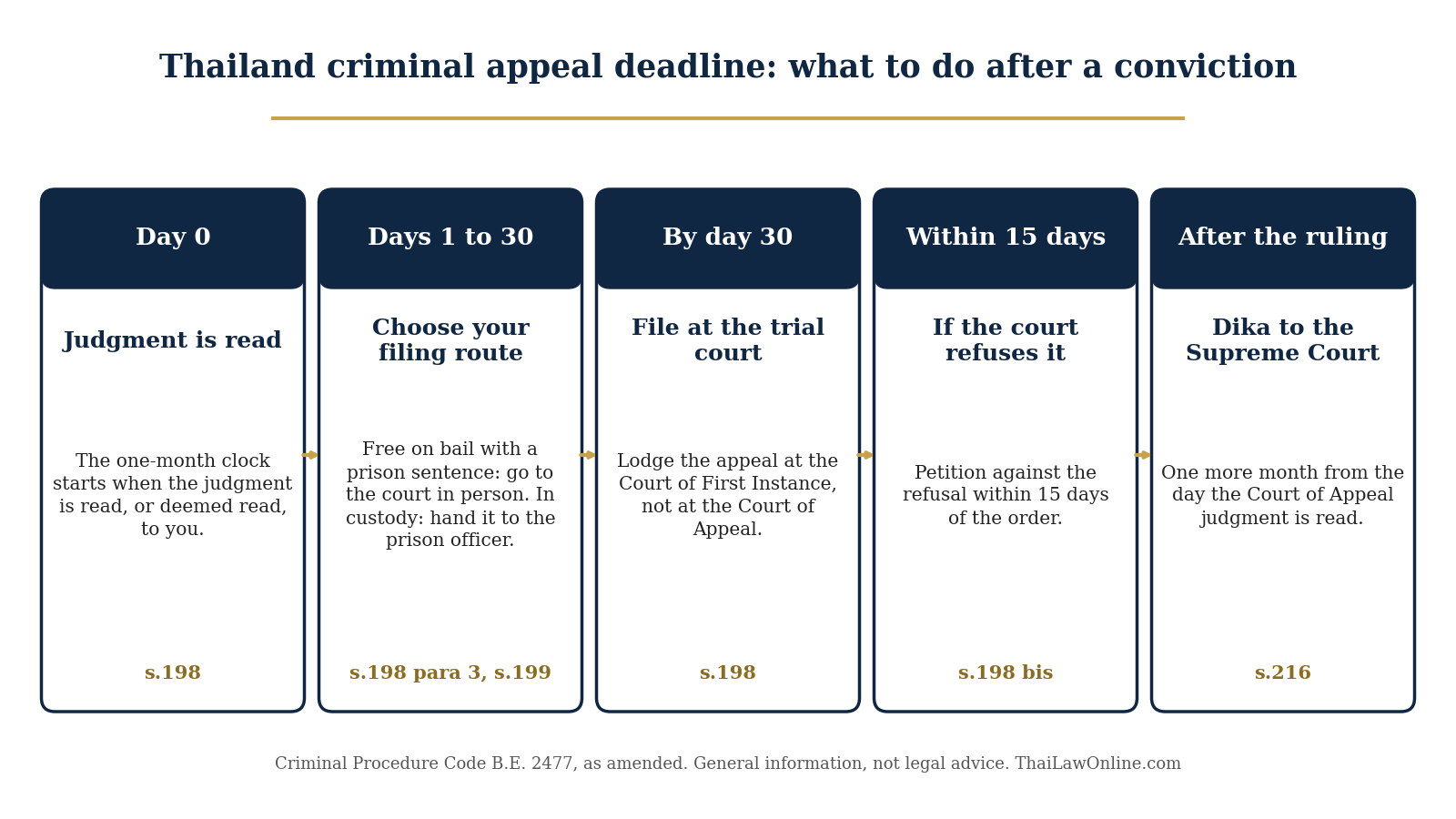
The Thailand criminal appeal deadline is one month. It runs from the day the judgment is read to you, or is treated as read to you, and it applies again at each later tier. You file the appeal at the court that convicted you, not at the court that will hear it. If you are sentenced to prison and are free on bail, you must also present yourself to a court officer when you file. Miss any of these steps and the judgment can become final.
The rule in one line: One month from the reading of the judgment, filed at the Court of First Instance (Criminal Procedure Code section 198). The same one-month rule applies to a Dika appeal to the Supreme Court after the Court of Appeal rules (section 216).
Section 193 is not the deadline section. Many people search for “section 193 appeal within one month”, and the two ideas get spliced together. Section 193 gives you the right to appeal a trial judgment on questions of fact and law. It sets no time limit. The clock sits in section 198 for the first appeal and section 216 for the Dika. Our annotated pages for section 193 and section 198 set out each text in full.
Understanding the Thai Court Structure
Thai criminal cases move through three tiers. The Court of First Instance tries the case and reads the judgment. The Court of Appeal reviews it on fact and law. The Supreme Court (Dika) reviews the Court of Appeal’s ruling, and its power to re-examine facts is narrower. Our guide to criminal trial procedures in Thailand covers the first tier, and the glossary entry on the Court of Appeal explains the second.
The filing rule surprises many defendants. Whichever court will hear your appeal, you lodge it at the Court of First Instance. That court checks the appeal and forwards it upward, or refuses to accept it. Filing at the wrong court does not stop the clock.
Key Legal Framework: Which Section Does What
The Criminal Procedure Code B.E. 2477 spreads the appeal rules across several sections. Read together, they work like this:
- Section 193: You may appeal a trial court judgment or order to the Court of Appeal on questions of fact and law, unless the Code or another law prohibits it. The appeal must state its grounds clearly. There is no deadline in this section.
- Section 193 bis: In minor cases, appeals on questions of fact are restricted, with exceptions. Ask a lawyer whether your sentence falls inside or outside the restriction before you rely on a fact-based appeal.
- Section 198: You file the appeal at the Court of First Instance within one month of the day the judgment or order is read, or is deemed read, to the party appealing.
- Section 198, paragraph 3: A defendant sentenced to imprisonment who is not in custody may appeal only by presenting himself to a court officer when filing. Otherwise the court orders that the appeal not be accepted. It does not apply where the imprisonment has been suspended or has been fully served.
- Section 198 bis: If the trial court refuses to accept your appeal, you may petition against the refusal within 15 days of the order.
- Section 199: A defendant held in prison may lodge the appeal with the prison officer within the appeal period. If the officer forwards it late through no fault of the appellant, it still counts as on time.
- Section 216: A Dika appeal is filed at the Court of First Instance within one month of the Court of Appeal judgment being read, or deemed read.
- Section 224: If the court refuses to accept a Dika appeal, you may petition against the refusal within 15 days. Count the 15 days from the day the order is read, the earlier of the possible start dates, so that you never file late.
Two limits matter at the Supreme Court. The Dika restricts appeals on questions of fact where the Court of Appeal has upheld, or only slightly amended, a sentence of five years or less (section 218; above five years only the prosecutor is barred, so the defendant may still argue the facts), section 219 bars fact appeals in low-sentence cases (up to two years or 40,000 baht) unless the Court of Appeal substantially amended the judgment and increased the defendant’s penalty, section 220 bars an appeal where both lower courts dismissed the prosecution’s case, and in any case barred by sections 218 to 220, a judge who sat in the case, signed the judgment or dissented may still allow a Dika appeal if the point decided is important enough for the Supreme Court, or the Director-General of the Public Prosecution Department may certify that it deserves a ruling (section 221). Our guide to pardons in Thailand covers what remains once every appeal is exhausted.
What to Do in the First 30 Days After a Conviction
- Write down the reading date. The month starts on the day the judgment is read to you. If the court treats it as read to you on another day, for example because you were absent, your lawyer must confirm which date applies. When in doubt, count from the earlier date.
- Decide how you will file. If you are in prison, the appeal can go through the prison officer (section 199). If you are free on bail and the judgment imposes imprisonment, plan to attend the court in person. A lawyer filing alone is not enough under section 198, paragraph 3.
- Get grounds ready early. Section 193 requires the appeal to state its grounds. A vague appeal that never explains why the judgment is wrong invites rejection. Give your lawyer the full judgment, and give your Thai and foreign counsel time to translate it.
- File at the trial court. Lodge the appeal at the Court of First Instance well before day 30. Keep the court’s receipt.
- Calendar the fallback dates. If the court refuses the appeal, you have 15 days to petition against the refusal. If you later win or lose at the Court of Appeal, a new one-month clock starts on the day that judgment is read.
- Deal with bail at the same time. Ask the court about bail while the appeal is pending. The court decides, and it is not automatic. See our guide to bail in Thailand and the glossary entry on bail.
If You Miss the Deadline
Treat a missed deadline as an emergency, not as a technicality you can fix later. Once the appeal period ends without a valid appeal, the judgment becomes final and the sentence can be enforced. Do not assume the court will extend the period. Whether any late filing can be accepted depends on the facts, the reason for the delay and the evidence you can show. Speak to a lawyer the same day you realise you are late, and bring every document showing when the judgment was read, where you were and why you could not file.
Who Else Can Appeal
Section 198 speaks of “the party filing the appeal”, so the one-month rule is not limited to the defendant. The prosecution can also appeal a judgment it disagrees with, for example an acquittal or a sentence it considers too light, and it works to the same month. This matters for you in two ways. A conviction you did not appeal can still be challenged by the other side, and an appeal against you does not remove your own right to file. If the prosecutor has appealed, tell your lawyer at once so your own filing is not overlooked.
Common Pitfalls
- Counting from the wrong date. The clock starts when the judgment is read or deemed read, not when you receive a written copy.
- Filing at the wrong court. The appeal goes to the Court of First Instance, whatever the tier it is bound for.
- Letting the lawyer file alone. A defendant on bail with a prison sentence must appear in person before a court officer.
- Vague grounds. An appeal that does not say what is wrong with the judgment can be rejected.
- Waiting for the written judgment. Translation and copying take time. File within the month and support it afterwards.
- Confusing the sections. Section 193 is the right to appeal. Sections 198 and 216 are the clocks.
Costs and Financial Considerations
Criminal appeals do not carry court fees: section 252 of the Criminal Procedure Code forbids the courts to charge any fee in a criminal case beyond those the Code itself lists. The real costs are elsewhere: legal representation, which typically ranges from 50,000 to 200,000 baht depending on the case, plus bail, translations and any fine you are ordered to pay. Budget for these before the month runs out, because a delay in arranging funds is not a reason the court will accept.
Frequently Asked Questions
Is section 193 the deadline for a criminal appeal in Thailand?
No. Section 193 gives the right to appeal on fact and law and requires the appeal to state its grounds. The deadline is one month under section 198 for the first appeal and section 216 for a Dika appeal.
How long do I have to appeal a criminal conviction in Thailand?
One month from the day the judgment is read, or deemed read, to you. The same period applies to a Dika appeal after the Court of Appeal ruling.
Where do I file a criminal appeal in Thailand?
At the Court of First Instance that convicted you, even though the Court of Appeal or the Supreme Court will hear it.
Can my lawyer file the appeal without me if I am on bail?
Not if you were sentenced to imprisonment. Section 198, paragraph 3 requires you to present yourself to a court officer when you file, unless the imprisonment has been suspended or fully served.
What if I am in prison and cannot reach the court?
Under section 199 you may lodge the appeal with the prison officer within the appeal period. If the officer forwards it late through no fault of yours, it still counts as on time.
What if the court refuses to accept my appeal?
You can petition against the refusal within 15 days of the order (section 198 bis for a first appeal, section 224 for a Dika appeal). Count from the day the order is read.
Can I ask for bail while my appeal is pending?
Yes, you can ask the court. The decision is the court’s, and it is not automatic. Ask your lawyer to file the bail request together with, or soon after, the appeal.
Does a Dika appeal cost court fees?
No. Criminal appeals do not carry court fees. Your costs are legal fees, bail, translation and any fine.
Conclusion: Act Inside the Month
The Thailand criminal appeal deadline leaves little room for error. Note the date the judgment is read, file at the trial court, attend in person if you are on bail with a prison sentence, and keep the fallback dates in view. Each step is short, and each one can end your appeal if you skip it.
ThaiLawOnline has advised clients in Thailand since 2006. If you or a family member has just been convicted, contact us today for a consultation at ThaiLawOnline.com or email info@thailawonline.com. Phone: +66 87 225 1340 (English and French) or +66 87 414 9288 (Thai).
General information only, not legal advice. Last reviewed 30 September 2026, against the Criminal Procedure Code read in Thai: sections 193 bis, 198 (including paragraph 3), 198 bis, 199, 216, 218, 219, 220, 221, 224 and 252.
Thai Law Updates, free by email
Plain-English updates on Thai law changes that affect foreigners: property, visas, marriage, business and wills. One short email a month from a firm practicing since 2006. No spam, unsubscribe anytime.