


Reviewed by ThaiLawOnline, a licensed Thai law firm practising in Thailand since 2006. Thai lawyer of record: Wichuda Atthamethakon, LL.M., Thai Bar Licence 3149/2556.
Last updated on
Short answer: Airbnb is not illegal in Thailand, but letting a property by the night usually is unless that property is licensed as a hotel or has been notified and acknowledged as a small one. The Hotel Act B.E. 2547 covers accommodation provided to travellers for remuneration and excludes only places let on a monthly basis or longer (section 4(2)), so a single nightly or weekly booking takes a unit outside the exclusion. A property of not more than eight rooms taking not more than thirty guests can be notified instead of licensed, once an official has inspected it and issued an acknowledgement valid for five years (Ministerial Regulation B.E. 2551 as replaced by No. 2 B.E. 2566). A condominium unit has a second problem: section 17/1 of the Condominium Act forbids running a hotel business in a condominium building, and a bylaw against daily letting is enforceable by the juristic person in the civil courts. The rules, the routes and the penalties are set out below.
Airbnb is the booking platform. Its Thailand hosting guidance places responsibility for compliance on the host. A published listing or an accepted booking does not establish whether the property has the permissions required for the proposed letting. Before accepting guests, check the accommodation rules, the building restrictions, the reporting duties and the tax position separately.
Table of Contents
Airbnb in Thailand: Legal Requirements, Licenses, and How to Stay Compliant
Airbnb hosting in Thailand is becoming more popular. However, it has strict legal responsibilities. You must ensure your rentals are legal in Thailand. If you are renting a beachfront villa or a condo in Bangkok, knowing the laws about short-term rentals is important. This knowledge can help you avoid fines and protect your investment. In this guide, we will help you understand important legal issues. This includes licenses, permits, tax rules, and building regulations.
How to List Your Property Legally on Airbnb in Thailand
Step 1: Create Your Airbnb Account
- Register on Airbnb using your email, phone number, or a social media account.
- You must either own the property or have a valid lease that allows subletting. If you’re unsure whether your lease permits this, we recommend reviewing our Lease Agreement in Thailand guide.
Step 2: Set Up Your Listing
- As of 2025, Airbnb requires hosts in Thailand to confirm they follow local laws. Violating these laws may lead to delisting
- Add clear images and detailed descriptions. Include if your property is a condo, house, or villa. This will make your rentals in Thailand more appealing.
- Set pricing for nightly, weekly, and monthly stays. You can also include cleaning fees or guest surcharges.
- Establish clear availability and house rules upfront.
But this is just the beginning. You must understand the rules, regulations and there are numerous ones.
Airbnb Rules and Regulations for Foreigners in Thailand: A Comprehensive Legal Guide
Thailand’s rules for short-term rental platforms like Airbnb are becoming more complex. These rules are getting stricter for foreign property owners. The country is a popular tourist spot, drawing millions of visitors each year. However, the rules for short-term rentals have changed a lot. Recent government actions in 2025 show the serious legal risks of not following these rules.
The main challenge for foreigners is understanding Thai law. This includes the Hotel Act B.E. 2547 (2004) and the Condominium Act B.E. 2522 (1979). They also need to know about foreign property ownership rules. Recently, enforcement has become stricter with more government oversight.
Legal Framework Governing Short-Term Rentals
Hotel Act Requirements
Thailand’s Hotel Act B.E. 2547 (2004) serves as the primary legislation regulating short-term accommodation services. The statutory test is not a room count and not a day count. Section 4 defines a hotel as accommodation established for business purposes to provide temporary lodging to travellers or anyone else for remuneration, and then excludes, in section 4(2), accommodation whose purpose is residential letting charged on a monthly basis or longer only. The Thai wording ends in เท่านั้น, meaning only, and that single word does more work than anything else in the Act:
- The exclusion attaches to the establishment, not to the individual booking. If your unit is set up to be let monthly or longer and nothing else, you are outside the Act. Take one nightly or weekly booking and you are no longer letting on a monthly basis only, so the exclusion in section 4(2) stops applying to the property as a whole. That is the real risk for a condo owner who lets long term but fills the odd gap week on a nightly platform.
- What matters is the basis on which you charge, not how long a particular guest happens to stay. A stay that runs 31 nights but is priced and invoiced per night is not a monthly letting.
The Supreme Court has read that same phrase the same way. In Decision 3464/2558 an insurer argued that an apartment building was a place of like kind to a hotel, so that its operator carried an innkeeper’s liability for a tenant’s car destroyed by flooding in the basement car park. The Court took the definition of hotel in section 4 of the Hotel Act, held that a place of like kind must provide temporary lodging for travellers, and found that an establishment letting rooms for residence charged monthly or longer only does not. The limit of the decision matters as much as the holding: it was a civil claim about liability for a guest’s property under section 674 of the Civil and Commercial Code, not a prosecution for running a hotel, so it is not authority that monthly rentals are exempt from the Hotel Act. What it does do is show the courts reading the monthly letting formula the way the Act writes it, and answer a question long-stay landlords ask, which is whether they carry a hotel’s strict liability for a tenant’s belongings. They do not.
The small-accommodation exemption, and the figures almost every English-language page still gets wrong. Separately from section 4(2), a ministerial regulation issued under section 4(3) takes small properties outside the definition. The original 2008 regulation set the threshold at four rooms and twenty guests, and required the operation to be a supplementary source of income. It was replaced by Ministerial Regulation (No. 2) B.E. 2566, published in the Royal Gazette on 30 August 2023 (vol. 140, part 52 Kor, p. 12) and in force sixty days later. The current threshold is not more than eight rooms and not more than thirty guests, and the supplementary-income condition was dropped altogether. Notification alone is no longer enough either: a competent official must inspect the property and issue an acknowledgement, which is then valid for five years.
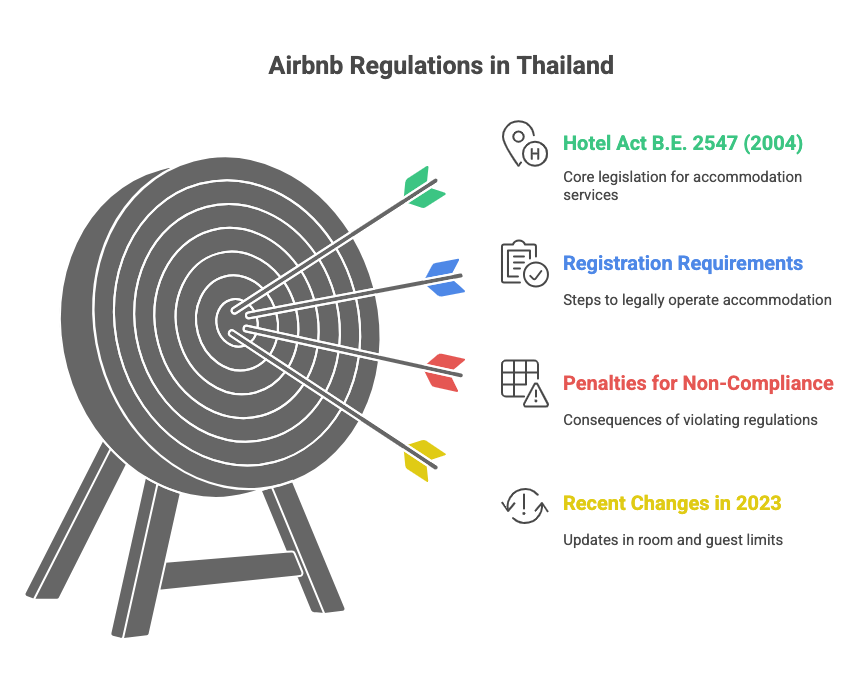
You must notify the Ministry of Interior and register your property. Not following the rules can result in fines up to THB 20,000. You could also face up to one year in jail. Additionally, there is a daily fine of THB 10,000 for any ongoing violation. The official has forty days from the date of your notification to inspect and issue the acknowledgement, and the process is now filed electronically. You will need:
- ID documents of the owner or notifier
- Power of attorney (if submitting on someone’s behalf, ensure compliance with local regulations).
- Lease agreement or property deed
- Condo layout/map
- Proof of income
For properties that go over these limits, operators need a full hotel license. This license requires following strict building rules, safety standards, fire protection systems, parking needs, and accessibility features. The licensing process is complex and expensive, involving multiple government agencies and substantial infrastructure investments that most residential properties cannot meet.
Condominium Act Restrictions
The Condominium Act B.E. 2522 (1979) adds another layer of complexity, specifically prohibiting commercial activities in residential condominium buildings. Section 17/1 explicitly states that no commercial trading shall be conducted in condominium buildings except in designated commercial areas with separate access arrangements. In a purely residential building there is no such designated commercial area, so letting units by the night breaches section 17/1 whether or not the Hotel Act is also engaged. A building can have commercial space with its own access, but that is a matter of how the condominium was registered and laid out, not something an individual owner can arrange for one unit.
Section 65 of the Act sets the penalty for breaching section 17/1 at a fine not exceeding 50,000 baht, plus a further fine not exceeding 5,000 baht for every day the breach continues.
The enforcement you are most likely to meet is not a prosecution. It is the condominium juristic person suing you under its own bylaws. In Supreme Court Decision 4215/2564 a juristic person sued a co-owner who had been letting his unit by the day. The bylaw limited use of a unit to occupation by the owner, the owner’s household and monthly tenants only, and recorded that daily letting is an offence under section 17/1 of the Condominium Act and section 15 of the Hotel Act. The Court held that the owner’s right to use his property under section 1336 of the Civil and Commercial Code has to be weighed against the harm to the other co-owners, upheld 300,000 baht of damages for the period up to the filing of the claim, and confirmed that the juristic person must give a written warning to stop before it can charge the bylaw penalty. It also struck out the daily penalty the lower courts had allowed to run forward from the filing date, because that penalty accrues only on days when a daily tenant is actually in the unit, and later stays were occasional rather than continuous.
Read the bylaws before you list. A bylaw prohibition on short-term letting is enforceable in the civil courts whatever the platform’s terms say, and the notice in the lobby saying this is not a hotel usually has one behind it.
Foreign Property Ownership Rules
Land and Property Ownership Restrictions
Foreigners face fundamental restrictions on property ownership in Thailand that significantly impact their ability to operate short-term rentals legally. Under the Land Code Act B.E. 2497 (1954), foreigners cannot own land directly in their own names (there are few exceptions). That link opens the unofficial English translation published by the Office of the Council of State, which is provided for information only and carries no legal authority; the Thai text in the Royal Gazette is the authoritative version. This prohibition extends to houses, villas, and any structures built on land, limiting foreign ownership options primarily to condominiums.
Condominium ownership represents the most accessible path for foreign property investment, though it comes with strict limitations. Foreigners can own condo units. However, total foreign ownership must not exceed 49% of the combined area of all the units in the building, measured at the time the condominium was registered. The quota is measured across all the units together rather than unit by unit, so foreigners must verify the available quota before purchase.
Alternative Ownership Structures
For land-based properties, foreigners usually use leasehold agreements (should be called “lease”) for up to 30 years. These can be renewed. They can also set up Thai limited companies where Thai citizens own at least 51%. However, these structures must comply with foreign business regulations and cannot be used solely to circumvent land ownership laws. We call them nominees, it is illegal and there are strict crackdowns in 2025.
Investment-based land ownership is possible under section 96 bis of the Land Code, not under Board of Investment rules: a foreigner who brings in at least 40 million baht of qualifying investment, kept for at least three years, may acquire up to one rai of land as a residence, with the Minister’s permission. It is a route to a home, not to an accommodation business.
Short-Term Rental Requirements by Property Type
Private Houses and Villas
Private houses and villas provide more flexibility for legal short-term rentals than condominiums. However, they still need proper licensing and registration. A property with not more than eight rooms in total, across one building or several, taking not more than thirty guests in total, falls outside the definition of a hotel and can be notified instead of licensed. Those are the figures set by clause 1 of the Ministerial Regulation as replaced by Ministerial Regulation (No. 2) B.E. 2566; the older four-room, twenty-guest figure that most English-language pages still quote was superseded in 2023. Notification alone does not do it: an official has to inspect and issue the acknowledgement, within forty days of the notification, and the acknowledgement then runs for five years from the date you notified.
This gives villa owners more chances to operate legally. The Ministerial Regulation puts no nationality condition on it: clause 1 says that any person who wishes to use premises in that way notifies the registrar, and the words for nationality and for alien do not appear anywhere in the consolidated text. What actually stands in a foreigner’s way is earlier in the chain, and it is on this page already. You cannot own the land or the house on it, so the villa has to be leased or owned by a company; and if the letting is run as a business rather than as an owner letting his own home, the Foreign Business Act applies to the operator. Neither of those is a bar at the notification counter, and neither is a reason to put the property in somebody else’s name.
Villa owners must still comply with safety requirements including proper lighting, door locks, bathroom facilities, and guest registration procedures. Properties exceeding the exemption thresholds require full hotel licenses with all associated building and safety requirements.
Condominium Units
Condominium rentals present the most restrictive scenario for short-term operations. Letting a unit on anything other than a monthly basis takes it outside the exclusion in section 4(2) of the Hotel Act, so nightly or weekly letting needs a hotel licence or a small-accommodation acknowledgement, and section 17/1 of the Condominium Act is a further obstacle. Most condominium buildings lack the necessary infrastructure and legal status to obtain hotel licenses, making short-term rentals practically impossible.
Letting on a monthly basis or longer is still allowed for condo owners. They must follow building rules and make sure their lease agreements allow subletting. Many condominium juristic persons have implemented strict policies against any form of short-term rental, regardless of duration.
Enforcement in the tourist provinces has concentrated on units let by the night through booking platforms, and has produced arrests, fines and closer scrutiny of foreign-owned units. The owner’s nationality is not what the Hotel Act turns on. The offence is carrying on a hotel business without a licence, and a Thai owner doing the same thing commits the same offence, so a foreign owner should read the crackdowns as evidence of how the rule is enforced rather than as a rule about foreigners.
Licensing and Registration Process
Hotel License Application
Obtaining a hotel license requires navigating a complex bureaucratic process involving multiple government agencies. Applicants must first make sure their property meets all building code rules. This includes fire safety systems, parking areas, waste management systems, and accessibility features. The building must be properly zoned for commercial use and meet all structural requirements for hotel operations.
The application process involves submitting detailed architectural plans, safety assessments, environmental impact studies, and financial documentation to the relevant provincial authorities. Processing times can extend several months, and many residential properties cannot meet the stringent requirements without substantial renovations.
Non-Hotel Registration
The simplified non-hotel registration process applies to smaller properties meeting the exemption criteria. Notification is filed electronically, with a fallback to the district office where the property sits, or, in Bangkok, to the Bureau of Investigation and Legal Affairs at the Department of Provincial Administration. The regulation itself sets no nationality condition, and it is worth being precise about that, because a good deal of English-language commentary says the route is closed to foreigners. What actually limits a foreign owner is upstream: whether you may hold the property at all, and whether operating an accommodation business engages the Foreign Business Act. The notification is not the obstacle.
Registration must be renewed every five years and requires ongoing compliance with safety standards and guest reporting requirements. Properties can be reclassified if they expand beyond the exemption thresholds or fail to maintain compliance standards.
Tax and Reporting Obligations
Income Tax Requirements
Foreign property owners earning rental income in Thailand face multiple tax obligations regardless of their residency status. The 15% figure that circulates for non-residents is a withholding rate, not a final tax, and the difference is worth money. Revenue Code section 50(3) obliges the payer to withhold 15% of rent paid to a person who is not resident in Thailand. It is not a flat final charge, because the election to settle at a flat rate and keep the income out of the return, in section 48(3), is available only for interest and for gains on the transfer of investment units. Rent, which is section 40(5) income, is not on that list. Under section 60 the amount withheld is a credit in computing your tax. So a non-resident landlord files a Thai return and is assessed at the same progressive rates a resident faces, crediting the 15% already taken. Where the tenant is a Thai company rather than an individual, a different instrument applies: Revenue Departmental Order T.P. 4/2528, clause 6, requires a company or juristic partnership paying rent to withhold 5%. Rental income from property situated in Thailand is taxable here whatever your residence and whether or not the money ever enters the country. That is section 41 paragraph 1 of the Revenue Code, which taxes assessable income from a property situated in Thailand “whether such income is paid within or outside Thailand”. Being paid into an account abroad changes nothing. The rule people confuse it with is paragraph 2, which taxes a resident on foreign income only when the money is brought into Thailand, and that paragraph has nothing to do with rent from a Thai condo. Against it you may take the 30% standard deduction for buildings, or itemise actual expenses with documentation.
Corporate income tax may apply to properties held by Thai companies. The rates can reach 20% for higher income levels. The old House and Land Tax at 12.5% no longer applies. Section 3(1) of the Land and Building Tax Act B.E. 2562 repealed it, and the Land and Building Tax took its place for tax years from 1 January 2020. That tax is charged on the government-appraised value of the property rather than on the rent you collect, and it is billed by the local municipality, so budget for it separately from income tax. Our guide to property taxes in Thailand sets out the current rates.
VAT is a separate question, and the answer turns on what you are supplying. Section 81(1) of the Revenue Code exempts the rental of immovable property from value added tax, at sub-paragraph (r) in the Revenue Department’s own English text and (ต) in the Thai, so a straight residential letting stays outside VAT however much rent you collect. Supplying accommodation with services, which is what a nightly operation is, is a supply of services rather than a lease, and it enters the VAT system once turnover passes the small business threshold under section 81/1, which the Revenue Department puts at 1.8 million baht a year. The way you let therefore decides the VAT answer as well as the licensing one.
Land and Building Tax: Letting Monthly Keeps You in the 0.02 Per Cent Band
The Land and Building Tax Act B.E. 2562 charges the owner on the government-appraised value of the property, and the rate depends on how the property is classified. For a condo owner, that classification is decided by how you let it, and the gap between the two answers is fifteenfold.
Section 37 of the Act caps the rate at 0.3 per cent of the tax base for residential use and 1.2 per cent for any other use, and requires the rates actually charged to be set by royal decree. The decree in force is the Royal Decree Prescribing Land and Building Tax Rates B.E. 2564 (Royal Gazette vol. 138, part 84 Kor, p. 1, 13 December 2021), which applies to tax years from 2565 (2022) onwards. Its bands are marginal, that is, each rate applies only to the slice of value inside its band:
- Residential, other than the home you live in and are registered at (clause 3(2)(c)): 0.02 per cent up to 50 million baht, 0.03 per cent on the part above 50 million up to 75 million, 0.05 per cent above that up to 100 million, and 0.1 per cent above 100 million. A condo you own and let out on a residential basis sits here.
- Other use (clause 3(3)): 0.3 per cent up to 50 million baht, rising through 0.4, 0.5 and 0.6 per cent to 0.7 per cent above 5 billion. A unit let by the night sits here.
What moves a unit from one band to the other is the joint announcement of the Ministry of Finance and the Ministry of Interior on the criteria for residential use, dated 30 January 2020 (Royal Gazette vol. 137, special part 126 Ngor, p. 18), made under section 37 paragraph 3 of the Act. Its clause 3 defines residential use and then excludes, among other things, a hotel under the hotel law, and land or buildings providing temporary accommodation to travellers or any other person for remuneration. The exclusion carries the same carve-out as the Hotel Act: it does not catch a letting charged monthly or longer, and it does not catch a homestay as the announcement defines it, meaning not more than four rooms and twenty guests under the same roof as the owner.
So the same fact that keeps you outside the Hotel Act keeps your tax bill in the residential band. Let the unit monthly and it is residential use at 0.02 per cent. Let it by the night and it is other use at 0.3 per cent, and the local authority may charge more than that: section 37 paragraph 6 lets it raise the rate by local ordinance up to the statutory ceiling.
Two practical points that catch owners out. First, the exemption of the first 50 million baht of value under section 41 of the Act belongs to a natural person who uses the property as a home and whose name is on the house register on 1 January of the tax year. A unit you let out is not that, so it is taxed from the first baht. Second, the local authority is supposed to send the assessment by February (section 44) and the tax is payable during April (section 46), although the deadline has been extended by ministerial announcement in most years. Our guide to property taxes in Thailand covers the tax in full.
Guest Reporting Requirements (TM30)
TM30 is your duty as the owner, not your guest’s and not the platform’s. Section 38 of the Immigration Act B.E. 2522 puts the obligation on the house master, the owner or the possessor of the dwelling, or on the hotel manager, who takes in a foreigner permitted to stay in the Kingdom temporarily. The notification goes to the immigration office for the district in which the property stands, or to the Immigration Division for a property in Bangkok, within twenty four hours of the foreigner taking up residence. Nothing in the section turns on how long the stay is, so it catches a tenant on a one-year lease exactly as it catches a guest who books two nights.
The TM30 process requires copies of guest passports, visa pages, departure cards, property ownership documents, and rental agreements. Section 77 of the same Act sets the penalty for failing to notify at a fine not exceeding 2,000 baht, rising to between 2,000 and 10,000 baht where the person in breach is a hotel manager. The amount an office actually demands varies, and the figures quoted around the expat internet are settlement amounts rather than the statutory maximum. Immigration authorities are checking compliance more often during visa extensions and other processes.
Property management companies often take care of TM30 compliance for foreign owners. However, this increases costs and makes rental operations more complex. Some Airbnb hosts attempt to avoid reporting requirements, creating additional legal risks and potential immigration violations. TM30 was often not requested before 2018. We have a text explaining that here.
Managing the Rental Yourself, and When That Becomes Work
Owning a Thai condo and receiving rent from it is not work. Running it might be, and the line matters because there is no small scale exemption to shelter under.
The Emergency Decree on Managing the Work of Aliens B.E. 2560 defines work, in section 5 as amended by the No. 2 Emergency Decree of B.E. 2561, as engaging in any occupation, whether or not there is an employer. The definition that applied before 2018 also caught the mere use of physical strength or knowledge, which is why so much old advice online is alarmist. The current test asks whether what you are doing amounts to an occupation. Section 8 forbids a foreigner to work without a permit, and section 101 punishes a breach with a fine of 5,000 to 50,000 baht, after which the foreigner is removed from the Kingdom. Taking on a foreigner who has no permit is a separate offence for the person who does it, under section 9.
We could not find a published Department of Employment ruling dealing squarely with an owner who manages his own unit, and we would rather say so than manufacture certainty. What the statutory test does settle:
- Acts of an owner are not an occupation. Signing a lease of your own property, receiving the rent, filing the tax return on it, instructing an agent or a lawyer, and attending the annual general meeting of the co-owners are things an owner does with his own asset.
- Operating the unit looks like an occupation. Writing and managing listings, meeting guests, handing over keys, cleaning and laundry, arranging transfers, dealing with complaints and doing it repeatedly, especially across more than one unit, is precisely the work a management company pays staff to do. An inspector who finds a foreigner doing it on site is looking at section 8, and the fact that the property is yours is not an answer to it.
The practical route is the one professional owners already use: a Thai agent or a management company does the operational work, and you remain the owner receiving the income. It costs a percentage of the rent, and it removes the argument entirely.
Recent Enforcement and Crackdowns
2025 Government Actions
The Thai government has significantly intensified enforcement of short-term rental regulations in 2025, with multiple high-profile operations targeting illegal accommodations. In March 2025, administrative officials conducted undercover operations in Bangkok’s Pratunam area, arresting operators of illegal hotel businesses and filing complaints with police.
The government warned foreign investors, and Chinese nationals in particular, against buying condominium units in order to rent them to tourists on Airbnb. These operations focused on the Sukhumvit area. Residents complained about noise, cannabis use, and property damage. This led to investigations.
Multi-Agency Coordination
Different authorities handle different parts of a hosting operation. Accommodation licensing enquiries start with the Department of Provincial Administration (DOPA) (กรมการปกครอง; French: Département de l’administration provinciale) and the competent local registration office. For guest reporting, consult the Immigration Bureau of Thailand (สำนักงานตรวจคนเข้าเมือง) and our TM30 guide. For rental-income tax guidance, use the Revenue Department (กรมสรรพากร; French: Département des impôts). The French names are explanatory translations. A reply from one authority does not resolve the obligations administered by another.
The House Committee on Consumer Protection wants online booking platforms to check hotel licenses before accepting listings. This could stop thousands of illegal places to stay. This systematic approach represents a significant shift from previous inconsistent enforcement patterns.
Penalties and Legal Risks
Criminal Penalties
Violating the Hotel Act can lead to serious penalties. These include up to one year in prison and fines of up to THB 20,000. There are also extra daily fines of THB 10,000 for ongoing violations. These penalties apply to property owners, operators, and potentially facilitating parties involved in illegal hotel operations.
Recent court cases have confirmed that unlicensed short-term rentals constitute criminal violations. The 2018 Hua Hin court ruling set a legal precedent. It convicted property owners for renting out condominiums daily and weekly. Fines for these violations ranged from THB 10,000 to THB 15,000. Recent cases have led to higher penalties. Some owners now face fines over THB 100,000, according to 2025 court reports. Deportation risks for foreigners are real but require immigration violations.
Administrative Consequences
Beyond criminal penalties, violators face administrative consequences including property seizure, business closure orders, and potential deportation for foreign nationals. The government has said that violations could impact work permit renewals and visa extensions for foreigners in illegal rentals.
Condominium owners also face civil action by the juristic person: bylaw penalties after a written warning, damages and court orders to stop, as in Supreme Court Decision 4215/2564 above, where the owner paid 300,000 baht. These civil consequences can prove more costly than criminal penalties, particularly in high-value properties.
Recommendations and Best Practices
For Foreign Property Owners
Foreign investors should prioritize legal compliance over potential rental income when considering short-term rental investments. For condo owners, letting only on a monthly basis or longer, priced and invoiced by the month, is the safe way to stay outside the Hotel Act. Monthly rentals can still generate reasonable returns while maintaining legal compliance.
Villa owners should check whether their property is inside the eight-room, thirty-guest threshold, in which case a notification and an official’s acknowledgement replace a licence. Do not take a Thai partner in order to obtain one. There is no nationality condition in the Ministerial Regulation, so a partner adds nothing at the counter, and a partner taken to hold what a foreigner may not hold is the nominee arrangement this page describes as illegal and currently being prosecuted. It is important to follow the laws of Airbnb in Thailand. Getting professional legal advice is crucial before starting any short-term rental. This is due to the complex rules and recent enforcement trends.
Property management companies can provide valuable assistance with compliance requirements, including TM30 reporting, tax obligations, and guest screening procedures. While this reduces profit margins, professional management significantly reduces legal risks and administrative burdens.
Alternative Investment Strategies
Given the restrictive regulatory environment, foreign investors might consider alternative approaches to Thailand’s hospitality market. Long-term rentals face fewer restrictions and can provide stable income without licensing requirements. Partnerships with established hotel operators or licensed accommodation providers offer another path to hospitality investment.
Commercial property investment in properly zoned areas may provide opportunities for legitimate hotel development, though this requires substantial capital and expertise. Some investors focus on serviced apartments that require longer minimum stays to ensure compliance with the legality of Airbnb in Thailand. This helps them avoid short-term rental rules and serve travelers who stay longer.
Current Market Outlook and Future Trends
Regulatory Evolution
The Thai government is still improving its rules for short-term rentals. They want to balance the needs of tourism, community concerns, and tax collection goals. Recent proposals include establishing comprehensive registration systems for all short-term rental operators and requiring platforms to verify legal status before accepting listings.
Industry observers expect continued enforcement expansion beyond Bangkok to popular tourist destinations including Phuket, Pattaya, and Chiang Mai. The success of recent operations suggests sustained government commitment to eliminating illegal accommodations and protecting the legitimate hotel industry.
Technology and Compliance
Emerging technologies may facilitate better compliance monitoring and guest reporting systems. The government has discussed digital integration between immigration databases and accommodation platforms to streamline TM30 reporting and verify guest legitimacy.
Blockchain-based verification systems and automated compliance reporting could reduce administrative burdens while ensuring regulatory compliance. However, these technological solutions remain in development stages and may take years to implement effectively.
Hotel Licensing: Cost, Process, and Pitfalls
If your property requires a hotel license, here’s what you should know:
- Application Fees: Generally a few thousand baht.
- Compliance Costs: You may need renovations for fire safety, hygiene, or accessibility.
- Application Time: Expect several weeks to months, depending on inspections and local office backlog.
- Transferability: Hotel licenses are not transferable to new owners. You must apply for a new license if you buy a property previously used for rentals.
Licenses are issued by your local District Office (Amphur), in coordination with other agencies.
Common Pitfalls and How to Avoid Them
- No Work Permit: a foreigner who operates the letting, rather than simply owning the unit and taking the rent, may be working within the meaning of the Emergency Decree on Managing the Work of Aliens. See Managing the Rental Yourself above.
- Non-compliant Properties: Properties failing safety or zoning checks can be denied licenses.
- Neighbour Complaints: can result in licence suspension or action by the condominium juristic person.
- Getting the taxes wrong: rent is assessable income under section 40(5) of the Revenue Code, withholding may be taken at source by the payer, the owner pays land and building tax on the appraised value, and VAT arises only where what you supply is accommodation with services rather than a lease.
Comparison of Airbnb Rental Options in Thailand
| Rental Type | Legal? | Requires Hotel License? | Common Issues |
|---|---|---|---|
| Condo Unit (under 30 days) | ❌ Often illegal under condo rules | ✔️ Yes, or register as non-hotel (if eligible) | Juristic person restrictions, TM30 reporting, fines |
| Villa / Detached House | ✅ Outside the Act if not more than 8 rooms and not more than 30 guests | ❌ Not required, but you must notify and be inspected under the 2566 (2023) regulation | Acknowledgement valid 5 years, tax obligations |
| Entire House (more than 8 rooms or more than 30 guests) | ✅ Legal with license | ✔️ Required | Lengthy registration, inspections, high compliance |
| Long-term Lease (30+ days) | ✅ Fully legal | ❌ Not required | Fewer tax benefits for short-term hosts |
Why the Law is So Strict
- Protecting Tourists: Ensuring health and safety standards.
- Leveling the Playing Field: Licensed hotels argue that unregulated rentals avoid compliance costs.
- Preserving Residential Use: Condos weren’t designed for transient guests.
- Ensuring Tax Revenue: Many Airbnb rentals historically bypassed tax obligations and operated without a license.
FAQS on AIRBNB and Thai Law
Is Airbnb legal in Thailand?
Airbnb is legal in Thailand, but it must comply with local laws and regulations. Hosts must follow the Hotel Act of 2004. This law may require them to get a hotel license if they provide short-term stays.
What are the legal issues for renting properties on Airbnb in Thailand?
Legal issues can arise if hosts do not comply with the Hotel Act and local regulations. Rentals for less than 30 days may be illegal without a hotel license. Not following this rule can lead to fines or jail time.
How can I apply for a hotel license for my Airbnb property?
To get a hotel license, property owners must send an application to the local authority. They need to follow the rules of the Hotel Act. This includes ensuring the property meets safety and health standards and is registered with the immigration office.
Are there specific regulations for renting condos on Airbnb?
Yes, condominium regulations often restrict short-term rentals. Many condo associations have rules against renting condos for less than 30 days. This can impact the legality of using Airbnb for these rentals.
Can I use Airbnb for daily or weekly rentals in Thailand?
Daily or weekly rentals are technically illegal without a hotel license according to the Hotel Act. Hosts must be cautious and ensure their rental practices comply with local laws to avoid penalties.
What should I know about taxation on Airbnb rentals in Thailand?
Hosts earning income from Airbnb rentals are required to pay personal income tax on their earnings. Also, there may be withholding tax obligations. It is important to keep good records of income and expenses for the property.
Are properties that have a hotel license treated differently under Thai law?
Yes, properties with a hotel license are treated differently and can legally offer short-term rentals without facing penalties. These properties must still comply with the regulations set forth by the local authorities and the Hotel Act.
What types of accommodations are popular for short-term rentals in Thailand?
Apart from Airbnb, other platforms like Booking.com and Agoda are popular for short-term rentals. Various accommodations, including condos, villas, and guesthouses, attract both local and international travelers.
Thinking of Hosting on Airbnb in Thailand?
You can do it legally, but only if you follow the rules. From lease contracts to immigration notifications, each step matters.
Let ThaiLawOnline help you get it right the first time. Book your consultation today and ensure your Airbnb business in Thailand is legal, compliant, and profitable by adhering to local regulations.
Conclusion
Running Airbnb rentals as a foreigner in Thailand means dealing with difficult and strict legal rules that are now more enforced in 2025. Some legal options are available. Villa owners who meet certain criteria and condo owners who rent for 30 days or more can benefit. However, the rules mainly support traditional hotels and licensed places to stay.
Recent government crackdowns demonstrate serious commitment to eliminating illegal short-term rentals, with foreign property owners facing particular scrutiny. The combination of criminal penalties, administrative consequences, and civil liability creates substantial risks for non-compliant operations that far exceed potential rental income benefits.
Foreign investors considering Thailand’s short-term rental market should prioritize legal compliance and consider alternative investment strategies that align with current regulatory frameworks. Professional legal guidance, proper licensing procedures, and comprehensive compliance systems are essential for any legitimate accommodation business in Thailand’s evolving regulatory landscape.
The government’s emphasis on protecting both community interests and legitimate tourism businesses suggests that enforcement will continue intensifying, making illegal operations increasingly untenable. Successful foreign investors in Thailand’s hospitality sector will adapt to rules. They should not try to avoid legal restrictions.
Legislative status, August 2026
Last reviewed: 5 September 2026. The licensing rules on this page were read against the instruments themselves. Specifically: the Ministerial Regulation prescribing the types and criteria of the hotel business B.E. 2551 as consolidated with Ministerial Regulation (No. 2) B.E. 2566, clause 1 and the transitional clauses, taken from the government’s central law register at law.go.th, which is where the eight-room and thirty-guest threshold, the forty-day inspection period, the five-year life of the acknowledgement and the sixty-day commencement all come from. What was not verified, said plainly rather than implied: the hotel licence fees, the processing times and the market figures on this page are not sourced to an instrument we could produce, and the four-room, twenty-guest homestay figure in the Land and Building Tax section is a different instrument’s definition and was not re-checked here.
No new statute has been enacted, and the monthly-letting exclusion in section 4(2) of the Hotel Act B.E. 2547 is still the rule that decides whether you need a licence. Two reform proposals are in circulation and neither is law. A Short-Term Rental Registration Act draft was floated in June 2025 to create a central platform registry, and a broader bill that would recognise a middle tier of non-hotel overnight accommodation has been under review during 2026. Until one of them is passed and published in the Royal Gazette, treat any offer to register a condominium unit as lawful short-stay accommodation as a proposal being sold as a product.
Links
Thai Law Updates, free by email
Plain-English updates on Thai law changes that affect foreigners: property, visas, marriage, business and wills. One short email a month from a firm practicing since 2006. No spam, unsubscribe anytime.