


Reviewed by ThaiLawOnline, a licensed Thai law firm practising in Thailand since 2006. Thai lawyer of record: Wichuda Atthamethakon, LL.M., Thai Bar Licence 3149/2556.
Last updated on
The TM.47 is the Immigration Bureau form for the 90-day report, the notification a foreigner staying in Thailand on a long-term permit must file every 90 days under section 37(5) of the Immigration Act. File it online, by post or at your local immigration office. Download the official TM.47 PDF below. Officially, the report is called the “Notification of Staying in the Kingdom over 90 Days”, and it is one of the most misunderstood duties an expat has.
FREE DOWNLOAD
90-Day Report Guide & Checklist (2026), Word + PDF, English & Thai
Our lawyers’ bilingual checklist: the filing rules for each reporting channel, the TM30 requirement in Bangkok, how offices differ, TDAC and the THIM app, fines, and every document to bring. Free, updated 21 September 2026. รายการเอกสารและคู่มือรายงานตัว 90 วัน ฟรี
Reporting duties depend on which permission you hold, which you can identify with the Thai Visa Finder.
Quick answer: the TM.47 and the 90-day report
- What it is: the TM.47 is the Immigration Bureau form for the 90-day address report under section 37(5) of the Immigration Act B.E. 2522 (1979).
- Get the form: download the official TM.47 PDF. You do not need it if you file online.
- File online: at tm47.immigration.go.th, within the 15 days before your due date. The Bureau says an officer checks the request in about 3 days.
- File at the office: from 15 days before the due date to 7 days after it.
- Cost: free when on time. A voluntary late report is usually settled at 2,000 THB. The statutory ceiling under section 76 is 5,000 THB plus up to 200 THB a day until you comply.
- Next due date: printed on your receipt. Leaving Thailand and re-entering restarts the count.
TM.47 form download (official PDF) and how to fill it in
The TM.47 (ตม.47) is the one-page bilingual form “Form for alien to notify of staying longer than 90 days” issued by the Immigration Bureau. We host a clean copy of the official form so you can print it before you go, or fill it in and post it. It is the same form whichever immigration office you report to.
- Download the official TM.47 form (PDF, 1 page, Thai and English), mirrored from the Immigration Bureau, checked August 2026.
- Download our free 90-day report guide and checklist (Word and PDF, English and Thai), which lists every document to bring and the office-by-office differences.
How to fill in the TM.47, field by field
Write in English, in block capitals, with a black or blue pen. Only the top part of the page is yours; the lower “Receipt of notification, for official use only” is completed by the officer and handed back to you as your receipt.
| Field on the form | What to write |
|---|---|
| Written at | The town or district where you are filling in the form, for example “Bangkok” or “Hua Hin”. |
| Date, month, year | The date you sign it. You may write the year in the Christian era; officers convert to the Buddhist era (add 543). |
| To the Immigration Officer | Pre-printed, nothing to add. |
| Full name in block letters | Your name exactly as printed in your passport, surname included. |
| Nationality | As shown on your passport. |
| Visa (Tourist or Non-Imm) | Tick the box that matches your entry. Holders of an extension of stay based on retirement, marriage, work or study tick Non-Imm. DTV holders are commonly recorded under the Tourist category. This checkbox is a form field only; it does not determine whether Section 37(5) applies. |
| Entered Thailand on (date, month, year) by | Your last entry date, from the most recent entry stamp, and how you arrived, for example “Thai Airways TG 921” or “car, Sadao checkpoint”. |
| Passport no. | The number of the passport you entered on. If you have changed passport since, bring both. |
| Arrival card no. | The paper TM.6 arrival card was abolished on 1 May 2025. Write the reference number from your TDAC confirmation if you have one, or leave the field blank; officers no longer insist on it. |
| Present address (lane or road, tambol, amphur, province, phone) | The address where you actually sleep, matching your TM.30 notification. Use the house number, soi and road, then the sub-district (tambol), district (amphur) and province, with a Thai mobile number the office can call. |
| Signature | Sign as in your passport. If a representative files for you, you still sign the form yourself and give them a signed authorisation letter. |
Bring the completed TM.47 with your passport, photocopies of the photo page, current visa or extension stamp and latest entry stamp, and your previous 90-day receipt if you have one. The full list, and what changes from office to office, is in the checklist above.
Whether you hold a retirement, marriage, business, education or DTV permission, the Section 37(5) question is whether you remain in Thailand for more than 90 consecutive days. If you do, report your address to Immigration at the 90-day point and every 90 days thereafter. Leaving Thailand resets the count. Missing a due report can result in a 2,000 THB settlement fine in practice and complications with future immigration transactions.
This guide covers what you need to know: who must file, when to file, and how to file. It explains how to file online or in person. It also covers the required TM47 form. It shows how to avoid common mistakes, even for long-term expats.
Table of Contents
TM.47, TM.30, TM.7 and TM.8: which immigration form is which?
Searches for “TM47”, “TM7” and “TM8” often land people on the wrong form. Only the TM.47 is the 90-day report. The others do different jobs, and filing one does not file another for you.
| Form | What it is | Who files it | Our guide |
|---|---|---|---|
| TM.47 | Notification of staying in Thailand over 90 days (the 90-day address report) | The foreigner, every 90 days of continuous stay | This page |
| TM.30 | Notification of a foreigner’s stay at an address | The host: landlord, owner or hotel, within 24 hours | TM.30 notification |
| TM.7 | Application to extend a temporary stay | The foreigner, before the permitted stay ends | Extension of stay, retirement extension |
| TM.8 | Application for a re-entry permit | The foreigner, before leaving Thailand | Re-entry permit |
A TM.7 extension does not file your 90-day report. Keep following the due date printed on your last TM.47 receipt, and consider booking the two visits close together.
Already missed your 90-day report? Here is what to do
First, the reassuring part: a missed 90-day report is not overstay. They are different offences with very different consequences. Overstay means your permission to stay has expired. A late 90-day report is a reporting failure under Section 37(5) of the Immigration Act B.E. 2522 while your permission to stay is still perfectly valid. You are not accruing daily overstay fines, and a late report on its own does not put you on a re-entry ban. If you are worried you have actually overstayed, that is a separate problem covered in our guide to visa overstay and criminal blacklists.
What to do depends on how late you are.
- Within 7 days after the due date. Attend the responsible immigration office within its permitted filing window. Do not rely on post at this stage: Immigration instructs postal applicants to send the report at least 15 days before the due date. Online reporting follows its separate advance-filing rules. Keep the receipt showing your next due date.
- More than 7 days late. Online and postal filing are no longer options. Go to your Immigration office in person, file the TM.47, and pay the 2,000 THB fine for a self-reported late notification. Bring your passport, the TM.47, and photocopies of your photo page, current visa, latest entry stamp and any extension stamps.
- You only found out because Immigration told you. If the lapse is discovered during another interaction, such as a visa extension appointment, expect it to be handled less favourably than a voluntary report. Go in and report before your next appointment rather than at it.
A worked example. You enter Thailand on 3 March 2026. Counting the entry date as day one, day 90 is 31 May 2026. The office window runs from 16 May to 7 June, subject to office opening days and any applicable official holiday arrangements. Online and postal reporting have earlier deadlines. After approval, follow the next due date on the receipt; do not calculate it from the submission date alone.
Last reviewed: 3 September 2026, against the consolidated text of the Immigration Act B.E. 2522 (1979). Checked section by section: section 37 (the duties of an alien permitted to stay temporarily, and sub-section (5), the notification itself, quoted below); the final paragraph of section 37 (in person or in writing, under regulations prescribed by the Director-General); section 15 (who is exempt from the duties of aliens, and from which of them); and section 76 (the penalty, which is a fine not exceeding 5,000 baht and a further fine not exceeding 200 baht per day until compliance). This review does not cover the figures Immigration settles late reports at in practice, the office-by-office differences, or the online system’s eligibility rules, none of which come from the Act; each is marked as practice where it appears.
Legal Foundation and Authority for Notification of Address
The 90-day notification requirement is set under Section 37(5) of the Immigration Act B.E. 2522 (1979). It requires foreign nationals with temporary residence in Thailand to report their address every 90 days. They must report to Immigration Bureau officers. This law has been in place since 1979. In recent years, it has been enforced more strictly. Thai Immigration now requires compliance for visa extensions and other services.
Read the sub-section itself and one thing follows that matters for the deadline. Section 37(5) requires the alien to notify the immigration officer of their residence without delay once the ninety days are complete, and to do the same every ninety days after that. It sets no window and no grace period. The office filing window used below, 15 days before the due date and 7 days after, is not in the Act: the final paragraph of section 37 lets the alien notify in person or in writing in accordance with regulations prescribed by the Director-General, and the window is set there. It is real and it is applied at every office, but it is an administrative rule that the Immigration Bureau can change, not a statutory right.
The law lets immigration authorities track foreign nationals who live in Thailand long term. They do this for security and administrative reasons. Failure to comply with this requirement can lead to significant penalties. These may include fines and problems with future visa applications.
Understanding the 90-Day Report System
The 90-day report is officially filed using form TM.47.It is a system for foreigners in Thailand. It requires them to report their current address to Thai Immigration every 90 days. This is required even if the address has not changed. This requirement is separate from visa extensions or renewals. It serves only as a tracking tool for immigration authorities.
The system uses a simple 90-day cycle. It starts on your Thailand entry date or your last successful report. Importantly, this counter resets each time you leave and re-enter Thailand. You then get a new 90-day period starting on your entry date.
Who Must File a 90-Day Report in Thailand?
A foreigner permitted to stay temporarily who remains in Thailand for more than 90 consecutive days generally must file the TM.47 report. The legal test is continuous stay, not the visa label. This includes Non-Immigrant stays for business, retirement, marriage, education or work, and also DTV and Thailand Privilege holders who cross the 90-day threshold. LTR visa holders follow a different rhythm: the BOI’s LTR site says holders who stay in Thailand for more than one year consecutively report their address once a year, in person or through an authorised person at the TIESC office in Bangkok. Check with the BOI one-stop desk whether any 90-day duty still applies to you before relying on that, and see our LTR visa guide. Section 15 separately exempts the listed diplomatic, consular and official categories discussed below.
Section 37(5) is a temporary-stay rule, not a Tourist-versus-Non-Immigrant rule. Permanent residents are outside Section 37(5) because it applies to temporary stays, but they have their own duties, such as endorsing the residence book and obtaining a re-entry permit before travel. A short tourist stay that ends before day 90 never triggers the report because the 90-day threshold is not crossed. Diplomatic and consular personnel are the exception people get wrong, and the Act is explicit. Section 15 exempts an alien holding one of the listed statuses, which includes members of a diplomatic mission, consular officers and employees, persons on a foreign government mission agreed with Thailand, the heads and staff of international organisations, their spouses and dependent children and their personal servants, from performing the duties of aliens under the Act, other than section 11, section 12 (1), (4) and (5), and section 18 paragraph two. Section 37 is not in that list, so the 90-day report does not apply to them. Note which way the exception runs: the same provision does not exempt them from the arrival card, because section 18 paragraph two is listed.
When Must You File the 90-Day Report?
The office filing window runs from 15 days before the due date through 7 days after it. Online and postal reporting follow separate advance-filing rules. Check the responsible office’s instructions and keep the approved receipt showing the next reporting date.
Calendar days count when calculating the reporting period. Check office opening days and any published holiday arrangements; plan to attend before a closure rather than assume an extension. If already late, contact or attend the responsible office promptly to resolve the report and any penalty.
Required Documents and Forms for the 90-day notification of address
What to bring: the completed TM.47, your original passport, and photocopies of the photo page, your current visa, your latest entry stamp and any extensions. Bring your TDAC confirmation and proof of your address, such as a rental agreement or a utility bill, and your TM.30 receipt, which some offices ask for and others do not. Complete the TM.47 in English in block letters, and give your full current address. Filing by post or online has its own timing rules, set out below.
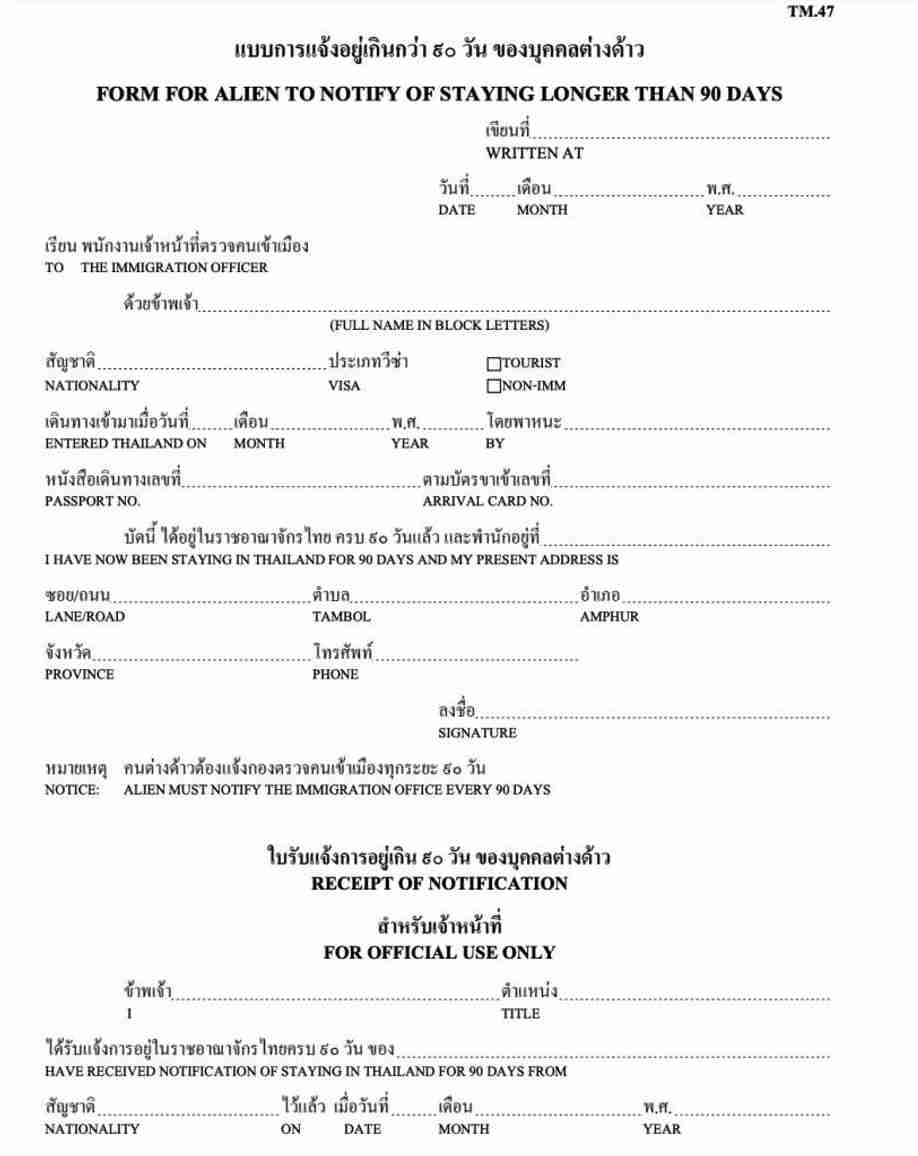
A standard TM.47 form used by aliens in Thailand to notify the Immigration Bureau of staying longer than 90 days.
To complete your 90-day notification of address in Thailand, you will typically need the following required documents:
- A completed TM47 form (the official form for 90-day notification)
- A copy of your passport (photo page and current visa stamp)
- A copy of your TDAC confirmation. The Thailand Digital Arrival Card replaced the paper TM.6 arrival/departure card on 1 May 2025
- Be careful, immigration might ask your TM30. You should do it just in case.
- Proof of address in Thailand (such as a rental agreement or a utility bill)
Additional documents may include your Thailand Digital Arrival Card (TDAC), if needed. You may also need previous 90-day report receipts for later reports.Some offices may ask for your TM.30 residence notification. Some offices have begun requiring TM.30 documentation more strictly, particularly for those not staying in registered accommodations.
How Can You File the 90-Day Report?
In-Person Reporting
In-person reporting remains the most reliable method, offering immediate processing and the ability to resolve any issues directly with immigration officers. You must visit the Immigration Office serving your area of residence during business hours, typically 8:30 AM to 4:00 PM on weekdays.
The process involves taking a queue number, submitting your completed documents when called, and receiving your new 90-day report receipt immediately. This method works for all reporting cycles and provides the highest success rate with no risk of rejection.
Online Reporting System
The online system runs on the official website at https://tm47.immigration.go.th/tm47/#/login. It offers easy reporting for eligible applicants. However, this system has major limits. The Immigration Bureau’s online manual asks you to register once with your email address and phone number, then submit within the 15 days before your due date. It rejects a request made when no report is due. The manual does not say a first report must be made in person. In practice, though, some first-time online requests are refused (this comes from foreigners’ reports, not from the Bureau), so bring your passport and a completed TM.47 to the office as a fallback. Online procedure re-checked on 11 October 2026 against the Bureau’s TM47 online manual. You can submit it online during the 15 days before the due date.
Processing usually takes 1 to 3 days for approval.However, applications may be rejected for several reasons.These include missing information or technical issues. If rejected, you must visit an immigration office in person to complete your reporting.
Mail Submission
Registered mail submission is available for those who cannot visit immigration offices in person. It requires careful timing and preparation. Documents must be sent to the correct immigration office at least 15 days before the due date. Include a self-addressed envelope with a 10 Baht stamp for the return receipt.
For Bangkok residents, send mail to the 90-day reporting section at Immigration Division 1, Chaeng Watthana Government Complex, Building B (full address below). Older guides give the Immigration Bureau’s Suan Phlu headquarters address, which is not where Bangkok reports are processed; check the current postal instructions on the Immigration Bureau website before sending. Processing can take 2-4 weeks, and you must retain your registered mail receipt as proof of submission.
Representative Filing
You can authorize another person to file your report on your behalf by providing them with a written authorization letter (power of attorney), copies of your identification, and all required documents. The representative must bring their own identification and may charge a service fee for this assistance.
Does the THIM app do your 90-day report?
Status checked 22 August 2026. No. In June 2026 the Immigration Bureau introduced the Thailand Immigration Management application, or THIM, with pilot access from 11 June 2026 and an official launch expected during August 2026. Much of the coverage describes it as compulsory for foreign nationals, and some of it implies it takes over immigration reporting. Neither is the position today.
What the Tourism Authority of Thailand’s announcement actually says is that “during the pilot phase, THIM is an optional app that travellers may use to access TDAC-linked registration”, and that “THIM is not an additional arrival-card requirement and does not replace TDAC at this stage”. Its published function is the Thailand Digital Arrival Card, which is an arrival formality, not an address notification.
Nothing published so far changes your obligation to notify your address every 90 days. Until an Immigration Bureau announcement says otherwise, keep filing by the routes set out above: in person, online, by post, or through a representative. Installing the app does not file anything for you, and it will not protect you from the fine for late notification.
What Does the 90-Day Report Cost, and What Are the Penalties?
Regular 90-day reporting is completely free when filed within the prescribed timeframe. However, penalties for late reporting are substantial and strictly enforced by Thai Immigration authorities.
Section 76 of the Immigration Act provides a statutory fine not exceeding 5,000 baht and a further fine not exceeding 200 baht per day until compliance. Distinguish this ceiling from the published settlement figures: 2,000 baht for a late report made voluntarily and 4,000 baht if arrested without having reported. See the Royal Thai Consulate’s published explanation. Attend the responsible office promptly to resolve a missed report and obtain an official receipt.
Professional visa service agencies usually charge 1,000 to 3,000 THB for 90-day reporting. Prices vary by location and service provider.
| Item | Detail |
|---|---|
| Form | TM.47 |
| How often | Every 90 days of continuous stay in Thailand |
| Filing window | From 15 days before the due date to 7 days after (office reporting; other channels differ) |
| By post | Send at least 15 days before the due date |
| Processing time | Varies by reporting channel, completeness and office; retain the approval receipt |
| Late, self-reported after the 7-day grace | 2,000 THB |
| Arrest without the required report | 4,000 THB published settlement figure; statutory maximum and possible daily fine are separate |
| Leaving Thailand before the due date | No fine; the count restarts on re-entry |
| Leaving Thailand while already late | The lapse can be raised at your next immigration dealing, up to 5,000 THB |
| Typical agency service fee | 1,000 to 3,000 THB |
Immigration Office Locations
Bangkok Area
The main Immigration Bureau office is in Building B at the Chaeng Watthana Government Complex. The address is 120 Moo 3, Chaeng Watthana Road, Soi 7.It is in Thung Song Hong, Lak Si District, Bangkok 10210. A temporary service center operates at Muang Thong Thani on Popular Road. It is in Ban Mai Sub-district, Pak Kret District, Nonthaburi 11120.
Provincial Offices
Foreigners residing outside Bangkok must report to the Immigration Office serving their area of residence. Each provincial office may have slightly different procedures and requirements, so contacting the local office beforehand is recommended.
Step-by-Step Filing Process
Preparation Phase
Begin preparation 1 to 2 days before your planned filing date. Download and print the TM.47 form from official immigration sources. Gather all required documents. Make the needed photocopies. Check your exact due date on your prior receipt or entry stamp.
Form Completion
Complete the TM.47 form entirely in English using clear block letters, ensuring all address information is accurate and complete. Sign and date the form, double-checking that all required fields are filled in correctly.
Office Visit
Arrive at the immigration office early, preferably when they open at 8:30 AM to minimize waiting times. Take a queue number, wait for your turn, and submit all documents to the processing officer. Pay any applicable fees if late, and receive your new 90-day report receipt.
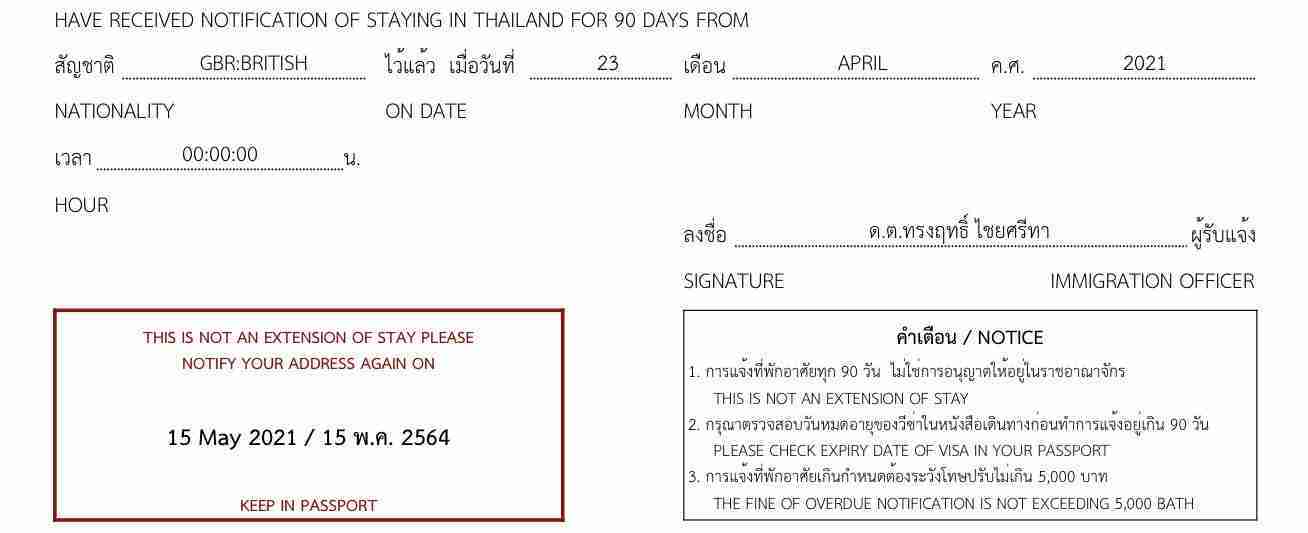
Official receipt for a 90-day notification of stay in Thailand (TM.47 form), detailing key information and important notices.
Post-Filing
Keep your receipt in a secure location and immediately note your next due date, which will be printed on the receipt. Set calendar reminders well in advance of your next reporting deadline to ensure timely compliance.
Common Issues and Solutions
Online system rejections frequently occur due to incomplete information, technical issues, or attempting to file outside the allowed timeframe. The solution is always to visit an immigration office in person with all required documents.
Lost receipts require a visit to the local police station first.You must file a lost document report, and it usually costs 50 THB. Then, proceed to immigration. Never attempt to conceal late reporting by claiming a lost receipt, as this can result in additional criminal charges.
Traveling near your due date can be managed by filing early within the 15-day window. You can also authorize a representative to file for you. Emergency situations may require consultation with immigration authorities for special arrangements.
Relationship with TM.30 Requirements
The TM.30 residence notification is a separate but related requirement. Property owners must file it within 24 hours. This applies when foreign nationals stay at their premises. While TM.30 was once separate from 90-day reporting, some immigration offices now require it for 90-day filings.
Expats staying with friends or in informal accommodations may face challenges if proper TM.30 registration hasn’t been completed. In such cases, temporary hotel stays can provide the necessary documentation for 90-day reporting compliance.
Essential Contact Information
For help with 90-day reporting issues, call the Immigration hotline at 1178 (1111 is the general government contact centre). Call during business hours, Monday through Friday, from 9:00 AM to 4:00 PM. The official Thai Immigration website at https://www.immigration.go.th provides updated information and forms.
Emergency contacts include Tourist Police at 1155 and the general police emergency number 191 for urgent situations requiring immediate assistance. Always keep these numbers readily available, especially when traveling within Thailand.
The 90-day address notification represents a fundamental compliance requirement for all long-term expats in Thailand. Success depends on understanding your obligations, maintaining accurate records of due dates, filing within prescribed timeframes, and keeping all required documentation properly organized. Remember that this requirement operates independently of your visa status and must be maintained consistently throughout your stay in Thailand.
4 Tips for Expats related to the 90-days notification of address in Thailand
- Set reminders: It’s easy to forget a date 90 days away. Setting electronic reminders can help. If your yearly extension is also coming up, see our guide to the retirement extension renewal with the TM.7 form, and time the two visits together.
- Keep documentation organized: Always keep your documents in order and easily accessible for each reporting period.
- Regularly check for regulation changes. Immigration laws can change. Stay informed through the official Thai Immigration Bureau website or your local embassy.
- If you are on an extension based on work with 80,000 baht per month, or on support with a Thai wife, or have a Thai child, you could maybe be eligible to permanent residency in Thailand. No more 90-day notification of address for the rest of your life!
The 90-day notification of address is a legal requirement for foreigners in Thailand. It is aimed at keeping immigration records up to date. By following the stipulated process and adhering to the timelines, foreigners can ensure they stay compliant with Thai law. They avoid any unnecessary penalties. Remember, staying informed and following local laws is part of the responsibility of living in Thailand.
For an overdue report, attend the responsible immigration office. The published settlement figures are 2,000 baht for voluntary late reporting and 4,000 baht if arrested without reporting. Section 76 sets the statutory maximum and possible daily fine separately. A reporting fine does not extend your permission to stay.
Frequently Asked Questions
What is the 90-day report in Thailand?
It is a requirement for long-staying foreigners to notify immigration of their current address every 90 days while they remain in the country.
Where can I download the TM.47 form?
Download the official one-page TM.47 form as a PDF from this page (the TM.47 form download section above), print it and fill it in in English block capitals. The same form is used at every immigration office in Thailand, and it is not needed for online filing.
Who has to file a 90-day report?
Any foreigner permitted to stay temporarily who remains in Thailand for more than 90 consecutive days, unless an exemption under Section 15 applies.
How do I file my 90-day report in Thailand?
Use the Immigration Bureau’s TM.47 online service, report in person, use an authorised representative, or send the documents by registered post where the office accepts postal filing. Follow the conditions for your chosen channel. Downloading THIM or submitting a TDAC does not complete a 90-day report.
What is the penalty for a late 90-day report?
Late filing usually carries a fine of around 2,000 THB, increasing if you are caught at a checkpoint, and repeated lapses can complicate future applications.
Does leaving Thailand reset the 90-day report count?
Yes. Each time you re-enter Thailand the 90-day period restarts from your new date of entry.
More questions about the TM.47 and the 90-day report
Can I file my 90-day report online?
Yes, through the Immigration Bureau’s TM.47 online service. You register once with your email address and phone number, then submit within the 15 days before your due date. The Bureau says an officer checks the request in about 3 days and emails you if it is not approved. If it is refused, go to the immigration office in person.
Do I need to print the TM.47 if I file online?
No. The paper TM.47 is for office and postal filing. The online service has its own form fields.
What is the difference between the TM.47 and the TM.30?
The TM.47 is your own 90-day address report. The TM.30 is filed by the place you stay (landlord, owner or hotel) within 24 hours of your arrival there. Some offices ask to see the TM.30 receipt when you do the TM.47. See our TM.30 guide.
Is the 90-day report the same as extending my visa?
No. The 90-day report only tells Immigration where you live. An extension of stay (TM.7) changes how long you may remain. Neither replaces the other.
Try it yourself first, free
You do not have to book anything to get started. These run in your browser, and you only pay us if you decide you want a lawyer involved.
Thai Visa Finder Free
Answer a few questions and see which Thai visa actually fits your situation.
Open the toolAsk our AI assistant Free
Trained on Thai law and 77,000+ Supreme Court decisions. Ask anything, free.
The 90 day report is one of several duties that continue for as long as you hold a long stay extension. Our Thai immigration overview sets out the rest of them.
Thai Law Updates, free by email
Plain-English updates on Thai law changes that affect foreigners: property, visas, marriage, business and wills. One short email a month from a firm practicing since 2006. No spam, unsubscribe anytime.