


Reviewed by ThaiLawOnline, a licensed Thai law firm practising in Thailand since 2006. Thai lawyer of record: Wichuda Atthamethakon, LL.M., Thai Bar Licence 3149/2556.
Last updated on
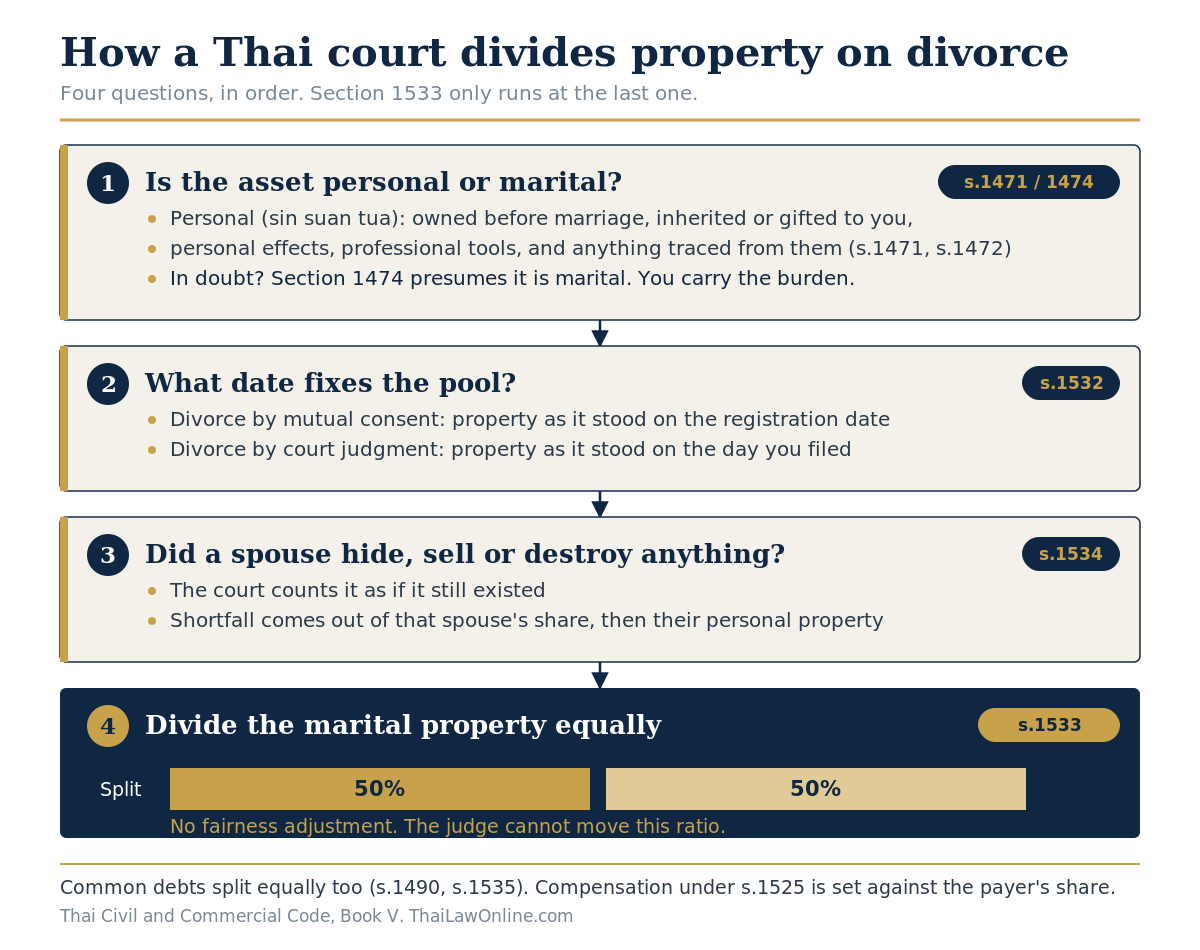
Most people arrive at divorce in Thailand property division expecting a judge to weigh who earned more, who raised the children, and who behaved badly. Thai law does none of that. Section 1533 of the Civil and Commercial Code says one thing: upon divorce, the marital property shall be divided in a manner which allows both spouses to receive equal portions. The court splits. It does not balance.
Table of Contents
LAWYER-DRAFTED TEMPLATE · ฿990
Divorce Settlement Agreement (Bilingual English & Thai): Same-Day Amphur Divorce, Made Safe
Property division with transfer deadlines, custody, child support, debts and the full-and-final clause, prepared before you reach the registrar’s counter. Includes the land rule for foreign spouses, three ready-to-fill schedules and recognition-abroad guidance. Word + PDF, updated August 2026. บันทึกข้อตกลงท้ายทะเบียนการหย่า ฉบับสองภาษา
Property division follows the sin somros rules explained in our guide to Thai family law.
One update most English-language guides have missed. The Civil and Commercial Code Amendment Act (No. 24), B.E. 2567, better known as the Marriage Equality Act, came into force in January 2025 and rewrote Book V. It repealed and replaced Sections 1532 and 1533, replaced “husband and wife” with “spouses” throughout, and made every ground for divorce reciprocal. We cover the reform itself in same-sex marriage in Thailand and the Marriage Equality Act. The equal-shares rule survived the rewrite intact, so the substance below holds. It now applies to same-sex spouses on exactly the same terms. Pages still quoting Section 1533 as dividing property “between man and woman” are quoting the pre-2025 text.
That single sentence changes every decision you make from here, including whether you divorce at the district office or in court, when you file, and what you sign. ThaiLawOnline has handled Thai family matters for foreign spouses since 2006, and the same three mistakes cost clients money every year: they wait too long to freeze assets, they sign a Thai-language agreement at the amphur without reading it, and they assume a judge will fix an unfair split later. A judge will not.
The rule in one line, and the myth to drop first
Thailand is not an equitable-distribution country. English, American, Canadian and Australian courts adjust the split according to the length of the marriage, each spouse’s contribution, and each spouse’s future needs. Thai courts have no such power over the marital pool. Section 1533 fixes the ratio at fifty-fifty and gives the judge no discretion to move it.
Four things can still produce an uneven net outcome, and all four sit outside Section 1533:
- Section 1534: the court adds back property your spouse hid, sold or destroyed, then makes up your shortfall out of that spouse’s own share and personal property.
- Section 1525: when the court orders one spouse to pay compensation, it takes that spouse’s share of the liquidated Sin Somros into account.
- Section 1535: you split the common debts equally too, which can swallow the asset side.
- Sections 1465 and 1466: a valid prenuptial agreement replaces the default regime entirely.
Argue about classification and about those four levers. Do not argue about the ratio.
Sin somros and sin suan tua: the two categories that decide everything
Section 1470 sets the default: everything the spouses own is Sin Somros unless a rule sets it aside as Sin Suan Tua. Your whole case turns on which bucket each asset falls into.
| Sin Suan Tua (personal, s.1471) | Sin Somros (marital, s.1474) | Who has to prove it |
|---|---|---|
| Property you owned before the marriage | Property either spouse acquired during the marriage | The spouse claiming personal status |
| Personal effects, clothing, ornaments suited to your station, and the tools of your profession | Property received during marriage by will or gift where the will or deed of gift declares it to be Sin Somros | The spouse claiming personal status |
| Property you received during the marriage by inheritance, under a will or as a statutory heir, or by gift, unless a will or written gift declares it Sin Somros | The fruits of Sin Suan Tua: rent, dividends, interest, crop income | The spouse claiming personal status |
| The khongman, or engagement property | Anything left in doubt, by force of the presumption in the final paragraph of s.1474 | Nobody. Doubt defaults to marital. |
Two rules decide most contested cases.
Section 1472 traces your personal property forward. Sell a pre-marriage apartment in Manchester, wire the proceeds to Bangkok, buy a condominium: the condominium stays Sin Suan Tua, and so does any money left over. The tracing works only as far as your paperwork does. Keep the sale contract, the bank statement showing the transfer, and the purchase contract in one file. Clients who lose this argument almost never lose it on the law. They lose it because five years of statements are gone. The Supreme Court shows what a complete paper trail achieves in Decision 372/2567: a wife proved that her shares in a plot came to her as a gift from her mother, and that the shares she had bought during the marriage had already been transferred away, so no marital property remained mixed in and the land, with the building on it, was held to be her personal property.
The final paragraph of Section 1474 breaks every tie against you. Where there is doubt whether property is Sin Somros, the court presumes that it is. Your spouse does not have to prove the asset is marital. You have to prove it is not. Read our companion guide on marital property under Thai law for the classification detail. Two decisions show the presumption doing its work: Decision 3122/2564 on a commercial leasehold, and Decision 2236/2562, which applied it to cooperative savings deposits whose source could not be shown (the salary-funded shares it classed as Sin Somros directly under Section 1474(1)). It cuts the other way too: in Decision 186/2565, land one spouse gave the other without naming it Sin Somros became the recipient’s personal property. Browse the whole line on our Supreme Court decisions database.
Section 1532: the date your property pool freezes
Almost no English-language guide publishes this section, and it decides whether you should file today or negotiate for another six months. Section 1532, as replaced by the Marriage Equality Act, fixes the snapshot date two different ways:
- Divorce by mutual consent: the property to be divided is the property that exists at the time you register the divorce.
- Divorce by court judgment: the parts of the judgment governing property take retroactive effect from the day you instituted the action.
Work through what that means. Your spouse runs a business that is about to sign a large contract. If you file next week, the court values the pool as at your filing date and the later windfall falls outside it. If you spend eight months negotiating a consent divorce and register it after the contract lands, the windfall is inside the pool and you take half. The reverse applies to your own earnings. Everything you earn after the filing date in a contested case is yours.
Filing a court action does more than start a case. It stops the clock on the asset pool.
Amphur divorce or court divorce: two completely different property outcomes
Section 1514 gives you two routes and no others: mutual consent, or a judgment of the court. Consent divorce must be in writing and signed by at least two witnesses, and under Section 1515 it takes effect only when both of you register it at the district office. A court divorce takes effect when the judgment becomes final, and under Section 1531 it does not bind a good-faith third party until you register it.
Here is the part competitors leave out. At the amphur, Section 1533 never runs. Your own written agreement governs the property, and the registrar records it. A foreign spouse who signs a Thai-language divorce agreement waiving the house has waived the house. No later court will restore an equal split because the agreement was one-sided, and the district officer will not warn you.
Read the Thai text or have it translated before you sign. If your spouse will not agree to an even split, use the court route and let Section 1533 do the work. Our guide to a contested divorce in Thailand sets out the twelve statutory grounds under Section 1516, and divorce in Thailand with a foreign marriage covers what happens when you married abroad.
Your spouse is moving the money: what the code actually gives you
This is the call we take most often, and Thai law answers it in five sections.
Section 1476: the acts that need your consent
Section 1476 bars either spouse from acting alone on the Sin Somros in these cases. You must manage jointly, or one of you must obtain the other’s consent, which under Section 1479 must be in writing where the act itself must be made in writing or registered:
- selling, exchanging, selling with a right of redemption, letting on hire-purchase, mortgaging, releasing a mortgage, or transferring a mortgage over immovable property or mortgageable movable property
- creating or extinguishing a servitude, right of habitation, superficies, usufruct or charge over immovable property
- letting immovable property for more than three years
- lending money
- making a gift, unless it is charitable, social or moral and suits the family’s condition
- making a compromise, submitting a dispute to arbitration, or putting property up as security with an official or the court
Anything outside that list, either spouse may do alone.
Sections 1480, 1483 and 1484: stopping it and undoing it
If your spouse did one of those acts without your consent, Section 1480 lets you apply to the court to revoke it. Two exceptions defeat you: your own later ratification, and a third party who acted in good faith and paid value. The deadline is strict. You must sue within one year from the day you learned of the ground for revocation, and in no case later than ten years from the day of the act.
You do not have to wait for the divorce. Where your spouse has sole power to manage the Sin Somros, Section 1483 lets you ask the court to forbid an act that is about to cause it serious loss. Section 1484 goes further: where a managing spouse causes undue loss, refuses support, becomes insolvent, incurs debts exceeding half the Sin Somros, obstructs your management, or behaves in a way that will ruin the pool, you may apply for sole management or for immediate division of the Sin Somros. The court may set temporary protective measures while it decides, and in an emergency the urgent-application rules of the Civil Procedure Code apply.
Section 1530: provisional orders once the case is filed
Under Section 1530, while a divorce action is pending the court may on your application make any provisional order it thinks proper, including orders about the Sin Somros, the lodging, maintenance, and the custody and maintenance of children. This is the practical freezing tool. Ask for it in the plaint. Do not wait for the first hearing. Decision 2109/2567 is a reminder that the maintenance question is not tied to the divorce at all: the Supreme Court held that the right to claim spousal maintenance does not arise only when a divorce is filed, so a spouse who is not being maintained can claim it under Section 1598/38 on its own.
Section 1534: the clawback for property that is already gone
Section 1534 answers the fear behind the phone call. Where a spouse disposed of Sin Somros for their exclusive benefit, or disposed of it intending to injure you, or disposed of it without a consent the law required, or wilfully destroyed it, the court treats that property as if it still existed for the Section 1533 division. If your half still falls short, the spouse at fault makes up the arrears out of their share of the Sin Somros, and then out of their own Sin Suan Tua. Where the money went to a third person, the route is different: you sue to revoke the transaction under Section 1480. That is what happened in Decision 139/2569, where a wife had her husband’s unconsented gifts of 1,431,731 baht to another woman revoked and repaid. She still lost on timing: the Supreme Court held that a gift made without consent stays valid until the court revokes it, so interest ran only from the date of the first-instance judgment, not from the transfers.
Your spouse cannot spend their way out of an equal split. They can only make the accounting harder, so gather the evidence now: land office records, bank statements, transfer receipts, and dates.
The house and the land: where foreign spouses actually lose
A Thai national who buys land while married to a foreigner signs a joint declaration at the land office confirming that the purchase money is her own Sin Suan Tua and not Sin Somros. Land offices have required this since the Ministry of Interior regulation of 23 March 1999, which exists to stop foreigners acquiring land indirectly. We explain the document itself in understanding the confirmation letter in Thailand.
Foreign husbands ask the same question every month: I signed that letter, have I lost my claim? The honest answer sits between the two extremes the market sells.
The declaration is an administrative form required by land office practice. It is not one of the four categories in Section 1471, so it does not by itself convert marital property into personal property. What it does is create strong documentary evidence that both of you stated an intention at the time of purchase, and a Thai court weighs that against your evidence about where the money actually came from. Bank records showing an overseas transfer on the purchase date do real work. A verbal understanding does not.
Be careful with the Supreme Court authority circulating on this point. Several English-language pages cite Decision 1523/2565 for the proposition that a land office letter cannot override Section 1474. The full judgment holds nothing of the kind. A Swedish plaintiff had sent 2,300,000 baht from Sweden in 2011 to buy two plots and a house, put the title in his Thai partner’s name, and had her sign a 2,400,000 baht loan agreement while he kept the deeds. They registered their marriage in Sweden only in 2014, so the purchase preceded the marriage and Section 1474 never applied. The court struck the loan agreement down as a sham under Section 155, found the real arrangement made her his agent under Section 797, and left the foreign-ownership question to Land Code Sections 86 and 94 because he had not pleaded it. He recovered nothing. Treat the case as a warning about sham loan agreements and about buying before you register the marriage, not as authority on the declaration. We track verified decisions on our Supreme Court prenuptial agreement decisions page.
Winning a share of land you cannot own
Suppose the court agrees the land is Sin Somros and awards you half. You still cannot register it. Section 86 of the Land Code lets a foreigner acquire land under a treaty, and no such treaty operates in practice; the one statutory route, Section 96 bis (an investment of at least 40 million baht, for up to one rai of residential land, with the Minister’s permission), will not help a divorcing spouse. Section 94 requires land acquired unlawfully to be disposed of within a period the Director-General sets, which runs from 180 days to one year, after which the Director-General disposes of it. Section 96 applies the same machinery where a Thai holds land in place of a foreigner.
Three routes convert your share into value:
- A money judgment for the value of your half, enforced against your former spouse’s other assets.
- An agreed sale to a third party with the proceeds split, usually negotiated into the settlement.
- A court-supervised disposal under the Land Code machinery above.
The building is a separate question. Thai law treats a house as property distinct from the land beneath it, and the Land Code restricts the land only. A foreigner can own the structure outright, evidenced by the building permit and the house registration book. See can foreigners own a house in Thailand. Condominiums are easier again: hold the unit inside the 49 percent foreign quota with the funds imported correctly and the title is yours, as our guide to buying a condominium in Thailand explains. A registered usufruct also binds the land whoever owns it and does not lapse because the marriage ended. Compare the instruments in our guide to leases, usufructs and sap ing sith, and see buying property in Thailand for the structures that hold up.
Debts: the half nobody plans for
Section 1535 makes both spouses liable equally for common debts once the marriage ends. Section 1490 makes a debt incurred by one spouse alone during the marriage a joint debt in four cases (debts you both contracted are joint anyway):
- debts for managing the household and providing family necessaries, maintenance, household medical expenses, and proper education of the children
- debts connected with the Sin Somros itself
- debts from a business the spouses carried on in common
- debts one spouse incurred for personal benefit but which the other ratified
Everything else stays personal. Under Section 1488 a spouse’s personal obligation is satisfied first out of their Sin Suan Tua, and only then out of their portion of the Sin Somros. So your former wife’s clothing habit is hers. Her car loan for the family vehicle is joint. The credit card she used to fund the business you ran together is joint. The loan she took for her brother, which you never approved, is hers alone.
Compensation and maintenance sit outside the split
Sections 1523 and 1524 give a compensation claim in specific cases: divorce granted on the ground in Section 1516(1), and divorce where the party at fault under Sections 1516(3), (4) or (6) acted with the intention of making life intolerable. The Marriage Equality Act rewrote Section 1523 to run both ways, so either spouse may claim from the other spouse and from the third person involved. Under Section 1525 the court sets the amount according to the circumstances, and where the payer is your spouse the court takes into account the share that spouse received from the liquidation of the Sin Somros.
Section 1526 adds a living allowance where the divorce arises from the fault of one party alone and the other is left destitute with insufficient income. It comes with a trap that has cost clients everything: the right is extinguished if you do not raise it in the plaint or counterclaim in the divorce action. Not in a later suit. Not in negotiation afterwards. In the pleadings, or never.
Can a prenuptial agreement override Section 1533?
Yes, and it is the only reliable way to change the ratio in advance. Section 1465 lets spouses set their own property regime by agreement made before the marriage. Section 1466 voids the agreement unless you enter it in the marriage register at the time you register the marriage, or make it in writing signed by both spouses and at least two witnesses and note in the register that it is annexed. Miss the registration and the whole document is worthless. Section 1476/1 lets a valid prenuptial agreement vary the joint-management rules as well.
Two limits matter. Section 1467 stops you altering the agreement after marriage except by court authorisation. Section 1469 lets either spouse void an agreement they made during the marriage at any time while married, or within one year of its dissolution, which is why a property agreement signed mid-marriage is a weak substitute for a prenup. Our guide to the prenuptial agreement in Thailand covers the drafting and the registration, and postnuptial agreements in Thailand explains what you can still do after the wedding. One decision in our library marks that boundary: 6711/2537, where a spouse promised that a house and land which were his separate property would become marital property, and the Court treated it as a prenuptial term entered in the marriage register at the time of registration under Sections 1465 and 1466.
Assets outside Thailand
A Thai court liquidates Thai property. It will not retitle a house in Vancouver, split a UK workplace pension, or reach an offshore account, and the Thai judgment does not execute itself abroad. Foreign assets need a parallel process in the country where they sit, and the two proceedings need to be coordinated so you do not settle the same asset twice or lose it in both. Raise cross-border assets at the first meeting with your lawyer, not after the Thai judgment lands.
Supreme Court case law on dividing property in a Thai divorce
The sections above are the rules. The decisions below are how the Supreme Court applies them when a couple cannot agree, and they are the authority a Thai family court will follow. Each number links to our bilingual summary with the full Thai text, in the Family Law decisions hub of our Supreme Court decisions database. Where a decision is already discussed earlier on this page we only recall it here.
| Decision | Sections | What the Supreme Court decided |
|---|---|---|
| Decision 3615/2568 | Section 1474, Section 1533, Section 1534 | A spouse who admits that marital assets existed but says they were sold must prove the sale. An unproved sale is treated as a disposal for that spouse’s sole benefit, so the asset is deemed to still exist and is divided anyway. Doubtful items are presumed sin somros. |
| Decision 8321/2568 | Section 1474, Section 1532, Section 1533 | Provident fund and Government Pension Fund balances built up during the marriage (salary deductions, employer contributions and returns) are an existing right, not an expectancy, so they are sin somros. The other spouse takes half of what accrued between the marriage and the filing of the divorce. A pension that starts after filing is not divided. |
| Decision 452/2567 | Section 1532, Section 368 | A property agreement annexed to the divorce registration at the district office binds both former spouses once it is found to be voluntary. A clause giving one spouse “the house” is read in good faith as giving the land it stands on as well. |
| Decision 1319/2568 | Section 1532 | A house bought during the marriage with a joint mortgage is sin somros. The registration agreement gave one spouse the first 2,800,000 THB of any sale and the other the balance. “Sale” included a later court auction, so when the auction fetched less than 2,800,000 THB the other spouse received nothing. |
| Decision 1303/2568 | Section 382, Section 383, Section 1516 | A written promise by a husband to give up all the sin somros if he assaulted his wife again is a penalty clause. The court enforced it but reduced it, from the whole of seven plots to six tenths of each. |
| Decision 1296/2558 | Section 1474 | A house built together before the marriage was registered is not sin somros, even if the couple lived in it afterwards. The partner who paid still recovers half, but as a co-owner under the ordinary law of property. |
| Decision 337/2530 | Section 1469, Section 1471 | A registered gift of one spouse’s share of the marital property to the other during the marriage is valid. The property stops being sin somros and becomes the recipient’s separate property, and the donor cannot take it back after the divorce. |
| Decision 1781/2567 | Section 218 | A divorce settlement gave the land to the husband and a percentage of its rent to the wife for life. He was free to sell, but the sale made the rent share impossible to perform, so he owed damages for non-performance. |
| Decision 5326/2568 | Section 1476, Section 1490 | A general spousal consent form signed for a bank facility is not ratification of the borrowing spouse’s debt. The debt stays that spouse’s own and is not a joint debt that follows both of you out of the marriage. |
Who has to prove what
Most property fights are lost on evidence, not law. Decision 3615/2568 settles the starting point: the burden follows the pleadings. If your spouse denies that an asset ever existed, you prove it. If your spouse admits it existed and says it was sold, your spouse proves the sale, and a bare assertion is treated as a disposal for sole benefit under Section 1534, so the court divides the asset as if it were still there. The Court also treated a defence that did not say which items were family property, personal property or sin somros as an admission. For anything whose character is doubtful, Section 1474 paragraph two presumes sin somros, and Decision 7534/2560 applied the same presumption to farm vehicles and machinery when the husband’s story about a third party’s contribution was contradictory.
Pensions and provident funds
Expats often assume a pension or an employer fund is personal. Decision 8321/2568 says otherwise for Thai funds: the balance credited during the marriage is a right you already hold, so it is sin somros under Section 1474, and because a court divorce is retroactive to the filing date under Section 1532 the other spouse takes half of what accrued between the marriage and that date, payable when the member leaves the fund. What accrues after filing, and benefits that only arise on leaving, are outside the divorce division. Whether a foreign pension is reached at all is a separate question, discussed under assets outside Thailand above.
What you sign at the district office stays signed
The property memorandum attached to an amphur divorce is a contract for the division of sin somros under Section 1532. In Decision 452/2567 a former husband who later argued the agreement was involuntary lost on the facts, and the Court then read the clause giving his wife “the house” as giving her the land too, because a house is a component part of the land and Section 368 requires contracts to be read in good faith and according to ordinary usage. In Decision 1319/2568 the agreement promised one spouse the first 2,800,000 THB from a sale of the house; the house was later sold at a court auction for less, and the other spouse recovered nothing, because the agreement said “sale” without a floor price or a private-sale condition. Both decisions make the same point: the registrar will not negotiate for you, so the schedule of assets and the wording of each clause have to be right before you sign. See our step-by-step guide to an uncontested divorce.
Agreements between spouses, penalties and gifts
Spouses can contract with each other about property during the marriage, within the limits already described. Decision 1303/2568 shows the court’s control over the harsh end of such bargains: a family agreement under which the husband forfeited all sin somros if he assaulted his wife again was valid as a bond of behaviour recognised by Section 1516 (8), but the forfeiture was a penalty under Section 382 and was reduced under Section 383 to six tenths of each plot. Decision 337/2530 and Decision 186/2565 are the other side: a registered gift from one spouse to the other converts sin somros, or the donor’s separate land, into the recipient’s separate property, and Decision 1781/2567 is a reminder that obligations written into a divorce settlement, here a life-long share of rent, survive the divorce and are enforced as contract.
Deadlines at a glance
| Section | What it governs | Deadline |
|---|---|---|
| 1480 | Revoking a sale, mortgage or gift your spouse made without your consent | 1 year from the day you knew the ground, and never later than 10 years from the act |
| 1529 | Divorce actions on grounds 1516(1), (2), (3) and (6), and compensation under 1523 | 1 year from when you knew or should have known the facts |
| 1526 | Living allowance after a fault-based divorce | Must be raised in the plaint or counterclaim, or it is extinguished |
| 1469 | Voiding an agreement made between spouses during the marriage | Any time during the marriage, or within 1 year of its dissolution |
| 1532 | The date that fixes the property pool | Registration date (consent) or filing date (court) |
| Land Code 94 | Disposing of land a foreigner acquired unlawfully | Between 180 days and 1 year, as the Director-General prescribes |
Frequently asked questions
Is marital property in Thailand always split 50/50?
The Sin Somros is, under Section 1533, and the court has no power to vary that ratio. Your personal property under Section 1471 is not divided at all. What changes the net figures is classification, the Section 1534 clawback, compensation under Section 1525, and the equal split of common debts under Section 1535.
Does the house count if it is registered only in my Thai spouse’s name?
Registration records who holds title. It does not decide classification. If your spouse acquired the property during the marriage, Section 1474 presumes it is Sin Somros, and the spouse claiming otherwise carries the burden of proof.
I signed a declaration at the land office saying the money was hers. Have I lost my claim?
Not automatically. The declaration is an administrative form required since the Ministry of Interior regulation of 23 March 1999, not a statutory exclusion under Section 1471. It is strong evidence of the intention you both stated at the time, and a court weighs it against your evidence about the actual source of the funds. Bring the transfer records.
Can I get half the land itself, or only half its value?
Half the value, in practice. Land Code Section 86 blocks a foreigner from registering the land, so the court converts your share into money, an agreed sale, or a supervised disposal. You can hold the house on that land in your own name, and a condominium unit inside the foreign quota outright.
What happens to property if we divorce at the amphur instead of in court?
Your written agreement governs the property and Section 1533 never runs. Whatever you sign at the district office binds you. Have the Thai text translated before you sign it.
My spouse sold a condominium last month. Can I still claim a share?
Yes, on two tracks. Section 1534 treats the unit as if it still existed when the court divides the Sin Somros, and makes up your shortfall out of your spouse’s share and personal property. Section 1480 may let you revoke the sale itself if your consent was required under Section 1476 and the buyer did not act in good faith for value, but you must sue within one year of learning the ground.
How long after the divorce can I bring a property claim?
It depends which claim. Revocation under Section 1480 runs one year from knowledge and ten years from the act. Compensation under Section 1523 runs one year under Section 1529. A living allowance under Section 1526 dies unless you plead it inside the divorce action. Bring the whole property claim inside the divorce case wherever you can.
Are we both liable for my spouse’s credit card debt?
Only if it falls inside Section 1490: household and family necessaries, debts connected to the Sin Somros, a business you ran in common, or a personal debt you ratified. Everything else stays with the spouse who incurred it and comes first out of that spouse’s Sin Suan Tua under Section 1488.
Does a prenuptial agreement override Section 1533?
A valid one does. It must comply with Sections 1465 and 1466, which means entering it in the marriage register at the time you register the marriage. An unregistered prenuptial agreement is void, and an agreement you sign after the wedding can be voided by either spouse under Section 1469.
Will a Thai court divide my pension or my house back home?
No. Thai courts liquidate property in Thailand. Foreign pensions, offshore accounts and overseas real estate need proceedings where those assets sit, coordinated with the Thai case.
My spouse says the marital assets were sold years ago. Do I have to prove they still exist?
No. Under Supreme Court Decision 3615/2568, a spouse who admits the assets existed but says they were sold carries the burden of proving the sale. If the sale is not proved, the court treats it as a disposal for that spouse’s sole benefit under Section 1534 and divides the asset as if it still existed.
Is my Thai spouse’s provident fund or government pension fund part of the sin somros?
Yes, for the part built up during the marriage. Supreme Court Decision 8321/2568 held that salary contributions, employer contributions and returns credited to a provident fund or the Government Pension Fund during the marriage are an existing right, so they are sin somros under Section 1474. In a court divorce the other spouse takes half of what accrued up to the filing date, payable when the member leaves the fund.
Can I reopen the property split we signed at the amphur?
Only if you can prove the agreement was not voluntary, and the courts rarely accept that. In Decision 452/2567 the agreement was upheld and read in good faith under Section 368, so “the house” included the land. In Decision 1319/2568 a clause giving one spouse the first 2,800,000 THB of a sale was applied to a later court auction, and the other spouse received nothing when the price fell short. Have every clause checked before you sign.
What to do next
If you are approaching a divorce in Thailand, three actions protect you more than anything else. Build the paper trail that proves which assets are yours under Sections 1471 and 1472, because the Section 1474 presumption decides every gap against you. Decide the timing deliberately, because Section 1532 freezes the pool on the day you register or the day you file. And if money is already moving, apply under Sections 1483, 1484 or 1530 now rather than relying on the Section 1534 clawback later, because recovering value from a spouse who has already spent it is slower and more expensive than stopping the transfer.
ThaiLawOnline has advised foreign spouses on Thai family matters since 2006. If you want your position assessed against the sections above before you sign anything, start with our divorce in Thailand overview and get in touch. Our family law consultation page sets out how that works. Where children are involved, read child custody in Thailand alongside this guide, since Section 1520 requires a written parental power agreement in every consent divorce.
This guide states the law as at July 2026, including the Civil and Commercial Code as amended by the Marriage Equality Act (Amendment Act No. 24, B.E. 2567). It gives general information and not legal advice on your situation. Thai courts decide classification on the evidence in each case, and the amounts at stake in a property division justify taking advice from a Thai lawyer before you sign, file or transfer anything.
Last reviewed: 26 October 2026. Read in Thai: Civil and Commercial Code sections 1466, 1469, 1476, 1480, 1484, 1490, 1514, 1515, 1523, 1524, 1526, 1532, 1533 and 1534, including the wording of Amendment Act No. 24 B.E. 2567 for the replaced sections; and Supreme Court Decisions 139/2569, 372/2567, 2109/2567, 186/2565, 1523/2565, 3122/2564, 2236/2562 and 6711/2537. Case-law section added 26 October 2026 from the full Thai texts of Decisions 3615/2568, 8321/2568, 452/2567, 1319/2568, 1303/2568, 1296/2558, 337/2530, 1781/2567, 5326/2568 and 7534/2560. The date and form of the land office declaration requirement are practice, not checked against the instrument.
Thai Law Updates, free by email
Plain-English updates on Thai law changes that affect foreigners: property, visas, marriage, business and wills. One short email a month from a firm practicing since 2006. No spam, unsubscribe anytime.