


Reviewed by ThaiLawOnline, a licensed Thai law firm practising in Thailand since 2006. Thai lawyer of record: Wichuda Atthamethakon, LL.M., Thai Bar Licence 3149/2556.
Last updated on
Buying land in Thailand through a Thai spouse used to be a twenty minute errand at the Land Office. You paid, your wife signed, you signed a short declaration confirming the money was hers, and the officer registered the title. Since May 2026 that errand takes longer, and the declaration is the first document the officer reads.
Between 15 and 25 May 2026 the Department of Lands sent a series of urgent circulars to every Provincial Land Office. Registrars must now investigate the source of funds before they register any acquisition involving a cash payment of THB 2 million or more, or an appraised value of THB 5 million or more. Land Offices cross-check applicants against records held by the Department of Business Development, the Anti-Money Laundering Office and the Department of Special Investigation. The circulars target nominee structures. A foreign husband funding a purchase in his Thai wife’s name looks, on paper, like exactly the arrangement the circulars describe.
Most English language guidance on this subject predates the circulars by five years or more, and repeats a claim about divorce that the Civil and Commercial Code does not support, and that a 2022 Supreme Court decision shows courts will look behind. This page corrects both. The short version: the declaration decides who is registered, not who owns.
Table of Contents
Can I buy land in Thailand if my wife is Thai?
No, not in your own name. Section 86 of the Land Code B.E. 2497 permits an alien to acquire land only under a treaty. Thailand has no such treaty in force, so outside the narrow section 96 bis investment route the prohibition is absolute. Marrying a Thai national changes nothing about your capacity to hold land.
What marriage does change is your wife’s position. Your Thai spouse buys the land and registers it in her sole name. You attend the Land Office and sign a joint declaration. That is the transaction, and it is lawful when the facts behind it are true.
What is a Land Department Confirmation Letter?
The confirmation letter, officially known as a “Letter of Confirmation” or “Certify Letter,” is a legal document required by Thailand’s Land Department when a Thai national married to a foreigner purchases land or property. This document serves as a joint written declaration between both spouses, confirming that all money used for the property purchase belongs exclusively to the Thai spouse as personal property (Sin Suan Tua) and not as marital property (Sin Somros).
The requirement stems from a Ministry of Interior regulation issued on March 23, 1999, which established procedures to prevent circumvention of Thailand’s foreign land ownership restrictions. Prior to this regulation, Thai nationals married to foreigners effectively lost their right to acquire land due to potential joint ownership issues. It is an obligation and if you do not sign the land department can refuse the transation.
The confirmation letter, line by line
The procedure comes from a Ministry of Interior instrument, Most Urgent Letter Mor Thor 0710/Wor 792 of 23 March 1999. We cite that instrument by its document number and not from its text: it is not held in any database we can search, so if you need the wording itself, search that number on dol.go.th. Before it, a Thai national who married a foreigner effectively lost the ability to register land, because the matrimonial property rules would hand the foreign spouse an interest the Land Code forbids him to hold. The 1999 procedure unblocked the market by asking the couple to state, in writing, that the purchase money belongs to the Thai spouse alone.
The declaration rests on two sections of the Civil and Commercial Code. Section 1471 defines sin suan tua, personal property: what a spouse owned before the marriage, personal effects, and property received during the marriage by inheritance or gift. Section 1472 keeps personal property personal when it changes form. Money that was hers before the wedding, spent on land during the marriage, produces land that is still hers.
Both spouses sign. The foreign spouse confirms that the funds were the Thai spouse’s personal property and that he claims no interest in the land. The Thai spouse confirms the same. The registrar files the letter and registers the title.
One document sitting in the same file often contradicts the letter. Where the money arrived from abroad, the receiving bank issues a Foreign Exchange Transaction Form for inward transfers of USD 50,000 or more. The form names the foreign remitter. The Land Office keeps both papers.
Understanding Thai Property Law: Sin Suan Tua vs Sin Som Ros
Thailand’s Civil and Commercial Code divides marital property into two distinct categories that are crucial for understanding the confirmation letter process. Personal property (Sin Suan Tua) includes assets owned before marriage, gifts, inheritances, and property for personal use, remaining under the exclusive control of one spouse, and is subject to the rights and juristic act of land acquisition in Thailand. Marital property (Sin Som Ros) encompasses assets acquired during marriage, income earned by either spouse, and fruits derived from personal property, which are jointly owned and require mutual consent for major transactions.
When a Thai spouse married to a foreigner purchases property, the Land Department must ensure the land becomes Sin Suan Tua to prevent foreign co-ownership, which is prohibited under Thai law. Remember that in case of divorce, even if a property is only under the Thai spouses, judges will normally separate the marital property as 50-50, and it is the same as for Thai citizens.
The confirmation letter does not by itself change the legal character of the land. It is an administrative declaration recorded at the Land Office, and it is not one of the four categories of personal property listed in Section 1471. What it does is create strong contemporaneous documentary evidence of what both spouses stated at the time, which a Thai court weighs against the money trail if the classification is later disputed. Separately, and this is the part that bites in practice, the register will show the land in the Thai spouse’s name, so she can deal with it at the counter without further consent and the registrar will act on the register.
What the declaration does not do
Read almost any competing page on this subject and you will find a sentence like this one: land can never become marital property and will always remain the separate property of the Thai spouse. Several firm pages state it flatly. One of the most widely read has not been updated since November 2019.
The Civil and Commercial Code does not support that proposition.
Section 1474 of the Civil and Commercial Code defines sin somros, marital property, as property acquired during the marriage. The section closes with a presumption: where there is doubt whether property is marital property, it is presumed to be marital property. The presumption applies to land the same way it applies to a car or a bank balance.
The presumption is a statement of the Code, and it stands on the Code alone. We are not aware of a reported decision applying it specifically to a Land Office confirmation letter, and we will not cite one we cannot produce.
What the reported cases do show is that a court will look past the paperwork to the arrangement underneath it. In Supreme Court Decision 1523/2565 a Swedish national remitted 2,300,000 baht to buy two plots and a house. His Thai partner took sole title. He had her sign a loan agreement for 2,400,000 baht, kept both title deeds, and registered a lifetime superficies for no consideration. When the relationship ended he sued on the loan.
The court held the loan agreement was a simulated act concealing another and void under section 155 paragraph one. The real transaction was agency under section 797: she held the land on his behalf. Because the purchase preceded the registered marriage and she had shared in the earnings that paid for it, she was co-owner of half under sections 1356 and 1357, not by way of sin somros. His position as an alien fell under sections 86 and 94 of the Land Code, but he had not pleaded it, so the court left it to separate proceedings. His claim was dismissed and he recovered nothing.
So the declaration is evidence, and strong evidence, about where the money came from. It is not a contractual release of your matrimonial rights, and it does not settle the character of the asset. A court can reach two outcomes. If the land is found to be marital property, section 1533 divides marital property equally on divorce. If you prove a personal contribution instead, you recover the contribution.
Neither outcome hands a foreigner registered title, which is the next question nobody answers.
Confirmation Letter in Thailand: Requirements by Scenario
The specific requirements for the confirmation letter process vary significantly depending on whether the foreign spouse is present in Thailand and their marital status, particularly in relation to land by a Thai national.
Foreign Spouse Present in Thailand
When both spouses are physically present in Thailand, they must appear together at the Land Department office to sign the confirmation letter in the presence of a competent official. For legally married couples, required documents include a certified marriage certificate, Thai national ID card, foreign spouse’s passport with valid long-term visa, and at least one witness (or two witnesses if using thumbprints). Unmarried couples living together must provide proof of cohabitation along with similar documentation, signing a modified version of the confirmation letter that addresses their non-marital status.
Foreign Spouse Located Abroad
When the foreign spouse cannot be present in Thailand, the process becomes more complex, requiring embassy or consulate involvement. The foreign spouse must visit a Thai Embassy, Thai Consulate, or certified notary public in their country of residence to sign the confirmation letter. All documents must be properly apostilled or legalized according to international treaty requirements, then translated into Thai and certified by Thailand’s Department of Consular Affairs. Very often, the foreign spouse abroad is not even consulted to avoid that paperwork. We can say that because we have seen many clients abroad and this process is rarely used.
Official Confirmation Letter in Thailand : The Template and Format
The Land Department provides a standardized template for confirmation letters that must be followed precisely to ensure legal compliance.
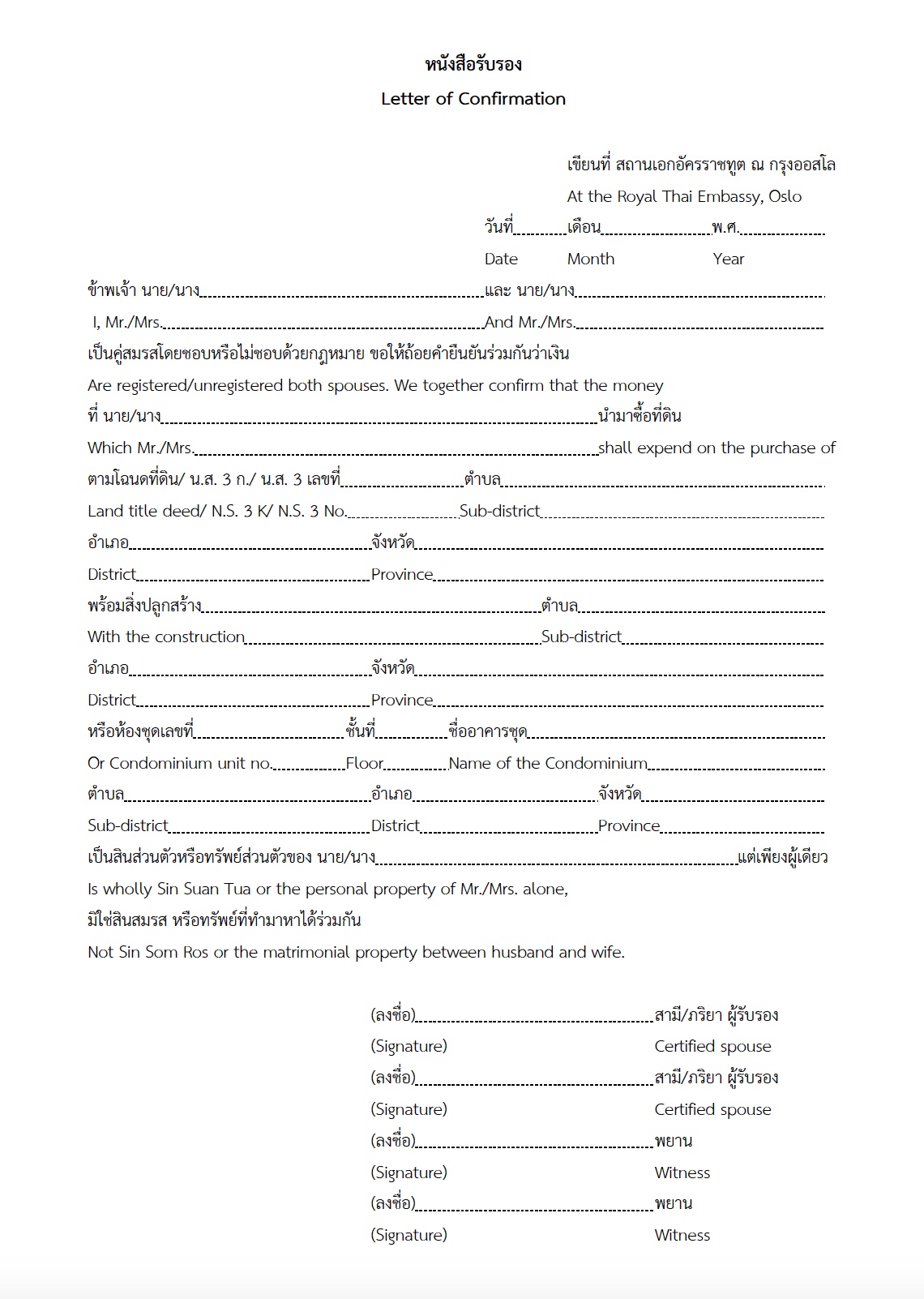
The template begins with location and date fields, followed by identification of both spouses as registered or unregistered partners. The core declaration states that money expended for land purchase is wholly Sin Suan Tua (personal property) of the Thai spouse and not Sin Som Ros (matrimonial property) between husband and wife, ensuring clear rights in the context of property ownership.
The template includes specific fields for property identification, whether land title deed numbers, sub-district, district, and province information, or for condominium units with floor numbers and building names. Signature lines are provided for both certified spouses, two witnesses, and must be executed in the presence of a competent Land Department official.
Embassy and Consulate Procedures for Foreign Spouses Abroad
Foreign spouses unable to travel to Thailand must complete confirmation letter procedures through Thai diplomatic missions or certified notary publics in their country of residence to facilitate land acquisition. Thai embassies and consulates are authorized to witness confirmation letter signatures and certify marital status, but specific procedures vary by location. All documents require proper authentication through apostille or legalization processes, followed by certified Thai translation.
The embassy or consulate must verify that the person signing the confirmation letter is actually married to or cohabiting with the Thai national, requiring presentation of marriage certificates or relationship documentation. Processing times typically range from one to two weeks, with original certified documents subsequently submitted to the relevant Land Department office in Thailand.
Essential Documentation Checklist for the Confirmation letter in Thailand
Success in the confirmation letter process depends on having complete, properly authenticated documentation For foreign spouses in Thailand, essential documents include valid passports with appropriate long-term visas, certified and translated marriage certificates, Thai spouse national ID cards, original confirmation letters using official templates, and identification for qualified witnesses.
Foreign spouses abroad require embassy or consulate certified confirmation letters, properly apostilled or legalized marriage certificates, embassy certification of spouse status, complete Thai translations of all documents, and original certified documents for Land Department submission. All scenarios require strict compliance with Land Code Act restrictions and establishment of property as Sin Suan Tua rather than Sin Som Ros.
What to do before you go to the Land Office
- Decide what the money is. Gift or loan. Paper it before the funds move, not after.
- Move the money early. A transfer months ahead of the purchase, with a signed gift document, produces a declaration you can defend.
- Expect the source of funds question. Bring bank statements. Cash of THB 2 million or more, or an appraised value of THB 5 million or more, triggers the check automatically.
- Run the title search first. Confirm the deed type, the boundaries, the access and any existing encumbrance. See title deeds in Thailand and property due diligence.
- Register your protective right the same day. Usufruct, superficies, lease or mortgage, registered at the same counter, in the same visit.
- Consider a prenuptial agreement if you are not yet married. Sections 1465 and 1466 let spouses set their own property rules by prenuptial agreement made and registered at the time of marriage, and section 1476/1 gives effect to that agreement on how marital property is managed.
- Read what you sign. The declaration is in Thai. Have it translated before the pen touches the paper.
Critical Legal Warnings and Protection Options
The confirmation letter carries significant legal implications that foreign spouses must fully understand before signing. Once executed, the Thai spouse owns the property completely, with the foreign spouse having no legal ownership rights whatsoever. The Thai spouse can sell, mortgage, transfer, or exchange the property without foreign spouse consent, and the property cannot be automatically inherited by the foreign spouse, which emphasizes the importance of understanding rights and juristic acts in Thailand land..
However, several protection mechanisms exist for foreign spouses who contribute financially to property purchases. Usufruct agreements or lease with a 30-year to use and occupy the property, while superficies agreements grant building rights on land. Proper financial documentation of contributions and prenuptial agreement considerations can provide additional legal protections.
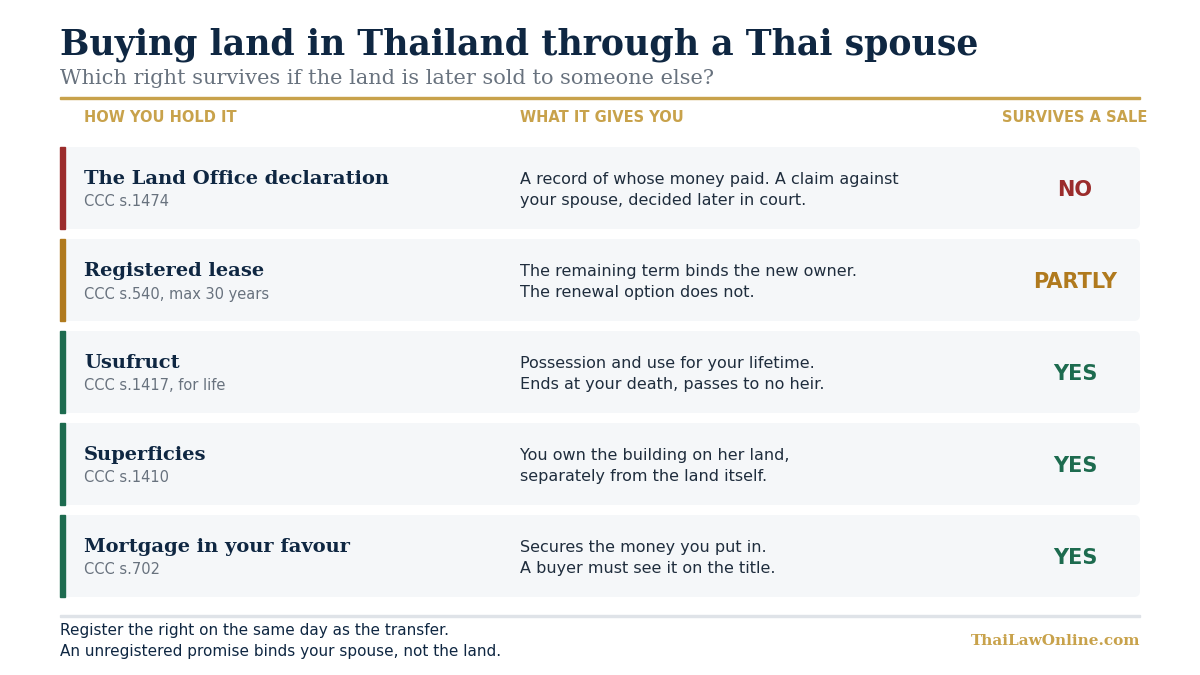
The four protective structures, compared on one question
Every guide lists the same four options. Almost none of them compare the options on the question a dispute actually turns on: if she sells the land to a stranger, does your right survive?
| Structure | Code | Term | Survives a sale to a third party? |
|---|---|---|---|
| Registered lease | CCC s.540 | Maximum 30 years, renewable by agreement | The registered lease binds the buyer for its remaining term. A renewal option does not. The option binds the original landlord personally, so a new owner can refuse it. |
| Usufruct | CCC ss.1417 to 1428 | Lifetime of the usufructuary, or a fixed term up to 30 years | Yes. A registered usufruct binds a subsequent purchaser, confirmed in Supreme Court Decision 2783/2516. It ends on the usufructuary’s death under s.1418 and passes to no heir. |
| Superficies | CCC ss.1410 to 1416 | Up to 30 years or for life | Yes, once registered. It separates ownership of the building from ownership of the land, which is the point of using it. |
| Mortgage in your favour | CCC ss.702 and following | Until repaid | Yes. It secures the money rather than the use of the house, and it puts your loan on the register where a buyer must see it. |
Registration is what makes the difference. An unregistered agreement between spouses gives you a claim against your spouse. A registered right gives you a claim against the land. Register it on the day of the transfer, at the same counter, in the same visit. Coming back six months later means asking a spouse who may by then have other ideas.
Detail on each: usufruct agreements, superficies, usufruct, lease and superficies compared, and what the Supreme Court has held about leases.
Can she sell it without telling me?
Section 1476 lists the dealings that require both spouses to agree, and it is a strong list. Selling, exchanging, mortgaging or releasing a mortgage over immovable property all sit inside it. So does creating or ending a servitude, a right of habitation, a superficies, a usufruct or a charge over immovable property, and letting immovable property for longer than three years. Anything outside the list, one spouse manages alone.
Section 1476 protects marital property. The land you helped buy is registered as her sin suan tua, and the registrar reads the register. The officer at the counter sees a sole owner dealing with her own personal property, and the transfer proceeds. Your remedy arrives after the sale, in court, and it runs against your spouse rather than against the buyer.
That gap between what the Code says and what the counter does is the single strongest argument for registering a real right in your own name on the day of purchase.
If a court awards the land to the foreign spouse, then what?
You do not keep it. Section 94 of the Land Code deals with land an alien has acquired without permission. The Director-General fixes a period for disposal of not less than 180 days and not more than one year. Miss the deadline and the Director-General disposes of the land himself, applying the forced sale rules.
The practical result of winning is cash, not a title deed. Plan the litigation around that fact, because it changes what a sensible settlement looks like.
No reported decision squarely addresses a Thai court awarding land to a foreign spouse who cannot lawfully hold it. Section 94 is the mechanism the Code supplies, and this is our reasoned reading of it rather than a settled rule. Treat any page that states the outcome with certainty as guessing.
When the Thai spouse dies
Section 93 of the Land Code lets the Minister of Interior permit an alien who is a lawful heir to acquire land by inheritance, subject to the area limits in section 87. In practice the Ministry reads section 93 as needing a treaty basis, no treaty exists, and permission does not come.
You inherit the right. You cannot register it. Section 94 runs again, and the disposal clock starts.
A Thai will does not fix this. It decides who inherits, which means it decides who carries the section 94 obligation. Where the couple has children who hold Thai nationality, leaving the land to them removes the problem entirely, and a lifetime right registered in your favour lets you stay in the house. See can a foreigner inherit land in Thailand and transferring land to a Thai child.
The criminal exposure nobody wants to discuss
Section 267 of the Penal Code punishes anyone who causes an official to make a false entry in a public document intended as evidence. The penalty is imprisonment of up to three years, a fine of up to THB 60,000, or both. The Penal Code Amendment Act (No. 26) B.E. 2560 raised that fine tenfold from the 1956 figure, and older English language sources still print the old THB 6,000. Section 137 covers false statements to an official.
A declaration saying the money was your wife’s personal property, filed alongside a Foreign Exchange Transaction Form naming you as the remitter, is the fact pattern those sections describe.
Section 96 of the Land Code adds a second exposure. Where it appears that a person acquired land as owner in place of an alien, the Director-General may dispose of the land. Section 113 punishes a Thai person who acquires land as agent for an alien with imprisonment of up to two years, a fine of up to THB 20,000, or both. A Land Office investigation can also pull in the Revenue Department, the Anti-Money Laundering Office and Immigration at the same time.
One distinction keeps couples out of this territory. Money you genuinely gave your Thai spouse, before the purchase, documented as a gift, becomes her personal property under section 1471 and stays personal under section 1472 when she spends it on land. The declaration is then true. Money routed through her account on the morning of the transfer is a different fact pattern, and the bank records show which one you have.
Read our note on recent nominee crackdowns and the court cases behind them before you decide how to structure the money.
Common Pitfalls and Legal Compliance Issues
Several common errors can invalidate confirmation letters or create legal complications for property purchases. Failure to disclose marriage to foreign spouses when purchasing property can amount to a false statement to an official under section 137 of the Penal Code, with both spouses potentially facing penalties. Using incorrect confirmation letter templates or failing to include required witness signatures can delay or prevent property registration.
Inadequate document authentication for foreign spouses abroad frequently causes processing delays, particularly when apostille or legalization requirements are not properly met. Misunderstanding the legal implications of Sin Suan Tua designation often leads to disputes later, when foreign spouses discover they have no legal claim to properties they helped finance.
Legal References and Regulatory Framework
The confirmation letter requirement is established under multiple layers of Thai law and regulation. The Ministry of Interior regulation dated March 23, 1999, provides the primary legal foundation, while the Thai Civil and Commercial Code Sections 1471-1472 define Sin Suan Tua (personal property) and Section 1474 addresses Sin Som Ros (marital property).
The Land Code Act establishes foreign ownership restrictions, and the Land Code Amendment Act (No. 8) B.E. 2542 (1999) added the section 96 bis investment route. These regulations work together to create a comprehensive legal framework designed to prevent circumvention of Thailand’s foreign land ownership prohibitions while allowing Thai nationals married to foreigners to purchase property legally.
Last reviewed: 26 September 2026. Read in Thai: Land Code sections 86, 87, 93, 94, 96, 96 bis and 113; Civil and Commercial Code sections 1476 and 1476/1; Penal Code sections 137 and 267; and Supreme Court decisions 1523/2565 and 2783/2516, each read to its disposition. The Ministry of Interior letter of 23 March 1999 is cited by number only, as the page explains.
Frequently asked questions
What is the primary purpose of the confirmation letter when a Thai citizen buys property with a foreign spouse?
The main objective of the confirmation letter is to affirm to the Thai Land Department that the funds used for the property purchase are the personal property of the Thai spouse, known as Sin Suan Tua. This is a crucial step because Thai law restricts foreign land ownership. The letter serves as a legal declaration that the property will not become a jointly owned marital asset, or Sin Som Ros, which would grant the foreign spouse a claim to the land.
Who needs to sign the confirmation letter and where?
Both the Thai national and their foreign spouse must sign the confirmation letter. Ideally, this is done together in front of the competent official at the provincial or local Land Office on the day of the property registration.
What happens if the foreign spouse is not in Thailand during the property transfer?
If the foreign spouse resides overseas and cannot be present, they must have their signature on the confirmation letter certified by a Royal Thai Embassy or Consulate in their country of residence, or by a notary public.The Thai spouse then brings the original certified letter to the Land Office to complete the registration.
Are there any specific requirements for the funds used for the purchase?
Yes, the Thai spouse must be able to demonstrate that the money used for the purchase is their personal property. According to the Civil and Commercial Code, Sin Suan Tua includes assets owned before the marriage, personal gifts, or inheritance received during the marriage. A gift between spouses is lawful, but three things qualify it. Under sections 1471(3) and 1474(2) a gift to your spouse becomes their personal property unless the written gift declares it to be sin somros, which is what Supreme Court Decision 186/2565 applied to land transferred between spouses. Under section 1473 the recipient then manages that property alone. And under section 1469 an agreement about property made between spouses during the marriage may be avoided by either of them at any time during the marriage, or within one year of its end, so a gift arranged to satisfy the Land Office is not necessarily final. Document the gift before the purchase, not on the day of it.
What are the risks for the foreign spouse in signing this confirmation letter?
The practical risk is real, but it is not the one usually described. Because the register shows the land as the Thai spouse’s personal property, she can in practice sell, mortgage or transfer it without your consent, and the registrar will act on the register. What the declaration does not do is release your matrimonial rights. It records where the purchase money came from. It is an administrative declaration, not a contract, and nothing in it purports to vary the Civil and Commercial Code. Your real protection is a right of your own registered over the land, a usufruct, superficies, lease or mortgage, entered on the day of the transfer.It is important for the foreign spouse to understand this before signing. On divorce the declaration is not ignored. It is strong contemporaneous evidence of what both of you stated at the time, and a court weighs it against the money trail when deciding whether the land is sin suan tua or sin somros. If the land is held to be marital property, section 1533 divides it equally. If the declaration stands, the land is not divided at all and your claim is for your contribution rather than for the land.
Can a Thai national who has renounced their Thai citizenship still own land in Thailand?
No, an individual who has given up their Thai citizenship is generally not permitted to purchase land in Thailand, as this right is reserved for Thai nationals. If a Thai citizen who already owns land later renounces their citizenship, they may be required to sell the property within a specified period.
Is a power of attorney a viable option if one party cannot be present at the Land Office?
Yes, a power of attorney can be used. However, the Thai Land Department only accepts its official standard forms, known as Tor Dor 21 (TD21) for land and houses. There are others for condos or Nor Sor Sam. General power of attorney forms are not accepted for property transactions.
What happens if a couple does not provide the confirmation letter?
Without the jointly signed confirmation letter, the Land Office will not proceed with the registration of ownership in the Thai spouse’s name. The request for registration would need to be escalated to the Land Department to seek approval from the Minister, a process that can be complex and is not guaranteed to be successful.
Can Thai children own land in Thailand?
Thai children having a foreign parent can also buy or accept land as a gift. But if it is done in order to avoid the law, as example for the purpose of Foreign ownership, the land department will not register the transaction. Also, most Land Departments will refuse to transfer land to a child under 7 years old, because they consider that the child is too young, can’t understand, and can’t sign his name, which impacts their rights in land by a Thai national. However, there is no minimum age in the law to own land in Thailand. We have seen in the last years (2010 and after), an opening from the Land Department and they often agree to transfer a property on a child’s name. Each case is different and if this is what you want, you should contact your local Land Department to verify the process and if they will agree.
Can a foreigner own land in Thailand through a Thai wife?
No. Your wife owns the land, in her own name, and you sign a declaration confirming the money was hers. Section 86 of the Land Code lets an alien acquire land only under a treaty, none is in force, and marriage creates no exception.
Can my Thai wife sell the land without my consent?
At the counter, in practice, yes. Section 1476 requires both spouses to agree to a sale of marital property, but the register shows the land as her personal property and the registrar acts on the register. Your remedy comes afterwards, in court. A registered usufruct or lease in your name stops the sale from erasing your position.
What happens to the land if we divorce?
The court decides whether the land is marital property. If it is, section 1533 divides marital property equally. If you instead prove that you supplied personal funds, you recover the contribution. Either way you cannot take registered title, because section 94 of the Land Code requires an alien to dispose of land within a period of 180 days to one year set by the Director-General.
What happens to the land if my Thai spouse dies?
You inherit the right but cannot register it. Section 93 permission is not granted in practice, so section 94 disposal follows. Where there are Thai children, leaving the land to them and holding a registered lifetime right yourself avoids the problem.
Can I get my money back if the marriage ends?
You can claim it, but do not assume you will succeed. Proof means transfer records, the gift or loan document, and the Foreign Exchange Transaction Form. Decision 1523/2565 is the warning rather than the recipe: the foreign funder there lost outright, because the loan agreement he relied on was held to be a sham papering over an arrangement the law does not let him have. Paperwork built to disguise the real transaction is the thing most likely to fail you, precisely when you need it.
Is it illegal to give my Thai wife the money to buy land?
Giving her the money is lawful. Making a false statement about it at the Land Office is not. A documented gift made before the purchase makes the declaration true. A same day transfer routed through her account to produce the paperwork is the pattern section 267 of the Penal Code and section 96 of the Land Code exist to catch.
What is a usufruct and does it survive if she sells the land?
A usufruct under sections 1417 to 1428 gives you the right to possess and use the land for your lifetime or for a fixed term of up to 30 years. Registered on the title, it binds a later purchaser, which Supreme Court Decision 2783/2516 confirmed. It ends when you die and passes to no heir.
Did the 2026 nominee crackdown change anything for married couples?
It changed the counter, not the law. The May 2026 Department of Lands circulars direct registrars to investigate the source of funds on cash payments of THB 2 million or more and appraised values of THB 5 million or more, and to share data with the Department of Business Development, the Anti-Money Laundering Office and the Department of Special Investigation. Couples who documented the money properly pass. Couples who did not now get asked.
Where this leaves you
Two documents govern this purchase and they answer different questions. The title deed answers who is registered. The Civil and Commercial Code answers who owns. The declaration you sign belongs to the first question, and firms that tell you it settles the second are working from a proposition the Code does not support.
What you control is the paperwork on the day. Document the source of the money honestly, register a real right in your own name at the same visit, and the arrangement holds up whether the challenge comes from a Land Office investigation, a divorce court, or a probate file.
ThaiLawOnline has handled Thai property and family matters for foreign clients since 2006. If you are planning a purchase, our flat fee property packages cover the title search, the declaration, and registration of your protective right in one visit. Related reading: foreigners buying land in Thailand, marital property under Thai law, separation of assets on divorce and divorce in Thailand.
Thai Law Updates, free by email
Plain-English updates on Thai law changes that affect foreigners: property, visas, marriage, business and wills. One short email a month from a firm practicing since 2006. No spam, unsubscribe anytime.