


Reviewed by ThaiLawOnline, a licensed Thai law firm practising in Thailand since 2006. Thai lawyer of record: Wichuda Atthamethakon, LL.M., Thai Bar Licence 3149/2556.
Last updated on
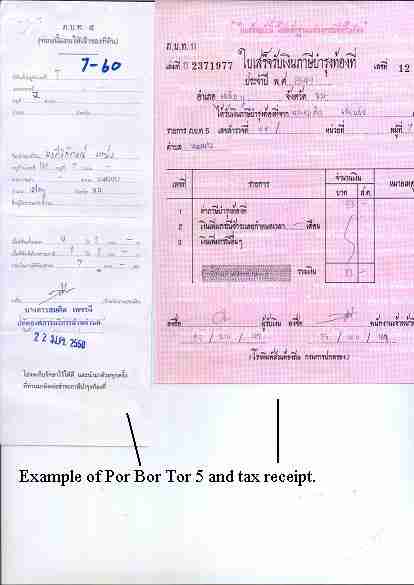
Por Bor Tor 5 (ภ.บ.ท.5) is the form on which land was declared for the local maintenance tax under the Local Maintenance Tax Act B.E. 2508. The Land and Building Tax Act B.E. 2562 repealed that Act (section 3(6)) and has governed the tax on land since 1 January 2020 (section 2), so no new PBT 5 receipts are issued. Old receipts remain the usual paperwork for untitled land held by possession. Land owned by the State for official use is a different category, Ratchaphatsadu land.
Not every document at the Land Office is a title: see our guide to property in Thailand.
The documents called “Por Bor Tor 5 in Thailand” is overseen by the Subdistrict Administrative Organization (SAO) in Thailand. It is not under the Department of Lands or “Land Department” Office. The documents related Por Bor Tor are some kind of tax receipts showing the taxpayers name, . A Por Bor Tor 5 in Thailand is essentially a right of possession. The real owner is the government but the people can use this land for farm purposes.
Do note that researching Por Bor Tor 5 could be complicated. Due, to the absence of computerization locating the landowner may involve spending a day sifting through books at the SAO office to find information about a particular land.
Dealing with Agreements and Tax Obligations
Contracts related to Por Bor Tor 5 in Thailand are often informal and might be endorsed by the village headman (known as Poo Yai Baan) for some semblance of authority. They are often some “templates” from the land department, sometimes without proper witnesses, or without dates, clear indications of the land and what should protect a buyer or seller.
Until 2020 the local maintenance tax was paid every year, and the receipts were issued by the SAO or Amphur. These records are meticulously maintained in books. Confirming ownership entails a thorough manual investigation. The value of the land is normally much lower than a “chanotte” title deed.
Unpacking Por Bor Tor 5 in Thailand (PBT 5)
Por Bor Tor 5 in Thailand (PBT 5) also referred to as ” maintenance tax” or colloquially as the “grass tax ” was the tax the PBT 5 recorded. The receipt showed that the occupier had paid that tax to the local authority, usually the SAO, which kept the records and issued the receipt. It never proved ownership.
Difference Between PBT 5 and Land Title Documents
It’s important to note that Por Bor Tor 5 in Thailand is not a land title document and is not issued by the Department of Lands. The SAO lacks the jurisdiction to confirm land ownership. Nor can a PBT 5 holder apply for a Sor Kor 1: that form was a notification of possession filed with the district office in 1955, when the Land Code came into force, and none are issued today. It is not an “ownership” but rather a right to “possess” the land. The government is the ultimate owner of this property.
Important Factors for Land Transactions
To prevent fraud in land transactions it’s crucial to verify ownership of these “possessory rights” through either the village headman (Poo Yai Baan) or the local authority (SAO). The origin of PBT 5 dates back decades when there was farmland available for the growing population. This situation led individuals to occupy land or clear forests for agriculture. By paying the maintenance tax they could acquire a PBT 5 certification as proof of land occupation.
Features of Por Bor Tor 5 in Thailand
One feature of PBT 5 designated land is its lack of a title deed, from the Department of Lands confirming possession or ownership.
PBT 5 land can be sold. Unlike transactions involving titled land this process only transfers the right to use the land, not ownership. The government maintains ownership.
In law, possession of untitled land passes when the seller hands the land over to the buyer (Civil and Commercial Code section 1378); no registration is needed (Supreme Court Decision 7740/2555). Under the old tax, the buyer then had the taxpayer’s name changed at the SAO, which is administrative evidence of the handover, not a title.
Risks Associated with Buying PBT 5 Land
As PBT 5 land lacks certification from the Department of Lands there are risks involved. The land could already be occupied by another party, or classified as public land, reserved forest, mangrove forest, national park or military zone. The holder of a PBT 5 document has no authority to challenge any government reclamation of that land. These risks need to be acknowledged.
However consulting with the Forest Department and military authorities can help determine if the land is categorized as forest or military territory. Checking with the Land Department can establish if someone else holds ownership rights, over that land. Key details needed for verification include map coordinates and survey numbers listed on the PBT 5 document.
Discrepancies, in PBT 5 Land Size
There is a possibility that the size of the purchased PBT 5 land may not match the information provided in the document. The declared area in Por Bor Tor 5 in Thailand is based on the occupants approximation not on surveying according to the Department of Lands mapping guidelines. If a survey is conducted later for the issuance of a land title document it could reveal a smaller area than the one stated in the PBT 5.
Is it Possible to Convert PBT 5 Land into Title Deeds?
PBT 5 landowners can apply for title deeds when instructed by the government to convert their documents. The PBT 5 documentation will be used as supporting evidence for obtaining title deeds as long as the land is not within forest areas, military zones or land already titled to someone else.
Buyers have the option to ask sellers to initiate the process of obtaining land title deeds under the Land Code Act to confirm whether title deeds can indeed be granted when required by authorities. This verification can be done at the Land Office overseeing the location of the land.
Building on PBT 5 Land
Occupants are allowed to construct buildings on Por Bor Tor 5 in Thailand after obtaining construction approval, from SAO (Sub district Administrative Organization).
With the approval of the construction permit, from SAO they can then request a house number from the village headman. Upon receiving the house number they are eligible to apply for household registration at the district office. Officially registered they can proceed with applications for electricity and telephone services.
It is possible to mortgage structures and buildings on PBT 5 land; however the mortgagor must also be the owner of these buildings/structures as per mortgage laws. The owner of the property being mortgaged must include any improvements attached to the land. It is worth noting that banks typically do not accept mortgages on PBT 5 land and such land cannot be foreclosed and sold at auction like land with a Chanote title.
Supreme Court Decisions related to Por Bor Tor 5 in Thailand
In terms of Supreme Court rulings on PBT 5 land, Supreme Court Decision 15551/2553 (2010) held that a sale of PBT 5 land transfers possession, not ownership, and is complete once the land is handed over and the price paid (sections 1377 and 1378). The seller then owes nothing more, so the buyer could not force a boundary survey or claim the price back.
Supreme Court Decision 7740/2555 (2012) held that a printed agreement to sell PBT 5 land was in substance a sale of possession, completed by handing over the land; when the buyer stopped paying and the seller sued for eviction instead of the price, the court treated the contract as mutually rescinded and ordered the 730,000 baht deposit returned (section 391). Whether a title deed can later be issued is a separate question for the Land Office, which will look at whether the land has been surveyed and whether neighbouring plots already carry title deeds or Nor Sor 3 documents.
Last reviewed: 25 September 2026. Sections 2 and 3(6) of the Land and Building Tax Act B.E. 2562 were read in the Thai text, and Supreme Court Decisions 15551/2553 and 7740/2555 were read in full. The practical points on SAO records, building permits, mortgages of buildings and title-deed conversion describe practice and were not checked against an instrument.
Please be aware that good information regarding Por Bor Tor 5 in Thailand is scarce so please refrain from using the information above without our permission.
- Department of Fisheries, explanation of Por Bor Tor 5. (In Thai language)
Thai Law Updates, free by email
Plain-English updates on Thai law changes that affect foreigners: property, visas, marriage, business and wills. One short email a month from a firm practicing since 2006. No spam, unsubscribe anytime.