


Reviewed by ThaiLawOnline, a licensed Thai law firm practising in Thailand since 2006. Thai lawyer of record: Wichuda Atthamethakon, LL.M., Thai Bar Licence 3149/2556.
Last updated on
What it costs, in one line: a frugal retirement runs 35,000 to 45,000 THB a month, a comfortable one 60,000 to 100,000, and a luxury one from 150,000. Rent is what moves the number most: a one-bedroom condo is 8,000 to 15,000 THB in Chiang Mai against 15,000 to 30,000 in Bangkok and 20,000 to 35,000 in Phuket. Separately from what you spend, the retirement visa requires capital you cannot touch: 800,000 baht in a Thai bank, or income of 65,000 baht a month. The sections below set out each tier, the visa routes and their financial tests, health insurance, and what the 2026 tax rules mean for money you bring in.
When thinking about the cost to retire in Thailand, it’s important to look at your choices. Consider your lifestyle and the differences between regions.
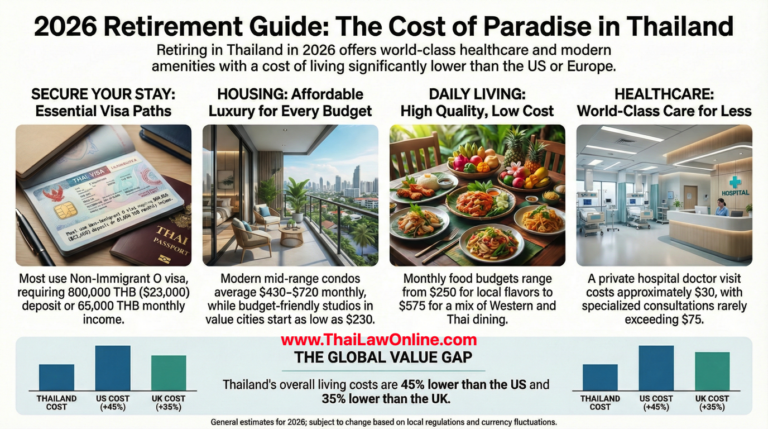
Table of Contents
1. Key Cost Figures for Retiring in Thailand (2026 Monthly Budgets)
In this guide, we will explore the cost to retire in Thailand in detail, focusing on various aspects that influence the Cost to Retire in Thailand.
Living costs are only half the budget. The other half is the capital a retirement visa requires you to immobilise in a Thai bank, which differs sharply between routes. Our guide to the financial requirements of the three retirement routes sets out the 800,000 baht rule, the 65,000 a month alternative and the O-X lock-in, with the Police Order clause behind each figure.
The cost of retirement has stratified into three distinct tiers. While headline inflation is expected to be low (0.0%, 1.0%), core lifestyle costs are going up, making it vital to understand the Cost to Retire in Thailand for effective budgeting and planning.
| Lifestyle Tier | Monthly Budget (THB) | Monthly Budget (USD approx.) | Description |
|---|---|---|---|
| Frugal | 35,000-45,000 | $1,000, $1,300 | Studio condo outside city centers (e.g., Rayong/Chiang Mai), street food, motorbike transport, fan cooling (limited AC), local insurance. |
| Moderate | 60,000-100,000 | $1,700, $2,900 | Modern 1-bedroom condo in Bangkok/Phuket, mix of Western/Thai food, comprehensive health insurance, regular domestic travel. |
| Luxury | 150,000+ | $4,300+ | High-end condo/villa, car ownership, frequent fine dining, premium international health insurance, international travel. |
• Currency Note: The Thai Baht has strengthened in early 2026 (approx. 30.50-32.50 THB/USD), reducing purchasing power for those with foreign pensions compared to previous years.
2. Visa Options and Costs (2026)
Thailand’s visa landscape is now segmented into traditional options and high-net-worth privileges. Note that “Hidden Costs” (insurance, agency fees, re-entry permits) significantly increase the base price. The first two are parts of non-immigrant visa in Thailand.
Non-Immigrant O-A (1-Year Renewable):
◦ Eligibility: Age 50+.
◦ Financials: Security deposit of 800,000 THB or monthly income of 65,000 THB.
◦ Cost: Visa fee 5,000 THB/year.
◦ Hidden Costs: Mandatory health insurance (~40k, 100k THB/year), 90-day reporting, re-entry permits (3,800 THB).
◦ Total 1st Year Estimate: ~15,000-25,000 THB (excluding deposit).
Non-Immigrant O-X (5-Year Renewable):
◦ Eligibility: Age 50+ from 14 specific countries (e.g., USA, UK, Japan).
◦ Financials: 3 Million THB deposit (or 1.8M deposit + 1.2M annual income).
◦ Cost: 10,000 THB (valid for 5 years).
◦ Total 5-Year Estimate: ~60,000 THB (mostly insurance costs).
Long-Term Resident (LTR) “Wealthy Pensioner”:
◦ Eligibility: $80,000 USD/year passive income (or $40k income + $250k investment).
◦ Cost: 50,000 THB for a 10-year visa.
◦ Key Benefit: Tax exemption on foreign-sourced income.
◦ Total 10-Year Estimate: ~150,000-200,000 THB (including insurance/digital work permit).
Thailand Privilege (formerly Elite Visa):
◦ Cost: 650,000 THB (Bronze, 5 years) or 900,000 THB (Gold, 5 years), up to 5 million THB (Reserve, 20 years, by invitation only), as Thailand Privilege publishes them.
◦ Key Benefit: No financial reporting, VIP airport service, points for perks (golf, spa).
◦ Suitability: High-net-worth individuals wanting to bypass bureaucracy.
Destination Thailand Visa (DTV), The “Soft Power” Hack:
◦ Eligibility: Digital nomads or participants in “soft power” activities (Muay Thai, cooking, medical treatment).
◦ Cost: 10,000 THB (valid 5 years, 180 days per entry).
◦ Total 5-Year Estimate: ~35,000 THB (Self-applied) or ~85,000 THB (via agency).
◦ Insight: A viable “semi-retirement” option for those under 50 or those willing to exit/re-enter every 180 days. The only downfall that we see is the impossibility to open a bank account since early 2025 with a DTV visa.
3. New 2026 Tax Regulations Affecting Retirees
The tax landscape has shifted from a “loophole” system to strict enforcement, with a potential relief measure proposed for 2026.
• The Core Rule (Effective Jan 1, 2024): All foreign-sourced income (pensions, dividends, interest) remitted to Thailand by a tax resident (anyone staying 180+ days) is taxable in the year it enters Thailand.
• The “Pre-2024” Protection: Savings earned before Jan 1, 2024, are tax-exempt regardless of when they are remitted. However, the burden of proof is on the retiree to document the “origin of funds” using bank statements.
• Proposed 2026 Royal Decree: A draft decree proposes that foreign income earned from 2024 onwards will be tax-exempt if remitted in the calendar year it was earned or in the following calendar year. This is a reversal intended to stimulate economic flow, and it is still only a draft. Checked on 3 September 2026 by enumerating the Revenue Department’s own register of Royal Decrees issued under the Revenue Code, which runs to No. 807 of B.E. 2569: not one of its entries concerns foreign-source income remitted into Thailand. So the rule that actually applies today is still Departmental Instruction Por. 161/2566 as qualified by Por. 162/2566, under which foreign income arising from 1 January 2024 is taxable in the year you bring it in if you were in Thailand for 180 days or more in the year it arose. Note: Other sources suggest the window might be 12-24 months.
• Strategic Move: LTR Visa holders are explicitly exempt from tax on foreign-sourced income, making this the most tax-efficient visa for high-income retirees.
4. Cost of Living by City/Region
| Region | Monthly Rent (1-Bed Condo) | Lifestyle Vibe | Budget Tier |
|---|---|---|---|
| Bangkok | 15,000-30,000 THB | Urban, world-class medical, connected transport (BTS/MRT). | Moderate/Luxury |
| Phuket | 20,000-35,000 THB | International beach resort, highest cost of living, car essential. | Luxury |
| Chiang Mai | 8,000-15,000 THB | Cultural, mountains, cheap food/rent. Risk: Severe air pollution (Feb-Apr). | Frugal/Moderate, |
| Hua Hin | 12,000-20,000 THB | Royal beach town, quiet, high retiree population, golf hub. | Moderate, |
| Rayong | 6,000-12,000 THB | Industrial/Coastal mix, authentic Thai feel, cheapest coastal option near Bangkok. | Frugal, |
5. Healthcare Costs
Medical inflation is rising (~10% annually), outpacing general inflation.
• Insurance: Mandatory for O-A/LTR visas.
◦ Ages 40-55: ~70,000-120,000 THB/year.
◦ Ages 60+: ~150,000-300,000 THB/year (4,300-8,600 USD).
• Out-of-Pocket Costs:
◦ GP Visit: 500-1,000 THB.
◦ Specialist Visit: 1,500-3,000 THB.
◦ Hip Replacement: 400,000-600,000 THB.
Insight: Many older retirees use “Self-Insurance.” They keep a $50,000 emergency fund and have a basic catastrophic policy. This helps them avoid high premiums for routine care.
6. Housing Costs
• Rent: A mid-range 1-bedroom condo in Bangkok averages 15,000-25,000 THB. In Rayong or Chiang Mai, this drops to 6,000-12,000 THB.
• Utilities:
◦ Electricity: The tariff for Jan-Apr 2026 is 3.88 THB per unit. A standard condo bill with AC use is 1,500-2,800 THB/month.
◦ Water: Very cheap, typically 100-300 THB/month.
7. Unique Insights
• The “Tax Evidence Folder”: Because of the 2024 tax changes, retirees must keep a detailed folder. This folder must show the source and date of their funds. If you cannot prove money transferred in 2026 was savings from 2023, the Revenue Department may default to taxing it.
• Rayong as the “Value Frontier”: While Pattaya and Phuket get the attention, sources highlight Rayong as the smart budget choice for 2026. It offers beaches and proximity to Bangkok/Pattaya but with rents 50% lower than Phuket.
• The PM2.5 Factor: Chiang Mai is financially attractive but environmentally risky due to the “Burning Season” (Feb-April). Retirees are advised to budget for a “seasonal relocation” south during these months, adding to annual costs.
• Inflation Divergence: While headline inflation is near zero (due to energy subsidies), food prices (vegetables, ready meals) are rising. Retirees relying on local markets will feel less impact than those buying imported goods, which are heavily taxed.
• DTV for Retirees: The Destination Thailand Visa (DTV) is meant for digital nomads. However, active retirees can also use it. Those who take cooking or Muay Thai courses can get this 5-year visa. It helps them avoid the high insurance costs of the O-A visa. They just need to manage the 180-day exit or extension rule.
How much money do I need to retire comfortably in Thailand?
A single retiree can live comfortably in Thailand on a budget of 45,000 to 65,000 THB ($1,300, $1,900 USD) per month. This budget typically covers a modern 1-bedroom condominium, utilities, high-speed internet, health insurance, and dining out regularly. If you choose to live in central Bangkok or luxury areas like Phuket, you will need a budget. A “comfortable” budget starts at around 80,000 THB ($2,300 USD) each month. This amount helps you maintain a Western standard of living. Do note that everyone is different and it depends on your lifestyle.
What are the financial requirements for a Thai Retirement Visa in 2026?
To get a Non-Immigrant O-A or O (Retirement) visa, you must meet one of three financial requirements
Bank Deposit: Hold 800,000 THB in a Thai bank account.
Monthly Income: Show proof of a monthly pension/income of at least 65,000 THB.
Combination: Have a combined total of deposit + annual income of at least 800,000 THB. Note on seasoning: the deposit must stand in the account for not less than 2 months before you file, and for not less than 3 months after permission is granted, after which you may draw on it provided the balance never falls below 400,000 THB. That 400,000 floor is criterion 2.22(4), the deposit-only route; on the combination route, criterion 2.22(5), the account must instead keep not less than half the deposit. Both criteria are in the table annexed to Immigration Bureau Order No. 12/2568 of 23 January 2025, which we have read in Thai. The three-month figure still widely quoted for the period before filing comes from Order of the Royal Thai Police No. 327/2557 and no longer states the requirement; that order and its amendment Order No. 654/2564 were repealed on 26 September 2023 by Order of the Royal Thai Police No. 542/2566. The two-month and three-month periods and the 800,000 and 400,000 baht figures survived the change of instrument unchanged. The half-the-deposit rule did not: the repealed order set no residual figure for the combination route at all.
Does the 800,000 THB for the retirement visa need to stay in the bank forever?
No, but you must maintain the full balance for 3 months after your visa is granted. After this 3-month waiting period, you can take out money for living expenses. However, your balance must stay above 400,000 THB at all times during the year. Ahead of your next annual renewal you must top the account back up to the full 800,000 THB, and leave it there for the seasoning period. Season it for the full 2 months before you file, and remember the balance must then stay at 800,000 THB for 3 months after permission is granted.
How much does health insurance cost for retirees in Thailand?
Comprehensive private health insurance for a retiree aged 60-65 usually costs between 40,000 and 80,000 THB. This is about $1,100 to $2,300 USD each year. Premiums increase significantly with age. For a Non-Immigrant O-A visa, you must have insurance. It must provide total coverage of at least 3,000,000 THB, or USD 100,000. That replaced the old split requirement of 400,000 THB inpatient and 40,000 THB outpatient for new applications from 1 October 2021 and, at extension inside Thailand, from 1 October 2022. The condition in force today is criterion 2.22(6) of the table annexed to Immigration Bureau Order No. 12/2568 of 23 January 2025; it entered the extension criteria through Order of the Royal Thai Police No. 654/2564, which was repealed with its parent order on 26 September 2023. Cover may be Thai or foreign. A Thai policy has to be bought online through longstay.tgia.org, and a foreign policy needs either a certification from the embassy of that country in Thailand or a notarised certificate of the signature on the document from your own Ministry of Foreign Affairs, in the form the Ministry of Public Health prescribes. Do not assume the O-X minimum is identical: the O-X base is a Thai policy at 40,000 THB outpatient and 400,000 THB inpatient, with practice varying between consular posts. Many retirees opt for higher deductibles to keep monthly premiums lower.
Is it cheaper to retire in Chiang Mai or Bangkok?
Retiring in Chiang Mai is generally 30% to 40% cheaper than retiring in Bangkok. A modern 1-bedroom condo in central Bangkok (Sukhumvit/Silom) costs between 20,000 and 35,000 THB per month. In Chiang Mai, a similar unit averages 10,000 to 15,000 THB. Food, transportation, and entertainment cost much less in the north. This helps people enjoy a better life on a smaller fixed pension.
Can I work in Thailand while on a retirement visa?
No, employment is strictly prohibited on a standard Retirement Visa (Non-Immigrant O or O-A). You cannot hold a work permit or generate active income within Thailand. If you want to work or start a business, you need to cancel your retirement visa. Then, apply for a Non-Immigrant B (Business) Visa. You can also consider the LTR (Long Term Resident) Visa. This visa has special categories for “Wealthy Pensioners” and “Work-from-Thailand Professionals.” But remote workers can work on a DTV visa.
Are there hidden costs to retiring in Thailand?
Yes, retirees often overlook visa overheads, inflation, and currency fluctuations. Common “hidden” costs include:
Visa Agent Fees: 15,000-25,000 THB per year (if you don’t do the paperwork yourself).
Re-Entry Permits: 3,800 THB per year for a multiple-entry permit to travel freely.
90-Day Reporting: Free to file. The statutory penalty for a late report is a fine of up to 5,000 THB plus up to 200 THB a day until you put it right, under section 76 of the Immigration Act. Offices settle a late report you bring in yourself at around 2,000 THB, and apply the full 5,000 where the lapse surfaces during some other dealing with immigration.
Air Conditioning: Heavy usage can push electricity bills over 4,000 THB/month.
Ready to Make the Move? Let Us Guide You. Understanding the costs is only the first step; navigating the legal landscape is where the real challenge begins. At ThaiLawOnline, we don’t just process paperwork; we provide peace of mind. Our Managing Director, Sébastien Brousseau, has lived in Thailand since 2004. He has managed legal operations for more than 20 years. We are well-suited to assist you with your needs and did it for hundreds of retirees. Whether you want to retire in the rice fields of Isaan, mountains of the North, the busy center of Bangkok, or the calm coastal areas, we can help. We speak several languages and are ready to handle your retirement visa, legal consultations, and property matters. Don’t leave your retirement to chance; contact us today to plan your future with confidence.
Last reviewed: 4 September 2026. The figures on this page were checked against primary sources or against the page on this site that owns them, and two were wrong. The Thailand Privilege price was attached to the wrong tier: 650,000 THB is the five-year Bronze membership and Gold is 900,000, as Thailand Privilege publishes on its own membership page, which also gives Platinum 1,500,000 for ten years, Diamond 2,500,000 for fifteen and Reserve 5,000,000 for twenty by invitation only. The 90-day reporting penalty was given as a flat 2,000 THB; the statutory penalty is section 76 of the Immigration Act B.E. 2522, a fine of up to 5,000 THB plus up to 200 THB a day until compliance, and 2,000 THB is what offices settle a self-reported late filing at. Checked and found correct, so nobody re-derives them: the 800,000 THB deposit seasoned for two months before filing and held for three months after permission, then never below 400,000 THB, and the 65,000 THB monthly income route, all of which match our retirement extension guide, which reads them from clause 2.22 of the annex to the Immigration Bureau order published in the Royal Gazette on 24 January 2022; the 3,800 THB multiple re-entry permit, which is the rate the fees Ministerial Regulation prescribes; and the tax section, whose enumeration of the Revenue Department register of Royal Decrees to No. 807 of B.E. 2569 was made on 3 September 2026 and still holds. Not verified from a primary source and left as written: the Non-Immigrant O-A and O-X visa fees, which vary by post, the health insurance coverage floor and its 1 October 2021 start, the cost-of-living, rent and insurance premium ranges, which are estimates and are presented as such, and the observation about opening a bank account on a DTV.
Links : BOI on LTR Visa
Thai Law Updates, free by email
Plain-English updates on Thai law changes that affect foreigners: property, visas, marriage, business and wills. One short email a month from a firm practicing since 2006. No spam, unsubscribe anytime.