


Reviewed by ThaiLawOnline, a licensed Thai law firm practising in Thailand since 2006. Thai lawyer of record: Wichuda Atthamethakon, LL.M., Thai Bar Licence 3149/2556.
Last updated on
Written by Mr. Sébastien Brousseau, LL.B., B.Sc., Attorney and Managing Director at ThaiLawOnline. Sebastien is a Canadian lawyer by training, based in Bangkok with 30 years in law, 20 of them in Thailand. He has been managing law firms in Thailand since 2006 and leads a team of Thai attorneys focused on family, property, and corporate law. He studied both Civil and Common Law before moving to Asia in 2002. He has been helping hundreds of foreigners about Thai divorces. Disclaimer: This article is for general information only and does not constitute legal advice. Consult a qualified attorney for advice on your specific situation. Full Profile | LinkedIn.
For where the certificate fits in the divorce as a whole, see our guide to Thai family law.
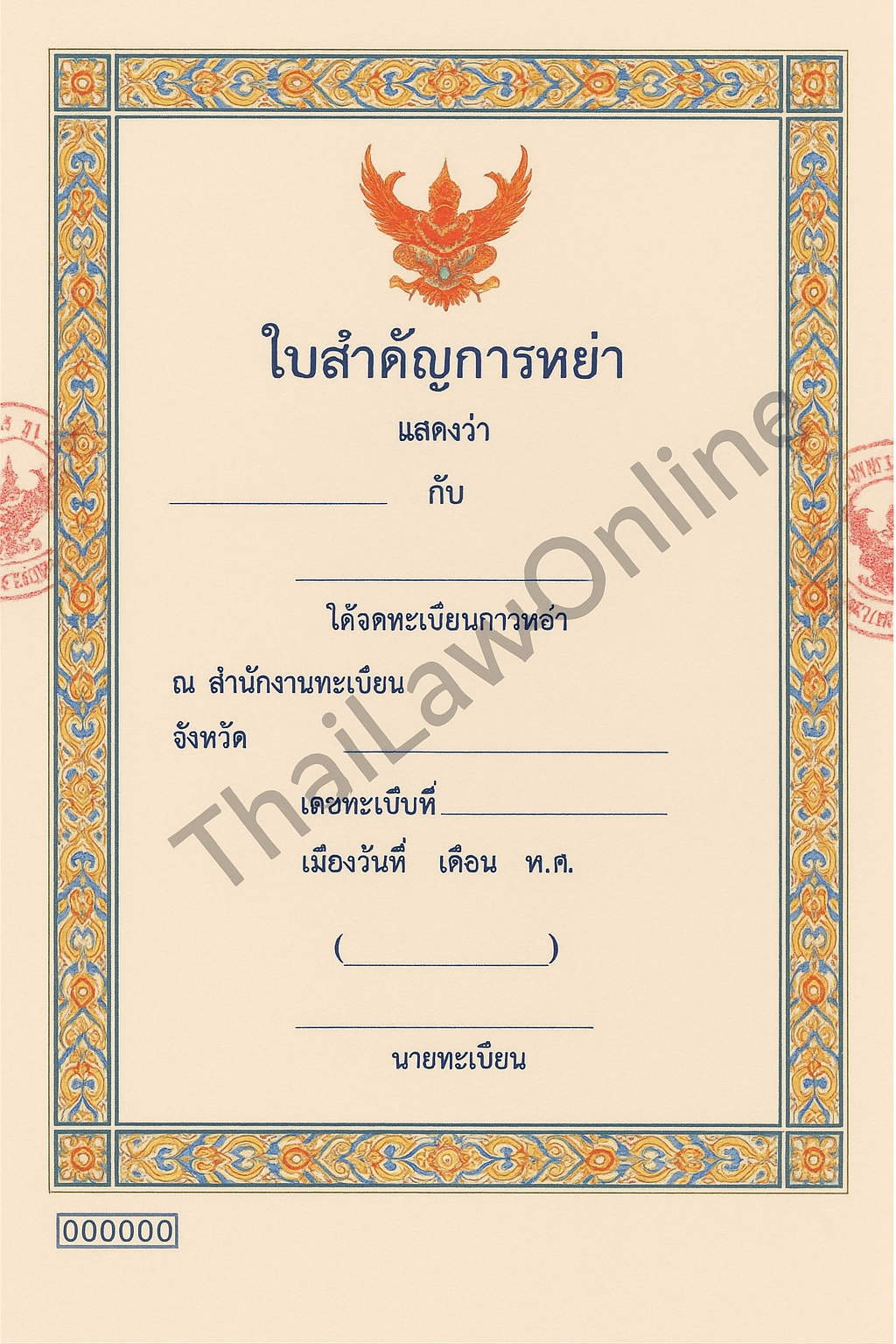
Most foreigners only think about the divorce certificate when somebody abroad asks for it. A new spouse’s embassy, a pension office, an immigration officer at home. By then the marriage is over, and finding the right paper is the last thing you want to deal with. So here is what the certificate is, where it comes from and how to make it usable outside Thailand.
Table of Contents
Last reviewed: 16 September 2026. The registration steps on this page were read in Thai against the Ministry of Interior Regulation on Family Registration of Buddhist Era 2541, as amended by Regulation No. 2 of Buddhist Era 2544 (which replaced the Kor Ror 7 form) and Regulation No. 3 of Buddhist Era 2561 (identity checks, database checks and English language register extracts). The Civil and Commercial Code rules on divorce by mutual consent, the rule that a consent divorce takes effect only when registered, and the rule that a court divorce must be registered before it binds third parties were read in Thai for what a divorce by consent requires and when each kind of divorce takes effect. The legalisation steps follow the Ministry of Foreign Affairs Regulation on the Legalization of Documents of Buddhist Era 2568, as read for our guide to legalising documents in Thailand, and the Apostille date is taken from the Hague Conference status table. Not verified, because they are practice rather than law: processing times, fee amounts, and which foreign authorities accept which documents. Rechecked on 5 October 2026: the Apostille entry reread on the Hague Conference status table (Thailand acceded 30 June 2026, in force 28 February 2027) and the page reread against this stamp; no change made.
What the divorce certificate is
The certificate is called ใบหย่า (Bai Yah) in Thai. It is the paper that proves your divorce was registered. You will be asked for it when you update your marital status, change a visa, transfer property or marry again.
Two documents get confused all the time:
- The divorce certificate (ใบหย่า, Bai Yah), formally the Kor Ror 7 (ค.ร.7). This is what you take home.
- The divorce registration (ทะเบียนหย่า, Tabien Yah), the Kor Ror 6 (ค.ร.6). This is the official record the district office keeps.
Where and when you get it
After an uncontested divorce is registered, the district office (Amphur) issues the certificate on the spot. Bring your marriage certificate and identification. If the papers are in order, it is a short visit.
You do not have to go back to the district office where you married. A family registration can be requested at any district office under the Interior Ministry’s family registration rules, and each spouse receives a certificate. If you cannot both attend the same office, each of you can sign at a different one, including a Thai registry abroad. The divorce takes effect when the second office registers it.
After a court divorce
A contested divorce ends with a judgment, not a visit to the registrar. Either spouse can then go to the district office alone with a certified copy of the final judgment. The registrar records the court, the case number and the date of judgment in the divorce register, and keeps the other spouse’s certificate until that spouse collects it.
Register it even though the divorce is already in effect. Until it is registered, the judgment cannot be relied on against a third party who acted in good faith (the rule that a court divorce must be registered before it binds third parties). People skip this step because the judge has already ruled. It comes back to bite them when they sell property or remarry.
Using a Thai divorce certificate abroad
A certificate in Thai means nothing to most foreign offices until it has been translated and legalized. The chain today is:
- Have your Kor Ror 7 translated, usually into English, by an accredited translator.
- Have the translation legalized at the Ministry of Foreign Affairs, Department of Consular Affairs (กรมการกงสุล).
- Have the document authenticated at your embassy or consulate in Thailand.
Thailand has acceded to the Apostille Convention with effect from 28 February 2027. From that date, for a country that is also a party and has not objected to Thailand’s accession, a single apostille replaces both the Ministry of Foreign Affairs legalization and the embassy step. Until then the chain above applies. You can also ask the district office for an extract of the divorce register in English (see the questions below).
Why some certificates are refused abroad
The two reasons we see are an uncertified translation and a missing legalization or embassy stamp. Each country sets its own rules for foreign documents. Ask the office that will receive yours what it wants before you start.
Lost certificate, or a mistake on it
Go to any district office. If that office did not register your divorce, the registrar traces it through the central registry. Bring your identification and the original marriage certificate. Ask for a certified copy of the entry in the divorce register (Kor Ror 6). That is the service the Regulation provides, at a fee set by ministerial regulation. The fee is small, and the copy is usually issued within one working day.
Frequently asked questions
What exactly is a Kor Ror 7 divorce certificate?
Kor Ror 7 is Thailand’s official divorce certificate (ใบหย่า), issued at the district office after the divorce is registered.
How long does it take to get a Thai divorce certificate?
After an uncontested divorce it is issued on the spot, once the divorce is registered. After a court divorce it takes as long as the court case, and then one visit to register the judgment.
Can I use my Thai divorce certificate abroad?
Yes, once it is translated, legalized at the Ministry of Foreign Affairs and authenticated by your embassy. From 28 February 2027 Thailand joins the Apostille Convention, so for a country that is also a member and has not objected, a single apostille replaces both the legalization and the embassy step.
Can I get a Thai divorce certificate if married abroad?
Do not assume so. Under the rule that a consent divorce takes effect only when registered, registration is the step that completes a divorce by consent where the marriage was registered under the Civil and Commercial Code, and a marriage made abroad was not. A marriage made abroad can be recorded at a district office as a family status record, but only if at least one spouse is a Thai national when asking, under the Interior Ministry’s family registration rules, and a record of that kind is not a registration under the Code. Take advice on your own facts before going to the district office.
Where do I get a divorce certificate translated into English?
Ask the district office first. Since 2018 a person with an interest can ask the registrar for an extract of the family register in English, certified on request, in the form the Department of Provincial Administration sets (added to the rules by an amendment of Buddhist Era 2561). Otherwise use a certified translation, which must then be legalized.
What is the difference between divorce certificate and divorce registration?
The divorce certificate (Bai Yah, Kor Ror 7) is the proof you keep. The divorce registration (Tabien Yah, Kor Ror 6) is the official record kept at the district office.
What if the Amphur refuses to issue a divorce certificate?
Usually the documents are incomplete, or the foreign marriage was never registered in Thailand.
Is online divorce registration available in Thailand?
No. A divorce by consent is registered at a district office. The spouses need not attend the same one: each can sign at a different office, including a Thai registry abroad, and the divorce takes effect when the second office registers it.
If you need help
If you have lost your certificate, need it translated, or want to know whether it will be accepted where you are going, write to us. We have worked with foreigners in Thailand since 2006, and our team works in English, French and Thai. An uncontested divorce with us is a fixed 9,900 baht.
Thai Law Updates, free by email
Plain-English updates on Thai law changes that affect foreigners: property, visas, marriage, business and wills. One short email a month from a firm practicing since 2006. No spam, unsubscribe anytime.