Last updated on April 12, 2026
Setting up a foundation in Thailand is a complex task. It requires careful attention to rules, financial commitments, and ongoing compliance. Recent laws have made the process harder. There is more government oversight and possible new rules coming soon.
Thailand’s laws for foundations are based on the Civil and Commercial Code and ministerial rules. These organizations must show they have real public benefit goals and must stay non-profit. The process usually takes 12 months or more. It requires a lot of money, between 200,000 and 500,000 Thai baht. The amount depends on the goals of the foundation. Given the complexity and evolving regulatory landscape, professional legal assistance is not just recommended but essential for successful foundation establishment. This guide is informational and not a substitute for personalized legal advice.
Table of Contents
Legal Framework and Recent Regulatory Changes
Governing Laws and Regulations
Thailand’s foundation establishment is mainly governed by the Civil and Commercial Code (Sections 110-136). It is also guided by the Ministerial Regulations on the Registration of Foundations from 2002. A foundation is defined under Section 110 of the Civil and Commercial Code. It is property set aside for public purposes. These purposes include charity, religion, art, science, education, and other public benefits. It is not meant for profit sharing.” The property must be managed solely for implementing the foundation’s objectives and cannot be used for personal interest.
Summary of Foundation Establishment Requirements in Thailand
| Topic | Key Laws/Rules | Purpose/Impact |
|---|---|---|
| Legal Framework | Civil and Commercial Code Sections 110–136, Ministerial Regulations 2002 | Ensures all foundations serve public benefit and stay non-profit |
| Capital Requirements | Minimum 500,000 THB; Some cases: 250,000 THB (100,000 in cash). There are in Ministerial Regulation No. 1 (B.E. The lower threshold applies to foundations for “public charity,” like education and health. It is not automatic and needs approval. Also, keep in mind that the registrar can change these amounts based on the foundation’s size. Foundations with foreign ties may face more scrutiny. | High entry barrier; ensures serious and financially stable applicants |
| Timeline & Steps | Preparation (1–2 months), Application + Review (7–13 months) | Long process requiring well-prepared documents and persistence |
| Oversight Authority | Department of Provincial Administration under Ministry of Interior | Enforces rules, reviews operations, ensures accountability |
| Recent Legal Developments | Draft Act on Associations & Foundations (Oct 2024) | May restrict unregistered orgs, add severe penalties & reporting |
| Taxation Rules | Donations tax-exempt; Business income taxed at 2%, other income at 10%. Under Revenue Department rules (Revenue Code Sections 47-49), foundations must qualify as “public benefit organizations” for exemptions. Clarify that failure to comply can lead to full corporate tax (20%). | Ensures transparency, prevents abuse of tax benefits |
| Compliance Duties | CPA-audited annual reports, 60-day tax registration, financial records | Demonstrates legitimacy, supports ongoing operation and audits |
| Role of Legal Assistance | Helps avoid delays, ensure compliance, draft charter, and board setup | Essential for avoiding mistakes and preparing for future legal changes |
The Ministry of Interior maintains oversight authority over all foundations through the Department of Provincial Administration. This government group has the power to check foundation activities. They review financial statements and make sure rules and laws are followed. Foundations must operate within strictly defined parameters, with activities limited to charitable, religious, artistic, scientific, literary, educational, or other public benefit purposes.
Draft Act on Associations and Foundations 2024
A significant development affecting foundation establishment is Thailand’s proposed Draft Act on Associations and Foundations, introduced in October 2024. This law takes a stricter approach to the non-profit sector. It may add new rules that could break international law standards. The draft act requires all associations and foundations to register with the Ministry of Interior. This will ban unregistered groups and create criminal penalties for those who do not comply.
Key concerns with the proposed law include rules for groups to have at least 30 members. It also gives inspection powers without search warrants. Additionally, it allows for broad dissolution based on unclear criteria. This includes actions that are “contrary to public morality” or could endanger “national security.” The bill also mandates burdensome reporting requirements for foreign funding, with thresholds to be determined by ministerial announcement. These provisions have drawn significant criticism from civil society organizations and international human rights groups who argue they could severely restrict legitimate charitable activities.
Increased Government Scrutiny
The regulatory environment for foundations has become increasingly strict, reflecting broader concerns about tax avoidance and security issues. Foundations enjoy low tax rates. They pay 2% on business income and 10% on other income. However, this has led to more government checks to stop misuse. This has drawn more attention from the government. Income from membership fees and donations is still tax-exempt. However, authorities are increasing oversight to stop abuse of these tax benefits.
Recent tax policy changes show the government’s commitment to closing loopholes. New rules for taxing foreign income under the revenue code will start in 2024. While these changes primarily affect individual taxpayers, they signal a broader trend toward stricter financial oversight that extends to charitable organizations.
Considerations for Foreign Founders and International Foundations
Expatriates or international organizations looking to establish a foundation in Thailand face additional hurdles due to foreign investment restrictions and security concerns. Under the Foreign Business Act B.E. 2542 (1999), foreigners can only own up to 49% of a foundation’s assets. To own more than 49%, they need special approval. The board must often have a majority of Thai nationals to ensure local oversight. Foreign funding must be reported clearly. This helps avoid issues with anti-money laundering laws under the Anti-Money Laundering Act B.E. 2542.
Cross-border charities can register as a branch of an international NGO. However, they need approval from the Ministry of Interior and must follow bilateral agreements. Common challenges include language barriers in documentation and cultural nuances in defining “public benefit.” Involving bilingual legal experts early can make this process easier. They can help create a foundation that meets both Thai law and international standards, such as those from the UN or OECD.
Capital Requirements and Financial Obligations
Minimum Capital Thresholds
Foundation establishment requires substantial initial capital investment, with requirements varying based on the organization’s objectives. The minimum capital requirement is 500,000 Thai baht. If you include other assets, you need at least 250,000 baht in cash. Foundations set up for certain charitable purposes can have lower capital requirements. These purposes include social work, education, sports, religion, medical treatment, research, and preventing drug abuse or AIDS. To qualify, they need 250,000 baht in total, with at least 100,000 baht in cash.
These capital requirements represent a significant barrier to entry for smaller charitable initiatives and non-profit organizations.. The funds must be deposited in a Thai bank account and cannot be withdrawn for personal use. If a foundation is dissolved, its remaining assets must go to another foundation or association with similar goals. They cannot be returned to the founders.
Despite the high barriers, establishing a foundation in Thailand offers significant incentives, particularly for charitable work. Registered foundations enjoy tax exemptions on donations (encouraging philanthropy), eligibility for government grants, and credibility for partnerships with NGOs. For expats, this offers a clear way to help Thai society. It may also help them qualify for long-term visas in some public benefit categories. However, these benefits depend on following non-profit rules. If any profits are shared, it could lead to penalties and closure.
Ongoing Financial Compliance
Foundations face continuous financial reporting obligations that require professional accounting expertise. Annual financial statements must be checked by certified public accountants as required by the revenue code. They should be sent to the relevant authorities. These statements must include activity reports. The reports should detail how funds were used and progress made toward goals. These reports must show that all income and donations are used only for the foundation’s purposes. They cannot be used for personal gain.
You must register for taxes within 60 days of starting your organization. Also, keep detailed records of all financial transactions. Foundations have some tax benefits, like not paying taxes on donations, which can significantly aid local organizations. However, they still pay income tax on business activities and investment earnings. Recent tax policy changes have introduced additional compliance requirements, particularly regarding foreign funding sources and electronic donation systems.
Establishment Process and Timeline
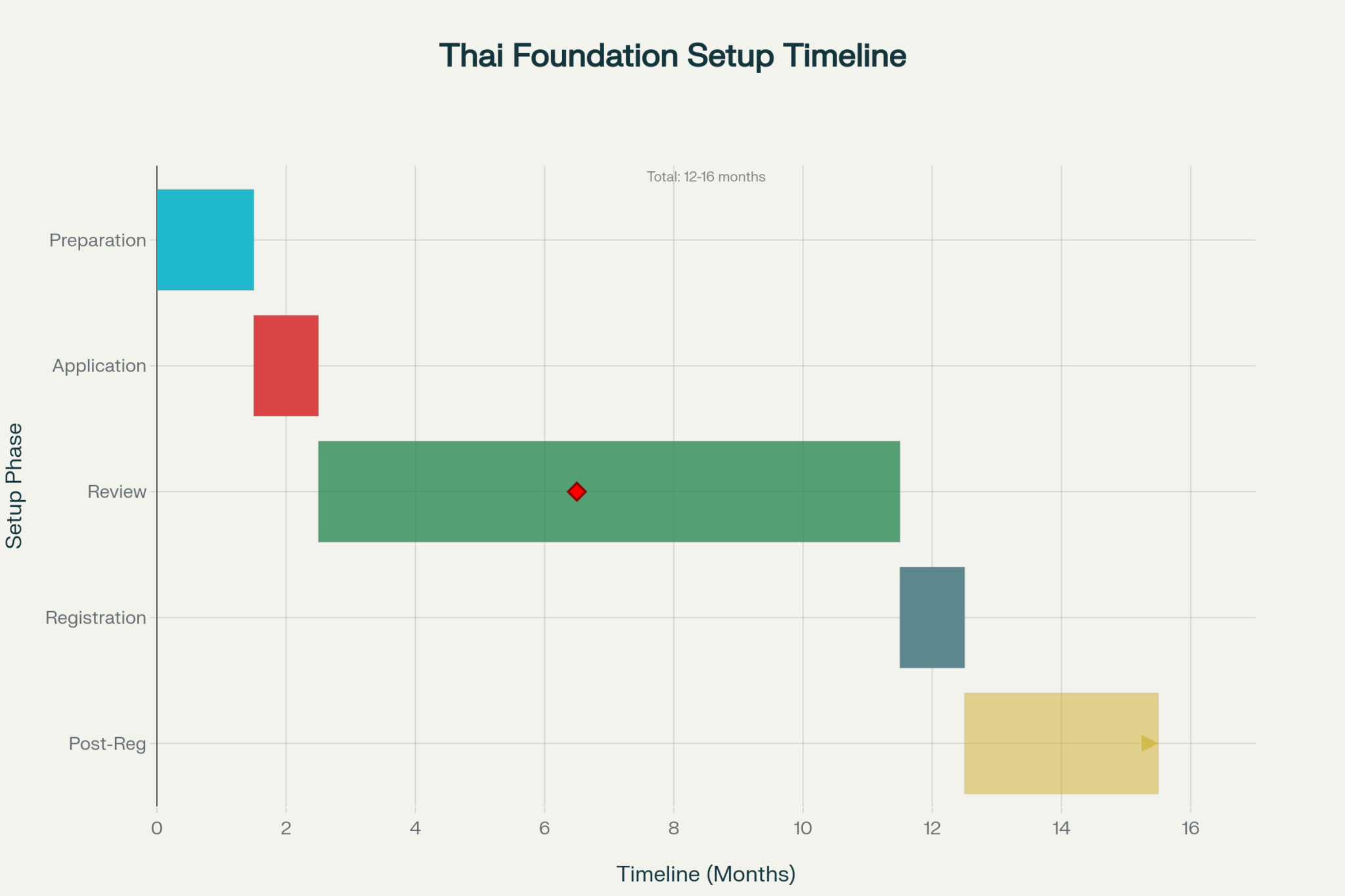
Preparation Phase (1-2 months)
The foundation establishment process starts with careful planning of goals, documents, and finances. This must follow the Thai civil and commercial code. Founders need to clearly state the foundation’s charitable purposes. This ensures they match the allowed activities for non-profit organizations under Thai law. This phase includes securing the required minimum capital, identifying potential board members, and developing the foundation’s charter and regulations.
Foundation Establishment Process Timeline in Thailand
Preparing documents during this phase is very important. Incomplete or incorrect submissions can cause big delays later on. You need to provide several documents, including a tax identification number for the foundation. These include a list of allocated assets and registered donation promises, which are crucial for non-profit organizations. You also need identification documents for all board members of the foundation or association. Lastly, include detailed foundation rules about management structure and operational procedures.
Application and Review Process (7-13 months)
The application must be submitted to the district registrar where the foundation’s principal office will be located. The review process is detailed and takes time. It usually lasts 6 to 12 months. During this time, authorities review the foundation’s goals. They also examine the financial plans and the qualifications of the board of directors. Government officials check if the foundation’s goals serve the public interest and do not threaten safety or security.
During this phase, authorities may request corrections or additional documentation, potentially extending the timeline further. The registrar can deny registration. This can happen if the goals break the law, are immoral, or could harm public order or national security. Applicants have 30 days to make the needed corrections. If they do not comply, their registration will be refused under the Thai civil and commercial code.
Registration and Post-Registration Requirements
Upon approval, the registrar issues a certificate of registration, and the foundation’s establishment is published in the Government Gazette. The newly registered foundation must then complete tax registration within 60 days and begin fulfilling ongoing compliance obligations. This includes establishing proper accounting systems, implementing governance procedures, and preparing for annual reporting requirements.
Post-registration compliance means keeping an eye on activities to make sure they meet goals. It also includes keeping accurate financial records and sending annual reports to the government. Foundations must also navigate evolving regulatory requirements, including potential new restrictions under the proposed Draft Act on Associations and Foundations.
The Critical Role of Legal Assistance
Complex Regulatory Navigation
The complexity of Thailand’s foundation establishment process makes professional legal assistance essential rather than optional. Legal practitioners specializing in non-profit law possess the expertise necessary to navigate the intricate regulatory framework and ensure compliance with all applicable requirements. The process involves multiple government agencies, detailed documentation requirements, and ongoing compliance obligations that require specialized knowledge.
Experienced legal help can assist founders of non-profit organizations. They can help avoid common mistakes that cause application rejections or delays.
- This includes writing the charter correctly.
- It also involves meeting capital needs.
- Additionally, it requires structuring the board well.
- Finally, it means handling any security issues that may arise during the review.
Legal professionals keep up with changing rules. They pay attention to new laws, like the Draft Act on Associations and Foundations.
Practical Advantages of Professional Guidance
Legal assistance provides practical benefits beyond regulatory compliance, including efficient document preparation, strategic planning for foundation objectives, and ongoing operational guidance. Lawyers can help structure foundations to maximize tax benefits while ensuring full compliance with applicable laws. They also provide valuable guidance on board composition, particularly regarding the practical advantages of including Thai nationals among directors.
Professional legal services are more important now. This is due to increased government scrutiny and possible new rules for non-profits. Lawyers can help foundations prepare for enhanced reporting requirements, navigate inspection procedures, and ensure compliance with evolving regulatory standards. This guidance is very important for foreign founders. They may not know Thai legal procedures and cultural aspects.
Long-term Compliance and Risk Management
Legal assistance extends beyond initial establishment to ongoing compliance management and risk mitigation. Foundations require continuous legal guidance to maintain their charitable status, fulfill reporting obligations, and adapt to changing regulatory requirements. Professional legal advice helps make sure that foundation activities stay within legal limits. It also ensures that any changes in rules are quickly handled.
The Draft Act on Associations and Foundations may be used. This makes legal help for non-profit groups more important. This proposed legislation could significantly alter the operating environment for foundations, requiring existing organizations to adapt their procedures and potentially face enhanced scrutiny. Legal professionals can help foundations prepare for these potential changes and ensure continued compliance with evolving regulatory standards.
FAQs on Setting Up a Foundation in Thailand
What are the steps for setting up a foundation in Thailand?
To start a foundation in Thailand, you first need to define its goals. Make sure these goals match non-profit purposes. You need to write the articles of association. Also, prepare supporting documents, like a copy of the house registration. After this, send your application to the local District Office. This office is part of the Department of Provincial Administration, Ministry of Interior. Once approved, you can register your foundation with the local registrar.
What is the legal structure required for establishing a non-profit organization in Thailand?
The legal structure for establishing a non-profit organization in Thailand typically involves registering as a foundation or association. Foundations are non-profit entities that operate for public benefit, while associations may have broader membership and activities. Both must comply with Thai law and the rules prescribed by the Ministry of the Interior.
How does a foundation in Thailand enter into contracts?
A foundation in Thailand can legally make contracts if it is registered with the Ministry of the Interior. The foundation must make sure that all contracts match its goals and follow Thai law. This includes corporate income tax and other legal duties.
What are the criteria for approval of a foundation or association in Thailand?
To get approval for a foundation or association in Thailand, you need clear goals that help the public. You must also submit valid documents and follow the rules set by the Ministry of the Interior. The foundation’s activities must also align with non-profit purposes to secure approval.
What types of activities can a non-profit organization in Thailand engage in?
A non-profit organization in Thailand can do many things. It can promote education, health, welfare, and other public benefits. Activities must follow the foundation’s goals. They must also meet the legal rules of Thai law and the Ministry of the Interior.
What is the process for setting up a charity in Thailand?
Setting up a charity in Thailand involves similar steps to establishing a non-profit organization. You need to define the charity’s goals. Then, prepare the articles of association. Finally, submit the required documents to the Ministry of the Interior for approval. Once registered, the charity must operate within its approved framework and comply with all relevant regulations.
What is the role of the Revenue Department in the context of non-profit organisations in Thailand?
The Revenue Department in Thailand plays a crucial role in overseeing tax compliance for non-profit organizations. Foundations may not pay corporate income tax, but they must follow certain rules. They also need to provide documents to show they comply with Thai law and the Revenue Department’s conditions.
How can one ensure compliance with Thai law when establishing a foundation?
To follow Thai law when starting a foundation, you must closely follow the steps set by the Ministry of the Interior. This includes preparing the necessary documents, understanding the criteria for approval, and adhering to the prescribed rules and regulations governing foundations in Thailand.
What support is available for non-governmental organizations in Thailand?
Non-governmental organizations (NGOs) in Thailand can benefit from various forms of support, including grants, training, and networking opportunities. These resources are often provided by other organizations, government agencies, and international bodies interested in promoting development and social welfare in Thailand.
Dissolution and Exit Strategies
If a foundation needs to dissolve, it follows CCC Sections 131-136. This can happen for reasons like non-compliance, insolvency, or mission completion. Assets cannot revert to founders but must be transferred to another similar organization, as approved by the registrar. Voluntary dissolution needs approval from the board and a notice to the Ministry. Involuntary cases, like breaking public morality laws, can lead to fines of up to 100,000 THB or imprisonment.
It is smart to plan an exit strategy from the beginning. A lawyer can write clauses in the charter. This helps make winding down easier. It also reduces risks like tax audits or asset disputes. This is especially important amid regulatory changes, where non-compliance could trigger forced dissolution.
Conclusion
Establishing a foundation in Thailand represents a significant undertaking that requires careful planning, substantial financial resources, and expert legal guidance. The process typically extends beyond 12 months and involves navigating complex regulatory requirements under increasingly strict government oversight. Recent developments, including the proposed Draft Act on Associations and Foundations, suggest that the regulatory environment will become even more challenging for charitable organizations.
The combination of substantial capital requirements (200,000-500,000 THB), complex documentation needs, and ongoing compliance obligations makes professional legal assistance essential for successful foundation establishment. The low tax burden has made Thai foundations attractive. However, it has also led to more government scrutiny. This means they must pay close attention to rules and operate transparently.
For expatriates and organizations considering foundation establishment in Thailand, early engagement with experienced legal counsel is crucial. The process is complex, and there can be big delays. The rules are always changing. Because of this, getting professional help is not just a good idea; it is essential. This help will ensure you meet your charitable goals and follow the law. As rules change, foundations that get good legal help early will be better prepared. They can handle future challenges and achieve their charitable goals more effectively.
- Read about the experience of one of our client that set up a foundation in Thailand
- Thai manual about foundations in Thailand (Thai PDF)