


Reviewed by Wichuda Atthamethakon, LL.M., Thai Bar Licence 3149/2556, for ThaiLawOnline, a Thai law firm acting for foreigners since 2006.
Update log
- 2 November 2026: Added the statute box with Thai, English and French text and checked the page against the official text
For a first move to Thailand, arrange the permission to stay, access to money, healthcare and a temporary place to live before making expensive commitments. You do not need to choose a permanent home during your first week.
A holiday gives a poor test of daily life. Visit the neighbourhood during working hours, travel the route to school or work, and check how ordinary tasks will fit your budget. Use the first month to test the plan before committing to a long lease or property purchase.
Table of Contents
Before departure: confirm the legal basis for the stay
Choose an immigration route matching the purpose of the move, such as employment, family, retirement or eligible remote work. Check the requirements for your nationality, application location and proposed activity with the responsible Thai embassy or consulate. Do not rely on an old visa-exemption list.
Visa validity and permission to remain after entry are different dates. Work permission is another question. If you intend to earn money while living here, describe the work accurately before choosing the route. Our visa finder helps compare options, and the digital-nomad guide addresses remote work.
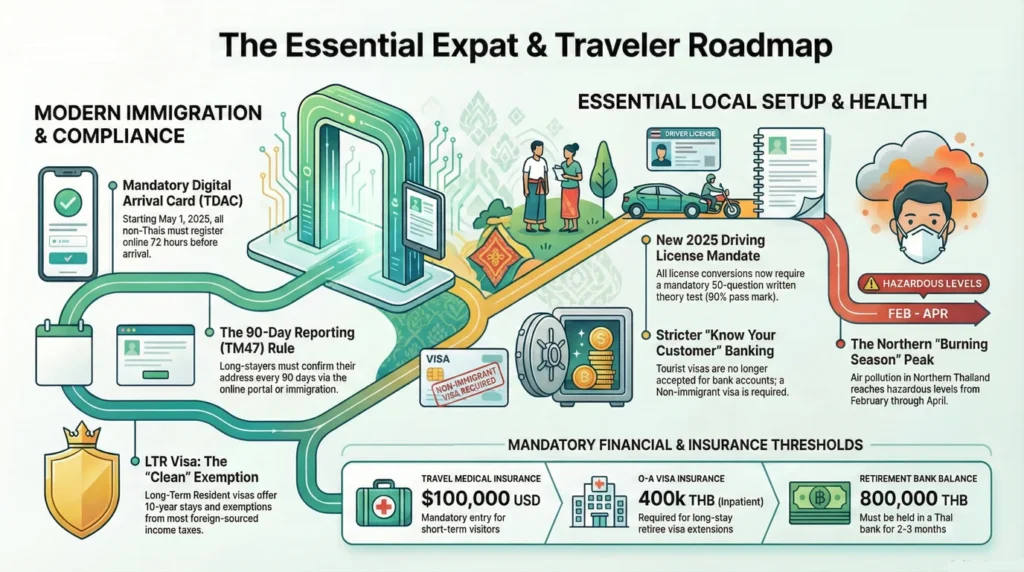
Check whether the Thailand Digital Arrival Card applies to your entry and submit through the official Immigration website within the required window. The official submission is free. The arrival card does not replace a visa or guarantee entry.
The law behind this page
English
Section 34 Immigration Act B.E. 2522
Full text
An alien who may enter the Kingdom temporarily must enter for the following purposes: (1) performing diplomatic or consular duties; (2) performing official government duties; (3) tourism; (4) sports; (5) business; (6) investment approved by the relevant ministries, sub-ministries and departments; (7) investment or other activities relating to investment, subject to the law on investment promotion; (8) transit through the Kingdom; (9) acting as the person in charge of, or as crew of, a conveyance arriving at a port, station or locality in the Kingdom; (10) study or observation visits; (11) performing mass media duties; (12) religious missionary work approved by the relevant ministries, sub-ministries and departments; (13) scientific research or training and teaching in a research institution or educational institution in the Kingdom; (14) performing work as a skilled craftsman or expert; (15) other purposes prescribed in ministerial regulations.
ThaiLawOnline translation
Section 35 Immigration Act B.E. 2522
Full text
In the case of an alien entering the Kingdom temporarily under section 34, the Director-General, or a competent official assigned by the Director-General, may permit the alien to stay in the Kingdom subject to any conditions. The period of permitted stay in the Kingdom shall be set as follows: (1) not more than 30 days, for cases under section 34 (4), (8) and (9); (2) not more than 90 days, for cases under section 34 (3); (3) not more than 1 year, for cases under section 34 (5), (10), (11), (12), (13), (14) and (15); (4) not more than 2 years, for cases under section 34 (6); (5) for the period necessary, for cases under section 34 (1) and (2); (6) for the period the Board of Investment considers appropriate, for cases under section 34 (7). Where an alien has a necessary reason to stay in the Kingdom beyond the periods set in (1), (2), (3) and (4), the Director-General shall consider permitting a further stay of not more than 1 year at a time and, having given permission, shall report it with reasons to the Committee for information within 7 days from the date of permission. For each application for permission to stay temporarily in the Kingdom further, the alien shall file an application in the prescribed form and pay the fee prescribed in ministerial regulations. While awaiting the order, the alien may remain in the Kingdom in the meantime.
ThaiLawOnline translation
Section 38 Immigration Act B.E. 2522
Full text
A house master, an owner or occupier of a dwelling, or a hotel manager who receives as a resident an alien permitted to stay in the Kingdom temporarily must notify the competent official at the immigration office located in the locality of the house, dwelling or hotel within 24 hours from the time the alien takes up residence. If no immigration office is located in that locality, the notification shall be made to a police officer at the local police station. Where the house, dwelling or hotel in which the alien resides under paragraph one is located in the Bangkok Metropolitan area, the notification shall be made to the competent official at the Immigration Division. Notification under paragraphs one and two shall be in accordance with rules prescribed by the Director-General.
ThaiLawOnline translation
Section 37 Immigration Act B.E. 2522
Full text
An alien permitted to stay in the Kingdom temporarily must comply with the following: (1) not engage in an occupation or work for hire, unless permitted under the law on foreign business or the law on the management of alien employment; (2) reside at the place notified to the competent official, except that where there is reasonable cause preventing residence at the notified place, the alien shall notify the competent official of the change of residence within 24 hours from the time of taking up residence; (3) notify a police officer at the local police station where the alien resides within 24 hours from the time of moving, in case of a change of residence, and if the new residence is in a different locality from the original local police station, the alien must also notify a police officer at the local police station of the new residence within 24 hours from the time of arrival; (4) if travelling to any province and staying in that province for more than 24 hours, notify a police officer at the local police station within 48 hours from the time of arrival; (5) if staying in the Kingdom for more than 90 days, notify the competent official at the Immigration Division in writing of the alien's place of residence without delay upon completing the 90-day period, and do the same every 90 days thereafter. In a locality where an immigration office is located, the notification may be made to the competent official at that immigration office. Whether (3) and (4) shall not apply to any case under section 34, and on what conditions, shall be as the Director-General prescribes. A notification under this section may be made by the alien in person or in writing to the competent official, in accordance with rules prescribed by the Director-General.
ThaiLawOnline translation
Section 8 Emergency Decree on Managing the Work of Foreigners B.E. 2560
Full text
An alien is prohibited from working without a work permit, or from doing work beyond what the alien has the right to do, in violation of this Emergency Decree.
ThaiLawOnline translation
Section 41 Revenue Code
Full text
A person who has assessable income under section 40 in the preceding tax year by reason of a duty or business carried on in Thailand, or by reason of the business of an employer in Thailand, or by reason of property situated in Thailand, shall pay tax under the provisions of this Part, whether that income is paid in or outside Thailand. A resident of Thailand who has assessable income under section 40 in the preceding tax year by reason of a duty or business carried on abroad, or by reason of property situated abroad, shall pay income tax under the provisions of this Part when that assessable income is brought into Thailand. A person who stays in Thailand for one period or several periods totalling 180 days or more in any tax year shall be deemed a resident of Thailand.
ThaiLawOnline translation
ไทย
มาตรา 34 พระราชบัญญัติคนเข้าเมือง พ.ศ. 2522
ข้อความเต็ม
คนต่างด้าวซึ่งจะเข้ามาในราชอาณาจักรเป็นการชั่วคราวได้จะต้องเข้ามาเพื่อการดังต่อไปนี้ (๑) การปฏิบัติหน้าที่ทางทูตหรือกงสุล (๒) การปฏิบัติหน้าที่ทางราชการ (๓) การท่องเที่ยว (๔) การเล่นกีฬา (๕) ธุรกิจ (๖) การลงทุนที่ได้รับความเห็นชอบจากกระทรวงทบวงกรมที่เกี่ยวข้อง (๗) การลงทุนหรือการอื่นที่เกี่ยวกับการลงทุนภายใต้บังคับกฎหมายว่าด้วยการส่งเสริมการลงทุน (๘) การเดินทางผ่านราชอาณาจักร (๙) การเป็นผู้ควบคุมพาหนะหรือคนประจำพาหนะที่เข้ามายังท่าสถานี หรือท้องที่ในราชอาณาจักร (๑๐) การศึกษาหรือดูงาน (๑๑) การปฏิบัติหน้าที่สื่อมวลชน (๑๒) การเผยแพร่ศาสนาที่ได้รับความเห็นชอบจากกระทรวงทบวงกรมที่เกี่ยวข้อง (๑๓) การค้นคว้าทางวิทยาศาสตร์หรือฝึกสอนในสถาบันการค้นคว้าหรือสถาบันการศึกษาในราชอาณาจักร (๑๔) การปฏิบัติงานด้านช่างฝีมือหรือผู้เชี่ยวชาญ (๑๕) การอื่นตามที่กำหนดในกฎกระทรวง
ตรงตามข้อความในราชกิจจานุเบกษา / สำนักงานคณะกรรมการกฤษฎีกา (Verbatim from the Royal Gazette / Office of the Council of State)
มาตรา 35 พระราชบัญญัติคนเข้าเมือง พ.ศ. 2522
ข้อความเต็ม
คนต่างด้าวซึ่งเข้ามาในราชอาณาจักรเป็นการชั่วคราวตามมาตรา ๓๔ อธิบดีหรือพนักงานเจ้าหน้าที่ซึ่งอธิบดีมอบหมายจะอนุญาตให้อยู่ในราชอาณาจักรภายใต้เงื่อนไขใด ๆ ก็ได้ ระยะเวลาที่จะอนุญาตให้อยู่ในราชอาณาจักรให้กำหนดดังนี้ (๑) ไม่เกินสามสิบวัน สำหรับกรณีตามมาตรา ๓๔ (๔) (๘) และ (๙) (๒) ไม่เกินเก้าสิบวัน สำหรับกรณีตามมาตรา ๓๔ (๓) (๓) ไม่เกินหนึ่งปี สำหรับกรณีตามมาตรา ๓๔ (๕) (๑๐) (๑๑) (๑๒) (๑๓) (๑๔) และ (๑๕) (๔) ไม่เกินสองปี สำหรับกรณีตามมาตรา ๓๔ (๖) (๕) ตามกำหนดระยะเวลาตามความจำเป็น สำหรับกรณีตาม มาตรา ๓๔ (๑) และ (๒) (๖) ตามกำหนดระยะเวลาที่คณะกรรมการส่งเสริมการลงทุนพิจารณาเห็นสมควรสำหรับกรณีตามมาตรา ๓๔ (๗) ในกรณีที่คนต่างด้าวมีเหตุจำเป็นจะต้องอยู่ในราชอาณาจักรเกินระยะเวลาที่กำหนดใน (๑) (๒) (๓) และ (๔) ให้อธิบดีเป็นผู้พิจารณาอนุญาตให้อยู่ต่อไปได้ครั้งละไม่เกินหนึ่งปี และเมื่อได้อนุญาตแล้วให้รายงานต่อคณะกรรมการเพื่อทราบพร้อมด้วยเหตุผลภายในเจ็ดวันนับแต่วันอนุญาต การขออนุญาตเพื่ออยู่ในราชอาณาจักรเป็นการชั่วคราวต่อไปแต่ละครั้ง ให้คนต่างด้าวยื่นคำขอตามแบบและเสียค่าธรรมเนียมตามที่กำหนดในกฎกระทรวง ในระหว่างรอฟังคำสั่งให้คนต่างด้าวผู้นั้นอยู่ในราชอาณาจักรไปพลางก่อนได้
ตรงตามข้อความในราชกิจจานุเบกษา / สำนักงานคณะกรรมการกฤษฎีกา (Verbatim from the Royal Gazette / Office of the Council of State)
มาตรา 38 พระราชบัญญัติคนเข้าเมือง พ.ศ. 2522
ข้อความเต็ม
เจ้าบ้าน เจ้าของหรือผู้ครอบครองเคหสถาน หรือผู้จัดการโรงแรมซึ่งรับคนต่างด้าวซึ่งได้รับอนุญาตให้อยู่ในราชอาณาจักรเป็นการชั่วคราวเข้าพักอาศัย จะต้องแจ้งต่อพนักงานเจ้าหน้าที่ ณ ที่ทำการตรวจคนเข้าเมืองซึ่งตั้งอยู่ในท้องที่ที่บ้าน เคหสถาน หรือโรงแรมนั้นตั้งอยู่ภายในยี่สิบสี่ชั่วโมงนับแต่เวลาที่คนต่างด้าวเข้าพักอาศัย ถ้าท้องที่ใดไม่มีที่ทำการตรวจคนเข้าเมืองตั้งอยู่ให้แจ้งต่อเจ้าพนักงานตำรวจ ณ สถานีตำรวจท้องที่นั้น ในกรณีที่บ้าน เคหสถาน หรือโรงแรมที่คนต่างด้าวเข้าพักอาศัยตามวรรคหนึ่งตั้งอยู่ในเขตท้องที่กรุงเทพมหานคร ให้แจ้งต่อพนักงานเจ้าหน้าที่ ณ กองตรวจคนเข้าเมือง การแจ้งตามวรรคหนึ่งและวรรคสองให้เป็นไปตามระเบียบที่อธิบดีกำหนด
ตรงตามข้อความในราชกิจจานุเบกษา / สำนักงานคณะกรรมการกฤษฎีกา (Verbatim from the Royal Gazette / Office of the Council of State)
มาตรา 37 พระราชบัญญัติคนเข้าเมือง พ.ศ. 2522
ข้อความเต็ม
คนต่างด้าวซึ่งได้รับอนุญาตให้อยู่ในราชอาณาจักรเป็นการชั่วคราว ต้องปฏิบัติดังต่อไปนี้ (๑) ไม่ประกอบอาชีพหรือรับจ้างทำงาน เว้นแต่จะได้รับอนุญาตตามกฎหมายว่าด้วยการประกอบธุรกิจของคนต่างด้าวหรือกฎหมายว่าด้วยการบริหารจัดการการทำงานของคนต่างด้าว (๒) พักอาศัย ณ ที่ที่ได้แจ้งต่อพนักงานเจ้าหน้าที่ เว้นแต่ในกรณีที่มีเหตุผลสมควรไม่สามารถพักอาศัย ณ ที่ที่ได้แจ้งต่อพนักงานเจ้าหน้าที่ ให้แจ้งการเปลี่ยนที่พักอาศัยต่อพนักงานเจ้าหน้าที่ภายในยี่สิบสี่ชั่วโมงนับแต่เวลาที่เข้าพักอาศัย (๓) แจ้งต่อเจ้าพนักงานตำรวจ ณ สถานีตำรวจท้องที่ที่คนต่างด้าวผู้นั้นพักอาศัยภายในยี่สิบสี่ชั่วโมงนับแต่เวลาที่ย้ายไป ในกรณีเปลี่ยนที่พักอาศัย และถ้าที่พักอาศัยใหม่อยู่ต่างท้องที่กับสถานีตำรวจท้องที่เดิม คนต่างด้าวผู้นั้นต้องแจ้งต่อเจ้าพนักงานตำรวจ ณ สถานีตำรวจท้องที่ที่ไปพักอาศัยใหม่ภายในยี่สิบสี่ชั่วโมงนับแต่เวลาที่ไปถึงด้วย (๔) ถ้าเดินทางไปจังหวัดใดและอยู่ในจังหวัดนั้นเกินยี่สิบสี่ชั่วโมง ให้คนต่างด้าวผู้นั้นแจ้งต่อเจ้าพนักงานตำรวจ ณ สถานีตำรวจท้องที่ภายในสี่สิบแปดชั่วโมงนับแต่เวลาที่ไปถึง (๕) ถ้าอยู่ในราชอาณาจักรเกินเก้าสิบวัน คนต่างด้าวผู้นั้นต้องมีหนังสือแจ้งให้พนักงานเจ้าหน้าที่ ณ กองตรวจคนเข้าเมืองทราบถึงที่พักอาศัยของตนโดยมิชักช้าเมื่อครบระยะเก้าสิบวัน และต่อไปให้กระทำเช่นเดียวกันทุกระยะเก้าสิบวัน ถ้าท้องที่ใดมีที่ทำการตรวจคนเข้าเมืองตั้งอยู่ จะแจ้งต่อพนักงานเจ้าหน้าที่ ณ ที่ทำการตรวจคนเข้าเมืองแห่งนั้นก็ได้ ความใน (๓) และ (๔) จะมิให้ใช้บังคับแก่กรณีใดตามมาตรา ๓๔ โดยเงื่อนไขอย่างใด ให้เป็นไปตามที่อธิบดีกำหนด การแจ้งตามมาตรานี้ คนต่างด้าวอาจไปแจ้งด้วยตนเองหรือมีหนังสือแจ้งต่อพนักงานเจ้าหน้าที่ก็ได้ ทั้งนี้ ตามระเบียบที่อธิบดีกำหนด
ตรงตามข้อความในราชกิจจานุเบกษา / สำนักงานคณะกรรมการกฤษฎีกา (Verbatim from the Royal Gazette / Office of the Council of State)
มาตรา 8 พระราชกำหนดการบริหารจัดการการทำงานของคนต่างด้าว พ.ศ. 2560
ข้อความเต็ม
ห้ามคนต่างด้าวทำงานโดยไม่มีใบอนุญาตทำงานหรือทำงานนอกเหนือจากที่มีสิทธิจะทำได้อันเป็นการฝ่าฝืนพระราชกำหนดนี้
ตรงตามข้อความในราชกิจจานุเบกษา / สำนักงานคณะกรรมการกฤษฎีกา (Verbatim from the Royal Gazette / Office of the Council of State)
มาตรา 41 ประมวลรัษฎากร
ข้อความเต็ม
ผู้มีเงินได้พึงประเมินตามมาตรา ๔๐ ในปีภาษีที่ล่วงมาแล้วเนื่องจากหน้าที่งานหรือกิจการที่ทำในประเทศไทย หรือเนื่องจากกิจการของนายจ้างในประเทศไทย หรือเนื่องจากทรัพย์สินที่อยู่ในประเทศไทย ต้องเสียภาษีตามบทบัญญัติในส่วนนี้ ไม่ว่าเงินได้นั้นจะจ่ายในหรือนอกประเทศ ผู้อยู่ในประเทศไทย มีเงินได้พึงประเมินตามมาตรา ๔๐ ในปีภาษีที่ล่วงมาแล้วเนื่องจากหน้าที่งานหรือกิจการที่ทำในต่างประเทศ หรือเนื่องจากทรัพย์สินที่อยู่ในต่างประเทศ ต้องเสียภาษีเงินได้ตามบทบัญญัติในส่วนนี้ เมื่อนำเงินได้พึงประเมินนั้นเข้ามาในประเทศไทย ผู้ใดอยู่ในประเทศไทยชั่วระยะเวลาหนึ่งหรือหลายระยะรวมเวลาทั้งหมดถึงหนึ่งร้อยแปดสิบวันในปีภาษีปีใด ให้ถือว่าผู้นั้นเป็นผู้อยู่ในประเทศไทย
ตรงตามข้อความในราชกิจจานุเบกษา / สำนักงานคณะกรรมการกฤษฎีกา (Verbatim from the Royal Gazette / Office of the Council of State)
Français
Article 34 Immigration Act B.E. 2522
L'étranger ne peut entrer temporairement dans le Royaume que pour les motifs énumérés, notamment fonctions diplomatiques ou officielles, tourisme, sport, affaires, investissement approuvé, transit, études, médias, recherche, missions religieuses approuvées, travaux de spécialiste, ou tout autre motif fixé par règlement ministériel.
résumé non officiel
Article 35 Immigration Act B.E. 2522
Séjour maximal : 30 jours, 90 jours, 1 an ou 2 ans selon l'article 34 ; durée nécessaire pour 34 (1), (2) ; fixée par le BOI pour 34 (7). Le directeur général peut prolonger ces quatre durées d'1 an maximum par fois. Le demandeur reste en attendant.
résumé non officiel
Article 38 Immigration Act B.E. 2522
Le chef de maison, le propriétaire ou occupant du logement, ou le gérant d'hôtel qui héberge un étranger en séjour temporaire doit le déclarer sous 24 heures au bureau d'immigration local, à défaut à la police locale, et à Bangkok à la Division de l'immigration.
résumé non officiel
Article 37 Immigration Act B.E. 2522
L'étranger en séjour temporaire ne peut travailler sans autorisation, doit résider à l'adresse déclarée, signaler tout changement sous 24 heures, tout séjour de plus de 24 heures dans une province sous 48 heures, et déclarer sa résidence tous les 90 jours, en personne ou par écrit.
résumé non officiel
Article 8 Emergency Decree on Managing the Work of Foreigners B.E. 2560
Il est interdit à l'étranger de travailler sans permis de travail ou au-delà de ce qu'il a le droit de faire, en violation du présent décret.
résumé non officiel
Article 41 Revenue Code
Le revenu de source thaïlandaise est imposable où qu'il soit payé; celui de source étrangère d'un résident l'est lorsqu'il est introduit en Thaïlande. Est résident quiconque y séjourne au moins 180 jours au total dans l'année fiscale.
résumé non officiel
Sources
- Immigration Act B.E. 2522, retrieved 31 October 2026
- Emergency Decree on Managing the Work of Foreigners B.E. 2560, retrieved 31 October 2026
- Revenue Code, retrieved 2 November 2026
Prepare the documents you will need
Carry secure copies separately from the originals. Depending on your circumstances, prepare:
- Passport, visa and application records.
- Marriage and birth certificates, together with any required translations or legalisation.
- Employment, retirement or financial evidence relevant to the immigration route.
- Insurance details, medical records and prescriptions.
- Driving-licence documents for the vehicles you intend to use.
- School records and parental-consent documents where relevant.
Check medicine restrictions with the Thai FDA’s traveller service before packing. A prescription from home does not remove Thai restrictions on controlled substances. Establish whether a permit is required early enough to obtain one.
Arrival week: get the dates and address right
Check the entry record and permitted-until date as soon as you arrive. Save a clear copy and put the expiry and relevant reporting deadlines in your calendar. Raise an apparent error promptly rather than waiting until the next application.
Ask the hotel or landlord about accommodation reporting and keep the available confirmation. If you later change address, check the reporting requirements for the new arrangement. An address notification does not extend your stay.
Keep enough accessible money for deposits and unexpected expenses, with a second lawful payment method if a card stops working. Before relying on a Thai bank account, ask the bank which documents your status requires. An account is not guaranteed simply because you hold a long-stay visa.
Choose the neighbourhood by the routine
Start with where you must go regularly: work, school, hospital, shops and public transport. A cheaper home becomes expensive if the daily journey is difficult. Test the route at the time you will use it.
Compare the particular area, rather than treating Bangkok, Chiang Mai or a coastal town as one uniform place. Noise, traffic, seasonal air quality, flooding exposure and access to medical care vary. Visit more than once and ask specific questions of people living in the building or street.
If you need reliable internet for work, test the connection in the property and confirm the installation terms. A building advertising Wi-Fi does not establish the quality available in your unit.
Read the lease before paying a large deposit
Confirm who is entitled to rent the property and who will receive the money. Agree the rent, deposit, utilities, repair responsibilities, inspection record, early termination and return of the deposit. Keep receipts and photographs of the condition at handover.
Check pets, guests, smoking, parking and any work-related use against the lease and building rules. Obtain the promises important to your decision in writing. Our lease agreement guide explains the legal issues in more detail.
For a first move, buying property before understanding the area adds risk. If you decide to buy, review ownership eligibility, the title and the contract before paying a non-refundable deposit.
Healthcare, transport and the real monthly budget
Choose medical care you are able to reach, including outside normal office hours. Compare insurance coverage, exclusions, deductibles, renewal conditions and the insurer’s payment procedure. Check continuing treatment and medication availability before relying on a particular policy or hospital.
Budget for transport as you will use it. If you plan to drive, confirm the licence and insurance requirements for the vehicle. A rental shop handing over a motorcycle does not establish your legal entitlement to ride or insurance coverage.
Track your own spending during the first month. Include rent, utilities, transport, food, insurance, school costs, immigration expenses and trips home. Published average budgets are a starting point, not a substitute for your actual commitments.
Keep financial records from the start
Record travel dates, earnings and transfers. Before moving substantial funds, distinguish income from savings, loans and sale proceeds, and obtain advice on the relevant tax treatment. Living in Thailand while receiving payment abroad does not automatically remove Thai tax exposure.
Keep bank statements and evidence of the source of funds. If you have ongoing obligations in another country, review both positions together. Our personal income tax guide explains the main questions.
Frequently asked questions
Do I need to choose a permanent home in my first week in Thailand?
No. Arrange permission to stay, access to money, healthcare and a temporary place to live first. Use the first month to test the neighbourhood, routine and budget before committing to a long lease or a property purchase.
Does the Thailand Digital Arrival Card replace a visa?
No. Check whether it applies to your entry and submit it through the official Immigration website within the required window. The official submission is free, but the card does not replace a visa or guarantee entry.
Does an address notification extend my stay?
No. Ask the hotel or landlord about accommodation reporting and keep the confirmation, and check the reporting rules again if you change address. An address notification does not extend your stay.
Can I bring my prescription medicines to Thailand?
Check medicine restrictions with the Thai FDA traveller service before packing. A prescription from home does not remove Thai restrictions on controlled substances, so find out early whether you need a permit.
At the end of the first month
Review what you have learned before extending the lease or making a major purchase. Does the location work? Is the budget realistic? Are the visa, work and tax arrangements consistent with what you are doing?
For everyday interactions, read our culture and etiquette guide. If a contract, immigration route or family arrangement needs review, book a consultation and send the documents before the signing or filing deadline.
Last reviewed: 22 September 2026. Read end to end. This guide deliberately states no fees, periods or section numbers, and its specific points were checked: the Thailand Digital Arrival Card is free on the official Immigration portal and does not replace a visa; controlled medicines need the Thai FDA traveller permit; accommodation reporting does not extend a stay. Every link was tested, and the FDA link now points at the permit service it redirects to. Immigration requirements change by mission and nationality, so confirm yours with the responsible Thai embassy or consulate. Re-read on 5 October 2026: every statement still general and accurate (no visa-exemption periods, fees or dates to go stale); no change made.
Thai Law Updates, free by email
Plain-English updates on Thai law changes that affect foreigners: property, visas, marriage, business and wills. One short email a month from a firm practicing since 2006. No spam, unsubscribe anytime.