Last updated on April 12, 2026
For expatriates in Thailand with assets in more than one country, estate planning gets complex. Trusts are common in the UK, US, Canada, and Australia. Thailand follows civil law and handles wealth protection and succession differently. Legally, trusts in Thailand can’t be created.
In common law, a trust separates legal ownership from beneficial interest. You, as settlor, transfer assets to a trustee. The trustee holds legal title and manages those assets for your beneficiaries.
Thailand does not recognize private trusts for family estate planning. A small exception applies to capital-market trusts. This is under the Trust for Transactions in Capital Market Act B.E. 2550 (2007). This act is supervised by the SEC. This regime serves REITs and securitization, not personal estates.
Table of Contents
What Is a Trust?
A trust is a legal arrangement that separates who owns an asset on paper from who benefits from it. The settlor gives assets to the trustee. The trustee holds the title and manages the assets for the beneficiaries.
Common types of trusts
- Revocable trusts: The settlor can change or end the trust while alive. These are often used for smooth estate transfers and to avoid probate.
- Irrevocable trusts: Harder to change. They can offer stronger asset protection and possible tax advantages.
- Discretionary trusts: The trustee has flexibility in how and when to distribute assets.
- Family trusts help manage cross-border wealth and support beneficiaries over generations. They are designed to support family members over generations and help keep family wealth together, especially for expats.
Key Benefits of Trusts
- Asset protection: Trusts can shield assets from certain claims, especially for expatriates navigating tax law.
- Estate planning efficiency: Trusts help avoid probate and keep your affairs private.
- Inheritance planning: Assets can pass smoothly across generations.
- Tax planning: Trusts may offer tax benefits, depending on the jurisdiction.
Trusts in Thailand: legal position
Thailand’s civil law system requires clear written rules for legal concepts. The Civil and Commercial Code does not provide a framework for private trusts used in personal estate planning. In other words, Thailand does not recognize private trusts for personal estate planning under the Civil and Commercial Code. The only exception is the Trust for Transactions in Capital Market Act B.E. 2550 (2007). This act applies to capital-market uses regulated by the SEC. It does not apply to family or succession planning.
There have been discussions about reform. Practical reality today is simple. If you want to use a trust, you need to set it up in another country. Limit the foreign trust to non-Thai assets. Use Thai instruments for Thai-situated assets.
Trusts used for Thai family estates are therefore set up abroad and should hold only non-Thai assets. Do not attempt to place Thai immovable property under a foreign trust. Thai law provides no mechanism to register trustee title for that purpose. Use Thai instruments for Thai-situated assets.
Even though the law is the same across Thailand, officials in different districts or provinces might apply it differently. This can affect probate steps or document checks. Clear planning helps reduce delays.
How People in Thailand Can Use Foreign Trusts
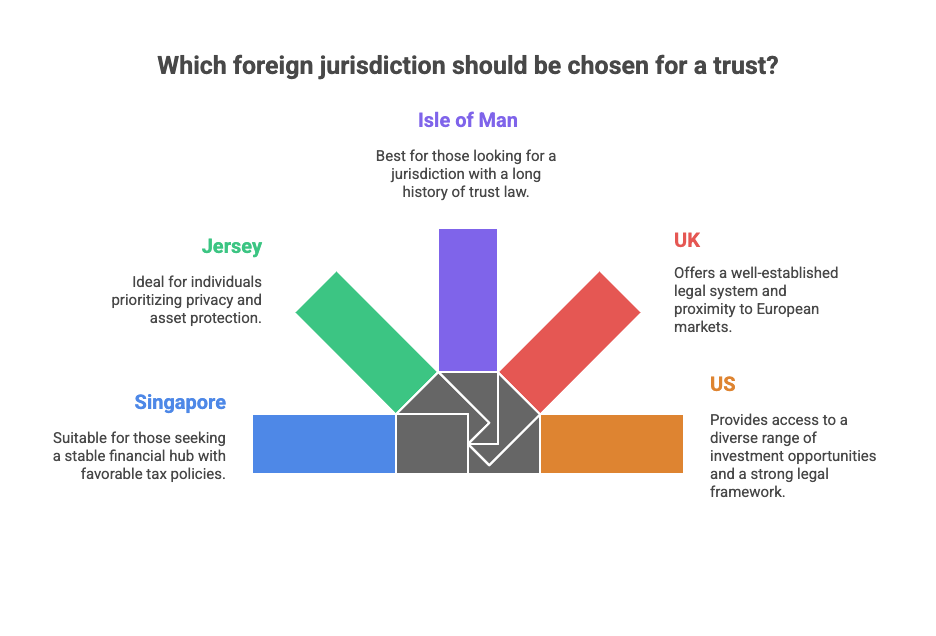
You can establish a trust in a trust-friendly jurisdiction and transfer non-Thai assets into it. Good options include Singapore, Jersey, the Isle of Man, the UK, or the US. Choose the place that fits your tax residence, asset types, and family goals while considering Thai tax implications.
Assets suitable for a foreign trust under Thai law can offer significant advantages.
- Bank accounts and investment portfolios held outside Thailand
- Real estate located abroad
- Shares in foreign companies and other business interests
- Intellectual property and royalties from outside Thailand
Benefits of a foreign trust paired with Thai tools
- Avoids multi-country probate and speeds up distributions
- Maintains continuity if the settlor becomes incapacitated
- Consolidates management of assets across borders for expats in Thailand.
Starting January 1, 2024, foreign income brought into Thailand will be taxed in the year it is sent, no matter when it was earned. This affects trust distributions remitted to Thailand by Thai tax residents. (Revenue Department Orders Por.161 and Por.162 (effective 1 January 2024) for remittances.). You should classify distributions by their type when you can. Track remittances and create a withholding and reporting plan. Do this before the first remittance in 2024 or later.
Inheritance tax has applied since 2015. Taxable amount is the portion over 100 million THB per heir. Rate is 10 percent, reduced to 5 percent for ascendants or descendants. Spouse is exempt. Filing is within 150 days. Do note that gifts from ascendants, descendants, or spouse are exempt up to 20 million THB per tax year, then taxed at 5 percent. Gifts from others on customary occasions are exempt up to 10 million THB per year, then 5 percent. Cite the Revenue Department language or a current tax booklet.
How ThaiLawOnline Can Help
At ThaiLawOnline, I help coordinate estate planning services. This ensures your foreign trust and Thai documents work well together.
Our support includes
- Jurisdiction analysis is important for expats to follow Thai tax and international laws. We help you choose the right trust jurisdiction and connect with foreign lawyers.
- International coordination: We work with trusted foreign lawyers and experts to set up the trust correctly.
- Thai legal documents for Thai assets:
- A tailored Thai will for assets in Thailand. See our page on Last Will and Testament in Thailand
- Usufruct agreements when appropriate for property use rights. See our deep analysis of usufruct agreement in Thailand.
- Prenuptial agreements when family planning is part of the goal. See our article about prenuptial agreement in Thailand.
- Company or property structures where needed can be essential for expats managing their assets. You can start with Property Lawyer in Bangkok.
We are not foreign lawyers. For the trust itself, we partner with qualified counsel in the chosen jurisdiction. This makes sure your trust deed follows local rules and coordinates with Thai documents.
Why Combine Foreign Trusts With Thai Estate Planning
Using a foreign trust for non-Thai assets and Thai tools for local assets gives full coverage.
- Complete jurisdiction fit: Each asset is managed under the correct law. This is important for expats to reduce inheritance tax.
- Fewer disputes: Clear documents reduce confusion for heirs.
- Tax awareness: Planning can lower overall taxes while staying compliant.
- Practical efficiency: Executors and trustees have clear roles and steps.
- Family security: Your plan supports loved ones across borders.
Real-life Examples
A person living in Bangkok owns a condo in Thailand, investment accounts in Singapore, and a house in the UK.
- A Singapore trust holds the non-Thai assets.
- A Thai will covers the condo and Thai bank accounts.
- Beneficiary designations match the overall plan.
- The team coordinates timing, tax reporting, and practical steps in each place.
If you live in Thailand and hold assets abroad, I can help you build a simple, lawful plan. Contact ThaiLawOnline to explore estate planning services tailored for expats in Thailand. Trusts in Thailand as a strategy using foreign trusts plus Thai estate tools. We will map your assets, choose a suitable jurisdiction, and prepare your Thai documents so everything works together.
Links: SEC in Thailand