


Reviewed by ThaiLawOnline, a licensed Thai law firm practising in Thailand since 2006. Thai lawyer of record: Wichuda Atthamethakon, LL.M., Thai Bar Licence 3149/2556.
Last updated on
Value Added Tax (VAT) is Thailand’s main tax on things people buy. It applies to most goods and services sold in the country. The Revenue Code sets the rate at 10% (section 80), and a Royal Decree has held it at 7% for most of the tax’s life: the rate went up to 10% in 1997 under Royal Decree No. 309, and came back down to 7% on 1 April 1999 under Royal Decree No. 353, where it has stayed since. VAT is an important part of Thailand’s tax system. It impacts both businesses and consumers. Royal Decree No. 807 B.E. 2569, published in the Royal Gazette on 23 August 2026 and in force from 1 October 2026, keeps the 7% rate to 30 September 2027. The decree itself fixes the Revenue Code rate at 6.3%; the local tax collected with it brings the rate charged to 7%.
Last reviewed: 3 September 2026. Revenue Code sections 80, 80/1, 81, 81/1, 81/3, 82, 82/3, 82/13, 82/14, 83, 83/6, 83/8, 84, 85, 85/1, 85/3, 85/4, 85/10, 85/17, 87/3, 89, 89/1, 90, 90/2 and 90/4 were read in Thai on the Revenue Department’s own text of the Code. Royal Decree No. 807 B.E. 2569 (the 7% rate to 30 September 2027), Royal Decree No. 353 B.E. 2542 (the return to 7% in 1999), Royal Decree No. 432 B.E. 2548 (the 1.8 million baht threshold), Ministry of Finance Announcement No. 8 of 18 March 2024 on internet filing and Ministry of Finance Announcement No. 68 of 13 November 2020 on VAT registration through the DBD were each read from the Gazette text. The local-tax component that takes the decree’s 6.3% to the 7% charged is stated as the Revenue Department states it and was not read from its own Act. The exemptions and zero-rated categories are summarised from sections 81 and 80/1; the detailed conditions in the Director-General’s notifications were not read. Processing times, document lists and the work-permit practice described below are practice, not statute, and were not verified against an instrument. Re-read on 4 October 2026: sections 81(1)(ฌ), 84 and 84/1 read in Thai on the Revenue Department’s text; the foreign-business row of the table, the refund mechanics and the exempt professions corrected, the work-permit note restated as office practice, and an unsourced 2028 e-invoicing mandate removed.
VAT is a company obligation; for the personal side see our guide to expat tax in Thailand.
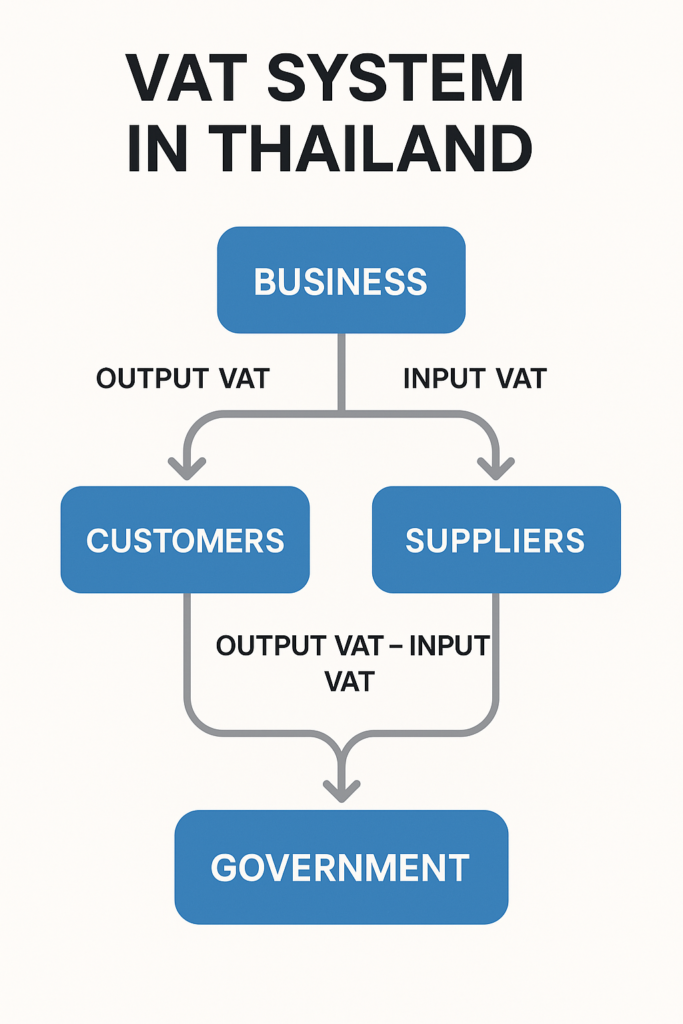
VAT Registration in Thailand works by allowing businesses to offset costs. They collect output VAT from customers when selling goods or services. They also pay input VAT on their business purchases. The difference between these amounts shows if a business owes VAT to the government or can get a refund.
Foreign businesses and expatriate entrepreneurs in Thailand need to understand VAT registration and compliance, especially regarding services rendered in Thailand. This knowledge is essential for staying legal and avoiding costly penalties. These penalties can greatly affect business profits.
Table of Contents
Mandatory VAT Registration in Thailand : Requirements
VAT Registration and Filing in Thailand, Quick Reference Table
| Requirement | Details |
|---|---|
| Standard VAT Rate | 7% (the Revenue Code rate is 10% under section 80; Royal Decree No. 807 keeps the reduced rate to 30 September 2027) |
| Mandatory Registration Threshold | Annual revenue over 1.8 million THB |
| Foreign Businesses | Register like any business if trading in Thailand above the threshold. A provider with no presence here registers only for electronic services sold to non-registered Thai customers above 1.8 million baht (section 82/13); for other cross-border services the Thai payer self-assesses on PP.36 (section 83/6) |
| Importers and Exporters | Importers pay VAT to Customs on entry whether registered or not (sections 82/14 and 83/8). Exporters below the threshold are exempt, not zero-rated, and usually register voluntarily under section 81/3 to reclaim input VAT |
| Voluntary Registration | Allowed below the threshold (section 81/3). Leaving again needs the Director-General’s order under section 85/10(3), after a minimum period the Code fixes at not less than two years, and only if turnover stayed below the threshold throughout |
| Required Form | VAT Registration: PP.01 (or PP.01.1 for voluntary); Monthly Filing: PP.30 |
| Filing Deadlines | Paper filing: 15th of following month; E-filing: 23rd of following month |
| Penalties | Late filing: a penalty of twice the VAT due for the month (section 89(2)), a surcharge of 1.5% a month on the unpaid tax capped at the tax itself (section 89/1), and a criminal fine of up to 2,000 baht (section 90) |
| Exemptions | Agriculture, education, healthcare, domestic transport, property rentals, charitable and religious services |
| Zero-Rated Transactions | Exports, services performed in Thailand and used abroad, international transport by aircraft or sea vessel, sales to the UN and embassies, and sales between bonded warehouses or free-zone operators (section 80/1) |
Annual Revenue Threshold
Any person or business doing taxable activities in Thailand must register for VAT. This is required when the value of their taxable sales and services exceeds 1.8 million baht a year, the small-business ceiling fixed by Royal Decree No. 432 B.E. 2548 under section 81/1 (a calendar year for individuals, the accounting period for companies). This threshold applies to both Thai and foreign businesses operating within the Kingdom. You must apply for registration within 30 days of the day the threshold is crossed (section 85/1(1)). This applies no matter when it happens during the tax year.
Foreign Business Requirements
Non-resident businesses fall into three groups. A foreign company that provides electronic services from abroad to customers in Thailand who are not VAT registrants must register and pay VAT on those sales once they exceed 1.8 million baht a year, with no input VAT credit, under section 82/13 as amended in 2021; it files and pays through the Revenue Department’s e-service system by the 23rd of the following month. Where the Thai customer is itself VAT registered, or the service is not electronic, the foreign provider does not register: the Thai payer self-assesses and remits the VAT on form PP.36 under section 83/6. A foreign business that comes into Thailand to sell goods or perform services only occasionally is not required to register either (section 85/3), although the Director-General can allow it to register temporarily.
Importing goods does not by itself require registration. The importer pays VAT to the Customs Department when the goods clear, whether registered or not (sections 82/14 and 83/8), so there is no threshold on the import side: the tax is collected at the border. Exporting is a sale taxed at 0% (section 80/1(1)), but an exporter whose turnover is under 1.8 million baht is exempt rather than zero-rated and cannot reclaim input VAT until it registers voluntarily under section 81/3. In practice most importers and exporters register from the start so that import VAT and other input VAT can be credited.
Work Permit Dependencies
In practice, Employment and Immigration offices usually ask for the company’s VAT registration certificate (PP.20) and recent PP.30 returns when a foreign employee’s work permit or visa extension is filed, even where turnover is below the 1.8 million baht threshold. That is one reason many small foreign-owned companies register voluntarily. It is office practice, not a rule in the Revenue Code, and offices differ on it.
Voluntary Registration Benefits
Businesses operating below the mandatory threshold may choose voluntary VAT registration to claim input VAT credits on business expenses. This option proves particularly advantageous for companies with significant startup costs, imported equipment, or substantial business-to-business transactions with VAT-registered suppliers.
However, voluntary registration requires careful consideration as deregistration proves difficult once established. A voluntary registrant can only leave the system by asking the Director-General to strike it off under section 85/10(3), which requires a continuous registration period set by ministerial regulation that the Code itself says may not be shorter than two years, with turnover below the 1.8 million baht threshold for the whole of that period. A business that was registered because it crossed the threshold can ask to leave only after three consecutive years below it (section 85/10(1)).
VAT Registration in Thailand : Process and Documentation
Required Documentation
The VAT registration process requires comprehensive documentation to establish business legitimacy and operational capacity. Essential documents include the completed VAT Registration Application Form (PP.01 or PP.01.1 for voluntary registration) in triplicate, signed by authorized company representatives.
Proof of business location is very important. You need lease agreements with the right stamp duty or letters from the owner for business use. House registration documents for the business premises, along with property ownership documentation from lessors, must accompany location proof.
You also need to provide detailed maps that show the exact location of your business. Include photographs of your business premises that show the company signage and the interior office space. Lastly, submit copies of your incorporation certificates along with your complete business objectives.
For foreign-owned companies, directors must provide passport copies, visa documentation, and work permit details with authorized signatures. Power of attorney documentation with stamp duty becomes necessary when representatives handle registration procedures.
Registration Procedures
Businesses in Bangkok apply at the Area Revenue Office for their district; businesses elsewhere apply at the Area Revenue Branch Office (section 85 and the Revenue Department’s own guidance). A company can also register for VAT at the same time as it incorporates: since 17 April 2020 the Ministry of Finance has appointed the DBD’s company registrar to accept VAT registration applications (Ministry of Finance Announcement on the Appointment of Officials No. 65, replaced by No. 68 of 13 November 2020).
Online registration has become increasingly available, though many businesses prefer working with qualified Thai accounting firms to ensure proper completion and submission. In our experience the paperwork takes a few days to prepare and file. The Revenue Department then issues the VAT registration certificate (PP.20), and the business is a registrant from the date stated on the certificate (section 85).
Upon approval, businesses must display their VAT registration certificate in an open, visible place at each establishment (section 85/4) alongside company registration documentation. Failure to display required certificates can result in compliance penalties during revenue inspections.
Monthly Filing Requirements
PP.30 Return Form
All businesses that are registered for VAT must file monthly VAT returns. They should use Form PP.30, even if they had no sales that month (section 83). This requirement applies universally, even businesses with zero sales must submit blank returns to maintain compliance.
The PP.30 form needs a clear report of output VAT collected from customers. It also requires input VAT paid on business purchases. Finally, it calculates the net VAT liability or refund amount. Businesses must maintain supporting documentation including original purchase invoices and copies of sales tax invoices for revenue department verification.
Monthly reporting periods follow calendar months, with returns due by the 15th of the following month (section 83). E-filed returns get eight extra days, to the 23rd, under the Ministry of Finance announcement on internet filing (No. 7 of 12 January 2024 as amended by No. 8 of 18 March 2024), which covers returns falling due between 1 February 2024 and 31 January 2027. For example, report January VAT activity by February 15th. If the 15th falls on a weekend or public holiday, a paper return filed on the next working day is accepted.
Electronic Filing Systems
Thailand has modernized VAT compliance through electronic filing systems that offer extended submission deadlines and improved convenience. Businesses that file electronically using the Revenue Department’s e-filing portal have a deadline. They must complete their returns by the 23rd of the following month.
The e-filing system supports document uploads, automatic calculations, and digital record-keeping that simplifies compliance management. Companies that handle many transactions can set up host-to-host connections for direct data transfer. This is especially helpful for businesses supervised by the Large Business Tax Administration Division.
The Revenue Department also runs an e-tax invoice system, which uses digital certificates and XML files that feed into the monthly VAT return. It is optional: no instrument we have read makes e-tax invoicing compulsory for VAT registrants generally.
Supporting Documentation Requirements
Proper tax invoices remain fundamental to VAT compliance and must include specific information elements. Valid tax invoices must show full company names and addresses for both parties. They should include VAT identification numbers, clear transaction descriptions, and stated VAT amounts.
Input VAT that is not claimed in the month of the invoice can be claimed in a later month within six months under the Director-General’s rules (the Code’s outer limit in section 82/3 is three years), so documentation timing matters. Companies must keep their VAT reports, tax invoices and supporting documents for at least five years from filing (section 87/3) to satisfy audit requirements and support refund claims.
Revenue authorities may request supporting documentation during filing or subsequent audits, making accurate record-keeping essential for sustainable operations. Digital record management systems increasingly support compliance while reducing physical storage requirements.
Penalties and Compliance Consequences
Late Filing Penalties
Thailand’s VAT penalty structure involves multiple penalty types that can accumulate rapidly for non-compliant businesses. Failing to file on time exposes the filer to a penalty of twice the VAT due (section 89(2)) and a surcharge of 1.5% a month on the unpaid VAT, capped at the amount of the tax (section 89/1).
More significant penalties apply to businesses with VAT liabilities. The penalty for a late return is 200% of the VAT for the month (section 89(2)); trading without registering at all costs 200% of the tax or 1,000 baht a month, whichever is more (section 89(1)). The 1.5% surcharge runs from the day after the filing deadline until payment; it is simple, not compound, and cannot exceed the tax itself (section 89/1).
A return that understates the tax carries a penalty of 100% of the shortfall (section 89(3) and (4)). Not filing at all is also a criminal offence carrying a fine of up to 2,000 baht (section 90); trading without registering when registration is required carries up to one month’s imprisonment or a fine of up to 5,000 baht, or both (section 90/2); and deliberate evasion by false entries, fake tax invoices or fraud carries three months to seven years’ imprisonment and a fine of 2,000 to 200,000 baht (section 90/4).
Administrative Consequences
Beyond financial penalties, VAT non-compliance creates operational challenges that can severely impact business activities. The Director-General can revoke the registration of a registrant that breaches the VAT rules, including by not filing, and must notify it in writing (section 85/17); the certificate must be returned within seven days, and trading on after revocation attracts the 200% penalty under section 89(1). The Code sets no fixed number of missed months.
Immigration and work permit authorities scrutinize VAT compliance records when reviewing visa extensions and work permit renewals. Poor VAT compliance history can result in application rejections or increased scrutiny that delays essential business processes.
Revenue authorities have the right to do compliance audits. These audits can disrupt business operations and take a lot of management time and resources. Maintaining current VAT compliance significantly reduces audit risk and associated operational disruptions.
VAT Exemptions and Zero-Rated Transactions
Exempt Transactions
Certain business activities remain completely exempt from VAT requirements, regardless of transaction values. Agricultural products sales, including unprocessed agricultural goods, animals, fertilizers, and animal feed, maintain VAT exemptions that support Thailand’s agricultural sector.
Educational services from government schools and approved private schools are exempt from VAT. This shows the unique nature of services in Thailand. Healthcare services from government hospitals and licensed clinics also qualify. Medical practice, auditing and court advocacy are exempt as independent professions (section 81(1)(ฌ)). The limb names court advocacy (การว่าความ), not legal services in general.
Transportation services, particularly domestic land transportation and international transportation by land, remain exempt along with immovable property rentals, religious services, and charitable activities. These exemptions recognize essential services that benefit Thai society broadly.
Zero-Rated Transactions
Zero-rated VAT applies to specific international transactions that support Thailand’s export economy. Goods and services sold outside Thailand can get zero-rated treatment. This lets exporters claim input VAT refunds. It helps them stay competitive in international markets.
International transportation services by air and sea receive zero-rated status, as do services provided to international carriers operating in Thailand. Free trade zone activities intended for export manufacturing also qualify for zero-rated treatment under specific documentation requirements.
To claim zero-rated status, businesses must keep detailed records. These records should show foreign sales or exports. They must include proof of payment from foreign sources, shipping documents, and customs clearance records. Revenue authorities closely check documents for zero-rated claims. This is especially true when a VAT registrant does not provide enough proof.
Input VAT Credits and Refunds
Credit Mechanism
Thailand’s VAT system allows businesses to offset input VAT paid on business purchases against output VAT collected from sales. This credit mechanism prevents double taxation and ensures VAT applies only to value-added at each business level.
Eligible input VAT includes buying raw materials, business equipment, professional services, and other goods used for business. However, certain expenses like entertainment costs remain excluded from input VAT credit eligibility.
Input VAT credits maintain six-month validity from the invoice date, requiring businesses to claim credits within this timeframe. Unused credits can be used in later months during the validity period. This gives businesses with uneven cash flows more flexibility.
Refund Procedures
When input VAT exceeds output VAT, businesses become entitled to VAT refunds that can significantly improve cash flow. Exporters and zero-rated suppliers have guaranteed rights to refunds. Their sales create little output VAT but keep a lot of input VAT from business purchases.
Under section 84 the registrant chooses, on the PP.30 for the month, either to claim the excess back as a refund or to carry it forward as a credit against later months. A refund not claimed with the return can still be claimed within three years (section 84/1). Electronic filing systems have streamlined refund processing and reduced processing times.
Businesses must maintain comprehensive documentation supporting refund claims, including original tax invoices, export documentation, and evidence of business use for input VAT items. Revenue authorities may audit refund claims, making accurate documentation essential for successful refund processing, especially when input tax exceeds expectations.
Recent Developments and Digital Transformation
E-Tax Invoice Systems
Thailand’s Revenue Department has introduced voluntary e-tax invoice systems that streamline VAT compliance while enhancing government oversight capabilities. Two systems meet different business needs. The E-Tax Invoice & e-Receipt system is for larger operations. The E-Tax Invoice by Email system is for smaller businesses.
These systems require electronic certificates, digital signatures, and XML format submissions that integrate with monthly VAT reporting requirements. Both systems are voluntary; we know of no enacted date from which they become compulsory.
Benefits include reduced document storage costs, faster processing times, and integration with accounting systems that improve accuracy and efficiency. However, implementation requires technical capabilities and certified service provider relationships that may challenge smaller operations.
Regulatory Updates
Recent regulatory changes reflect Thailand’s commitment to modernizing tax administration and closing compliance gaps. Foreign digital service providers now have stricter rules. They must submit and complete payments by the 23rd of each month.
Proposals to lower the 1.8 million baht threshold have been floated more than once, but none has been enacted: the figure in Royal Decree No. 432 has stood since 1 April 2005. A change would pull in many small businesses that do not have to register right now. These changes would significantly expand the VAT-registered business base while increasing compliance burdens on micro-enterprises.
Digital transformation initiatives increasingly emphasize electronic filing and digital record-keeping that support efficient tax administration. Businesses investing in digital compliance capabilities position themselves advantageously for future regulatory requirements while improving operational efficiency in managing output tax.
Best Practices for VAT Compliance
Internal Systems
Successful VAT compliance requires robust internal systems that support accurate record-keeping, timely filing, and effective communication with revenue authorities. Businesses should implement accounting systems capable of tracking VAT transactions separately and generating required reports efficiently.
Monthly compliance calendars help meet deadlines. They also reduce last-minute filing pressure, which can cause errors and penalties. Regular internal reviews of VAT processes identify improvement opportunities and compliance gaps before they become significant problems, particularly for services rendered in Thailand.
Staff training on VAT requirements and documentation standards ensures consistent compliance across all business activities. This training should cover invoice requirements, record-keeping standards, and penalty awareness that motivates careful attention to compliance details.
Professional Support
Many businesses struggle with Thai VAT rules. These rules are complex, and there are strict penalties for not following them. This is especially true if a VAT registrant does not meet reporting requirements. Because of this, most businesses need help from qualified professionals. Thai accounting firms specializing in VAT compliance can provide registration assistance, monthly filing services, and advisory support that ensures ongoing compliance.
Professional support proves particularly valuable for foreign-owned businesses navigating language barriers and unfamiliar regulatory requirements. Qualified accountants can communicate effectively with revenue authorities and provide guidance during audits or compliance challenges.
The cost of professional support is usually a small part of possible penalties. It also offers peace of mind and helps businesses grow and make money.
Strategic Considerations
VAT registration and compliance should align with broader business strategies rather than representing mere regulatory obligations, especially for companies subject to VAT. Voluntary registration may support business expansion plans, supplier relationships, or competitive positioning in VAT-sensitive markets.
Cash flow management is very important for VAT-registered businesses. This is especially true for those who get regular refunds and those whose input tax is higher than their output tax. Strategic timing of major purchases and sales can optimize VAT positions and improve working capital management.
Long-term business planning should consider VAT implications of expansion activities, new product lines, or market entry strategies. Early consultation with qualified advisors ensures VAT considerations support rather than hinder business objectives.
FAQs about VAT Registration in Thailand
What is the current VAT rate in Thailand and who has to pay it?
Thailand’s Value Added Tax (VAT) is 7%: the Revenue Code rate is 10% (section 80) and Royal Decree No. 807 keeps it reduced to 7% until 30 September 2027. It applies to most goods and services sold or used in Thailand, affecting both businesses and consumers. Businesses collect output VAT from sales. They can offset this with input VAT paid on purchases. The difference shows if VAT is payable or refundable.
When is VAT registration mandatory in Thailand (thresholds and timing)?
You must register if your taxable revenue is more than 1.8 million THB in a year (Royal Decree No. 432 under section 81/1). You must register within 30 days of reaching the threshold. Importers pay VAT at Customs whether registered or not, so importing alone does not force registration. You can choose to register voluntarily below the threshold (section 81/3), but leaving again needs the Director-General’s approval after a minimum period of at least two years below the threshold (section 85/10(3)).
How do foreign companies and expat entrepreneurs handle VAT in Thailand?
A foreign-owned Thai company registers like any other once its turnover passes 1.8 million baht. A foreign company with no presence here registers only if it supplies electronic services to non-VAT-registered customers in Thailand above that threshold (section 82/13); for other cross-border services the Thai payer self-assesses the VAT on form PP.36 (section 83/6). Import VAT is paid to Customs on entry whether or not the importer is registered (section 83/8). Maintaining VAT registration can be necessary for work permit and visa processes, so compliance directly supports immigration renewals.
What are the monthly VAT filing rules (PP.30), deadlines, and penalties?
All VAT registrants file Form PP.30 every month, even with no sales (file a nil return). Paper filing is due by the 15th of the following month; e-filing extends the deadline to the 23rd. Keep sales tax invoices, purchase invoices, and records for five years. Failing to file on time exposes the filer to a penalty of twice the VAT due (section 89(2)) and a surcharge of 1.5% a month on the unpaid VAT, capped at the amount of the tax (section 89/1).
What transactions are VAT-exempt or zero-rated, and how do refunds work?
Exempt: Agriculture, education, healthcare, domestic land transport, property rentals, and religious and charitable services do not have VAT. Input VAT cannot be credited.
Zero-rated (0%): This includes exports, international air and sea transport, free-trade zones, and services for international carriers. No VAT is charged, but input VAT can be credited or refunded. Input VAT credits generally have six-month validity from invoice date. If the input VAT is more than the output VAT, you can claim a refund using PP.30. Include supporting documents like tax invoices and shipping or customs proof. You choose on the return between a refund and a credit carried forward to later months (section 84).
VAT registration and monthly filing requirements represent fundamental obligations for most businesses operating in Thailand. These requirements are complex, but they help organize Thailand’s tax system. This system funds important government services and supports a competitive business environment. Success requires careful attention to registration requirements, accurate monthly filing, comprehensive record-keeping, and strategic professional support that ensures compliance while supporting business objectives.
Links:
Whether and when you must register for VAT follows from how the business is set up, which is covered in our guide to registering a company in Thailand and our business law overview.
Thai Law Updates, free by email
Plain-English updates on Thai law changes that affect foreigners: property, visas, marriage, business and wills. One short email a month from a firm practicing since 2006. No spam, unsubscribe anytime.