


Last updated on
If you are living in Thailand and concerned about a U.S. warrant, federal indictment, or Interpol Red Notice, one question matters immediately: Does Thailand have an extradition treaty with the United States?
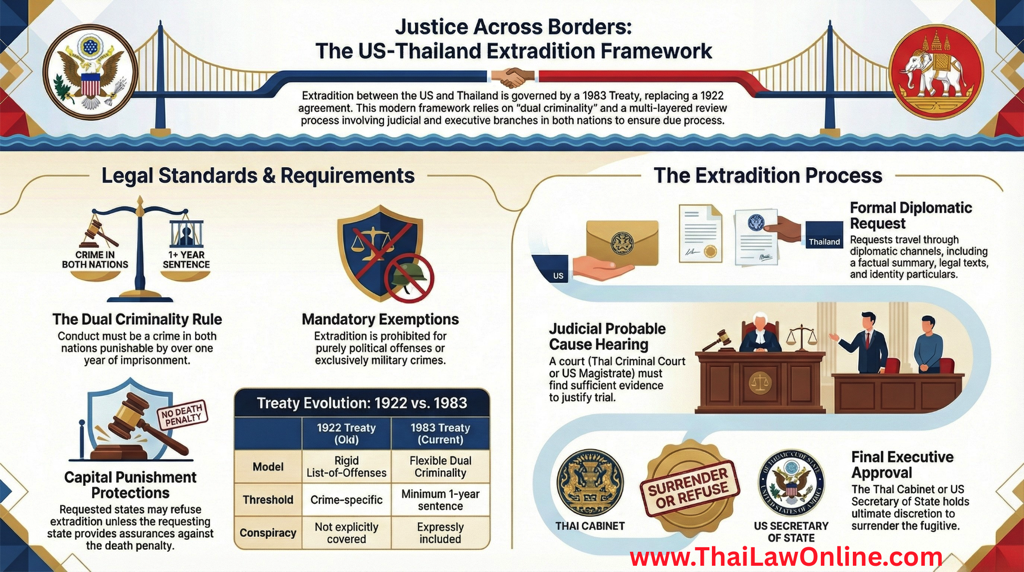
Yes. Thailand and the United States have a binding extradition treaty, signed on December 14, 1983, and in force since May 17, 1991. It replaced the earlier treaty of 1922 and remains the only extradition treaty between the two countries; no supplementary or amending extradition treaty has been concluded since. Extradition requests are processed under Thailand’s Extradition Act B.E. 2551 (2008). It must be reviewed by the Thai Criminal Court before surrender is authorized.
Extradition is not automatic. It is a judicial process with constitutional protections, and it can be challenged. But time is critical: once arrested on an extradition warrant, your options narrow significantly.
If you are facing criminal exposure with a U.S. dimension, review our Criminal Defense Services in Thailand. We regularly assist clients in cases involving theft and property offenses, defamation charges, drug allegations, financial crimes, and cross-border investigations.
Table of Contents
Legal Basis of the U.S., Thailand Extradition Treaty
The extradition relationship between the United States and the Kingdom of Thailand rests on three legal instruments:
- Treaty Relating to Extradition Between the United States and Thailand (1983), the primary bilateral agreement, ratified by both governments.
- Treaty on Mutual Assistance in Criminal Matters (1986), signed at Bangkok on 19 March 1986 and in force since 10 June 1993, which is how evidence is exchanged between the two countries. It is not itself an extradition instrument, but an extradition request is normally built on evidence obtained under it.
- Thai Extradition Act B.E. 2551 (2008), Thailand’s domestic legislation governing how all extradition requests are processed, regardless of the requesting country.
Under the treaty, extradition applies to criminal offenses punishable in both countries by imprisonment for a period of more than one year, or by any greater punishment. This is Article 2(1) of the 1983 treaty, and it is the principle of dual criminality, the core legal test that determines whether an extradition request can proceed. Thailand’s own Extradition Act B.E. 2551 sets a slightly wider domestic threshold in section 7, of imprisonment of one year or more, so an offence carrying exactly one year can satisfy the Act while falling outside the treaty.
Thailand also maintains extradition treaties with over 15 other countries, including the United Kingdom, Australia, Canada, China, and several ASEAN nations. For a full overview of Thailand’s criminal law framework, see our guide to criminal cases in Thailand.
What Crimes Are Extraditable Between Thailand and the U.S.?
The Principle of Dual Criminality
For extradition to proceed, the alleged conduct must constitute a criminal offense in both Thailand and the United States. The Thai Criminal Court examines the substance of the act, not merely the title or classification of the offense.
This means a U.S. charge must have a corresponding offense under Thai law. If no Thai equivalent exists, extradition cannot be ordered, regardless of the severity of the U.S. charge.
Commonly Extraditable Offenses
| Offense Category | U.S. Law | Thai Law | Notes |
|---|---|---|---|
| Drug Trafficking | 21 U.S.C. § 841 | Narcotics Code B.E. 2564 | Thailand-U.S. cooperation is very active in drug cases |
| Wire Fraud / Financial Crimes | 18 U.S.C. § 1343 | Criminal Code Sec. 341-344 (fraud/cheating) | Includes bank fraud, securities fraud |
| Tax Fraud (criminal) | 26 U.S.C. § 7201 | Revenue Code, Sec. 37 | Must be criminal fraud, not mere non-payment |
| Cybercrime | 18 U.S.C. § 1030 | Computer Crime Act B.E. 2550, as amended by the Act (No. 2) B.E. 2560 | Growing area of bilateral cooperation |
| Child Exploitation | 18 U.S.C. § 2251 | Criminal Code Sec. 277-287 | High-priority enforcement between both countries |
| Human Trafficking | 18 U.S.C. § 1589 | Anti-Trafficking Act B.E. 2551 | Active bilateral enforcement |
| Money Laundering | 18 U.S.C. § 1956 | Anti-Money Laundering Act B.E. 2542 | AMLO cooperation with FinCEN |
| Serious Violent Felonies | Various | Criminal Code (assault, homicide) | Must meet 1-year minimum threshold |
What Does NOT Qualify for Extradition
Civil disputes, unpaid private debts, contractual disagreements, and ordinary tax non-payment do not qualify for extradition. The treaty applies exclusively to criminal offenses.
However, be aware that cases beginning as domestic matters, such as theft or misappropriation or criminal defamation proceedings, can acquire an international dimension if parallel charges exist in the United States and dual criminality is satisfied.
Does Thailand Extradite Its Own Citizens?
Thailand generally does not extradite Thai nationals, but this is a statutory rule with defined exceptions rather than a blanket bar. Under section 12 of the Extradition Act B.E. 2551, a Thai national may be extradited in three cases: where an extradition treaty between Thailand and the requesting country so provides, where the person consents to be extradited, or where it is done under reciprocity arrangements between Thailand and the requesting country. The United States treaty is such a treaty: Article 8(1) provides that neither country is bound to extradite its own nationals, and that where Thailand is the requested state the competent authority may extradite them if not prevented from doing so.
However, this protection is not absolute:
- If extradition of a Thai citizen is refused, the requested state must, at the request of the other country, submit the case to its own prosecutors. That duty is in Article 8(2) of the treaty itself, not only in the Extradition Act.
- Foreign nationals residing in Thailand, including U.S. citizens, Canadians, Europeans, and other expats, remain fully subject to extradition if treaty conditions are satisfied.
- Dual Thai-U.S. citizens occupy a legally complex position that requires case-specific analysis.
How the Extradition Process Works in Thailand, Step by Step
Extradition is both a judicial and diplomatic process. Below is how it unfolds in practice, from initial arrest through final surrender.
Step 1, Provisional Arrest
The United States requests provisional arrest through diplomatic channels (U.S. Embassy Bangkok → Thai Ministry of Foreign Affairs) or via Interpol Red Notice. The Royal Thai Police execute the arrest, which can occur at a residence, hotel, office, or airport.
The police must hand the arrested person to the public prosecutor without delay, so that a court can order detention while the formal request is awaited (section 16 of the Extradition Act). Where the Act is silent the Criminal Procedure Code applies (section 18), and under its section 87 an arrested person must be brought before a court within 48 hours. If the court has not received the extradition petition within 60 days of the arrest, or within a longer period it sets of no more than 90 days, the person must be released (section 16), and the United States cannot then seek a second provisional arrest on the same grounds, although it can still make a formal request.
Step 2, Formal Extradition Request
Within the treaty deadline (typically 60 days from provisional arrest), the United States must submit a complete extradition package through the U.S. Embassy to the Thai Ministry of Foreign Affairs. This package includes:
- The charging document or indictment
- Evidence summary supporting probable cause
- Identity verification (fingerprints, photographs)
- Certified copies of applicable U.S. statutes
- Treaty certification
If the formal request is not submitted within the deadline, the provisionally arrested person must be released, though this does not prevent a future request.
Step 3, Review by the Thai Attorney General
The Office of the Attorney General (OAG) reviews the request for legal sufficiency. If the OAG determines the requirements are met, it files the case with the Thai Criminal Court. The OAG can also reject insufficient requests.
Step 4, Criminal Court Hearing
This is the core judicial phase. The Thai Criminal Court does not determine guilt or innocence. It examines whether legal prerequisites for extradition are satisfied:
- Dual criminality, is the conduct criminal in both countries?
- Sufficiency of evidence, does the evidence meet extradition standards (lower than trial standard)?
- Treaty compliance, does the request conform to treaty requirements?
- Statute of limitations, has the limitation period expired under either country’s law?
- Political offense exception, is the charge political in nature?
- Specialty principle, will the requesting country limit prosecution to the extradited charges?
The defendant has the right to legal representation, to present evidence, and to challenge the request on any of these grounds.
If the court finds the requirements satisfied, it orders extradition. If not, the request is denied.
Step 5, Appeal
Either the public prosecutor or the person sought may appeal the first instance order to the Court of Appeal within 30 days of the day the order is read, under section 21 of the Extradition Act B.E. 2551. The judgment of the Court of Appeal is final. There is no further appeal to the Supreme Court (Dika Court) in extradition proceedings, and the Court of Appeal rules only on the grounds listed in section 19, namely whether the first instance court had sufficient evidence for its order. An appeal can still add many months to the timeline.
This appeal is a statutory right under the Extradition Act, not a matter of diplomatic discretion, but it is confined to the section 19 grounds and to the 30 day limit.
Step 6, Executive Decision (Cabinet Approval)
Even after court approval, the Thai Cabinet retains final discretion. The executive branch can refuse surrender on humanitarian or political grounds, though this is rare in U.S. cases.
Only after Cabinet approval is the individual physically surrendered to U.S. Marshals or designated U.S. authorities. Under section 22 of the Extradition Act, once the court order is final and the Thai government has decided to surrender, the handover must be completed within 90 days of the final order, unless the court extends that period on the public prosecutor’s application. Under section 23, if the requesting country fails without good reason to take custody in time, a later request for the same offence must be refused.
Notable Extradition Cases Involving Thailand
Understanding how Thailand’s courts have handled real extradition cases helps illustrate the principles above. These cases demonstrate that extradition from Thailand is not merely theoretical, it is actively enforced, but also contested through the courts.
Viktor Bout, The “Merchant of Death” (2008-2010)
Viktor Bout, a Russian arms dealer, was arrested in Bangkok in 2008 during a sting operation led by U.S. DEA agents. His case became a landmark in Thai extradition law and drew intense international attention.
The Bangkok Criminal Court initially denied extradition in August 2009, ruling that the underlying charges (conspiracy to sell arms to the Colombian FARC) were political in nature, triggering the political offense exception under the treaty.
However, the Thai Court of Appeal reversed the decision on August 20, 2010, ruling that the charges were criminal, not political, in nature. The Court of Appeal held that conspiracy to sell weapons and support terrorism satisfied dual criminality requirements. Following Cabinet approval, Bout was surrendered to U.S. Marshals on November 16, 2010. He was subsequently convicted in a Manhattan federal court and sentenced to 25 years’ imprisonment.
Key legal takeaway: The political offense exception is available as a defense, but Thai appellate courts apply a narrow interpretation. Charges involving violence, arms trafficking, or terrorism are unlikely to qualify as “political” offenses.
Rakesh Saxena, The Longest Extradition Battle (1996-2009)
Rakesh Saxena, a financial advisor accused of embezzlement from the Bangkok Bank of Commerce during Thailand’s 1997 financial crisis, fought extradition for 13 years from Canada. He was eventually extradited to Thailand in October 2009 and convicted in 2012 by the Bangkok South Criminal Court on five counts of securities fraud, receiving a 10-year sentence.
Key legal takeaway: Thailand does not only surrender individuals, it also requests extradition from other countries. Extradition proceedings can extend over many years through multiple levels of appeal.
Recent U.S., Thailand Cooperation (2024-2025)
The U.S. Department of Justice confirmed in 2025 that Thailand remains an active partner in extradition. Recent cases include the extradition of alleged transnational drug trafficking leader Tien Vy Tai Truong on methamphetamine export conspiracy charges. In November 2025, Russian national Denis Obrezko was arrested in Phuket in a joint FBI-Thai police operation on cybercrime charges connected to the Void Blizzard hacking group, with extradition proceedings to the U.S. underway.
Key legal takeaway: Thailand-U.S. extradition cooperation is increasing, particularly in drug trafficking, cybercrime, and financial fraud cases. The DEA, FBI, and Homeland Security Investigations all maintain a permanent presence in Bangkok.
Practical Timeline, How Long Does Extradition Take?
| Scenario | Estimated Timeline | Notes |
|---|---|---|
| Uncontested (waived appeal) | 3-6 months | Rare, most defendants contest |
| Standard contested case | 6-18 months | One round of appeals |
| Fully contested, through the Court of Appeal | 1-3 years | The Court of Appeal is final (section 21); the rest is evidence and government steps (e.g., Viktor Bout: over two years) |
| Provisional arrest → release (no formal request) | Up to 60 days | If U.S. fails to submit formal package |
Detention during proceedings is the norm. Most extradition detainees are held in Bangkok Remand Prison (Bangkok Special Prison) or other central detention facilities. For more details, see our guide on bail in Thailand.
Bail in extradition cases is legally possible but rarely granted. Thai courts typically consider extradition defendants to present a high flight risk.
Immigration Consequences During Extradition Proceedings
If arrested on an international warrant in Thailand, expect the following immigration consequences:
- Visa cancellation, your visa or extension of stay is likely to be revoked.
- Deportation proceedings, if extradition is ultimately denied, you may face separate deportation proceedings under the Immigration Act.
- Blacklisting, depending on the outcome, you may be placed on Thailand’s immigration blacklist, preventing future entry.
For a detailed explanation of these processes, see our guide on deportation and blacklisting in Thailand.
How Thailand Compares to Other Countries on Extradition
Many people ask: can you be extradited from Thailand? The answer is yes, and Thailand is more cooperative with the United States than many assume.
| Country | Treaty with U.S.? | Extradites Own Citizens? | Cooperation Level |
|---|---|---|---|
| Thailand | Yes (1983, in force 1991) | No (generally) | Active, especially drug, fraud, cybercrime |
| Cambodia | No formal treaty | N/A | Limited, case-by-case |
| Vietnam | No formal treaty | N/A | Limited cooperation |
| UAE | Yes (2022) | Varies | Increasing cooperation |
| Philippines | Yes (1994) | Yes | Active cooperation |
| Indonesia | No formal treaty | N/A | Case-by-case |
| Laos | No formal treaty | N/A | Minimal |
| Malaysia | Yes (1995) | No (generally) | Moderate |
Thailand is not a non-extradition country. It maintains active law enforcement cooperation with the United States, particularly through the DEA Bangkok office, FBI legal attaché, and Homeland Security Investigations (HSI) presence in Bangkok.
Frequently Asked Questions, Extradition Between Thailand and the U.S.
Can I fight extradition in Thailand?
Yes. You have the constitutional right to legal counsel and may challenge the extradition request on multiple grounds: political offense exception, lack of dual criminality, insufficient evidence, expired statute of limitations, specialty principle violations, or humanitarian considerations. As the Viktor Bout case demonstrated, a lower court denial can succeed, though higher courts may overturn. Engaging experienced legal counsel early significantly improves outcomes.
Will Thailand extradite me for unpaid taxes?
Ordinary unpaid taxes and civil tax disputes do not qualify for extradition. However, criminal tax fraud involving substantial amounts and willful evasion can satisfy dual criminality requirements under both U.S. tax law (26 U.S.C. § 7201) and Thailand’s Revenue Code. The distinction between civil tax liability and criminal tax fraud is critical.
What happens if there is an Interpol Red Notice against me?
An Interpol Red Notice is not an arrest warrant and not a conviction. It is a request to law enforcement worldwide to locate and provisionally arrest a person pending extradition. However, Thai police do act on Red Notices, and an alert in the Interpol system can trigger arrest at airports, border crossings, or during routine police checks. Legal strategy depends on the underlying charge and the issuing country’s procedural posture.
Can I leave Thailand if I suspect there is a warrant?
Attempting to depart Thailand while subject to an outstanding international warrant is extremely risky. Thai border controls at Suvarnabhumi, Don Mueang, and all land crossings are integrated with Interpol’s I-24/7 system and immigration alert databases. Departure can trigger immediate arrest at the border.
Is extradition automatic between Thailand and the U.S.?
No. Extradition requires: (1) a formal diplomatic request, (2) review by the Attorney General, (3) approval by the Thai Criminal Court, and (4) final executive authorization by the Thai Cabinet. At each stage, the request can be challenged or refused. The Viktor Bout case took over two years from arrest to physical surrender.
Does Thailand have an extradition treaty with the U.S.?
Yes. The Treaty Relating to Extradition between the United States of America and the Kingdom of Thailand was signed on December 14, 1983, entered into force on May 17, 1991, and remains the only extradition treaty between the two countries. It is a fully binding bilateral agreement.
What should I do if I think I may face extradition?
Contact an experienced Thai criminal defense lawyer immediately, before arrest if possible. Early legal intervention allows for strategic planning, evidence review, and potentially negotiating with authorities. Waiting until after arrest severely limits available options. Our firm has handled cross-border criminal matters for 20 years.
Why ThaiLawOnline, 20 Years of Criminal Defense Experience
Extradition cases are among the most complex matters in Thai criminal law. They sit at the intersection of international treaty law, Thai domestic criminal procedure, and diplomatic relations. Few Thai law firms have the depth of experience required.
ThaiLawOnline brings:
- 20+ years of Thai legal practice with deep criminal defense experience
- Fluent English-Thai legal communication, we bridge the gap between common law and Thai civil law systems
- Experience with U.S.-Thailand cross-border matters including extradition, Interpol alerts, and multi-jurisdictional investigations
- Established working relationships with the Thai Attorney General’s office, Criminal Court, and relevant law enforcement agencies
- Modern legal technology for secure, confidential communication
Do not wait until arrest. If you are an expat in Thailand with concerns about U.S. criminal exposure, whether from an existing indictment, a grand jury investigation, or an Interpol alert, early legal consultation is your most important step.
Links : Treaty of Extradition between Thailand and the USA (1983)
Last reviewed: 6 September 2026. The 1983 Treaty Relating to Extradition was read in full from the United States Treaties and Other International Acts Series text, TIAS 91-517, the document linked above: Article 2(1) for the more than one year threshold, Article 8 for nationals, Article 10 for the 60 day provisional arrest limit, and Article 20(3), under which this treaty replaced the treaty of 1922. The Thai Extradition Act B.E. 2551 was read in Thai in full: section 7 for the domestic threshold, section 12 for when a Thai national may be extradited, section 19 for the grounds the court decides, and section 21, under which an appeal goes to the Court of Appeal within 30 days and the judgment of that court is final. The list of instruments in force between the two countries was checked against the United States Department of State list of Treaties in Force as at 1 January 2025. On 4 October 2026 sections 21 to 23 were re-read in Thai: the timeline table’s ‘Supreme Court appeal’ row was corrected to the Court of Appeal, the 90-day surrender period of section 22 was added, and a FAQ’s ‘flight from justice’ offence, which Thai law does not contain, was removed. Not verified: the accounts of the Viktor Bout and Rakesh Saxena cases and of recent bilateral cooperation, the statement that Thailand has extradition treaties with more than 15 other countries, the 48 hour period for a first court appearance, the estimated timelines, and the entries for other countries in the comparison table. Those are matters of reported fact or of current practice rather than of the treaty or the Act, and they were not checked against a primary source. Re-checked on 10 October 2026: Extradition Act B.E. 2551 sections 15, 16 and 18 read in Thai on the government’s central law register, with Criminal Procedure Code section 87; the 48 hour period is the Code’s general limit, which the Act applies, and the provisional arrest paragraph now gives section 16’s 60-day release rule and the court’s power to extend it to 90 days. The case accounts, the treaty count, the estimated timelines and the comparison table remain unverified.
Thai Law Updates, free by email
Plain-English updates on Thai law changes that affect foreigners: property, visas, marriage, business and wills. One short email a month from a firm practicing since 2006. No spam, unsubscribe anytime.