


Reviewed by Wichuda Atthamethakon, LL.M., Thai Bar Licence 3149/2556, for ThaiLawOnline, a Thai law firm acting for foreigners since 2006.
Update log
- 2 November 2026: Added the statute box with Thai, English and French text and checked the page against the official text
The laws about drug testing in Thailand have changed a lot in recent years. This has created a complex legal system that every expatriate needs to understand. The country’s drug enforcement uses strict penalties and strong police powers. It is important for foreigners to know their rights and duties under Thai law. So here’s our guide about mandatory drug testing laws in Thailand and what you should know. If you need more information about criminal law in Thailand, look at this page here.
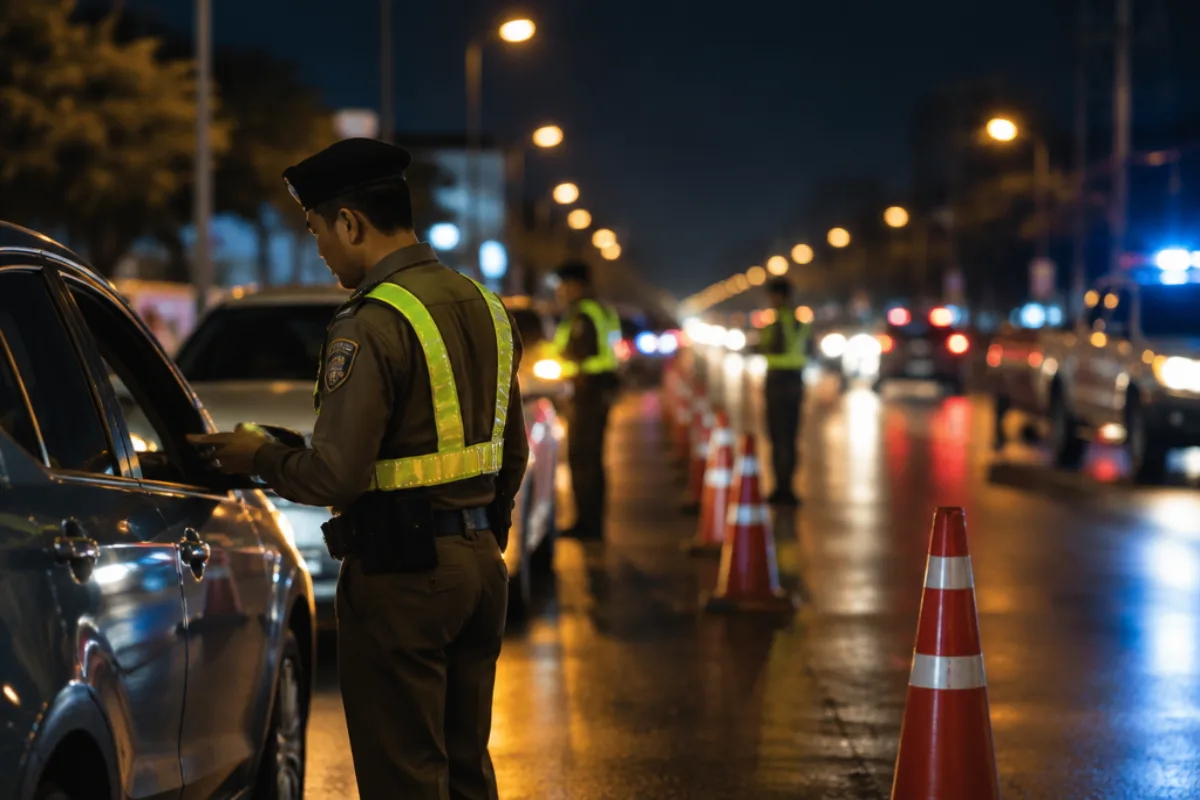
Table of Contents
Legal Framework and Authority
Thailand’s drug control system follows the Narcotics Code B.E. 2564 (2021). Section 4 of the Act Promulgating the Narcotics Code repealed 24 instruments and put the Code in their place: the Narcotics Act B.E. 2522 and its seven amendments, the four Prevention and Suppression of Narcotics Acts, the Psychotropic Substances Act B.E. 2559, the Narcotic Addict Rehabilitation Act B.E. 2545, the volatile-substances and suppression-of-offenders legislation, and four National Council for Peace and Order instruments. The Code took effect on 9 December 2021. It created new categories for controlled substances and updated enforcement procedures.
The testing power is section 115 of the Narcotics Code. It lets ONCB officers, administrative officials and police search a person whose conduct gives reasonable grounds to suspect drug use, and test a person for drugs in the body, or order them to be tested, where there is a need to and reasonable grounds to believe the person has used drugs in a dwelling, any place or a vehicle. They do not need to find drugs or see anyone using them. A person who tests positive may be held for up to 24 hours from the test while the officer arranges treatment. Section 58/1, which most English guides still cite, belonged to the Narcotics Act B.E. 2522, which the Code repealed.
The idea of “reasonable suspicion” in Thai law is widely understood. It can involve being in areas where drugs are common, increasing the risk of illicit drug encounters. It can also mean looking drunk or being reported by anonymous sources. This may lead to more questions about drug use in Thailand. The National Human Rights Commission of Thailand has stressed that officers need real reasons for suspicion. They cannot act only on anonymous complaints without further investigation.
You should know that it is not rare that the police goes to some clubs and raid them as they are opened after hours, do not have proper licenses, because minors are involved or drugs are suspected to be there. For instance, here’s a police raid in Bangkok in August 2025.
The law behind this page
English
Section 115 Narcotics Code B.E. 2564
Full text
For the purpose of treating narcotic addicts, a Narcotics Control official, an administrative official or a police officer shall have the following duties and powers: (1) to inspect or search a person whose conduct gives reasonable suspicion of consuming a narcotic; (2) to seize a narcotic from a person possessing it; (3) to examine or test, or order to undergo an examination or test for, a narcotic substance in the body of a person, when there is necessity together with reasonable grounds to believe that the person consumed a narcotic in a dwelling, any place or a vehicle; (4) to question and check in order to learn the name, occupation, address, history, income and other conduct of a person under (1), (2) or (3); (5) to ask about willingness and have the person sign as willing or unwilling to undergo treatment; (6) for the purpose of carrying out (1), (2), (3), (4) and (5), and of sending the person to a narcotics treatment facility, to keep that person under temporary care, but not exceeding 24 hours from the time of the examination or test showing that the person has a narcotic substance in the body; (7) to record the circumstances of the acts carried out under (1), (2), (3), (4), (5) and (6), and send the record to the inquiry official to be kept as evidence in case proceedings are to be brought against that person. The rules, procedures and conditions for carrying out paragraph one shall be as prescribed by the Minister of Justice in a ministerial regulation. The positions or levels of Narcotics Control officials, administrative officials or police officers who have the duties and powers prescribed in paragraph one shall be as prescribed by the Minister of Justice in a ministerial regulation.
ThaiLawOnline translation
Section 176 Narcotics Code B.E. 2564
Full text
A person who does not give a statement, or does not deliver accounts, documents or any object, or refuses to allow an examination or test of whether any person has a narcotic in the body, in the performance of duties by the Secretary-General of the Narcotics Control Board, a Deputy Secretary-General of the Narcotics Control Board or a Narcotics Control official in an investigation, an inquiry or an examination of assets under the law on narcotics case procedure, shall be liable to imprisonment for a term not exceeding 1 year, or a fine not exceeding 20,000 baht, or both.
ThaiLawOnline translation
Section 142 Land Traffic Act B.E. 2522
Full text
A chief traffic officer or a traffic officer has the power to order a driver to stop the vehicle when: (1) the condition of the vehicle does not comply with section 6; (2) the officer considers that the driver or any person in the vehicle has violated or failed to comply with this Act or the law relating to that vehicle. Where there are circumstances giving reason to believe that a driver has violated section 43 (1) or (2), the chief traffic officer, inquiry official or traffic officer shall order a test of the driver to determine whether the driver is impaired in the ability to drive or drunk from liquor or another intoxicant. Where the driver under paragraph two refuses to be tested, the chief traffic officer, inquiry official or traffic officer has the power to detain the person to carry out the test, for such period as is necessary in the circumstances so that the test is completed promptly. If the person submits to the test and the result shows no violation of section 43 (1) or (2), the person shall be released immediately. Where there are circumstances giving reason to believe that a driver drove while drunk from liquor or another intoxicant, and the person still refuses, without reasonable cause, to be tested under paragraph three, the person shall be presumed to have violated section 43 (2). The test under paragraph two shall follow the rules and procedures prescribed in a ministerial regulation. Where an accident occurs and there is reason to believe that the driver, or a person who may have been the driver, has violated section 43 (2), and that person is unconscious or physically injured so as to be unable to consent to a test for substances in the body under paragraph two, section 43 bis/1 shall apply mutatis mutandis.
ThaiLawOnline translation
Section 162 Narcotics Code B.E. 2564
Full text
Any person who consumes a Category 1, Category 2 or Category 5 narcotic, or a Schedule 1 or Schedule 2 psychotropic substance, not being a case under section 113 or section 114, in violation of section 104, shall be punished by imprisonment not exceeding 1 year, or a fine not exceeding 20,000 baht, or both.
ThaiLawOnline translation
Section 114 Narcotics Code B.E. 2564
Full text
Where a Narcotics Control official, an administrative official or a police officer finds a person whose conduct gives reasonable suspicion of having committed the offence of consuming a narcotic under section 162 or section 163, or of possessing a narcotic for consumption under section 164, if it does not appear that the person is an accused or is being prosecuted for another offence punishable by imprisonment, or is serving a sentence of imprisonment under a court judgment, and the person does not have behaviour that may cause danger to others or society, or has behaviour that may cause danger to others or society that results from a mental and neurological disease or from symptoms caused by the effect of the narcotic used, and the person volunteers for treatment, the Narcotics Control official, administrative official or police officer shall send that person to a narcotics treatment facility or a screening centre. When a person who volunteers for treatment under paragraph one undergoes treatment and fully complies with the rules, procedures and conditions prescribed by the Committee on the Treatment and Rehabilitation of Drug Addicts by notification in the Government Gazette, until certified in writing as having satisfactorily completed treatment by the head of the narcotics treatment facility or narcotic addict rehabilitation facility, that person shall not be guilty under those sections. If a person undergoing treatment under paragraph one escapes or fails to cooperate in treatment until complete in accordance with the rules, procedures and conditions prescribed by the Committee on the Treatment and Rehabilitation of Drug Addicts by notification in the Government Gazette, the narcotics treatment facility or narcotic addict rehabilitation facility shall prepare a record of the history, information and conduct of the person who escaped or failed to cooperate, for use in considering admission to treatment under paragraph one.
ThaiLawOnline translation
Section 107 Narcotics Code B.E. 2564
Full text
No person shall have in possession a narcotic of Category 1, Category 2 or Category 5, or a psychotropic substance of Category 1 or Category 2, for consumption. Possession of a narcotic of Category 1, Category 2 or Category 5, or a psychotropic substance of Category 1 or Category 2, in a small quantity not exceeding the quantity prescribed by the Minister of Public Health in a ministerial regulation, is presumed to be possession for consumption.
ThaiLawOnline translation
Section 145 Narcotics Code B.E. 2564
Full text
A person who produces, imports, exports, disposes of or has in possession a narcotic of Category 1 in contravention of section 90 shall be liable to imprisonment for a term not exceeding 15 years and a fine not exceeding 1,500,000 baht. If the commission of the offence under paragraph one is any of the following acts, the offender shall be liable to imprisonment for a term of 2 to 20 years and a fine of 200,000 to 2,000,000 baht: (1) an act for trade; (2) causing spread among the public; (3) disposal to a person aged not exceeding 18 years; (4) disposal within the area of an educational institution, a place of religious worship of any community, or a government premises; (5) an act committed by using violence or threatening to use violence; (6) an act committed while carrying or using a weapon. If the commission of the offence under paragraph one or paragraph two is any of the following acts, the offender shall be liable to imprisonment for a term of 5 years to life and a fine of 500,000 to 5,000,000 baht, or to death: (1) an act committed by a leader, a person with the duty of giving orders, or a person with the duty of management in a criminal network; (2) causing an impact on the security of the State or the safety of the general public.
ThaiLawOnline translation
Section 39 Narcotics Code B.E. 2564
Full text
The licensing authority may permit a patient travelling internationally to carry on the person, into or out of the Kingdom, a narcotic required for the treatment of that patient's own disease, together with a licence, with a prescription or certificate from the treating medical practitioner, dental practitioner, Thai traditional medicine practitioner, applied Thai traditional medicine practitioner or folk healer under the law on Thai traditional medicine practice. The application for and issue of the licence shall be in accordance with the rules, procedures and conditions prescribed by the Minister of Public Health in a ministerial regulation. Carrying a psychotropic substance of Category 2, Category 3 or Category 4 on the person into or out of the Kingdom, not exceeding the quantity required for the treatment of the carrier's own disease within 30 days, with a prescription or certificate from a medical practitioner, a dental practitioner or a first-class veterinary practitioner, requires no permission. Carrying for treatment for more than 30 days requires a licence. The application for and issue of the licence shall be in accordance with the rules, procedures and conditions prescribed by the Minister of Public Health in a ministerial regulation. Carrying a narcotic or psychotropic substance on the person into or out of the Kingdom under paragraphs one and two is not an offence of importing or exporting a narcotic or psychotropic substance under this Code.
ThaiLawOnline translation
ไทย
มาตรา 115 ประมวลกฎหมายยาเสพติด
ข้อความเต็ม
เพื่อประโยชน์ในการบำบัดรักษาผู้ติดยาเสพติด ให้เจ้าพนักงาน ป.ป.ส. หรือพนักงานฝ่ายปกครองหรือตำรวจ มีหน้าที่และอำนาจ ดังต่อไปนี้ (๑) ตรวจหรือค้นผู้มีพฤติการณ์อันควรสงสัยว่าเสพยาเสพติด (๒) ยึดยาเสพติดจากผู้ครอบครองยาเสพติด (๓) ตรวจหรือทดสอบหรือสั่งให้รับการตรวจหรือทดสอบสารเสพติดในร่างกายของบุคคล เมื่อมีเหตุจำเป็นประกอบกับมีเหตุอันควรเชื่อว่าบุคคลนั้นเสพยาเสพติดในเคหสถาน สถานที่ใด ๆ หรือยานพาหนะ (๔) สอบถามและตรวจสอบ เพื่อทราบชื่อ อาชีพ ที่อยู่ ประวัติ รายได้ และพฤติการณ์อื่นของบุคคลตาม (๑) (๒) หรือ (๓) (๕) สอบถามความสมัครใจและให้ลงนามสมัครใจหรือไม่สมัครใจเข้ารับการบำบัดรักษา (๖) เพื่อประโยชน์ในการดำเนินการตาม (๑) (๒) (๓) (๔) และ (๕) และเพื่อส่งตัวผู้นั้นไปยังสถานพยาบาลยาเสพติด จะให้บุคคลนั้นอยู่ในความดูแลเป็นการชั่วคราวได้แต่ต้องไม่เกินยี่สิบสี่ชั่วโมงนับแต่เวลาที่ตรวจหรือทดสอบว่าบุคคลนั้นมีสารเสพติดอยู่ในร่างกาย (๗) บันทึกพฤติการณ์แห่งการดำเนินการตาม (๑) (๒) (๓) (๔) (๕) และ (๖) และส่งไปยังพนักงานสอบสวนเพื่อเก็บไว้เป็นพยานหลักฐานในกรณีที่จะดำเนินคดีกับบุคคลนั้น หลักเกณฑ์ วิธีการ และเงื่อนไขการดำเนินการตามวรรคหนึ่ง ให้เป็นไปตามที่รัฐมนตรีว่าการกระทรวงยุติธรรมกำหนดในกฎกระทรวง เจ้าพนักงาน ป.ป.ส. หรือพนักงานฝ่ายปกครองหรือตำรวจตำแหน่งใดหรือระดับใด จะมีหน้าที่และอำนาจตามที่กำหนดไว้ในวรรคหนึ่ง ให้เป็นไปตามที่รัฐมนตรีว่าการกระทรวงยุติธรรมกำหนดในกฎกระทรวง
ตรงตามข้อความในราชกิจจานุเบกษา / สำนักงานคณะกรรมการกฤษฎีกา (Verbatim from the Royal Gazette / Office of the Council of State)
มาตรา 176 ประมวลกฎหมายยาเสพติด
ข้อความเต็ม
ผู้ใดไม่ให้ถ้อยคำหรือไม่ส่งบัญชีเอกสารหรือวัตถุใด ๆ หรือไม่ยอมให้มีการตรวจหรือทดสอบว่าผู้ใดมียาเสพติดอยู่ในร่างกายหรือไม่ ในการปฏิบัติหน้าที่ของเลขาธิการ ป.ป.ส. รองเลขาธิการ ป.ป.ส. หรือเจ้าพนักงาน ป.ป.ส. ในการสืบสวน สอบสวน หรือตรวจสอบทรัพย์สินตามกฎหมายว่าด้วยวิธีพิจารณาคดียาเสพติด ต้องระวางโทษจำคุกไม่เกินหนึ่งปี หรือปรับไม่เกินสองหมื่นบาท หรือทั้งจำทั้งปรับ
ตรงตามข้อความในราชกิจจานุเบกษา / สำนักงานคณะกรรมการกฤษฎีกา (Verbatim from the Royal Gazette / Office of the Council of State)
มาตรา 142 พระราชบัญญัติจราจรทางบก พ.ศ. 2522
ข้อความเต็ม
หัวหน้าเจ้าพนักงานจราจร*หรือเจ้าพนักงานจราจร*มีอำนาจสั่งให้ผู้ขับขี่หยุดรถในเมื่อ (๑) รถนั้นมีสภาพไม่ถูกต้องตามที่บัญญัติไว้ในมาตรา ๖ (๒) เห็นว่าผู้ขับขี่หรือบุคคลใดในรถนั้นได้ฝ่าฝืนหรือไม่ปฏิบัติตามบทบัญญัติแห่งพระราชบัญญัตินี้หรือกฎหมายอันเกี่ยวกับรถนั้น ๆ ในกรณีที่มีพฤติการณ์อันควรเชื่อว่าผู้ขับขี่ฝ่าฝืนมาตรา ๔๓ (๑) หรือ (๒) ให้หัวหน้าเจ้าพนักงานจราจร* พนักงานสอบสวน หรือเจ้าพนักงานจราจร*สั่งให้มีการทดสอบผู้ขับขี่ดังกล่าวว่าหย่อนความสามารถในอันที่จะขับหรือเมาสุราหรือของเมาอย่างอื่นหรือไม่ ในกรณีที่ผู้ขับขี่ตามวรรคสองไม่ยอมให้ทดสอบ ให้หัวหน้าเจ้าพนักงานจราจร* พนักงานสอบสวน หรือเจ้าพนักงานจราจร*มีอำนาจกักตัวผู้นั้นไว้ดำเนินการทดสอบได้ภายในระยะเวลาเท่าที่จำเป็นแห่งกรณีเพื่อให้การทดสอบเสร็จสิ้นไปโดยเร็ว หากผู้นั้นยอมให้ทดสอบและผลการทดสอบปรากฏว่าไม่ได้ฝ่าฝืนมาตรา ๔๓ (๑) หรือ (๒) ก็ให้ปล่อยตัวไปทันที ในกรณีที่มีพฤติการณ์อันควรเชื่อว่าผู้ขับขี่ขับรถในขณะเมาสุราหรือของเมาอย่างอื่น หากผู้นั้นยังไม่ยอมให้ทดสอบตามวรรคสามโดยไม่มีเหตุอันสมควร ให้สันนิษฐานไว้ก่อนว่าผู้นั้นฝ่าฝืนมาตรา ๔๓ (๒) การทดสอบตามวรรคสองให้เป็นไปตามหลักเกณฑ์และวิธีการที่กำหนดในกฎกระทรวง ในกรณีที่มีอุบัติเหตุเกิดขึ้นและมีเหตุอันเชื่อได้ว่า ผู้ขับขี่หรือบุคคลที่อาจเป็นผู้ขับขี่ได้กระทำการฝ่าฝืนมาตรา ๔๓ (๒) และบุคคลดังกล่าวอยู่ในภาวะหมดสติหรือได้รับอันตรายแก่กายจนไม่อาจให้ความยินยอมในการทดสอบการมีสารอยู่ในร่างกายตามวรรคสอง ให้นำความในมาตรา ๔๓ ทวิ/๑ มาใช้บังคับโดยอนุโลม
ตรงตามข้อความในราชกิจจานุเบกษา / สำนักงานคณะกรรมการกฤษฎีกา (Verbatim from the Royal Gazette / Office of the Council of State)
มาตรา 162 ประมวลกฎหมายยาเสพติด
ข้อความเต็ม
ผู้ใดเสพยาเสพติดให้โทษในประเภท ๑ ประเภท ๒ หรือประเภท ๕ หรือเสพวัตถุออกฤทธิ์ในประเภท ๑ หรือประเภท ๒ และมิใช่กรณีตามมาตรา ๑๑๓ หรือมาตรา ๑๑๔ อันเป็นการฝ่าฝืนมาตรา ๑๐๔ ต้องระวางโทษจำคุกไม่เกินหนึ่งปี หรือปรับไม่เกินสองหมื่นบาท หรือทั้งจำทั้งปรับ
ตรงตามข้อความในราชกิจจานุเบกษา / สำนักงานคณะกรรมการกฤษฎีกา (Verbatim from the Royal Gazette / Office of the Council of State)
มาตรา 114 ประมวลกฎหมายยาเสพติด
ข้อความเต็ม
ในกรณีที่เจ้าพนักงาน ป.ป.ส. หรือพนักงานฝ่ายปกครองหรือตำรวจตรวจพบผู้ที่มีพฤติการณ์อันควรสงสัยว่ากระทำความผิดฐานเสพยาเสพติดตามมาตรา ๑๖๒ หรือมาตรา ๑๖๓ หรือมีไว้ในครอบครองซึ่งยาเสพติดเพื่อเสพตามมาตรา ๑๖๔ ถ้าไม่ปรากฏว่าผู้นั้นเป็นผู้ต้องหาหรืออยู่ในระหว่างถูกดำเนินคดีในความผิดอื่นซึ่งเป็นความผิดที่มีโทษจำคุก หรืออยู่ในระหว่างรับโทษจำคุกตามคำพิพากษาของศาล ไม่มีพฤติกรรมที่อาจก่อให้เกิดอันตรายแก่ผู้อื่นหรือสังคม หรือมีพฤติกรรมที่อาจก่อให้เกิดอันตรายแก่ผู้อื่นหรือสังคมที่เกิดจากโรคทางจิตและประสาท หรืออาการที่เกิดจากฤทธิ์ของยาเสพติดที่ใช้ และสมัครใจเข้ารับการบำบัดรักษา ให้เจ้าพนักงาน ป.ป.ส. หรือพนักงานฝ่ายปกครองหรือตำรวจส่งตัวผู้นั้นไปสถานพยาบาลยาเสพติดหรือศูนย์คัดกรองต่อไป เมื่อผู้สมัครใจเข้ารับการบำบัดรักษาตามวรรคหนึ่งเข้ารับการบำบัดรักษาและปฏิบัติครบถ้วนตามหลักเกณฑ์ วิธีการ และเงื่อนไขที่คณะกรรมการบำบัดรักษาและฟื้นฟูผู้ติดยาเสพติดกำหนดโดยประกาศในราชกิจจานุเบกษา จนได้รับการรับรองเป็นหนังสือว่าเป็นผู้ผ่านการบำบัดรักษาเป็นที่น่าพอใจจากหัวหน้าสถานพยาบาลยาเสพติดหรือสถานฟื้นฟูสมรรถภาพผู้ติดยาเสพติด ให้ผู้นั้นไม่มีความผิดในมาตราดังกล่าว หากผู้เข้ารับการบำบัดรักษาตามวรรคหนึ่งหลบหนีหรือไม่ให้ความร่วมมือในการบำบัดรักษาจนครบถ้วนตามหลักเกณฑ์ วิธีการ และเงื่อนไขที่คณะกรรมการบำบัดรักษาและฟื้นฟูผู้ติดยาเสพติดกำหนดโดยประกาศในราชกิจจานุเบกษา ให้สถานพยาบาลยาเสพติดหรือสถานฟื้นฟูสมรรถภาพผู้ติดยาเสพติดจัดทำประวัติ ข้อมูล และพฤติการณ์ของผู้หลบหนีหรือไม่ให้ความร่วมมือในการบำบัดรักษาดังกล่าว เพื่อประโยชน์ในการพิจารณาให้เข้ารับการบำบัดรักษาตามวรรคหนึ่ง
ตรงตามข้อความในราชกิจจานุเบกษา / สำนักงานคณะกรรมการกฤษฎีกา (Verbatim from the Royal Gazette / Office of the Council of State)
มาตรา 107 ประมวลกฎหมายยาเสพติด
ข้อความเต็ม
ห้ามผู้ใดมีไว้ในครอบครองซึ่งยาเสพติดให้โทษในประเภท ๑ ประเภท ๒ หรือประเภท ๕ หรือวัตถุออกฤทธิ์ในประเภท ๑ หรือประเภท ๒ เพื่อเสพ การมีไว้ในครอบครองซึ่งยาเสพติดให้โทษในประเภท ๑ ประเภท ๒ หรือประเภท ๕ หรือวัตถุออกฤทธิ์ในประเภท ๑ หรือประเภท ๒ ในปริมาณเล็กน้อยซึ่งไม่เกินปริมาณที่รัฐมนตรีว่าการกระทรวงสาธารณสุขกำหนดในกฎกระทรวง ให้สันนิษฐานไว้ก่อนว่ามีไว้ในครอบครองเพื่อเสพ
ตรงตามข้อความในราชกิจจานุเบกษา / สำนักงานคณะกรรมการกฤษฎีกา (Verbatim from the Royal Gazette / Office of the Council of State)
มาตรา 145 ประมวลกฎหมายยาเสพติด
ข้อความเต็ม
ผู้ใดผลิต นำเข้า ส่งออก จำหน่าย หรือมีไว้ในครอบครองซึ่งยาเสพติดให้โทษในประเภท ๑ อันเป็นการฝ่าฝืนมาตรา ๙๐ ต้องระวางโทษจำคุกไม่เกินสิบห้าปี และปรับไม่เกินหนึ่งล้านห้าแสนบาท ถ้าการกระทำความผิดตามวรรคหนึ่งเป็นการกระทำดังต่อไปนี้ ต้องระวางโทษจำคุกตั้งแต่สองปีถึงยี่สิบปี และปรับตั้งแต่สองแสนบาทถึงสองล้านบาท (๑) การกระทำเพื่อการค้า (๒) การก่อให้เกิดการแพร่กระจายในกลุ่มประชาชน (๓) การจำหน่ายแก่บุคคลอายุไม่เกินสิบแปดปี (๔) การจำหน่ายในบริเวณสถานศึกษา สถานอันเป็นที่เคารพในทางศาสนาของหมู่ชนใด หรือสถานที่ราชการ (๕) การกระทำโดยใช้กำลังประทุษร้ายหรือขู่เข็ญว่าจะใช้กำลังประทุษร้าย (๖) การกระทำโดยมีอาวุธหรือใช้อาวุธ ถ้าการกระทำความผิดตามวรรคหนึ่งหรือวรรคสองเป็นการกระทำดังต่อไปนี้ ต้องระวางโทษจำคุกตั้งแต่ห้าปีถึงจำคุกตลอดชีวิต และปรับตั้งแต่ห้าแสนบาทถึงห้าล้านบาท หรือประหารชีวิต (๑) การกระทำโดยหัวหน้า ผู้มีหน้าที่สั่งการ หรือผู้มีหน้าที่จัดการในเครือข่ายอาชญากรรม (๒) การทำให้เกิดผลกระทบต่อความมั่นคงของรัฐหรือความปลอดภัยของประชาชนทั่วไป
ตรงตามข้อความในราชกิจจานุเบกษา / สำนักงานคณะกรรมการกฤษฎีกา (Verbatim from the Royal Gazette / Office of the Council of State)
มาตรา 39 ประมวลกฎหมายยาเสพติด
ข้อความเต็ม
ผู้อนุญาตอาจอนุญาตให้ผู้ป่วยซึ่งเดินทางระหว่างประเทศนำยาเสพติดให้โทษซึ่งต้องใช้รักษาโรคเฉพาะตัวติดตัวเข้ามาในหรือออกไปนอกราชอาณาจักรพร้อมใบอนุญาตด้วย โดยมีใบสั่งยาหรือหนังสือรับรองของผู้ประกอบวิชาชีพเวชกรรม ผู้ประกอบวิชาชีพทันตกรรม ผู้ประกอบวิชาชีพการแพทย์แผนไทย ผู้ประกอบวิชาชีพการแพทย์แผนไทยประยุกต์ หรือหมอพื้นบ้านตามกฎหมายว่าด้วยวิชาชีพการแพทย์แผนไทยซึ่งเป็นผู้ให้การรักษา ทั้งนี้ การขออนุญาตและการออกใบอนุญาต ให้เป็นไปตามหลักเกณฑ์ วิธีการ และเงื่อนไขที่รัฐมนตรีว่าการกระทรวงสาธารณสุขกำหนดในกฎกระทรวง การนำวัตถุออกฤทธิ์ในประเภท ๒ ประเภท ๓ หรือประเภท ๔ ติดตัวเข้ามาในหรือออกไปนอกราชอาณาจักรไม่เกินปริมาณที่จำเป็นต้องใช้รักษาโรคเฉพาะตัวภายในสามสิบวัน โดยมีใบสั่งยาหรือหนังสือรับรองของผู้ประกอบวิชาชีพเวชกรรม ผู้ประกอบวิชาชีพทันตกรรม หรือผู้ประกอบวิชาชีพการสัตวแพทย์ชั้นหนึ่ง ไม่ต้องขออนุญาต กรณีการนำติดตัวเพื่อใช้รักษาโรคเกินกว่าสามสิบวันต้องได้รับใบอนุญาต ทั้งนี้ การขออนุญาตและการออกใบอนุญาต ให้เป็นไปตามหลักเกณฑ์ วิธีการ และเงื่อนไขที่รัฐมนตรีว่าการกระทรวงสาธารณสุขกำหนดในกฎกระทรวง การนำยาเสพติดให้โทษหรือวัตถุออกฤทธิ์ติดตัวเข้ามาในหรือออกไปนอกราชอาณาจักรตามวรรคหนึ่งและวรรคสอง ไม่เป็นความผิดฐานนำเข้าหรือส่งออกยาเสพติดให้โทษหรือวัตถุออกฤทธิ์ตามประมวลกฎหมายนี้
ตรงตามข้อความในราชกิจจานุเบกษา / สำนักงานคณะกรรมการกฤษฎีกา (Verbatim from the Royal Gazette / Office of the Council of State)
Français
Article 115 Narcotics Code B.E. 2564
Aux fins de traitement, les agents peuvent notamment fouiller les suspects, saisir la drogue, ordonner un test en cas de nécessité et de motifs raisonnables, interroger, recueillir le consentement au soin et retenir la personne au plus 24 heures après le test.
résumé non officiel
Article 176 Narcotics Code B.E. 2564
Refuser une déclaration, la remise de comptes, documents ou objets, ou un test de dépistage, lors d'une enquête ou d'un contrôle d'actifs par les autorités antidrogue, est puni d'au plus un an d'emprisonnement, d'une amende d'au plus 20 000 bahts, ou des deux.
résumé non officiel
Article 142 Land Traffic Act B.E. 2522
L'agent peut arrêter un véhicule non conforme ou en infraction et doit ordonner un test en cas de soupçon d'ivresse ou d'incapacité. Le conducteur refusant peut être retenu; un refus persistant sans motif raisonnable fait présumer l'infraction à l'article 43 (2). Article 43 bis/1 applicable au conducteur inconscient ou blessé.
résumé non officiel
Article 162 Narcotics Code B.E. 2564
La consommation d'un stupéfiant de catégorie 1, 2 ou 5, ou d'un psychotrope de catégorie 1 ou 2, hors cas des articles 113 et 114, en violation de l'article 104, est punie d'un an au plus, de 20 000 bahts au plus, ou des deux.
résumé non officiel
Article 114 Narcotics Code B.E. 2564
Le suspect de consommation ou détention pour consommation (articles 162 à 164), sans autre poursuite ou peine d'emprisonnement ni comportement dangereux, sauf d'origine mentale ou liée à la drogue, et volontaire, est orienté vers un soin. Un soin achevé et certifié écarte l'infraction.
résumé non officiel
Article 107 Narcotics Code B.E. 2564
Interdit la détention pour consommation de stupéfiants des catégories 1, 2 ou 5 ou de psychotropes des catégories 1 ou 2. Une petite quantité n'excédant pas le seuil du règlement ministériel est présumée détenue pour consommation.
résumé non officiel
Article 145 Narcotics Code B.E. 2564
Production, importation, exportation, cession ou détention de stupéfiant de catégorie 1: au plus 15 ans et 1,5 million de bahts; circonstances aggravantes, notamment commerce: 2 à 20 ans et 200 000 à 2 millions. Chef de réseau ou atteinte à la sécurité: 5 ans à perpétuité et amende, ou mort.
résumé non officiel
Article 39 Narcotics Code B.E. 2564
Le voyageur malade peut être autorisé à transporter un stupéfiant pour son traitement, avec ordonnance ou certificat; les psychotropes des catégories 2 à 4 en sont dispensés jusqu'à 30 jours de traitement, sur ordonnance ou certificat, licence au-delà. Ce transport n'est pas une importation ou exportation illicite.
résumé non officiel
Sources
- Narcotics Code B.E. 2564, retrieved 2 November 2026
- Land Traffic Act B.E. 2522, retrieved 31 October 2026
Recent Developments in Cannabis Regulation
Significant changes occurred in June 2025 when Thailand reversed its previous liberal cannabis policies. The Ministry of Public Health published a new notification in the Royal Gazette on 25 June 2025, in force on 26 June 2025, requiring doctor’s prescriptions for cannabis purchases and effectively ending recreational cannabis access. Under the new Ministry of Public Health Notification on Controlled Herbs (Cannabis) B.E. 2568, cannabis sellers can only sell to customers with valid medical prescriptions. These prescriptions must come from licensed Thai medical practitioners.
This represents a dramatic shift from Thailand’s position as the first Asian country to decriminalize cannabis in 2022. The new rules rest on cannabis being a controlled herb (samunphrai khuapkhum) under section 44 of the Protection and Promotion of Traditional Thai Medicine Wisdom Act B.E. 2542, which is the power the Minister uses to declare a herb controlled by Gazette notification. Studying, exporting, selling or processing the controlled herb for trade without a section 46 licence carries up to one year in prison or a fine of up to 20,000 baht, or both (section 78 of that Act). Smoking cannabis in public can be treated as a nuisance under the Public Health Act B.E. 2535; disobeying a local official’s order to stop it carries up to three months in prison, a fine of up to 25,000 baht, or both (section 74).
Procedures and Methods related to Mandatory Drug Testing Laws in Thailand
Thai police use two types of rapid urine screening kits: one screening methamphetamines only and another screening multiple drugs. These early tests must be confirmed at hospitals with the right testing facilities. This is especially important for urine tests for drug use. This follows the rules set by the Department of Medical Sciences. However, police often arrest people based only on initial positive results. This happens even before confirmatory tests are done. This raises concerns about how people who use drugs are treated.
Recent regulatory changes in September 2024 expanded police authority regarding impaired driving. New rules let officers take urine samples from drivers who refuse breath tests. They can also take drivers to hospitals for blood tests, especially if there is reasonable suspicion of drug use. Drivers who refuse a medical exam without a good reason are assumed to have drunk too much alcohol.
The testing process typically involves roadside checkpoints, particularly in tourist areas and “red zones” where drug activity is suspected. Police also conduct operations around methadone clinics and use civilian volunteers to identify potential drug users, contributing to the broader drug policy. Mass testing campaigns, like the “X-ray” operations ordered by Prime Minister Srettha Thavisin in 2024, need urine tests. These tests are for everyone aged 16 and older in high-risk areas.
Rights and Obligations of Foreigners
Foreigners have specific rights during drug testing procedures, though these are not always respected in practice. Thonglor police were reported in December 2014 as saying that foreigners may refuse a test. That predates the Narcotics Code, which lets an officer order a test under section 115, and makes refusing a test in an ONCB investigation an offence under section 176.
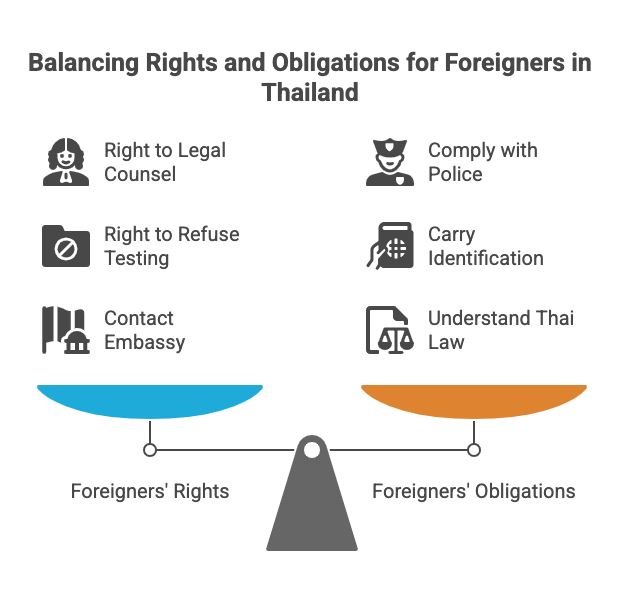
Key rights include:
- Right to remain silent, and you need not give any statement at all
- Refusing a test is risky: an officer with reasonable grounds may order one under section 115, and refusing a test in an ONCB investigation is itself an offence under section 176, carrying up to one year, a fine of up to 20,000 baht, or both
- Right to contact embassy or consulate for assistance and notification of family regarding potential drug use.
- Right to legal representation: you may meet and consult a lawyer privately, and have a lawyer or trusted person present during questioning
Critical obligations include:
- Carrying proper identification at all times, as foreigners without passports may face additional complications during police encounters
- Complying with lawful police requests for identification and basic questioning
- Understanding that Thai law applies equally to foreigners and nationals, with no special exemptions
Enforcement Patterns and Problem Areas
Drug testing enforcement has intensified significantly since 2011, with particular focus on tourist areas in Bangkok. The Sukhumvit area between Asoke and Thong Lor stations is now a main enforcement zone. There are many reports of foreign nationals facing searches and drug tests. Other high-risk areas include Khao San Road, Patong, Nana, and various nightlife districts.
Enforcement typically occurs through:
- Roadside checkpoints set up at night and in red zones
- Random stops of foreigners in tourist areas, where drug use may be more prevalent.
- Surveillance around entertainment venues and transportation hubs
- Home raids based on tip-offs or previous arrests
Unfortunately, corruption and extortion remain serious concerns in drug testing enforcement. Many documented cases show police officers asking for payments between 2,000 and 80,000 baht. They demand this money to avoid drug charges. The Public Sector Anti-Corruption Commission and Crime Suppression Division have investigated numerous cases of officers extorting money from motorists during urine testing procedures.
Penalties and Legal Consequences
Penalties for drug offenses vary significantly based on the substance category and nature of the offense. Under the 2021 Narcotics Code, Thailand maintains five categories of controlled substances, with Category I (heroin, methamphetamines, MDMA) carrying the harshest penalties.
For possession offenses:
- Category I (section 145): up to 15 years and a fine of up to 1.5 million baht; 2 to 20 years and 200,000 to 2 million baht where the offence is for trade or has another aggravating feature
- Category II or IV (section 146): up to 10 years and a fine of up to 1 million baht
- Category V, for example the opium plant (section 148): up to 5 years and a fine of up to 500,000 baht; 1 to 15 years and 100,000 to 1.5 million baht where the offence is for trade or has another aggravating feature
- Possession for personal use of Category I, II or V (section 164): up to 2 years, a fine of up to 40,000 baht, or both. A small quantity below the ministerial threshold is presumed to be for use (section 107)
For consumption offenses:
- Using Category I, II or V (section 162): up to 1 year, a fine of up to 20,000 baht, or both, but a user who volunteers for treatment before being found (section 113), or who is found and volunteers while not facing another imprisonable charge and not posing a danger to others (section 114), and then completes treatment, commits no offence
Refusing a drug test in an ONCB investigation carries up to one year, a fine of up to 20,000 baht, or both (section 176). The presumption against a driver who refuses a test is a separate rule of the road traffic law, not of the Narcotics Code.
Medical Prescription and Legal Drug Importation
Foreigners may legally bring prescription medications containing controlled substances under specific conditions. For Category 2 narcotics like codeine, fentanyl, morphine, and oxycodone, travelers need permits from the Thai FDA. You must get these permits at least two weeks before you arrive. They allow up to 90 days of prescribed medication. However, this can be checked under drug policy if there are signs of illegal drug use. Travelers can bring up to 30 days’ worth of certain medications. These are psychotropic substances in Categories 2, 3 and 4. Travelers must have the right medical prescriptions and certificates.
Required documentation includes:
- Valid medical prescription from prescribing physician
- Patient identification and medical condition details
- Medication names, strengths, and usage instructions
- Physician’s name, address, and license number
Travelers must declare Category 2 narcotics at customs red channels upon arrival and departure, while other medications are considered personal belongings if properly documented.
Practical Guidance for Expatriates
To minimize risks of drug-related complications, expatriates should:
Avoid high-risk areas and situations, particularly late-night entertainment districts and areas known for drug enforcement activity. Carry proper identification at all times, including original passport or certified copies. Understand that prescription medications legal elsewhere may be prohibited in Thailand, requiring advance research and permits.
If stopped by police, remain calm and polite while requesting to see proper identification. Exercise your right to remain silent until a lawyer is present. Speaking without knowing Thai legal procedures can hurt you. Contact embassy or consulate immediately if arrested or detained, as they can provide attorney lists and notify family members.
Stay informed about changing cannabis laws. Regulations are evolving, with new rules for medical prescriptions and stricter penalties for not following them. Report any corruption or extortion attempts to appropriate authorities, including the Public Sector Anti-Corruption Commission.
FAQs about Mandatory Drug Testing Laws in Thailand
What are the drug testing regulations in Bangkok?
Drug testing in Bangkok follows the same national law as the rest of Thailand: section 115 of the Narcotics Code, with its procedure set by ministerial regulation of the Minister of Justice. These regulations include mandatory urine tests for drug use, especially in cases of suspected drug-related offences. Police officers can do these tests at police stations. Not following the rules can lead to serious legal problems.
How does the Thai government address drug possession?
The Thai government has enacted punitive measures to address drug possession. Drug-related problems are taken seriously, with penalties ranging from fines to imprisonment. Under current drug laws, having narcotics like cocaine and opium can lead to serious consequences. Trafficking Category I drugs can carry the death penalty where the offender leads, directs or manages a criminal network, or the offence affects national security or public safety (Narcotics Code section 145).
What is the role of the Narcotics Control Board?
The Narcotics Control Board plays a crucial role in drug law enforcement in Thailand. This government agency is responsible for formulating and implementing drug policies, including harm reduction strategies. They oversee the healthcare services related to drug rehabilitation and promote initiatives to combat drug trafficking.
How does the Bangkok Post report on drug policies?
The Bangkok Post frequently covers issues related to drug policies and law enforcement in Thailand. Their articles often show the current state of drug trafficking. They discuss the government’s view on drug-related crimes. They also cover the effects of mandatory testing on the people. This gives readers important insights into the challenges the Thai government faces in fighting illegal drug use.
What are the implications of the new drug law?
The new drug law in Thailand aims to reclassify certain substances and change the approach to drug-related offences. This law emphasizes rehabilitation over punishment for users, aligning with international harm reduction principles. However, it maintains strict penalties for trafficking and possession of illicit drugs.
How has drug testing evolved since the late 1990s?
Since the late 1990s, drug testing in Thailand has changed a lot. This change happened mainly under Prime Minister Thaksin Shinawatra. He started a war on drugs that included strict drug testing policies. Over the years, drug policies have changed. They now focus more on rehabilitation and public health instead of just punishment.
Current Legal Landscape and Future Changes
Thailand’s drug enforcement continues evolving under the 2021 Narcotics Code, emphasizing rehabilitation over punishment while maintaining strict penalties for serious offenses. The code introduced alternatives to imprisonment and reduced minimum sentences for many drug offenses, though implementation remains inconsistent.
Enforcement intensity has risen, and the community “X-ray” testing directive issued under the Srettha government in 2024 was the escalation that set the current pattern. It has outlasted the administration that ordered it, so treat it as the standing approach rather than as a new announcement. These “X-ray” operations focus on people aged 16 and older in high-risk communities. This means that foreigners living in these areas may have to be tested more often.
The government is now focusing more on drug rehabilitation instead of just punishment. This gives hope for better treatment of drug users. However, the way police enforce laws on the streets may not change right away. Expatriates need to stay alert about legal changes. Thai drug laws are some of the strictest in the world. There is little tolerance for violations, no matter your nationality or situation.
Understanding these complex regulations and maintaining compliance represents an essential aspect of expatriate life in Thailand. The legal framework offers some protections. However, how these laws are enforced can differ a lot from what is written. It is important for anyone facing drug-related legal issues in the Kingdom to be aware of the situation. They should seek good legal advice.
Links:
Last reviewed: 5 September 2026. The instrument behind the June 2025 cannabis rules was corrected: cannabis is a controlled herb under section 44 of the Protection and Promotion of Traditional Thai Medicine Wisdom Act B.E. 2542, and the one-year / 20,000 baht penalty quoted here is section 78 of that same Act, not the Herbal Product Act. The Narcotics Code framework, the section 58/1 testing power and the category structure were checked and left as written. The per-category prison terms and fine ranges are NOT verified here: the only copy of the Narcotics Code available to us is a 333-character summary record, not the Code, so those figures need the Gazette text before they can be relied on. Updated on 4 October 2026: the Gazette text of the Code (volume 138, part 73 Kor, 8 November 2021) has since been obtained and was read in Thai, sections 107, 115, 145, 146, 148, 162, 164 and 176. Every penalty figure on the page was wrong or came from the repealed Narcotics Act and has been replaced from the Code, the testing power is now cited as section 115 rather than the old Act’s section 58/1, and the refusal penalty is section 176.
Thai Law Updates, free by email
Plain-English updates on Thai law changes that affect foreigners: property, visas, marriage, business and wills. One short email a month from a firm practicing since 2006. No spam, unsubscribe anytime.