Last updated on April 12, 2026
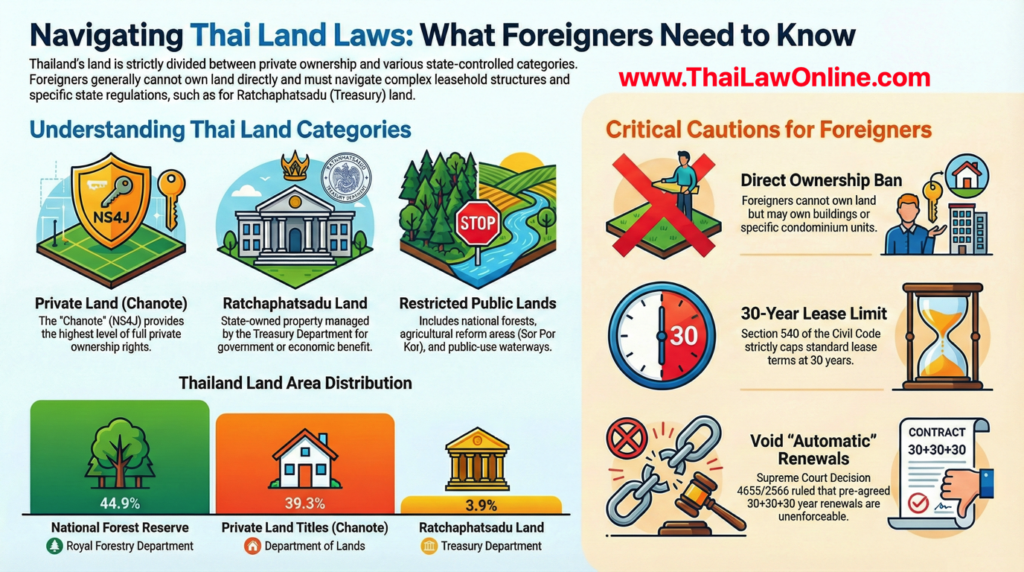
“Ratchaphatsadu” (ราชพัสดุ) literally translates to “royal supplies” or “state property.” In Thai real estate law, Ratchaphatsadu land means any immovable property owned by the State, with some exceptions. It is the single largest category of government-held land in Thailand. “Ratchaphatsadu land in Thailand” is sometimes translated as “treasury department land.” It is also translated using names linked to “possessory rights.” Examples include “Por Bor Tor” now called since 2019 “Por Dor Sor 3.”“Por Dor Sor 3” (ภ.ด.ส.).
Table of Contents
1. What Is Ratchaphatsadu Land in Thailand (ที่ราชพัสดุ)?
Under Section 4 of the Ratchaphatsadu Land Act B.E. 2518 (1975), the law defines Ratchaphatsadu land. It means “every immovable property that is State property.” The definition excludes two categories. First, it excludes land in the public domain, or domaine public. This land is used by the general public. Examples include public highways, rivers, foreshores, waterways, and lakes.Second, it excludes immovable property owned by state enterprises that are juristic persons. It also excludes property owned by local administrative organizations.
Key Fact
The Thai Treasury Department manages about 12.5 million rai of Ratchaphatsadu land in Thailand. That is roughly 2 million hectares. Its estimated value is over 5 trillion Baht. This represents about 2.57% of Thailand’s total land area.
In simple terms, Ratchaphatsadu land includes government office buildings. It also includes military sites. It includes state-owned markets. It includes land set aside for agencies. It also includes land the State leases to private parties for commercial or residential use. It does not include public commons land, such as beaches or public roads. It also leaves out land owned by autonomous state enterprises. These include the State Railway of Thailand and the Electricity Generating Authority of Thailand.
For Western readers, Ratchaphatsadu land is similar to “Crown land” in Commonwealth countries or “treasury land”. Examples include Canada, Australia, and the UK.It is also similar to “federal land” in the United States. It is government-owned land that may be leased or used for specific purposes.The public cannot freely buy it.
2. The Legal Framework: Key Legislation Governing Treasury Land
Ratchaphatsadu land is governed by a layered system of primary legislation, secondary regulations, and ministerial policies. Understanding this framework is essential for anyone seeking to lease or interact with government-owned land in Thailand.
2.1 Ratchaphatsadu Land Act B.E. 2518 (1975)
The original Ratchaphatsadu Land Act was enacted on February 14, B.E. 2518 (1975). It served as the foundational law for more than four decades. This Act has 12 sections. It defined Ratchaphatsadu land. It created the Ratchaphatsadu Land Committee, chaired by the Minister of Finance. It also set basic rules to supervise, maintain, use, and manage state property.
Section 5 of the B.E. 2518 Act vested ownership of all Ratchaphatsadu land in the Ministry of Finance. Section 6 established the Ratchaphatsadu Land Committee with authority to formulate policy and issue Ministerial Regulations. Section 8 said you needed an Act of Parliament to transfer Ratchaphatsadu land. This applied when the land was public land set aside for special state use. Section 9 stated that when the land was no longer needed for its purpose, a Royal Decree had to revoke its reserved status.
Reference: Ratchaphatsadu Land Act B.E. 2518 (1975), Sections 4–12; Royal Gazette Vol. 92, Part 35.
2.2 Ratchaphatsadu Land Act B.E. 2562 (2019)
The newer Ratchaphatsadu Land Act B.E. 2562 (2019) was published in the Royal Gazette on March 9, 2019. It replaced the 1975 Act to modernize state property management. This updated law set clearer rules for buying, managing, and leasing Ratchaphatsadu land. It also added rules for managing state property outside Thailand. This change reflects Thailand’s growing international government interests.
The B.E. 2562 Act reinforced a rule for government agencies and local administrative organizations. If they want to use Ratchaphatsadu land, they must notify the Treasury Department of their goals. They must also seek formal approval under Ministerial Regulations. It also introduced a key threshold. Projects valued at 5 billion Baht or less fall under the Ratchaphatsadu Land Act. They do not fall under the Public-Private Partnership (PPP) framework. This gives the Treasury Department direct oversight of medium-scale government property projects.
Reference: Ratchaphatsadu Land Act B.E. 2562 (2019); Royal Gazette Vol. 136, Part 31 Kor.
2.3 Ministerial Regulations B.E. 2545 (2002)
The Ministerial Regulations on Principles for Administration, Maintenance, Use, and Profit from State Property B.E. 2545 (2002) set rules. These rules explain how to apply the Ratchaphatsadu Land Act. These regulations specify the lease terms, rental calculation methods, approval processes, and reporting requirements. Section 23 of these rules requires approval from the Ministry of Finance. This approval is needed for any contract that uses state property.
Reference: Ministerial Regulations on Administration of State Property B.E. 2545 (2002), Section 23.
3. Classification of State Land in Thailand
To understand Ratchaphatsadu land properly, it must be situated within the broader classification of state-owned land in Thailand. The Land Code B.E. 2497 (1954) and related laws recognize several types of government land. Each type has different legal rules and administrative frameworks.
| Category | Thai Term | Description | Managing Authority | Can Be Leased? |
|---|---|---|---|---|
| Publicly Used Land | ที่สาธารณประโยชน์ | Land commonly used by the public: roads, rivers, beaches, canals, public parks | Ministry of Interior / Local Government | No — protected as public domain |
| Waste Land | ที่รกร้างว่างเปล่า | Abandoned or unused land that has reverted to the State | Ministry of Interior / Land Department | May be allocated for private use under certain programs |
| Treasury Land (Ratchaphatsadu) | ที่ราชพัสดุ | State-owned land used for government administration, military, commercial leasing | Treasury Department / Ministry of Finance | Yes — under the Ratchaphatsadu Land Act |
| State Enterprise Land | ที่ดินรัฐวิสาหกิจ | Land owned by state enterprises with juristic person status (e.g., SRT, EGAT) | Respective State Enterprise | Under the enterprise’s own governing law |
| Government-Reserved Land | ที่ดินสงวนหวงห้าม | Land reserved for specific purposes: natural resources, environmental protection | Various (Forestry Dept., etc.) | Generally no — protected by reservation |
Reference: Land Code B.E. 2497 (1954); Chandler MHM, “Doing Business in Thailand,” Chapter 8, Section 2(A).
The key commercial distinction is that Ratchaphatsadu land can be leased to private parties. Unlike public-use or reserved land, it is often leased for business, housing, and farming. This makes it a significant category for businesses, investors, and individuals seeking to utilize state-owned property in Thailand.
4. The Treasury Department (กรมธนารักษ์): Role and Powers
The Treasury Department (กรมธนารักษ์, Krom Thanarak) is a government unit within the Ministry of Finance. It oversees and maintains all Ratchaphatsadu land across Thailand. The Department’s mandate includes surveying state property and keeping a national registry of government-owned immovable property. It also sets assessed land values for tax and fee calculations nationwide. It also manages lease agreements for treasury land.
The Treasury Department’s assessed land values are very important. They set the baseline for transfer fees, taxes, and registration costs in Thailand. This applies to all land transactions. It includes Ratchaphatsadu land and private land transactions. The assessed price announced by the Treasury Department is usually much lower than the property’s market value.
The Department runs provincial offices (สำนักงานธนารักษ์พื้นที่) in every province.These offices act as the local administrative arm. They process lease applications and conduct inspections. They also manage lease relationships. They work with tenants who use state property.
5. The Ratchaphatsadu Land Committee
The Ratchaphatsadu Land Committee (คณะกรรมการที่ราชพัสดุ) is the top policy body for state property in Thailand. It was created under Section 6 of the Ratchaphatsadu Land Act B.E. 2518 (1975). Its members and powers were updated under the B.E. 2562 (2019) Act.
The Committee is chaired by the Minister of Finance. It includes the Permanent Secretary of the Ministry of Finance. It also includes the Director-General of the Treasury Department. The Director-General serves as both a member and secretary. Various other senior officials from relevant ministries are also included. The Committee can set policies. It can approve major lease agreements. It can allow the revocation or reclassification of state property. It can issue guidelines. These guidelines become binding through Ministerial Regulations published in the Government Gazette.
Practice Point: For high-value or large-scale leases, the lessee must navigate the Treasury Department’s process. The lessee must also secure approval from the Ratchaphatsadu Land Committee. Prospective lessees should factor this committee approval process into their project timelines.
6. How to Lease Ratchaphatsadu Land
Leasing Ratchaphatsadu land is a main way the State earns revenue from its property holdings. The Treasury Department runs a clear process for awarding leases. The terms follow Ministerial Regulations B.E. 2545 (2002) and later amendments.
6.1 Eligibility Requirements
Applicants for a Ratchaphatsadu land lease must generally be Thai nationals or Thai-registered juristic persons. Government agencies, state enterprises, local administrative organizations, educational institutions, and temples may also be granted the right to use state property. Private entities seeking commercial leases must show a valid business purpose. They must also have enough money to develop and maintain the property. This must meet the Treasury Department’s requirements.
Existing occupants on Treasury land may get priority for lease applications. They must have used the property with the Treasury Department’s knowledge. They must also follow the Ministerial Regulations.
6.2 Lease Duration and Renewal
| Purpose of Lease | Typical Duration | Maximum Duration | Renewal Possible? |
|---|---|---|---|
| Residential use | 1–3 years | 30 years | Yes, subject to Treasury Dept. approval |
| Commercial / retail (shophouses, markets) | 3–15 years | 30 years | Yes, subject to review |
| Industrial / large-scale development | 15–30 years | 30 years (50 years under special laws) | Yes, with renegotiation |
| Agricultural use | 1–6 years | 12 years (typically) | Yes, subject to review |
| Government agency use | As needed | Indefinite (reserved status) | N/A — granted by allocation |
| BOI / EEC zone projects | 30–50 years | 50 years (up to 99 years in EEC with renewal) | Yes, under EEC Act |
The general maximum lease period is 30 years, under Section 540 of the Thai Civil and Commercial Code. It states that a lease of immovable property cannot exceed 30 years. If the parties agree to a longer term, it will be reduced to 30 years. However, certain special legislation provides exceptions. The Lease of Immovable Property for Commercial and Industrial Purposes Act B.E. 2542 (1999) allows 50-year leases. These leases apply to qualifying commercial and industrial projects. The projects must meet minimum investment thresholds. The Eastern Special Development Zone Act B.E. 2561 (2018) is also called the EEC Act. It allows 50-year leases.It also allows a 49-year renewal in designated EEC zones.
Important: A renewal clause in a Ratchaphatsadu lease does not create a vested right. Renewal is always up to the Treasury Department. The terms, including rental rates, may be renegotiated at renewal. Lessees should not assume automatic renewal.
6.3 Rental Rates and Fees
Rental rates for Ratchaphatsadu land are based on the Treasury Department’s assessed land value. They are not based on market value. These rates are usually lower than private-market rental rates. The specific formula varies by the type of use, but the Treasury Department publishes guidelines and rate schedules. In addition to monthly or yearly rent, lessees often pay key money (เงินกินเปล่า). They may also pay a building usage fee. This may apply if the lease includes state-owned structures.
The standard registration fee for a Ratchaphatsadu lease is 1% of the total rental value. This amount covers the full lease term. It follows the Land Department’s fee schedule for registered leases in Thailand. Stamp duty of 0.1% of total rent applies (agricultural leases are exempt from stamp duty).
| Fee / Cost | Rate | Payable By | Notes |
|---|---|---|---|
| Annual rent | Based on assessed value formula | Lessee | Lower than private market rates |
| Key money (เงินกินเปล่า) | Varies by property | Lessee | One-time upfront payment |
| Lease registration fee | 1% of total rent throughout lease term | Lessee (by practice) | Registered at Land Office |
| Stamp duty | 0.1% of total rent throughout lease term | Shared (by law); lessee (by practice) | Agricultural leases exempt |
| Land and Building Tax | Varies (0.01%–0.7% of assessed value) | Lessee (if contractually stipulated) | Under Land and Building Tax Act B.E. 2562 |
Reference: Ministerial Regulations B.E. 2545 (2002); Chandler MHM, “Doing Business in Thailand,” Table 8-1.
6.4 Step-by-Step Lease Procedure
Obtaining a lease on Ratchaphatsadu land has several steps and often takes months to finish. The exact time depends on the project’s size and value.
Step 1 — Identification and Inquiry: The prospective lessee identifies the specific Ratchaphatsadu land plot. They ask about it at the provincial Treasury Department office (สำนักงานธนารักษ์พื้นที่). The office will confirm whether the land is available for leasing and the permitted use categories.
Step 2 — Application Submission: The applicant submits a formal lease application. It includes ID documents and business registration for juristic persons. It also includes a proposed use plan and proof of financial capacity. The applicant must also provide any supporting documents required by applicable Ministerial Regulations.
Step 3 — Evaluation and Inspection: The Treasury Department conducts a site inspection. It evaluates the application against the Ministerial Regulations. It reviews the proposed rental rate and terms. For large-scale projects, an environmental impact assessment may be required.
Step 4 — Committee or Ministerial Approval: Depending on the lease value and type, approval is needed. It may come from the Treasury Director-General, the Ratchaphatsadu Land Committee, or the Finance Minister. Projects exceeding certain thresholds require Cabinet approval.
Step 5 — Lease Execution and Registration: After approval, the Treasury Department and the lessee sign the lease agreement. If the lease term is more than 3 years, you must register it at the relevant Land Office. This ensures it is enforceable under Section 538 of the Civil and Commercial Code.
Step 6 — Ongoing Compliance: The lessee must follow the lease terms. This includes use limits, maintenance duties, and regular reports. The Treasury Department retains the right to inspect the property and may terminate the lease for material breach.
7. Types of Permitted Use of Ratchaphatsadu Land
The Treasury Department permits Ratchaphatsadu land for many uses.These include commercial uses like hotels, department stores, markets, and shophouses.It also allows residential use. Educational and religious uses are allowed, such as temples, schools, and universities. Agricultural use is also permitted.Government agencies may use the land for administrative functions. The permitted uses for any parcel come from the Treasury Department’s zoning and use plan. Lessees must follow the approved use category. Unauthorized changes in use constitute grounds for lease termination.
Several large commercial properties in Bangkok and other provinces sit on Ratchaphatsadu land. These include popular markets, government-owned shop rows, and some hotel projects. The long-term nature of these leases and their lower rental rates make Ratchaphatsadu leases commercially attractive. However, the lessee must accept limits when leasing from the government. The lessee cannot own the land outright.
8. Foreigners and Ratchaphatsadu Land
The intersection of Ratchaphatsadu land and foreign investment is a nuanced area of Thai law. As a general rule, Ratchaphatsadu land leases are awarded to Thai nationals or Thai-registered entities. The Land Code B.E. 2497 (1954) limits foreign land ownership. The Treasury Department’s internal policies are also strict. It follows a similar approach when granting leases on state property.
However, foreigners may indirectly access Ratchaphatsadu land through several recognized structures. A Thai-majority company, with at least 51% Thai shareholding, may apply for a Ratchaphatsadu lease as usual. Foreign investors in BOI projects or in the EEC may also lease state property. They may do so under special lease rules in the related promotional laws. In such cases, the lease is between the Treasury Department and the Thai-registered project entity.
Legal Risk Warning: Using nominee shareholders to bypass Thai ownership rules to access Ratchaphatsadu land is illegal. This violates the Foreign Business Act B.E. 2542 (1999) and the Land Code. Violations carry criminal penalties including fines and imprisonment. The Treasury Department may also terminate the lease if nominee arrangements are discovered.
8.1 The 99-Year Lease Proposal
A proposal to allow foreigners to hold long-term land leases for up to 99 years has been discussed in Thai policy circles. Under this proposal, Thai landowners who want to lease land to foreigners would first transfer the title deed. They would transfer it to the Treasury Department for oversight. Foreign lessees would then hold a lease for up to 99 years. After that, the land would return to state ownership under the Treasury Department. Restrictions would prevent foreigners from acquiring agricultural land or developing low-income housing under this scheme.
However, as of early 2026, this proposal remains at the discussion stage and has not been enacted into law. The Finance Ministry’s permanent secretary has said that this proposal would need changes to state property law. It would also need changes to related laws. Public consultation would be required under the Constitution. Prospective foreign investors should not rely on this proposal for current planning. They should work within the existing 30-year framework. Special laws may allow a 50-year term.
9. Ratchaphatsadu Land vs. Private Land vs. Public Domain: Comparison
| Feature | Ratchaphatsadu Land (ที่ราชพัสดุ) | Private Land (Chanote / NS4) | Public Domain (ที่สาธารณะ) |
|---|---|---|---|
| Ownership | State (Ministry of Finance) | Private individual or entity | State — for public benefit |
| Can be purchased? | No (except in limited disposal cases under the B.E. 2562 Act) | Yes — freely transferable | No |
| Can be leased? | Yes — up to 30 years (50 years under special laws) | Yes — up to 30 years (50 years under special laws) | No |
| Can be mortgaged? | No (leasehold interest only; no security over the land itself) | Yes | No |
| Managing authority | Treasury Department | Land Department (registration only) | Ministry of Interior / Local Govt. |
| Title document | Treasury Department registry | Chanote (NS4), NS3G, NS3 | No private title issued |
| Rent level | Below market (based on assessed value) | Market rate (negotiated between parties) | N/A |
| Foreign access | Limited — through Thai entities, BOI, or EEC | Lease only (no ownership for foreigners, except condos) | None |
| Key legislation | Ratchaphatsadu Land Act B.E. 2518 / 2562 | Land Code B.E. 2497; CCC Sections 537–571 | Land Code; CCC Section 1304 |
10. Tax Obligations on Ratchaphatsadu Land
Under the Land and Building Tax Act B.E. 2562 (2019), Ratchaphatsadu land leased to private parties may face annual land and building tax. The tax is based on the value of the land and buildings. It is calculated using rates that vary by use category. These include residential, commercial, agricultural, and vacant. Tax rates range from 0.01% to 0.7% of the assessed value, depending on the use classification and the value tier.
Ratchaphatsadu land used directly by government agencies for governmental purposes is generally exempt from land and building tax. However, when the state leases property to a private lessee for business use, the lessee may pay the taxes. The lease agreement must state this. The Treasury Department’s assessed land value — which is typically below market value — serves as the tax base.
Lessees should also be aware of income tax implications on buildings or improvements constructed on Ratchaphatsadu land. Upon lease expiration, any structures on the land may revert to the State. This depends on the lease terms. The lessee may or may not receive compensation for these improvements. This is a critical commercial consideration that must be addressed clearly in the lease negotiations.
Reference: Land and Building Tax Act B.E. 2562 (2019); Revenue Code.
11. Transfer, Revocation, and Disposal of Treasury Land
Ratchaphatsadu land cannot be freely transferred or sold in the manner of private land. The B.E. 2518 Act established strict procedures for changing the status of state property. A transfer of Ratchaphatsadu land is only allowed if Parliament passes a law. This applies when the land is part of the public domain.It must also be set aside for special state use. When Ratchaphatsadu land reserved for official use is no longer needed, a Royal Decree must revoke its status. A boundary map must be attached to the Decree.
The B.E. 2562 Act added a new mechanism. The Treasury Department may sell property seized in money laundering and drug trafficking cases. The Ministry of Finance must approve the sale. This was a notable expansion of the disposal powers that did not exist under the original 1975 legislation.
Reference: Ratchaphatsadu Land Act B.E. 2518, Sections 8–9; Ratchaphatsadu Land Act B.E. 2562 (2019).
11. Supreme Court Decisions on Ratchaphatsadu Land (คำพิพากษาศาลฎีกา)
Thai Supreme Court (San Dika, ศาลฎีกา) decisions interpret the Ratchaphatsadu Land Act and related state property laws. These decisions give essential guidance on how these laws apply in practice. Unlike common law jurisdictions, Thai court decisions do not formally create binding precedent. However, Supreme Court judgments carry strong persuasive weight. Lower courts, lawyers, and the Treasury Department often rely on them. For lessees, investors, and legal advisors, knowing these landmark decisions is key to judging risk. It also helps them handle disputes over treasury land.
11.1 Classification: What Qualifies as State Property (สาธารณสมบัติของแผ่นดิน)
One of the most common issues in Thai land law is whether a parcel is Ratchaphatsadu land.This is state land used for government purposes. Or it may be private land that people can own and sell freely. The Supreme Court has developed a robust body of case law on this classification question.
Supreme Court Decision No. 5200/2566 (2023)
In this landmark case, the Supreme Court addressed the evidentiary weight of a prior final judgment declaring land to be state property. The disputed land was split from a plot that a court had already ruled was public domain property. The property was used for the State’s specific benefit under Section 1304(3) of the Civil and Commercial Code. The defendants argued that the subdivided parcels should not carry the same classification.
The Supreme Court held that a judgment awarding property ownership to one party can bind third parties. This applies unless the third parties prove they have stronger rights. This is based on Section 145, paragraph 2(2) of the Civil Procedure Code. Since the defendants only reinterpreted existing documents, they did not prove stronger rights. The Court upheld the property’s status as state-owned.
Key Principle: When the Supreme Court classifies land as state property (สาธารณสมบัติของแผ่นดิน), that status applies to all subdivided parcels. Third parties claiming rights must affirmatively prove superior title — merely offering alternative interpretations of existing documents is insufficient.
Reference: คำพิพากษาศาลฎีกาที่ 5200/2566; CCC Section 1304(3); CPC Section 145.
Supreme Court Decision No. 3169/2564 (2021)
This decision addressed a dispute. The Ministry of Finance registered its name on a land utilization certificate (NS3, Nor Sor 3). It did so after buying the land from one individual. However, the actual occupant, a different person (“S.”), had possessed and cultivated the land for years. Later, S. sold the land to the plaintiff.
The Supreme Court ruled that the name appearing on the NS3 creates only a presumption of possessory rights under Section 1373 of the CCC. When the possessor (“S.”) had physical control of the land, “S.” had valid possessory rights under Section 1367. “S.” could also transfer those rights. The Ministry of Finance registered its name after buying it from someone without land ownership. This did not override the rights of the person who actually possessed the land.
Key Principle: Listing the Ministry of Finance on a land certificate creates a presumption, not final proof. Actual physical possession (การครอบครอง) prevails over paper registration. A person who never took physical possession cannot validly sell land to the government. The government’s later registration does not fix this defect.
Reference: คำพิพากษาศาลฎีกาที่ 3169/2564; CCC Sections 1367, 1373.
Supreme Court Decision No. 478/2559 (2016)
The Supreme Court defined Ratchaphatsadu land in a case about the Treasury Department leasing state buildings. The Court confirmed that Ratchaphatsadu land includes buildings, structures, and improvements on state-owned land. The Court also confirmed that the Treasury Department solely manages this land under the Ratchaphatsadu Land Act.
Reference: คำพิพากษาศาลฎีกาที่ 478/2559; Ratchaphatsadu Land Act B.E. 2518, Section 4.
11.2 Encroachment and Eviction from Treasury Land
Disputes involving unauthorized occupants on Ratchaphatsadu land are among the most common state property cases in the Thai courts. The Supreme Court has upheld the government’s right to evict encroachers. It has also recognized the rights of occupants with valid possessory claims.
Supreme Court Decision No. 2103/2565 (2022)
The plaintiff lived on a plot of land in Kanchanaburi Province, paid local taxes, and installed concrete boundary posts. The provincial Treasury Department office (สำนักงานธนารักษ์พื้นที่กาญจนบุรี) later surveyed the land. It found the land was Ratchaphatsadu property. It also had the features of a public right-of-way. When third parties entered the property to lay drainage pipes, the plaintiff sued for trespass and criminal damage. The Supreme Court held that the land was ultimately state property. Still, the plaintiff’s ongoing physical occupation gave him standing. He could file trespass and property damage claims. The plaintiff’s possessory rights, inherited from his predecessor in title, were enough to maintain the criminal action. This was true even if the state owned the property.
Key Principle: A person physically occupying Ratchaphatsadu land — even without formal authorization — retains possessory rights that the courts will protect against third-party interference. However, this does not create ownership rights.The occupant is still subject to the Treasury Department’s authority to take back the land.
Reference: คำพิพากษาศาลฎีกาที่ 2103/2565; Criminal Code Sections 362, 365, 358.
Supreme Court Decision No. 8649/2560 (2017)
In this criminal case, the defendant was charged with trespassing on Ratchaphatsadu land. The defendant was also charged with violating the Forestry Act. The defendant was also charged with violating the Land Code. The Court ordered eviction of the defendant, workers, agents, and dependents from the state property. The decision confirmed that the Land Code and the Forestry Act each set separate criminal penalties. Both laws punish unauthorized occupation of state-owned land. Prosecutors may use either statute or both.
Reference: คำพิพากษาศาลฎีกาที่ 8649/2560; Land Code Sections 9, 108; Forestry Act Sections 54, 55.
11.3 Lease Disputes and Sub-Lease Rights
Supreme Court Decision No. 8901/2563 (2020)
This important decision addressed the legal position of sub-lessees on Ratchaphatsadu land. The defendant, the Treasury Department, signed a lease with Plaintiff No. 1. Plaintiff No. 1 then subleased the property to Plaintiff No. 2. Plaintiff No. 2 then subleased the property to Plaintiff No. 3.When a dispute arose, Plaintiff No. 3 tried to claim rights directly against the Treasury Department.
The Supreme Court ruled under Section 545 of the CCC.A sub-lessee is directly responsible to the original lessor. This is a one-way obligation. It is a statutory exception to the general rule. Contracts usually bind only the parties who signed them. The Court held that this exception cannot be read in reverse. It does not allow a sub-lessee to bring claims against the original lessor. Because no law gives the sub-lessee rights against the original lessor, Plaintiff No. 3 lacked standing. Plaintiff No. 3 could not bring claims directly against the Treasury Department.
Key Principle (Critical for Lessees): A sub-lessee on Ratchaphatsadu land has no direct legal relationship with the Treasury Department. The sub-lessee is liable to the Department, but cannot claim rights against it. Sub-lessees must enforce their rights exclusively against their immediate lessor. This means that if the head lease ends, the sub-lessee cannot challenge the Treasury Department’s decision. The sub-lessee can only claim damages from the head lessee.
Reference: คำพิพากษาศาลฎีกาที่ 8901/2563; CCC Section 545.
Supreme Court Decision No. 13387/2555 (2012)
This case involved a dispute between private parties and government agencies. It included the provincial Treasury Department office (ธนารักษ์พื้นที่สิงห์บุรี). The dispute was over whether the agricultural college land was Ratchaphatsadu property. The plaintiffs argued their land was not state property and challenged the Treasury Department’s claim of jurisdiction. The Supreme Court reviewed the relationship between the defendant agencies. It confirmed that the provincial Treasury Department office (สำนักงานธนารักษ์พื้นที่) has legal standing. The office may act for the Treasury Department in property disputes. The Court also confirmed that the burden to prove the land is not Ratchaphatsadu property is on the party. That party must challenge the state’s claim when the Treasury Department has registered its interest.
Reference: คำพิพากษาศาลฎีกาที่ 13387/2555.
11.4 Fraudulent Title Deeds on State Land
Supreme Court Decision No. 5161/2566 (2023)
This case involved a criminal prosecution related to the fraudulent issuance of title documents over state-owned land. The case proceeded through the criminal retrial process under the Criminal Case Retrial Act B.E. 2526 (1983). The Supreme Court set limits on appeals in retrial cases. Under Section 15 of the Act, a retrial trial court may issue a judgment. If that judgment is appealed to the Court of Appeal, its decision is final. No further appeal to the Supreme Court is allowed. This case shows how criminal law can apply when fraudulent title deeds cover Ratchaphatsadu land. It also shows that appellate rulings are final in retrial cases.
Reference: คำพิพากษาศาลฎีกาที่ 5161/2566; Criminal Case Retrial Act B.E. 2526, Sections 13, 15.
11.5 Jurisdictional Issues: Civil Courts vs. Administrative Courts
Supreme Court Decision No. 4818/2562 (2019)
This significant procedural decision clarified the boundary between civil court and administrative court jurisdiction in Ratchaphatsadu land disputes. The plaintiffs filed a civil case challenging the legality of a Royal Decree affecting state property. The Jurisdictional Dispute Resolution Committee ruled that the case challenged the legality of a Royal Decree.
The Decree was issued by, or approved by, the Cabinet. The Committee said this issue falls under the Supreme Administrative Court’s exclusive jurisdiction. The Supreme Court confirmed that the Committee’s decision is final.This is based on Sections 10 and 11 of the Jurisdictional Dispute Resolution Act B.E. 2542 (1999). The civil court must either transfer the case or dismiss it so that the parties can re-file in the Administrative Court.
Key Principle: Disputes that challenge Royal Decrees about Ratchaphatsadu land must go to the Supreme Administrative Court. They must not be filed in civil courts. Filing in the wrong court will result in dismissal or transfer, costing the litigant significant time and expense. Legal counsel should carefully assess jurisdictional questions before commencing proceedings.
Reference: คำพิพากษาศาลฎีกาที่ 4818/2562; Jurisdictional Dispute Resolution Act B.E. 2542, Sections 10, 11.
11.6 Conversion of Forest Reserve to Ratchaphatsadu Land
Supreme Court Decision No. 321/2568 (2025) — Most Recent
The latest Supreme Court decision in our database involves Ratchaphatsadu land. It addresses the sensitive issue of converting national forest reserve land into Ratchaphatsadu land. In this criminal defamation case from Phetchabun Province, the defendant put up large vinyl banners. The banners were placed along the Phitsanulok–Lom Sak highway.They accused the provincial governor of seeking Cabinet approval. The approval was to convert national forest reserves into Ratchaphatsadu land.The defendant claimed this would benefit capitalists and politicians. They were allegedly linked to illegal forest encroachment in the Khao Kho area. The banners used language like, “Use Khao Kho as a model to help politicians who take forest land keep it legally.”
The Supreme Court upheld the criminal defamation conviction. The Court found the defendant’s accusations were untrue. The governor had only applied existing government policy. This was one way to address illegal forest encroachment. The Court also ruled that putting up public banners was not good-faith criticism. This was under Section 329 of the Criminal Code. The Court affirmed damages of 500,000 Baht for reputational harm.
Significance for Ratchaphatsadu Law: This case is mainly a defamation ruling. However, it shows a key real-world issue. It explains how national forest reserves (ป่าสงวนแห่งชาติ) can become Ratchaphatsadu land. This can happen through Cabinet approval. This conversion mechanism is a valid government tool. It is used to resolve encroachment disputes. In this approach, the Treasury Department manages the forest land. However, it is still politically controversial. The case shows that the boundary between forest reserve land and Ratchaphatsadu land is not fixed. It can change through government policy decisions.
Reference: คำพิพากษาศาลฎีกาที่ 321/2568; Criminal Code Sections 136, 328, 329.
11.7 Summary Table: Key Supreme Court Principles on Ratchaphatsadu Land
| Legal Issue | Case No. | Year | Key Ruling / Principle |
|---|---|---|---|
| State property classification extends to subdivisions | 5200/2566 | 2023 | Once land is classified as state property, all subdivided parcels carry the same classification. Third parties must prove superior rights. |
| Actual possession prevails over paper registration | 3169/2564 | 2021 | Physical possession trumps the Ministry of Finance’s name on land certificates. Government registration without actual possession is a mere formality. |
| Occupants retain possessory rights against third parties | 2103/2565 | 2022 | Even unauthorized occupants of treasury land can sue third-party trespassers. Possessory rights exist independently of ownership. |
| Sub-lessees have no direct claim against Treasury Dept. | 8901/2563 | 2020 | Sub-lessees on state land cannot assert rights against the Treasury Department. They are liable to the Department but cannot claim from it. |
| Royal Decree challenges go to Administrative Court | 4818/2562 | 2019 | Disputes over Royal Decrees affecting state property are within the exclusive jurisdiction of the Supreme Administrative Court. |
| Criminal penalties for encroachment | 8649/2560 | 2017 | Unauthorized occupation of Ratchaphatsadu land is prosecutable under both the Land Code and Forestry Act, with eviction orders. |
| Provincial Treasury offices have legal standing | 13387/2555 | 2012 | Provincial Treasury offices (ธนารักษ์พื้นที่) have standing to act for the Treasury Department in court proceedings. |
| Forest-to-Ratchaphatsadu conversion is policy tool | 321/2568 | 2025 | Conversion of national forest reserves to Ratchaphatsadu land through Cabinet approval is a legitimate government policy mechanism. |
| Retrial finality in fraudulent title cases | 5161/2566 | 2023 | In retrials for fraudulent state land titles, the Court of Appeal’s decision is final — no further appeal to the Supreme Court. |
Practical Lessons for Lessees and Investors
Supreme Court rulings on Ratchaphatsadu land offer key practical lessons for anyone leasing or dealing in state property:
1. Conduct thorough due diligence on land classification. The 5200/2566 decision shows that state property classification, once established, is extremely difficult to overturn. Before entering any land transaction with possible government ties, check its classification history. Use records from the Treasury Department and the Land Department.
2. Verify actual possession, not just paper titles. The 3169/2564 decision shows that Thai courts focus on who uses and occupies the land. They do not rely only on the name on the certificate. This is critical when purchasing land from entities claiming government-derived title.
3. Structure sub-lease arrangements carefully. The 8901/2563 decision makes clear that sub-lessees have no direct recourse against the Treasury Department. Any sub-lease on Ratchaphatsadu land must include contract protections from the head lessee. This is because if the head lease ends, the sub-lessee can only claim against the head lessee. The sub-lessee cannot claim against the government.
4. File in the correct court. The 4818/2562 decision confirms this rule.You must file challenges to government decisions in the Administrative Court.This includes Royal Decrees and Ministerial Regulations.This applies when decisions affect Ratchaphatsadu land.Do not file these cases in the civil court. Filing in the wrong forum wastes time and resources.
5. Unauthorized occupation carries criminal liability. The 8649/2560 decision confirms that encroachment on state land is a criminal offense, not merely a civil dispute. The penalties include imprisonment and forced eviction.
Reference: All Supreme Court decisions cited above come from the ThaiLawOnline case law database. It contains over 200 Ratchaphatsadu-related judgments from the Thai Supreme Court (B.E. 2529–2568).
12. Practical Considerations and Risks
Leasing Ratchaphatsadu land offers commercial benefits, mainly lower rent and access to prime government-owned locations. However, it also brings unique risks that private land deals do not.
No ownership interest: The lessee acquires only a leasehold right, not an ownership interest. The land cannot be used as collateral for a mortgage. Still, the leasehold interest may have some value in financing talks. This limits the lessee’s ability to leverage the property for external financing.
Government discretion on renewal: Lease renewal is not a right but a privilege. The Treasury Department may decline to renew, change the terms, or reallocate the land for a different purpose. Lessees who invest a lot in improvements should negotiate clear renewal terms and compensation in the original lease.
Restricted transferability: Unlike a private lease, a Ratchaphatsadu lease typically cannot be freely assigned or sublet without the Treasury Department’s prior written consent. This limits the lessee’s ability to exit the arrangement or bring in partners.
Reversion of improvements: Unless the lease explicitly provides otherwise, structures and improvements made by the lessee on Ratchaphatsadu land may revert to the State upon lease expiration. This is a major financial risk, particularly for lessees who invest heavily in building development on state property.
Political and policy risk: Government policy on Ratchaphatsadu land may shift with changes in administration. New policies regarding rental rates, permitted uses, or lease durations can affect existing lessees, particularly upon renewal.
13. Frequently Asked Questions
What is the difference between “tanarak” and “ratchaphatsadu”?
“Tanarak” (ธนารักษ์) refers to the Treasury Department itself — the government body that manages state property. “Ratchaphatsadu” (ราชพัสดุ) refers to the state property (land and buildings) that the Treasury Department manages. In everyday Thai, people often say “ที่ดินธนารักษ์” (tanarak land). They mean Ratchaphatsadu land. They use the managing agency’s name instead of the legal land type.
Can I build a house on Ratchaphatsadu land?
Yes, if the lease permits residential construction. Many Thais build homes on leased Ratchaphatsadu land, especially in areas set aside for housing. However, the lessee should carefully review the lease terms regarding ownership of the structure upon lease expiration.
Is Ratchaphatsadu land cheaper than private land?
Yes, rental rates for Ratchaphatsadu land are usually lower than similar private-market rates. They are based on the Treasury Department’s assessed value, not market value. However, the trade-off is the lack of ownership rights and the restrictions inherent in leasing from the government.
Can a Ratchaphatsadu lease be inherited?
A standard lease under the Civil and Commercial Code is a personal right.It ends when the lessee dies, unless the lease allows inheritance. In practice, the Treasury Department may allow heirs to take over, but this usually requires new approval. It is not automatic.
What happens if I default on the lease?
The Treasury Department may terminate the lease for non-payment of rent or breach of lease conditions. The lessee may need to leave the land. They may also lose any structures or improvements without compensation, based on the lease terms.
Ratchaphatsadu land represents a substantial and strategically important category of real property in Thailand. With over 12.5 million rai managed by the Treasury Department, it supports government operations nationwide. It also supports businesses, homes, and public institutions across the country. The legal framework is based on the Ratchaphatsadu Land Act B.E. 2518 (1975). It was updated by the B.E. 2562 (2019) Act. It is also supported by the Ministerial Regulations B.E. 2545 (2002). It provides a clear system for administering, leasing, and managing state property.
For Thai nationals and Thai-registered businesses, leasing Ratchaphatsadu land can be a strong option. It offers lower rental costs, access to well-located government property, and long-term stability. For foreign investors, the opportunities are more limited but not fully closed. They are available through BOI-promoted projects, EEC zone developments, and well-structured Thai-majority entities.
As with all aspects of Thai property law, proper legal due diligence and expert guidance are essential. The Ratchaphatsadu Land Act, the Land Code, the Civil and Commercial Code, and other special laws create complex rules. These rules reward careful planning and punish assumptions.