


Reviewed by ThaiLawOnline, a licensed Thai law firm practising in Thailand since 2006. Thai lawyer of record: Wichuda Atthamethakon, LL.M., Thai Bar Licence 3149/2556.
Last updated on
When handling family law issues about children in Thailand, you need to have an interview at the Juvenile Division. This division is often part of the Juvenile and Family Court system. This step is necessary for several situations. These include joint or sole custody, legalizing a father’s parental rights, and a divorce decided by the court where there are minor children; an agreed divorce registered at the district office involves no such interview. This process ensures that all decisions prioritize the “best interest of the child,” as mandated by Thai law. If you get a divorce and have children, you may need to ask the court to review custody in Thailand. You will have an interview at the juvenile division in Thailand.
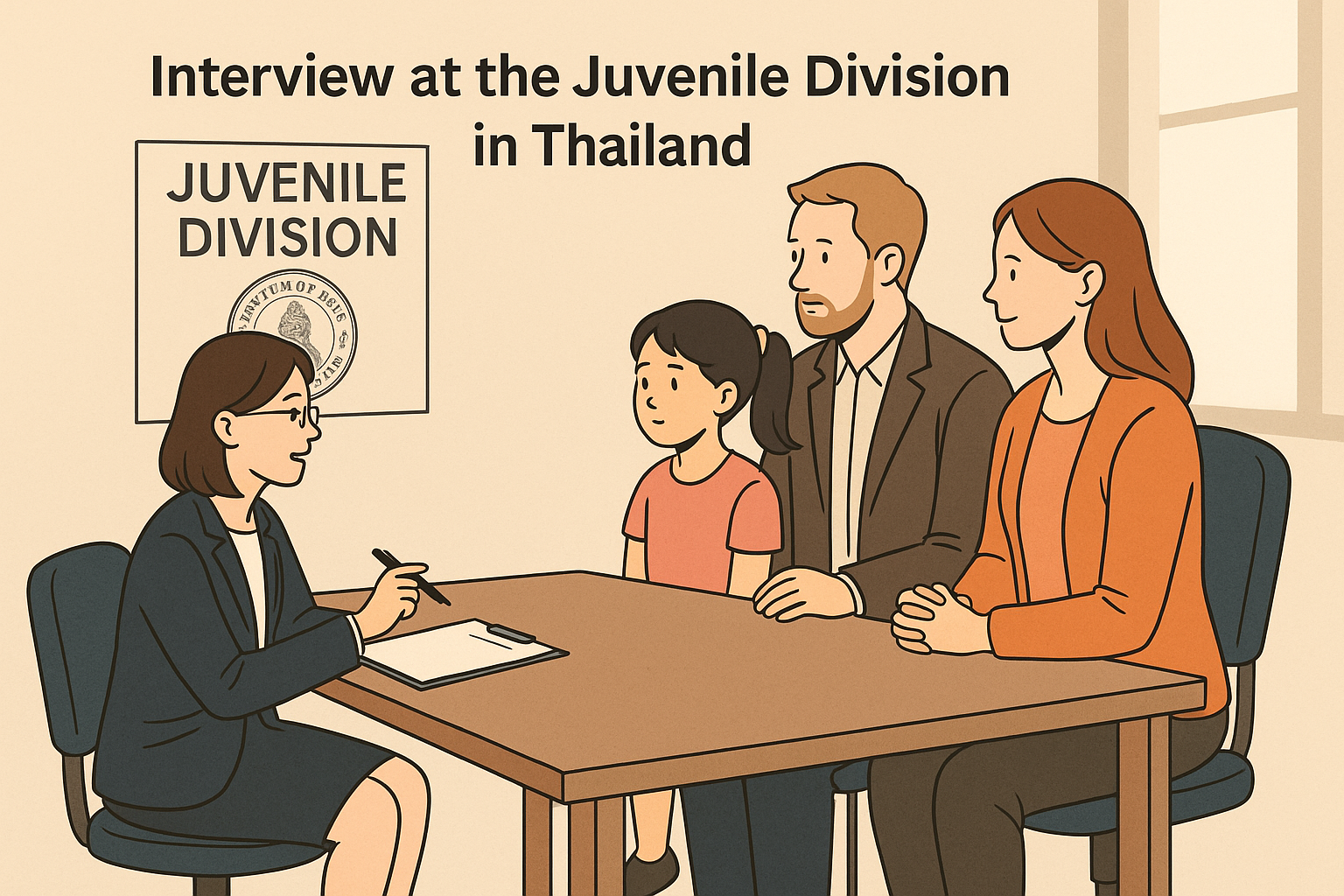
Under Section 1520 of Thailand’s Civil and Commercial Code (CCC), the court deciding custody in a divorce must give primary weight to the child’s happiness and interests. Section 167 of the Juvenile and Family Court and Juvenile and Family Procedure Act B.E. 2553 (2010) requires the court, whenever a family case involves a minor’s interests, to notify the local Observation and Protection Centre, whose director reports to the court on the family’s circumstances and the child’s welfare, wishes and best interests. This helps protect children from harm and ensures they have stable homes. This guide is made to help parents, especially foreigners and expats, prepare well. Interviews can be scary, especially if you don’t speak Thai well or know the system. However, good preparation can help a lot. In practice your lawyer is not usually in the room for the interview itself, so professional advice beforehand is invaluable.
Table of Contents
Understanding the Juvenile Division Interview
Interview at the Juvenile Division in Thailand
The Observation and Protection Centre (สถานพินิจ), part of the Department of Juvenile Observation and Protection in the Ministry of Justice (section 34 of the 2010 Act), conducts these interviews through its social workers to evaluate parental fitness and family circumstances. Each case is unique, and interviews typically last 1 to 3 hours. Factors influencing the duration and focus include:
- The location of the application (e.g., Bangkok vs. provincial courts).
- The assigned social worker or officer.
- The case type (e.g., divorce, custody disputes, or surrogacy-related legitimization).
- How you present yourself and answer questions.
| Focus | What officers review | What parents prepare |
|---|---|---|
| Parental ability | Daily care, parenting involvement, stability | Income proof, daily routine, photos with child |
| Home environment | Suitable housing, safe location, family support | Lease or house book, household members, proof of residence |
| Child wellbeing | Health, education, emotional development | School records, medical info, insurance, vaccination record |
| Foreign parent factors | Long-term plans in Thailand, legal stay, cultural adaptation | Passport, visa, interpreter, proof of long-term residency plans |
The goal is to create a report for the judge. This report will focus on the child’s best interests. It will cover emotional, physical, financial, and educational needs. For foreigners, officers may scrutinize long-term plans in Thailand, visa status, and cultural integration to ensure stability.
Importance of Preparation
Preparation demonstrates your commitment and reliability. Arrive 15 minutes early to show punctuality, a valued trait in Thai culture. Dress conservatively: opt for long sleeves, closed-toe shoes, and avoid casual items like flip-flops, shorts, or revealing clothing. This conveys respect and professionalism.Turn off your mobile phone to stay focused, distractions can be seen as disinterest. If you are a foreigner and do not speak Thai well, bring a certified interpreter.
A friend is not enough to ensure clear communication. Misunderstandings could negatively impact the report. Expats should get ready for questions about living in Thailand. Officers will check if the child can thrive in a multicultural setting. If you have witnesses, like a family member, friend, or nanny, bring them with you. They might be asked questions for 15 to 30 minutes to support your story, but this is not guaranteed.
Essential Documents to Bring for the Interview at the Juvenile Division in Thailand
Thai government offices emphasize evidence, so come prepared with tangible proof. Bring two copies of everything: one for the Juvenile Division and one for your interpreter (or to keep as a record). Key documents include:
- Identification: Copy of your passport (and visa/work permit for foreigners, to prove legal residency).
- Housing: Lease agreement, title deed, or rental contract showing a stable living environment.
- Education and Qualifications: Copies of degrees or certificates to demonstrate your background and stability.
- Family and Relationship Proof: Include the child’s birth certificate and photos of you with the child. These can be from family outings or daily life, showing a strong bond.
- Financial Evidence: Proof of income (e.g., bank statements, pay slips, tax returns, especially important for expats with overseas earnings).
- Health and Welfare: Medical reports, insurance details, or vaccination records for the child.
- Other: Any court-related documents, school records, or letters from teachers/doctors attesting to your parenting.
For surrogacy cases, do not bring surrogacy agreements unless asked. This could cause legal issues under Thai surrogacy laws. These laws ban commercial surrogacy according to the Protection of Children Born from Assisted Reproductive Technologies Act B.E. 2558. If you can, print photos and documents in color. Also, organize them neatly. If the division claims they lack prior submissions, having extras ensures nothing is missed.
Frequently Asked Questions During the Interview
Questions differ by case. Some focus on money, while others look at relationships or parenting. All questions aim to see if you can create a nurturing environment. They reflect the parents’ duty to maintain and educate the child (CCC section 1564) and, in a divorce, section 1520. Officers are trained to detect inconsistencies, so answer honestly and calmly. As a foreigner, be prepared to explain cultural differences, like discipline styles, without getting defensive. I have listed possible questions below. These are based on common experiences in custody, divorce, and legitimization cases. This list is non-exhaustive (drawn from real cases) and includes tips for expats.
Personal and Family Background
- Can you introduce yourself, including your name, address, profession, family details, and siblings?
- Describe your educational background and any relevant qualifications.
- When and where did you first meet the child’s other parent? What led to your decision to have a child together?
- Why did your relationship end, or why are you seeking a divorce/custody?
- When did you first visit Thailand, and what was the purpose? How long after was your second visit, and what places did you explore?
- When did you move to Thailand, and for what reason (e.g., work, family)? Tip for expats: Mention your visa type and long-term plans to show commitment.
Living and Financial Situation
- What is your current employment status, monthly/annual salary, and sources of income?
- How much financial support do you provide for the child monthly? Do you have documentation (e.g., receipts, bank transfers)?
- Who paid for the hospital expenses when the child was born?
- Describe your living arrangements, neighborhood, and why it’s suitable for a child. Tip for expats: Highlight safety features, proximity to international schools, and how you’ve adapted to Thai living.
Childcare and Parenting Plans
- Who assists with childcare? If seeking sole custody, explain your support system (e.g., nanny, family).
- Who will care for the child while you’re working? Who has cared for them previously?
- Describe your daily routine and how the child fits into it.
- How do you plan to address the child’s educational needs (e.g., school choice, costs)?
- What are your child-rearing philosophies, including discipline methods?
- What medical care and insurance will you provide for the child?
- What are the child’s hobbies and interests, and how do you support them?
- How will you facilitate the child’s relationship with their other parent and extended family? Tip for expats: If the other parent is abroad, discuss video calls or visitation plans to show cooperation.
Future and Stability
- What are your long-term plans for residing in Thailand or elsewhere? Tip for expats: Address visa renewals or relocation risks honestly.
- Describe your relationship with the child’s extended family on both sides.
- Have there been any previous legal issues, child welfare concerns, or disputes that need disclosure (e.g., prior court cases)?
- Why are you pursuing legal action for custody now?
- How do you handle conflicts or stress in parenting?
- If applicable, explain any cultural or language barriers and how you’ll overcome them for the child’s benefit.
Prepare concise, evidence-backed answers. For example, if asked about income, reference your documents immediately.
Should the Child Attend the Interview?
It’s not always required, especially for infants. However, if the child is old enough to communicate (e.g., 2-10 years or older), bringing them can help officers observe your bond. They may ask the child simple questions (e.g., “Do you like spending time with Mommy/Daddy?”). For very young children, bring a nanny or family member to assist, these individuals can also serve as witnesses.
Special Cases: Surrogacy and Other Scenarios
In surrogacy cases, like when establishing parental rights after surrogacy, the surrogate may need to attend. The questioning can vary; some are short, while others may not happen at all. Focus on being a caring parent. Avoid talking about money, as Thai law has strict rules on surrogacy. In divorce cases with older children, there will be more focus on emotional effects. In international custody disputes, officers may reference the Hague Convention (if applicable) to prevent child abduction risks.
Practical Tips for a Successful Interview
- Be Honest and Composed: Officers detect dishonesty easily, stick to the truth to build trust.
- Cultural Sensitivity: Thai officials value politeness; use “wai” greetings and avoid confrontation.
- For Foreigners: If on a non-immigrant visa, explain how it supports family stability. Practice with an interpreter beforehand.
- Backup Plans: Interviews may involve waiting for a stenographer, bring water/snacks.
- Post-Interview: The report goes to the judge, and the court must tell the parties what the director’s opinion is. You have the right to object to it and to bring evidence to rebut it (section 167, last paragraph), so if the report is wrong, consult a lawyer immediately.
Last reviewed: 27 September 2026. Read in Thai: Civil and Commercial Code sections 1520, 1548, 1564 and 1566; Juvenile and Family Court and Juvenile and Family Procedure Act B.E. 2553, sections 34, 50, 51 and 167 (current consolidated text on law.go.th). Interview length, dress, documents, the question list and whether a lawyer may sit in are practice guidance, not rules we found in the Act.
What is the Juvenile Division interview in Thailand and who must attend?
The Juvenile Division, part of the Juvenile and Family Court system, conducts interviews. These interviews assess parental fitness and family situations. They are important for issues like joint or sole custody, child legitimization, and divorce involving children. Sessions usually last 1 to 3 hours. A social worker will review your living situation, caregiving routine, finances, and long-term plans in Thailand. This is to make sure decisions follow the “best interests of the child” standard. This standard comes from Section 1520 of the Civil and Commercial Code (CCC), and the report itself is required by section 167 of the Juvenile and Family Court and Juvenile and Family Procedure Act B.E. 2553 (2010). Parents and sometimes supporting witnesses (e.g., nanny, relative) may be called; the officer compiles a report for the judge.
Which documents should I bring to the Juvenile and Family Court interview in Thailand?
Please bring two sets of organized and clearly labeled copies. Include your identification, such as a passport or visa/work permit. Also, bring your child’s birth certificate. You will need proof of housing, like a lease, title deed, or house book/tabien baan. Include proof of income, such as bank statements, pay slips, or tax returns. Bring school and daycare records, as well as medical and vaccination records. Don’t forget your health insurance information. Include photos that show your bond with the child and any relevant court filings. For foreign parents, provide proof of legal stay and stability. This can include a non-immigrant visa, work contract, or long-term residency plans. Printed color photos and a succinct contents list help officers review faster.
Can my lawyer attend the Juvenile Division interview, and do I need an interpreter?
In practice, lawyers are not usually in the room during the interview. However, it is very important to prepare beforehand. If you don’t speak Thai confidently, arrange a certified Thai interpreter; a friend is not sufficient. Clear communication prevents misunderstandings that could affect the social inquiry report. Turn off your phones, arrive 15 minutes early, and dress modestly. These small signs of being on time and respectful are important in Thai administrative culture.
How do Thai courts decide custody, parental power, and legitimization outcomes?
Officers and judges prioritize the child’s welfare, happiness, and development (CCC section 1520, and the parents’ duties under section 1564). They look at several factors. These include daily caregiving, home stability, and financial ability. They also consider health and school plans. Lastly, they think about support for the child’s relationship with the other parent. For legitimization (recognizing a father’s parental rights), consistency of involvement and proof of support weigh heavily. Foreign-parent factors, like visa status, cultural adaptation, and long-term residence plans, are examined. This is done to ensure stability and continuity for the child.
Should my child attend, and what special cases (e.g., surrogacy or cross-border issues) are handled?
Attendance is not always required, especially for infants. However, older children may be invited. This allows officers to see the parent-child bond and ask questions that are right for their age. In surrogacy cases, do not submit surrogacy contracts unless asked. Thailand has rules against commercial surrogacy. This is under the Protection of Children Born from Assisted Reproductive Technologies Act B.E. 2558. For international custody, officers may look at travel risks. They may also consider cross-border safeguards. These safeguards are often discussed with the Hague Convention’s principles to prevent abduction. Be ready to show practical plans for visitation, school continuity, and healthcare in Thailand.
Final Thoughts and Professional Assistance
This interview is mainly about protecting the child’s best interests according to Thai law. This includes CCC Section 1520 and section 167 of the Juvenile and Family Court Act. By preparing well, you show your commitment as a parent. This increases the chances of a good outcome. At ThaiLawOnline, we focus on family law for both expats and locals.
We can’t join the interview, but our team offers personalized prep sessions. We also do document reviews and post-interview strategies. These help with custody, divorce, or legitimization processes. Contact us today for expert help. We can protect your rights and your child’s future. For more resources, visit the Ministry of Justice website or check with the Thai Bar Association. Remember, this guide is informational; seek professional legal advice for your specific case.
Links: Juvenile and Family Court in Thailand
Thai Law Updates, free by email
Plain-English updates on Thai law changes that affect foreigners: property, visas, marriage, business and wills. One short email a month from a firm practicing since 2006. No spam, unsubscribe anytime.