


Reviewed by ThaiLawOnline, a licensed Thai law firm practising in Thailand since 2006. Thai lawyer of record: Wichuda Atthamethakon, LL.M., Thai Bar Licence 3149/2556.
Last updated on
Thailand’s criminal justice system works differently from many Western systems. It is important for expatriates to know the procedures, rights, and expectations when facing criminal charges. This comprehensive guide explains the key aspects of Thai criminal trial procedures to help expats navigate the system effectively. Disclaimer: This guide is for general informational purposes only and is not legal advice. Thai criminal law changes regularly, and procedures may vary between courts. For advice on your specific situation, consult a licensed lawyer in Thailand.
Table of Contents
These procedures sit inside the wider framework explained in our guide to criminal law in Thailand.
Last reviewed: 21 September 2026. Every statutory citation on this page was read in Thai against the Penal Code (sections 29, 30 and 56) and the Criminal Procedure Code (sections 66, 78, 80, 87, 117, 193 bis and 229/1), and all of them check out, including the 500 baht per day rate for detention in lieu of a fine, the one year cap and the two year extension where the fine is 200,000 baht or more, and the full detention ladder of 48 hours, then 7, 48 and 84 days. Supreme Court Decision 736/2569 was read in full to its disposition: the juvenile record was properly weighed because the case was not before a Juvenile and Family Court, and the Court then suspended the sentence for two years because the defendant had repaid 20,000 baht against an 8,500 baht loss. Not verified here: the bail provision of the Constitution, the Electronic Transactions Act point, the rule on authenticating foreign documents, the stated processing times, and the section on recent reforms. Re-checked on 10 October 2026: section 29 of the Constitution B.E. 2560 read in Thai (a bail request must be considered, security may not be excessive, and refusal must rest on law), which matches; section 11 of the Electronic Transactions Act and its amendment history (2008, and Nos. 3 and 4 of 2019) read on the government’s central law register, and the reforms paragraph and the electronic-evidence line now state what section 11 provides, without the unsourced claim that further updates were proposed in 2024; Civil Procedure Code sections 46 and 47 and Criminal Procedure Code sections 13 and 15 read in Thai, and the statement that all foreign documents must be authenticated was narrowed to what section 47 requires. Still unverified: the processing times and the rest of the recent-reforms section.
Juvenile records in adult proceedings (Dika 736/2569)
Section 84 of the Juvenile and Family Court Act shields a child from having earlier proceedings held against them. Practitioners have long argued that the shield travels with the person into adulthood. Supreme Court Decision (Dika) No. 736/2569 holds that it does not.
The protection is forum-specific. It operates inside the Juvenile and Family Court. Once the same individual is an adult standing trial in an ordinary criminal court, the juvenile record is fully admissible against them. It can be placed before the court on sentencing, and it can be the reason a suspension under Section 56 is refused.
The practical lesson runs backwards in time. A matter disposed of quickly in the juvenile forum is not disposed of permanently. Anyone advising a young client in Thailand should assume the record will resurface.
The same decision sets the counterweight on the other side of the scale. Restitution paid above the victim’s actual loss is what moves a court to suspend a sentence, and it can outweigh an adverse record. See our case note on Dika 736/2569.
Understanding the Thai Criminal Justice System
Thailand has a civil law system. This system is based on written laws. It is mainly guided by the Criminal Procedure Code B.E. 2477 (1934) and the Thai Penal Code. Unlike common law countries, Thai courts do not follow past decisions. However, Supreme Court rulings can still affect case outcomes. The system does not allow jury trials. All criminal cases are decided only by judges. Judges find the facts and apply the law.
The Thai Constitution B.E. 2560 (2017) sets important rules. It includes the presumption of innocence until proven guilty. It also guarantees the right to a fair trial. These constitutional protections apply equally to all individuals in Thailand, regardless of nationality.
Recent Reforms and Updates in Thai Criminal Procedure
Thailand’s criminal justice system continues to evolve to meet international standards. The 2017 Constitution strengthened protections like the right to a speedy trial and access to justice. The Electronic Transactions Act B.E. 2544 (2001), amended in 2008 and twice in 2019, recognises electronic data and signatures. Since the 2019 amendment, section 11 says in terms that a court may not refuse electronic data as evidence in a civil, criminal or any other case merely because it is electronic, and that the same applies to printouts of it. That covers emails, chat messages, social media posts and CCTV recordings, which matters to expats in online disputes or surveillance cases.
Initial Arrest and Detention Procedures
Arrest Authority and Procedures
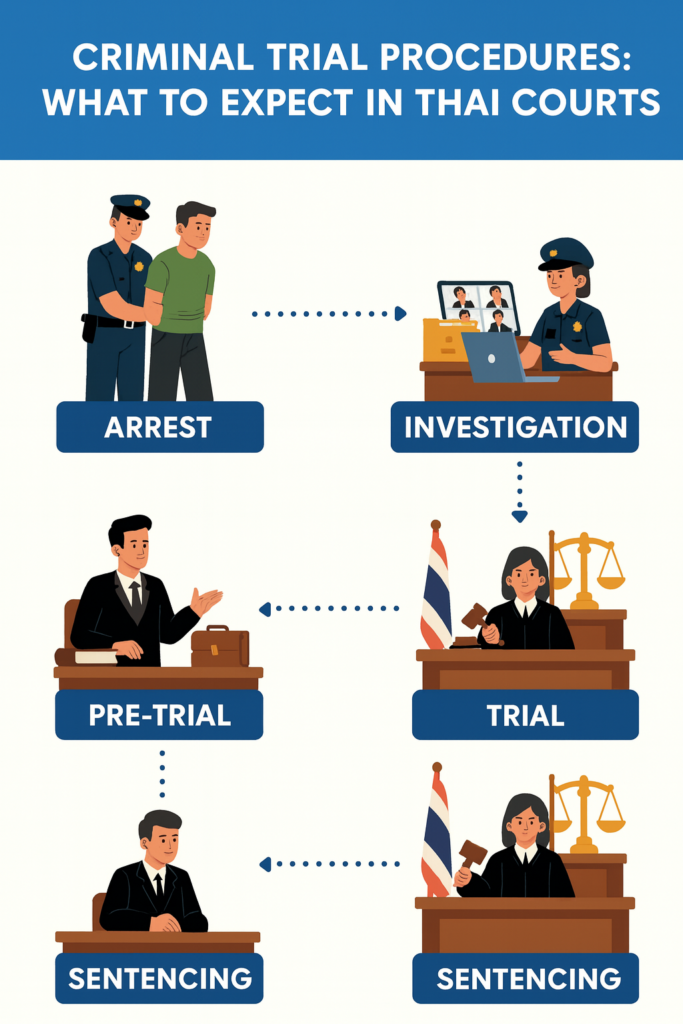
Thai police can arrest people with or without a warrant in certain situations. Section 78 of the Criminal Procedure Code sets out when police or administrative officers may arrest without a warrant, and section 80 defines a flagrant offence. A warrantless arrest is permitted only where:
- A person is committing a flagrant offence, as defined in section 80
- Someone is found in suspicious circumstances suggesting they are about to cause harm to people or property, carrying a tool, weapon or other object that could be used to commit an offence
- There are grounds for a warrant under section 66(2), but the matter is too urgent to ask the court for one
- A suspect or defendant has escaped, or is about to escape, while on provisional release (section 117)
Upon arrest, police must:
- Inform you that you are being arrested
- Explain the charges against you
- Tell you that you may remain silent or give a statement, and that what you say may be used as evidence at trial
- Tell you that you have the right to meet and consult a lawyer
- Let you inform a relative or a person you trust of the arrest, where this is practicable and safe
Detention Time Limits
Following arrest, Thai law establishes strict time limits for detention:
Initial Police Custody: Up to 48 hours from arrival at the investigating officer’s station before being brought before a court, unless force majeure or another unavoidable necessity prevents it (section 87).
Court-Ordered Detention: After the initial 48 hours, further detention requires judicial authorization with specific limits based on offense severity.
- Minor offenses (up to 6 months imprisonment or 500 THB fine): one detention order of no more than 7 days
- Moderate offenses (6 months to 10 years imprisonment): Multiple 12-day periods, maximum 48 days total
- Serious offenses (10+ years imprisonment): Multiple 12-day periods, maximum 84 days total
The 84 days are the ceiling for the most serious offences. Section 87 adds no further period for the prosecutor: if the case is not filed in court within the court-ordered detention, the suspect must be released. Beyond the first 48 days, each further order also requires the investigator or prosecutor to show necessity and produce evidence to the court.
Investigation Stage and Evidence Gathering
Police Investigation Process
The investigation phase involves evidence collection by police or administrative officials under their statutory authority. During this stage, suspects have important rights:
- Right to remain silent is crucial during any criminal prosecution to ensure that individuals are aware of their rights. without self-incrimination
- Right to legal counsel during questioning
- Right to interpreter services if not fluent in Thai
Prosecutorial Review
Upon completion of investigation, police submit their findings to the Public Prosecutor who determines whether to:
- File formal charges in court
- Issue a non-prosecution order
- Order continued investigation
The prosecutor must make this decision within the maximum detention period or the suspect must be released.
Pre-Trial Proceedings and Bail Applications
Bail Rights and Procedures
All people charged with crimes have the constitutional right to apply for bail under Section 29 of the Thai Constitution. However, bail is not automatically granted and depends on judicial discretion. We have an extensive article about bail in Thailand and you should have a look.
Trial Procedures and Court Structure
Court System Hierarchy
Thailand’s criminal courts operate through a three-tier system:
- Court of First Instance: Initial trial court where most criminal cases begin
- Court of Appeal: Reviews decisions from lower courts
- Supreme Court (Dika Court): Final appellate jurisdiction
Language Requirements and Translation
All criminal proceedings are conducted exclusively in Thai language. Foreign defendants have the right to:
- Court-appointed interpreters during all proceedings
- Translation of some documents (not all) into their native language
- Certified translation services for evidence and legal documents
Recent reforms emphasize professional interpretation standards, requiring complete and accurate interpretation without summarization or omission.
Evidence and Discovery Rules
Thai criminal procedure includes limited discovery compared to common law systems. Key evidence rules include:
- Witness and evidence lists: The prosecution must file its list at least 15 days before the preliminary examination or the first day of evidence; the defence files its list before the defence evidence is heard (section 229/1)
- Documentary evidence standards: A document in a foreign language must be filed with a certified Thai translation of the whole or of its material parts, as the court orders (Civil Procedure Code section 46, applied in criminal cases by section 15 of the Criminal Procedure Code). A power of attorney or similar certificate made abroad must be witnessed by a Thai consul or, where there is none, by a notary public or other authorised official with the foreign government’s certificate of that authority, when the court or the other side has reason to doubt it is genuine (section 47)
- Electronic evidence: May not be refused merely because it is electronic (Electronic Transactions Act B.E. 2544, section 11); its weight depends on how reliably it was created, stored and kept unaltered
- Judicial discretion: Judges may admit or exclude evidence based on relevance and legal standards
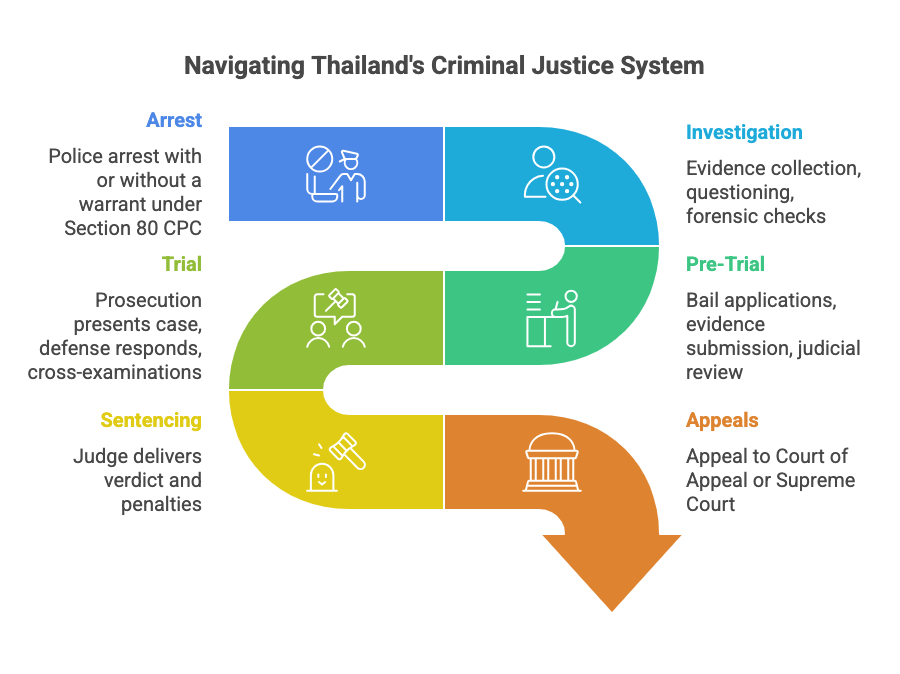
| Stage | Key Actions | Time Limits | Rights of Defendant |
|---|---|---|---|
| Arrest | Police arrest with or without a warrant under sections 78 to 83 CPC | Must be brought before a court within 48 hours of arriving at the station (section 87) | Right to be informed of charges, remain silent, contact family or lawyer |
| Investigation | Evidence collection, questioning, forensic checks | Within maximum detention period (up to 84 days for the most serious offences) | Right to remain silent, have legal counsel, interpreter if needed |
| Pre-Trial | Bail applications, evidence submission, judicial review | Bail decisions made quickly | Right to apply for bail, present evidence, challenge prosecution |
| Trial | Prosecution presents case, defense responds, cross-examinations | Continuous until completion | Right to interpreter, present witnesses, cross-examine |
| Sentencing | Judge delivers verdict and penalties | Sentencing immediately or later | Right to appeal, request suspended sentence (if eligible) |
| Appeals | Appeal to Court of Appeal or Supreme Court | Within 1 month of judgment | Right to legal counsel, file written appeal grounds |
Trial Process
Criminal trials follow an adversarial system with the following sequence:
- Entry of Plea: Defendant enters guilty or not guilty plea
- Prosecution Case: State presents evidence and witnesses first
- Defense Case: Defendant presents counter-evidence and witnesses
- Cross-examination: Both sides may question opposing witnesses
- Closing Arguments: Final statements from prosecution and defense
- Judgment: Court renders verdict and sentencing decision
Rights of Defendants, Especially Expats
Fundamental Constitutional Rights
All defendants in Thailand, including foreigners, enjoy constitutional protections:
- Right to remain silent and avoid self-incrimination
- Right to legal counsel at all stages of proceedings
- Right to be informed of charges in understandable language
- Right to present evidence and witnesses
- Right to cross-examine prosecution witnesses
- Right to bail consideration
- Right to appeal adverse decisions
Special Considerations for Foreign Defendants
Expatriates face unique challenges requiring additional protections:
- Embassy notification rights: Right to contact home country embassy or consulate
- Language assistance: Mandatory interpreter services during all proceedings
- Cultural considerations: Judges may take your background into account, for example in sentencing, but no rule requires it
- Extended trial duration: Foreign defendants may request permission to travel during lengthy proceedings
Immigration Issues for Expats: Criminal charges can affect immigration status. This may lead to visa loss or deportation under the Immigration Act B.E. 2522 (1979). If you have a marriage visa, you could face problems if you have family-related charges. For instance, charges like domestic violence may result in immigration holds. These holds can happen even after you are released from criminal charges. Notify your embassy immediately, as they can assist with coordinating between authorities. Our team at ThaiLawOnline has helped many expats navigate these dual proceedings to avoid unnecessary detention or expulsion
Sentencing and Penalties
Types of Punishments
The Thai Penal Code establishes five categories of punishment:
- Death penalty (for the most serious offenses)
- Imprisonment (terms varying by offense severity)
- Confinement (lighter form of custody)
- Fines (monetary penalties)
- Forfeiture of property
Sentencing Considerations
Thai courts consider multiple factors during sentencing:
- Offense severity and circumstances
- Defendant’s criminal history
- Age, education, and background
- Cooperation with authorities
- Potential for rehabilitation
Suspended sentences may be available where the court would impose imprisonment of five years or less and the offender has not been imprisoned before, or only for negligence, a petty offence or up to six months (Penal Code section 56).
Fine Payment and Enforcement
Defendants sentenced to fines must pay within 30 days of judgment. If the fine is not paid in time, the defendant’s property must be seized or claims attached to pay it, or failing that the defendant is confined in lieu of the fine (Penal Code section 29).
- Property seizure to satisfy the fine
- Detention in lieu of fine at a rate of 500 THB per day, under Penal Code section 30. Confinement is capped at one year, or two years where the fine is 200,000 baht or more.
- Maximum detention period of 1-2 years depending on fine amount
Appeals Process in Criminal Trial Procedures in Thailand
Appeal Rights and Timelines
Defendants have the right to appeal criminal convictions within one month of judgment being read. However, appeals are subject to certain restrictions:
Limited factual appeals: Where the maximum penalty for the offence is three years’ imprisonment or less, or a fine of 60,000 baht or less, you cannot appeal on the facts (section 193 bis). The exceptions are a sentence of imprisonment or confinement in its place, a suspended sentence, a finding of guilt with punishment deferred, and a fine of more than 1,000 baht. Appeals on points of law remain open.
Appeal process stages:
- Court of Appeal: Reviews first instance decisions
- Supreme Court: Final review through “Dika appeal” process
- Written submissions: Appeals must contain detailed grounds and legal arguments
Appeal Processing Times
Recent reforms establish specific timeframes for appeal consideration:
- Court of Appeal: Typically 8 months to 2 years for case resolution
- Supreme Court: One year maximum for most cases, with exceptions for complex matters
Since January 2023, the guidance suggests about 6 to 12 months for the Court of Appeal. For the Supreme Court, it is about one year, with some exceptions. There is nothing automatic.
Legal Representation
Right to Counsel
Thai law guarantees the right to legal representation throughout criminal proceedings. Key aspects include:
Court-appointed counsel: Where the offence carries the death penalty, or the defendant was not over 18 on the day the charge was filed in court, the court must appoint a lawyer if the defendant has none; in any case punishable by imprisonment it appoints one if the defendant has none and asks for one (section 173, and section 134/1 at the investigation stage)
Private representation: Defendants may hire private attorneys at any stage of proceedings
Language considerations: Foreign defendants should seek bilingual lawyers familiar with both Thai law and their home country’s legal systems
Choosing Legal Counsel for Criminal Trial Procedures in Thailand
When selecting criminal defense counsel, expatriates should consider:
- Experience with Thai criminal law and procedures
- Language capabilities for effective communication
- Track record with foreign client representation
- Understanding of cultural differences in legal systems
- Availability for extended proceedings
Key Differences from Western Systems
Structural Differences
Thai criminal procedure differs significantly from common law systems:
- No jury system: Judges decide all questions of fact and law
- Civil law foundation: Based on codified statutes rather than precedent
- Judicial discretion: Broader judge authority in evidence and procedure decisions
- Continuous trial system: Hearings proceed without interruption until completion
Procedural Variations
- Limited discovery: Restricted access to prosecution evidence before trial
- Different bail standards: More restrictive approach, especially for foreigners
- Longer potential pre-trial detention: Up to 84 days in court-ordered detention before the case is filed
- Mandatory interpreter services: Required by section 13 of the Criminal Procedure Code for anyone who cannot speak or understand Thai
Practical Advice for Expats
Immediate Actions Upon Arrest
If arrested in Thailand, expatriates should:
- Remain calm and respectful to avoid escalating the situation
- Exercise right to remain silent until legal counsel is present
- Request interpreter services if not fluent in Thai
- Contact embassy or consulate for assistance and notification
- Avoid signing documents without legal advice and translation
- Request legal counsel immediately and decline questioning without representation
Pre-Trial Preparation
During pre-trial detention or release on bail:
- Maintain communication with legal counsel
- Gather supporting evidence and witness information
- Understand charge implications and potential penalties
- Comply with all bail conditions to avoid revocation
- Prepare for potential language barriers in court proceedings
Trial Preparation
Before trial proceedings:
- Review evidence lists with legal counsel
- Prepare witness testimony and supporting documentation
- Understand court procedures and expected timeline
- Arrange for qualified interpreters if needed beyond court-appointed services
- Consider cultural factors that may affect case presentation
Real-Life Examples for Expats in Thai Criminal Cases
Consider a common scenario: An expat teacher accused of assault in a bar altercation. Without good legal help, they could spend up to 48 days in detention before charges are filed (assault under section 295 carries at most two years, which puts it in the 48-day band of Criminal Procedure Code section 87). However, with a strong bail application, they might be released in just a few days. This application should include proof of community ties and a Thai guarantor. In another case, a business owner accused of fraud used emails to prove their innocence. This led to a decision not to prosecute.
These examples highlight why early intervention matters. If you are married to a Thai partner and facing family dispute charges, cultural misunderstandings can make things harder. Our bilingual lawyers can help you with this.
FAQs about Criminal Trial Procedures in Thailand
How does the Thai criminal justice system work for foreigners (civil law, no jury, presumption of innocence)?
Thailand uses a civil law system based on written laws. These include the Criminal Procedure Code, the Thai Penal Code, and the Constitution from 2017. There are no jury trials; panels of career judges find facts and apply the law. All defendants, including expats, benefit from the presumption of innocence and the right to a fair trial. This means cases go through the Court of First Instance. If there is an appeal, they move to the Court of Appeal. Finally, they go to the Supreme Court (Dika). Since precedent is persuasive and not binding in Thailand, Supreme Court rulings can affect outcomes. However, lower courts do not have to follow past decisions strictly. For searchers comparing systems, think “civil law, judge-led trials, codified rules, and strong judicial discretion.
What are my rights on arrest in Thailand and what happens in the first 48 hours?
Police can make arrests with a warrant. They can also arrest without a warrant in certain situations. These situations include catching someone in the act, urgent need, or if the person might escape. When you are arrested, you must be told why. You should know the charges against you. You have the right to remain silent. You can contact your family or a lawyer. If you don’t speak Thai, you should get an interpreter. After you arrive at the investigating officer’s station, the 48-hour clock starts. You must see a judge within that time for a detention review. In this early “inquiry” phase, use your right to have a lawyer. Do not sign documents that are not translated. Also, ask for consular notification under the Vienna Convention on Consular Relations (Article 36).
How long can Thai police and courts detain a suspect before filing charges (7, 48, 84 days)?
After the first 48 hours, more detention needs a court order. The length of detention depends on the offense. Minor offenses allow one order of up to 7 days. Mid-range offenses can be held for 12-day blocks, up to 48 days. Serious offenses can be held for 12-day blocks, up to 84 days. There is no extra period for prosecutors: 84 days is the ceiling. If the case is not filed within the court-ordered detention, the suspect must be released. For expats, remember that immigration holds are different from criminal remand. Talk to your lawyer about any possible “overstay” or visa problems that could affect your release.
How does bail work in Thailand for expats, and what securities are accepted?
Bail is a constitutional right to apply (not an automatic release). Judges weigh charge severity, strength of evidence, flight risk, potential witness/evidence interference, and community ties. Foreign defendants often have to give up their passports. They may also face higher security amounts and travel bans. Leaving Thailand while on bail needs the court’s permission, and immigration is notified. Courts accept different types of securities. These include cash, bank books, fixed deposits, land title deeds, and sometimes government job guarantees. A good petition will have proof of where you live, your job, medical needs, and a Thai guarantor. This “flight-risk mitigation package” can greatly improve your chances.
What is the Thai criminal trial process and how is evidence handled (discovery, electronic evidence, interpreters)?
Trials are adversarial but judge-driven. After the plea, the prosecution presents first, followed by the defense case, cross-examination, closing arguments, and judgment/sentencing. Discovery is more limited than in common-law systems. Each side must file witness and evidence lists: the prosecution at least 15 days before its evidence is heard, the defence before its own evidence (section 229/1). The court has wide discretion on what evidence is allowed and when to schedule it. Foreign-language documents must be filed with a certified Thai translation, and a power of attorney made abroad must be legalised if the court or the other side has reason to doubt it. Electronic evidence, like emails, chats, metadata, CCTV, and phone extractions, can be used in court. This is allowed under the Electronic Transactions Act B.E. 2544. However, it must be reliable and follow the chain of custody. All court proceedings are in Thai. Court-appointed interpreters are available. The modern standard is to provide complete and accurate interpretation without summaries.
What sentences and fines can Thai courts impose, and how do suspended sentences and fine enforcement work?
Available penalties include death (for the gravest crimes), imprisonment, confinement, fines, and forfeiture. Judges assess offense gravity, circumstances, criminal history, age/education, cooperation, and rehabilitation prospects. Offenders the court would sentence to five years or less, who have not been imprisoned before (or only for negligence, a petty offence or up to six months), may be eligible for a suspended sentence or probation. Fines must be paid within the court-set period (often 30 days). If the fine is not paid, the state may take property. They can also change the fine to detention. This is done at a rate of 500 THB per day (Penal Code section 30). There is a maximum time limit based on the fine amount. Defendants can request installment payments or time extensions with cause.
How do criminal appeals work in Thailand (Court of Appeal & Supreme Court/Dika) and how long do they take?
You generally have one month from pronouncement of judgment to file an appeal. The Court of Appeal looks at legal issues and, in some cases, factual issues. A further appeal to the Dika (Supreme Court) can happen on certain grounds. Timelines can be different based on complexity. The courts’ published target is about 6 to 12 months at the Court of Appeal, though complex appeals take longer. Dika review usually aims to be done in about a year for standard cases. Appeals are made through written submissions. These include transcripts, documents, and specific legal arguments. It is important to keep objections and evidence issues during the trial. This helps ensure they are considered in the appeal.
Conclusion
Understanding Thai criminal trial procedures is essential for expatriates living in or visiting Thailand. The system is based on civil law and does not have jury trials. It also has special protections for foreign defendants. This creates a unique legal environment. It is important to navigate this carefully with help from a qualified lawyer.
Key principles for expats to remember include: exercising constitutional rights to remain silent and obtain legal counsel. But also understanding the importance of interpreter services and document translation, recognizing the potential for extended pre-trial detention periods. Lastly, appreciating the significant judicial discretion in Thai criminal proceedings.
The Thai criminal justice system offers basic protections for all defendants, no matter their nationality. However, the procedures can be complex, and cultural differences exist, which can affect how courts of justice handle cases. This makes having a lawyer very important for getting fair and just results. Getting help from a qualified bilingual lawyer who knows Thai law and international legal rules is important. This support gives you the best chance to succeed in Thai criminal trial procedures.
By knowing these procedures and rights, expatriates can protect themselves better in the event of a criminal complaint. They can also make informed choices when dealing with the Thai criminal justice system. This helps ensure their constitutional protections are kept during the legal process.
Thai Law Updates, free by email
Plain-English updates on Thai law changes that affect foreigners: property, visas, marriage, business and wills. One short email a month from a firm practicing since 2006. No spam, unsubscribe anytime.