Last updated on April 12, 2026
We know this page is long – But it is intentional
TL;DR: Superficies in Thailand is a legal right. It allows someone, often a foreigner, to own and register a building, structure, or plantation on land they do not own. It can last up to 30 years, or for the owner’s life. It is transferable and can be inherited. It must be registered to be enforceable. This article aims to include all the information we have about superficies. We want to be the best source on the internet.
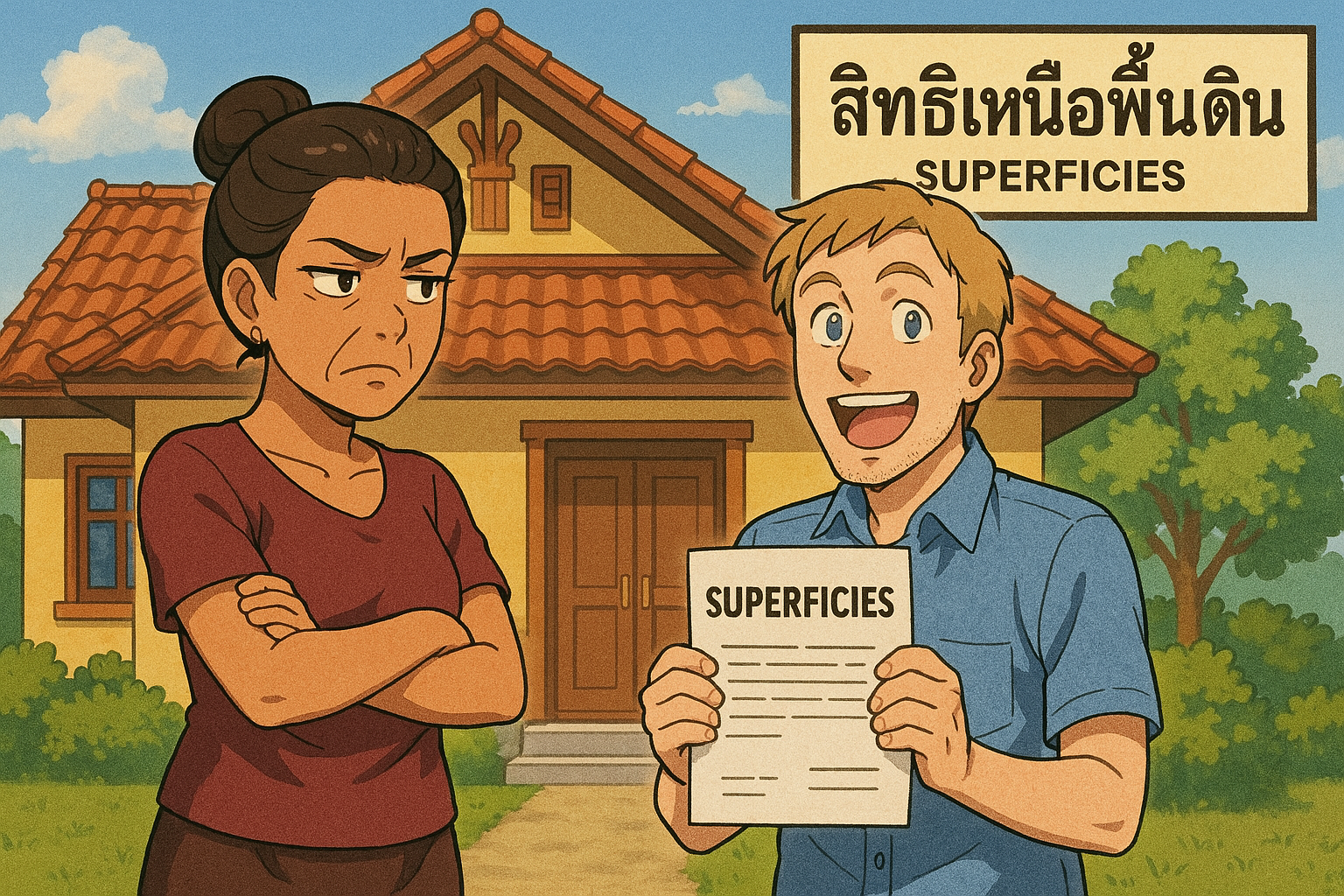
Key Takeaways about Superficies Rights in Thailand:
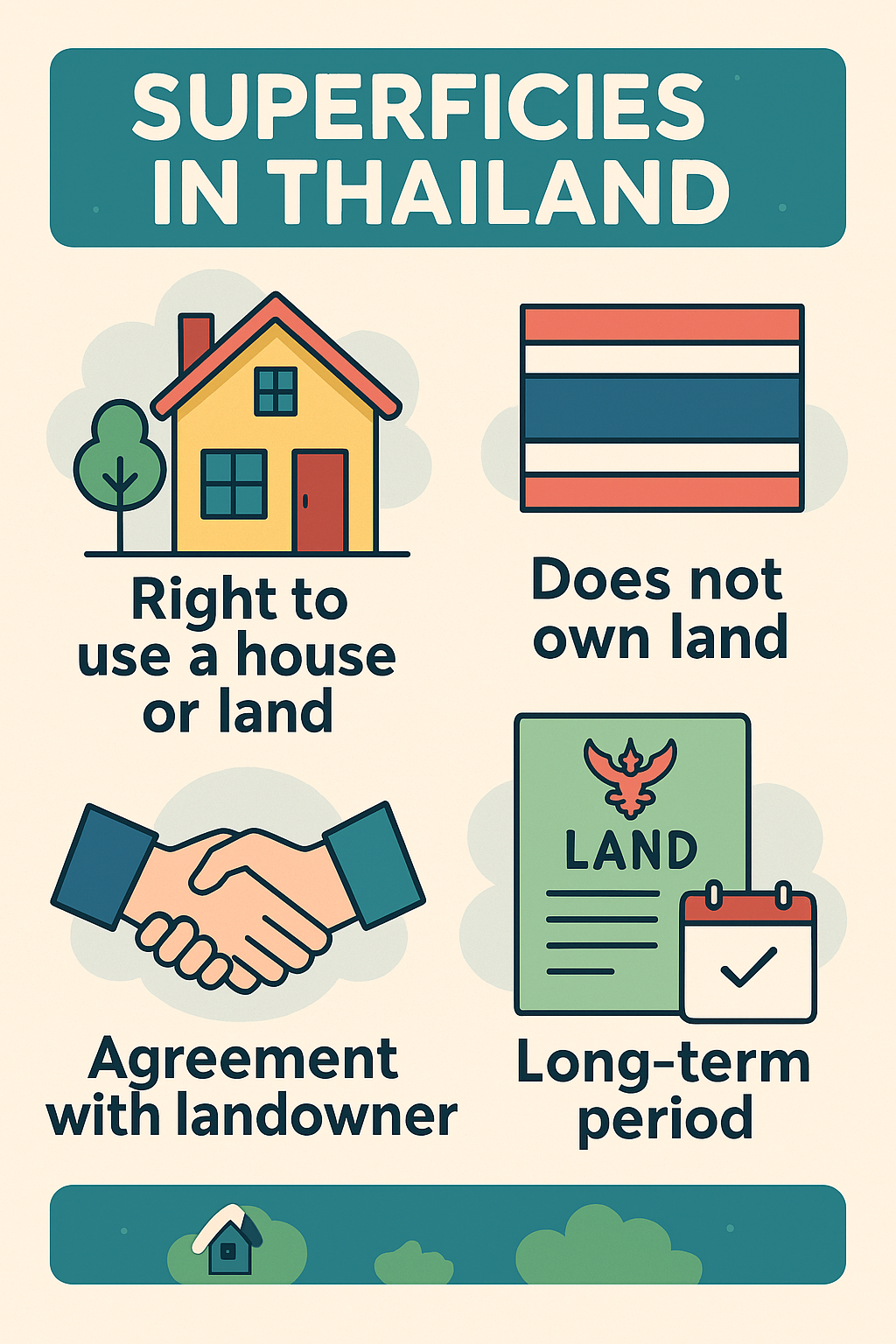
- A “right of superficies” (สิทธิเหนือพื้นดิน) empowers a person to own constructions on land they don’t own, like a long-term lease.
- It can be granted for up to 30 years or for the life of either party. Registration at the Land Department is required to affect third parties.
- Enables foreign nationals (who cannot own land) to legally own buildings on Thai soil.
- Not widely used in Thailand. Some Land Offices may not allow registration. Existing buildings often need their own registration or transfer before getting a new superficies right.
Table of Contents
What is the Right of Superficies in Thailand?
Superficies (สิทธิเหนือพื้นดิน – See Tee Neua Peun Din) is an important right in Thai property law. A person called the ‘superficiary’ can own buildings, structures, or plantations. These are on land that belongs to another person, known as the ‘landowner.’ This legal tool separates the ownership of the structure from the ownership of the land itself. It must be on the property’s title deed, like Chanote. You cannot register superficies on a Por Bor Tor 5 or a Sor Por Kor title deed. This registration must be done at the Land Department. It is necessary for it to be legally binding for others.
Superficies in Thailand: Key Points
- Allows owning a building on someone else’s land.
- Maximum duration: 30 years or life of owner/superficiary.
- Renewable right of superficies may require agreement. Note: While specific rulings may vary, Thai Supreme Court decisions regarding the non-enforceability of automatic lease renewals suggest caution is warranted when relying on automatic renewal clauses for Superficies agreements as well. Reciprocal Agreements could be a way to add a renewal and binding heirs.
- Must be registered on the land title deed (Chanote).
- Right of superficies is transferable and inheritable (unless restricted).
- Different from a lease (real right vs. personal right).
- Crucial option for foreigners building property in Thailand.
Legal Framework for Superficies Agreement in Thailand
The right of superficies in Thailand (สิทธิเหนือพื้นดิน) is covered by Sections 1410 to 1416 of the Thai Civil and Commercial Code. It allows someone, often a foreigner, to legally own a building or structure on land owned by someone else. To be enforceable against third parties, the agreement must be made in writing and registered with the Land Office.
Why is Superficies Important for Foreigners in Thailand?
Thai law restricts land ownership for foreigners. The Right of Superficies, or Superficies Agreements, offers a key legal option. Foreigners can invest in building houses, factories, or other structures on Thai land. This is often possible if they have a Thai spouse or a Thai company. They can own the buildings, even if they cannot own the land itself. This provides greater security than a standard lease for those making significant construction investments.
Superficies vs. Usufruct: What’s the Difference?
| Feature | Superficies | Usufruct |
|---|---|---|
| Ownership of Buildings | You can own buildings or structures on someone else’s land. | You cannot own structures, only have the right to use the land or buildings. |
| Duration | Superficies can last for up to 30 years. It can also last for the life of the landowner or the person with the right. This depends on what the parties agree on | Usually lasts for the lifetime of the usufructuary. Cannot exceed lifetime. |
| Transferability | Transferable and inheritable, unless stated otherwise in the contract. | Not inheritable. Can sometimes be transferred with conditions. |
| Common Use | Often used when someone builds a house on another person’s land. | Often used for living in or managing property without owning it. |
| Registration | Must be registered with the Land Department to be enforceable. | Must also be registered to be valid beyond 3 years. |
If you’re unsure whether a superficies or usufruct Thailand is best for your situation, talk to our legal team. At ThaiLawOnline, we can help you draft contracts, register rights, and understand your long-term property options in Thailand.
Comparison with Land Lease Agreements
When comparing the right of superficies with traditional land lease agreements, several distinctions emerge. A land lease lets the lessee use the land for a limited time. A superficies agreement in Thailand allows the superficiary to build permanent structures on the land. Also, unlike a lease that ends after a set time, the right of superficies often lasts longer than the landowner’s life. This gives more security to the superficiary. This permanence can lead to more substantial investments in construction or development, ultimately benefiting both parties involved.
| Feature | Superficies | Usufruct | Lease |
|---|---|---|---|
| Definition | Right to build, own, and use structures on another’s land. | Right to use and enjoy another’s property, including deriving benefits. | Contractual agreement to rent property for a specified period. |
| Ownership Rights | Owns the structures but not the piece of land may create complications. | Does not own the property; has usage rights only. | Does not own the property; has usage rights as per contract. |
| Duration | Typically up to 30 years or for the lifetime of the superficiary. | Usually for the lifetime of the usufructuary; can be shorter if agreed upon. | Maximum of 30 years; renewable depending on agreement. |
| Transferability | Can be transferred or inherited, subject to agreement terms. | Cannot be transferred or inherited; ends with the death of the usufructuary. | Can be assigned if the lease agreement permits; subject to landlord’s consent. |
| Registration | Must be registered at the Land Department to be legally enforceable. | Must be registered at the Land Department to be legally enforceable. | Leases over 3 years must be registered; shorter leases do not require registration. |
How to Register a Superficies in Thailand
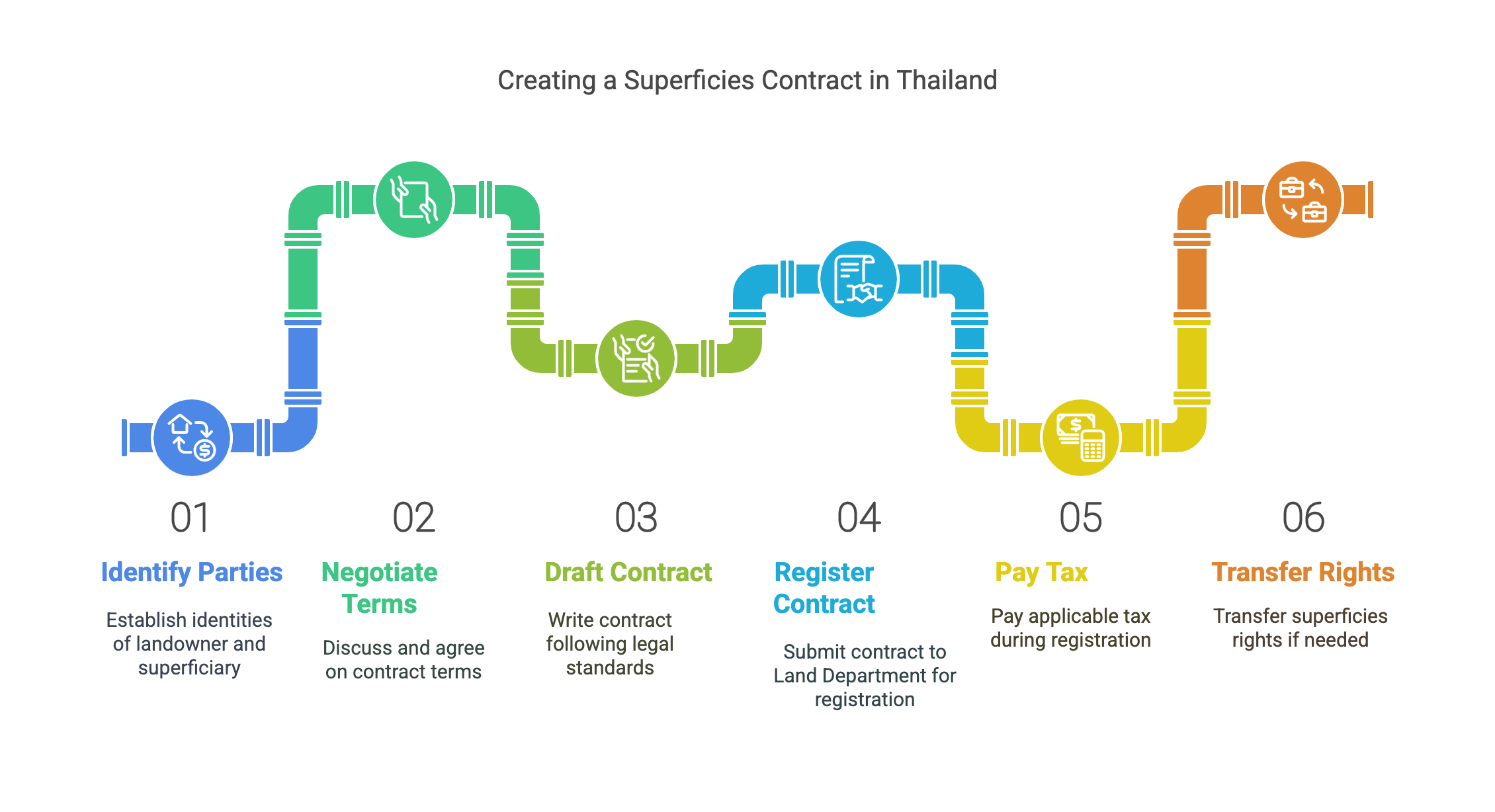
To make a superficies agreement valid in Thailand, it must be registered at the Land Office. This registration makes it enforceable against third parties. Both the landowner and the superficiary, who is often a foreigner, must be present for registration. They can also be represented by someone with the right power of attorney. The agreement must be in writing and in Thai. If it’s originally in English, a Thai translation will be required by the Land Department.
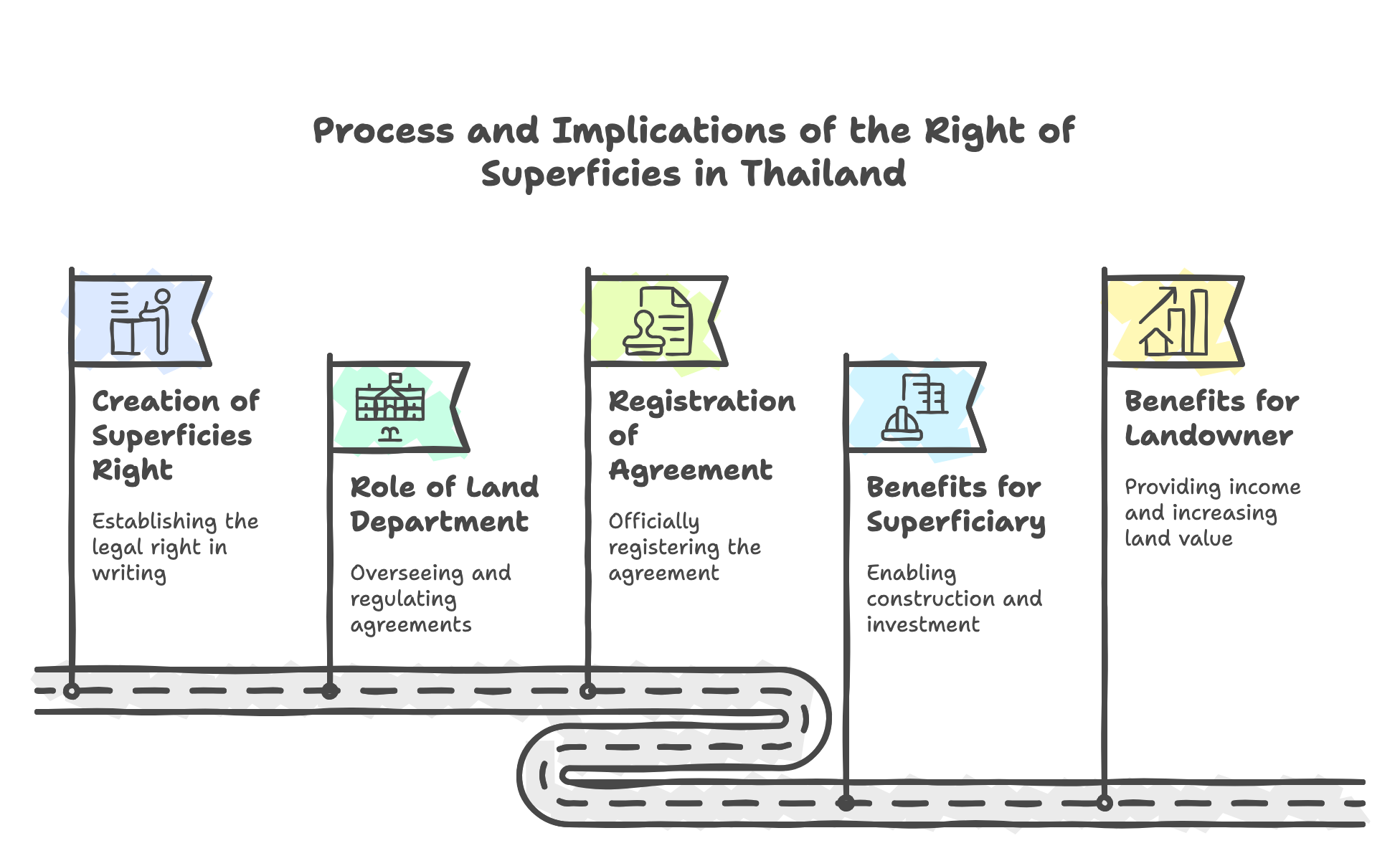
Before registration, the parties should gather all necessary documents. These include identification, the title deed (Chanote), and company papers if a legal entity is involved. The superficies agreement should clearly explain the purpose, duration, and conditions. This includes rights to build, transfer, inherit, or lease the structure. Once accepted, the right of superficies is recorded on the back of the title deed. Government fees apply, usually calculated as a percentage of the contract value or agreed rent. If the agreement is made free of charge, lower fees may apply.
Superficies Registration Checklist (What to Prepare)
- A written contract in Thai (or with certified Thai translation – better use a law firm with experience)
- Landowner and superficiary present (or legal representatives with POA)
- Title deed (โฉนดที่ดิน) of the land
- Valid IDs or company documents if applicable
- Clearly stated term (e.g., 30 years, or lifetime of one party)
- Stated purpose (residential, commercial, etc.)
- Registration fees (about 1.1% of declared value if a fee is involved)
✅ Tip: Always fill in the term. If you leave it blank, it could end with one year’s notice. This is based on the Supreme Court’s interpretation of Section 1413.
Unlike a lease, which only allows you to use the land, a superficies lets you own the building on someone else’s land. This distinction is especially important for foreigners who can’t own land in Thailand. Registering a superficies gives both parties legal certainty and helps prevent future disputes.
Practical Considerations for Superficies in Thailand
When preparing a Thai superficies agreement, it’s important to think beyond just the registration process. The contract should clearly include details like rent, the length of the agreement, renewal rights, and what happens when it ends. For example, will the landowner compensate the superficiary for the building? Can the building be sold or removed? These terms should be written into the contract to avoid future confusion.
If the land is sold later, a registered superficies will still be valid for the new owner. However, having clear written terms is your best protection. Foreigners should also consider combining a superficies with a lease for added security. Before signing anything, it’s wise to speak with a lawyer who understands Thai property law. A well-drafted contract reduces legal risks and ensures that both parties understand their rights and responsibilities.
Thai courts have ruled that superficies agreements used to conceal unlawful land transfers may be void. For example, in the Supreme Court judgment คำพิพากษาศาลฎีกาที่ 6065/2564, a superficies and mortgage deal was canceled. This was because they were used to hide the true ownership and get around restrictions. This case shows how important it is to structure superficies agreements transparently and with proper legal intent.
✅ Legal Tips and ⚠️ Cautions for Superficies in Thailand
✅ Legal Tip: Always register the superficies at the Land Office. Without registration, the right is not enforceable against third parties—even with a signed contract.
✅ Legal Tip: Make sure the contract states whether the superficies is transferable or inheritable. If it’s silent, the default is that it is transferable under Thai law (Section 1411).
✅ Legal Tip: If you use money you got before marriage to build a house on your Thai spouse’s land, make a legal declaration. This will confirm that it is your personal property. This protects your rights under Thai family law.
✅ Legal Tip: Combine a superficies with a long-term lease for stronger legal protection—especially if you’re building on land you don’t own.
⚠️ Caution: Automatic renewal clauses in superficies or lease contracts may not be enforceable under Thai law. Thai Supreme Court decisions have rejected such clauses when not clearly agreed upon again at renewal. It was a case related to a lease but we can believe it would be the same for superficies rights in Thailand. However, creative lawyers can use techniques like reciprocal agreements if the land is empty and an investment wish to be added like building structures on land. Read our article about reciprocal agreements here.
⚠️ Caution: Superficies gives rights to the structure only, not the land. If the land is sold, your rights continue only if properly registered and stated in the agreement.
⚠️ Caution: Not all Land Offices interpret the law the same way. Some might request additional documents or question fee exemptions. Always check with your local Land Office before your appointment.
⚠️ Caution: If the contract does not mention a fixed term, the superficies can be ended with reasonable notice. This is often seen as one year, especially if rent is paid yearly (Section 1413).
⚠️ Caution: Not all plots of land in Thailand are eligible for superficies. Land given by the state for farming, like Sor Por Kor or allocated land, usually cannot have a superficies. A relevant case, คำพิพากษาศาลฎีกาที่ 8887/2563, explained that superficies rights must follow land use rules in Land Code Section 58 bis. Always check with the local Land Office to verify eligibility. In a recent case in 2025, a land department in Chiang Mai refused to register superficies on land with buildings.
Land Office Practice and Regional Variations
In practice, Land Office procedures for registering a superficies can differ by province. Knowing local details can help avoid mistakes
- Concurrent lease and superficies: Some provincial land offices are unfamiliar with registering a lease and a superficies on the same parcel for the same parties. For example, mixing a 30-year land lease with a superficies can confuse local officials. A superficies is a common way to give a foreigner both land use and house ownership rights. One guide notes that not all land offices readily accept registering both instruments together, even though no law prohibits. You may need to politely insist or show legal authority. A lease (personal right) and superficies (real right) can legally exist together. Checking with the specific Land Office in advance is wise.
- Documentation and formalities: All superficies agreements must be registered at the Land Department (สำนักงานที่ดิน) where the land is located. Both the landowner and the superficiary, or their authorized representatives, must attend. They need to sign the official superficies contract in Thai. The Land Office will annotate the title deed (โฉนดที่ดิน) to record the superficies. Not using the official registration process, like just signing a private contract, is a common mistake. This mistake makes the “superficies” unenforceable. Also, if the landowner is married, spousal consent may be required similar to other property transactions.
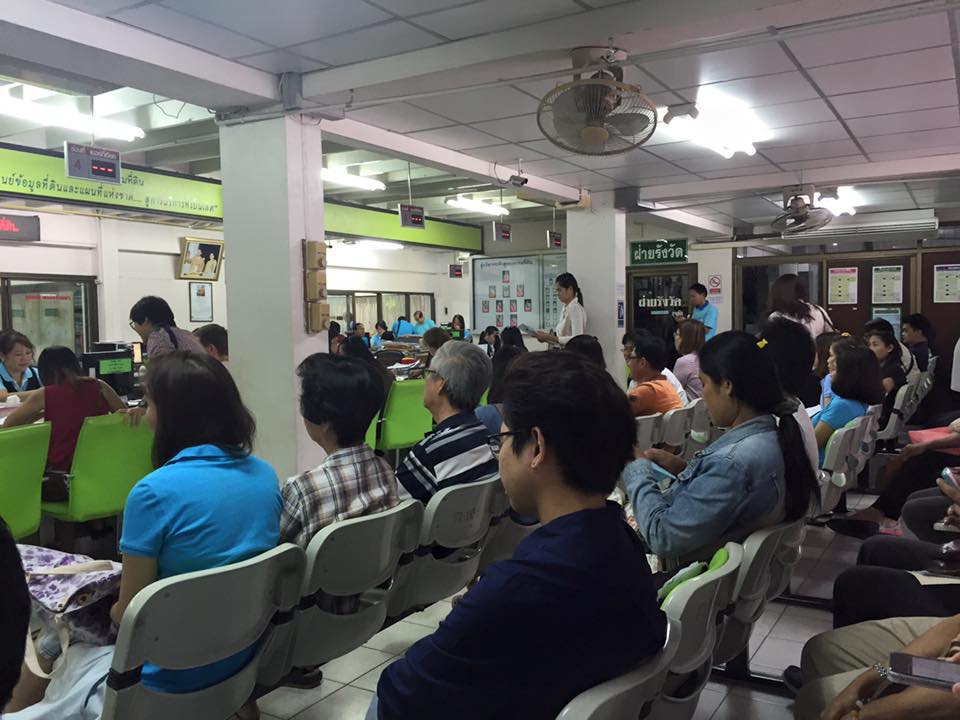
- Terms and Conditions: When you register, you must state the duration of the superficies. This can be a maximum of 30 years for a fixed term, or for the lifetime of the landowner or superficiary. Avoid leaving the term “unspecified” – an indefinite term will be treated as terminable at will under law. It’s also important to clarify any conditions (e.g. rent, if any, or maintenance obligations) in the registration document. Omitting material conditions can cause disputes or even termination under Section 1414 CCC. For example, if the superficiary does not pay the agreed ground rent for two years in a row, the landowner can cancel the right. Each Land Office may have its own preferred wording or forms. Reviewing the standard form (แบบฟอร์มสิทธิเหนือพื้นดิน) with an officer can help ensure everything is recorded correctly.
- Local quirks: Some Land Offices rarely see superficies cases. Staff may confuse superficies with long-term leases or Thai usufruct. Some offices hesitate to give a lifetime superficies to a foreigner. They do this because it is rare, even though it is allowed by law. In such cases, having the text of the law (Sections 1410-1412 allows a superficies for the life of the owner or superficiary. This can be helpful. Patience and a reference to the law or Ministry of Interior regulations can usually overcome local reluctance.
Real-Life Examples of Superficies in Thailand
Example 1 – Residential Use: Securing Your Home
Chris, an Australian retiree, wanted to build his dream home in Phuket on land owned by his Thai wife. Since Thai law prevents him from owning the land, they registered a 30-year superficies agreement at the Land Office. This allows Chris to legally own and control the house, even though the land remains in his wife’s name.
This gives him peace of mind—his right can be transferred to heirs if the contract clearly allows it. Thai courts have confirmed this right in cases like คำพิพากษาศาลฎีกาที่ 7119/2561. This case explained that superficies can be passed to the next generation if the agreement allows inheritance.
Example 2 – Commercial Use: Protecting a Business Investment
Anna, a German entrepreneur, leased a plot of land in Bangkok to build a small boutique hotel. Instead of just using a lease, she got a superficies agreement to register the building in her name. This gave her more control over the investment and legal security.
Even if the land is sold later, Anna’s registered superficies means she keeps full rights to her hotel for the whole agreement. This strategy not only strengthens her position but also opens the door to future resale or transfer options.
Important Supreme Court Rulings
- Superficies must be in writing and registered. If not, it cannot be enforced as a real right (e.g., Supreme Court Decision No. 749/2536).
- Agreements not registered may only be enforceable between the parties, not third parties (e.g., Supreme Court Decision No. 5560/2537).
- A right granted through a will can be recognized as a valid superficies (e.g., Supreme Court Decision No. 667/2542).
Recent Interpretations (2020–2025)
Recent decisions by the Thai Supreme Court have clarified how sections 1410–1416 of the Civil and Commercial Code (CCC) are applied in practice. These sections relate to สิทธิเหนือพื้นดิน (right of superficies)
- Sham transactions voided – Supreme Court Judgment No. 6065/2564 (2021) – The Court canceled a superficies agreement. This agreement was a sham to hide a land sale. In this case, a landowner gave a company a 30-year superficies. At the same time, the landowner mortgaged the land to the company’s lender. This was an attempt to avoid legal restrictions on transfer. The Court held that the parties never truly intended a superficies or mortgage. This ruling warns that a superficies must not be used to circumvent land laws.
- Unregistered superficies = personal right only – Supreme Court Judgment No. 2577/2551 (2008) – (A slightly older case still instructive) The Court confirmed that if a landowner permits someone to build on their land without a written, registered superficies, the building is not a “fixture” of the land and belongs to the builder – effectively creating a de facto superficies. However, it was not registered with the Land Office. This means it only created obligations between the parties and not a real right. The landowner could terminate this unregistered arrangement at any time since no fixed term was set. A superficies must be in writing and registered on the title deed. This is needed for it to be legally enforceable against third parties. If no duration is specified, Section 1413 CCC allows either party to terminate at will with reasonable notice. An indefinite “perpetual” superficies is not allowed without a term.
- Transferability and inheritance – Under Thai law, a superficies can be transferred and inherited unless the parties decide otherwise. For example, Supreme Court Judgment No. 7119/2561 stated that a possessory interest in land can pass to heirs by will. This shows that สิทธิเหนือพื้นดิน can be given or assigned like other property. A properly created superficies does not end when the landowner or superficiary dies. This is true unless it was given for a person’s life. It lasts for the agreed term or until it is ended according to the agreement.
- In Thailand, superficies rights must be clearly written and registered. In คำพิพากษาศาลฎีกาที่ 2577/2551, the court decided that if someone builds a house on land with only verbal permission, it is not a real right. This means the arrangement can be ended at any time. This highlights the risk of unregistered agreements, especially in personal or family situations.
Another key decision, คำพิพากษาศาลฎีกาที่ 7119/2561, confirmed that a properly created superficies can be inherited unless the contract says otherwise. This reinforces the need to include inheritance clauses when drafting the agreement.
Taxes and Registration Fees
- Without compensation: 50 Baht per plot.
- With compensation: Fee is 1% of the agreed value.
- If compensation is involved, a stamp duty of 0.5% is applied based on the payment value.
FAQS about Superficies in Thailand
Can a superficies be inherited?
Yes, if the contract allows it. Thai law lets you pass the right of superficies to heirs, so long as it’s stated clearly in the agreement.
What happens if the superficies in Thailand is terminated?
The right ends after the set term, upon death (if life-based), or by breach. The superficiary can usually remove the building unless the landowner chooses to buy it.
Is there a limit to the duration of the right of superficies in Thailand?
Yes, the surface can be created for a set time or for the life of the person using it. This depends on the agreement between the parties involved.
What legal advice should one seek regarding superficies rights?
It’s important to consult a Thai property lawyer before entering into a superficies agreement. A lawyer can look over the contract. They can explain your rights and duties. They will check if it can be inherited. They will also make sure it is registered correctly at the Land Office.
Are there any restrictions on what can be built under the superficies right?
The superficiary (the holder of the right) can build structures or plant crops on the land. However, they must follow local building rules and zoning laws. Some areas may limit certain types of development or require permits from authorities.
Dispositions about Superficies in Thailand in the Thai Commercial and Civil Code:
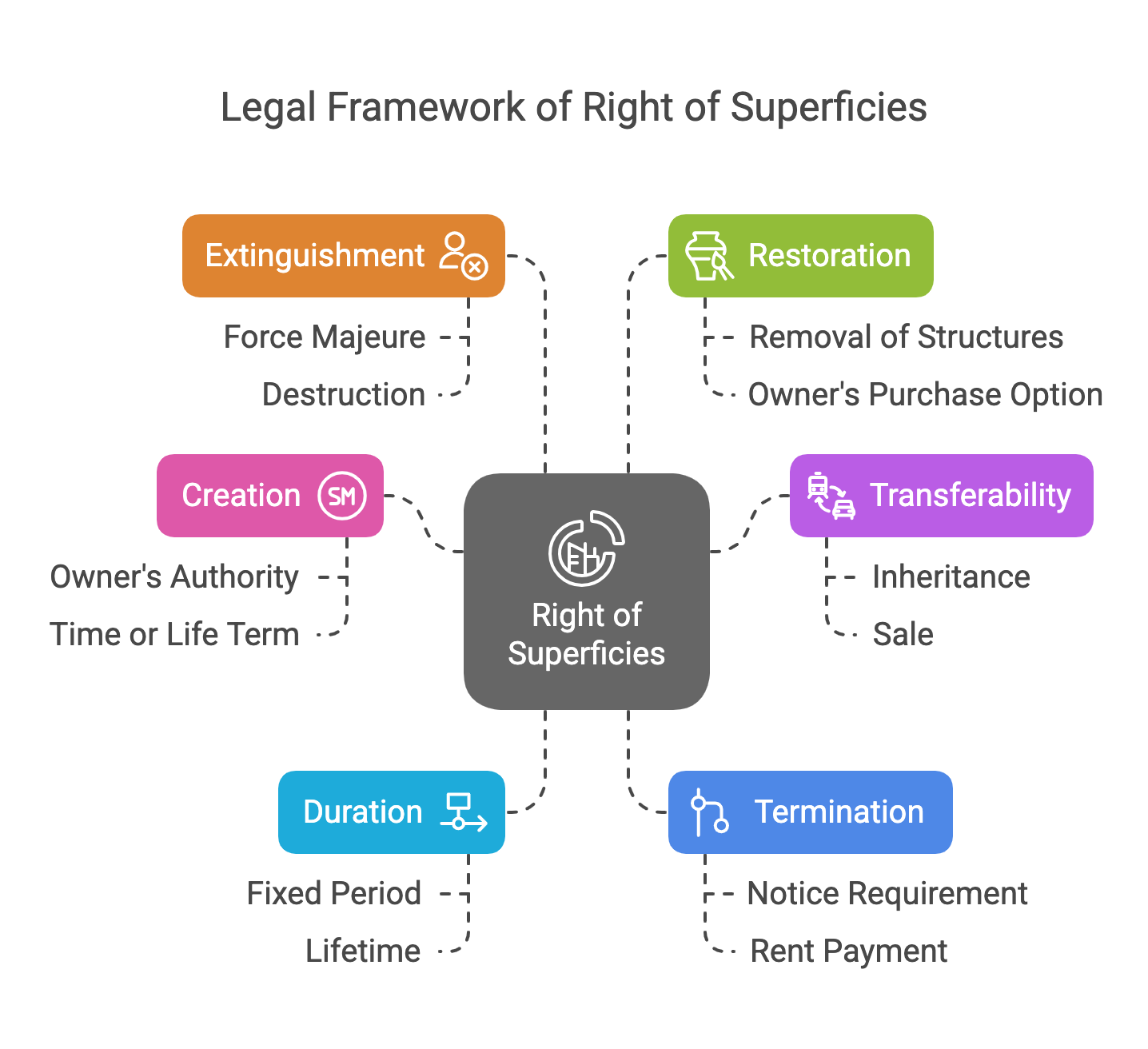
Following is a summary of Thai Law related to Superficies in Thailand. If you wish a real estate property guide, click here.
| Section | Key Point |
|---|---|
| 1410 | Superficies gives the right to own buildings, structures, or plantations on someone else’s land. |
| 1411 | The right is transferable and inheritable, unless stated otherwise in the agreement. |
| 1412 | It can be created for life or for a fixed term. |
| 1413 | If no term is specified, either party may terminate with reasonable notice or one year’s rent. |
| 1414 | The right can be terminated for non-compliance or two years of unpaid rent. |
| 1415 | Superficies survives destruction of buildings, even by force majeure. |
| 1416 | When it ends, the superficiary may remove structures unless the owner buys them at market value. |
How Thai Law Online Can Assist You
If you’re in a similar situation to Chris or Anna, a superficies might be the right solution. Reach out to ThaiLawOnline for expert guidance and a bilingual agreement tailored to your needs. We offer customized contracts, to protect your rights. Bilingual (Thai-English), prepared by licensed lawyers, for just 9,900 baht. Remember that you need strong contracts to protect your rights.
You can communicate with us on 💬 Messenger📱 WhatsApp📸 Instagram📧 Email