


Reviewed by ThaiLawOnline, a licensed Thai law firm practising in Thailand since 2006. Thai lawyer of record: Wichuda Atthamethakon, LL.M., Thai Bar Licence 3149/2556.
Last updated on
Whether you’re living, working, or just spending time in Thailand, understanding the country’s laws on sexual consent isn’t optional. It’s essential. Thailand takes the protection of minors seriously, and the penalties for violations are among the harshest in Southeast Asia.
This guide gives you a clear, practical breakdown of the age of consent, the relevant sections of the Thai Penal Code, recent legislative reforms, and what foreigners specifically need to know. We’ve written it in plain English, but every claim is backed by the actual statute.
Last reviewed: 3 September 2026. Every penalty figure on this page was checked against the Thai text of Penal Code Sections 1(18), 277, 277 bis, 277 ter, 279, 282, 283, 283 bis, 284, 284/1, 285, 285/1 and 285/2 as amended by the Criminal Code Amendment Acts (No. 27) B.E. 2562 and (No. 30) B.E. 2568, and the operative sections of Act No. 27 were read from the amending Act itself.
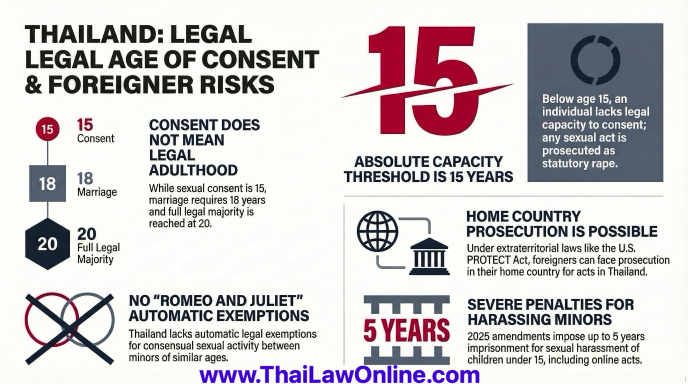
Table of Contents
What Is the Legal Age of Consent in Thailand?
The statutory legal age of consent in Thailand is 15 years old, as defined under Thai Penal Code Section 277. This means individuals aged 15 or under cannot legally consent to any sexual activity, constituting statutory rape (ความผิดฐานกระทำชำเรา) regardless of willingness, initiation, or perceived maturity. The law applies gender-neutrally, including to same-sex acts and persons with surgically constructed sexual organs, following the Criminal Code Amendment Act (No. 30) B.E. 2568, Royal Gazette volume 142 part 90 Kor, 29 December 2025, in force 30 December 2025. Section 3 of that Act replaced the definition of sexual intercourse at section 1(18) of the Penal Code and closed with the words that genitals include genitals resulting from surgery (full Thai text of the Act). Gender neutrality itself is older: it came in with the Criminal Code Amendment Act (No. 27) B.E. 2562 on 28 May 2019.
However, note the effective age of consent is often interpreted as 18. This is due to overlapping protections under laws like the Prevention and Suppression of Prostitution Act (B.E. 2539) and Child Protection Act (B.E. 2546), which prohibit exploitation or “taking” of minors under 18 for sexual purposes even if consensual. For ages 15-17, additional scrutiny applies (see Position of Authority section below).
Key age thresholds in Thai law:
- Sexual Consent: 15 (Penal Code Sec. 277)
- Minimum Marriage Age: 18 (Civil and Commercial Code Sec. 1448, amended by Marriage Equality Act B.E. 2567, effective Jan. 23, 2025)
- Criminal Majority: 18 (Juvenile and Family Court Act)
- Full Legal Majority (Civil Capacity): 20 (Civil and Commercial Code Sec. 19)
Example: A 16-year-old is above the age of consent, so Section 277 does not apply to consensual sex with a peer, but they remain a minor until 20 for civil matters like contracts, cannot marry before 18 without a court order, and need parental consent to marry until 20.
Key Takeaway
15 is the age of sexual consent. But this doesn’t mean everything is legally straightforward once someone turns 15, there are other important thresholds at 18 and 20 that we cover below. Pay attention “taking a Person Aged 15-18 for Sexual Purposes” explained below.
Key Thai Laws Governing Sexual Consent
The core legal framework sits within Title IX of the Thai Penal Code (ประมวลกฎหมายอาญา). If you’re dealing with any issue related to sexual crimes in Thailand, these are the sections you need to know.
Thai Penal Code Section 277: Statutory Rape
Section 277 is the big one. It criminalizes sexual intercourse with anyone aged 15 or under, whether or not the child consented. The penalties are severe and depend on the victim’s age:
Penalties Under Section 277
| Victim’s Age | Imprisonment | Fine (THB) |
|---|---|---|
| Over 13 and not over 15 (paragraph one) | 5 to 20 years | 100,000-400,000 Baht |
| 13 or under (paragraph two) | 7 to 20 years, or life imprisonment | 140,000-400,000 Baht |
| Offender makes the child believe he has a gun or explosives (paragraph three) | 10 to 20 years, or life imprisonment | 200,000-400,000 Baht |
| Armed with a gun, explosives or any weapon, or a gang rape (paragraph four) | Life imprisonment | No fine |
| The child suffers grievous bodily harm (Section 277 bis; Section 277 ter if the rape was armed or a gang rape) | 15 to 20 years or life; death or life if armed or a gang rape | 300,000-400,000 Baht with a fixed term |
| The child dies (Section 277 bis; Section 277 ter if armed or a gang rape) | Death or life imprisonment; death if armed or a gang rape | No fine |
These are the figures set by the Criminal Code Amendment Act (No. 27) B.E. 2562, in force 28 May 2019. Many guides still show the earlier range for a child aged 15 or under, 4 to 20 years and a fine of 80,000 to 400,000 Baht, which was the text as amended in 2015 and 2017 and no longer applies. Where a fine is listed the court imposes both the prison term and the fine, because the section says “and”, not “or”.
Section 285: Position of Trust
If the offender is a parent, guardian, teacher, or anyone in a position of authority over the victim. Section 285 kicks in and increases the standard penalty by one-third. Thai courts take abuse of trust extremely seriously, we cover this in detail in its own section below.
For a broader overview of how Thailand handles these cases, see our detailed article on sexual crimes in Thailand.
Thai Penal Code Section 279: Indecent Acts Against Minors
Not every sexual offense involves intercourse. Section 279 covers “indecent acts” inappropriate touching, exposure, and other sexual misconduct committed against a child aged 15 or under. As with Section 277, the child’s consent is legally irrelevant.
| Circumstance | Imprisonment | Fine (THB) |
|---|---|---|
| Indecent act, victim aged 15 or under | Up to 10 years | Up to 200,000 Baht |
| Indecent act, victim aged 13 or under | 1 to 10 years | 20,000-200,000 Baht |
| By threat, force, while the child cannot resist, or by impersonation | 1 to 15 years | 20,000-300,000 Baht |
Related sections worth reviewing: Section 278 (indecent acts by force), Section 280, and Section 281.
Position of Authority: Can a Teacher Have Sex with a Student Over 15?
This is one of the most common questions we get, and the answer surprises many people. The age of consent being 15 does not give a free pass to people in positions of authority.
Even if the other person is 16, 17, or even 19, if there’s a relationship of authority, dependency, or trust, several additional criminal provisions come into play:
Section 283 bis: Taking a Person Aged 15-18 for Sexual Purposes
Section 283 bis specifically targets situations where someone brings or takes a person over 15 but not yet 18 for the purpose of sexual acts, even with that person’s consent. The penalty: up to 5 years imprisonment and/or a fine of up to 100,000 Baht. Where the person taken is aged 15 or under, it rises to up to 7 years and/or a fine of up to 140,000 Baht.
This is critical to understand: even though a 17-year-old is above the age of sexual consent, they are still under 18, and the law provides extra protection when someone takes them or brings them somewhere for sexual purposes.
Section 284: Taking Another Person by Deception or Coercion
Section 284 goes further. If someone uses deceit, threats, coercion, or “unjust influence” to bring another person (of any age) for sexual purposes, the penalty is 1 to 10 years and a fine of 20,000 to 200,000 Baht. The concept of “unjust influence” is particularly relevant in teacher-student or employer-employee dynamics.
Section 285: The One-Third Penalty Enhancement
Section 285 is the multiplier, but only for the offences it lists: Sections 276, 277, 277 bis, 277 ter, 278, 279, 280, 282 and 283. It does not list Section 281, Section 283 bis or Section 284. If the offender in one of the listed offences is:
- A parent or ascendant of the victim,
- A teacher or instructor with care over the victim,
- A person with official authority or control over the victim, or
- A guardian, tutor, or custodian of the victim,
…the court must increase the penalty by one-third. This is not discretionary, it’s mandatory.
The Teacher-Student Scenario: A Practical Example
Let’s say a 35-year-old teacher has a sexual relationship with a 17-year-old student. Even though the student is above the age of consent (15), the teacher faces potential criminal liability under multiple provisions:
| Provision | Offense | Penalty |
|---|---|---|
| Sec. 283 bis | Taking a person 15-18 for sexual acts (even with consent) | Up to 5 years |
| Sec. 284 | Using “unjust influence” for sexual purposes | 1 to 10 years |
| Sec. 285 | One-third increase for a teacher or person in authority. It applies only where the conduct also falls under a section it lists, such as Sec. 282 or 283 (procuring) or, if the student is aged 15 or under, Sec. 277 or 279 | + one-third on those sections only, not on Sec. 283 bis or 284 |
The same logic applies to employers and employees, coaches and athletes, doctors and patients, or any relationship where one person holds power or influence over the other.
Bottom line: The age of consent protects against statutory rape charges specifically. It does not give people in positions of authority a license to pursue sexual relationships with minors aged 15-17. The Thai Penal Code has multiple overlapping provisions designed to catch exactly this type of situation.
For related reading, see our articles on criminal law in Thailand, domestic violence, and child custody.
2025 Penal Code Amendment No. 30: Redefining Rape and Criminalizing Sexual Harassment
Effective 30 December 2025, the Act Amending the Criminal Code (No. 30) B.E. 2568 is one of the most significant reforms in recent Thai legal history. The International Commission of Jurists (ICJ) called the reform “a step in the right direction.” Here’s what changed:
Expanded Definition of Rape
The law now covers all forms of penetration. It includes with foreign objects or body parts. It treats them with the full severity of rape-level penalties. The definitions are gender-neutral and LGBTQ+-inclusive, closing loopholes that previously allowed some offenders to face reduced charges.
New Section 284/1: Sexual Harassment
For the first time, Thai law explicitly criminalizes sexual harassment (การคุกคามทางเพศ), covering physical, verbal, visual, and digital conduct. This includes cyberstalking and online harassment through computer systems or electronic devices.
| Circumstance | Penalty |
|---|---|
| Standard sexual harassment | Up to 1 year and/or fine up to 20,000 THB |
| Repeated or continuous, so that the victim cannot lead a normal life | Up to 2 years and/or fine up to 40,000 THB |
| In a public place, in front of others, or on a computer system the public can access | Up to 3 years and/or fine up to 60,000 THB |
| Against a child aged 15 or under, whether or not the child consents | Up to 5 years and/or fine up to 100,000 THB |
The first three are compoundable offences, so the victim can settle them; the offence against a child aged 15 or under is not. Section 284/1 applies only where the conduct is not already an indecent act under Section 278 or 279.
See also: Section 284/1 and Section 283 (procuring by deceit, threats or coercion).
Supreme Court Decisions Worth Knowing
Thai Supreme Court (ศาลฎีกา) decisions carry significant weight in interpreting these statutes. Here are the key rulings:
Abolition of the Marital Exemption
Supreme Court Decision 4355/2558 is the case on the marital exemption, and it concerns Section 276, not Section 277. The Court put the change in terms: under Section 276 as it formerly stood, only a man could commit rape and only against a woman who was not his wife; under Section 276 as amended, which applied at the time of the offence, both a man and a woman may commit it even against their own spouse, where there is a threat of the kind Section 276 describes. The amendment is the Criminal Code Amendment Act (No. 19) B.E. 2550, Royal Gazette volume 124 part 56 Kor, 19 September 2007, in force 20 September 2007.
Supreme Court Decision 302/2559 is a divorce case rather than a criminal one, and it applies the same principle. Spouses must live together under section 1461 paragraph one of the Civil and Commercial Code, which contemplates sexual relations, but the Court held that intercourse must rest on the consent of both and that a spouse who forces it commits the offence under Section 276. On the facts the husband summoned the couple’s young child to listen to him berating his wife until she submitted so the child could be released; the Court held that was not consent. He also continued after learning the intercourse had given her a uterine infection, until she fled the house. That was serious mental cruelty, a ground for divorce under section 1516(3), and conduct seriously adverse to the marriage under section 1516(6).
The Section 277 marriage exemption is a separate story, and it survived far longer. Until 2019 a court could permit an offender to marry a child over thirteen but not over fifteen, and the offender then went unpunished. That paragraph was repealed by the Criminal Code Amendment Act (No. 27) B.E. 2562, Royal Gazette volume 136 part 69 Kor, 27 May 2019, in force 28 May 2019, and replaced by the juvenile court welfare measures described below. Section 277 was not touched by the 2007 Act at all.
Interpretation of “Sexual Intercourse”
The test is in the Code itself. Section 1(18), as replaced by the 2019 and 2025 amendments, defines sexual intercourse (กระทำชำเรา) as penetration: of the other person’s genitals, anus or mouth by the offender’s genitals, or of the other person’s genitals or anus by another part of the offender’s body or by an object, or making the other person do the same to the offender (other than with another body part or an object). Genitals include genitals resulting from surgery. A sexual act that involves no penetration is an indecent act under Section 279 (Section 278 where the victim is over 15), not statutory rape under Section 277.
Aggravated Sentencing
In cases involving parents, teachers, guardians and other persons of authority, the one-third increase under Section 285 is a statutory rule rather than a sentencing discretion: it applies whenever the offence is one the section lists and the victim is one of the persons it names. Two companion provisions matter alongside it. Section 285/1 bars an offender from pleading ignorance of the child’s age where an offence under Section 277, Section 279, Section 282 paragraph three, Section 283 paragraph three or Section 283 bis paragraph two is committed against a child not over thirteen. Section 285/2, inserted by the same 2019 Act, adds a further one third where the person could not protect themselves by reason of disability, mental defect or illness, sickness, old age or pregnancy.
For more on how Thai courts work, see our guide on what to know before going to court in Thailand and our overview of the Criminal Procedure Code.
Important Age-Based Legal Thresholds in Thailand
People often confuse the age of sexual consent with other legal milestones. In Thailand, there are several distinct thresholds between 15 and 20:
Important Age-Based Legal Thresholds in Thailand
| Legal Category | Age | Legal Source | What It Means |
|---|---|---|---|
| Age of Sexual Consent | 15 | Penal Code Sec. 277 | Below this = statutory rape. The effective age is often 18, because of separate protections for persons over 15 and not over 18: Penal Code Section 283 bis (taking a person of that age away for an indecent purpose, even with consent) and section 8 of the Prevention and Suppression of Prostitution Act B.E. 2539 (commercial sex with anyone aged 18 or under). |
| Minimum Marriage Age | 18 | CCC Sec. 1448 (amended) | Raised from 17 by the Marriage Equality Act, the Civil and Commercial Code Amendment Act (No. 24) B.E. 2567, which came into force on 23 January 2025. |
| Criminal Majority | 18 | Juvenile and Family Court Act | Under 18 tried in juvenile court. |
| Full Legal Majority | 20 | CCC Sec. 19 | Full civil capacity for contracts without guardian. |
A 16-year-old is above the age of consent, so Section 277 does not apply to consensual sex with a peer, but they remain a minor until 20 for civil matters, cannot marry before 18 without a court order, and need parental consent to marry until 20.
The Marriage Equality Act (B.E. 2567)
In 2024, Thailand made history by passing the Marriage Equality Act (Civil and Commercial Code Amendment Act No. 24, B.E. 2567), effective 23 January 2025. Besides legalizing same-sex marriage, it made two changes relevant to this guide:
- Raised the minimum marriage age from 17 to 18, aligning with international child protection standards.
- Replaced gendered terms, “husband and wife” became “spouses” (คู่สมรส), granting same-sex couples full marriage, inheritance, and adoption rights.
Marriage under 18 is only possible with a court order. Persons aged 18-20 still need parental consent.
For a deep dive, read our full article on the Civil and Commercial Code Amendment Act No. 24.
Are There “Romeo and Juliet” Laws in Thailand?
Thailand does not have automatic “close-in-age” exemptions (commonly called Romeo and Juliet laws). Nothing in the Code decriminalizes consensual sex between minors as such. What exists is Section 277 paragraph five: where the offender is aged 18 or under and the other party is over 13 but not over 15 and consented, the Juvenile and Family Court may order welfare protection measures under the Child Protection Act instead of punishment. If those measures succeed the offender is not punished; if they fail, the court may sentence below the statutory minimum. This is not guaranteed and depends on case specifics (e.g., no coercion or authority imbalance).
No exemption applies if the victim is 13 or under or if the offender is over 18. Note: Some sources (e.g., Wikipedia) incorrectly claim a broader exemption allowing acts from age 14 if the older partner is no more than 21, this is a misconception and not supported by Thai law. For reference, see ECPAT’s child protection guidelines: ECPAT Thailand Overview or ICMEC’s national legislation summary: ICMEC Thailand PDF.
What Thailand Has Instead: Judicial Discretion (Section 277, Paragraph 5)
If the offender is aged 18 or under and the other person is over 13 and not over 15, and the act was genuinely consensual, the juvenile court may choose to substitute welfare-based protective measures (มาตรการคุ้มครองสวัสดิภาพ) or rehabilitation instead of criminal penalties.
The key word is “may”, this is entirely at the judge’s discretion. There is no statutory guarantee of leniency. Practically speaking, adolescent sexual activity with a child of 15 or under remains a legal risk, even if both parties are teenagers.
Extraterritorial Jurisdiction: A Warning for Tourists and Expats
This section is critical for anyone who isn’t Thai. The Thai courts prosecute sexual offenses vigorously regardless of the offender’s nationality, and “I didn’t know the law” is never a defense.
A conviction means imprisonment in Thailand, deportation upon release, and a permanent immigration blacklist, meaning you can never return.
But it gets worse. Many countries also prosecute their own citizens for child sex offenses committed abroad, even if the conduct was legal where it occurred:
| Country | Relevant Law | Maximum Penalty |
|---|---|---|
| United States | PROTECT Act / 18 U.S.C. § 2423 | Up to 30 years federal prison |
| United Kingdom | Sexual Offences Act 2003 | Up to life imprisonment |
| Australia | Criminal Code Act 1995 (Div. 272) | Up to 25 years |
| Canada | Criminal Code s. 7(4.1) | Up to 14 years |
| Germany | StGB § 5 | Up to 15 years (aggravated) |
| Sweden | Penal Code Ch. 2 § 2 | Up to 10 years |
Under the U.S. PROTECT Act specifically, any American citizen who engages in sexual conduct with anyone under 18 abroad, commercial or not, commits a federal crime carrying up to 30 years, regardless of Thailand’s age of consent being 15.
Thailand does have extradition treaties with multiple countries. For more on how this works, see our article on extradition from Thailand.
Prostitution and the Protection of Minors: The Under-18 Rule
Thailand’s nightlife and entertainment industry are well-known around the world. Prostitution is technically illegal under the Prevention and Suppression of Prostitution Act B.E. 2539 (1996), though in practice, enforcement against adults overwhelmingly focuses on organized crime, trafficking networks, and establishments, not on private conduct between consenting adults. This is a reality that most people living in or visiting Thailand will observe.
However, when it comes to anyone under 18, the situation is completely different. This is where the law draws an absolute, non-negotiable line:
The Under-18 Rule: Zero Tolerance
No person aged 18 or under can be involved in prostitution, in any capacity, under any circumstances. This is not an area where the “age of consent is 15” argument applies. The age thresholds for prostitution-related offenses are entirely separate from the age of sexual consent.
| Offense | Legal Basis | Penalty |
|---|---|---|
| Procuring a person aged 18 or under for sexual acts (even with consent) | Sec. 282, Sec. 283 | Sec. 282 (with consent): 3 to 15 years for a person over 15 and not over 18, 5 to 20 years for a child aged 15 or under, plus a fine. Sec. 283 (by deceit, threats, violence or undue influence): 7 to 20 years or life for over 15 and not over 18; 10 to 20 years, life or death for 15 or under |
| Taking a person 15-18 for sexual purposes, even consensually | Sec. 283 bis | Up to 5 years + fine |
| Exploiting a minor for commercial sexual purposes | Human Trafficking Act (B.E. 2551) | Up to 20 years |
| Any sexual exploitation of a child | Child Protection Act (B.E. 2546) | Separate standalone offense |
| An offence under Sec. 282 or 283 by a person in authority (Sec. 285 does not cover Sec. 283 bis) | Sec. 285 | Penalty increased by one-third |
Why This Matters Practically
Whatever your views on adult prostitution, the legal and practical reality regarding minors is straightforward: the Royal Thai Police, in coordination with INTERPOL, the FBI, Australian Federal Police, and UK NCA, actively conduct raids on establishments suspected of employing underage individuals. International cooperation has led to numerous high-profile arrests and prosecutions, both in Thailand and in the offender’s home country through extraterritorial jurisdiction.
Remember also that under the U.S. PROTECT Act and similar laws in many Western nations, the threshold is under 18, not 15. An American or Australian who pays for sex with a 16-year-old in Thailand faces prosecution at home regardless of Thai consent laws.
For a detailed breakdown of how prostitution law works in Thailand more broadly, see our full article on prostitution laws in Thailand. See also our coverage of criminal law and the Thai Penal Code.
Frequently Asked Questions
Is the age of consent in Thailand 15 or 18?
Sexual consent: 15. Marriage: 18 (raised from 17 by the Marriage Equality Act). Full legal majority: 20 (CCC Section 19). These are three separate legal thresholds. As we said, section 283 bis and the Prostitution Act create a de facto higher threshold of 18 in many practical scenarios.
Can a 16-year-old legally consent to sex in Thailand?
Yes, they’re above the age of consent (15). But they remain a minor under civil law until 20 and cannot marry before 18 without court permission, and until 20 they also need parental consent to marry (Civil and Commercial Code sections 1448 and 1454). They also benefit from additional protections under family law. Taking a person over 15 but not over 18 away for an indecent purpose remains an offence even with their consent (Penal Code section 283 bis). Several countries also prosecute their own nationals for sexual offences against minors committed abroad.
Does Thailand have Romeo and Juliet laws?
No automatic close-in-age exemption exists. However, Section 277 Paragraph 5 allows the juvenile court to use discretion when the offender is 18 or under and the victim is over 13 but 15 or under. The court may substitute rehabilitation for punishment, but it’s not guaranteed.
Can a foreigner be prosecuted in their home country for sex offenses in Thailand?
Yes. The US (PROTECT Act), UK, Australia, Canada, Germany, Sweden, and many others have extraterritorial laws. An American, for example, faces up to 30 years in federal prison for sexual conduct with anyone under 18 abroad, even if it was legal in Thailand. See also: extradition treaties.
Does Thailand recognize same-sex marriage?
Yes, since January 2025. The Marriage Equality Act (B.E. 2567) grants same-sex couples full marriage, inheritance, and adoption rights.
Is prostitution legal in Thailand?
No, prostitution is technically illegal under the Prevention and Suppression of Prostitution Act B.E. 2539 (1996). While enforcement regarding adults is nuanced, the exploitation of anyone under 18 carries extreme penalties. Read our full breakdown: Prostitution Laws in Thailand.
What is the penalty for statutory rape if the victim is 13 or under?
Under Section 277 paragraph two: 7 to 20 years and a fine of 140,000 to 400,000 Baht, or life imprisonment. If the offender was armed or it was a gang rape, the sentence is life (paragraph four). The death penalty is available only where the child suffers grievous bodily harm or dies (Sections 277 bis and 277 ter), and it is the only sentence where an armed or gang rape causes the child’s death.
What changed in Thailand’s sexual harassment law in 2025?
Amendment No. 30 (B.E. 2568) introduced Section 284/1, criminalizing sexual harassment, physical, verbal, and digital, for the first time. Penalties reach up to 5 years when directed at children aged 15 or under.
Was there ever a marital exemption for statutory rape?
Yes, until 2019. Section 277 formerly allowed a court to permit the offender to marry a child over 13 but under 15, and the offender then went unpunished. That paragraph was repealed by the Criminal Code Amendment Act (No. 27) B.E. 2562, in force 28 May 2019, and replaced by the juvenile court welfare measures described above. The 2007 Act (No. 19) changed Section 276, the marital rape provision, and left Section 277 untouched. Supreme Court Decision 4355/2558 concerns Section 276, and 302/2559 is a divorce case.
What if both parties are 15 or under?
Technically a criminal offense. But the juvenile court has discretion under Section 277 Paragraph 5 to impose welfare measures instead of criminal penalties when both are minors.
Reporting Sexual Offenses and Resources in Thailand
If you suspect or experience a violation:
- Royal Thai Police: Call 191 (emergency) or 1155 (Tourist Police, English-speaking).
- Child Protection Hotline: 1300 (operated by Ministry of Social Development and Human Security).
- Legal Aid: Contact the Lawyers Council of Thailand or international orgs like ICMEC .
- For Foreigners: Report to your embassy; many countries (e.g., US, UK) have extraterritorial laws allowing home-country prosecution.
This guide is for informational purposes only and not a substitute for professional legal advice.
Thai Law Updates, free by email
Plain-English updates on Thai law changes that affect foreigners: property, visas, marriage, business and wills. One short email a month from a firm practicing since 2006. No spam, unsubscribe anytime.