


Reviewed by ThaiLawOnline, a licensed Thai law firm practising in Thailand since 2006. Thai lawyer of record: Wichuda Atthamethakon, LL.M., Thai Bar Licence 3149/2556.
Last updated on
As an expatriate in Thailand, you may be married to a Thai partner. You could also be running a small business or enjoying retirement. You may face immigration rules that seem simple but can have serious consequences if not handled correctly. At ThaiLawOnline.com, we help expats understand Thai law. This includes issues like illegal entry, hiding undocumented people, and human trafficking under Thai law. This guide explains the important laws, penalties and real risks, and it is not a substitute for legal advice. We use our 20+ years of experience to help clients like you avoid problems. Remember, this is for informational purposes only: laws evolve, so consult our team for personalized advice.
Last reviewed: 27 September 2026. Sections 11, 62, 63, 64, 81 and 84 of the Immigration Act were read in its Thai text, and sections 6, 52, 53 and 53/1 of the Anti-Trafficking in Persons Act in the Thai text consolidated to its 2015 and 2017 amendments and the 2019 Emergency Decree. Enforcement figures are quoted from the US State Department’s 2024 Trafficking in Persons Report. The case examples and the recent-developments list are practice experience and news, not law.
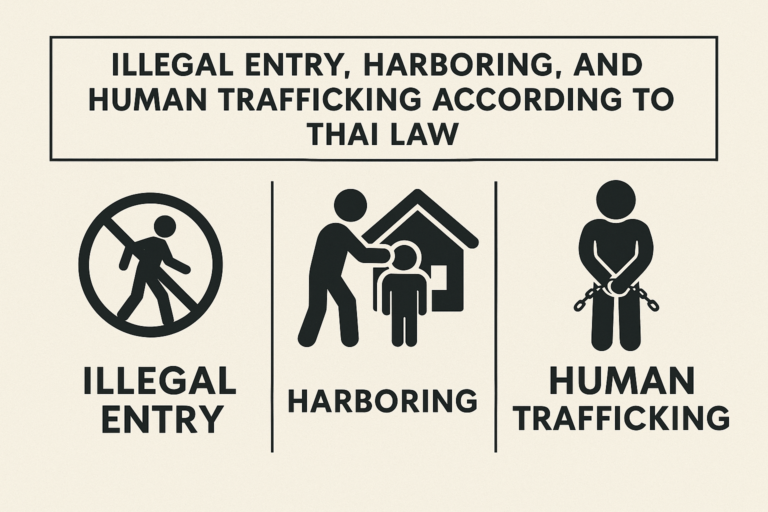
Table of Contents
Key Legal Framework
The guide explains how Thailand’s immigration and criminal laws work together through several interconnected statutes:
Primary Legislation:
- Immigration Act B.E. 2522 (1979), governing entry and deportation
- The Anti-Trafficking in Persons Act B.E. 2551 (2008) has been updated several times. It was amended in 2015 (Act No. 2), 2017 (Act No. 3, which raised the penalties) and 2019 (an Emergency Decree that added forced labour)
- Emergency Decree on Managing the Work of Aliens B.E. 2560 (2017)
- Relevant sections of the Criminal Code
Critical Penalties and Provisions
Illegal Entry Penalties:
- For illegal entrants (Section 62, entering other than through an immigration checkpoint): They can face up to 2 years in prison and a fine of up to 20,000 THB. Facilitators who bring in or help an alien enter illegally are punished under Section 63 with up to 10 years in prison and a fine of 100,000 THB. Harbouring or concealing an illegal alien to evade arrest is a separate offence under Section 64, punishable by up to 5 years and a fine of 50,000 THB. Deportation usually follows a conviction, and organised smuggling can also bring other criminal charges.
- For facilitators: Up to 10 years imprisonment and 100,000 THB fine
Harboring Illegal Aliens (Section 64):
- Up to 5 years imprisonment and 50,000 THB fine
- Legal presumptions regarding knowledge and accommodation
- Anyone who lodges an unlawful entrant is presumed to know, unless they prove they took reasonable care; the court may decline to punish someone who helped their own parent, child or spouse
Human Trafficking:
- Basic offence (Section 52): 4 to 12 years in prison and a fine of 400,000 to 1,200,000 THB, both imposed together. If the victim is over 15 but under 18: 6 to 15 years and 600,000 to 1,500,000 THB. If the victim is 15 or under, or has a physical or mental disability: 8 to 20 years and 800,000 to 2,000,000 THB (also Section 52).
- If the victim suffers grievous bodily harm or a life-threatening disease: 8 to 20 years and 800,000 to 2,000,000 THB, or life imprisonment. If the victim dies: life imprisonment or death (Section 53/1). Learn what to do if you are arrested in Thailand.
- A company convicted of trafficking is fined 1,000,000 to 5,000,000 THB, and a director or manager whose order, act or failure to act led to the offence is punished as well (Section 53).
Illegal Entry Under Thai Law
Illegal entry usually means crossing borders without the right visas or documents. Under the Immigration Act B.E. 2522 (1979), entering other than through an immigration checkpoint is an offence under Sections 11 and 62, punishable by up to 2 years in prison and a fine of up to 20,000 THB. Staying without permission, including an overstay, is a separate offence under Section 81 (up to 2 years, a fine of up to 20,000 THB, or both). For expats, the risk is usually assisting a family member or employee who is in one of these situations.
Facilitators, like those who provide transport or fake documents, face tougher punishments. They can get up to 10 years in prison and a fine of 100,000 THB under Section 63. In practice, we have seen cases where expat business owners face charges. They may unknowingly hire workers with expired permits. This can lead to deportation and business shutdowns. To mitigate risks, always verify visas through the Thai Immigration Bureau.
Harboring Illegal Aliens
Section 64 of the Immigration Act punishes anyone who, knowing that a foreigner entered Thailand unlawfully, gives them lodging, hides them, or helps them avoid arrest. The penalty is up to 5 years in prison and a fine of up to 50,000 THB. Anyone who gives such a person lodging is presumed to know, unless they prove they did not know despite taking reasonable care. The court may decline to punish someone who acted to help their own parent, child or spouse. Section 64 covers unlawful ENTRY; a foreigner who entered lawfully and then overstays commits the Section 81 offence instead, and hiring them is a work-permit matter under the Emergency Decree. A landlord should still check passports and file the TM30 notification. Our clients often ask about this in property disputes. Here’s a tip: Include visa checks in lease agreements to protect yourself.
Human Trafficking: A Serious Criminal Offense
The Anti-Trafficking in Persons Act B.E. 2551 (2008) defines trafficking. It includes recruiting, transporting, or exploiting people. For an adult victim this must be done by means such as threats, force, abduction, fraud, deception or abuse of power; for a child no such means is needed, and the victim’s consent is irrelevant (Section 6). Basic offenses can lead to 4 to 12 years in prison. Fines range from 400,000 to 1,200,000 THB.
For vulnerable groups, like children or the disabled, the punishment increases to 6 to 15 years where the victim is over 15 but under 18, and to 8 to 20 years where the victim is 15 or under or has a physical or mental disability (Section 52). Expats might unknowingly intersect with this via domestic worker hires or business partnerships. A recent case involved a bar owner from another country. They were charged with exploiting migrant workers. Where the offender is a company, the fine is 1 to 5 million THB, and the directors or managers responsible are punished too (Section 53). If you’re starting a business in Thailand, conduct due diligence on partners to avoid complicity.
According to the US State Department’s 2024 Trafficking in Persons Report, in 2023 the government investigated 312 trafficking cases (253 in 2022), prosecuted 542 suspected traffickers (308 in 2022) and convicted 211 traffickers (249 in 2022). In 2023, courts sentenced 293 traffickers. About 95 percent received two or more years in prison. Additionally, 37 percent were sentenced to 10 or more years.
In 2023, courts ordered the seizure of assets worth about 31.84 million THB ($927,470). This was in trafficking cases handled by the Anti-Money Laundering Office. The Thai Internet Crimes Against Children Task Force looked into 99 cases of online child trafficking in 2023. This is up from 41 cases in 2022. Officials initiated investigations of 15 cases of suspected labor trafficking, compared with 47 labor trafficking investigations in 2022.
Practical Steps for Expats and Employers
This guide covers the practical risks for expats, including:
- Documentation requirements and overstay consequences
- Employer liability for hiring illegal workers
- Property owner risks when accommodating foreign nationals
- Recent enforcement trends and case examples
- Risk mitigation strategies for individuals and businesses
To safeguard your life in Thailand, implement these strategies: Regularly audit employee documents, report suspicions to authorities via the Immigration Hotline (1178), and seek legal reviews for property rentals. Businesses should adopt anti-trafficking policies per international standards like the UN Palermo Protocol, which Thailand ratified.
What if I accidentally hire an illegal worker?
Employer liability under the Emergency Decree on Managing the Work of Aliens B.E. 2560 can lead to fines and deportation, contact us for compliance audits.
How do overstay fines work?
Section 81 of the Immigration Act allows up to two years in prison or a fine of up to 20,000 THB; in practice an overstay is settled under section 84 at 500 THB a day, up to 20,000 THB, with potential blacklisting. Read our article on overstaying in Thailand for more info.
What are the main issues related to human trafficking in Thailand?
What are the main issues related to human trafficking in Thailand?
Human trafficking in Thailand is a big problem. It includes different types of exploitation, like labor trafficking and sex trafficking. Many migrant workers from neighboring countries such as Laos and Cambodia are particularly vulnerable to trafficking. They often face false promises of employment and can fall prey to traffickers who exploit their desperate circumstances. The Thai government has taken steps to fight trafficking. However, challenges still exist. Trafficking rings are complex, and there is a high demand for cheap labor in industries like fishing.
How does the Thai government address trafficking in persons?
The Thai government is working to fight human trafficking. They have made new laws and joined international agreements, like the ASEAN Convention Against Trafficking. Efforts include working more closely with law enforcement, like the Thai police and immigration police. There are also initiatives to raise awareness and prevent human trafficking. The US State Department’s 2024 Trafficking in Persons Report keeps Thailand in Tier 2: it does not fully meet the minimum standards for eliminating trafficking but is making significant efforts. This highlights ongoing problems with enforcement and support for victims.
What measures are in place to protect vulnerable migrant workers?
To protect vulnerable migrant workers, Thailand has established legal frameworks and partnerships with international organizations aimed at preventing trafficking and providing support to victims. The Ministry of Social Development and Human Security runs victim shelters, and the 1300 hotline takes reports. Furthermore, the Royal Thai police have been active in cracking down on human traffickers and rescuing victims. However, more comprehensive measures are needed to ensure the safety and rights of migrant workers facing exploitation.
How can individuals and communities help combat trafficking in persons in Thailand?
How can individuals and communities help combat trafficking in persons in Thailand?
People and communities can help fight human trafficking. They can raise awareness about the signs of trafficking. They can also support local anti-trafficking efforts. Working with NGOs that help trafficking victims is important. We need to push for stronger laws and better enforcement. Promoting fair recruitment practices is also essential. Teaching others about the dangers of illegal migration and forced labor is important. It can help reduce the number of people at risk of trafficking. This is true in Thailand and other places.
Recent Developments related to Human Trafficking under Thai Law
The guide includes current enforcement information, such as:
- Recent border security enhancements following Thai-Cambodian disputes
- Increased penalties through 2017 amendments to trafficking laws
- Current cases involving Myanmar journalists (December 2024) and Uyghur asylum seekers
- 2024 ASEAN anti-trafficking pacts.
Navigating Thai immigration and trafficking laws can be daunting, especially as an expat building a life here. If you have problems with overstaying, business rules, or trafficking risks, our team at ThaiLawOnline.com can help you. Contact us today for a consultation, by email [info@thailawonline.com] or call +66-(0)872 251 340. Don’t risk your future; let our experienced lawyers guide you to compliance and peace of mind.
Thai Law Updates, free by email
Plain-English updates on Thai law changes that affect foreigners: property, visas, marriage, business and wills. One short email a month from a firm practicing since 2006. No spam, unsubscribe anytime.