


Reviewed by Wichuda Atthamethakon, LL.M., Thai Bar Licence 3149/2556, for ThaiLawOnline, a Thai law firm acting for foreigners since 2006.
Update log
- 2 November 2026: Added the statute box with Thai, English and French text and checked the page against the official text
Setting up a foundation in Thailand is a complex task. It requires careful attention to rules, financial commitments, and ongoing compliance. Recent laws have made the process harder. There is more government oversight and possible new rules coming soon.
Thailand’s laws for foundations are based on the Civil and Commercial Code and ministerial rules. These organizations must show they have real public benefit goals and must stay non-profit. The registration itself has an official service time of 30 days, or about 60 where the registrar must consult another agency, but preparing the documents and answering the registrar’s questions usually takes longer. The foundation needs a fund of 200,000 or 500,000 Thai baht, depending on its goals. Given the complexity and evolving regulatory landscape, professional legal assistance is not just recommended but essential for successful foundation establishment. This guide is informational and not a substitute for personalized legal advice.

Table of Contents
Legal Framework and Recent Regulatory Changes
Governing Laws and Regulations
Thailand’s foundation establishment is mainly governed by the Civil and Commercial Code (Sections 110-136). It is also guided by the Ministerial Regulations on the Registration of Foundations from 2002. A foundation is defined under Section 110 of the Civil and Commercial Code. It is property set aside for public purposes. These purposes include charity, religion, art, science, education, and other public benefits. It is not meant for profit sharing.” The property must be managed solely for implementing the foundation’s objectives and cannot be used for personal interest.
Summary of Foundation Establishment Requirements in Thailand
| Topic | Key Laws/Rules | Purpose/Impact |
|---|---|---|
| Legal Framework | Civil and Commercial Code Sections 110-136, Ministerial Regulations 2002 | Ensures all foundations serve public benefit and stay non-profit |
| Capital Requirements | Minimum fund set by the Ministry of Interior: 500,000 THB in cash, or at least 250,000 THB in cash plus other property bringing the total to 500,000 THB; 200,000 THB for foundations for social welfare, education, sport, religion, disaster relief, drug or AIDS treatment and prevention, or those founded by a State agency. Evidenced by a bank certificate, or the title deed where land is given. | High entry barrier; ensures serious and financially stable applicants |
| Timeline & Steps | Preparation (1-2 months); official registration service time 30 days, about 60 if another agency is consulted | Long process requiring well-prepared documents and persistence |
| Oversight Authority | Department of Provincial Administration under Ministry of Interior | Enforces rules, reviews operations, ensures accountability |
| Recent Legal Developments | Draft Act on Associations & Foundations (public consultation Oct to Nov 2024; not enacted) | Would restrict unregistered orgs and add penalties and reporting if ever passed |
| Taxation Rules | Donations tax-exempt; Business income taxed at 2%, other income at 10%. Donors get a tax deduction only once the foundation is recognised as a public charitable organisation, which is a separate Revenue Department application (see our guide to the foundation rules). | Ensures transparency, prevents abuse of tax benefits |
| Compliance Duties | Annual report to the registrar by March with auditor-certified accounts, tax ID within 60 days of registration, financial records | Demonstrates legitimacy, supports ongoing operation and audits |
| Role of Legal Assistance | Helps avoid delays, ensure compliance, draft charter, and board setup | Essential for avoiding mistakes and preparing for future legal changes |
The Ministry of Interior maintains oversight authority over all foundations through the Department of Provincial Administration. This government group has the power to check foundation activities. They review financial statements and make sure rules and laws are followed. Foundations must operate within strictly defined parameters, with activities limited to charitable, religious, artistic, scientific, literary, educational, or other public benefit purposes.
The law behind this page
English
Section 110
Full text
A foundation is property specifically allocated for the purposes of public charity, religion, art, science, literature or education, or for any other public benefit, without the aim of seeking profits for distribution, and registered in accordance with the provisions of this Code. The management of the property of a foundation must not be aimed at securing a benefit for any person other than for carrying out the objects of the foundation itself.
ThaiLawOnline translation
Section 115
Full text
When the registrar has received the application and is of opinion that the application is correct under Section 114, that the regulations are correct under Section 112, that the objects accord with Section 110 and are not contrary to law or to the good morals of the people, and are not dangerous to the peace of the people or to the security of the State, that the particulars entered in the application or in the regulations conform to the objects of the foundation, and that the persons who are to be directors of the foundation have a standing and conduct suitable for carrying out the objects of the foundation, the registrar shall register the foundation, issue a certificate of registration to it and publish the establishment of the foundation in the Government Gazette. If the registrar is of opinion that the application or the regulations are not correct under Section 114 or Section 112, or that the particulars entered in the application or in the regulations do not conform to the objects of the foundation, or that the persons who are to be directors of the foundation do not have a standing or conduct suitable for carrying out the objects of the foundation, the registrar shall order the applicant to correct or alter them. When they have been correctly corrected or altered, the registrar shall register the foundation and issue a certificate of registration to it. If the registrar is of opinion that registration cannot be accepted because the objects of the foundation do not accord with Section 110, or are contrary to law or to the good morals of the people, or may be dangerous to the peace of the people or to the security of the State, or because the applicant has not corrected or altered them within thirty days from the day on which the registrar's order came to his knowledge, the registrar shall order that registration be refused and shall without delay notify the applicant of the order together with the reasons for the refusal. The applicant has the right to appeal against the order refusing registration to the Minister of Interior, in writing submitted to the registrar within thirty days from the day on which notice of the order refusing registration was received. The Minister of Interior shall decide the appeal and notify the appellant of the decision within ninety days from the day on which the registrar received the written appeal. The decision of the Minister of Interior is final.
ThaiLawOnline translation
Section 114
Full text
An application for registration of a foundation shall be submitted in writing by the applicant founder to the registrar of the locality where the head office of the foundation is to be established. The application must state at least the owner of the property and the list of property to be allocated to the foundation, and the names, addresses and occupations of all the prospective committee members of the foundation, and the regulations of the foundation must be attached to the application.
ThaiLawOnline translation
Section 112
Full text
The regulations of a foundation must contain at least the following particulars: (1) the name of the foundation; (2) its objects; (3) the location of its principal office and all its branch offices; (4) its property at the time of creation; (5) rules concerning the Committee of the foundation, namely the number of directors, the appointment of directors, the term of office of directors, the vacation of office by directors and the meetings of the Committee; (6) rules concerning the management of the foundation and the management of the property and accounts of the foundation.
ThaiLawOnline translation
Section 111
Full text
A foundation must have regulations and must have a committee of the foundation, consisting of at least three persons, which conducts the affairs of the foundation in accordance with the law and the regulations of the foundation.
ThaiLawOnline translation
Section 131
Full text
On the application of the Registrar, the public prosecutor or any interested person, the court may order a foundation to be dissolved in any of the following cases: (1) it appears that the objects of the foundation are contrary to law; (2) it appears that the foundation has acted contrary to law or to good morals, or may endanger the public peace or national security; (3) it appears that the foundation cannot continue its activities for any reason whatsoever, or has ceased its activities for two years or more.
ThaiLawOnline translation
Section 134
Full text
When the liquidation has been completed, the property of the foundation shall be transferred to the foundation or juristic person having objects under section 110 which is named in the regulations of the foundation. If the regulations of the foundation do not name such a foundation or juristic person, the public prosecutor, the liquidator or any interested person may apply to the Court for the property to be allocated to another foundation or juristic person whose objects appear closest to the objects of that foundation. If the foundation was dissolved by order of the Court under section 131 (1) or (2), or if the allocation of property under paragraph one cannot be made, the property of the foundation shall vest in the State.
ThaiLawOnline translation
Section 67 Revenue Code
Full text
Tax under this Part shall be paid at the rates specified in the income tax rate schedule annexed to this Chapter, except that: (1) where a company or juristic partnership under section 66 paragraph two carries on a transport business through various countries, tax shall be paid only on the transport business, on the following basis: (a) for the carriage of passengers, tax at the rate of 3 percent of the fares, fees and any other benefits collected in Thailand, before deducting any expenses in connection with that carriage of passengers; (b) for the carriage of goods, tax at the rate of 3 percent of the freight, fees and any other benefits collected, whether in or outside Thailand, before deducting any expenses in connection with that carriage of goods out of Thailand; (2) a foundation or association carrying on a business that generates revenue other than revenue under section 65 bis (13) shall pay tax at the rate of 10 percent of that revenue before deducting any expenses; (3) income under section 40 (4) (a) of a company or juristic partnership that is a mutual fund shall be taxed at the rate of 15 percent of the revenue before deducting any expenses.
ThaiLawOnline translation
ไทย
มาตรา 110
ข้อความเต็ม
มูลนิธิได้แก่ทรัพย์สินที่จัดสรรไว้โดยเฉพาะสำหรับวัตถุประสงค์เพื่อการกุศล สาธารณะ การศาสนา ศิลปะ วิทยาศาสตร์ วรรณคดี การศึกษา หรือเพื่อสาธารณประโยชน์อย่างอื่น โดยมิได้มุ่งหาผลประโยชน์มาแบ่งปันกัน และได้จดทะเบียนตามบทบัญญัติแห่งประมวลกฎหมายนี้ การจัดการทรัพย์สินของมูลนิธิ ต้องมิใช่เป็นการหาผลประโยชน์เพื่อบุคคลใดนอกจากเพื่อดำเนินการตามวัตถุประสงค์ของมูลนิธินั้นเอง
ตรงตามข้อความในราชกิจจานุเบกษา / สำนักงานคณะกรรมการกฤษฎีกา (Verbatim from the Royal Gazette / Office of the Council of State)
มาตรา 115
ข้อความเต็ม
เมื่อนายทะเบียนได้รับคำขอแล้วเห็นว่า คำขอนั้นถูกต้องตามมาตรา ๑๑๔ และข้อบังคับถูกต้องตามมาตรา ๑๑๒ และวัตถุประสงค์เป็นไปตามมาตรา ๑๑๐ และไม่ขัดต่อกฎหมายหรือศีลธรรมอันดีของประชาชน หรือไม่เป็นภยันตรายต่อความสงบสุขของประชาชนหรือความมั่นคงของรัฐ และรายการซึ่งจดแจ้งในคำขอหรือข้อบังคับสอดคล้องกับวัตถุประสงค์ของมูลนิธิ และผู้จะเป็นกรรมการของมูลนิธินั้นมีฐานะและความประพฤติเหมาะสมในการดำเนินการตามวัตถุประสงค์ของมูลนิธิ ให้นายทะเบียนรับจดทะเบียนและออกใบสำคัญแสดงการจดทะเบียนให้แก่มูลนิธินั้น และประกาศการจัดตั้งมูลนิธิในราชกิจจานุเบกษา ถ้านายทะเบียนเห็นว่าคำขอหรือข้อบังคับไม่ถูกต้องตามมาตรา ๑๑๔ หรือมาตรา ๑๑๒ หรือรายการซึ่งจดแจ้งในคำขอหรือข้อบังคับไม่สอดคล้องกับวัตถุประสงค์ของมูลนิธิ หรือผู้จะเป็นกรรมการของมูลนิธิมีฐานะหรือความประพฤติไม่เหมาะสมในการดำเนินการตามวัตถุประสงค์ของมูลนิธิ ให้มีคำสั่งให้ผู้ขอจดทะเบียนแก้ไขหรือเปลี่ยนแปลงให้ถูกต้อง เมื่อแก้ไขหรือเปลี่ยนแปลงถูกต้องแล้ว ให้รับจดทะเบียนและออกใบสำคัญแสดงการจดทะเบียนให้แก่มูลนิธินั้น ถ้านายทะเบียนเห็นว่าไม่อาจรับจดทะเบียนได้เนื่องจากวัตถุประสงค์ของมูลนิธิไม่เป็นไปตามมาตรา ๑๑๐ หรือขัดต่อกฎหมายหรือศีลธรรมอันดีของประชาชนหรืออาจเป็นภยันตรายต่อความสงบสุขของประชาชนหรือความมั่นคงของรัฐ หรือผู้ขอจดทะเบียนไม่แก้ไขหรือเปลี่ยนแปลงให้ถูกต้องภายในสามสิบวันนับแต่วันที่ทราบคำสั่งของนายทะเบียน ให้นายทะเบียนมีคำสั่งไม่รับจดทะเบียน และแจ้งคำสั่งพร้อมด้วยเหตุผลที่ไม่รับจดทะเบียนให้ผู้ขอจดทะเบียนทราบโดยมิชักช้า ผู้ขอจดทะเบียนมีสิทธิอุทธรณ์คำสั่งไม่รับจดทะเบียนนั้นต่อรัฐมนตรีว่าการกระทรวงมหาดไทย โดยทำเป็นหนังสือยื่นต่อนายทะเบียนภายในสามสิบวันนับแต่วันที่ได้รับแจ้งคำสั่งไม่รับจดทะเบียน ให้รัฐมนตรีว่าการกระทรวงมหาดไทยวินิจฉัยอุทธรณ์และแจ้งคำวินิจฉัยให้ผู้อุทธรณ์ทราบภายในเก้าสิบวันนับแต่วันที่นายทะเบียนได้รับหนังสืออุทธรณ์ คำวินิจฉัยของรัฐมนตรีว่าการกระทรวงมหาดไทยให้เป็นที่สุด
ตรงตามข้อความในราชกิจจานุเบกษา / สำนักงานคณะกรรมการกฤษฎีกา (Verbatim from the Royal Gazette / Office of the Council of State)
มาตรา 114
ข้อความเต็ม
การขอจดทะเบียนมูลนิธินั้น ให้ผู้ขอจัดตั้งมูลนิธิยื่นคำขอเป็นหนังสือต่อนายทะเบียนแห่งท้องที่ที่สำนักงานใหญ่ของมูลนิธิจะตั้งขึ้น ในคำขออย่างน้อยต้องระบุเจ้าของทรัพย์สินและรายการทรัพย์สินที่จะจัดสรรสำหรับมูลนิธิ รายชื่อ ที่อยู่และอาชีพของผู้จะเป็นกรรมการของมูลนิธิทุกคน พร้อมกับแนบข้อบังคับของมูลนิธิมากับคำขอด้วย
ตรงตามข้อความในราชกิจจานุเบกษา / สำนักงานคณะกรรมการกฤษฎีกา (Verbatim from the Royal Gazette / Office of the Council of State)
มาตรา 112
ข้อความเต็ม
ข้อบังคับของมูลนิธิอย่างน้อยต้องมีรายการ ดังต่อไปนี้ (๑) ชื่อมูลนิธิ (๒) วัตถุประสงค์ของมูลนิธิ (๓) ที่ตั้งสำนักงานใหญ่และที่ตั้งสำนักงานสาขาทั้งปวง (๔) ทรัพย์สินของมูลนิธิขณะจัดตั้ง (๕) ข้อกำหนดเกี่ยวกับคณะกรรมการของมูลนิธิ ได้แก่ จำนวนกรรมการ การตั้งกรรมการ วาระการดำรงตำแหน่งของกรรมการ การพ้นจากตำแหน่งของกรรมการ และการประชุมของคณะกรรมการ (๖) ข้อกำหนดเกี่ยวกับการจัดการมูลนิธิ การจัดการทรัพย์สินและบัญชีของมูลนิธิ
ตรงตามข้อความในราชกิจจานุเบกษา / สำนักงานคณะกรรมการกฤษฎีกา (Verbatim from the Royal Gazette / Office of the Council of State)
มาตรา 111
ข้อความเต็ม
มูลนิธิต้องมีข้อบังคับ และต้องมีคณะกรรมการของมูลนิธิประกอบด้วยบุคคลอย่างน้อยสามคน เป็นผู้ดำเนินกิจการของมูลนิธิตามกฎหมายและข้อบังคับของมูลนิธิ
ตรงตามข้อความในราชกิจจานุเบกษา / สำนักงานคณะกรรมการกฤษฎีกา (Verbatim from the Royal Gazette / Office of the Council of State)
มาตรา 131
ข้อความเต็ม
นายทะเบียน พนักงานอัยการ หรือผู้มีส่วนได้เสียคนหนึ่งคนใดอาจร้องขอต่อศาลให้มีคำสั่งให้เลิกมูลนิธิได้ในกรณีหนึ่งกรณีใด ดังต่อไปนี้(๑) เมื่อปรากฏว่าวัตถุประสงค์ของมูลนิธิขัดต่อกฎหมาย (๒) เมื่อปรากฏว่ามูลนิธิกระทำการขัดต่อกฎหมายหรือศีลธรรมอันดีของประชาชน หรืออาจเป็นภยันตรายต่อความสงบสุขของประชาชนหรือความมั่นคงของรัฐ (๓) เมื่อปรากฏว่ามูลนิธิไม่สามารถดำเนินกิจการต่อไปได้ไม่ว่าเพราะเหตุใด ๆ หรือหยุดดำเนินกิจการตั้งแต่สองปีขึ้นไป
ตรงตามข้อความในราชกิจจานุเบกษา / สำนักงานคณะกรรมการกฤษฎีกา (Verbatim from the Royal Gazette / Office of the Council of State)
มาตรา 134
ข้อความเต็ม
เมื่อได้ชำระบัญชีแล้ว ให้โอนทรัพย์สินของมูลนิธิให้แก่มูลนิธิหรือนิติบุคคลที่มีวัตถุประสงค์ตามมาตรา ๑๑๐ ซึ่งได้ระบุชื่อไว้ในข้อบังคับของมูลนิธิ ถ้าข้อบังคับของมูลนิธิมิได้ระบุชื่อมูลนิธิหรือนิติบุคคลดังกล่าวไว้ พนักงานอัยการ ผู้ชำระบัญชี หรือผู้มีส่วนได้เสียคนหนึ่งคนใด อาจร้องขอต่อศาลให้จัดสรรทรัพย์สินนั้นแก่มูลนิธิหรือนิติบุคคลอื่นที่ปรากฏว่ามีวัตถุประสงค์ใกล้ชิดที่สุดกับวัตถุประสงค์ของมูลนิธินั้นได้ ถ้ามูลนิธินั้นถูกศาลสั่งให้เลิกตามมาตรา ๑๓๑ (๑) หรือ (๒) หรือการจัดสรรทรัพย์สินตามวรรคหนึ่งไม่อาจกระทำได้ ให้ทรัพย์สินของมูลนิธิตกเป็นของแผ่นดิน
ตรงตามข้อความในราชกิจจานุเบกษา / สำนักงานคณะกรรมการกฤษฎีกา (Verbatim from the Royal Gazette / Office of the Council of State)
มาตรา 67 ประมวลรัษฎากร
ข้อความเต็ม
การเสียภาษีตามความในส่วนนี้ ให้เสียตามอัตราที่กำหนดไว้ในบัญชีอัตราภาษีเงินได้ท้ายหมวดนี้ เว้นแต่ (๑) ในกรณีที่บริษัทหรือห้างหุ้นส่วนนิติบุคคลตามมาตรา ๖๖ วรรคสอง กระทำกิจการขนส่งผ่านประเทศต่าง ๆ ให้เสียภาษีเฉพาะกิจการขนส่งตามเกณฑ์ ดังต่อไปนี้ (ก) ในกรณีรับขนคนโดยสาร ให้เสียภาษีในอัตราร้อยละ ๓ ของค่าโดยสาร ค่าธรรมเนียม และประโยชน์อื่นใดที่เรียกเก็บในประเทศไทยก่อนหักรายจ่ายใด ๆ เนื่องในการรับขนคนโดยสารนั้น (ข) ในกรณีรับขนของ ให้เสียภาษีในอัตราร้อยละ ๓ ของค่าระวาง ค่าธรรมเนียม และประโยชน์อื่นใดที่เรียกเก็บไม่ว่าในหรือนอกประเทศไทย ก่อนหักรายจ่ายใด ๆ เนื่องในการรับขนของออกจากประเทศไทยนั้น (๒) มูลนิธิหรือสมาคมที่ประกอบกิจการซึ่งมีรายได้อันมิใช่รายได้ตามมาตรา ๖๕ ทวิ (๑๓) ให้เสียภาษีในอัตราร้อยละ ๑๐ ของรายได้ก่อนหักรายจ่ายใด ๆ (๓) เงินได้ตามมาตรา ๔๐ (๔) (ก) ของบริษัทหรือห้างหุ้นส่วนนิติบุคคลที่เป็นกองทุนรวม ให้เสียภาษีในอัตราร้อยละ ๑๕ ของรายได้ก่อนหักรายจ่ายใด ๆ
ตรงตามข้อความในราชกิจจานุเบกษา / สำนักงานคณะกรรมการกฤษฎีกา (Verbatim from the Royal Gazette / Office of the Council of State)
Français
Article 110
Une fondation est un patrimoine affecté spécialement à un but caritatif, public, religieux, artistique, scientifique, littéraire, éducatif ou d'utilité publique, sans partage de profits, et enregistré selon ce Code. Sa gestion ne peut profiter à personne hors de la poursuite de ce but.
résumé non officiel
Article 115
Dossier conforme (art. 110, 112, 114), licite, administrateurs aptes : enregistrement, certificat, Journal officiel. Vice corrigible : correction ordonnée. Objet illicite ou dangereux, ou correction omise sous 30 jours : refus motivé. Recours au ministre de l'Intérieur, écrit au registraire sous 30 jours; décision définitive sous 90 jours.
résumé non officiel
Article 114
Le fondateur dépose une demande écrite auprès du registraire du ressort du futur siège. Elle indique au moins le propriétaire et la liste des biens affectés, ainsi que les nom, adresse et profession de chaque futur administrateur, et joint les statuts.
résumé non officiel
Article 112
Les statuts d'une fondation doivent au moins indiquer : son nom, son objet, son siège et toutes ses succursales, ses biens à la constitution, les règles du conseil (nombre, nomination, mandat, cessation des fonctions, réunions), et la gestion de la fondation, de ses biens et de ses comptes.
résumé non officiel
Article 111
Une fondation doit avoir des statuts et un conseil d'administration d'au moins trois personnes, qui gère ses activités conformément à la loi et aux statuts.
résumé non officiel
Article 131
Le registraire, le procureur ou tout intéressé peut demander au tribunal de dissoudre une fondation : (1) objet illégal; (2) actes illégaux, contraires aux bonnes mœurs, ou pouvant menacer la paix publique ou la sûreté de l'État; (3) activité impossible à poursuivre, ou arrêtée depuis deux ans ou plus.
résumé non officiel
Article 134
Après liquidation, les biens vont à l'entité d'objet conforme à l'art. 110 désignée par les statuts; sinon, sur requête du procureur, du liquidateur ou d'un intéressé, le tribunal les attribue à l'entité d'objet le plus proche. Dissolution (art. 131 (1), (2)) ou attribution impossible : biens à l'État.
résumé non officiel
Article 67 Revenue Code
Barème annexé, sauf: transport international par société étrangère de l'article 66, 3 % des recettes brutes (passagers encaissés en Thaïlande, fret au départ de la Thaïlande); fondations et associations, 10 % des recettes brutes hors article 65 bis (13); fonds communs, 15 % du revenu de l'article 40 (4) (a).
résumé non officiel
Sources
- Civil and Commercial Code, Office of the Council of State, retrieved 31 October 2026
- Revenue Code, retrieved 2 November 2026
Draft Act on Associations and Foundations 2024
A significant development affecting foundation establishment is Thailand’s proposed Draft Act on Associations and Foundations, which the Department of Provincial Administration published for public comment from 28 October to 26 November 2024. It would move the foundation and association rules out of the Civil and Commercial Code (sections 78 to 136) into a separate Act and take a stricter approach to the non-profit sector; critics say parts of it breach international human rights standards. As published, the draft would require all associations and foundations to register, ban unregistered groups and create criminal penalties for those who do not comply. It had not been enacted when this page was reviewed, so the Civil and Commercial Code still governs.
Key concerns with the proposed law include rules for groups to have at least 30 members. It also gives inspection powers without search warrants. Additionally, it allows for broad dissolution based on unclear criteria. This includes actions that are “contrary to public morality” or could endanger “national security.” The bill also mandates burdensome reporting requirements for foreign funding, with thresholds to be determined by ministerial announcement. These provisions have drawn significant criticism from civil society organizations and international human rights groups who argue they could severely restrict legitimate charitable activities.
Increased Government Scrutiny
The regulatory environment for foundations has become increasingly strict, reflecting broader concerns about tax avoidance and security issues. Foundations enjoy low tax rates. They pay 2% on business income and 10% on other income. However, this has led to more government checks to stop misuse. This has drawn more attention from the government. Income from membership fees and donations is still tax-exempt. However, authorities are increasing oversight to stop abuse of these tax benefits.
Recent tax policy changes show the government’s commitment to closing loopholes. Since 1 January 2024 the Revenue Department has taxed foreign income earned in a year of Thai tax residence when it is brought into Thailand, in whatever later year that happens (Instruction Por. 161/2566). While these changes primarily affect individual taxpayers, they signal a broader trend toward stricter financial oversight that extends to charitable organizations.
Considerations for Foreign Founders and International Foundations
Expatriates or international organizations looking to establish a foundation in Thailand face additional hurdles due to foreign investment restrictions and security concerns. A foundation has no owners or shareholders. Its assets belong to the foundation itself, a juristic person governed by the Civil and Commercial Code (sections 110 to 136), not by the Foreign Business Act. What matters is the composition of the board and the source of the endowment, not any percentage of foreign ownership. The law sets no nationality quota for the board, but a foreign would-be director must produce a valid passport, visa and work permit, and the district office asks the National Intelligence Agency and the director’s embassy to certify the person before registration (Department of Provincial Administration registration guideline). Foreign funding must be reported clearly. This helps avoid issues with anti-money laundering laws under the Anti-Money Laundering Act B.E. 2542.
A foreign charity that wants to open an office or run projects in Thailand without forming a Thai foundation applies instead under the Ministry of Labour Regulation on the Operation of Foreign Private Organisations in Thailand B.E. 2541, administered by the Department of Employment; the Council of State has confirmed that it binds foreign private organisations, not Thai ones (opinion 1035/2547). Common challenges include language barriers in documentation and cultural nuances in defining “public benefit.” Involving bilingual legal experts early can make this process easier. They can help create a foundation that meets both Thai law and international standards, such as those from the UN or OECD.
Capital Requirements and Financial Obligations
Minimum Capital Thresholds
Foundation establishment requires substantial initial capital investment, with requirements varying based on the organization’s objectives. The Department of Provincial Administration’s registration guideline puts the minimum fund set by the Ministry of Interior at 500,000 baht, or 200,000 baht, evidenced by a bank certificate for the funds or the title deed where land is given. Its public service manual gives the detail: 500,000 baht in cash, or at least 250,000 baht in cash with other property bringing the total to 500,000 baht; and 200,000 baht for foundations for social welfare, education, sport, religion, disaster relief, the treatment, research and prevention of drug addiction or AIDS, or those founded by a State agency. The ministerial regulation on foundation registration itself sets no figure. The registration fees are 210 baht (10 for the application, 200 for registration).
These capital requirements represent a significant barrier to entry for smaller charitable initiatives and non-profit organizations.. The funds must be deposited in a Thai bank account and cannot be withdrawn for personal use. If a foundation is dissolved, its remaining assets go to the foundation or juristic person with public-benefit objects named in its regulations, or, if none is named, to one with the closest objects chosen by the court; they cannot be returned to the founders (Civil and Commercial Code section 134).
Despite the high barriers, establishing a foundation in Thailand offers significant incentives, particularly for charitable work. Registered foundations enjoy tax exemptions on donations (encouraging philanthropy), eligibility for government grants, and credibility for partnerships with NGOs. For expats, this offers a clear way to help Thai society. It may also help them qualify for long-term visas in some public benefit categories. However, these benefits depend on following non-profit rules. If any profits are shared, it could lead to penalties and closure.
Ongoing Financial Compliance
Foundations face continuous financial reporting obligations that require professional accounting expertise. Every year, by the end of March, the foundation must report to the registrar with an activity report for the past year, a balance sheet and income and expenditure account certified by an authorised auditor, and the minutes of every board meeting held that year (Ministerial Regulation on foundation registration B.E. 2545, clause 13). The reports should detail how funds were used and progress made toward goals. These reports must show that all income and donations are used only for the foundation’s purposes. They cannot be used for personal gain.
A foundation liable to corporate income tax must apply for a tax identification number within 60 days of registration or of starting business in Thailand, whichever is later. Also, keep detailed records of all financial transactions. Foundations have some tax benefits, like not paying taxes on donations, which can significantly aid local organizations. However, they still pay income tax on business activities and investment earnings. Recent tax policy changes have introduced additional compliance requirements, particularly regarding foreign funding sources and electronic donation systems.
Establishment Process and Timeline
Preparation Phase (1-2 months)
The foundation establishment process starts with careful planning of goals, documents, and finances. This must follow the Thai civil and commercial code. Founders need to clearly state the foundation’s charitable purposes. This ensures they match the allowed activities for non-profit organizations under Thai law. This phase includes securing the required minimum capital, identifying potential board members, and developing the foundation’s charter and regulations.
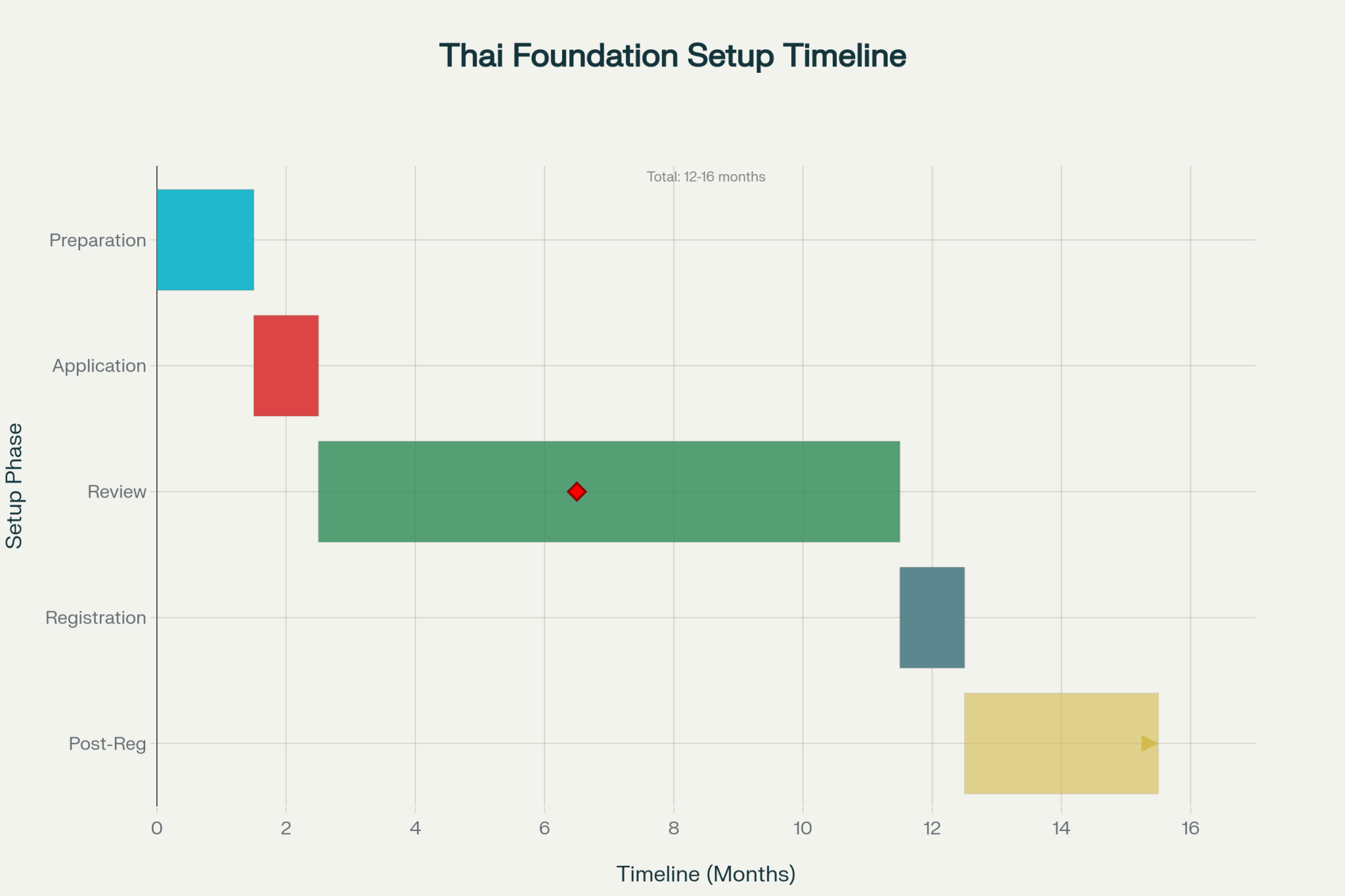
Foundation Establishment Process Timeline in Thailand
Preparing documents during this phase is very important. Incomplete or incorrect submissions can cause big delays later on. You need to provide several documents, including a tax identification number for the foundation. These include a list of allocated assets and registered donation promises, which are crucial for non-profit organizations. You also need identification documents for all board members of the foundation or association. Lastly, include detailed foundation rules about management structure and operational procedures.
Application and Review Process
The application is lodged at the district office where the foundation’s principal office will be (in Bangkok the khet office, elsewhere the amphoe office), for the foundation registrar of that locality. The official service time is 30 days, plus up to 30 more where the foundation’s name, objects or emblem require the registrar to consult another government agency; in practice, corrections and follow-up questions often make it longer. During this time, authorities review the foundation’s goals. They also examine the financial plans and the qualifications of the board of directors. Government officials check if the foundation’s goals serve the public interest and do not threaten safety or security.
During this phase, authorities may request corrections or additional documentation, potentially extending the timeline further. The registrar can deny registration. This can happen if the goals break the law, are immoral, or could harm public order or national security. Applicants have 30 days from notice of the registrar’s order to make the needed corrections, failing which registration is refused (Civil and Commercial Code section 115). A refusal can be appealed in writing to the Minister of Interior within 30 days; the Minister decides within 90 days and that decision is final.
Registration and Post-Registration Requirements
Upon approval, the registrar issues a certificate of registration, and the foundation’s establishment is published in the Government Gazette. The newly registered foundation must then complete tax registration within 60 days and begin fulfilling ongoing compliance obligations. This includes establishing proper accounting systems, implementing governance procedures, and preparing for annual reporting requirements.
Post-registration compliance means keeping an eye on activities to make sure they meet goals. It also includes keeping accurate financial records and sending annual reports to the government. Foundations must also navigate evolving regulatory requirements, including potential new restrictions under the proposed Draft Act on Associations and Foundations.
The Critical Role of Legal Assistance
Complex Regulatory Navigation
The complexity of Thailand’s foundation establishment process makes professional legal assistance essential rather than optional. Legal practitioners specializing in non-profit law possess the expertise necessary to navigate the intricate regulatory framework and ensure compliance with all applicable requirements. The process involves multiple government agencies, detailed documentation requirements, and ongoing compliance obligations that require specialized knowledge.
Experienced legal help can assist founders of non-profit organizations. They can help avoid common mistakes that cause application rejections or delays.
- This includes writing the charter correctly.
- It also involves meeting capital needs.
- Additionally, it requires structuring the board well.
- Finally, it means handling any security issues that may arise during the review.
Legal professionals keep up with changing rules. They pay attention to new laws, like the Draft Act on Associations and Foundations.
Practical Advantages of Professional Guidance
Legal assistance provides practical benefits beyond regulatory compliance, including efficient document preparation, strategic planning for foundation objectives, and ongoing operational guidance. Lawyers can help structure foundations to maximize tax benefits while ensuring full compliance with applicable laws. They also provide valuable guidance on board composition, particularly regarding the practical advantages of including Thai nationals among directors.
Professional legal services are more important now. This is due to increased government scrutiny and possible new rules for non-profits. Lawyers can help foundations prepare for enhanced reporting requirements, navigate inspection procedures, and ensure compliance with evolving regulatory standards. This guidance is very important for foreign founders. They may not know Thai legal procedures and cultural aspects.
Long-term Compliance and Risk Management
Legal assistance extends beyond initial establishment to ongoing compliance management and risk mitigation. Foundations require continuous legal guidance to maintain their charitable status, fulfill reporting obligations, and adapt to changing regulatory requirements. Professional legal advice helps make sure that foundation activities stay within legal limits. It also ensures that any changes in rules are quickly handled.
The Draft Act on Associations and Foundations may yet be revived. This makes legal help for non-profit groups more important. This proposed legislation could significantly alter the operating environment for foundations, requiring existing organizations to adapt their procedures and potentially face enhanced scrutiny. Legal professionals can help foundations prepare for these potential changes and ensure continued compliance with evolving regulatory standards.
FAQs on Setting Up a Foundation in Thailand
What are the steps for setting up a foundation in Thailand?
To start a foundation in Thailand, you first need to define its goals. Make sure these goals match non-profit purposes. You need to write the articles of association. Also, prepare supporting documents, like a copy of the house registration. After this, send your application to the local District Office. This office is part of the Department of Provincial Administration, Ministry of Interior. The district office checks the file and forwards it with its opinion to the foundation registrar, which outside Bangkok is the provincial governor. The registrar decides, registers the foundation and issues its certificate of registration.
What is the legal structure required for establishing a non-profit organization in Thailand?
The legal structure for establishing a non-profit organization in Thailand typically involves registering as a foundation or association. Foundations are non-profit entities that operate for public benefit, while associations may have broader membership and activities. Both must comply with Thai law and the rules prescribed by the Ministry of the Interior.
How does a foundation in Thailand enter into contracts?
A foundation in Thailand can legally make contracts if it is registered with the Ministry of the Interior. The foundation must make sure that all contracts match its goals and follow Thai law. This includes corporate income tax and other legal duties.
What are the criteria for approval of a foundation or association in Thailand?
To get approval for a foundation or association in Thailand, you need clear goals that help the public. You must also submit valid documents and follow the rules set by the Ministry of the Interior. The foundation’s activities must also align with non-profit purposes to secure approval.
What types of activities can a non-profit organization in Thailand engage in?
A non-profit organization in Thailand can do many things. It can promote education, health, welfare, and other public benefits. Activities must follow the foundation’s goals. They must also meet the legal rules of Thai law and the Ministry of the Interior.
What is the process for setting up a charity in Thailand?
Setting up a charity in Thailand involves similar steps to establishing a non-profit organization. You need to define the charity’s goals. Then, prepare the articles of association. Finally, submit the required documents to the Ministry of the Interior for approval. Once registered, the charity must operate within its approved framework and comply with all relevant regulations.
What is the role of the Revenue Department in the context of non-profit organisations in Thailand?
The Revenue Department in Thailand plays a crucial role in overseeing tax compliance for non-profit organizations. Foundations are subject to income tax (2% on business income, 10% on other income, as set out above), and they must follow certain rules. They also need to provide documents to show they comply with Thai law and the Revenue Department’s conditions.
How can one ensure compliance with Thai law when establishing a foundation?
To follow Thai law when starting a foundation, you must closely follow the steps set by the Ministry of the Interior. This includes preparing the necessary documents, understanding the criteria for approval, and adhering to the prescribed rules and regulations governing foundations in Thailand.
What support is available for non-governmental organizations in Thailand?
Non-governmental organizations (NGOs) in Thailand can benefit from various forms of support, including grants, training, and networking opportunities. These resources are often provided by other organizations, government agencies, and international bodies interested in promoting development and social welfare in Thailand.
Dissolution and Exit Strategies
A foundation is dissolved on a ground stated in its regulations, at the end of a fixed term, when its object is achieved or becomes impossible, on bankruptcy, or by court order (Civil and Commercial Code section 130). The registrar, the public prosecutor or any interested person may ask the court to dissolve a foundation whose objects or acts are unlawful, immoral or a danger to public peace or national security, or which cannot continue or has stopped operating for two years or more (section 131). In the first three cases the board must notify the registrar within 14 days (section 132). The foundation is then liquidated and the liquidator’s report is approved by the registrar (section 133). Remaining assets go to the public-benefit body named in the regulations, or one chosen by the court; if the court dissolved the foundation for unlawful objects or acts, or no such allocation is possible, they vest in the State (section 134).
It is smart to plan an exit strategy from the beginning. A lawyer can write clauses in the charter. This helps make winding down easier. It also reduces risks like tax audits or asset disputes. This is especially important amid regulatory changes, where non-compliance could trigger forced dissolution.
Last reviewed: 27 September 2026. Civil and Commercial Code sections 110 to 136 (in particular 114, 115 and 130 to 135), the Ministerial Regulation on foundation registration B.E. 2545, the Department of Provincial Administration’s registration guideline and public service manual, the Revenue Department’s guidance on foundation tax, and Council of State opinion 1035/2547 were read in Thai. Figures for the draft Act come from its published consultation draft as reported.
Conclusion
Establishing a foundation in Thailand represents a significant undertaking that requires careful planning, substantial financial resources, and expert legal guidance. It involves navigating complex regulatory requirements under increasingly strict government oversight. Recent developments, including the proposed Draft Act on Associations and Foundations, suggest that the regulatory environment will become even more challenging for charitable organizations.
The combination of substantial capital requirements (200,000-500,000 THB), complex documentation needs, and ongoing compliance obligations makes professional legal assistance essential for successful foundation establishment. The low tax burden has made Thai foundations attractive. However, it has also led to more government scrutiny. This means they must pay close attention to rules and operate transparently.
For expatriates and organizations considering foundation establishment in Thailand, early engagement with experienced legal counsel is crucial. The process is complex, and there can be big delays. The rules are always changing. Because of this, getting professional help is not just a good idea; it is essential. This help will ensure you meet your charitable goals and follow the law. As rules change, foundations that get good legal help early will be better prepared. They can handle future challenges and achieve their charitable goals more effectively.
- Read about the experience of one of our client that set up a foundation in Thailand
- Thai manual about foundations in Thailand (Thai PDF)
What Is a Charity Foundation in Thailand?
A foundation is property set aside for a charitable, religious, artistic, scientific, educational or other public-benefit purpose, and registered as a juristic person. The defining feature is that it is property dedicated to a purpose, not an organisation owned by members. Nobody owns a foundation, and its assets can never be distributed to its founders or committee.
Foundation or Association: Which Do You Need?
These are different vehicles and people routinely pick the wrong one. A foundation is built around dedicated assets pursuing a stated public-benefit purpose, governed by a committee. An association is built around members pursuing a shared activity, governed by the members themselves through a general meeting. If your project is funded by an endowment or donations and run by a small board, you want a foundation. If it is a club, professional body or community group whose members drive it, you want an association.
Is a Thai Foundation Automatically Tax-Exempt?
No, and this is the most common misunderstanding. Registration as a foundation does not by itself confer tax exemption. A foundation is still subject to tax on its income unless and until it obtains recognition as a charitable organisation from the Revenue Department. That is a separate application with its own criteria, and donors only get a deduction once it is granted. Budget for it as a second step, not an automatic consequence of registration.
Thai Law Updates, free by email
Plain-English updates on Thai law changes that affect foreigners: property, visas, marriage, business and wills. One short email a month from a firm practicing since 2006. No spam, unsubscribe anytime.