


Reviewed by Wichuda Atthamethakon, LL.M., Thai Bar Licence 3149/2556, for ThaiLawOnline, a Thai law firm acting for foreigners since 2006.
Update log
- 2 November 2026: Added the statute box with Thai, English and French text and checked the page against the official text
Last reviewed: 4 September 2026. The ownership and registration rules on this page were read against the Thai Vessels Act B.E. 2481 itself, sections 7, 8, 9, 10, 47, 50 and 51, taken from the consolidated text published in the government’s central law register at law.go.th. The correction that follows from that reading is set out under the document table. What was not verified, said plainly rather than implied: the licence procedure, the fee figures and the processing times on this page are not sourced to a statute or a ministerial regulation we could produce. Treat every number below as indicative and confirm it with the Marine Department.
Thailand’s stunning coastlines make it a top destination for yachting and boating enthusiasts. If you have a boat or live here as an expat, you need to know the laws about getting a boat license in Thailand. This knowledge helps you avoid penalties and ensures safe navigation. In this guide, we will help you understand the process. Our firm has a lot of experience with expats and maritime issues. We will use the Thai Vessel Act and Marine Department rules. If you are a foreigner married to a Thai partner or running a business in Phuket, this guide is for you. It covers all the needed documents and offers practical tips.
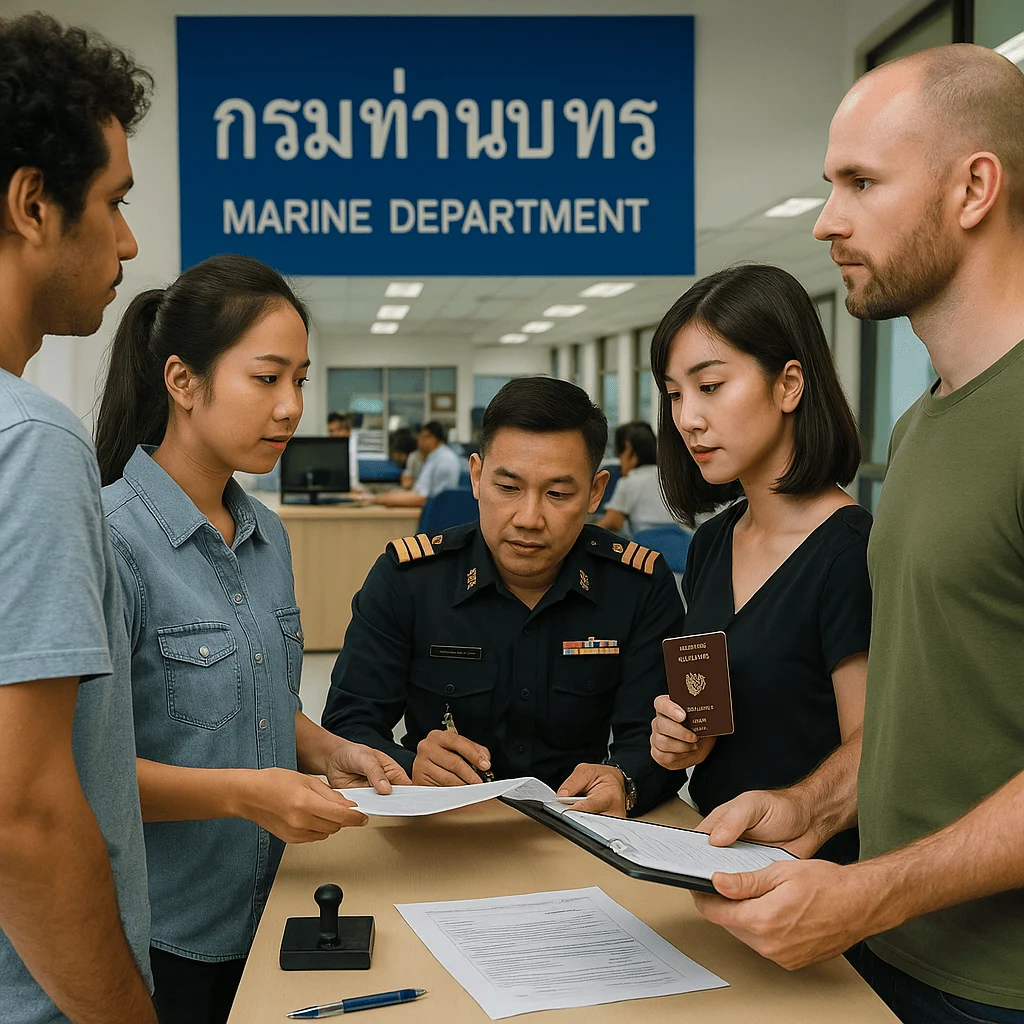
Table of Contents
What Are the Requirements for a Boat License in Thailand?
To apply for a boat license in Thailand (often called a “boat driving license” or ใบอนุญาตขับเรือ), you must meet legal and administrative criteria set by the Marine Department. The documents below are what the Marine Department asks of any applicant. Owning the boat is a separate question and there the law is not the same for foreigners: see the ownership note under the table. Here’s a summary table of essential documents:
| Required Document | Notes |
|---|---|
| Passport (photocopy) | Must be valid; include visa page if applicable. |
| Residence Certificate | Issued by the Immigration Bureau (or work permit for long-term expats). |
| Medical Certificate | Confirms good eyesight, hearing, and overall health; obtain from a Thai clinic. |
| International Boat License (if applicable) | Not mandatory but can expedite approval. |
| Proof of Boat Ownership/Registration | Registration is not universal. Under the Thai Vessels Act B.E. 2481, section 8 read with section 9, a boat has to be registered as a Thai vessel only for trade in Thai waters and only above set sizes (10 gross tons for a powered vessel, 20 for a non-powered sea-going vessel, 50 for a non-powered inland vessel; for fishing, any powered vessel and 6 gross tons for a non-powered one). A boat owned by a person who qualifies under section 7 does not have to be registered if it is below those sizes, or if it is not used for trade in Thai waters, and section 9 still treats it as a Thai vessel. A foreign individual’s boat is not covered by section 9. |
| Photos (2×2 inches) | Three passport-style photos for ID. |
Who may own the boat is where foreigners and Thais genuinely differ. Under the Thai Vessels Act B.E. 2481, section 7, a vessel registered as a Thai vessel for trade in Thai waters under section 47 may be owned only by a Thai natural person, an all-Thai partnership, a state enterprise, or a Thai-law company with at least half its directors Thai and at least 70% of its registered capital held by non-aliens. Section 10(2) makes the applicant prove that, so a foreign individual cannot register such a vessel in their own name. Two related rules follow: the crew of a vessel registered under section 7 and able to trade in Thai waters must all be Thai nationals (section 50), and only a Thai vessel may fly the Thai flag (section 51). Section 47 second paragraph carves out one case: the trading restriction does not reach a foreign individual’s vessel that is below the section 8 sizes. Applicants also need to pass a theory and practical test, and English options are available for foreigners. The application fee for a standard 5-year license is usually between 200 and 500 THB. Fees are higher for advanced types. Processing takes 1 to 2 weeks, depending on how complete the documents are. For expats, ensure your boat’s registration aligns with property laws if it’s tied to a Thai spouse or business.
The law behind this page
English
Section 277 Navigation in Thai Waters Act B.E. 2456
Full text
No person may work in a steamship, a motor vessel, a seagoing vessel, a cargo vessel of 100 hap or more that operates in connection with seagoing vessels, or a vessel used as a lifeboat of a seagoing vessel, in a position for which the vessel inspection rules require a certificate, unless that person holds a certificate of knowledge and competence permitting such work.
ThaiLawOnline translation
Section 282 Navigation in Thai Waters Act B.E. 2456
Full text
Any person who works in a vessel in a position for which the vessel inspection rules require a certificate of knowledge and competence, without having received a valid certificate of knowledge and competence under this Act, shall be liable to imprisonment not exceeding 6 months, or a fine of 1,000 baht to 10,000 baht, or both. If the person works in a vessel while the certificate has expired, the person shall be liable to a fine not exceeding 2,000 baht.
ThaiLawOnline translation
Section 278 Navigation in Thai Waters Act B.E. 2456
Full text
Before such a certificate is issued to a person to work as master, navigator, serang, tai kong, coxswain, helmsman, engineer or engine operator, that person must have passed an examination of knowledge, and when applying for the examination must produce evidence giving satisfaction as to not being a dissolute person, addicted to alcohol or addicted to narcotics, as to skill in work previously done, and as to general conduct. A master, navigator, serang, tai kong or coxswain must also show good eyesight. In this section: “serang” means a person in control of a lighter; “tai kong” means a person in control of a seagoing sailing vessel with a carrying capacity of 800 hap or more; “helmsman” means a person who controls, steers or sculls at the stern of a cargo vessel operating in connection with seagoing vessels.
ThaiLawOnline translation
Section 279 Navigation in Thai Waters Act B.E. 2456
Full text
The Harbour Master, with the approval of the Minister of Transport, has the power to issue regulations on examinations of knowledge of persons working in vessels concerning: (1) the classification of grades of knowledge; (2) the method of examination; (3) syllabuses; (4) the qualifications of examination candidates; (5) examination fees; (6) the issue of certificates of knowledge and competence; (7) other details concerning examinations of knowledge. Those regulations take effect once published in the Government Gazette.
ThaiLawOnline translation
Section 280 Navigation in Thai Waters Act B.E. 2456
Full text
A certificate of knowledge must state the name, age and identifying physical description of the holder and other necessary particulars, and must bear an affixed photograph of the holder. A helmsman's certificate is valid for 3 years; other certificates are valid for 5 years. On expiry the holder must bring the certificate to have it replaced. The fee for replacing a certificate shall be charged at half of the original fee rate, and the Harbour Master may, if so required, call for the evidence set out in section 278.
ThaiLawOnline translation
ไทย
มาตรา 277 พระราชบัญญัติการเดินเรือในน่านน้ำไทย พระพุทธศักราช 2456
ข้อความเต็ม
ห้ามมิให้ผู้ใดทำการในเรือกลไฟ เรือยนต์ เรือเดินทะเล เรือบรรทุกสินค้าขนาดตั้งแต่ ๑๐๐ หาบขึ้นไปซึ่งทำการติดต่อกับเรือเดินทะเลหรือเรือซึ่งใช้เป็นเรือชูชีพประจำเรือเดินทะเล ในตำแหน่งที่กฎข้อบังคับสำหรับการตรวจเรือกำหนดให้ต้องมีประกาศนียบัตร เว้นแต่เป็นผู้ที่ได้รับประกาศนียบัตรรับรองความรู้ความสามารถให้ทำการเช่นนั้นได้
ตรงตามข้อความในราชกิจจานุเบกษา / สำนักงานคณะกรรมการกฤษฎีกา (Verbatim from the Royal Gazette / Office of the Council of State)
มาตรา 282 พระราชบัญญัติการเดินเรือในน่านน้ำไทย พระพุทธศักราช 2456
ข้อความเต็ม
ผู้ใดทำการในเรือในตำแหน่งที่กฎข้อบังคับสำหรับการตรวจเรือกำหนดให้ต้องมีประกาศนียบัตรรับรองความรู้ความสามารถ โดยมิได้รับประกาศนียบัตรรับรองความรู้ความสามารถอันถูกต้องตามบทบัญญัติแห่งพระราชบัญญัตินี้ ต้องระวางโทษจำคุกไม่เกินหกเดือน หรือปรับตั้งแต่หนึ่งพันบาทถึงหนึ่งหมื่นบาท หรือทั้งจำทั้งปรับ ถ้าทำการในเรือในขณะที่ประกาศนียบัตรสิ้นอายุแล้ว ต้องระวางโทษปรับไม่เกินสองพันบาท
ตรงตามข้อความในราชกิจจานุเบกษา / สำนักงานคณะกรรมการกฤษฎีกา (Verbatim from the Royal Gazette / Office of the Council of State)
มาตรา 278 พระราชบัญญัติการเดินเรือในน่านน้ำไทย พระพุทธศักราช 2456
ข้อความเต็ม
เมื่อจะออกประกาศนียบัตรเช่นว่ามาแล้วให้แก่ผู้ใดสำหรับทำการเป็นนายเรือ ต้นหน สรั่ง ไต้ก๋ง นายท้าย คนถือท้าย หรือต้นกล คนใช้เครื่อง ท่านว่าผู้นั้นต้องสอบความรู้ได้แล้ว และเมื่อยื่นใบสมัครสอบนั้นต้องมีพยานหลักฐานมาแสดงให้เป็นที่พอใจถึงเรื่องไม่เป็นคนประพฤติเสเพลติดสุรายาเมา หรือติดยาเสพติดให้โทษความชำนาญการงานที่ได้ทำมา และความประพฤติทั่วไปนั้นด้วย แต่ถ้าผู้นั้นเป็นนายเรือ ต้นหน สรั่ง ไต้ก๋ง และนายท้าย จะต้องแสดงว่ามีสายตาดีด้วย ในมาตรานี้ คำว่า “สรั่ง” หมายความถึงผู้ทำการควบคุมเรือลำเลียง “ไต้ก๋ง” หมายความถึงผู้ควบคุมเรือใบเดินทะเลที่มีน้ำหนักบรรทุกตั้งแต่ ๘๐๐ หาบขึ้นไป “คนถือท้าย” หมายความถึงผู้ควบคุมหรือผู้ถือท้ายหรือคนแจวท้ายของเรือบรรทุกสินค้าที่ทำการติดต่อกับเรือเดินทะเล
ตรงตามข้อความในราชกิจจานุเบกษา / สำนักงานคณะกรรมการกฤษฎีกา (Verbatim from the Royal Gazette / Office of the Council of State)
มาตรา 279 พระราชบัญญัติการเดินเรือในน่านน้ำไทย พระพุทธศักราช 2456
ข้อความเต็ม
ให้เจ้าท่าโดยอนุมัติรัฐมนตรีว่าการกระทรวงคมนาคมมีอำนาจออกข้อบังคับเกี่ยวกับการสอบความรู้ของผู้ทำการในเรือในเรื่องดังต่อไปนี้ (๑) การแบ่งชั้นความรู้ (๒) วิธีการสอบความรู้ (๓) หลักสูตร (๔) คุณสมบัติของผู้สมัครสอบ (๕) ค่าธรรมเนียมในการสอบ (๖) การออกประกาศนียบัตรรับรองความรู้ความสามารถ (๗) รายละเอียดอื่น ๆ เกี่ยวกับการสอบความรู้ ข้อบังคับนั้น เมื่อได้ประกาศในราชกิจจานุเบกษาแล้ว ให้ใช้บังคับได้
ตรงตามข้อความในราชกิจจานุเบกษา / สำนักงานคณะกรรมการกฤษฎีกา (Verbatim from the Royal Gazette / Office of the Council of State)
มาตรา 280 พระราชบัญญัติการเดินเรือในน่านน้ำไทย พระพุทธศักราช 2456
ข้อความเต็ม
ประกาศนียบัตรแสดงความรู้นั้นต้องระบุ ชื่อ อายุ และตำหนิรูปพรรณของผู้ถือประกาศนียบัตร และข้อความอื่น ๆ ตามที่จำเป็น และต้องมีรูปถ่ายของผู้ถือประกาศนียบัตร ปิดไว้ด้วย ประกาศนียบัตรสำหรับคนถือท้ายให้มีอายุสามปี นอกนั้นให้มีอายุห้าปี เมื่อครบกำหนดแล้ว ผู้ถือต้องนำมาเปลี่ยนใหม่ ให้เรียกค่าธรรมเนียมการเปลี่ยนประกาศนียบัตรกึ่งหนึ่งแห่งอัตราค่าธรรมเนียมเดิม และถ้าเจ้าท่าจะต้องการให้ แสดงพยานหลักฐานดังที่บัญญัติไว้ในมาตรา ๒๗๘ ก็ทำได้
ตรงตามข้อความในราชกิจจานุเบกษา / สำนักงานคณะกรรมการกฤษฎีกา (Verbatim from the Royal Gazette / Office of the Council of State)
Français
Article 277 Navigation in Thai Waters Act B.E. 2456
Nul ne peut occuper, à bord des navires à vapeur, à moteur, de mer, des cargos de 100 hap ou plus liés aux navires de mer, ou des canots de sauvetage de ceux-ci, un poste exigeant un certificat sans détenir le certificat de compétence correspondant.
résumé non officiel
Article 282 Navigation in Thai Waters Act B.E. 2456
Occuper à bord un poste exigeant un certificat sans certificat valable est puni d'un emprisonnement de 6 mois au plus, d'une amende de 1 000 à 10 000 bahts, ou des deux; avec un certificat expiré, l'amende est de 2 000 bahts au plus.
résumé non officiel
Article 278 Navigation in Thai Waters Act B.E. 2456
Le certificat notamment de maître, navigateur, serang, tai kong, barreur ou mécanicien suppose la réussite d'un examen et la preuve de l'absence d'inconduite, d'alcoolisme ou de toxicomanie, de la compétence et de la conduite générale; certains doivent aussi prouver une bonne vue.
résumé non officiel
Article 279 Navigation in Thai Waters Act B.E. 2456
Le capitaine de port, avec l'approbation du ministre des Transports, réglemente les examens du personnel navigant, notamment grades, méthode, programmes, qualités des candidats, droits et délivrance des certificats; ces règlements s'appliquent dès leur publication au Journal officiel.
résumé non officiel
Article 280 Navigation in Thai Waters Act B.E. 2456
Le certificat indique nom, âge, signalement et porte une photographie. Il vaut 3 ans pour le barreur, 5 ans pour les autres; son remplacement à l'échéance coûte la moitié du droit initial, et le capitaine de port peut exiger les preuves de l'article 278.
résumé non officiel
Sources
- Navigation in Thai Waters Act B.E. 2456, retrieved 2 November 2026
Practical Considerations
A foreign boat licence is sometimes accepted for short visits, but we could not find a Thai instrument that says so and we are not going to assert one. There is no “international reciprocity” rule in the Vessels Act or the Navigation in Thai Waters Act that we were able to produce. Ask the Marine Department office at your port of entry, in writing, before you rely on a foreign licence. However, for long-term use, a Thai license is required. Foreign boats, like those from Langkawi, Malaysia, must follow entry rules at ports such as Phuket Marina. This process involves the Marine Department, Immigration, and Customs. This usually takes 1 day for arrival and 1-3 days for departure, with a 100 THB fee. Key documents include:
- Boat registration certificate.
- Owner’s and crew’s passports.
- Vaccination certificates.
- Radio license (with MMSI number).
- Power of attorney (if the captain isn’t the owner).
Quick Tip for Expats: If your boat is a family asset, like in a marriage or business, check Thai family law. This can help protect your ownership. Our team has helped many clients avoid disputes.
Step-by-Step Process for Obtaining a Boat License in Thailand
- Prepare Required Documents: Gather your passport, residence certificate, medical certificate, photos, and boat registration if the boat has one.
- Enroll in a Course (if needed): Complete a Marine Department-approved boating course for skills and safety knowledge.
- Submit Application: Apply at your local Marine Department office or online via their portal.
- Pass the Test: Take the theory and practical exams (English available).
- Pay the Fee: Settle the 200-500 THB fee (or more for specialized licenses).
- Receive Your License: Expect issuance in 1-2 weeks if all is in order.
Tips for a Smooth Process
- Double-Check Documents: Incomplete submissions cause most delays, verify everything twice.
- Get a Health Check Early: Thai clinics can issue medical certificates quickly and affordably.
- Stay Compliant: Learn about the Vessel Act to avoid fines. Apps like the Marine Department’s portal can help you track updates.
Types of Boat Licenses in Thailand
Licenses vary by vessel size and scope:
- Restricted Sea-Going License (ใบอนุญาตเรือกลเดินทะเลเฉพาะเขต): For Thai waters only.
- Unlimited Sea-Going License (ใบอนุญาตเรือกลเดินทะเลไม่จำกัดเขต): For international voyages.
- Basic Boat Driving License (ใบอนุญาตขับเรือ): Ideal for most expats with smaller vessels. Choose based on your plans, e.g., coastal cruising vs. open-sea adventures.
FAQs about Boat License in Thailand
What is the process to obtain a boat license in Thailand?
To obtain a boat license in Thailand, you must complete a boating course that is recognized by the Thai Marine Department. After you finish the course, you must submit an application. Include required documents like proof of identity and residency. Send these to the local registrar or marine office. You’ll also need to pass theory and practical tests, with processing typically taking 1-2 weeks.
Do foreigners need a Thai boat license to operate a vessel in Thailand?
Yes, where the vessel inspection rules require a certificate for your position on board: section 277 of the Navigation in Thai Waters Act B.E. 2456 then bars anyone without a certificate of competency from that position on a powered or sea-going vessel. On the licence itself we found no Thai instrument distinguishing foreigners from Thais, and we say that as a negative finding rather than as a rule. Ownership is different and is not equal: Thai Vessels Act B.E. 2481 section 7 restricts who may own a vessel registered as a Thai vessel for trade in Thai waters, and a foreign individual is not on that list. This ensures that all boat operators know local maritime laws and rules.
What types of boating courses are available in Thailand?
In Thailand, there are various boating courses available, including powerboat courses, sailing courses, and skipper courses. These courses teach important skills for operating various types of boats. They focus on safety and following Thai law. Approved providers in areas like Phuket or Bangkok offer both in-person and online options.
How can I register my boat in Thailand?
To register your boat in Thailand, you need to apply at the right marina or marine office. You must also provide important documents, like proof of ownership and a registration certificate. The registration process may vary depending on whether the vessel is Thai-flagged or foreign-flagged. For foreign-flagged vessels, additional customs clearance is required upon entry.
What is the cost of obtaining a boat license in Thailand?
The cost of getting a boat license in Thailand can change. It depends on the course you pick and the application fees. You can usually expect to pay for the course, exam fees, and registration fees. These costs may add up to several thousand THB. Basic courses start at 5,000-10,000 THB, with official fees around 200-500 THB for a 5-year license.
Can I transfer ownership of my boat in Thailand?
Yes, you can transfer ownership of your boat in Thailand. You must document the transfer of ownership. Then, submit it to the marine office or registrar. Include any required forms and fees. Both the seller and buyer need to be present during the transfer process. This must comply with the Vessel Act, and fees are typically 100-500 THB.
What are the penalties for operating a vessel without a boat license in Thailand?
Driving a boat without a valid license in Thailand can lead to penalties. Section 282 of the Navigation in Thai Waters Act B.E. 2456 punishes anyone working in a position that requires a certificate of competency without one: up to six months in prison, a fine of 1,000 to 10,000 baht, or both. Working on an expired certificate carries a fine of up to 2,000 baht. Which positions need a certificate is set by the vessel inspection rules, so confirm yours with the Marine Department office for your port.
Is there a boating directory for finding courses and registration services in Thailand?
Yes, there are boating directories available that provide information on various boating courses, registration services, and marinas in Thailand. These directories can help boat owners and future skippers find the resources they need. They make it easier to navigate the licensing and registration process. Check the Marine Department’s website or associations like the Thailand Yacht Show for comprehensive listings.
What is the role of the Marine Department in boat licensing in Thailand?
The Marine Department in Thailand oversees the regulation and enforcement of maritime laws, including the issuance of boat licenses. They make sure all boat operators have the right qualifications. They also ensure that boats follow safety standards in the Vessel Act.
Conclusion
Getting a boat license in Thailand is easy if you prepare well. This lets you enjoy the country’s beautiful waters safely and legally. From document submission to testing, our expat clients often find the process manageable, especially with guidance on local nuances. Check with the Marine Department before you act on any figure on this page.Need personalized help? Contact our team at ThaiLawOnline.com for expert assistance with boat licensing, registration, or related legal matters like property ownership.
Other links related to boat license in Thailand
If you also drive in Thailand, the equivalent process is set out in our guide on how to obtain a Thai driving license.
Thai Law Updates, free by email
Plain-English updates on Thai law changes that affect foreigners: property, visas, marriage, business and wills. One short email a month from a firm practicing since 2006. No spam, unsubscribe anytime.