


Reviewed by Wichuda Atthamethakon, LL.M., Thai Bar Licence 3149/2556, for ThaiLawOnline, a Thai law firm acting for foreigners since 2006.
Update log
- 31 October 2026: Added the statute box with Thai, English and French text and checked the page against the official text
What the Labour Protection Act actually requires, what the cabinet calendar does not, and how to pay staff correctly when they work the day.
Table of Contents
Last reviewed: 17 September 2026. The rules on this page were read in Thai against the Labour Protection Act B.E. 2541 (sections 9, 25, 29, 56, 61 to 66, 68, 70, 108, 114, 115, 144 and 146, as amended to No. 9 B.E. 2568; amendments No. 8 and No. 9 do not touch them). The 2027 bank dates were checked against Bank of Thailand Notification No. 37/2569 (Royal Gazette, 25 August 2026), and the 2026 dates against the cabinet resolutions of 2 December 2025 and 19 May 2026. Not verified here: the government’s own 2027 list and its substitute days (not yet announced), the Royal Ploughing Ceremony date, Labour Court procedure, and the rule on reducing an established number of holidays. Re-checked on 5 October 2026: every weekday in both calendars recomputed and correct; a search for a cabinet resolution on the 2027 government list or bridge days found none yet (only unofficial calendars), so the open items above stay open; no change made. Re-checked on 10 October 2026: Labour Court Act B.E. 2522 sections 27, 35 and 36 and Labour Relations Act B.E. 2518 sections 10 and 20 read in Thai; the Labour Court paragraph now says the fee exemption covers both sides and gives the oral-claim and representation rules, and the point about reducing an established holiday list now cites its basis. The 2027 government list, its substitute days and the Royal Ploughing Ceremony date remain open.
A client called us last November in a mild panic. Their Bangkok office had copied the Bank of Thailand calendar straight into the staff handbook, closed on all of it, and felt generous.
A labour inspector disagreed. The handbook was missing Khao Phansa, which is fine. It also failed to announce the year’s list in advance, which isn’t.
That is the trap with Thailand public holidays. There are three overlapping calendars in this country, and only one of them creates a legal duty for you. Copy the wrong list and you can be closed on days you did not owe while short-changing staff on days you did.
This guide sets out the rules for private employers. You’ll get the 2027 calendar, the remaining 2026 dates, the pay multipliers with worked examples, and the penalties for getting it wrong.
How many public holidays must you give in Thailand?
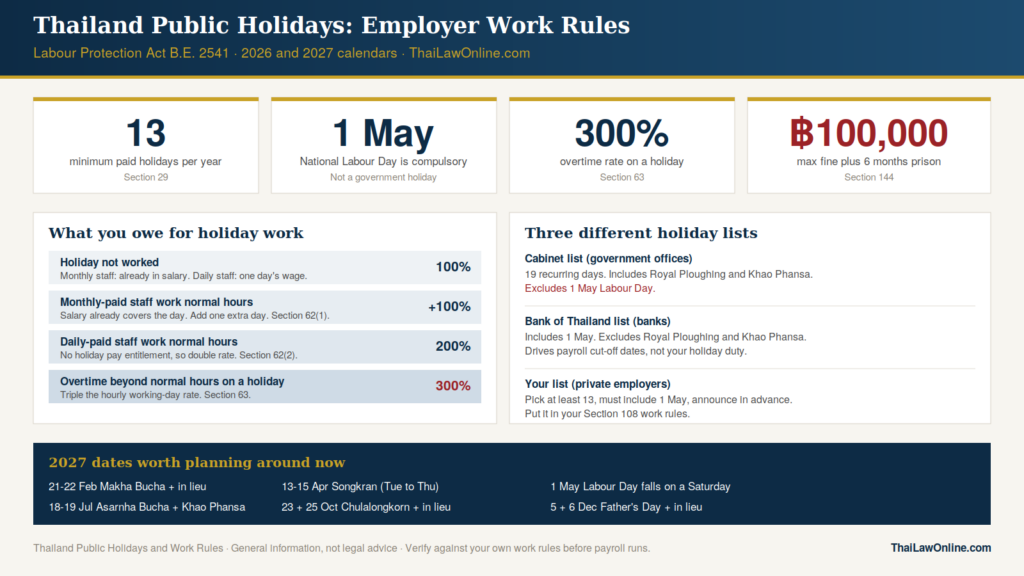
Thirteen. That’s the floor, and it comes from Section 29 of the Labour Protection Act B.E. 2541 (1998).
The section is short and it does three things. It fixes the minimum at not less than thirteen traditional holidays per year. It requires that National Labour Day be one of them.
And it obliges you to announce the list to your employees in advance.
The 13-day minimum and National Labour Day
Most foreign employers get the number right and the announcement wrong. Announcing “in advance” means before the year starts, in writing, where staff can see it. A calendar circulated in March for a year already underway does not cure a January breach.
National Labour Day on 1 May is compulsory. You cannot swap it out for Christmas or for a day that suits your production schedule better. Everything else in your thirteen is your choice, provided the days are drawn from official annual holidays, religious holidays or local custom (Section 29).
In our experience
Foreign-managed companies routinely assume the government’s list is the legal standard. It isn’t. The cabinet list governs government offices.
Your duty is your own announced list. Publish fourteen or eighteen days and that becomes your contractual standard.
Going above thirteen is fine. Quietly dropping back down next year is not, because it worsens an existing employment condition.
Government list, bank list, your list
Here is where the confusion starts. The three lists genuinely differ, and the differences are not trivial.
| Holiday | Cabinet list (government) | Bank of Thailand list (banks) | Private employer duty (LPA) |
|---|---|---|---|
| National Labour Day (1 May) | Not a holiday | Holiday | Compulsory |
| Royal Ploughing Ceremony | Holiday | Not a holiday | Optional |
| Khao Phansa (Buddhist Lent) | Holiday | Not a holiday | Optional |
| Songkran (13, 14, 15 April) | Holiday | Holiday | Optional but near universal |
| All other recurring days | Holiday | Holiday | Optional |
| Cabinet “bridge” long weekends | Holiday | Follows cabinet | Not binding |
The cabinet’s standing list has held 19 recurring days since the 2019 revision that added Coronation Day and Queen Suthida’s birthday. So government offices get more days than the statutory minimum. That is a policy choice, not a legal obligation you inherit.
Why does the Bank of Thailand list matter, then? For a different reason. It tells you when banks close, which drives your payroll cut-off dates and your supplier payment runs.
Treat it as an operations input, not a legal one.
The law behind this page
English
Section 29 Labour Protection Act B.E. 2541
Full text
The employer shall announce traditional holidays to employees in advance, being not fewer than 13 days a year, including National Labour Day as announced by the Minister. The employer shall determine traditional holidays from the annual public holidays, religious holidays, or local customs and traditions. Where a traditional holiday falls on an employee's weekly holiday, the employee shall have a compensatory holiday on the next working day. Where the employer is unable to give employees a traditional holiday because they perform work of a nature or condition prescribed in a Ministerial Regulation, the employer shall agree with the employees either to take another day off in compensation for the traditional holiday or that the employer will pay holiday work pay.
ThaiLawOnline translation
Section 56 Labour Protection Act B.E. 2541
Full text
The employer shall pay an employee wages equal to the wages for a working day for the following holidays: (1) weekly holidays, except for employees who receive wages on a daily or hourly basis, or by results calculated per unit; (2) traditional holidays; (3) annual holidays.
ThaiLawOnline translation
Section 62 Labour Protection Act B.E. 2541
Full text
Where the employer requires an employee to work on a holiday under section 28, section 29 or section 30, the employer shall pay the employee holiday work pay at the following rates: (1) for an employee entitled to wages on the holiday, an additional payment over and above the wages of not less than 1 times the hourly wage rate for a working day for the number of hours worked, or, for an employee paid by results calculated per unit, not less than 1 times the unit wage rate for a working day for the number of units produced; (2) for an employee not entitled to wages on the holiday, not less than 2 times the hourly wage rate for a working day for the number of hours worked, or, for an employee paid by results calculated per unit, not less than 2 times the unit wage rate for a working day for the number of units produced.
ThaiLawOnline translation
Section 63 Labour Protection Act B.E. 2541
Full text
Where the employer requires an employee to work overtime on a holiday, the employer shall pay the employee holiday overtime pay at a rate of not less than 3 times the hourly wage rate for a working day for the number of hours worked, or, for an employee paid by results calculated per unit, not less than 3 times the unit wage rate for a working day for the number of units produced.
ThaiLawOnline translation
Section 64 Labour Protection Act B.E. 2541
Full text
Where the employer does not give an employee holidays, or gives fewer holidays than prescribed in section 28, section 29 and section 30, the employer shall pay the employee holiday work pay and holiday overtime pay at the rates prescribed in section 62 and section 63, as if the employer had required the employee to work on a holiday.
ThaiLawOnline translation
Section 25 Labour Protection Act B.E. 2541
Full text
The employer shall not require an employee to work on a holiday, except that where the nature or condition of the work requires it to be continuous and stopping would damage the work, or in the case of emergency work, the employer may require the employee to work on a holiday as far as necessary. The employer may require an employee to work on a holiday in hotels, places of entertainment, transport work, food shops, beverage shops, clubs, associations, medical establishments, or other businesses prescribed in a Ministerial Regulation. For the benefit of production, sale and services, the employer may require an employee to work on a holiday in cases other than those in paragraph one and paragraph two as far as necessary, with the employee's prior consent on each occasion.
ThaiLawOnline translation
Section 65 Labour Protection Act B.E. 2541
Full text
An employee who has the following authority, or whom the employer assigns to any of the following work, is not entitled to overtime pay under section 61 or holiday overtime pay under section 63, but an employee assigned to work under (3), (4), (5), (6), (7), (8) or (9) is entitled to monetary compensation equal to the hourly wage rate for a working day for the number of hours worked: (1) an employee with authority to act on behalf of the employer in hiring, granting rewards or terminating employment; (2) work of peddling or soliciting the purchase of goods for which the employer pays the employee a sales commission; (3) railway train operations work, being work performed on trains and work facilitating the running of trains; (4) opening and closing water gates or sluice gates; (5) reading water levels and measuring water volumes; (6) firefighting or public danger prevention work; (7) work whose nature or condition requires working away from the workplace and for which, by that nature or condition, fixed working hours cannot be set; (8) on-duty watch over premises or property that is not the employee's normal work; (9) other work prescribed in a Ministerial Regulation. This does not apply where the employer agrees to pay the employee overtime pay or holiday overtime pay.
ThaiLawOnline translation
Section 144 Labour Protection Act B.E. 2541
Full text
An employer who violates or fails to comply with any of the following provisions shall be liable to imprisonment for a term not exceeding 6 months, or a fine not exceeding 100,000 baht, or both: (1) section 10, section 17/1, section 23 paragraph two, section 24, section 25, section 26, section 37, section 38, section 39, section 39/1, section 40, section 42, section 43, section 46, section 47, section 48, section 51, section 57/1, section 61, section 62, section 63, section 64, section 67, section 70, section 71, section 72, section 76, section 90 paragraph one, section 118 paragraph one, or section 118/1 paragraph two; (2) section 120, section 120/1, section 121 or section 122, as regards failure to pay special severance pay in lieu of advance notice or special severance pay; (3) a Ministerial Regulation issued under section 22 as regards labour protection in the various cases, other than those concerning the employment of children below the age prescribed in a Ministerial Regulation as employees, the taking on of children below the age prescribed in a Ministerial Regulation for work, or the prohibition on employers requiring employees who are children under 18 years of age to perform the types of work and work in the places prescribed in a Ministerial Regulation, or a Ministerial Regulation issued under section 95. Where the employer's violation of or failure to comply with section 37, section 38, section 39, section 39/1, section 42, section 47 or section 48 causes an employee bodily or mental harm or death, the employer shall be liable to imprisonment for a term not exceeding 1 year, or a fine not exceeding 200,000 baht, or both.
ThaiLawOnline translation
ไทย
มาตรา 29 พระราชบัญญัติคุ้มครองแรงงาน พ.ศ. 2541
ข้อความเต็ม
ให้นายจ้างประกาศกำหนดวันหยุดตามประเพณีให้ลูกจ้างทราบเป็นการล่วงหน้าปีหนึ่งไม่น้อยกว่าสิบสามวันโดยรวมวันแรงงานแห่งชาติตามที่รัฐมนตรีประกาศกำหนด ให้นายจ้างพิจารณากำหนดวันหยุดตามประเพณีจากวันหยุดราชการประจำปี วันหยุดทางศาสนา หรือขนบธรรมเนียมประเพณีแห่งท้องที่ ในกรณีที่วันหยุดตามประเพณีวันใดตรงกับวันหยุดประจำสัปดาห์ของลูกจ้าง ให้ลูกจ้างได้หยุดชดเชยวันหยุดตามประเพณีในวันทำงานถัดไป ในกรณีที่นายจ้างไม่อาจให้ลูกจ้างหยุดตามประเพณีได้ เนื่องจากลูกจ้างทำงานที่มีลักษณะหรือสภาพของงานตามที่กำหนดในกฎกระทรวง ให้นายจ้างตกลงกับลูกจ้างว่า จะหยุดในวันอื่นชดเชยวันหยุดตามประเพณีหรือนายจ้างจะจ่ายค่าทำงานในวันหยุดให้ก็ได้
ตรงตามข้อความในราชกิจจานุเบกษา / สำนักงานคณะกรรมการกฤษฎีกา (Verbatim from the Royal Gazette / Office of the Council of State)
มาตรา 56 พระราชบัญญัติคุ้มครองแรงงาน พ.ศ. 2541
ข้อความเต็ม
ให้นายจ้างจ่ายค่าจ้างให้แก่ลูกจ้างเท่ากับค่าจ้างในวันทำงานสำหรับวันหยุด ดังต่อไปนี้ (๑) วันหยุดประจำสัปดาห์ เว้นแต่ลูกจ้างซึ่งได้รับค่าจ้างรายวัน รายชั่วโมง หรือตามผลงานโดยคำนวณเป็นหน่วย (๒) วันหยุดตามประเพณี (๓) วันหยุดพักผ่อนประจำปี
ตรงตามข้อความในราชกิจจานุเบกษา / สำนักงานคณะกรรมการกฤษฎีกา (Verbatim from the Royal Gazette / Office of the Council of State)
มาตรา 62 พระราชบัญญัติคุ้มครองแรงงาน พ.ศ. 2541
ข้อความเต็ม
ในกรณีที่นายจ้างให้ลูกจ้างทำงานในวันหยุดตามมาตรา ๒๘ มาตรา ๒๙ หรือมาตรา ๓๐ ให้นายจ้างจ่ายค่าทำงานในวันหยุดให้แก่ลูกจ้างในอัตรา ดังต่อไปนี้ (๑) สำหรับลูกจ้างซึ่งมีสิทธิได้รับค่าจ้างในวันหยุด ให้จ่ายเพิ่มขึ้นจากค่าจ้างอีกไม่น้อยกว่าหนึ่งเท่าของอัตราค่าจ้างต่อชั่วโมงในวันทำงานตามจำนวนชั่วโมงที่ทำหรือไม่น้อยกว่าหนึ่งเท่าของอัตราค่าจ้างต่อหน่วยในวันทำงานตามจำนวนผลงานที่ทำได้สำหรับลูกจ้างซึ่งได้รับค่าจ้างตามผลงานโดยคำนวณเป็นหน่วย (๒) สำหรับลูกจ้างซึ่งไม่มีสิทธิได้รับค่าจ้างในวันหยุด ให้จ่ายไม่น้อยกว่าสองเท่าของอัตราค่าจ้างต่อชั่วโมงในวันทำงานตามจำนวนชั่วโมงที่ทำ หรือไม่น้อยกว่าสองเท่าของอัตราค่าจ้างต่อหน่วยในวันทำงานตามจำนวนผลงานที่ทำได้สำหรับลูกจ้างซึ่งได้รับค่าจ้างตามผลงานโดยคำนวณเป็นหน่วย
ตรงตามข้อความในราชกิจจานุเบกษา / สำนักงานคณะกรรมการกฤษฎีกา (Verbatim from the Royal Gazette / Office of the Council of State)
มาตรา 63 พระราชบัญญัติคุ้มครองแรงงาน พ.ศ. 2541
ข้อความเต็ม
ในกรณีที่นายจ้างให้ลูกจ้างทำงานล่วงเวลาในวันหยุด ให้นายจ้างจ่ายค่าล่วงเวลาในวันหยุดให้แก่ลูกจ้างในอัตราไม่น้อยกว่าสามเท่าของอัตราค่าจ้างต่อชั่วโมงในวันทำงานตามจำนวนชั่วโมงที่ทำ หรือไม่น้อยกว่าสามเท่าของอัตราค่าจ้างต่อหน่วยในวันทำงานตามจำนวนผลงานที่ทำได้ สำหรับลูกจ้างซึ่งได้รับค่าจ้างตามผลงานโดยคำนวณเป็นหน่วย
ตรงตามข้อความในราชกิจจานุเบกษา / สำนักงานคณะกรรมการกฤษฎีกา (Verbatim from the Royal Gazette / Office of the Council of State)
มาตรา 64 พระราชบัญญัติคุ้มครองแรงงาน พ.ศ. 2541
ข้อความเต็ม
ในกรณีที่นายจ้างมิได้จัดให้ลูกจ้างหยุดงาน หรือจัดให้ลูกจ้างหยุดงานน้อยกว่าที่กำหนดไว้ตามมาตรา ๒๘ มาตรา ๒๙ และมาตรา ๓๐ ให้นายจ้างจ่ายค่าทำงานในวันหยุดและค่าล่วงเวลาในวันหยุดให้แก่ลูกจ้างตามอัตราที่กำหนดไว้ในมาตรา ๖๒ และมาตรา ๖๓ เสมือนว่านายจ้างให้ลูกจ้างทำงานในวันหยุด
ตรงตามข้อความในราชกิจจานุเบกษา / สำนักงานคณะกรรมการกฤษฎีกา (Verbatim from the Royal Gazette / Office of the Council of State)
มาตรา 25 พระราชบัญญัติคุ้มครองแรงงาน พ.ศ. 2541
ข้อความเต็ม
ห้ามมิให้นายจ้างให้ลูกจ้างทำงานในวันหยุด เว้นแต่ในกรณีที่ลักษณะหรือสภาพของงานต้องทำติดต่อกันไป ถ้าหยุดจะเสียหายแก่งาน หรือเป็นงานฉุกเฉิน นายจ้างอาจให้ลูกจ้างทำงานในวันหยุดได้เท่าที่จำเป็น นายจ้างอาจให้ลูกจ้างทำงานในวันหยุดได้สำหรับกิจการโรงแรม สถานมหรสพ งานขนส่ง ร้านขายอาหาร ร้านขายเครื่องดื่ม สโมสร สมาคม สถานพยาบาล หรือกิจการอื่นตามที่กำหนดในกฎกระทรวง เพื่อประโยชน์แก่การผลิต การจำหน่าย และการบริการ นายจ้างอาจให้ลูกจ้างทำงาน นอกจากที่กำหนดตามวรรคหนึ่งและวรรคสองในวันหยุดเท่าที่จำเป็น โดยได้รับความยินยอมจากลูกจ้างก่อนเป็นคราว ๆ ไป
ตรงตามข้อความในราชกิจจานุเบกษา / สำนักงานคณะกรรมการกฤษฎีกา (Verbatim from the Royal Gazette / Office of the Council of State)
มาตรา 65 พระราชบัญญัติคุ้มครองแรงงาน พ.ศ. 2541
ข้อความเต็ม
ลูกจ้างซึ่งมีอำนาจหน้าที่หรือซึ่งนายจ้างให้ทำงานอย่างหนึ่งอย่างใด ดังต่อไปนี้ ไม่มีสิทธิได้รับค่าล่วงเวลาตามมาตรา ๖๑ และค่าล่วงเวลาในวันหยุดตามมาตรา ๖๓ แต่ลูกจ้างซึ่งนายจ้างให้ทำงานตาม (๓) (๔) (๕) (๖) (๗) (๘) หรือ (๙) มีสิทธิได้รับค่าตอบแทนเป็นเงินเท่ากับอัตราค่าจ้างต่อชั่วโมงในวันทำงานตามจำนวนชั่วโมงที่ทำ (๑) ลูกจ้างซึ่งมีอำนาจหน้าที่ทำการแทนนายจ้างสำหรับกรณีการจ้าง การให้บำเหน็จ หรือการเลิกจ้าง (๒) งานเร่ขายหรือชักชวนซื้อสินค้าซึ่งนายจ้างได้จ่ายค่านายหน้าจากการขายสินค้าให้แก่ลูกจ้าง (๓) งานขบวนการจัดงานรถไฟ ซึ่งได้แก่งานที่ทำบนขบวนรถและงานอำนวยความสะดวกแก่การเดินรถ (๔) งานเปิดปิดประตูน้ำหรือประตูระบายน้ำ (๕) งานอ่านระดับน้ำและวัดปริมาณน้ำ (๖) งานดับเพลิงหรืองานป้องกันอันตรายสาธารณะ (๗) งานที่มีลักษณะหรือสภาพต้องออกไปทำงานนอกสถานที่ และโดยลักษณะหรือสภาพของงานไม่อาจกำหนดเวลาทำงานที่แน่นอนได้ (๘) งานอยู่เวรเฝ้าดูแลสถานที่หรือทรัพย์สินอันมิใช่หน้าที่การทำงานปกติของลูกจ้าง (๙) งานอื่นตามที่กำหนดในกฎกระทรวง ทั้งนี้ เว้นแต่นายจ้างตกลงจ่ายค่าล่วงเวลาหรือค่าล่วงเวลาในวันหยุดให้แก่ลูกจ้าง
ตรงตามข้อความในราชกิจจานุเบกษา / สำนักงานคณะกรรมการกฤษฎีกา (Verbatim from the Royal Gazette / Office of the Council of State)
มาตรา 144 พระราชบัญญัติคุ้มครองแรงงาน พ.ศ. 2541
ข้อความเต็ม
นายจ้างผู้ใดฝ่าฝืนหรือไม่ปฏิบัติตามบทบัญญัติดังต่อไปนี้ ต้องระวางโทษจำคุกไม่เกินหกเดือน หรือปรับไม่เกินหนึ่งแสนบาท หรือทั้งจำทั้งปรับ (๑) มาตรา ๑๐ มาตรา ๑๗/๑ มาตรา ๒๓ วรรคสอง มาตรา ๒๔ มาตรา ๒๕ มาตรา ๒๖ มาตรา ๓๗ มาตรา ๓๘ มาตรา ๓๙ มาตรา ๓๙/๑ มาตรา ๔๐ มาตรา ๔๒ มาตรา ๔๓ มาตรา ๔๖ มาตรา ๔๗ มาตรา ๔๘ มาตรา ๕๑ มาตรา ๕๗/๑ มาตรา ๖๑ มาตรา ๖๒ มาตรา ๖๓ มาตรา ๖๔ มาตรา ๖๗ มาตรา ๗๐ มาตรา ๗๑ มาตรา ๗๒ มาตรา ๗๖ มาตรา ๙๐ วรรคหนึ่ง มาตรา ๑๑๘ วรรคหนึ่ง หรือมาตรา ๑๑๘/๑ วรรคสอง (๒) มาตรา ๑๒๐ มาตรา ๑๒๐/๑ มาตรา ๑๒๑ หรือมาตรา ๑๒๒ ในส่วนที่เกี่ยวกับการไม่จ่ายค่าชดเชยพิเศษแทนการบอกกล่าวล่วงหน้าหรือค่าชดเชยพิเศษ (๓) กฎกระทรวงที่ออกตามมาตรา ๒๒ ในส่วนที่เกี่ยวกับการคุ้มครองแรงงานในกรณีต่าง ๆ ที่ไม่เกี่ยวกับการจ้างเด็กอายุต่ำกว่าที่กำหนดในกฎกระทรวงเป็นลูกจ้างหรือการรับเด็กซึ่งมีอายุต่ำกว่าที่กำหนดในกฎกระทรวงเข้าทำงาน หรือการห้ามมิให้นายจ้างให้ลูกจ้างซึ่งเป็นเด็กอายุต่ำกว่าสิบแปดปีทำงานตามประเภทของงานและสถานที่ที่กำหนดในกฎกระทรวง หรือกฎกระทรวงที่ออกตามมาตรา ๙๕ ในกรณีที่นายจ้างฝ่าฝืนหรือไม่ปฏิบัติตามมาตรา ๓๗ มาตรา ๓๘ มาตรา ๓๙ มาตรา ๓๙/๑ มาตรา ๔๒ มาตรา ๔๗ หรือมาตรา ๔๘ เป็นเหตุให้ลูกจ้างได้รับอันตรายแก่กายหรือจิตใจ หรือถึงแก่ความตาย ต้องระวางโทษจำคุกไม่เกินหนึ่งปี หรือปรับไม่เกินสองแสนบาทหรือทั้งจำทั้งปรับ
ตรงตามข้อความในราชกิจจานุเบกษา / สำนักงานคณะกรรมการกฤษฎีกา (Verbatim from the Royal Gazette / Office of the Council of State)
Français
Article 29 Labour Protection Act B.E. 2541
L'employeur annonce à l'avance au moins 13 jours fériés traditionnels par an, dont la Fête nationale du travail. Si l'un tombe un jour de repos hebdomadaire, il est reporté au jour ouvré suivant. Pour certains travaux réglementés, les parties conviennent d'un repos compensateur ou d'une rémunération.
résumé non officiel
Article 56 Labour Protection Act B.E. 2541
L'employeur verse un salaire égal à celui d'un jour ouvré pour les jours de repos hebdomadaire, sauf aux salariés payés à la journée, à l'heure ou à la pièce, ainsi que pour les jours fériés traditionnels et les congés annuels.
résumé non officiel
Article 62 Labour Protection Act B.E. 2541
Le travail un jour de repos visé aux articles 28, 29 ou 30 est payé au moins une fois le taux horaire ou unitaire en sus du salaire si le salarié a droit au salaire ce jour-là, sinon au moins deux fois ce taux.
résumé non officiel
Article 63 Labour Protection Act B.E. 2541
Les heures supplémentaires effectuées un jour de repos sont payées au moins trois fois le taux horaire d'un jour ouvré selon les heures travaillées, ou trois fois le taux unitaire selon la production pour les salariés payés à la pièce.
résumé non officiel
Article 64 Labour Protection Act B.E. 2541
L'employeur qui n'accorde pas les jours de repos prévus aux articles 28, 29 et 30, ou en accorde moins, paie le travail et les heures supplémentaires de ces jours aux taux des articles 62 et 63, comme s'il avait fait travailler le salarié.
résumé non officiel
Article 25 Labour Protection Act B.E. 2541
Le travail les jours de repos est interdit, sauf, au strict nécessaire, travail continu dont l'arrêt nuirait à l'ouvrage ou urgent, et sauf activités telles qu'hôtels, spectacles, transport et restauration, notamment. Ailleurs, pour la production, la vente et les services: au besoin, avec consentement préalable à chaque occasion.
résumé non officiel
Article 65 Labour Protection Act B.E. 2541
Sauf accord de l'employeur, aucune heure supplémentaire, même un jour de repos, n'est due aux salariés habilités à embaucher, récompenser ou licencier, aux vendeurs à commission, ni pour les travaux des points (3) à (9), notamment ferroviaires, extérieurs ou de garde, qui ouvrent droit au taux horaire simple.
résumé non officiel
Article 144 Labour Protection Act B.E. 2541
L'employeur enfreignant les dispositions énumérées, notamment les articles 25, 61 à 64, 70 et 90, encourt jusqu'à 6 mois d'emprisonnement, 100 000 bahts d'amende, ou les deux. En cas de préjudice corporel ou moral ou de décès du salarié pour certains articles: un an, 200 000 bahts, ou les deux.
résumé non officiel
Sources
- Labour Protection Act B.E. 2541, retrieved 31 October 2026
Thailand public holidays 2027: the full calendar
The table below is the working 2027 calendar. Bank of Thailand published its official bank-holiday list for B.E. 2570 on 25 August 2026 (Notification No. 37/2569), and every bank date below matches it.
The cabinet had approved no special bridge days for 2027 as of mid-September 2026. We flag the dates that are still unsettled.
| Date | Day | Holiday | Notes for employers |
|---|---|---|---|
| 1 Jan | Fri | New Year’s Day | Follows Thursday 31 December 2026 and precedes the weekend, creating a four-day break. |
| 21 Feb | Sun | Makha Bucha | Falls on a Sunday. |
| 22 Feb | Mon | Substitution day | In lieu of Makha Bucha. |
| 6 Apr | Tue | Chakri Memorial Day | Isolated Tuesday. Expect leave requests for Monday. |
| 13-15 Apr | Tue-Thu | Songkran | All three on weekdays, so no substitution arises. |
| 1 May | Sat | National Labour Day | Compulsory. Falls on a Saturday. See the substitution rules below. |
| 3 May | Mon | Bank in-lieu day | Banks close. Staff whose weekly holiday is Saturday take the Section 29 substitute for 1 May on their next working day, usually this Monday. |
| 4 May | Tue | Coronation Day | Confirmed across sources. |
| TBA May | TBA | Royal Ploughing Ceremony | Date set annually by royal astrologers. Not yet announced. Government only. |
| 20 May | Thu | Visakha Bucha | Lunar date, verified against the full moon. |
| 3 Jun | Thu | HM Queen Suthida’s Birthday | Fixed date. |
| 18 Jul | Sun | Asarnha Bucha | Falls on a Sunday. Confirmed by the Bank of Thailand notification. |
| 19 Jul | Mon | Khao Phansa | Government holiday. Banks close too, as their substitute for Asarnha Bucha. |
| 20 Jul | Tue | Substitution day | Government substitute expected in lieu of Asarnha Bucha. Not yet official. |
| 28 Jul | Wed | HM King Vajiralongkorn’s Birthday | Fixed date. |
| 12 Aug | Thu | HM Queen Mother’s Birthday | Mother’s Day. |
| 13 Oct | Wed | Passing of King Bhumibol | Nawaminthara Maharaj Day. |
| 23 Oct | Sat | Chulalongkorn Day | Falls on a Saturday. |
| 25 Oct | Mon | Substitution day | In lieu of Chulalongkorn Day. |
| 5 Dec | Sun | King Bhumibol’s Birthday | National Day and Father’s Day. |
| 6 Dec | Mon | Substitution day | In lieu of 5 December. |
| 10 Dec | Fri | Constitution Day | Three-day weekend. |
| 31 Dec | Fri | New Year’s Eve | Three-day weekend into 2028. |
Date to watch
Asarnha Bucha 2027 is now settled. The Bank of Thailand’s notification puts it on Sunday 18 July, with Khao Phansa on Monday 19 July. A few English-language calendars still publish 19 and 20 July for the two days. Those calendars are wrong.
What is still open is the government side: its substitute day for Asarnha Bucha and any cabinet bridge days. Those announcements usually come late in the preceding year.
Remaining 2026 public holidays
Seven dates are listed for the remainder of 2026 as of late August. Two of them create three-day weekends, and one applies only in Bangkok.
| Date | Day | Holiday | Employer note |
|---|---|---|---|
| 13 Oct | Tue | Passing of King Bhumibol | Nationwide. |
| 16 Oct | Fri | Special holiday, Bangkok only | Approved for the World Bank and IMF Annual Meetings. Government and banks in Bangkok. Not binding on private employers. |
| 23 Oct | Fri | Chulalongkorn Day | Three-day weekend. |
| 5 Dec | Sat | King Bhumibol’s Birthday | Falls on a Saturday. |
| 7 Dec | Mon | Substitution day | In lieu of 5 December. |
| 10 Dec | Thu | Constitution Day | Nationwide. |
| 31 Dec | Thu | New Year’s Eve | Rolls into 1 January 2027 for a four-day break. |
Note what is not on that list. Two extra bridge days for June and July 2026 were proposed. The cabinet withdrew them in December 2025 over concerns about the impact on employers.
A viral post in May 2026 claimed they’d been approved. The government spokesperson denied it and the Anti-Fake News Centre logged the claim. Several HR teams had already published revised calendars by then.
The moveable Buddhist holidays
Four of Thailand’s holidays move each year with the lunar calendar. They are Makha Bucha, Visakha Bucha, Asarnha Bucha and Khao Phansa. Each is tied to a full moon in a specific Thai lunar month, and Khao Phansa always falls the day after Asarnha Bucha.
Think of them the way a British employer thinks of Easter. The date shifts, the entitlement doesn’t, and your rota software won’t work it out on its own.
The Royal Ploughing Ceremony is different again. An auspicious date is chosen each year by the Bureau of the Royal Household, usually in May. It’s a government holiday only.
Substitution days and how they actually work
Section 29 paragraph three handles the collision case. When a traditional holiday falls on an employee’s weekly holiday, the employee takes the substitute on the next working day.
A couple of details trip people up.
First, the rule keys off the employee’s weekly holiday, not off Saturday and Sunday. If your security team’s weekly holiday is Wednesday, a holiday landing on their Wednesday triggers a substitution. A holiday landing on their Sunday, which is a normal working day for them, does not.
Second, the substitute is a full paid holiday. It carries the same Section 62 and Section 63 pay consequences if someone works it.
Employers sometimes treat the in-lieu day as a discretionary favour. It isn’t.
Cabinet special holidays are not binding on you
Every year or two the Thai cabinet announces an extra day to bridge a holiday to a weekend. The aim is usually to stimulate domestic tourism.
These bind government offices, and the Bank of Thailand usually follows for banks. Private employers are free to ignore them.
Most companies close anyway, because half their counterparties and all the banks are shut. That’s a commercial decision with a payroll consequence.
Close on a day that isn’t on your announced list and you still owe full wages for it. You cannot deduct it. Annual leave is a separate matter: Section 30 lets you fix those dates in advance or agree them with staff.
Practical drafting point
Add a clause to your work rules saying the company may observe additional government-announced holidays at its discretion. State that doing so in one year creates no entitlement in later years. We put this in every set of work rules we draft. It costs nothing and it kills the “but we got it last year” argument.
Holiday pay in Thailand: what you owe and when
This is where the money is, and where most disputes start. Three sections do the work.
Pay for the holiday itself (Section 56)
Section 56 requires you to pay wages equal to a working day for weekly holidays, traditional holidays and annual leave. For monthly-salaried staff this is invisible, because the salary already covers the month.
Daily-paid, hourly-paid and piece-rate staff are the exception on weekly holidays only. Section 56 expressly carves them out of paid weekly holidays.
But they’re fully entitled to paid traditional holidays and paid annual leave. Read that twice. It’s the single most common payroll error we see in factories and construction firms.
Working on a holiday (Section 62)
Section 62 splits by whether the employee is entitled to holiday pay for that day.
- Entitled to holiday pay (the monthly-salaried case): you add not less than one times the hourly working-day rate for the hours worked. The salary covers the first 100%, so the total is 200%.
- Not entitled to holiday pay (the daily-paid weekly-holiday case): you pay not less than two times the hourly working-day rate.
Overtime on a holiday (Section 63)
Hours beyond normal working hours on a holiday attract not less than three times the hourly working-day rate. It does not stack on top of Section 62. Normal hours that day are paid under Section 62, and only the hours beyond them at three times.
| Scenario | Rate | Section | What it means in practice |
|---|---|---|---|
| Holiday not worked, monthly-salaried | 100% | 56 | Already inside the monthly salary. No extra line item. |
| Traditional holiday not worked, daily-paid | 100% | 56 | Pay one day’s wage even though nobody worked. |
| Weekly holiday not worked, daily-paid | 0% | 56 | Expressly excluded. This is the one carve-out. |
| Normal hours worked, employee has holiday pay right | +100% | 62(1) | One extra day on top of salary. Effective 200%. |
| Normal hours worked, no holiday pay right | 200% | 62(2) | Double the hourly working-day rate. |
| Overtime hours worked on a holiday | 300% | 63 | Triple the hourly working-day rate. |
| Overtime on an ordinary working day | 150% | 61 | For comparison. |
| You failed to give the holiday at all | 62 and 63 rates | 64 | Treated as if you ordered the employee to work it. |
Two worked examples
Numbers make this concrete. Assume an eight-hour normal working day in both cases.
| Step | Somchai: monthly salary THB 30,000 | Malee: daily wage THB 400 |
|---|---|---|
| Hourly working-day rate | 30,000 ÷ 30 ÷ 8 = THB 125 | 400 ÷ 8 = THB 50 |
| Works 8 normal hours on Chakri Day | Salary covers it, plus 8 × 125 = THB 1,000 | Holiday wage of THB 400 (Section 56), plus 8 × 50 = THB 400 under Section 62(1) |
| Plus 3 hours overtime that day | 3 × 125 × 3 = THB 1,125 | 3 × 50 × 3 = THB 450 |
| Total extra for the day | THB 2,125 on top of salary | THB 850 on top of the THB 400 holiday wage |
Had Malee worked her weekly holiday instead, the answer changes. Daily-paid staff get no wage for a weekly holiday, so Section 62(2) applies: 8 × 50 × 2 = THB 800 for the normal hours, with overtime still at three times.
The monthly divisor of 30 is not a convention. Section 68 fixes it: for monthly-paid staff, the hourly rate is the monthly wage divided by 30 times the average normal hours per working day. It is also what the Labour Court will expect to see. Using 22 or 26 working days instead inflates the hourly rate and quietly overpays. Using 31 underpays, which is the version that gets you an inspection.
Under Section 70 holiday pay and holiday overtime pay must be paid at least once a month. On termination the clock is much tighter: everything owed must be settled within three days.
When can you require staff to work on a holiday?
Section 25 is the gate. The default is that you cannot order it.
You may require holiday work without consent in two situations. The first is work whose nature requires continuous performance, where stopping would damage the work. The second is genuine emergency work.
Beyond that, Section 25 lists sectors where holiday work may be required. Hotels, entertainment venues, transport, food and beverage outlets, clubs, associations and medical establishments are all named. Ministerial regulation can add more. If you’re running a resort in Phuket or a logistics operation, you are probably inside this exception.
Everyone else needs the employee’s prior consent, on each occasion. A blanket contract clause saying the employee agrees to work holidays whenever asked doesn’t satisfy this.
The consent must be specific and it must come first. Get it in writing, even a dated email or a signed roster acknowledgement.
The Section 64 trap
Section 64 is the provision employers never see coming. Fail to give the holidays required by Sections 28, 29 or 30 and the law steps in. It treats you as if you’d ordered the employee to work them.
You then owe holiday pay and holiday overtime pay at the Section 62 and 63 rates for every one of those days. Across a workforce of 60 people over three years, that arithmetic gets ugly fast.
Who is exempt: managers and special categories
Not every employee is entitled to the premium rates. Section 65 lists the exceptions, and Section 66 adds a sting for one of them.
Section 65 covers employees with authority to act for the employer in hiring, granting rewards or dismissal. It also covers commission-paid sales work and a short list of operational roles.
Railway operations, water gates, water level readings, firefighting and public disaster prevention are all in there. So is work outside the premises where hours can’t be fixed, plus watching over property outside normal duties.
All of them lose the right to overtime pay under Section 61 and holiday overtime pay under Section 63. The operational roles in categories (3) to (9) still receive money equal to the hourly working-day rate for hours actually worked. Commission-paid sales staff under category (2) do not.
Category one, the managerial group, is treated differently. Section 66 says an employee under Section 65(1) is not entitled to holiday pay under Section 62 either, unless the employer agrees to pay it. So a genuine manager who works Songkran gets nothing extra by default.
Careful
The Section 65(1) test is about actual authority, not job title. Calling someone “Assistant Manager” while they have no power to hire, reward or dismiss won’t defeat an overtime claim.
Thai labour courts look at what the person actually does. We’ve seen employers lose six-figure back-pay claims on exactly this point. If you rely on this exemption, make the delegation of authority documented and real.
Penalties for getting holidays wrong
The Act splits penalties by how serious the breach is, and the split is not intuitive. Failing to give the holidays is the cheaper offence. Failing to pay for them is the expensive one.
| What you did wrong | Breached | Penalty section | Exposure |
|---|---|---|---|
| Gave fewer than 13 holidays, or failed to announce the list | s.29 | s.146 | Administrative (pinai) fine up to THB 20,000 |
| Did not give a weekly holiday or annual leave | s.28, s.30 | s.146 | Administrative (pinai) fine up to THB 20,000 |
| Did not pay wages for a holiday | s.56 | s.146 | Administrative (pinai) fine up to THB 20,000 |
| Underpaid holiday pay or holiday overtime pay | s.62, s.63 | s.144 | Up to 6 months prison, fine up to THB 100,000, or both |
| Failed to give holidays, so deemed holiday work unpaid | s.64 | s.144 | Up to 6 months prison, fine up to THB 100,000, or both |
| No written work rules with 10 or more employees | s.108 | s.146 | Administrative (pinai) fine up to THB 20,000 |
Fines are not the real risk. Section 9 is. Unpaid wages, overtime pay, holiday pay and holiday overtime pay carry interest at 15% per annum from the due date.
Withhold payment deliberately and without reasonable cause and it gets worse. An additional surcharge of 15% runs for every seven-day period the money stays unpaid.
Read that surcharge again. It is per seven days, not per year. A deliberate withholding that runs for a few months builds into something no finance director wants to explain.
Claims typically start with a complaint to a labour inspector at the Department of Labour Protection and Welfare. The inspector can issue an order to pay.
From there it goes to the Labour Court, where filing and every later step are free of court fees for both sides (Labour Court Act section 27), and an employee can state the claim to the court orally instead of filing a written plaint (section 35) or have a labour union or a labour official sue on their behalf (section 36), so no lawyer is needed. That is deliberate. It means small claims get litigated here that would never be worth pursuing elsewhere.
Step-by-step: setting your holiday calendar
Here’s the process we walk clients through each Q4.
- Pull the official lists in October or November. Take the cabinet resolution and the Bank of Thailand announcement for the coming year. Both usually publish in the second half of the preceding year.
- Pick your days, minimum thirteen. Start with 1 May because it is compulsory. Add Songkran and New Year because staff expect them. Fill the rest from the cabinet list.
- Check what you did last year. If you gave sixteen days for three years running, dropping to thirteen is a reduction in employment conditions and needs consent: where it is unclear whether a separate agreement exists, your work rules are deemed to be the agreement on employment conditions (Labour Relations Act section 10), and an employment contract cannot be less favourable than that agreement (section 20). Match or exceed the established practice.
- Map the substitutions. Work out which holidays land on each employee group’s weekly holiday. Shift teams and office teams often produce different answers.
- Write it into your work rules. Section 108 requires employers with ten or more employees to have work rules in Thai. Holidays and the rules for taking them are a mandatory item, as are the rules governing overtime and holiday work.
- Announce and post it before the year begins. Physical notice board and intranet. Keep a dated copy. This is your evidence if an inspector asks.
- Brief payroll on the multipliers. Especially the monthly versus daily-paid distinction under Section 62. Test it against a real December payslip before January.
- Keep the records. Section 114 requires employers with ten or more employees to keep wage payment documents showing working days, hours and the amounts of overtime pay and holiday pay. Section 115 requires two years of retention.
If your headcount crosses ten mid-year, the work rules must be in place within fifteen days. That deadline catches a lot of growing startups.
Our Thailand employment law guide for employers covers the wider compliance picture. We also keep an employment agreement template for Thailand with the right holiday clauses already in it.
Frequently asked questions
How many public holidays are there in Thailand?
Private employers must give at least 13 paid traditional holidays a year under Section 29. National Labour Day on 1 May must be one of them. The cabinet list used by government offices runs to 19 recurring days.
Do I have to give staff the extra long weekends the cabinet announces?
No. Cabinet bridge days bind government offices, not private employers. If you close anyway, you still owe full wages for the day.
What do I pay a monthly-salaried employee who works on a public holiday in Thailand?
Their salary already covers the day. Section 62(1) requires one extra day of pay for the normal hours worked. Hours beyond normal working hours attract triple pay under Section 63.
What is a substitution holiday in Thailand?
If a traditional holiday falls on an employee’s weekly holiday, Section 29 requires a substitute day off on the next working day. The substitute is a paid holiday in its own right.
Can I make employees work on a public holiday in Thailand?
Only in limited cases. Section 25 allows it for continuous work where stoppage causes damage and for emergency work. It also allows it in listed sectors such as hotels, transport, food and beverage and medical establishments. Otherwise you need prior consent each time.
Is National Labour Day a public holiday for government offices?
No. 1 May is not on the cabinet list, so government offices stay open. It is compulsory for private employers and it is a Bank of Thailand holiday, so banks close.
Do managers get holiday pay in Thailand?
Employees with real authority to act for the employer in hiring, granting rewards or dismissal fall under Section 65(1). They get no overtime pay, no holiday overtime pay, and under Section 66 no holiday pay unless you agree to it. They still get the holiday itself.
What is the penalty for not giving public holidays in Thailand?
Breaching Section 29 carries an administrative (pinai) fine of up to THB 20,000 under Section 146, as converted by the Pinai Fines Act B.E. 2565. Underpaying holiday pay under Sections 62, 63 or 64 is worse. Section 144 carries up to six months in prison, a fine up to THB 100,000, or both. Unpaid amounts also run 15% annual interest.
Can I substitute Christmas or Chinese New Year for a Thai holiday?
Yes for any day except 1 May. Many international firms in Bangkok swap in Christmas Day or Chinese New Year, and that is perfectly lawful. Just announce it in advance and put it in your work rules.
Do foreign employees on work permits get the same holidays?
Yes. The Labour Protection Act applies to everyone employed in Thailand regardless of nationality. Holiday entitlements are identical for a Thai machine operator and a foreign managing director, subject to the Section 65 and 66 exemptions.
How ThaiLawOnline can help
We’ve been advising employers in Thailand since 2006. Holiday compliance is one of the cheapest problems to fix before it turns expensive. If your current handbook was translated from a head-office template, it almost certainly does not satisfy Section 108.
We draft work rules, audit payroll multipliers against the Act, and defend employers at labour inspection and in the Labour Court. We also handle work permits in Bangkok, social security registration and minimum wage compliance for the same clients.
Already in a dispute? Read what to know before you go to court in Thailand. Then consider whether alternative dispute resolution gets you a better outcome. Employees can review their side of the ledger in our guide to employee rights in Thailand.
Setting up in Thailand from scratch? Start with company registration and the wider business law framework, then build the employment layer on top. Contact us for a consultation.
Key takeaways
- Thirteen paid traditional holidays is the statutory floor under Section 29, and 1 May is compulsory.
- Announce your list in writing before the year starts. Failing to announce is itself a breach.
- The cabinet list and the Bank of Thailand list are not your legal duty. Your announced list is.
- Cabinet bridge holidays do not bind private employers. Close if you like, but pay full wages.
- Monthly staff working a holiday get one extra day. Daily staff get double. Overtime on a holiday is triple.
- Daily-paid staff are excluded from paid weekly holidays only. They still get paid traditional holidays.
- Section 64 turns a failure to give holidays into a deemed order to work them, with pay to match.
- Underpayment carries prison exposure under Section 144 plus 15% interest and a 15% per-seven-day surcharge.
- Ten or more employees means written work rules in Thai within fifteen days, holidays included.
Thai Law Updates, free by email
Plain-English updates on Thai law changes that affect foreigners: property, visas, marriage, business and wills. One short email a month from a firm practicing since 2006. No spam, unsubscribe anytime.