


Reviewed by ThaiLawOnline, a licensed Thai law firm practising in Thailand since 2006. Thai lawyer of record: Wichuda Atthamethakon, LL.M., Thai Bar Licence 3149/2556.
Last updated on
Thailand rewrote its harassment laws on 30 December 2025. Here’s what actually changed, what each offence is worth, and the steps that turn a complaint into a result.
ThaiLawOnline · Criminal & Civil Litigation · Published 25 July 2026 · Reviewed against the Royal Gazette text of Act No. 30
A client called us in February. She’d been getting messages from a former colleague for four months. Nothing violent. Just constant. Photos of her building. Comments on every post she made. She’d been to a police station in November and walked out with a slip of paper, convinced she had filed charges.
She hadn’t. What she had was a daily record entry, which starts nothing.
Thailand’s sexual-harassment law changed fundamentally on 30 December 2025. Conduct previously prosecuted under Section 397 as a petty offence may now fall, depending on the facts, under Section 284/1 or Section 284/2, with maximum penalties ranging from one to five years’ imprisonment. The new definition expressly includes watching and stalking where the conduct is sexual in nature and satisfies the statutory harm test. Courts also received new powers to issue protective orders and remove qualifying obscene online content.
This guide covers both halves. The law, and the part that actually decides your case.
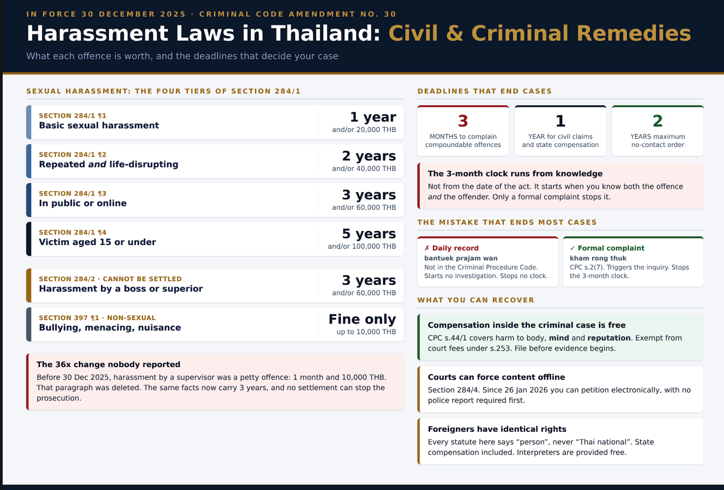
The short version
- Sexual harassment is now a standalone crime. Criminal Code Section 284/1, in force 30 December 2025. Up to 5 years and 100,000 baht depending on the tier.
- Watching and stalking are expressly listed in Section 1(19), but only as forms of sexual harassment where the conduct is sexual in nature and satisfies the statutory harm test. Thailand still has no standalone offence covering every form of stalking.
- Bosses face triple exposure. Section 284/2 turns supervisor harassment into a 3-year, non-compoundable offence. Money can’t make it go away.
- You may have only 3 months. For compoundable offences, Criminal Code Section 96 kills your case 3 months after you know the offence and the offender.
- Compensation can be free. Criminal Procedure Code Section 44/1 lets you claim damages inside the criminal case with no court fee.
Table of Contents
What changed on 30 December 2025
The instrument is the Criminal Code Amendment Act (No. 30), B.E. 2568. It received royal assent on 28 December 2025 and was published in the Royal Gazette on 29 December. Section 2 says it takes effect the day after publication. So the operative date is 30 December 2025, with no grace period.
Before that date, Thailand had no offence called sexual harassment. Prosecutors used Section 397, a petty nuisance provision carrying a 5,000 baht fine. The Act’s own statement of grounds admits the problem. That provision “does not yet directly agree with the nature of sexual harassment”.
Four things changed that matter to you.
A definition was added to the Code’s general dictionary
Most commentary says the definition lives in Section 284/1. It doesn’t. It was inserted at Section 1(19), the Criminal Code’s general definitions article. That placement matters. It applies Code-wide, not just to one offence.
The definition covers conduct of a sexual nature committed by body, speech, sound, gesture, contact, communication, watching, or stalking. It expressly includes acts done through a computer system, telecommunications device, or other electronic device.
Two features are worth understanding. The list ends with “or any other means”, so it isn’t closed. And the harm test is objective and forward-looking. The conduct need only be likely to cause annoyance, shame, degradation, fear, or sexual insecurity. You don’t have to prove you were actually distressed.
Why this matters for stalking
Thai law does not create a standalone offence covering every form of stalking. Section 1(19) expressly includes watching and stalking within the definition of sexual harassment. Stalking with a sexual dimension may therefore fall under Section 284/1. Non-sexual following or surveillance must be assessed under Section 397 or another applicable offence, depending on the facts.
Four new provisions were created
Sections 284/1 to 284/4 created a substantive sexual-harassment offence, an offence involving abuse of authority, a protective-order mechanism with a separate breach offence, and an online takedown mechanism with a separate breach offence.
Section 397 was cut back and its fine doubled
Section 397 remains a general petty-offence provision covering bullying, oppression, harassment, humiliation, annoyance and nuisance. Sexual conduct is now addressed specifically under Sections 284/1 and 284/2, but Section 397 itself is not written as applying only to non-sexual conduct.
You’ll still find English pages quoting the 5,000 figure. That’s the pre-amendment number.
Penetrative indecency became rape
The Act widened the definition of sexual intercourse in Section 1(18) to include penetration by an object or by an organ other than the genitals. It then repealed the “indecency by penetration” paragraphs of Sections 278 and 279. That conduct is now prosecuted as rape under Section 276 or 277, which carry far heavier penalties.
The definition also states that a genital organ “shall include one acquired through surgery”. That brings post-operative transgender complainants and defendants squarely inside the offence.
One correction worth making
You’ll read that Amendment No. 30 “made rape gender-neutral”. It didn’t. Section 276 already said “another person” before this Act, and Section 276 wasn’t amended at all. What changed is the definition it borrows from. Precision matters when you’re deciding whether a case is worth bringing.
Which law fits your situation
Harassment isn’t one offence in Thailand. It’s about eight, spread across three statutes, with different penalties and different deadlines. Picking the wrong one wastes months.
This table is the part of the guide we’d hand a client first.
| What happened | Provision | Maximum penalty | Settleable? | Your deadline |
|---|---|---|---|---|
| Sexual harassment, one-off | Criminal Code s.284/1 ¶1 | 1 year and/or 20,000 THB | Yes | 3 months |
| Sexual harassment, repeated and life-disrupting | s.284/1 ¶2 | 2 years and/or 40,000 THB | Yes | 3 months |
| Sexual harassment in a public place, before the public, or through a computer system accessible to the general public | s.284/1 ¶3 | 3 years and/or 60,000 THB | Yes | 3 months |
| Sexual harassment of a child aged 15 or under | s.284/1 ¶4 | 5 years and/or 100,000 THB | No | General limitation |
| Harassment by a boss or superior | s.284/2 | 3 years and/or 60,000 THB | No | General limitation |
| Breach of a no-contact order | s.284/3 ¶2 | 6 months and/or 10,000 THB | No | General limitation |
| Ignoring a court takedown order | s.284/4 ¶2 | 6 months and/or 10,000 THB | No | General limitation |
| Non-sexual bullying or nuisance | s.397 ¶1 | 10,000 THB fine only | No | General limitation |
| Non-sexual bullying in public | s.397 ¶2 | 1 month and/or 10,000 THB | No | General limitation |
| Coercion by threat | s.309 ¶1 | 3 years and/or 60,000 THB | Yes | 3 months |
| Defamation | s.326 | 1 year and/or 20,000 THB | Yes | 3 months |
| Defamation by publication | s.328 | 2 years and 200,000 THB | Yes | 3 months |
| Doctored or manipulated images posted online | Computer Crime Act s.16 | 3 years and 200,000 THB | Yes | 3 months |
| Harassment by a supervisor at work | Labour Protection Act s.16 | Civil penalty up to 20,000 THB (s.147) | n/a | See labour rules |
Two columns in that table decide more cases than the penalty column does.
“Settleable” means compoundable. In Thai law that’s a term of art. A compoundable offence can be settled or withdrawn by the victim, and the state can’t prosecute without the victim’s formal complaint. That sounds like power, and it is. But it comes with the three-month deadline attached.
Note something counter-intuitive in the last column. The lesser offences often give you more time. Section 397 harassment isn’t compoundable, so the three-month rule doesn’t apply to it. Sexual harassment under Section 284/1 paragraphs 1 to 3 is compoundable, so the clock runs hard.
Sexual harassment: Section 284/1
This is the centrepiece of the reform. Four paragraphs, escalating.
Paragraph 1: the base offence
The text of Section 284/1 makes it an offence to sexually harass another person, “if the act does not constitute the offence of indecency”. Up to 1 year, or a fine up to 20,000 baht, or both.
That opening condition is doing real work. Section 284/1 is a residual offence. It fills the gap below indecent assault. If the conduct amounts to indecency under Sections 278 or 279, you charge those instead, and they’re much heavier. Almost no English commentary mentions this, and it’s the first thing a Thai prosecutor will look at.
Paragraph 2: repeated conduct
Up to 2 years and/or 40,000 baht. But read the trigger carefully. The conduct must be continuous or repeated and it must have left the victim unable to live normally.
That “and” is conjunctive. Repetition on its own isn’t enough. Several published summaries describe this tier as simply “repeated harassment”, which understates what a prosecutor has to prove. In practice you need evidence of the disruption: the job you left, the route you changed, the treatment you sought.
Paragraph 3: public or online
Up to 3 years and/or 60,000 baht. Triggered by a public place, the presence of other people, or a computer system accessible by the general public.
Public social-media posts and computer systems accessible to the general public fall within paragraph 3. A private direct message does not satisfy paragraph 3 merely because it was sent electronically, although it may fall under paragraph 1. A group chat falls within paragraph 3 only if access is genuinely open to the general public.
Paragraph 4: child victims
Up to 5 years and/or 100,000 baht where the victim is aged 15 or under, whether or not the child consented.
The Thai wording is อายุไม่เกินสิบห้าปี, meaning not older than fifteen. A fifteen-year-old is protected. You’ll see this reported as “under 15”, which is off by a year and could cost someone a prosecution.
Practice note
Paragraph 4 applies to the whole section. So a child victim triggers the 5-year ceiling regardless of whether the conduct was public, private, one-off or repeated. It’s also the only tier of Section 284/1 that isn’t compoundable. Parents can’t settle it away.
Harassment by a boss: Section 284/2
Section 284/2 covers harassment by someone exploiting power over the victim. The statute names three categories: commander, employer, or other superior. The penalty is up to 3 years and/or 60,000 baht.
Here’s the change nobody is writing about. Before 30 December 2025, this exact conduct sat in Section 397 paragraph 3 as a petty offence carrying one month and 10,000 baht. That paragraph was deleted. The same facts now carry three years.
That’s a thirty-six-fold increase in the custodial maximum, overnight, for workplace power abuse. If you’re an employer in Thailand, this is the single most commercially significant line in the amendment.
Settlement will not stop this one
Section 284/2 is not compoundable. It’s absent from the compoundability list in Section 284/1 paragraph 5 and absent from the rewritten Section 281. Under Thai law an offence is settleable only where a statute says so.
The practical effect is blunt. A severance package, an NDA, a signed withdrawal: none of it stops a prosecution. We’ve seen companies assume a private settlement closes the matter. It doesn’t. The state can proceed even if the complainant is paid and wants out.
One open question, and we’d rather flag it than pretend it’s settled. Section 284/2 sets a flat 3-year ceiling by reference to “an offence under Section 284/1”. Where the victim is a child aged 15 or under, Section 284/1 paragraph 4 already carries 5 years. Read literally, Section 284/2 would reduce the maximum in a supervisor-on-minor case. That can’t be the intention. There’s no case law yet and no commentary on the point.
Non-sexual harassment: Section 397
Not all harassment is sexual. Debt collectors who call your employer. A neighbour who bangs on your door nightly. An ex who won’t stop turning up. Section 397 may apply, depending on the facts.
Current text, post-amendment: bullying, oppressing, menacing, humiliating or annoying another person carries a fine of up to 10,000 baht. If it happens in a public place or in front of others, it rises to one month’s imprisonment, a 10,000 baht fine, or both.
Paragraph 1 is fine-only. There’s no imprisonment for private non-sexual harassment, however persistent. Some Thai commentary has suggested the amendment made cyberbullying imprisonable. On the gazette text, it didn’t. Non-sexual online bullying remains a fine.
This is the real remaining gap in Thai harassment law. If the conduct has no sexual dimension and happens privately, your criminal remedy is a modest fine. That pushes serious non-sexual harassment cases toward the civil courts, which is covered below.
Online harassment, and getting content taken down
Online conduct now gets attacked from three directions.
Section 284/1 paragraph 3
Sexual harassment through a publicly accessible computer system. Three years. This is the main route for social media harassment with a sexual element.
Computer Crime Act Section 16: doctored images
Posting an edited, modified or manipulated image of another person in a way likely to cause disrepute, insult, hatred or humiliation. Up to 3 years and a fine up to 200,000 baht. Note the “and”: the penalty is conjunctive, so both can be imposed.
Computer Crime Act Section 16 applies to an edited, modified or manipulated image of an identifiable person where the statutory harm test is met. It may cover visual deepfakes, but it should not be described as covering every synthetic-audio, synthetic-video or deepfake case. The offence is compoundable and includes a good-faith fair-comment defence. We cover it further in our guide to online and social media defamation in Thailand.
It’s compoundable, and it carries a good-faith fair-comment defence. Thailand has no dedicated deepfake statute as of July 2026, so this provision is doing that work.
Section 284/4: the takedown power
Where sexual harassment under paragraph 3 involves posting obscene data to a publicly accessible system, the court can order the content removed. It can direct the uploader, the platform or service provider, or a competent official. Non-compliance carries 6 months and/or 10,000 baht.
On 26 January 2026, the Office of the Judiciary launched a fast track for this on the Court Integral Online Service platform. It’s genuinely useful, and almost nobody knows about it.
The take-it-down route
Applicants able to authenticate through ThaID may file electronically without travelling to court. No prior police complaint or criminal prosecution is required. During the initial rollout, the Criminal Court handles online petitions nationwide. Paper petitions remain available at courts in every province during office hours.
The current CIOS process relies on ThaID. Most foreign victims cannot authenticate through ThaID. A foreign victim without ThaID should use the paper filing route or first confirm whether the court now accepts another identity-verification method.
Two limits. Petitions cover suspension or removal only, so damages have to be pursued separately. And the gateway is sexual harassment involving obscene material. A defamatory post with no sexual element is outside this route entirely.
One widely repeated error is worth correcting. Several summaries state that platforms have 15 days to comply. On the statutory text, the 15 days is the competent official’s deadline to report back to the court. Removal deadlines are set by the court case by case. Don’t rely on a fifteen-day window that doesn’t exist.
The defamation counter-suit trap
This section is here because it’s the mistake we see most often, and no other guide on this topic warns about it.
You’re being harassed. You post about it. You name the person, or you post their photo. In most Western countries that’s risky but survivable. In Thailand it can put you in the dock.
Our pillar page on defamation laws in Thailand covers this in full. The short version follows.
Truth is not a complete defence to criminal defamation here. Section 326 catches anyone who imputes something to another person, before a third party, in a way likely to damage their reputation. That carries up to 1 year and 20,000 baht. Do it by publication, which includes social media, and Section 328 raises it to 2 years and a fine up to 200,000 baht.
Section 330 lets you prove truth. But it expressly bars that defence where the imputation concerns a private matter and proof would not benefit the public. Harassment between two private individuals is close to the paradigm case of a private matter.
What we tell clients on day one
Do not post about your harasser. Not a name, not a photo, not a screenshot with an identifiable handle. Not while the case is live, and preferably not at all.
We have watched a strong harassment complaint collapse into a two-front war because the complainant vented on Facebook. The counter-suit doesn’t have to succeed to be effective. It just has to give the other side something to trade.
For the same reason, be sceptical of anyone threatening you with the Computer Crime Act over an ordinary defamation dispute. The 2017 amendment added an express carve-out to Section 14(1). It applies only where the act is “not constituting an offence of defamation under the Criminal Code”. The Supreme Court has applied that carve-out consistently, including in Decision No. 2778/2561 and Decision No. 6794/2561. Section 14(1) also now requires proof of dishonest or deceitful intent.
Complainants still plead it, hoping for the five-year ceiling and to strip the good-faith and truth defences. But where the post targets one person rather than the public, the final paragraph of Section 14 caps the offence at three years or 60,000 baht and makes it compoundable, so even on its own terms the threat is smaller than it sounds. If it’s been used against you, that’s a defence to argue, not a reason to settle. Our detailed treatment is in defamation defences and the relevant Supreme Court decisions. If you’re the one facing charges, see our guide for foreigners facing defamation in Thailand.
No-contact orders: Section 284/3
This is the most useful thing in the amendment, and the least documented.
In a sexual harassment case, the court can prohibit the accused from doing specified acts for up to two years. Breach carries up to 6 months and/or 10,000 baht.
Three features make it powerful.
The court can act on its own motion. It can also act on a proposal from the prosecutor, the plaintiff, the injured party, or an officer. You don’t need to be the one who asks, though you should be.
It doesn’t depend on conviction. The statute says the order is available “whether or not the accused party is punished by the court”. So an acquittal doesn’t automatically dissolve your protection.
The content is open-ended. The statute says “any acts”, on conditions the court designates. That gives room to tailor: no contact, no approach within a distance, no posting.
Until this provision, protection orders in Thailand were largely confined to domestic violence cases. The International Commission of Jurists singled this out as the amendment’s most significant advance. If you’re in a live harassment case, ask for one. Judges can’t grant what nobody requests.
Civil damages for harassment
Criminal penalties punish. They don’t pay you. For that you need the Civil and Commercial Code, and it’s often the better route when the criminal penalty is a 10,000 baht fine.
Section 420: the general wrongful act
Injure another person’s life, body, health, liberty, property or any right, wilfully or negligently and unlawfully, and you commit a wrongful act. You must then compensate. That phrase “any right” is the doorway for harassment claims that don’t fit a named tort.
Section 423: injury to reputation
Asserting or circulating, contrary to the truth, something injurious to another’s reputation, credit, earnings or prosperity. Liability attaches even where the person didn’t know it was untrue, provided they ought to have known.
Two differences from the criminal provision are worth noting. Section 423 requires falsity, so truth is a genuine answer with no “private matter” carve-out. And it imports a negligence standard through “ought to know”. Paragraph 2 gives a qualified privilege where the speaker or the recipient has a rightful interest.
Section 438: what you can recover
The court determines the manner and extent of compensation according to the circumstances and the gravity of the wrongful act. That’s wide discretion, and it cuts both ways. There’s no tariff.
A correction you’ll want if you’re reading other guides
Section 446 is not a general provision for reputational harm. Paragraph one covers non-pecuniary loss caused by injury to body or health, or loss of liberty. Paragraph two separately gives the same type of claim to a woman harmed by an immoral criminal offence.
Reputation-specific corrective measures appear in Section 447, which permits the court to order suitable measures to restore reputation instead of, or together with, damages. Do not cite Section 446 solely because reputation was harmed, but do not describe Section 446 as containing only the first-paragraph categories.
The reputation provision is Section 447. It lets the court order proper measures to rehabilitate the injured person’s reputation, instead of or together with damages. Think retraction, apology, publication of the judgment. Getting this citation wrong in a pleading is not a small error.
Section 448: the one-year clock
A claim in tort is barred one year after the day the injured person knew of both the wrongful act and the person liable. There’s a longstop of ten years from the act itself.
Paragraph 2 is the limb that saves cases. Where the damages are claimed for an act punishable under criminal law carrying a longer prescription, the longer period applies. So a civil claim built on facts that also constitute criminal defamation or harassment can survive past the one-year mark.
Also useful: under Section 424, the civil court is not bound by the criminal outcome. A prosecution that fails doesn’t automatically end your damages claim. Our overview of civil liability in Thailand covers the mechanics in more depth.
Getting paid inside the criminal case
Most foreigners never hear about this, and it’s the most valuable procedural right a harassment victim has in Thailand.
Criminal Procedure Code Section 44/1 lets an injured person file a motion in the criminal court asking it to order the defendant to pay compensation. You don’t start a separate civil action. You don’t wait for the criminal case to finish.
The heads of loss are broad and they fit harassment well. Life, body, mind, deprivation of bodily liberty, reputation, and property. Psychological harm and reputational harm are expressly in.
It’s free, with three caveats
The exemption isn’t in Section 44/1 itself. It’s in Section 253 paragraph 1, which says no court fee is charged on a victim’s compensation motion in a prosecutor-led case.
The caveats: the court can impose fees if it considers the sum claimed excessive or the claim brought in bad faith. Ignore such an order and your civil claim is treated as abandoned. And the exemption covers adjudication only, not enforcement. Chasing the money afterwards attracts civil fees.
The deadline is early
You must file before the taking of evidence begins. If no evidence is taken, for instance on a guilty plea, then before the court adjudicates. In practice that means at or before the first substantive hearing. Miss it and you’re pushed into a separate civil suit with full court fees.
The trade-off nobody explains
Section 44/1 applies only where the public prosecutor is the plaintiff. If you prosecute privately because the police wouldn’t act, you cannot use it.
That’s the hidden cost of going private. You gain control of the case and lose the free compensation route. It’s a decision worth making deliberately rather than discovering later.
Two more provisions worth knowing. Section 44/2 lets the court appoint a lawyer, at public expense, for a Section 44/1 applicant who is poor and cannot retain one. And Section 46 requires the civil part of the judgment to follow the facts found in the criminal part. A conviction hands you the facts. An acquittal on the facts binds against you.
State compensation
Thailand also runs a state compensation scheme. It sits in the Act on Compensation for Injured Persons and for the Accused in Criminal Cases B.E. 2544, amended in B.E. 2559.
Foreigners are eligible. The definition of injured person is “a person” who suffered harm to life, body or mind from another’s criminal offence, without being complicit. There is no nationality condition anywhere in the Act. Payments to foreign nationals are documented in practice.
The Schedule covers Criminal Code Sections 276 to 287, the whole of the sexual offences title, plus offences against life, body and liberty including Section 309 coercion. Section 397 harassment and the defamation chapter are not in the Schedule.
Rates rose on 3 March 2026. Medical expenses now run to 80,000 baht, rehabilitation to 50,000 baht, and other damages to 100,000 baht. Where the victim dies, the ceiling is 300,000 baht. Older sources still quote the previous figures of 40,000, 20,000 and 50,000.
The deadline is one year from the day you knew of the offence. There’s no extension mechanism. Applications are free, can be filed at any provincial justice office or police station, and the inquiry official is legally obliged to tell you this right exists.
Whether sexual harassment qualifies
The Schedule lists Sections 276 to 287 as a range, and the new Sections 284/1 to 284/4 were inserted inside that range. On a natural reading they fall within it, and the harm must be to life, body or mind, which mental distress can satisfy.
We think the better view is that a Section 284/1 victim can apply. But the Schedule was drafted before these sections existed, and we’re not aware of a decision testing it. If you’re within the one-year window, apply. The application costs nothing.
How to file a harassment complaint, step by step
This is where cases are won and lost, and it’s the part every other guide skips. If you want the wider procedural picture first, see our overview of the Criminal Procedure Code in Thailand.
- Understand what you’re actually asking forYou want a formal criminal complaint. In Thai that’s คำร้องทุกข์, pronounced roughly kham rong thuk. It’s defined in Criminal Procedure Code Section 2(7).What you don’t want is a บันทึกประจำวัน, a bantuek prajam wan or daily record entry. That’s an internal police log. The Criminal Procedure Code doesn’t even mention it. It starts no investigation and stops no clock.This single distinction is the most common and most expensive mistake foreigners make in Thailand.
- Write the complaint before you go, in ThaiSection 123 says a complaint may be oral, and that the officer must then record it. In practice, arriving with a signed Thai-language document changes the dynamic entirely. It converts a discretionary conversation into a documented statutory act.Section 123 paragraph 2 requires five things. Your name and address. The nature of the offence. The circumstances in which it was committed. The harm you suffered. And the offender’s name or description, so far as you can give it.Add one sentence that people forget. State expressly that you intend the offender to be punished, ประสงค์ให้ผู้กระทำความผิดได้รับโทษ. Punitive intent is a required element under Section 2(7). Without it, what you’ve filed may not be a complaint at all.
- Go to a station with jurisdictionSection 18 is wider than counter staff usually admit. Jurisdiction lies with the place of the offence, or the accused’s residence, or the place of arrest. If you’re told to travel to another province, that may be convenience rather than law.
- Ask for an interpreter if you need one, and don’t pay for itSection 13 covers the police inquiry, the preliminary examination and the trial. It’s not court-only.Where an injured person cannot speak or understand Thai, the inquiry official, the prosecutor or the court shall procure an interpreter. The state pays the interpreter’s fee, travel and accommodation. You pay nothing.The right is clear. Availability at a provincial station on a Sunday night is another matter. Tourist Police on 1155 staff interpreters in English, Russian, Chinese, Korean and Japanese and will attend.
- Never sign Thai text you can’t readBring your own translator if you have any doubt. Our guide on the police interview in Thailand covers this in more detail.
An interpreter provided under Section 13 must translate accurately without adding or omitting, must take an oath, and must sign the translation. Hold them to that. - Leave with proofAsk for a receipt of complaint, ใบรับคำร้องทุกข์, or a stamped copy. Note the date, the station, and the name and rank of the officer.Be aware of a limit here. No provision of the Code gives you a right to a certified copy of your complaint on the spot. Section 8(1)(6) gives you access to your own statement, but only after the prosecutor files the charge in court. What you get at the counter is a matter of internal police practice, so ask politely and persistently.
- Ask about state compensation while you’re thereSection 6/1 of the compensation Act puts a duty on the inquiry official. He must notify you of the right to compensation and record that notification in the file. Most foreigners are never told. Ask, and ask for it to be noted.
- File your Section 44/1 motion earlyOnce the prosecutor charges, the window for a free compensation claim closes at the start of evidence. Diarise it the day you learn the case has been filed in court.
The three grounds for refusal, and they’re exhaustive
Section 122 lets an inquiry official decline in only three situations. The victim asks for help but refuses to make a regular complaint. The victim has already sued directly without complaining. Or the denunciation is anonymous or unsigned.
“This is a civil matter” is not on that list. Neither is “go to the station where it happened”.
The deadlines that end cases
Thai limitation rules are short and unforgiving. Three matter here.
Three months for compoundable offences
Criminal Code Section 96. If the injured person doesn’t lodge a complaint within three months from the day they knew of the offence and knew the offender, prosecution is barred.
Four precision points. The trigger is conjunctive, so if you’re being harassed anonymously the clock hasn’t started. It runs from knowledge, not from the date of the act. The act that stops it is a formal complaint, not a daily record entry. And it applies only to compoundable offences.
Which is why the table earlier matters. Sexual harassment paragraphs 1 to 3, coercion, and the entire defamation chapter are all compoundable and all on a three-month fuse. Section 284/2 and Section 397 aren’t.
Why this is the deadline that catches people
Harassment is cumulative. Victims wait. They hope it stops, or they hope one more conversation fixes it. By the time it’s unbearable, the three months from first knowledge may be gone.
In our experience this is the single most common reason a viable harassment case can’t be brought. If something is escalating, get advice inside the first month.
One year for civil claims
Section 448 of the Civil and Commercial Code, running from knowledge of both the act and the person liable, with the criminal-prescription extension in paragraph 2.
One year for state compensation
From the day you knew of the offence. No tolling, no good-cause extension.
What it costs and how long it takes
Nobody publishes this, which is why clients arrive with wildly wrong expectations.
| Route | Court fee | Who runs it | Realistic timeline |
|---|---|---|---|
| Police complaint | None | Police, then prosecutor | Inquiry typically several months |
| Compensation motion, s.44/1 | Exempt under s.253 ¶1 | You, inside the criminal case | Decided with the criminal judgment |
| Joining as co-plaintiff, s.30 | None | You, alongside the prosecutor | Any time before first-instance judgment |
| Online takedown petition, s.284/4 | None stated | You, electronically via CIOS | Designed as a fast track |
| State compensation claim | None | Justice Ministry sub-committee | 21-day service standard |
| Separate civil suit | 2% of the claim, capped at 200,000 THB, plus 0.1% of any part above 50 million THB | You | First instance often a year or more |
| Small civil claim up to 300,000 THB | 2% capped at 1,000 THB | You | Shorter, simplified track |
| Private criminal prosecution | None, but preliminary examination required | You, entirely | Longest route |
A few notes on that table.
The 2% court fee is capped at 200,000 baht. The cap bites at a claim of 10 million. Above 50 million the rate drops to 0.1%. The commonly repeated “flat 1,000 baht for small claims” is wrong in form. It’s 2% capped at 1,000. So a 40,000 baht claim costs 800.
Fee waivers exist. The old “suing as a pauper” regime was abolished in 2008. The current test asks whether you lack property to pay or would suffer undue hardship given your circumstances, and for claimants, whether the claim has reasonable grounds. There’s also a better waiver for crime victims in Criminal Procedure Code Section 254 paragraph 2, which turns on merit and good faith rather than poverty. That one suits an employed expat far better.
Evidence that actually holds up
“Document everything” is useless advice. Here’s what to document and how.
Screenshots need context. A cropped message bubble proves little. Capture the sender’s profile, the account handle or number, the full thread, and the timestamps. Where a platform allows a data export, take it. Keep the original device.
Keep a contemporaneous log. Date, time, place, what happened, who else saw it. Written at the time, not reconstructed later. For a Section 284/1 paragraph 2 charge you need to show disruption to normal life, and a log is how that gets proved.
Preserve the disruption evidence. Medical or counselling records, the email where you asked to change shifts, the tenancy you broke, the flights you rebooked. That’s the paragraph 2 element.
Get CCTV requested fast. Condominium and mall systems typically overwrite within one to two weeks. A written request to the juristic person, dated, is worth making immediately even if you’re unsure you’ll use it.
Be careful with covert recordings. Thai courts have accepted recordings in some circumstances, but admissibility is fact-specific and the exercise carries its own risks. Take advice before you rely on one, and never publish it.
Identify witnesses early. Colleagues and neighbours move on, and foreign witnesses leave the country. Get names and contact details while people still remember.
If your harasser is also a foreigner
Nothing about the criminal law changes. Offences committed in Thailand are prosecuted in Thailand regardless of anyone’s nationality, and you’re an injured person with full rights whatever passport you hold. The statutes say “person”, and a full-text search of the compensation Act for nationality terms returns nothing.
What changes is practical risk. Flight risk is real. Raise it early, because bail conditions and passport surrender are matters the court can address if someone asks.
On immigration consequences, be careful with what you read online. Three points are commonly stated wrongly.
A Thai criminal court cannot order deportation. The punishments available under Criminal Code Section 18 are death, imprisonment, confinement, fine and forfeiture. Deportation isn’t among them, and it isn’t among the safety measures in Section 39 either. The Supreme Court settled this long ago and struck a deportation ruling out of a judgment. Removal is an executive act, not a sentence.
Removal happens through immigration or ministerial channels. Immigration officers act under the Immigration Act once permission to stay is revoked or expires. The Minister of Interior can order deportation under the Deportation Act B.E. 2499 where necessary for public order or good morals.
A conviction can bar future entry, but only on the right facts. Section 12(6) of the Immigration Act bars someone who has served a prison sentence, with exceptions for petty and negligent offences. A fine-only conviction doesn’t engage it. The provision requires an actual custodial sentence. Section 12(7) is different. It covers conduct giving reason to believe a person is a danger to society. It needs no conviction at all. This is the provision actually used against badly behaved foreigners.
In July 2026 the Cabinet approved a Prime Minister’s Office regulation on deportation, and it was published in the Royal Gazette on 27 August 2026 (vol. 143, special part 205 Ngor) and is in force from 28 August 2026. Once a sentence has been served, it directs the Minister of Interior to order the deportation of a foreigner convicted of, among others, an offence punishable by imprisonment of five years or more, and requires the Corrections Department to notify the Ministry of Interior at least 15 days before a foreign prisoner is released.
If the police won’t take your complaint
It happens. Here’s the escalation ladder, in order.
Use Section 124. You may complain to an administrative or police officer senior or junior to the inquiry official. On receiving a written complaint, that officer must promptly forward it. In practice: ask for the superintendent, or take it to the district office.
Invoke Section 125. Once an officer has investigated a request for help, wholly or partly, it becomes his duty to cause a proper complaint to be recorded. That’s a statutory obligation, not a courtesy.
Damrongtham Centre. The provincial grievance centre, hotline 1567, handles complaints about official inaction.
Tourist Police 1155. Useful for language support and for getting through the door, though the substantive complaint still has to be recorded by an inquiry official with jurisdiction.
Ministry of Justice hotline 1111, then press 77. Free and 24 hours. Note the two-step dial, which most listings omit.
Prosecute privately. Criminal Procedure Code Section 28 makes the injured person a person entitled to prosecute. Section 34 confirms that a non-prosecution order does not bar you from prosecuting yourself. You file directly at the criminal court. You must then survive a preliminary examination under Section 162, showing a prima facie case before the charge is accepted.
Before choosing that route, weigh the four costs. You lose Section 44/1 compensation. You carry the whole evidential burden without police powers. You must clear the preliminary hearing. And you pay your own lawyer throughout.
Consider joining instead. Section 30 lets an injured person apply to join the prosecutor as co-plaintiff at any time before first-instance judgment. It’s the cheaper middle path. You get standing and a voice, and you keep your Section 44/1 rights. It’s underused, and for most harassment victims it’s the right answer.
Workplace harassment
Two systems now run in parallel, and they don’t displace each other.
Labour Protection Act Section 16 prohibits an employer, chief, supervisor or work inspector from committing sexual abuse, harassment or nuisance against an employee. The penalty under Section 147 is a civil penalty (ค่าปรับเป็นพินัย) of up to 20,000 baht, with no imprisonment: since the Act on Conversion of Fines to Civil Penalties B.E. 2565 it is no longer a criminal fine, so it leaves no criminal record. It applies to employees of all genders, including lawfully employed foreign workers.
Criminal Code Section 284/2 now covers the same ground with a 3-year maximum and no possibility of settlement.
Same conduct, two liabilities. The labour provision wasn’t amended and remains in force.
The interesting question is whether the new statutory definition in Section 1(19) fills the gap that Section 16 always had. Thai courts interpreting Section 16 have required a certain degree of seriousness. The new objective “likely to cause” test is markedly lower. We’d argue the definition is persuasive on the construction of Section 16. But they’re separate statutes with separate purposes, and no court has ruled on it. Treat it as an argument, not a settled position.
On dismissal, harassment may support termination without severance under Section 119. The established route runs through Section 119(4), breach of the employer’s lawful work rules. That’s how the Supreme Court approached it in Decision No. 1372/2545. There, a credit manager pressed women under his supervision to go out with him after hours, and a female job applicant to go for a meal, with the threat that he would report them as failing probation or not hire them. The Court held this breached the employer’s work rules, that the breach was serious, and that the company could dismiss him with no severance under Section 119(4) and no payment in lieu of notice under Section 583 of the Civil and Commercial Code. His claim was dismissed in full.
Last reviewed: 17 September 2026. This was a targeted review of the case citations on this page rather than of the page as a whole. The three Supreme Court decisions cited on this page were read in Thai against the published judgments and all three stand as published. 1372/2545 supports dismissal without severance through Section 119(4), and its facts are now given. 2778/2561 and 6794/2561 both apply the Computer Crime Act carve-out as described: where the posting is defamation under the Criminal Code it is not an offence under Section 14(1) as amended, and in both the Supreme Court gave the defendant the benefit of the later law under Section 2 paragraph two of the Criminal Code. The statutory analysis elsewhere on this page, including the Section 16 argument, was not re-checked here. Re-checked on 11 October 2026: Computer Crime Act section 16 (consolidated to B.E. 2565) and Labour Protection Act sections 16 and 147 (consolidated to Act No. 9) read in Thai; the Computer Crime Act penalty, the compounding rule and the fair-comment defence match; the Labour Protection Act penalty is now a civil penalty rather than a criminal fine, and the two lines that called it a fine are corrected. The Section 16 construction argument remains the firm’s argument, not a holding. Re-read on 5 October 2026: Criminal Code sections 284/1 and 397 were read in Thai and match the table; the stalking FAQ was narrowed to sexual stalking, as the page itself says; and the Computer Crime Act paragraph now reflects the final paragraph of Section 14, under which a post aimed at one person carries three years or 60,000 baht and is compoundable.
That’s why work rules matter. If your handbook doesn’t prohibit the conduct, the cleanest dismissal route is weaker. Employers with ten or more employees already have to maintain Thai-language work rules covering discipline and grievances. Updating them to track the new definition is inexpensive and sensible. See our guides to Thai labour law and employee rights in Thailand.
What the Act does not do
Amendment No. 30 imposes no direct compliance obligation on employers. There’s no duty to adopt a policy, train staff, investigate, or run a complaints channel. No regulator, no filing, no inspection regime. Criminal liability under Section 284/2 is individual.
You may see claims that companies face fines or licence suspension under this Act. They don’t. That assertion appears in one commentary and has no basis in the statutory text.
Frequently asked questions
When did Thailand’s new harassment law come into force?
On 30 December 2025. The Criminal Code Amendment Act (No. 30) B.E. 2568 was published in the Royal Gazette on 29 December 2025 and took effect the following day. There was no grace period.
Does sexual harassment require physical contact under Thai law?
No. The definition covers speech, sounds, gestures, communications, watching and stalking. It also expressly covers acts done through a computer system or other electronic device.
Is stalking illegal in Thailand?
Partly. Since 30 December 2025, watching and stalking of a sexual nature are sexual harassment under Section 1(19) and Section 284/1. Non-sexual following has no offence of its own and is dealt with under Section 397 or another offence that fits the facts.
Can men and LGBTQ+ people be victims of harassment under Thai law?
Yes. The provisions are gender-neutral throughout. The Act’s statement of grounds expressly refers to protecting persons of every age and sex, including persons with sexual diversity.
How long do I have to file a harassment complaint in Thailand?
For compoundable offences, three months from when you knew both the offence and the offender. That covers sexual harassment under Section 284/1 paragraphs 1 to 3, coercion and defamation. Miss it and prosecution is barred.
What is the difference between a daily record and a formal criminal complaint?
A daily record entry is an internal police log with no basis in the Criminal Procedure Code. A formal complaint under Section 2(7) triggers the investigation and stops the three-month clock. Many foreigners leave with the wrong one.
How do I make sure I filed a real complaint and not just a log entry?
Bring a signed Thai-language document containing the five items required by Section 123, including an express statement that you want the offender punished. Ask for a receipt of complaint and note the officer’s name and rank.
Can I claim compensation without filing a separate civil lawsuit?
Yes. Criminal Procedure Code Section 44/1 lets you file a compensation motion inside the criminal case, exempt from court fees. You must file before the taking of evidence begins.
What can I claim compensation for?
Harm to life, body, mind, bodily liberty, reputation and property. Psychological and reputational harm are expressly included, which fits most harassment cases.
How much does it cost to bring a harassment case in Thailand?
A police complaint is free, and a Section 44/1 compensation motion is exempt from court fees. A separate civil suit costs 2% of the claim, capped at 200,000 baht. Lawyer fees are separate.
Do I need to speak Thai to file a complaint?
No. Criminal Procedure Code Section 13 requires the inquiry official, prosecutor or court to provide an interpreter, and the state pays the cost. The right applies at the police station, not just in court.
Can a Thai court order harassing photos or posts removed from the internet?
Yes, under Section 284/4, where the harassment involves obscene material posted to a publicly accessible system. Since 26 January 2026 you can petition electronically through the Court Integral Online Service. No police report is required first.
Can I get a restraining or no-contact order in Thailand?
Yes. Section 284/3 lets the court prohibit specified acts for up to two years in a sexual harassment case. The order is available whether or not the defendant is convicted, and breach carries up to six months.
What are the penalties if my boss harasses me?
Up to three years, a fine of up to 60,000 baht, or both, under Section 284/2. The same conduct was a one-month petty offence before 30 December 2025.
Can my employer settle a harassment case to make it go away?
No. Section 284/2 is not compoundable, so the state can prosecute regardless of any settlement or withdrawal. An NDA or severance payment does not stop a prosecution.
Can I withdraw a harassment complaint after filing it?
Only for compoundable offences, which include Section 284/1 paragraphs 1 to 3. Harassment of a child, harassment by a superior, and breaches of court orders cannot be withdrawn.
Can I be sued for defamation if I post about my harasser online?
Yes, and it happens often. Truth is not a full defence where the matter is private. Posting can bring Section 328 into play, with up to two years and a 200,000 baht fine. Do not post about your case.
What evidence do I need for a harassment case?
Full-context screenshots showing the account and timestamps, a contemporaneous log, and proof of disruption to your normal life. Request CCTV quickly, because most systems overwrite within one to two weeks.
What if my harasser is also a foreigner?
Nothing changes legally. Offences committed in Thailand are prosecuted in Thailand whatever anyone’s nationality. Raise flight risk early so the court can consider bail conditions.
Can my harasser be deported if convicted?
Not by the criminal court, which has no power to order deportation. Removal is an executive act, and a custodial sentence can also bar future entry under Immigration Act Section 12(6).
Will filing a complaint affect my own visa or work permit?
Filing a complaint as a victim does not affect your immigration status. Keep your status valid throughout, because an overstay creates separate problems that can undermine your case.
What do I do if the police refuse to accept my complaint?
Section 122 allows refusal on only three narrow grounds, and “it’s a civil matter” is not one of them. Escalate under Section 124 to a senior officer in writing, or contact the Damrongtham Centre on 1567.
Can I get money from the state as a harassment victim?
Possibly. The state compensation scheme covers Criminal Code Sections 276 to 287 and foreigners are eligible. You must apply within one year of learning of the offence, and the application is free.
Should I go to the Tourist Police or a regular police station?
Tourist Police on 1155 are useful for interpreters and for getting through the door. The substantive complaint still has to be recorded by an inquiry official with jurisdiction over the offence.
How ThaiLawOnline can help
Harassment cases turn on the first two weeks. Whether the complaint was recorded properly. Whether the three-month clock was stopped. Whether the compensation motion went in before evidence started.
We’ve practised law in Thailand for 20 years, and we handle these matters in English, Thai and French. What that usually looks like in practice:
- Drafting your complaint in Thai to the Section 123 requirements, and attending the station with you
- Filing the Section 44/1 compensation motion inside the criminal case, at no court-fee cost to you
- Applying for a Section 284/3 no-contact order, and Section 284/4 takedown petitions through the online system
- Advising employers on work rules and disciplinary process after Amendment No. 30
- Defending clients facing retaliatory defamation or Computer Crime Act complaints
Speak to a Thai lawyer about your situation, or read more about our team and our work in Thai criminal law.
Key takeaways
- Thai harassment law changed on 30 December 2025. Anything you read that predates that date is describing a different legal landscape.
- Sexual harassment is now its own offence under Section 284/1. Four tiers run from 1 year to 5 years, depending on repetition, publicity and the victim’s age.
- Stalking and online conduct are inside the definition, not bolted on as separate offences.
- Harassment by a boss carries three years and cannot be settled. Section 284/2 replaced what used to be a one-month petty offence.
- Non-sexual private harassment is still only a fine. Section 397 paragraph 1 carries no imprisonment, which is the real remaining gap.
- The three-month rule ends more cases than any defence. It runs from knowledge, and only a formal complaint stops it.
- A daily record entry is not a complaint. If you took away one thing, take that.
- Compensation inside the criminal case is free under Section 44/1, but only in prosecutor-led cases and only if you file before evidence begins.
- Do not post about your harasser. Criminal defamation counter-suits are the most common way a good case becomes a bad one.
- Every remedy here is open to foreigners. Nationality appears nowhere in these statutes.
Thai Law Updates, free by email
Plain-English updates on Thai law changes that affect foreigners: property, visas, marriage, business and wills. One short email a month from a firm practicing since 2006. No spam, unsubscribe anytime.