


Reviewed by ThaiLawOnline, a licensed Thai law firm practising in Thailand since 2006. Thai lawyer of record: Wichuda Atthamethakon, LL.M., Thai Bar Licence 3149/2556.
Last updated on
A mother in Nakhon Sawan transfers her land to her daughter. Years later, the daughter calls her an “accursed person” in front of neighbours. Can the mother take the land back? Under Thailand’s Ungrateful Child Law, the answer was yes. The Supreme Court ordered the land returned.
The “ungrateful child law” is a media nickname. The real rules sit in Sections 531 to 536 of the Thai Civil and Commercial Code (CCC). They let a donor revoke a completed gift when the donee commits an act of ingratitude. We ran this topic through our database of over 70,000 Supreme Court (Dika) decisions and found 206 rulings on point, from 1929 to 2025. A 2026 dispute in the family behind Singha beer has put the subject back in the news. This guide explains what Thailand’s Ungrateful Child Law actually says and what Thai courts accept as ingratitude. It also covers the strict deadlines, and how to protect yourself whether you’re giving or receiving.
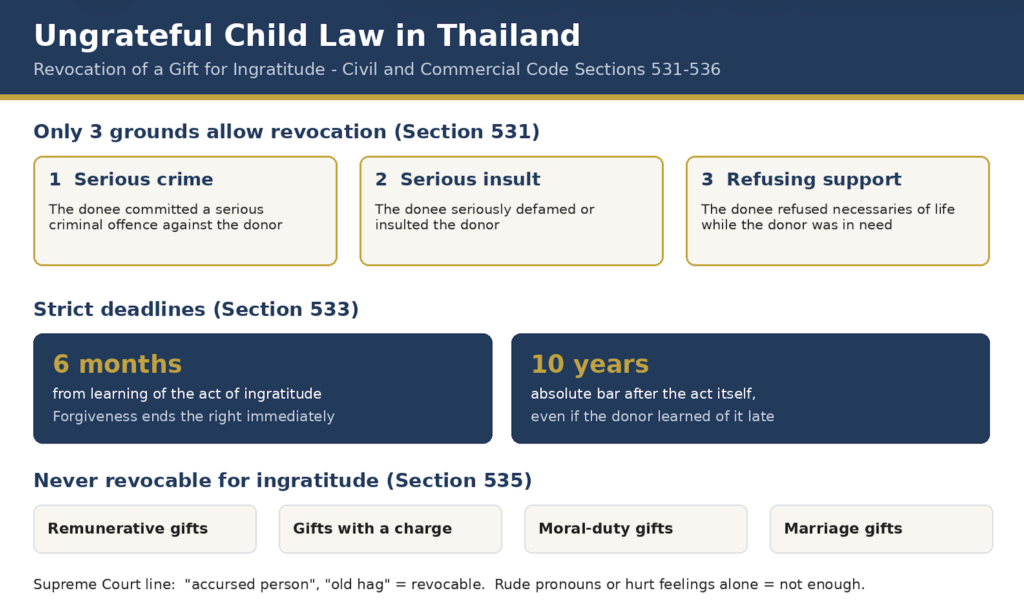
Table of Contents
Understanding Thailand’s Ungrateful Child Law
Let’s start with what a gift is. Under CCC Section 521, a gift is a contract. The donor transfers property gratuitously, and the donee accepts it. For land and registered property, Section 525 requires registration at the Land Office. Once that’s done, the transfer is complete and ownership has passed.
That finality is exactly why Sections 531 to 536 exist. Thai law carves out one narrow exception: ingratitude (การประพฤติเนรคุณ). If the donee’s conduct crosses a serious line, the donor can sue to revoke the gift and demand the property back.
The nickname “ungrateful child law” is misleading in two ways. First, the law isn’t limited to children. Any donee can be sued, including siblings, nieces, spouses’ relatives, or friends. In Supreme Court Decision No. 1078/2553 (2010), an aunt revoked a gift after her niece gravely insulted her. Second, “ungrateful” understates the threshold. Ordinary rudeness, coldness or family friction is never enough. The conduct must fit one of three specific statutory grounds.
Culturally, the rule reflects กตัญญู (katanyu), the deep Thai value of gratitude toward parents and benefactors. But legally, courts apply it with restraint. Revocation is the exception, not the rule. In our review of the case law, claims fail more often than they succeed, usually on evidence or on the seriousness threshold.
The Three Grounds for Revocation of a Gift Under Section 531
Section 531 is exhaustive. If the conduct doesn’t fit one of these three grounds, there’s no claim, no matter how badly the donee behaved.
CCC Section 531. The donor can claim revocation of a gift for ingratitude only in the following cases:
(1) if the donee committed a serious criminal offence against the donor;
(2) if the donee seriously defamed or insulted the donor; or
(3) if the donee refused the donor, being in need, the necessaries of life while able to supply them.
Text verified against the official Thai version (มาตรา 531) in our statutory database.
Ground 1: A Serious Criminal Offence Against the Donor
This covers physical attacks and other grave crimes committed against the donor personally. Think assault causing injury, attempted murder, or serious fraud targeting the donor. A minor offence won’t do. The statute says “serious,” and courts take that word at face value. In practice, a criminal conviction makes the civil revocation case far stronger, though it’s not formally required.
Ground 2: Serious Defamation or Insult of the Donor
This is the ground in most reported cases, and the hardest to predict. The court examines the exact words, who heard them, the context, and the relationship. Words that humiliate a parent or benefactor in a degrading way qualify. Words spoken in anger or hurt feelings usually don’t. We break down the real cases in the next section, because the line the Supreme Court draws is subtle.
Ground 3: Refusing Necessaries of Life
Three elements must all be present. The donor must be genuinely in need. The donee must be able to provide support. And the donee must have refused. In Supreme Court Decision No. 6323/2552 (2009), the claim failed because the donor still owned at least one other plot of land and was supported by her other children, so she was not in need within Section 531(3); the insult limb failed too, because she never proved what words were used. Courts check the donor’s actual circumstances, not just the family estrangement.
Supreme Court Decisions: Where Thai Courts Draw the Line
Here’s the thing about Section 531(2). Two insults that sound similar to a foreign reader can produce opposite results. The pattern from the case law: degrading, dehumanising words said with intent to humiliate justify revocation. Rude pronouns, reproaches and emotional outbursts don’t. The table below summarises key decisions from our database.
| Decision | What the donee did | Result |
|---|---|---|
| No. 7301/2559 (2016) | Called her father “คนจัญไร” (an accursed, wretched person), a term the court measured against the Royal Institute Dictionary | Revocation granted |
| No. 8752/2558 (2015) | Called her mother “อีเฒ่าหัวหงอก” (old grey-haired hag) and addressed her with the degrading pronoun “mueng” | Revocation granted |
| No. 1078/2553 (2010) | Told her aunt (the donor): “unfair old hag, you broke my family apart”, using mueng/ku pronouns | Revocation granted |
| No. 1665/2567 (2024) | Adopted son cursed and expelled his elderly adoptive mother from the home; court accepted her sole testimony as credible | Revocation granted |
| No. 10552/2557 (2014) | Son used mueng/ku to his father and said “if I hadn’t helped you, you’d have been in jail long ago” | Claim dismissed (a boastful reproach, not grave defamation) |
| No. 18347/2557 (2014) | Told her 90-year-old mother she “keeps flip-flopping” and should leave the house | Claim dismissed (not serious enough) |
| No. 5997/2564 (2021) | Said her mother “is unfair, loves her children unequally”, spoken out of hurt feelings | Claim dismissed (no intent to gravely defame) |
| No. 43/2566 (2023) | Insulted her father during court mediation; the statements were admissible evidence but held to be disrespectful venting | Claim dismissed |
| No. 3745/2568 (2025) | Japanese donor meant to give a condo to his Thai partner, who used his power of attorney to register the transfer as a sale; the sale was void as a concealing act, the gift behind it stood, and no ingratitude was proved | Claim dismissed |
Last reviewed: 17 September 2026. This was a targeted review of the case citations on this page rather than of the page as a whole. The decisions cited on this page were read in Thai against the published judgments. Accurate as published and left unchanged: 909/2472, 15028/2557, 1975/2562, 5997/2564 and 43/2566. Two were corrected: 1804/2558 was presented as a Section 535 ruling when what it decided was a spouse’s consent claim, and in 3745/2568 it was the recipient, not the donor, who registered the transfer as a sale. The count of 206 decisions, the practice guidance and the statutory sections were not re-checked in this review. Re-read on 5 October 2026: the remaining decisions in the table and text, 1078/2553, 6323/2552, 7301/2559, 8752/2558, 1665/2567, 10552/2557 and 18347/2557, were read in Thai and match, except 6323/2552, which failed because the donor owned other land and was supported by her other children, not because she still had housing; the condominium paragraph was aligned with the corrected account of 3745/2568. Re-checked on 10 October 2026: Civil and Commercial Code sections 521, 525, 528, 531 to 536, 1437 and 1469 read in Thai in this site’s annotated Code; the statements of them match, except that sin sod had been listed as a gift in consideration of marriage under section 535(4) (it has its own rules in section 1437) and the section 1469 window was described as running from divorce when it runs from the end of the marriage, both corrected; the count of 206 decisions and the practice guidance remain unverified.
Notice the pronoun cases. Using มึง/กู (mueng/ku, crude forms of “you” and “I”) toward a parent is offensive in Thai culture. But on its own, the Supreme Court treats it as rudeness, not grave insult. It’s the combination with degrading labels (“hag”, “accursed person”) or public humiliation that tips a case over the line. That distinction has decided millions of baht worth of land.
The 2025 condominium case deserves a special note for our expat readers. A foreign donor meant to give a condo to his Thai partner, and the partner, using his power of attorney, registered the transfer as a sale. The Supreme Court treated the sale as void and the gift it concealed as valid under Section 155. So the foreigner couldn’t undo it as a fake sale, and he lost on ingratitude too. Are you a foreigner buying a condominium in Thailand and registering it in someone else’s name? Understand this: the law will likely treat it as a completed gift. (Land is different: a foreigner who buys land in a Thai person’s name runs into the Land Code, and the purchase itself can be void.) Section 531 is then your only narrow exit.
A Century of Case Law: What 206 Decisions Tell Us
Our database search returned 206 Supreme Court decisions on gift revocation, from Decision No. 909/2472 (1929) to Decision No. 3745/2568 (2025). That’s nearly a century of continuous use. This isn’t a dead letter from the old Code. Thai families still litigate it every year, and the Supreme Court still refines the doctrine.
A few patterns stand out from reading the case law in bulk. First, land dominates. Almost every modern case involves a plot of land or a house transferred at the Land Office, usually from an aging parent to one child. Second, the insult ground, Section 531(2), carries most of the caseload. Physical violence cases exist but settle or go criminal. Support-refusal cases under 531(3) often fail because the donor can’t prove genuine need. Third, the courts police procedure hard. A large share of dismissals have nothing to do with the insult itself. They fail on vague pleadings, evidence that drifts from the complaint, or the six-month deadline.
There’s also a human pattern we see in practice. The gift is usually made when relations are warm, often to the child who promised to care for the parent. The dispute erupts years later, commonly after the child marries or after siblings start fighting over who got what. By the time the parent consults a lawyer, the words have been said, the deadline is running, and the evidence is one person’s memory. That’s why documentation and speed decide these cases more often than moral merit does.
Defences Donees Raise (and Which Ones Work)
If you’ve been sued for revocation, you’re not defenceless. These are the defences that appear repeatedly in the winning side of the case law.
- “I never said it, and the plaintiff can’t prove I did.” The burden sits on the donor. If the only evidence is the donor’s word against yours, credibility decides. It can go either way, as the 2024 adopted-son case shows.
- “The words weren’t serious enough.” The most successful defence by far. Rudeness, reproaches and hurt-feelings outbursts fall short of Section 531(2). Courts have said so again and again.
- “The complaint is too vague.” If the plaint doesn’t state the exact words, the date and the audience, move to dismiss. Decision No. 1975/2562 backs you.
- “It wasn’t a pure gift.” Prove the transfer was remuneration, carried a charge, or discharged a moral duty. Section 535 then bars revocation entirely. Witness evidence is allowed for this, per Decision No. 1804/2558.
- “The deadline passed or I was forgiven.” Six months from knowledge is short. If the donor kept living with you normally after the incident, forgiveness is arguable.
One defence that does not work: arguing the donor had other assets and didn’t need the gifted property back. Ingratitude revocation isn’t about the donor’s poverty, except under the support-refusal ground. If the statutory elements are met, the court can order the return of valuable land even from a donee who has lived on it for decades.
Deadlines: The Six-Month Rule That Kills Most Cases
Section 533 sets two clocks, and they’re brutal.
| Rule | Time limit | Starting point |
|---|---|---|
| Prescription period | 6 months | The day the person entitled to revoke learned of the act of ingratitude |
| Absolute bar | 10 years | The date of the act itself, regardless of knowledge |
| Forgiveness | Immediate | Once the donor forgives the donee, the right to revoke is gone for that act |
Six months is very short. Families often try reconciliation first, then talk to a lawyer when it’s too late. Worse, continuing to live together normally and accepting the donee’s care can be read as forgiveness. If a serious incident happens and you’re even considering revocation, get legal advice within weeks, not months. A fresh act of ingratitude restarts the analysis, but you can’t revive a claim based on an old, forgiven or time-barred incident.
Who Can Sue, and What Happens After Revocation
The donor sues; heirs only in extreme cases
The right to revoke is personal to the donor. Under Section 532, heirs can start a revocation claim only if the donee intentionally and unlawfully killed the donor, or prevented the donor from revoking. If the donor filed a proper case before dying, the heirs may continue it. So children of a deceased donor generally can’t reach back and undo gifts their parent chose not to challenge. That property question then belongs to succession law, and our Thailand inheritance guide covers how gifted assets interact with the estate.
Return of the property under undue enrichment rules
Section 534 says revoked gifts are returned under the CCC’s undue enrichment provisions. In the typical land case, the court orders the donee to re-register the property to the donor. If the donee refuses, the judgment itself substitutes for the donee’s consent at the Land Office.
But there’s a serious practical risk: third parties. If the donee already sold or mortgaged the land to an outsider acting in good faith, recovering the property itself becomes difficult. The donor’s claim may shrink to whatever enrichment remains in the donee’s hands. This is why speed matters, and why plaintiffs often ask the court for protective measures early in the case.
Gifts That Can Never Be Revoked for Ingratitude
Section 535 lists four categories that are simply off the table.
| Section 535 category | What it means in practice |
|---|---|
| (1) Gifts as pure remuneration | Transfers that reward services rendered. In Decision No. 1804/2558 (2015), which arose from a wife’s claim to undo her husband’s transfer of marital property made without her consent, the Supreme Court held that the recipient may call witnesses to show the transfer was really remunerative or made under a moral duty, even though the deed recorded a gift for no consideration. The Court found that it was, so the husband had needed no consent under Section 1476(5). |
| (2) Gifts encumbered with a charge | Gifts where the donee took on an obligation, like supporting someone or paying debts. |
| (3) Gifts made under a moral duty | Transfers that discharge a moral obligation, for example providing for someone the donor was duty-bound to help. |
| (4) Gifts made in consideration of marriage | Property given to a person on their marriage. Engagement property (khong man) and sin sod are different: they follow their own rules in Section 1437, which say when they must be returned. |
One more trap sits outside Section 535. Gifts between spouses during marriage follow their own rule. In Decision No. 15028/2557 (2014), the Court applied Section 1469 instead. A spouse can avoid such an agreement at any time during marriage, or within one year after the marriage ends. No proof of ingratitude is needed at all. If your dispute involves property given to a husband or wife, the analysis changes completely. Read our guide on prenuptial agreements in Thailand before transferring anything.
How a Revocation Case Actually Works in Thai Courts
Based on our firm’s litigation experience and the procedural rulings in the database, here’s the path.
- Preserve the evidence immediately. Record dates, exact words, witnesses present, and any messages or recordings. Under Decision No. 43/2566 (2023), even statements made during court mediation in another case can be admissible.
- Check the deadlines. Confirm you’re inside six months from knowledge of the act and ten years from the act itself.
- Plead with precision. This is where cases die. In Decision No. 1975/2562 (2019), the Supreme Court held the complaint must state the exact words, when they were spoken, and to whom. “The defendant insulted me many times with vulgar words” is a vague pleading that invites dismissal.
- Prove what you pleaded. In Decision No. 5997/2564 (2021), the plaintiff’s trial evidence didn’t match the words alleged in the complaint, and the claim failed. Your witnesses must support the specific allegations.
- Expect a fight over the gift’s character. Donees routinely argue the transfer was remunerative, encumbered or made under moral duty, which would defeat revocation entirely under Section 535.
- Enforcement. If you win, the judgment supports re-registration at the Land Office, with the court’s decision substituting for the donee’s signature if needed.
A single witness can be enough. In the 2024 adopted-son case (No. 1665/2567), the elderly donor was the only witness to the insults. The Supreme Court weighed her credibility against the surrounding circumstances, including the suspicious way the adoption and transfers had been arranged, and believed her. Thai judges look at the whole picture. If you’re heading toward litigation, our overview of what to know before you go to court in Thailand explains the stages and realistic timelines.
Practical Advice: Protecting Yourself Before and After a Gift
If you’re the one giving
Don’t rely on Section 531 as your safety net. It’s narrow, the deadline is short, and courts dismiss weak cases. In our experience, prevention beats revocation every time. Options we regularly draft for clients:
- Reserve a usufruct. Transfer the land but register a lifetime usufruct agreement in your favour. You keep the right to live on and use the property no matter how the relationship sours. Be aware that a reserved benefit can make the gift one with a charge, which then cannot be revoked for ingratitude (Decision 1516/2525, where the mother also took a share of the rice each year).
- Make it a charged gift. Registering an obligation (for example, the donee must support you) changes the remedy. Ironically, a charged gift can’t be revoked for ingratitude, but non-performance of the charge gives its own claim for return under Section 528.
- Consider a will instead. A gift is immediate and nearly irreversible. A Thai last will keeps ownership with you for life and can be changed any time. If you die without planning, statutory heirs take under fixed rules, as explained in our article on dying without a will in Thailand.
If you’re the one who received
Keep evidence that the transfer wasn’t a pure gift: payments you made, work you performed, obligations you assumed. Under Decision No. 1804/2558, you’re allowed to prove the real character of the transfer with witnesses. And obviously, treat your benefactor with respect. The cheapest legal strategy in this entire area is not calling your mother a hag.
One more point for donors who were seriously insulted: the same words may also support a criminal defamation complaint. That’s a separate track with different elements and deadlines, covered in our guide to defamation laws in Thailand.
Frequently Asked Questions
Can parents take back land they gave to a child in Thailand?
Yes, but only for ingratitude under Section 531. The child must have committed a serious crime against the parent, gravely defamed or insulted them, or refused necessaries of life. Ordinary family conflict doesn’t qualify.
What counts as a u0022serious insultu0022 under Section 531(2)?
Courts weigh the exact words and context. Degrading labels like u0022accursed personu0022 or u0022old grey-haired hagu0022 have justified revocation. Rude pronouns alone, or words spoken from hurt feelings, usually haven’t
How long do I have to file a revocation case?
Six months from learning of the act of ingratitude, with an absolute bar ten years after the act. Forgiveness ends the right immediately. See Section 533.
Does the ungrateful child law apply only to children?
No. Any donee can be sued. An aunt won against her niece in Decision No. 1078/2553. Parent-child cases are just the most common.
Can heirs revoke a gift after the donor dies?
Only if the donee intentionally and unlawfully killed the donor or blocked the revocation (Section 532). Heirs can also continue a case the donor filed while alive.
Can a gift made for marriage be revoked?
No. Gifts in consideration of marriage can’t be revoked for ingratitude under Section 535(4). Gifts between spouses follow Section 1469 instead, with a one-year window after the marriage ends.
What if the donee already sold the property?
The gift is returned under undue enrichment rules (Section 534). A sale to a good faith buyer makes recovering the land itself difficult, and the claim may be limited to what remains.
How ThaiLawOnline Can Help
Our firm has served expats and Thai families since 2006, with more than 5,000 client matters handled. We maintain our own research database of over 77,000 Supreme Court decisions, which is how every case cited in this article was verified. If you’re weighing a gift, worried about one you already made, or facing a revocation claim, we can assess your position quickly. The six-month deadline doesn’t wait.
Start with a family law consultation or book a consultation directly. You can also browse the full Civil and Commercial Code in our law library.
Key Takeaways
- The “ungrateful child law” is CCC Sections 531 to 536. It lets a donor revoke a completed gift for ingratitude, and it applies to any donee, not just children.
- Only three grounds exist: a serious crime against the donor, serious defamation or insult, or refusing necessaries of life. Courts interpret all three strictly.
- The Supreme Court’s line on insults: degrading, humiliating words justify revocation; rudeness and emotional reproaches don’t.
- Deadlines are harsh: six months from knowledge, ten years absolute, and forgiveness ends the claim.
- Remunerative, charged, moral-duty and marriage gifts can never be revoked for ingratitude. Spousal gifts follow Section 1469 instead.
- Plead the exact words, dates and audience. Vague complaints get dismissed.
- For donors, prevention beats litigation: reserve a usufruct, register a charge, or use a will instead of a lifetime gift.
Links : Example of the Singha Beer Dynasty in 2026
Thai Law Updates, free by email
Plain-English updates on Thai law changes that affect foreigners: property, visas, marriage, business and wills. One short email a month from a firm practicing since 2006. No spam, unsubscribe anytime.