


Reviewed by ThaiLawOnline, a licensed Thai law firm practising in Thailand since 2006. Thai lawyer of record: Wichuda Atthamethakon, LL.M., Thai Bar Licence 3149/2556.
Last updated on
A paper title deed looks powerful, but the Land Office register is what controls the official record. Supreme Court Decision No. 914/2569 shows how a false “lost deed” report was used to obtain a replacement Chanote and transfer property to another person. This case highlights the serious consequences of a False Lost Chanote in Thailand.
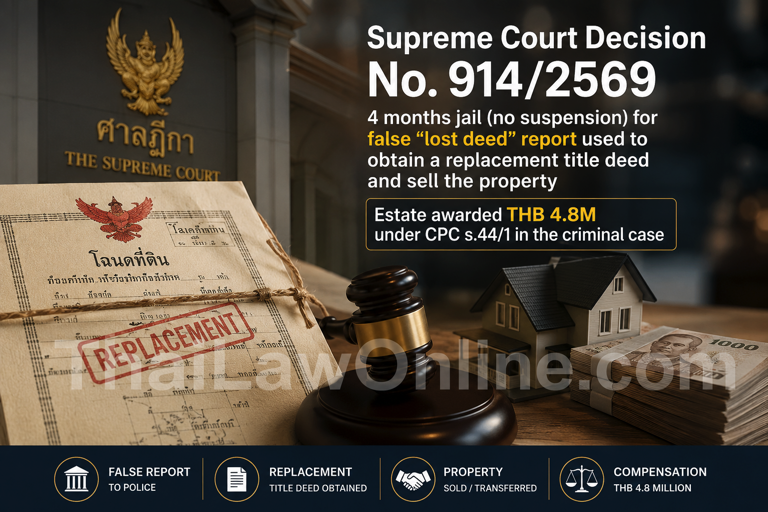
The defendant received a final sentence of four months’ imprisonment without suspension. The court also upheld an order requiring the defendant to pay THB 4.8 million to the deceased seller’s estate under Section 44/1 of the Thai Criminal Procedure Code.
The decision matters for property buyers, sellers, heirs, and lawyers because the original Chanote had never been lost. The seller still held it. Even so, the registered owner obtained a replacement deed after giving false information to the police and the Land Office, tying into the broader issue of False Lost Chanote in Thailand.
The Decision in One Minute
The agreed price for the land and commercial building was THB 6 million. The buyer paid a total of THB 1 million. A Chanote was issued in the buyer’s name, but the seller kept the original deed while waiting for the balance.
The buyer later reported the Chanote as lost, although the buyer knew the seller still held it. The police report was then used to request a replacement title deed from the Chiang Rai Provincial Land Office, Mae Sai Branch.
After the replacement was issued, the property was mortgaged, redeemed and sold to another person. The seller discovered the transfer during a Land Office search. The seller later died, and the court-appointed estate administrator continued the compensation claim.
The Court of Appeal Region 5 imposed six months’ imprisonment, reduced the sentence by one-third under Criminal Code Section 78, leaving four months. The Supreme Court upheld the sentence without suspension and confirmed THB 4.8 million compensation.
Table of Contents
What Happened in Supreme Court Decision No. 914/2569?
On 3 June 2013, the defendant agreed to purchase land with a commercial building for THB 6 million. Payments eventually totalled THB 1 million.
On 21 August 2013, Chanote No. 49754 was issued in the defendant’s name. The evidence accepted by the courts showed that the seller kept the original title deed. The arrangement was intended to allow the buyer to seek bank financing and pay the remaining purchase price.
On 8 January 2014, the defendant reported to the police that the Chanote had been lost. The same police report was presented to the Land Office in support of an application for a replacement deed. The replacement was issued on 26 March 2014.
The defendant later mortgaged the property, redeemed the mortgage and sold the property on 29 December 2014. The seller discovered the transfer in March 2016 after checking the Land Office record.
The seller died on 5 November 2019. The Chiang Rai Provincial Court appointed the applicant as estate administrator, and the compensation petition dated 1 June 2022 attached that order. The estate administrator sought THB 5 million in compensation. The Court of Appeal Region 5 awarded THB 4.8 million, and the Supreme Court upheld that amount.
Why the False Report Became a Criminal Offence
The case was not treated as a simple dispute over an unpaid property price. The defendant knowingly caused public officials to record false information in official documents and then used documents produced from the false report.
The Court of Appeal Region 5 found the defendant guilty under former Criminal Code Section 267 and Section 268. Section 267 concerned causing an official, acting in the course of duty, to record false information in a public or official document intended as evidence. Section 268 concerned using or referring to a document resulting from the offence.
The appellate court dismissed the separate charge under Criminal Code Section 137. The final punishment was imposed under Section 268 paragraph two, applying the penalty under former Section 267. It was a conviction for causing officials to record false information and using the resulting documents, not a conviction for fraud.
Why the Court Refused to Suspend the Four-Month Sentence
The appellate court first imposed six months’ imprisonment. Because part of the defence evidence assisted the proceedings, the court reduced the sentence by one-third under Criminal Code Section 78. The remaining sentence was four months.
The Supreme Court refused to suspend imprisonment. It found that the conduct showed no respect for the law and affected public order. The defendant had not accepted responsibility or reduced the consequences of the offence after the event.
The court also considered a short prison term necessary to deter the defendant and others from similar conduct. The case therefore shows that a non-violent document offence does not automatically lead to a suspended sentence.
How Section 44/1 Allowed the Estate to Claim THB 4.8 Million
Section 44/1 of the Thai Criminal Procedure Code allows an injured person to request compensation inside a criminal prosecution brought by the public prosecutor. The loss must arise from the criminal conduct charged by the prosecutor.
The Supreme Court found a direct connection between the offences and the seller’s property loss. By using the false police report to obtain the replacement Chanote and sell the property, the defendant altered or diminished the seller’s rights concerning the land and commercial building.
The estate administrator therefore had standing to continue the claim on behalf of the deceased. The Supreme Court accepted THB 4.8 million as the unpaid balance supported by the evidence.
The judgment awarded THB 4.8 million. The published decision does not show whether the estate has since collected it.
The Most Important Property Lesson: Holding the Original Chanote Was Not Enough
The seller kept the original Chanote, but the title was already registered in the buyer’s name. That informal arrangement left the seller exposed.
Possession of the owner’s copy of a Chanote is useful evidence and normally matters at the Land Office. Still, possession does not replace properly registered security. A registered owner who persuades the Land Office to issue a replacement might create serious practical problems before the true facts are discovered.
Where a seller transfers title before receiving full payment, the balance should be protected through an enforceable structure. Depending on the transaction, this might include a registered mortgage, clear payment conditions, escrow arrangements where available, or postponing transfer until full payment.
A seller should not assume, “I still hold the paper Chanote, so the buyer cannot do anything.” Decision No. 914/2569 proves why this assumption is dangerous.
What Buyers Should Check Before Accepting a Replacement Chanote
A replacement Chanote is not automatically fraudulent. Original deeds are genuinely lost, destroyed or damaged. However, a recent replacement requires more investigation, not less.
Before signing or paying a large deposit, the buyer’s lawyer should conduct a current search at the Land Office responsible for the property. The search should confirm the registered owner, the issue date, whether a replacement was issued, and every registered mortgage, lease, usufruct, superficies, servitude, seizure or transfer.
Where the replacement was issued recently, the underlying Land Office file should be reviewed. The lawyer should ask why the replacement was requested, who filed the application, what police report or supporting evidence was used, and whether another person claims to hold the original deed.
A photocopy supplied by the seller or agent is not enough. The official register might contain later entries or a replacement history that does not appear on the copy presented to the buyer.
Warning Signs in a Thai Property Transaction
Stop and investigate where the seller refuses to produce the original Chanote, gives an unclear story about a recent loss, or pressures the buyer to complete before a fresh Land Office search.
Other warning signs include a replacement deed issued shortly before sale, a quick sequence of mortgage, redemption and resale, disputed authority involving an heir or former spouse, inconsistent signatures, unexplained powers of attorney, or another person claiming possession of the original title.
One warning sign does not prove fraud. Several warning signs together justify postponing the transfer until the Land Office file and payment history have been checked.
A Practical Due Diligence Checklist
A proper Thai property due diligence review should confirm the registered owner against identification documents, company documents or estate papers.
The lawyer should review the complete registration history, confirm whether any replacement deed was issued, inspect the supporting file where necessary, check the land boundaries and legal access, confirm possession, and review payment records.
The title search should be repeated shortly before transfer. A search performed several months earlier does not prove that the property remains free from a new mortgage, seizure or transfer on completion day.
Last reviewed: 27 September 2026. Every fact, date, sentence and amount on this page was checked against the full text of Supreme Court Decision 914/2569 (the first-instance, Court of Appeal Region 5 and Supreme Court dispositions). Not re-checked: the Land Code chapter reference in the related guides. Re-checked on 11 October 2026: the Land Code read in Thai (Council of State consolidated text); Chapter 4, on the issue of title documents, runs from section 56 (which also governs replacement deeds) to section 64, as the related-guides line says; nothing changed.
Frequently Asked Questions
What was the final sentence in Supreme Court Decision No. 914/2569?
Four months’ imprisonment without suspension. The appellate court imposed six months and reduced the term by one-third under Criminal Code Section 78. The Supreme Court upheld the result.
How much compensation did the estate receive?
The court ordered the defendant to pay THB 4.8 million. The published judgment confirms the award, but does not confirm that collection or enforcement had already been completed.
Why was the compensation THB 4.8 million rather than THB 5 million?
The estate requested THB 5 million. The evidence accepted by the Supreme Court supported an unpaid balance of THB 4.8 million, which the court considered appropriate.
Was the defendant convicted under Criminal Code Section 137?
No, not in the final appellate result. The Court of Appeal Region 5 dismissed the Section 137 charge and convicted under former Section 267 and Section 268.
Does holding the original Chanote prevent a replacement deed from being issued?
It should make a genuine lost-deed application impossible on the true facts, but a dishonest registered owner might still obtain a replacement by giving false information. The victim then faces the burden of proving the fraud and seeking criminal, civil or Land Office remedies.
Is every replacement Chanote suspicious?
No. Replacement deeds are issued for genuine loss, destruction or damage. A buyer should still verify the reason, date, supporting file and later registration history.
Did the Supreme Court cancel the sale to the later buyer?
The published decision discussed the criminal convictions and compensation. It did not order cancellation of the later transfer. Cancellation or recovery of the land might require separate proceedings and depends on the facts.
What does Criminal Procedure Code Section 44/1 do?
It permits an injured person to claim qualifying compensation within a criminal case prosecuted by the public prosecutor, where the loss arises from the offence charged.
Can an estate administrator file a Section 44/1 claim?
Yes. Decision No. 914/2569 confirms that a court-appointed estate administrator may pursue the deceased victim’s property compensation claim.
What should a buyer do when the seller presents a replacement Chanote?
Conduct a current Land Office search, inspect the replacement history and supporting documents, confirm the seller’s identity and authority, review all encumbrances, and investigate whether anyone claims possession of the original.
What to Do After Discovering a Fraudulent Replacement Deed
Obtain certified Land Office records immediately. Preserve the original Chanote, contracts, receipts, bank records, messages and every document showing who held the deed and how much remained unpaid.
The criminal complaint should identify each false statement and each official document created from the false information. A vague complaint describing the matter only as “property fraud” gives police and prosecutors less to work with.
The victim should also assess Land Office objections, civil proceedings to cancel or correct registrations, temporary injunctions, asset attachment and a compensation motion under Section 44/1. The correct strategy depends on whether the property remains with the offender, whether a third party now holds it, and whether mortgages or later transfers have been registered.
What This Decision Does Not Automatically Prove
Decision No. 914/2569 was a criminal case with a compensation claim. It did not, in the published judgment, order cancellation of the later transfer or declare every transaction involving the replacement deed void.
A separate civil or administrative remedy might still be required to cancel Land Office registrations or recover the land itself. Outcomes involving a later buyer depend on the facts, the buyer’s good faith, the validity of the replacement deed and the legal relief requested.
The decision therefore supports three precise propositions: the false report and use of the resulting official documents were criminal; imprisonment was not suspended; and the estate administrator was entitled to THB 4.8 million compensation under Section 44/1.
Related ThaiLawOnline Guides
For the different classes of Thai land documents, see Thai Title Deeds: Chanote, Nor Sor 3 Gor and the Rest.
For the entries shown on the front and back of the document, see How to Read a Title Deed in Thailand.
For a broader verification checklist, see Property Due Diligence in Thailand.
For the relevant procedural law, see Thai Criminal Procedure Code, including Section 44/1.
For title documents and replacement deeds, see Land Code Chapter 4, Sections 56 to 64.
Thai Law Updates, free by email
Plain-English updates on Thai law changes that affect foreigners: property, visas, marriage, business and wills. One short email a month from a firm practicing since 2006. No spam, unsubscribe anytime.