


Évalué par Wichuda Atthamethakon, LL.M., titulaire de la licence de l’Ordre des avocats thaïlandais 3149/2556, pour ThaiLawOnline, un cabinet d’avocats thaïlandais œuvrant pour des étrangers depuis 2006.
Journal des mises à jour
- 4 novembre 2026: Added the statute box with Thai, English and French text and checked the page against the official text
Un titre de propriété papier semble puissant, mais c'est le registre du bureau foncier qui fait foi dans le dossier officiel. Arrêt de la Cour suprême n° 914/2569 montre comment une fausse déclaration de “ perte de titre ” a été utilisée pour obtenir un Chanote de remplacement et transférer le bien à une autre personne. Cette affaire met en évidence les graves conséquences d'une fausse déclaration de perte de Chanote en Thaïlande.
Le prévenu a été condamné à une peine définitive de quatre mois d'emprisonnement ferme. Le tribunal a également confirmé l'obligation pour le prévenu de verser 4,8 millions de bahts thaïlandais, au titre du vendeur décédé, à sa succession en vertu de l'article 44/1 du Code de procédure pénale thaïlandais.
La décision importe pour les acheteurs, les vendeurs, les héritiers et les avocats car le Chanote original n'avait jamais été perdu. Le vendeur l'avait toujours en sa possession. Malgré cela, le propriétaire enregistré a obtenu un titre de remplacement après avoir fourni de fausses informations à la police et au Bureau foncier, ce qui s'inscrit dans le problème plus large du faux Chanote perdu en Thaïlande.
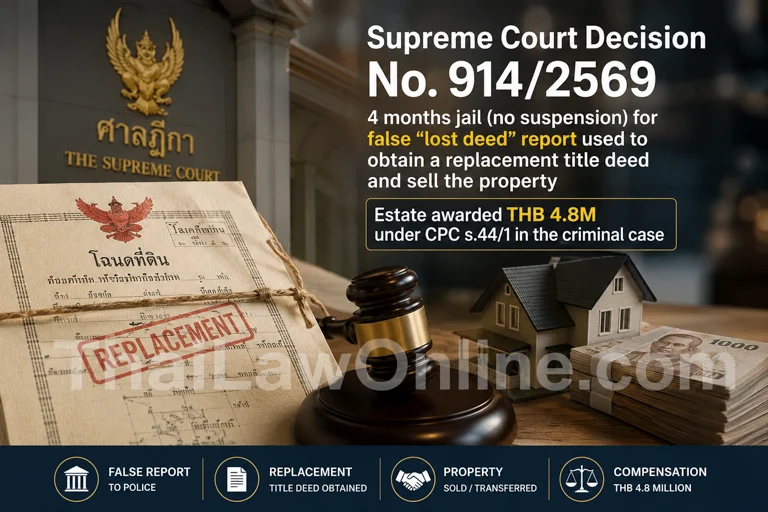
La décision en une minute
Le prix convenu pour le terrain et le bâtiment commercial était de 6 millions de THB. L'acheteur a payé un total de 1 million de THB. Un titre de propriété Chanote a été émis au nom de l'acheteur, mais le vendeur a conservé l'acte original en attendant le solde.
L'acheteur a ensuite déclaré le Chanote comme perdu, bien qu'il sût que le vendeur le détenait toujours. Le rapport de police a ensuite été utilisé pour demander un nouveau titre de propriété auprès du bureau foncier provincial de Chiang Rai, antenne de Mae Sai.
Après l'émission du remplacement, le bien a été hypothéqué, racheté et vendu à une autre personne. Le vendeur a découvert le transfert lors d'une recherche au Bureau foncier. Le vendeur est décédé plus tard, et son administrateur de succession nommé par le tribunal a poursuivi la demande d'indemnisation.
Le Cour d'appel La Région 5 a imposé une peine d’emprisonnement de six mois, réduisant la peine de moitié. Article 78 du Code pénal, laissant quatre mois. Cour suprême a confirmé la peine ferme et validé l'indemnisation de 4,8 millions de THB.
Table des matières
Que s'est-il passé dans la décision de la Cour suprême n° 914/2569 ?
Le 3 juin 2013, le défendeur a accepté d'acheter un terrain avec un bâtiment commercial pour 6 millions de THB. Les paiements ont finalement totalisé 1 million de THB.
Le 21 août 2013, le titre de propriété chanote n° 49754 a été émis au nom du défendeur. Les éléments de preuve retenus par les tribunaux ont montré que le vendeur a conservé l'original du titre de propriété. Cet arrangement visait à permettre à l'acheteur de solliciter un financement bancaire et de payer le solde du prix d'achat.
Le 8 janvier 2014, le défendeur a déclaré à la police que le Chanote avait été perdu. Le même rapport de police a été présenté au bureau foncier à l'appui d'une demande de délivrance d'un titre de remplacement. Le titre de remplacement a été émis le 26 mars 2014.
Le défendeur a ensuite hypothéqué le bien, remboursé son hypothèque et a vendu le bien le 29 décembre 2014. Le vendeur a découvert le transfert en mars 2016 après avoir consulté le registre du cadastre.
Le vendeur est décédé le 5 novembre 2019. La Cour provinciale de Chiang Rai a nommé le requérant administrateur de la succession, et la requête de compensation datée du 1er juin 2022 a été annexée à cette ordonnance. L’administrateur de la succession a demandé une indemnisation de 5 millions de bahts. La Cour d’appel de la Région 5 a accordé 4,8 millions de bahts, et la Cour suprême a confirmé cette somme.
Pourquoi la fausse déclaration est devenue une infraction pénale
L'affaire n'a pas été traitée comme un simple litige concernant le prix d'un bien impayé. Le défendeur a sciemment fait consigner de fausses informations par des agents publics dans des documents officiels, puis a utilisé les documents issus de cette fausse déclaration.
La Cour d'appel de la Région 5 a déclaré le prévenu coupable en vertu de l'ancienne loi. Article 267 du Code pénal et l’article 268. L’article 267 concerne la contrainte d’un fonctionnaire, agissant dans l’exercice de ses fonctions, à enregistrer des informations fausses dans un document public ou officiel destiné à servir de preuve. L’article 268 concerne l’utilisation ou la référence à un document résultant de l’infraction.
La cour d'appel a rejeté l'accusation distincte Article 137 du Code pénal. La peine finale a été prononcée en vertu de l’article 268, deuxième alinéa, en appliquant la peine prévue précédemment par l’article 267. Il s’agissait d’une condamnation pour avoir incité des fonctionnaires à enregistrer des informations fausses et pour avoir utilisé les documents obtenus, et non d’une condamnation pour fraude.
Le droit applicable à cette page
English
Section 267
This section punishes giving a false statement to an official so that it is recorded in a public or official document meant to serve as evidence, when this is likely to cause damage. The penalty is up to three years imprisonment, a fine up to 60,000 baht, or both.
Full text
Whoever gives information to an official acting in the course of duty, causing the official to record a false statement in a public document or an official document intended to serve as evidence, in a manner likely to cause damage to another person or to the public, shall be liable to imprisonment not exceeding three years, or a fine not exceeding sixty thousand baht, or both.
ThaiLawOnline translation
Section 268
This section punishes using or citing a document that was forged or falsified under Sections 264 to 267 in a manner likely to cause damage to another person or the public, with the penalty of the underlying section. If the user is also the forger, or caused the official to record the false statement, they are punished under this section only, as a single offence.
Full text
Whoever uses or refers to a document arising from the commission of an offence under Section 264, Section 265, Section 266, or Section 267, in a manner likely to cause damage to another person or to the public, shall be liable to the penalty prescribed in that Section. If the offender under paragraph one is the person who forged that document, or is the person who gave the information causing the official to record that statement, that offender shall be punished under this Section as a single offence only.
ThaiLawOnline translation
Section 63 Issuance of Documents Showing Rights in Land
Full text
The owner of land whose title deed is endangered, damaged or lost by any means whatsoever may apply for a substitute. After the substitute has been issued, the original title deed shall be cancelled unless otherwise ordered by the court. The above-mentioned provisions shall apply mutatis mutandis to the application for a substitute for a pre-emption certificate, certificate of utilization or certificate of investigation (bai tai suan).
Unofficial translation by the Office of the Council of State
Section 44/1
In a public-prosecutor case, the victim can file a motion in the same criminal court asking the defendant to pay compensation for injury or loss. It must be filed before evidence-taking starts and is treated as a civil plaint.
Full text
In a case where the public prosecutor is the plaintiff, if the injured person has a right to claim compensation because of harm to life, body or mind, or damage to liberty of the body, to reputation, or to property, arising from the defendant's commission of the offence, the injured person may file a motion with the court trying the criminal case asking that the defendant be ordered to pay compensation to him. The motion under paragraph one must be filed by the injured person before the taking of evidence begins; where there is no taking of evidence, the motion must be filed before the court adjudicates the case. Such motion shall be deemed a plaint under the provisions of the Civil Procedure Code, and the injured person stands in the position of plaintiff in that civil part. The motion must set out reasonable particulars concerning the damage and the amount of compensation claimed. If the court is of the view that the motion still lacks some essential matter, it may order the applicant to amend the motion to make it clear. The motion under paragraph one may not include any request other than an order that the defendant pay compensation arising from the defendant's commission of the offence in the criminal case, and it must not conflict with the charge in the criminal case brought by the public prosecutor. In a case where the public prosecutor has already proceeded under section 43, the injured person may not file a motion under paragraph one to claim the property or its value again.
ThaiLawOnline translation
Section 137
This section punishes giving false information to an official where it may cause damage to another person or to the public. The penalty is imprisonment not exceeding six months, or a fine not exceeding 10,000 baht, or both.
Full text
Whoever gives a false statement to an official, in a manner likely to cause injury to another person or to the public, shall be liable to imprisonment not exceeding six months, or a fine not exceeding ten thousand baht, or both.
ThaiLawOnline translation
Section 78
Where mitigating circumstances appear, the court may reduce the punishment to be imposed by up to one half, whether or not the punishment has already been increased or reduced under any other provision. The section lists examples such as remorse and effort to repair the harm, surrender to officials, prior good conduct, grievous distress, and giving the court useful information.
Full text
When it appears that there are mitigating circumstances, whether or not there has been an increase or reduction of punishment under the provisions of this Code or of any other law, if the court thinks fit it may reduce the punishment to be imposed on the offender by not more than one half. Such mitigating circumstances include: the offender being ignorant and of feeble understanding, being in grievous distress, having previously had good conduct, feeling remorse and endeavouring to mitigate the injurious consequences of the offence, surrendering to the official, or giving the court information that is beneficial, or any other circumstance that the court considers to be of a similar nature.
ThaiLawOnline translation
Section 61 Issuance of Documents Showing Rights in Land
Full text
Where it appears that any title deed or certificate of utilization has been issued, or right and juristic act registration regarding immovable property has been effected, or document or particulars of immovable property registration have been recorded, for any person inaccurately or unlawfully, the Director-General, or the person assigned by the Director-General who is a Deputy Director-General or Inspector of the Department of Lands, shall have the power to order a revocation or correction thereof. Before proceeding under paragraph one, the Director-General, or the person assigned by the Director-General under paragraph one, shall set up an investigation committee, who shall have the power to demand, for consideration, the title deed, certificate of utilization, documents which right and juristic act registration has been effected, documents showing particulars of immovable property registration, or other pertinent documents, and the interested persons shall be advised to accord them a chance to object. If no objection is raised within thirty days from the date of advice, it shall be assumed that no objection has been raised. The committee investigating inaccurate or unlawful issuance of title deeds or certificates of utilization shall at least comprise an administrative official and a representative of the local administrative body or a local administrator of the locality where the land is located, as committee members. The investigation under paragraph two must be completed and forwarded to the Director-General or the person assigned by the Director-General under paragraph one, within sixty days from the date of issue of an order for an investigation. In case the investigation committee cannot complete its investigation within the said timeframe, it shall then report to the Director-General or the person assigned by the Director-General under paragraph one the cause as to why the investigation could not be completed, so as to request an extension of the period of time for investigation, in which case the Director- General or the person assigned by him under paragraph one may order an extension of the period for such investigation as necessary, but in no case shall it exceed sixty days. The Director-General or the person assigned by him under paragraph one shall complete his consideration within fifteen days from the date of receipt of investigation report from the investigation committee under paragraph four. Upon the Director-General or the person assigned by the Director-General under paragraph one having made any consideration thereof, steps shall then be taken according to his decision. In proceeding with revocation or correction under this Section, if no title deed or certificate of utilization has been produced, it shall be regarded that such title deed or certificate of utilization is lost. In this respect, the land official shall issue a substitute land right document for further processing. In the event of any inaccuracy due to writing or typing errors, for which clear evidence is available, and the interested person has consented thereto in writing, the land official shall have the power to make correction. In case a final court judgement or order is issued for a revocation or correction to be effected, the land official shall proceed in accordance with such court judgement or order according to the procedure prescribed by the Director-General. The setting up of the investigation committee, investigation, notice to the interested person to raise an objection, and consideration for revocation or correction shall be in accordance with the rules and procedure prescribed in the ministerial regulations.
Unofficial translation by the Office of the Council of State
Section 56Amended on 8 April 2016
Where the court is to impose imprisonment not exceeding five years, whether or not a fine is also imposed, or is to impose a fine, and the person's record falls within one of the three descriptions the section gives, the court may adjudge them guilty but suspend the determination of the punishment, or determine the punishment but suspend its execution, for a period it fixes of not more than five years from the day of the judgment, and it may attach conditions for controlling their conduct.
Full text
Whoever commits an offence punishable by imprisonment or by fine, and in that case the court is to impose imprisonment not exceeding five years, whether or not a fine is also imposed, or is to impose a fine, if it appears that that person: (1) has never previously received a punishment of imprisonment; (2) has previously received a punishment of imprisonment, but it was a punishment for an offence committed negligently, or for a petty offence, or was imprisonment not exceeding six months; or (3) has previously received a punishment of imprisonment but was released from it more than five years before committing the further offence, the later offence being one committed negligently or a petty offence, and when the court has taken into account the age, personal history, conduct, intelligence, education and training, health, mental condition, disposition, occupation, and environment of that person, or the nature of the offence, or that person's sense of remorse and efforts to mitigate the harm caused, or any other extenuating circumstance, the court may adjudge that the person is guilty but suspend the determination of the punishment, or determine the punishment but suspend its execution, whether the punishment be imprisonment or a fine or both, so as to give that person an opportunity to reform within such period as the court fixes, which must not exceed five years from the day of the judgment; and the court may or may not fix conditions for controlling that person's conduct. The conditions for controlling the conduct of an offender under paragraph one may be fixed by the court, one or several as may be appropriate to the case, as follows: (1) to report in person from time to time to the official designated by the court, so that the official may question, advise, assist, or admonish the offender as it thinks fit as to conduct and occupation, or to arrange for the offender to perform social service or public benefit activities; (2) to train for or to carry on a regular lawful occupation; (3) to refrain from association, or from any conduct, that might lead to the commission of a similar offence again; (4) to undergo treatment for narcotic addiction, for physical or mental deficiency, or for any other illness, at the place and for the period fixed by the court; (5) to undergo training at the place and for the period fixed by the court; (6) to be prohibited from leaving the place of residence, or from entering any place, during the times fixed by the court, and for this purpose an electronic device or any other device capable of monitoring or restricting travel may be used; (7) to pay compensation, or otherwise to remedy the damage, to the injured person as agreed between the offender and the injured person; (8) to repair, restore, or remedy damage caused to natural resources or to the environment, or to pay compensation for that purpose; (9) to enter into a bond in such sum as the court thinks fit that the offender will not commit an act of mischief or cause danger to another person or to property; (10) any other condition that the court thinks fit to fix in order to correct or rehabilitate the offender, or to prevent the offender from committing or having the opportunity to commit an offence again, or any condition for remedying the injured person as the court thinks fit. As to the conditions fixed by the court under paragraph two, if it later appears to the court, on the application of the offender, of the offender's legal representative, of the offender's curator, of the public prosecutor, or of an official, that the circumstances relating to the control of the offender's conduct have changed, the court may, if it thinks fit, amend, add to, or revoke any of them, or may additionally fix any condition mentioned in paragraph two that it has not already fixed. If there is a breach of a bond, the provisions of Section 47 shall apply mutatis mutandis.
ThaiLawOnline translation
ไทย
มาตรา 267
ข้อความเต็ม
ผู้ใดแจ้งให้เจ้าพนักงานผู้กระทำการตามหน้าที่จดข้อความอันเป็นเท็จลงในเอกสารมหาชนหรือเอกสารราชการ ซึ่งมีวัตถุประสงค์สำหรับใช้เป็นพยานหลักฐาน โดยประการที่น่าจะเกิดความเสียหายแก่ผู้อื่นหรือประชาชน ต้องระวางโทษจำคุกไม่เกินสามปี หรือปรับไม่เกินหกหมื่นบาท หรือทั้งจำทั้งปรับ หมายเหตุ: [อัตราโทษ แก้ไขเพิ่มเติมโดยมาตรา ๔ แห่งพระราชบัญญัติแก้ไขเพิ่มเติมประมวลกฎหมายอาญา (ฉบับที่ ๒๖) พ.ศ. ๒๕๖๐]
ข้อความจากฐานข้อมูลประมวลกฎหมายของเรา โปรดตรวจสอบกับข้อความทางการ (Thai text from our annotated code. Check it against the official text.)
มาตรา 268
ข้อความเต็ม
ผู้ใดใช้หรืออ้างเอกสารอันเกิดจากการกระทำความผิดตามมาตรา ๒๖๔ มาตรา ๒๖๕ มาตรา ๒๖๖ หรือมาตรา ๒๖๗ ในประการที่น่าจะเกิดความเสียหายแก่ผู้อื่นหรือประชาชน ต้องระวางโทษดังที่บัญญัติไว้ในมาตรานั้น ๆ ถ้าผู้กระทำความผิดตามวรรคแรกเป็นผู้ปลอมเอกสารนั้น หรือเป็นผู้แจ้งให้เจ้าพนักงานจดข้อความนั้นเองให้ลงโทษตามมาตรานี้แต่กระทงเดียว
ตรงตามข้อความในราชกิจจานุเบกษา / สำนักงานคณะกรรมการกฤษฎีกา (Verbatim from the Royal Gazette / Office of the Council of State)
มาตรา 63
ข้อความเต็ม
โฉนดที่ดินของผู้ใดเป็นอันตราย ชำรุด สูญหายด้วยประการใด ให้เจ้าของมาขอรับใบแทนโฉนดที่ดินนั้นได้ เมื่อได้ออกใบแทนไปแล้ว โฉนดที่ดินเดิมเป็นอันยกเลิก เว้นแต่ศาลจะสั่งเป็นอย่างอื่น สำหรับการขอใบแทนใบจอง หนังสือรับรองการทำประโยชน์หรือใบไต่สวน ให้นำความดังกล่าวข้างต้นมาใช้บังคับโดยอนุโลม
ตรงตามข้อความในราชกิจจานุเบกษา / สำนักงานคณะกรรมการกฤษฎีกา (Verbatim from the Royal Gazette / Office of the Council of State)
มาตรา 44/1
ข้อความเต็ม
ในคดีที่พนักงานอัยการเป็นโจทก์ ถ้าผู้เสียหายมีสิทธิที่จะเรียกเอาค่าสินไหมทดแทนเพราะเหตุได้รับอันตรายแก่ชีวิต ร่างกาย จิตใจ หรือได้รับความเสื่อมเสียต่อเสรีภาพในร่างกายชื่อเสียงหรือได้รับความเสียหายในทางทรัพย์สินอันเนื่องมาจากการกระทำความผิดของจำเลย ผู้เสียหายจะยื่นคำร้องต่อศาลที่พิจารณาคดีอาญาขอให้บังคับจำเลยชดใช้ค่าสินไหมทดแทนแก่ตนก็ได้การยื่นคำร้องตามวรรคหนึ่ง ผู้เสียหายต้องยื่นคำร้องก่อนเริ่มสืบพยาน ในกรณีที่ไม่มีการสืบพยานให้ยื่นคำร้องก่อนศาลวินิจฉัยชี้ขาดคดี และให้ถือว่าคำร้องดังกล่าวเป็นคำฟ้องตามบทบัญญัติแห่งประมวลกฎหมายวิธีพิจารณาความแพ่งและผู้เสียหายอยู่ในฐานะโจทก์ในคดีส่วนแพ่งนั้น ทั้งนี้คำร้องดังกล่าวต้องแสดงรายละเอียดตามสมควรเกี่ยวกับความเสียหายและจำนวนค่าสินไหมทดแทนที่เรียกร้อง หากศาลเห็นว่าคำร้องนั้นยังขาดสาระสำคัญบางเรื่อง ศาลอาจมีคำสั่งให้ผู้ร้องแก้ไขคำร้องให้ชัดเจนก็ได้คำร้องตามวรรคหนึ่งจะมีคำขอประการอื่นที่มิใช่คำขอบังคับให้จำเลยชดใช้ค่าสินไหมทดแทนอันเนื่องมาจากการกระทำความผิดของจำเลยในคดีอาญามิได้ และต้องไม่ขัดหรือแย้งกับคำฟ้องในคดีอาญาที่พนักงานอัยการเป็นโจทก์ และในกรณีที่พนักงานอัยการได้ดำเนินการตามความในมาตรา ๔๓ แล้ว ผู้เสียหายจะยื่นคำร้องตามวรรคหนึ่งเพื่อเรียกทรัพย์สินหรือราคาทรัพย์สินอีกไม่ได้
ตรงตามข้อความในราชกิจจานุเบกษา / สำนักงานคณะกรรมการกฤษฎีกา (Verbatim from the Royal Gazette / Office of the Council of State)
มาตรา 137
ข้อความเต็ม
ผู้ใดแจ้งข้อความอันเป็นเท็จแก่เจ้าพนักงาน ซึ่งอาจทำให้ผู้อื่นหรือประชาชนเสียหาย ต้องระวางโทษจำคุกไม่เกินหกเดือน หรือปรับไม่เกินหนึ่งหมื่นบาท หรือทั้งจำทั้งปรับ หมายเหตุ: [อัตราโทษ แก้ไขเพิ่มเติมโดยมาตรา ๔ แห่งพระราชบัญญัติแก้ไขเพิ่มเติมประมวลกฎหมายอาญา (ฉบับที่ ๒๖) พ.ศ. ๒๕๖๐]
ข้อความจากฐานข้อมูลประมวลกฎหมายของเรา โปรดตรวจสอบกับข้อความทางการ (Thai text from our annotated code. Check it against the official text.)
มาตรา 78
ข้อความเต็ม
เมื่อปรากฏว่ามีเหตุบรรเทาโทษ ไม่ว่าจะได้มีการเพิ่มหรือการลดโทษตามบทบัญญัติแห่งประมวลกฎหมายนี้หรือกฎหมายอื่นแล้วหรือไม่ ถ้าศาลเห็นสมควรจะลดโทษไม่เกินกึ่งหนึ่งของโทษที่จะลงแก่ผู้กระทำความผิดนั้นก็ได้ เหตุบรรเทาโทษนั้น ได้แก่ผู้กระทำความผิดเป็นผู้โฉดเขลาเบาปัญญาตกอยู่ในความทุกข์อย่างสาหัส มีคุณความดีมาแต่ก่อน รู้สึกความผิดและพยายามบรรเทาผลร้ายแห่งความผิดนั้น ลุแก่โทษต่อเจ้าพนักงานหรือให้ความรู้แก่ศาลอันเป็นประโยชน์แก่การพิจารณา หรือเหตุอื่นที่ศาลเห็นว่ามีลักษณะทำนองเดียวกัน
ตรงตามข้อความในราชกิจจานุเบกษา / สำนักงานคณะกรรมการกฤษฎีกา (Verbatim from the Royal Gazette / Office of the Council of State)
มาตรา 61
ข้อความเต็ม
เมื่อความปรากฏว่าได้ออกโฉนดที่ดินหรือหนังสือรับรองการทำประโยชน์ หรือได้จดทะเบียนสิทธิและนิติกรรมเกี่ยวกับอสังหาริมทรัพย์ หรือจดแจ้งเอกสารรายการจดทะเบียนอสังหาริมทรัพย์ให้แก่ผู้ใดโดยคลาดเคลื่อนหรือไม่ชอบด้วยกฎหมาย ให้อธิบดีหรือผู้ซึ่งอธิบดีมอบหมายซึ่งดำรงตำแหน่งรองอธิบดีหรือผู้ตรวจราชการกรมที่ดินมีอำนาจหน้าที่สั่งเพิกถอนหรือแก้ไขได้ ก่อนที่จะดำเนินการตามวรรคหนึ่ง ให้อธิบดีหรือผู้ซึ่งอธิบดีมอบหมายตามวรรคหนึ่ง ตั้งคณะกรรมการสอบสวนขึ้นคณะหนึ่ง โดยมีอำนาจเรียกโฉนดที่ดิน หนังสือรับรองการทำประโยชน์ เอกสารที่ได้จดทะเบียนสิทธิและนิติกรรม เอกสารที่ได้จดแจ้งรายการทะเบียนอสังหาริมทรัพย์ หรือเอกสารอื่นที่เกี่ยวข้องมาพิจารณา พร้อมทั้งแจ้งให้ผู้มีส่วนได้เสียทราบเพื่อให้โอกาสคัดค้าน ถ้าไม่คัดค้านภายในกำหนดสามสิบวันนับแต่วันที่ได้รับแจ้ง ให้ถือว่าไม่มีการคัดค้าน คณะกรรมการสอบสวนการออกโฉนดที่ดินหรือหนังสือรับรองการทำประโยชน์ที่ออกโดยคลาดเคลื่อนหรือไม่ชอบด้วยกฎหมาย อย่างน้อยต้องมีเจ้าพนักงานฝ่ายปกครองและตัวแทนคณะผู้บริหารท้องถิ่นหรือผู้บริหารท้องถิ่นที่ที่ดินนั้นตั้งอยู่เป็นกรรมการ การสอบสวนตามวรรคสองต้องดำเนินการให้แล้วเสร็จและส่งให้อธิบดีหรือผู้ซึ่งอธิบดีมอบหมายตามวรรคหนึ่งภายในกำหนดหกสิบวันนับแต่วันที่ได้มีคำสั่งให้ทำการสอบสวน ในกรณีที่คณะกรรมการสอบสวนไม่สามารถดำเนินการให้แล้วเสร็จภายในกำหนดเวลาดังกล่าว ให้คณะกรรมการสอบสวนรายงานเหตุที่ทำให้การสอบสวนไม่แล้วเสร็จต่ออธิบดีหรือผู้ซึ่งอธิบดีมอบหมายตามวรรคหนึ่งเพื่อขอขยายระยะเวลาการสอบสวน โดยให้อธิบดีหรือผู้ซึ่งอธิบดีมอบหมายตามวรรคหนึ่งสั่งขยายระยะเวลาดำเนินการได้ตามความจำเป็นแต่ไม่เกินหกสิบวัน ให้อธิบดีหรือผู้ซึ่งอธิบดีมอบหมายตามวรรคหนึ่งพิจารณาให้แล้วเสร็จภายในสิบห้าวันนับแต่ได้รับรายงานการสอบสวนจากคณะกรรมการสอบสวนตามวรรคสี่ เมื่ออธิบดีหรือผู้ซึ่งอธิบดีมอบหมายตามวรรคหนึ่งพิจารณาประการใดแล้ว ก็ให้ดำเนินการไปตามนั้น การดำเนินการเพิกถอนหรือแก้ไขตามความในมาตรานี้ ถ้าไม่ได้โฉนดที่ดินหรือหนังสือรับรองการทำประโยชน์มา ให้ถือว่าโฉนดที่ดินหรือหนังสือรับรองการทำประโยชน์นั้นสูญหาย และให้เจ้าพนักงานที่ดินออกใบแทนหนังสือแสดงสิทธิในที่ดินเพื่อดำเนินการต่อไป ถ้ามีการคลาดเคลื่อนเนื่องจากเขียนหรือพิมพ์ข้อความผิดพลาดโดยมีหลักฐานชัดแจ้งและผู้มีส่วนได้เสียยินยอมเป็นลายลักษณ์อักษรแล้ว ให้เจ้าพนักงานที่ดินมีอำนาจหน้าที่แก้ไขให้ถูกต้องได้ ในกรณีที่ศาลมีคำพิพากษาหรือคำสั่งถึงที่สุดให้เพิกถอนหรือแก้ไขอย่างใดแล้ว ให้เจ้าพนักงานที่ดินดำเนินการตามคำพิพากษาหรือคำสั่งนั้นตามวิธีการที่อธิบดีกำหนด การตั้งคณะกรรมการสอบสวน การสอบสวน การแจ้งผู้มีส่วนได้เสียเพื่อให้โอกาสคัดค้านและการพิจารณาเพิกถอนหรือแก้ไข ให้เป็นไปตามหลักเกณฑ์และวิธีการที่กำหนดในกฎกระทรวง
ตรงตามข้อความในราชกิจจานุเบกษา / สำนักงานคณะกรรมการกฤษฎีกา (Verbatim from the Royal Gazette / Office of the Council of State)
มาตรา 56แก้ไขเมื่อ 8 เมษายน 2559
ข้อความเต็ม
ผู้ใดกระทำความผิดซึ่งมีโทษจำคุกหรือปรับ และในคดีนั้นศาลจะลงโทษจำคุกไม่เกินห้าปีไม่ว่าจะลงโทษปรับด้วยหรือไม่ก็ตามหรือลงโทษปรับ ถ้าปรากฏว่าผู้นั้น (๑) ไม่เคยรับโทษจำคุกมาก่อน หรือ (๒) เคยรับโทษจำคุกมาก่อนแต่เป็นโทษสำหรับความผิดที่ได้กระทำโดยประมาท หรือความผิดลหุโทษ หรือเป็นโทษจำคุกไม่เกินหกเดือน หรือ (๓) เคยรับโทษจำคุกมาก่อนแต่พ้นโทษจำคุกมาแล้วเกินกว่าห้าปี แล้วมากระทำความผิดอีก โดยความผิดในครั้งหลังเป็นความผิดที่ได้กระทำโดยประมาทหรือความผิดลหุโทษ และเมื่อศาลได้คำนึงถึงอายุ ประวัติ ความประพฤติ สติปัญญา การศึกษาอบรม สุขภาพ ภาวะแห่งจิต นิสัย อาชีพ และสิ่งแวดล้อมของผู้นั้น หรือสภาพความผิด หรือการรู้สึกความผิด และพยายามบรรเทาผลร้ายที่เกิดขึ้น หรือเหตุอื่นอันควรปรานีแล้ว ศาลจะพิพากษาว่าผู้นั้นมีความผิดแต่รอการกำหนดโทษหรือกำหนดโทษแต่รอการลงโทษไว้ ไม่ว่าจะเป็นโทษจำคุกหรือปรับอย่างหนึ่งอย่างใดหรือทั้งสองอย่าง เพื่อให้โอกาสกลับตัวภายในระยะเวลาที่ศาลจะได้กำหนดแต่ต้องไม่เกินห้าปีนับแต่วันที่ศาลพิพากษา โดยจะกำหนดเงื่อนไขเพื่อคุมความประพฤติของผู้นั้นด้วยหรือไม่ก็ได้ เงื่อนไขเพื่อคุมความประพฤติของผู้กระทำความผิดตามวรรคหนึ่ง ศาลอาจกำหนดข้อเดียวหรือหลายข้อตามควรแก่กรณีได้ ดังต่อไปนี้ (๑) ให้ไปรายงานตัวต่อเจ้าพนักงานที่ศาลระบุไว้เป็นครั้งคราว เพื่อเจ้าพนักงานจะได้สอบถาม แนะนำ ช่วยเหลือ หรือตักเตือนตามที่เห็นสมควรในเรื่องความประพฤติและการประกอบอาชีพ หรือจัดให้กระทำกิจกรรมบริการสังคมหรือสาธารณประโยชน์ (๒) ให้ฝึกหัดหรือทำงานอาชีพอันเป็นกิจจะลักษณะ (๓) ให้ละเว้นการคบหาสมาคมหรือการประพฤติใดอันอาจนำไปสู่การกระทำความผิดในทำนองเดียวกันอีก (๔) ให้ไปรับการบำบัดรักษาการติดยาเสพติดให้โทษ ความบกพร่องทางร่างกายหรือจิตใจ หรือความเจ็บป่วยอย่างอื่น ณ สถานที่และตามระยะเวลาที่ศาลกำหนด (๕) ให้เข้ารับการฝึกอบรม ณ สถานที่และตามระยะเวลาที่ศาลกำหนด (๖) ห้ามออกนอกสถานที่อยู่อาศัย หรือห้ามเข้าในสถานที่ใดในระหว่างเวลาที่ศาลกำหนด ทั้งนี้ จะใช้อุปกรณ์อิเล็กทรอนิกส์หรืออุปกรณ์อื่นใดที่สามารถใช้ตรวจสอบหรือจำกัดการเดินทางด้วยก็ได้ (๗) ให้ชดใช้ค่าสินไหมทดแทนหรือเยียวยาความเสียหายโดยวิธีอื่นให้แก่ผู้เสียหายตามที่ผู้กระทำความผิดและผู้เสียหายตกลงกัน (๘) ให้แก้ไขฟื้นฟูหรือเยียวยาความเสียหายที่เกิดแก่ทรัพยากรธรรมชาติ หรือสิ่งแวดล้อม หรือชดใช้ค่าเสียหายเพื่อการดังกล่าว (๙) ให้ทำทัณฑ์บนโดยกำหนดจำนวนเงินตามที่ศาลเห็นสมควรว่าจะไม่ก่อเหตุร้าย หรือก่อให้เกิดภยันตรายแก่บุคคลอื่นหรือทรัพย์สิน (๑๐) เงื่อนไขอื่น ๆ ตามที่ศาลเห็นสมควรกำหนดเพื่อแก้ไข ฟื้นฟู หรือป้องกันมิให้ผู้กระทำความผิดกระทำหรือมีโอกาสกระทำความผิดขึ้นอีก หรือเงื่อนไขในการเยียวยาผู้เสียหายตามที่เห็นสมควร เงื่อนไขตามที่ศาลได้กำหนดตามความในวรรคสองนั้น ถ้าภายหลังความปรากฏแก่ศาลตามคำขอของผู้กระทำความผิด ผู้แทนโดยชอบธรรมของผู้นั้น ผู้อนุบาลของผู้นั้น พนักงานอัยการหรือเจ้าพนักงานว่าพฤติการณ์ที่เกี่ยวแก่การควบคุมความประพฤติของผู้กระทำความผิดได้เปลี่ยนแปลงไป เมื่อศาลเห็นสมควรศาลอาจแก้ไขเพิ่มเติมหรือเพิกถอนข้อหนึ่งข้อใดเสียก็ได้ หรือจะกำหนดเงื่อนไขข้อใดตามที่กล่าวในวรรคสองที่ศาลยังมิได้กำหนดไว้เพิ่มเติมขึ้นอีกก็ได้ หรือถ้ามีการกระทำผิดทัณฑ์บนให้นำบทบัญญัติมาตรา ๔๗ มาใช้บังคับโดยอนุโลม
ตรงตามข้อความในราชกิจจานุเบกษา / สำนักงานคณะกรรมการกฤษฎีกา (Verbatim from the Royal Gazette / Office of the Council of State)
Français
Article 267
Quiconque fait inscrire par un fonctionnaire agissant dans ses fonctions une fausse mention dans un document public ou officiel destiné à servir de preuve, de manière à pouvoir nuire à autrui ou au public, encourt jusqu'à trois ans d'emprisonnement, 60 000 bahts d'amende, ou les deux.
résumé non officiel
Article 268
Quiconque fait usage ou se prévaut d'un document issu d'une infraction prévue aux articles 264, 265, 266 ou 267, d'une manière susceptible de causer un préjudice à autrui ou au public, encourt la peine prévue par l'article concerné. Si l'auteur de cet usage est aussi celui qui a falsifié le document ou qui a fait inscrire la mention par le fonctionnaire, il n'est puni qu'une seule fois, en vertu du présent article.
résumé non officiel
Article 63
Si le titre foncier (chanote) est détruit, endommagé ou perdu, le propriétaire peut en demander un duplicata; l'original est alors annulé, sauf décision contraire du tribunal. La règle s'applique par analogie au certificat de réservation, au certificat d'utilisation et au procès-verbal d'enquête.
résumé non officiel
Article 44/1
Si le ministère public poursuit, la victime lésée par l'infraction dans sa vie, son corps, son esprit, sa liberté, sa réputation ou ses biens peut demander au tribunal pénal de condamner le prévenu à réparation, avant l'audition des témoins ou, à défaut, avant jugement. La demande vaut assignation civile, la victime étant demanderesse. Elle détaille préjudice et montant, sans autre prétention ni contradiction avec l'accusation, ni biens déjà réclamés selon l'article 43.
résumé non officiel
Article 137
Quiconque fait une fausse déclaration à un fonctionnaire, susceptible de nuire à autrui ou au public, encourt jusqu'à six mois d'emprisonnement, 10 000 bahts d'amende, ou les deux.
résumé non officiel
Article 78
En présence de circonstances atténuantes, le tribunal peut réduire la peine de moitié au plus. Il s'agit notamment de l'ignorance, d'une grande détresse, de bons antécédents, du repentir et de la réparation, de la reddition ou de l'aide apportée au tribunal.
résumé non officiel
Article 61
Si un titre foncier ou un certificat d'utilisation a été délivré, ou un droit ou acte immobilier enregistré ou mentionné, par erreur ou illégalement, le directeur général du Département des terres, ou son délégué (directeur général adjoint ou inspecteur), peut l'annuler ou le rectifier, après enquête d'une commission qui notifie les intéressés (trente jours sans opposition valent absence d'opposition) et comprend, pour les titres, un agent de l'administration et un représentant de l'exécutif local. Délais : enquête soixante jours, prorogeable de soixante jours au plus ; décision quinze jours. Titre non produit : réputé perdu, un duplicata est délivré. Erreur matérielle manifeste : rectification par l'agent foncier avec accord écrit des intéressés. Décision judiciaire définitive : exécutée par l'agent foncier. Modalités : règlement ministériel.
résumé non officiel
Article 56Modifié le 8 avril 2016
Prison de cinq ans au plus ou amende; auteur jamais emprisonné, ou pour imprudence, contravention ou six mois au plus, ou libéré depuis plus de cinq ans, récidivant par imprudence ou contravention : vu sa situation, sursis possible au prononcé ou à l'exécution, cinq ans maximum, mise à l'épreuve facultative.
résumé non officiel
Sources
- Code pénal, Office of the Council of State, consulté le 31 octobre 2026
- Code foncier, Office of the Council of State, consulté le 31 octobre 2026
- Code de procédure pénale, Office of the Council of State, consulté le 31 octobre 2026
Pourquoi le tribunal a refusé de suspendre la peine de quatre mois
La cour d'appel a d'abord prononcé une peine de six mois d'emprisonnement. Une partie des éléments de preuve de la défense ayant contribué à la procédure, la cour a réduit la peine d'un tiers en vertu de l'article 78 du Code pénal. Le reliquat de la peine était de quatre mois.
La Cour suprême a refusé de suspendre la peine d'emprisonnement. Elle a estimé que le comportement ne témoignait d'aucun respect de la loi et portait atteinte à l'ordre public. Le prévenu n'avait pas assumé sa responsabilité ni atténué les conséquences de l'infraction après les faits.
Le tribunal a également estimé qu'une courte peine de prison était nécessaire pour dissuader le prévenu et d'autres personnes d'adopter un comportement similaire. L'affaire montre donc qu'une infraction non violente liée à des documents ne conduit pas automatiquement à une peine avec sursis.
Comment l'article 44/1 a permis à la succession de réclamer 4,8 millions de THB
Article 44/1 du Code de procédure pénale thaïlandais Permet à une personne blessée de demander une indemnisation dans le cadre d’une procédure pénale intentée par l’État. ministère public. La perte doit découler de la conduite criminelle imputée par le procureur.
La Cour suprême a établi un lien direct entre les infractions et la perte patrimoniale du vendeur. En utilisant le faux rapport de police pour obtenir le Chanote de remplacement et vendre le bien, le défendeur a altéré ou réduit les droits du vendeur concernant le terrain et le bâtiment commercial.
L'administrateur de la succession avait donc qualité pour poursuivre l'action au nom du défunt. La Cour suprême a retenu 4,8 millions de THB comme solde impayé étayé par les éléments de preuve.
Le jugement a accordé 4,8 millions de THB. La décision publiée ne précise pas si la succession a depuis perçu cette somme.
La leçon immobilière la plus importante : détenir le Chanote original ne suffisait pas
Le vendeur a conservé le Chanote original, mais le titre était déjà enregistré au nom de l'acheteur. Cet arrangement informel a laissé le vendeur vulnérable.
La possession de la copie du propriétaire d'un Chanote constitue une preuve utile et compte généralement auprès du Bureau foncier. Néanmoins, la possession ne remplace pas une sûreté régulièrement enregistrée. Un propriétaire enregistré qui persuade le Bureau foncier de délivrer un duplicata pourrait créer de sérieux problèmes pratiques avant que la vérité ne soit découverte.
Lorsque le vendeur transfère la propriété avant de recevoir le paiement intégral, le solde doit être protégé par une structure contraignante. Selon la transaction, cela peut inclure une hypothèque enregistrée, des conditions de paiement claires, séquestre des dispositions en cas de disponibilité, ou le report du transfert jusqu’au paiement intégral.
Un vendeur ne doit pas supposer : “ Je possède toujours le Chanote papier, donc l'acheteur ne peut rien faire. ” La décision n° 914/2569 prouve pourquoi cette supposition est dangereuse.
Ce que les acheteurs doivent vérifier avant d'accepter un Chanote de remplacement
Un Chanote de remplacement n'est pas automatiquement frauduleux. Il arrive réellement que des actes originaux soient perdus, détruits ou endommagés. Cependant, un remplacement récent exige plus d'investigation, et non moins.
Avant de signer ou de payer un grand dépôt de garantie, le conseil de l’acheteur devrait effectuer une recherche auprès du bureau foncier compétent pour la propriété. Cette recherche devrait confirmer l’identité du propriétaire inscrit, la date de délivrance de la carte d’identité, si une carte de remplacement a été délivrée et toutes les hypothèques, les baux immobiliers enregistrés., usufruit, droit de superficie, servitude, saisie ou transfert.
Lorsqu'un remplacement a été délivré récemment, le dossier foncier sous-jacent doit être examiné. L'avocat doit demander pourquoi le remplacement a été demandé, qui a déposé la demande, quel rapport de police ou quelle preuve justificative a été utilisé, et si une autre personne prétend détenir l'acte original.
Une photocopie fournie par le vendeur ou l'agent ne suffit pas. Le registre officiel peut contenir des inscriptions ultérieures ou un historique de remplacement qui n'apparaît pas sur la copie présentée à l'acheteur.
Signes d'alerte lors d'une transaction immobilière en Thaïlande
Arrêtez-vous et enquêtez lorsque le vendeur refuse de produire le Chanote original, raconte une histoire confuse au sujet d'une perte récente, ou pousse l'acheteur à conclure avant qu'une nouvelle recherche au Bureau foncier ne soit effectuée.
D'autres signes d'alerte comprennent un acte de succession délivré peu avant la vente, une succession rapide de prêts hypothécaires, de rachat et de revente, une autorité contestée impliquant un héritier ou un ex-conjoint, des signatures incohérentes et des faits inexplicables. procurations, ou une autre personne prétendant posséder le titre original.
Un seul signal d'alerte ne prouve pas une fraude. Plusieurs signaux d'alerte combinés justifient de reporter le transfert jusqu'à ce que le dossier du bureau foncier et l'historique des paiements aient été vérifiés.
Une liste de contrôle pratique de due diligence
Une propriété thaïlandaise de qualité Revue de la diligence raisonnable Il doit confirmer l’identité du propriétaire enregistré sur la base de documents d’identification, de documents de l’entreprise ou de documents immobiliers.
L'avocat doit examiner l'historique complet de l'enregistrement, confirmer si un acte de remplacement a été émis, inspecter le dossier justificatif si nécessaire, vérifier les limites du terrain et l'accès légal, confirmer la possession et examiner les registres de paiements.
La recherche de titres doit être répétée peu de temps avant le transfert. Une recherche effectuée plusieurs mois auparavant ne prouve pas que le bien reste libre de toute nouvelle hypothèque, saisie ou mutation le jour de la conclusion de la vente.
Dernière révision : 27 septembre 2026. Chaque fait, date, phrase et montant présentés sur cette page ont été vérifiés par rapport au texte intégral de la décision 914/2569 de la Cour suprême (dispositifs de première instance, Cour d’appel de la région 5 et Cour suprême). Non revérifié : la référence au chapitre du Code foncier dans les guides correspondants. Revérifié le 11 octobre 2026 : le Code foncier lu en thaï (texte consolidé du Conseil d’État) ; Chapitre 4, relatif à la délivrance des titres fonciers, s’étend de l’article 56 (qui régit également les actes de remplacement) à l’article 64, comme le précise la ligne des guides correspondants ; rien n’a changé.
Foire aux questions
Quelle a été la peine définitive prononcée dans la décision de la Cour suprême n° 914/2569 ?
Quatre mois d'emprisonnement sans sursis. La cour d'appel a prononcé une peine de six mois et a réduit la durée d'un tiers en vertu de l'article 78 du Code pénal. La Cour suprême a confirmé le résultat.
Quel montant d'indemnisation la succession a-t-elle reçu ?
Le tribunal a ordonné à l'accusé de verser 4,8 millions de THB. Le jugement publié confirme cette condamnation, mais ne confirme pas que le recouvrement ou l'exécution a déjà été achevé.
Pourquoi l'indemnité était-elle de 4,8 millions de THB plutôt que de 5 millions de THB ?
La succession a réclamé 5 millions de bahts. Les preuves acceptées par la Cour suprême ont étayé un solde impayé de 4,8 millions de bahts, que la cour a jugé approprié.
L'accusé a-t-il été condamné en vertu de l'article 137 du Code pénal ?
Non, pas dans le résultat final de l'appel. La Cour d'appel de la région 5 a rejeté l'accusation portée en vertu de l'article 137 et a prononcé une condamnation en vertu des anciens articles 267 et 268.
La possession du Chanote d'origine empêche-t-elle l'émission d'un acte de remplacement ?
Cela devrait rendre impossible une demande authentique de titre de propriété perdu sur la base des faits réels, mais un propriétaire inscrit malhonnête pourrait tout de même obtenir un remplacement en fournissant de fausses informations. La victime fait alors face à la charge de prouver la fraude et de rechercher des recours pénaux, civils ou auprès du Bureau foncier.
Est-ce que chaque Chanote de remplacement est suspect ?
Non. Des actes de remplacement sont émis en cas de perte, de destruction ou de dommage avérés. Un acheteur doit tout de même vérifier le motif, la date, le dossier justificatif et l'historique des enregistrements ultérieurs.
La Cour suprême a-t-elle annulé la vente au second acheteur ?
La décision publiée a examiné les condamnations pénales et l'indemnisation. Elle n'a pas ordonné l'annulation du transfert ultérieur. L'annulation ou la récupération du terrain pourrait nécessiter une procédure distincte et dépend des faits.
Que fait l'article 44/1 du Code de procédure pénale ?
Il permet à une personne lésée de réclamer une indemnisation admissible dans le cadre d'une action pénale poursuivie par le ministère public, lorsque le préjudice découle de l'infraction poursuivie.
Un administrateur de succession peut-il introduire une réclamation au titre de l'article 44/1 ?
Oui. La décision n° 914/2569 confirme qu'un administrateur de succession désigné par le tribunal peut exercer l'action en indemnisation des biens de la victime décédée.
Que doit faire un acheteur lorsque le vendeur présente un Chanote de remplacement ?
Effectuer une recherche à jour auprès du Bureau foncier, inspecter l'historique de remplacement et les documents justificatifs, confirmer l'identité et les pouvoirs du vendeur, examiner toutes les charges et enquêter pour savoir si quelqu'un revendique la possession de l'original.
Que faire après la découverte d'un acte de remplacement frauduleux
Obtenez immédiatement des registres certifiés du Bureau foncier. Préservez le Chanote original, les contrats, les reçus, les relevés bancaires, les messages et chaque document montrant qui détenait le titre de propriété et quel montant restait impayé.
La plainte pénale doit identifier chaque fausse déclaration et chaque document officiel créé à partir de ces fausses informations. Une plainte vague décrivant l'affaire uniquement comme une “ fraude immobilière ” donne moins d'éléments sur lesquels la police et les procureurs peuvent travailler.
La victime doit également évaluer les oppositions auprès du Bureau foncier, les procédures civiles en annulation ou en rectification d'enregistrements, les injonctions temporaires, la saisie de biens et une demande d'indemnisation en vertu de l'article 44/1. La stratégie adéquate dépend de savoir si le bien est resté entre les mains de l'auteur de l'infraction, s'il est désormais détenu par un tiers, et si des hypothèques ou des transferts ultérieurs ont été enregistrés.
Ce que cette décision ne prouve pas automatiquement
La décision n° 914/2569 était une affaire pénale assortie d’une demande d’indemnisation. Dans l’arrêt publié, elle n’ordonnait pas l’annulation de la cession ultérieure et ne déclarait pas nulles toutes les transactions portant sur le titre de remplacement.
Un recours civil ou administratif distinct pourrait encore être nécessaire pour annuler les enregistrements auprès du bureau foncier ou récupérer le bien lui-même. Les résultats concernant un acheteur ultérieur dépendent des faits, de la bonne foi de l’acheteur, de la validité du titre de propriété de remplacement et des recours juridiques demandés.
La décision soutient donc trois propositions précises : le faux rapport et l’utilisation des documents officiels qui en résultaient constituaient des faits criminels ; l’emprisonnement n’a pas été suspendu ; et l’administrateur de la succession avait droit à une indemnisation de 4,8 millions de THB en vertu de l’article 44/1.
Guides connexes de ThaiLawOnline
Pour les différentes catégories de documents fonciers thaïlandais, voir Titre de propriété Thaïlande : Chanote, Nor Sor 3 Gor et les autres.
Pour les entrées figurant à l’avant et à l’arrière du document, voir Comment lire un titre de propriété en Thaïlande.
Pour une liste de vérification plus complète, consultez Vérification préalable des biens immobiliers en Thaïlande.
Pour le droit procédural applicable, voir Code de procédure pénale thaïlandais, y compris l’article 44/1.
Pour les titres de propriété et les actes de substitution, voir Code foncier, chapitre 4, articles 56 à 64.
Actualités juridiques thaïlandaises, gratuites par courriel
Des mises à jour en anglais simple sur les changements législatifs thaïlandais concernant les étrangers : propriété, visas, mariage, affaires et testaments. Un court courriel par mois, envoyé par un cabinet d’avocats établi depuis 2006. Zéro spam, désabonnement possible à tout moment.