


Révisé par ThaiLawOnline, un cabinet d'avocats thaïlandais agréé exerçant en Thaïlande depuis 2006. Avocate thaïlandaise en charge du dossier : Wichuda Atthamethakon, LL.M., licence du barreau thaïlandais 3149/2556.
Dernière mise à jour :
Every English guide to pension alimentaire pour enfants en Thaïlande tells you the same thing: there is no formula, it depends. That is true and useless. Thai courts do reach a number, they reach it the same way every time, and the reasoning sits in one section of the Code civil et commercial that almost no competing page quotes. This guide gives you the test the judge applies, a real case with the figure at every instance, the rule that lets a child claim for years already gone, and what happens when the paying parent leaves the country.
La réponse courte
Thailand has no statutory child support formula. No percentage of income, no state calculator, no published table. Section 1598/38 of the Civil and Commercial Code gives the court three factors and nothing else:
- le ability of the person who must pay;
- le condition in life of the child receiving it;
- le circumstances of the case.
Those three words decide every maintenance case in Thailand. In the leading Cour suprême decision on a foreign father, the mother asked for 50,000 baht a month, the father said he could manage 1,000, and the Supreme Court fixed 10,000. Below you can follow how the courts got there.
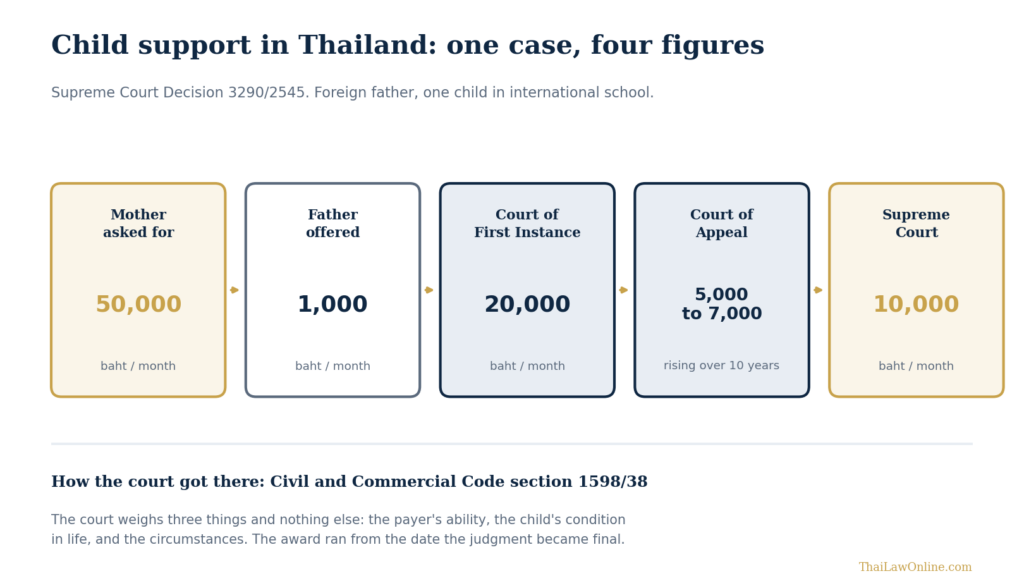
Table des matières
Ce que dit réellement la loi thaïlandaise sur la pension alimentaire pour enfants
Five sections carry the whole subject. Read them in this order and the system makes sense.
| Section | Ce qu'il fait |
|---|---|
| CCC s.1564 | Creates the duty. Parents must maintain their children and provide proper education during minority. Paragraph 2 continues the duty for an adult child who is infirm and cannot earn a living. |
| CCC s.19 | Majority at twenty. This is the normal end date of the duty, subject to s.1564 paragraph 2. |
| CCC s.1598/38 | Sets the amount. Maintenance may be claimed where the child has received none or has received too little for their condition in life. The court weighs ability, condition in life, and the circumstances. |
| CCC s.1598/39 | Allows change. On a change in circumstances, means or condition in life, the court may cancel, reduce, increase or re-establish the maintenance. |
| CCC s.1598/40 | Sets the mode. Periodical money payments unless the parties agree or the court orders otherwise. Where there is special reason, the court may order support in another form, including sending the child to a named school at the payer’s expense. |
| CCC s.1598/41 | Protects the right. The Thai text gives three limbs: the right to maintenance cannot be renounced, cannot be transferred, and is not subject to execution. That last limb is what keeps an award out of reach of creditors once it has been made. Note that the common English translation adds the word “attached”, which does not appear in the Thai. |
Two competitor pages in this search result cite section 1598/33 as the authority for support outside marriage. That section sits in the adoption title. The maintenance chapter runs from 1598/38 to 1598/41, and everything above comes from it.
Comment un tribunal thaïlandais arrive à un chiffre : une affaire, du début à la fin
Décision de la Cour suprême 3290/2545 is the clearest worked example in Thai family law, and we publish the full Thai text of it in our library. A Thai mother and a foreign resident married in an Indian ceremony without registering. Their daughter was born in October 1992. The relationship broke down, the mother moved home to Chonburi with the child, and the father paid nothing and never visited.
The mother sued for two things in one action: an order declaring paternity, and maintenance. DNA testing at Siriraj Hospital established that the defendant was the father. Then the courts went to work on the number.
| Étape | Chiffre |
|---|---|
| Mother’s demand | 50,000 baht per month |
| Father’s answer | No more than 1,000 baht per month |
| Tribunal de première instance | 20,000 baht per month until majority |
| Cour d'appel | 5,000 for five years, then 6,000 for five years, then 7,000 until majority |
| Cour suprême | 10,000 baht per month, from the date the judgment became final, until majority |
The evidence explains the movement. The child was at an international school in India costing 150,000 baht a year, rising to 170,000 in later grades, plus roughly 80,000 baht a year in flights, 30,000 in clothing and 10,000 in incidentals. The father ran a motorcycle dealership, a fabric shop and a tailoring business on Koh Samui. The Supreme Court held that the father alone could not carry the full cost of an education the mother had chosen, and in the same breath held that the Cour d'appel‘s stepped schedule was too low. It replaced both with 10,000 baht a month.
One detail matters: the Supreme Court ordered payment from the date the judgment became final, not from the child’s birth. Retroactive support arrived fifteen years later, in a different case, which is the next section.
Read the full bilingual judgment: Decision 3290/2545, paternity and maintenance in a single action.
Pouvez-vous faire une réclamation pour les années passées ?
Yes, if the parents never married and the father is légitimé. This is the single most valuable rule on this page, and no English guide we found covers it.
Décision de la Cour suprême 7345/2560 (2017) decided a claim by a child of unmarried parents for 10,000 baht a month from birth to the filing date, a total of 1,720,000 baht. The father argued the claim was time-barred by the five-year prescription for periodical payments in CCC s.193/33(4). The Tribunal de première instance rejected that argument, holding this was not a claim for maintenance fixed to be paid periodically, and the father failed to preserve the point on appeal, so the prescription ruling stood.
The Supreme Court then decided the two questions that matter for anyone in this position:
- Support runs from birth. Section 1557 once made legitimation effective only from the date of the judgment. The section was amended with effect from 8 March 2008 to make legitimation date back to the child’s birth. A child legitimated after that amendment is treated as legitimate from birth and can therefore claim maintenance from the day they were born, in the same action that asks the court to declare paternity.
- Parents do not split the bill down the middle. The Court of Appeal had cut the trial court’s award of 1,370,000 baht in half, to 685,000, reasoning that both parents are jointly liable in equal shares. The Supreme Court restored the full 1,370,000. Joint liability under s.1564 does not mean identical contributions. Section 1598/38 governs, and it looks at each parent’s ability, not at arithmetic.
For a mother who waited eight years before legitimating the father, that rule is the difference between starting at zero and starting at seven figures.
Ce dont le montant dépend en pratique
The payer’s real ability, not the payer’s declared income. Courts look at businesses, property and lifestyle, not just a salary slip. The obvious workaround does not work: a parent who voluntarily reduces their own income does not reduce the obligation, because variation under s.1598/39 requires a change of circumstances and a self-inflicted drop in earnings is not treated as one.
The child’s established standard of living. International school fees, medical needs and travel all feed the figure. So does the reverse: a court will not order private-school money for a child in a government school.
The shape of the payment. Under s.1598/40 the court is not limited to a flat monthly figure. It can order a stepped schedule that rises as the child ages, as the Court of Appeal did in 3290/2545, and where there is special reason it can direct payment in another form, such as tuition paid to a named institution by the parent who must provide maintenance. If you want school fees paid directly to the school rather than into an ex-partner’s account, ask for it in the pleadings.
More children does not mean multiplying the figure. The test is the payer’s capacity across the whole family, weighed against each child’s needs.
Parents non mariés : pas de légitimation, aucun recours contre le père
A child born to an unmarried mother is the legitimate child of the mother alone (s.1546). The father owes nothing until he is legitimated, by one of three routes under s.1547: the parents marry afterwards, the father registers the child at the district office, or a court declares paternity.
Two procedural points decide real cases. Section 1556 turns on the child’s age. While the child has not completed fifteen years, the action is brought by the child’s statutory representative on the child’s behalf, not by the mother in her own name; the Supreme Court dismissed the mother’s personal claim in 3290/2545 for exactly that reason while allowing the child’s. From fifteen the child must sue personally, and does not need the statutory representative’s consent to do it. Where the child has no statutory representative, or has one who cannot act, a close relative or the ministère public may ask the court to appoint a representative for the case. Section 1556 also runs a clock: a child who has reached majority must file within one year, which is the point our own Décision 3379/2565 turned on. And section 1557, as amended in 2008, makes legitimation effective from the child’s birth, which is what unlocks the retroactive claim above.
Our guide to the registration route sits here: legitimation and a father’s rights in Thailand. For pouvoir parental and who decides where the child lives, see garde d'enfants en Thaïlande.
Pension alimentaire pour enfants dans le cadre d'un divorce
Section 1522 splits the question in two. In a divorce par consentement mutuel, the agreement fixes maintenance for the children. In a divorce by court judgment, or where the consent agreement says nothing about it, the court fixes the amount.
Do not read that as permission to settle it privately and forget the court. Section 1598/41 is the reason: the right to maintenance belongs to the child and cannot be renounced or transferred. A private agreement binds the parents between themselves, but it cannot bind the child, and it is court approval that makes the arrangement enforceable. A clause in which a mother waives child support in exchange for keeping the house does not extinguish the child’s claim, and the child can bring it later.
Voir divorce en Thaïlande for the consent route and divorce contesté for the litigated one. Division of assets is a separate exercise, covered in biens matrimoniaux en droit thaïlandais.
Il ne paie pas. Et maintenant ?
A maintenance order is a civil judgment and you enforce it like any other, under the Civil Procedure Code. You apply to the court that gave the judgment for a writ of execution, then work with the Legal Execution Department (กรมบังคับคดี) to garnish wages or bank accounts, or to seize and sell property.
What that means in practice for a foreign payer in Thailand: a Thai employer served with a garnishment order will comply, and a Thai bank account is reachable. A payer with no Thai employer, no Thai account and no Thai asset is a much harder target, which is why the enforcement plan belongs in the case strategy before you file, not after you win. Expect execution to take months rather than weeks, and budget for it. Our page on Ce qu'il faut savoir avant de se présenter devant un tribunal en Thaïlande sets out the procedural reality.
Il a quitté la Thaïlande. Puis-je encore récupérer [le paiement/l'argent] ?
Start with the fact that every competitor page gets wrong or dodges. Thailand is not a Contracting Party to the Hague Convention of 23 November 2007 on the International Recovery of Child Support and Other Forms of Family Maintenance. The HCCH status table for that Convention lists 56 Contracting Parties as at its last update on 30 June 2025, and Thailand does not appear on it. There is no treaty channel, no central authority, no automatic registration of a Thai order abroad.
What works instead is comity. A court in the payer’s home country may recognise and enforce a Thai maintenance judgment under its own rules on foreign judgments. Whether it does turns almost entirely on the Thai proceeding: did the Thai court have jurisdiction over the defendant, was he properly served, did he have a real chance to be heard. In practice a Thai court will hear the case even where the foreign parent does not appear, provided service was properly effected, and a clean record on service and participation is what makes later recognition possible.
The practical lesson is unglamorous. Build the file for a foreign judge you will never meet: proper service, certified translations, a reasoned judgment, and a payment history. That file is your asset if the payer moves to a jurisdiction that will hear you.
Modification d'une commande existante
Section 1598/39 is wider than most guides say. It is not limited to the parents: any interested person who can show a change in circumstances, means or condition in life may ask the court to alter the maintenance, which brings in the child’s statutory representative and the public prosecutor as well. The court may cancel, reduce, increase or re-establish it. Spousal maintenance does not depend on a divorce at all: in Décision 2109/2567 the Supreme Court dismissed a husband’s divorce claim and held that the right to claim maintenance does not arise only when a divorce is filed, so a spouse who is not being maintained may claim it under Section 1598/38 on its own. The wife there had no regular work and an uncertain income. Décision 1218/2567 (2024) applies it to the situation nobody plans for: the child moves permanently to the other parent, and the support order is recalculated to match.
Two cautions. Losing a job is a change in circumstances; choosing to earn less is not. And an order stays in force until a court varies it. Arrears accrue in the meantime, so file the application rather than paying less and explaining later.
Ce que cela coûte chez nous
Un initial consultation is 2,000 THB per hour with a bilingual Thai-licensed attorney, and it includes a written fee estimate before any work starts. Divorce by mutual consent, where the agreement covers custody and support, is a fixed 9,900 THB including registration at the district office. Child custody and support work through the Juvenile and Family Court is quoted after the consultation, because the route and the opponent decide the workload. Contested litigation starts at 70,000 THB. Court filing fees are a government disbursement charged at cost, normally 2% of the amount claimed and capped at 200,000 THB. Full list on our page de tarification.
Prendre rendez-vous pour une consultation if you want the figure in your own case assessed against the three factors above rather than against a number you read on a forum.
Foire aux questions
Quel montant de pension alimentaire un tribunal thaïlandais ordonnera-t-il ?
There is no set figure. The court applies CCC s.1598/38 and weighs the payer’s ability, the child’s condition in life, and the circumstances. In Decision 3290/2545 the courts moved between 5,000 and 20,000 baht a month for one child in international education before the Supreme Court settled on 10,000.
Y a-t-il une formule pour la pension alimentaire pour enfants en Thaïlande ?
No. Thailand has no percentage-of-income formula and no official calculator. The three factors in s.1598/38 are the whole method.
Puis-je réclamer une pension alimentaire pour les années passées ?
A child of unmarried parents can claim back to the date of birth once paternity is established, following Decision 7345/2560 and the 2008 amendment to s.1557 that makes legitimation effective from birth. The claim can be brought in the same action as the paternity claim.
Est-ce que la pension alimentaire pour enfants s'arrête à 20 ans ?
Usually yes, because majority arrives at twenty under s.19. Section 1564 paragraph 2 continues the duty for an adult child who is infirm and unable to earn a living.
Pouvons-nous convenir d'un montant nous-mêmes et éviter le tribunal ?
You can agree, and many parents do. The agreement binds the parents between themselves but does not bind the child, and it is court approval that makes a private support agreement enforceable. Section 1598/41 puts it beyond argument: the right to maintenance cannot be renounced.
I was never married to the mother. Do I have to pay?
Not until you are legitimated as the father, by later marriage, by registration at the district office, or by court judgment under s.1547. Once that happens the duty applies from the child’s birth.
Can the amount be reduced if I lose my job?
Apply under s.1598/39 and show the change. A genuine loss of income is a change in circumstances. Deliberately reducing your own income is not.
Can a Thai order be enforced in my home country?
There is no treaty route, because Thailand is not a party to the 2007 Hague Child Support Convention. Recognition depends on the foreign court’s own rules on foreign judgments, and it turns on whether the Thai proceeding gave the defendant jurisdiction-grounded, properly served, fair notice.
Does paying support give me custody or visitation rights?
No. Maintenance and parental power are separate questions under Thai law. Paying does not create a right to see the child, and being refused contact does not suspend the duty to pay.
Can the mother waive child support in a divorce agreement?
She cannot waive the child’s right. Section 1598/41 makes maintenance non-renounceable and non-transferable, so a waiver clause does not stop the child claiming later.
More from our own decision library
Two further decisions we hold in full Thai text bear on the questions this page raises most often.
- Décision 3772/2565, on a second bite. A father who once sued for legitimation by registration and dropped that claim on a settlement is not barred from bringing a fresh claim, because the first case ended in agreement rather than adjudication.
- Décision 3902/2568, on what happens to parental power when a parent dies. It vests in the survivor automatically, with no further court order. Worth reading alongside the point above that maintenance and parental power are separate questions.
Où aller ensuite
- Garde d'enfants en Thaïlande, for parental power and who decides
- Legitimation and a father’s rights, the step that creates the duty
- Le divorce en Thaïlande ET what a divorce costs
- Travel permits for children, when one parent takes the child abroad
- The full Thai family law guide
ThaiLawOnline has advised foreign residents and international families in Thailand since 2006. Statutory references are to the Civil and Commercial Code; the Supreme Court decisions cited are published in full Thai text in our Bibliothèque juridique thaïlandaise. This guide is information, not legal advice on your matter.
Last reviewed: 27 September 2026. Read in Thai: Civil and Commercial Code sections 19, 1522, 1546, 1547, 1556, 1557 (as replaced by Amendment Act No. 19 B.E. 2551, in force 8 March 2008) and 1598/38 to 1598/41; Supreme Court Decisions 3290/2545, 3379/2565, 3772/2565, 1218/2567 and 3902/2568. Decision 7345/2560 was read by an earlier review. The court fee figure, the HCCH status and enforcement abroad are not checked against a primary source here.
Actualités juridiques thaïlandaises, gratuites par courriel
Des informations claires et concises sur les changements législatifs thaïlandais concernant les étrangers : propriété, visas, mariage, affaires et testaments. Un court courriel par mois, envoyé par un cabinet d’avocats établi depuis 2006. Zéro spam, désabonnement possible à tout moment.