


Révisé par ThaiLawOnline, un cabinet d'avocats thaïlandais agréé exerçant en Thaïlande depuis 2006. Avocate thaïlandaise en charge du dossier : Wichuda Atthamethakon, LL.M., licence du barreau thaïlandais 3149/2556.
Dernière mise à jour :
Last reviewed: 22 September 2026. Read in Thai against the Civil Procedure Code: sections 60 and 61 (appointing a lawyer), 150 and 151 (court fees on appeal and refunds), 155 to 156/1 (fee exemption), 177 (the fifteen days to answer), 189 and 190/4 (petty cases and their 1,000 baht fee cap), 228(1), 247 (permission to appeal to the Supreme Court) and 253 (security for costs). The 300,000 baht petty-case threshold is consistent with Supreme Court Decision 9500/2556, which applies the Royal Decree B.E. 2546. Not verified in this review: the rates in Tables 1 and 6 annexed to the Code, section 27 of the Labour Court Act, section 18 of the Consumer Case Procedure Act, and the case-duration regulation of the Courts of Justice. Re-checked on 5 October 2026: section 61 of the Civil Procedure Code (this site’s statute library), section 27 of the Labour Court Act B.E. 2522 and section 18 of the Consumer Case Procedure Act B.E. 2551 (Council of State consolidated text) read in Thai; the consumer exemption now lists all the grounds on which the court can order the fees paid. Still unverified: Tables 1 and 6 (no copy of the annexed tables in this firm’s stores) and the case-duration regulation. Re-checked on 6 October 2026: the case-duration regulation of 18 January 2023 read in its Royal Gazette text (volume 140, part 5 Kor, pages 8 to 13); every period stated below matches clauses 4 to 19, and the six-month target for a criminal case with a defendant in custody, which was missing, has been added; Tables 1 and 6 remain unverified.
Pour ce qui précède une audience, voir notre aperçu de droit pénal en Thaïlande.
Table des matières
Devez-vous aller au tribunal en Thaïlande ? Si oui, ce texte peut vous aider. Le système juridique thaïlandais est un mélange unique de coutumes traditionnelles thaïlandaises et de principes juridiques occidentaux. Avant de commettre une erreur, vous devriez vous renseigner sur ce qu'il faut savoir avant d'aller au tribunal en Thaïlande. Le système juridique thaïlandais repose sur une base de droit civil : la loi est codifiée dans des textes écrits plutôt que construite à partir de précédents créés par les juges, ce qui est la différence qui surprend la plupart des clients occidentaux. Notre guide du système juridique thaïlandais explains what that changes in practice. Courtroom etiquette is strict, down to how you sit, and the section on dress code below explains it.
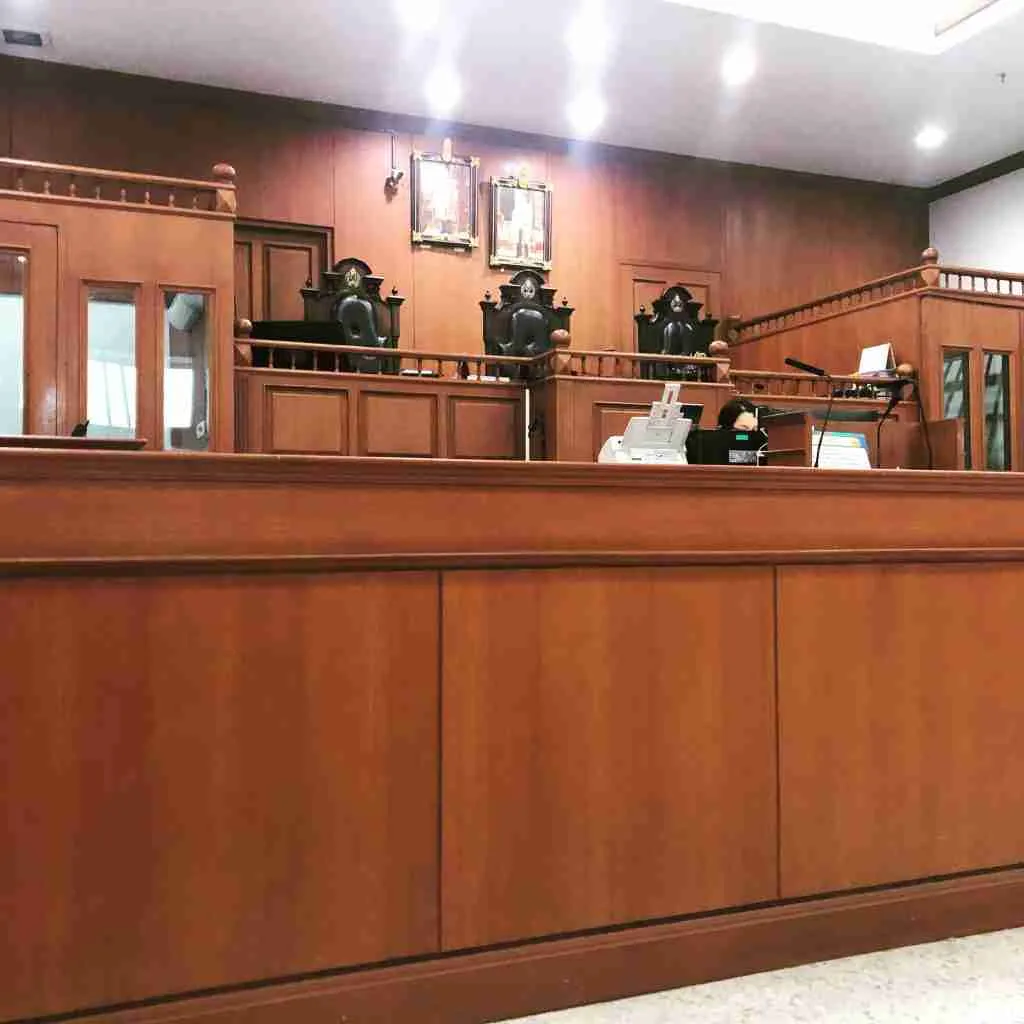
Exemple de tribunal thaïlandais.
Système codifié
En Thaïlande, le système juridique est fondé sur des lois écrites. Ces lois sont soigneusement consignées et facilement accessibles au public. La Constitution est le fondement de notre système juridique. Les lois et les décrets sont également importants mais viennent après elle. Cette structure hiérarchique garantit que toutes les dispositions juridiques sont en harmonie avec les principes fondamentaux consacrés par la Constitution. Le système juridique thaïlandais comporte trois niveaux principaux. Ce sont les Tribunal de première instance, le Cour d'appel, et le Cour suprême (also known as the Dika Court). Alongside them sit specialised courts, among them the Juvenile and Family Courts, the Labour Courts, the Tax Court, the Bankruptcy Court and the Intellectual Property and International Trade Court. Disputes with the state go to a separate system, the Administrative Courts, which are not part of the Courts of Justice.
La médiation et la conciliation sont privilégiées, Très important à savoir
Il est important de savoir que le système judiciaire thaïlandais privilégie la médiation et la conciliation, notamment dans les litiges civils. Les procédures judiciaires pouvant être longues, les modes alternatifs de règlement des différends sont souvent encouragés. Avant de saisir un tribunal en Thaïlande, sachez que les autorités s'efforceront de trouver un accord amiable. Elles privilégieront la médiation et aideront les deux parties à parvenir à un consensus, tout en préservant la dignité de chacune.
Les documents doivent être signés afin qu'un avocat thaïlandais puisse vous représenter.
Representation by a Thai lawyer in court requires signing a “lawyer’s appointment” document. You also need to provide copies of your identification. This formalizes the attorney-client relationship and authorizes the lawyer to act on the client’s behalf. Clients sign and date the appointment, a form of procuration, with the name of the lawyer left blank, and provide a copy of their passport. The signed appointment is what the law requires: under Section 61 of the Civil Procedure Code, the appointment of a lawyer must be in writing, signed by the client and by the lawyer, and filed with the court, and it is valid only for the case in which it is filed. Keeping the document blank lets the firm update or change the appointed attorney easily. This means no new signatures are needed if schedules or workloads change. For example, if another lawyer from our office needs to take over, it can be done smoothly. If the form is fully completed ahead of time, any changes would require new paperwork. This means clients would have to sign again, which can cause delays. This process is safe. Every attorney is registered with the Lawyers Council of Thailand. The power of attorney is only for legal representation. It cannot be used to withdraw funds from a bank account, conduct real estate transactions or serve any other purpose. By signing a blank power of attorney at the start, clients help us work better. This allows us to provide smooth service during their case.
Frais de justice
Frais de justice s'appliquent dans les affaires civiles en Thaïlande, et elles sont distinctes de ce que vous payez à votre avocat.
Lorsque vous poursuivez en justice pour une somme d'argent, les frais de dossier sont fixés par le tableau 1 annexé au Code de procédure civile : 2 pour cent du montant réclamé, plafonné à 200 000 bahts, pour une réclamation pouvant aller jusqu'à cinquante millions de bahts. Ainsi, une réclamation de 500 000 bahts coûte 10 000 bahts à déposer et une réclamation de 5 millions en coûte 100 000. Deux pour cent de 10 millions font exactement 200 000, donc à partir de 10 millions et plus, le plafond s'applique et chaque réclamation jusqu'à cinquante millions paie les mêmes 200 000. Le taux ne change pas à 10 millions ; le plafond prend simplement le relais. Au-delà de cinquante millions, l'excédent est taxé à 0,1 pour cent, donc une réclamation de 60 millions de bahts verse 200 000 sur les premiers cinquante millions et 10 000 sur les dix millions au-dessus. Une affaire qui demande quelque chose qui ne peut être évalué en argent, une déclaration ou une injonction par exemple, n'est pas du tout taxée en pourcentage : le tableau 1 la fixe à 200 bahts par affaire, et un appel contre une ordonnance en vertu de l'article 228(1), la disposition couvrant les ordonnances qui détiennent, condamnent à une amende ou emprisonnent quelqu'un en vertu du Code, ne comporte aucun frais de dépôt.
Trois points importent plus pour un plaideur étranger que le taux lui-même. La redevance est à nouveau exigible en cas d'appel. En vertu de l'article 150, l'appelant paie sur le montant encore en litige à ce niveau, qui est le même montant à nouveau, à moins que le jugement de première instance n'ait réduit l'enjeu. Une partie peut être remboursée. L'article 151 exige le remboursement de la totalité des frais lorsque le tribunal rejette purement et simplement la plainte, l'appel ou la requête Dika, et lui confère le pouvoir discrétionnaire de restituer tout ou partie de ces frais lorsque l'affaire fait l'objet d'un désistement ou se solde par un règlement. Une partie qui ne peut pas payer peut demander à être dispensée. Les articles 155 à 156/1 permettent de demander une dispense, que le tribunal n'accorde que s'il est crédible que le requérant n'a pas de biens suffisants pour payer les frais ou subirait par ailleurs un préjudice excessif et, lorsque le requérant est celui qui introduit la demande ou l'appel, qu'il a également des motifs raisonnables. Si le tribunal rejette cette demande ou ne l'accorde que partiellement, le requérant dispose de sept jours à compter de l'ordonnance pour interjeter appel, et la décision de la cour d'appel sur cet appel est définitive.
Une disposition surprend les demandeurs étrangers plus que toute autre. En vertu de Article 253, si vous êtes le demandeur et que vous n'avez ni domicile ni établissement en Thaïlande et aucun bien ici qui pourrait être saisi pour satisfaire à une ordonnance de condamnation aux dépens, le défendeur peut demander à tout moment avant le jugement qu'il vous soit ordonné de déposer de l'argent auprès du tribunal ou de fournir une caution pour garantir les frais de justice et les dépens du défendeur. Il en va de même si le tribunal est convaincu que vous vous soustrairiez au paiement de ceux-ci. Si vous ne vous conformez pas à l'ordonnance, le tribunal radie l'affaire du rôle, à moins que le défendeur ne demande qu'elle se poursuive. Prévoyez cette possibilité dans votre budget avant d'agir en justice.
Les frais de justice susmentionnés ne sont pas la seule somme que la partie perdante supporte. En vertu de Tableau 6, annexé au même Code, le tribunal condamne également la partie perdante à contribuer aux honoraires de l'avocat de la partie gagnante, et il en fixe lui-même le montant, en pesant la difficulté de l'affaire par rapport au temps et au travail que l'avocat a dû y consacrer. Le barème prévoit un plancher et un plafond et laisse tout le reste à l'appréciation du tribunal : jamais moins de 3 000 bahts pour une affaire, et jamais plus de 5 pour cent du montant en litige en première instance, ou 3 pour cent en appel ou devant la Cour suprême. Là où la réclamation ne peut être évaluée en argent, les deux plafonds sont remplacés par des montants fixes, 30 000 bahts ET 20 000 bahts. Sur une réclamation d'un million de bahts, le maximum en première instance est donc de 50 000 bahts. Il s'agit de limites, et non d'une grille tarifaire : ce que le tribunal octroie est une contribution aux frais payés par la partie gagnante, et non la facture qu'elle a reçue. Les tableaux 1 et 6 ont tous deux pris leur forme actuelle dans la loi portant modification du code de procédure civile (n° 24) de l'ère bouddhique 2551.
Deux types de réclamations ne comportent aucuns frais de dossier, et ce sont les deux qu'un résident étranger est le plus susceptible de porter. Une réclamation prud'homale est gratuite: l'article 27 de la loi portant création des tribunaux du travail et procédure en matière de travail de 2522 exempte de frais de justice le dépôt de la plainte et toutes les étapes de la procédure, sans condition. Une réclamation de consommateur est gratuite au départ mais pas de manière inconditionnelle: section 18 of the Consumer Case Procedure Act B.E. 2551 exempts a consumer, or a body suing on behalf of consumers, from all court fees, yet it does not reach final liability for costs, and it lets the court order the exempted fees to be paid after all where it finds the claim was brought without reasonable cause, the damages claimed were excessive, the consumer behaved improperly, the proceedings were being drawn out unnecessarily, or there is some other circumstance the court considers justifies it. If that order is not obeyed the case is struck off the list. The exemption is real, and it is not a licence to file anything.
Petites créances : une procédure, pas un tribunal distinct
La Thaïlande n'a pas de “ tribunal des petites créances ” distinct. Ce qu'elle a, c'est une procédure plus rapide procédure au sein des tribunaux civils ordinaires, que le Code de procédure civile appelle affaire mineure (Khadi manosare). Les articles 189 à 196 en exposent le fonctionnement, et le tribunal qui en connaît est la juridiction civile ordinaire qui aurait de toute façon eu l'affaire.
Qu'est-ce qui est considéré comme une affaire mineure. L'article 189 établit deux conditions d'accès, et dans les deux cas, le montant indiqué dans le Code a été relevé depuis. Une demande en paiement est admissible si elle ne dépasse pas 300 000 bahts. Une action en expulsion est admissible si le loyer ne dépasse pas 30 000 bahts par mois. Le Code lui-même indique toujours 40 000 bahts et 4 000 bahts par mois, mais chacun de ces chiffres est suivi des mots ou tout autre montant fixé par décret royal, et le décret royal fixant le montant d'argent dans les affaires mineures B.E. 2546 est le décret qui a fixé les plus élevés. La Cour suprême l'applique ainsi, de sorte que les chiffres applicables sont de 300 000 et 30 000.
Comment le montant est calculé. L'article 190 retient le montant réclamé par le demandeur et exclut tant les frais de justice eux-mêmes que les intérêts qui ne sont pas encore dus au moment du dépôt de la plainte. Les intérêts déjà courus au jour du dépôt constituent une question différente, car ils entrent en compte dans le total. Une demande de 300 000 bahts assortie d'intérêts courant à compter d'une date antérieure se situe donc au-dessus du seuil plutôt que pile au seuil, et c'est la même arithmétique qui détermine quelle juridiction est compétente pour connaître de l'affaire.
Ce que cela coûte, ce qui est le but de la procédure. L'article 190 quattuor fixe les frais de justice : vous payez selon le tableau 1 de manière habituelle, mais les frais de justice combinés sont plafonnés à 1 000 bahts. Sur une réclamation de 300 000 bahts, les 2 pour cent habituels s'élèveraient à 6 000 bahts, de sorte que le plafond permet d'économiser 5 000 bahts dès le départ. Il est bon de connaître deux limites à ce sujet. Il s'agit d'un plafond pour le tribunal de première instance, donc si vous faites appel ou allez jusqu'à la Cour suprême, les frais à ce niveau sont calculés sur le montant encore en litige à ce stade. Et cela ne s'applique pas à une affaire portée dans la procédure en vertu de l'article 196 ci-dessous, que l'article 196 exclut expressément.
Pourquoi la procédure vaut la peine d'être demandée. En vertu de l'article 191, vous pouvez introduire la réclamation oralement: vous le déclarez au tribunal et le tribunal le consigne par écrit et vous fait signer, au lieu de déposer une plainte rédigée. En vertu de l'article 193, le tribunal fixe une audience préliminaire et la citation à comparaître indique au défendeur de venir pour la conciliation, pour répondre et pour fournir des preuves le même jour, le tribunal s'efforçant d'abord de régler l'affaire. En vertu de l'article 194, le jugement lui-même peut être rendu oralement.
Elle peut s'appliquer à une affaire qui n'est pas mineure. L'article 196 permet qu'une action ordinaire en recouvrement d'une somme fixe fondée sur un effet de commerce impayé, ou sur un contrat écrit qui paraît authentique et exécutoire à première vue, soit jugée selon la procédure relative aux affaires mineures lorsque le tribunal estime l'affaire simple, que vous l'ayez demandé ou non. Si l'affaire cesse d'être simple, l'article 192 permet au tribunal de la renvoyer sur la voie ordinaire.
Combien de temps prend une affaire
Depuis 2023, les tribunaux publient leurs propres objectifs, et une partie peut exiger qu'ils respectent le chiffre publié. La loi sur la détermination des délais pour les opérations dans le processus judiciaire B.E. 2565 ne fixe pas de calendrier propre. Ce qu'elle fait, c'est exiger de chaque organe du système judiciaire qu'il fixe et publie un délai d'achèvement pour chaque étape de son travail, qu'il enregistre et explique tout retard, et qu'il exploite un système permettant à une partie de vérifier l'état d'avancement. Pour les Cours de justice, ces délais sont fixés par un règlement pris par le président de la Cour suprême, publié dans la Gazette royale le 23 janvier 2023 et entré en vigueur le lendemain.
En première instance. The regulation sorts cases into three classes. A special management case is one that is not complicated and can realistically be finished in a single hearing, and the class expressly includes petty cases, consumer cases, cases where the defendant does not answer, and uncontested applications such as an application to administer an estate. Those are to be decided within six months of the complaint being accepted. An ordinary case is one year, and so is a complex ordinary case, meaning one that cannot be heard straight through and has to be set down in blocks of two to four days. Any case in a Kwaeng court, which is the district court, is six months whether it is civil or criminal and whatever its type. And a criminal case in which any defendant is held in custody during the trial is six months from the date of the detention warrant.
En appel. La Cour d'appel dispose d'un délai d'un an à compter du jour où elle reçoit le dossier de la juridiction inférieure, et de six mois lorsque la seule question concerne la peine. Les cours d'appel régionales et spécialisées disposent d'un délai de quatre mois pour la catégorie d'appels la plus simple, de six mois pour la suivante et d'un an pour tout le reste. La Cour suprême dispose d'un délai d'un an à compter de la réception du dossier et de six mois pour statuer sur une demande d'autorisation de former un pourvoi devant elle. Cette autorisation constitue le filtre : en vertu de l'article 247, vous ne pouvez pas interjeter appel d'un arrêt de la Cour d'appel de plein droit, vous devez demander à la Cour suprême de l'autoriser, et la demande est introduite avec l'appel lui-même dans le mois suivant la lecture de l'arrêt de la Cour d'appel.
Demandes en cours de procédure. Une demande de mise en liberté sous caution doit être tranchée le jour où le tribunal la reçoit. Une demande de restitution d'argent est tranchée dans un délai de trois jours ouvrables et versée dans les sept jours. Les autres demandes sont de trois jours ouvrables en première instance et de trois mois dans les tribunaux d'appel.
Ce sont des objectifs, et non des garanties, et le règlement le stipule en termes exprès. Il permet de dépasser le délai lorsque le dossier doit être transféré, lorsqu'un projet de jugement est soumis à consultation ou à une formation plénière, lorsque les parties causent elles-mêmes le retard en recourant à la médiation ou en attendant l'issue d'une autre affaire, et lorsque le blocage provient de l'extérieur du tribunal, tel que la signification d'actes à l'étranger, la cartographie de terrains litigieux ou l'examen médico-légal de preuves. Ce que le règlement vous offre n'est pas une date limite, mais un droit à une réponse. Si votre affaire dépasse le délai, le motif doit figurer au dossier du tribunal, vous pouvez vous renseigner auprès du greffe à ce sujet, et ce greffe doit vérifier l'état d'avancement et vous faire part du résultat dans les quinze jours. Vous pouvez également suivre vous-même le dossier sur le système de suivi des tribunaux de justice à l'adresse cios.coj.go.th/tracking.
Code vestimentaire : ce qu'il faut savoir avant d'aller au tribunal en Thaïlande
Le decorum dans les tribunaux en Thaïlande est pris très au sérieux. Une tenue appropriée est très importante, ce qui signifie que vous devez éviter de porter des tongs, des shorts, des chemises sans manches ou des vêtements décontractés. Il est conseillé aux hommes de porter un pantalon long et une chemise à col, tandis que les femmes doivent s'habiller de manière modeste, en évitant les jupes courtes, les vêtements moulants ou les hauts sans manches. Ce code vestimentaire témoigne du respect envers le tribunal, qui représente Sa Majesté le Roi. Il exige un haut niveau de respect et de formalisme. Ce n'est pas toujours obligatoire, mais c'est également une bonne idée de respecter le code vestimentaire lors de la visite de bureaux gouvernementaux, tels que le service de l'Immigration ou le ministère du Travail. Les fonctionnaires de ces services peuvent interpréter une tenue respectueuse comme un signe de sérieux, de professionnalisme et de courtoisie. S'habiller de manière appropriée peut grandement influencer la fluidité des interactions et avoir souvent un impact positif sur l'issue de votre visite. Le comportement au sein du tribunal et des bureaux gouvernementaux doit également refléter le plus grand respect et la plus grande politesse. Les perturbations, le manque de formalisme ou les postures décontractées, telles que croiser les jambes en position assise, sont interdits dans les salles d'audience. De plus, afin de protéger la vie privée et de préserver la dignité, la photographie est strictement interdite dans l'enceinte des tribunaux. Le respect de ces directives démontre une conscience culturelle et du respect, vous aidant ainsi à éviter les malentendus ou d'éventuelles accusations d'outrage à magistrat.
Les étrangers ont besoin d'interprètes
Les étrangers sont confrontés à des complexités supplémentaires au sein du système juridique thaïlandais. La réglementation des visas, les lois sur la propriété immobilière et les réglementations commerciales présentent des subtilités qui exigent une grande prudence et souvent le recours à une expertise juridique locale.
Les étrangers ont également besoin d'interprètes devant les tribunaux.Parce que toutes les procédures se déroulent en thaï. Que faut-il savoir avant de se rendre au tribunal en Thaïlande ? Sachez que votre interprète peut faire toute la différence.
Contentieux civil en Thaïlande : à quoi ressemble la procédure
Si un litige ne peut être réglé, le contentieux civil est la voie à suivre. Les affaires civiles sont régies principalement par le Code civil et commercial, et ils couvrent les litiges et ruptures contractuels, les questions de propriété et de bailleurs-locataires, délit civil, comme les demandes pour préjudice corporel et diffamation, les affaires familiales, y compris le divorce, garde et les litiges successoraux, ainsi que le recouvrement de créances.
Les étapes, dans l'ordre
- Mise en demeure préalable. Une mise en demeure est généralement envoyée en premier, exposant le litige et l'action envisagée.
- Dépôt de la plainte. Si aucun accord n'est trouvé, une plainte est déposée auprès du tribunal exposant les demandes et les réparations recherchées.
- Réponse du défendeur. Le défendeur dispose d'un délai déterminé, généralement de 15 jours, pour répondre.
- Médiation. Les tribunaux thaïlandais encouragent activement la médiation avant le procès. Il ne s'agit pas d'une simple formalité : voir la section ci-dessus sur les raisons pour lesquelles cela importe.
- Procès. Si la médiation échoue, les deux parties présentent des preuves et des arguments devant un juge. Il n'y a pas de jury.
- Jugement. Le tribunal peut accorder des dommages-intérêts ou ordonner à une partie de faire ou de s'abstenir de faire quelque chose.
- Appel. Chaque partie peut interjeter appel devant une juridiction supérieure.
Trois éléments qui décident des affaires rapidement
Prescription. La loi thaïlandaise fixe des délais de prescription pour intenter une action en justice. Manquez ce délai et la réclamation est perdue quel que soit son bien-fondé, de sorte que la première question dans tout litige est de savoir de combien de temps vous disposez.
Juridiction. Le tribunal compétent dépend du lieu où les faits se sont produits, du domicile du défendeur, de la nature et de la valeur de la demande, et du fait que vous attaquiez en justice une personne, une entreprise ou un organisme d'État. Saisir le mauvais tribunal fait perdre un temps précieux dont vous ne disposez peut-être pas.
Langue. Les procédures se déroulent en thaï. Les documents dans d'autres langues doivent faire l'objet d'une traduction certifiée et une partie étrangère a besoin d'un interprète.
La valeur d'un avocat ici se concentre au début : évaluer si l'action en justice en vaut la peine, respecter le délai de prescription et choisir la bonne juridiction, rédiger correctement les actes de procédure et négocier lors de la médiation avant que les frais n'augmentent. Si vous avez besoin d'être représenté dans un litige civil, Contactez-nous.
Actualités juridiques thaïlandaises, gratuites par courriel
Des informations claires et concises sur les changements législatifs thaïlandais concernant les étrangers : propriété, visas, mariage, affaires et testaments. Un court courriel par mois, envoyé par un cabinet d’avocats établi depuis 2006. Zéro spam, désabonnement possible à tout moment.