


Révisé par ThaiLawOnline, un cabinet d'avocats thaïlandais agréé exerçant en Thaïlande depuis 2006. Avocate thaïlandaise en charge du dossier : Wichuda Atthamethakon, LL.M., licence du barreau thaïlandais 3149/2556.
Dernière mise à jour :
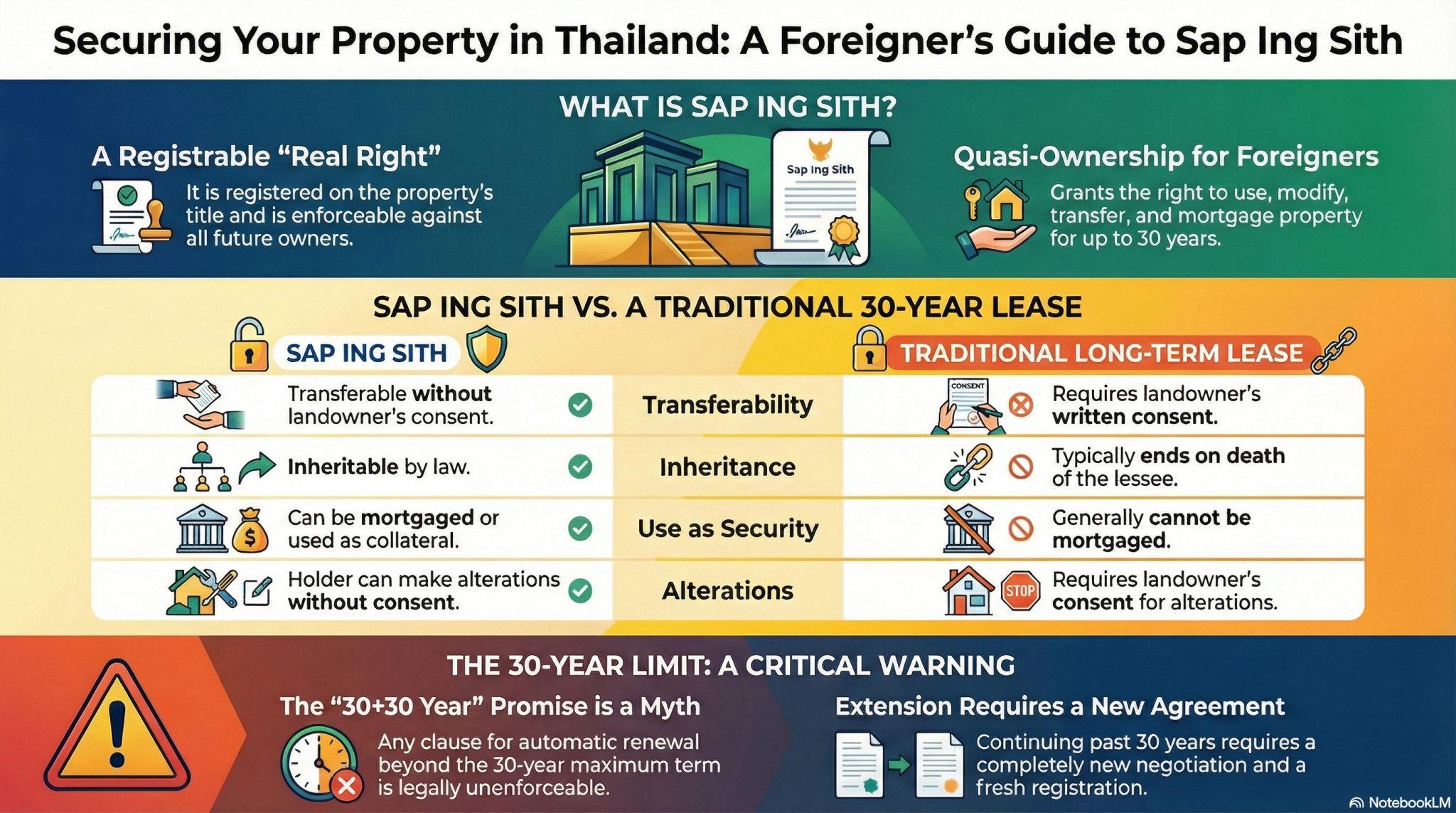
Sap-Ing-Sith, Introduite par la législation thaïlandaise de 2019, cette nouvelle forme de propriété représente une véritable avancée. Elle a été conçue pour combler le fossé entre les structures de propriété traditionnelles et les besoins d’investissement modernes. Elle offre aux étrangers des droits d’utilisation des biens immobiliers renforcés tout en remédant aux restrictions persistantes sur la propriété foncière étrangère en Thaïlande. Le potentiel du système Sap-Ing-Sith en Thaïlande attire l’attention. De nombreux investisseurs commencent à adopter cette forme de propriété. Les investisseurs s’intéressent de plus en plus au système Sap-Ing-Sith en Thaïlande en tant qu’alternative viable à la propriété foncière traditionnelle.
L'article suivant est coécrit par M. Sébastien H. Brousseau (LL.B., B.Sc.) ET Khun Wichuda Atthamethakon (LL.M.). ThaiLawOnline est l'un des rares cabinets d'avocats à avoir enregistré plus de quinze Sap-Ing-Sith en Thaïlande.
Table des matières
Qu'est-ce que le Sap-Ing-Sith en Thaïlande ?
Au fond, le Sap-Ing-Sith est un nouveau droit de propriété que certains appellent “ droit transférable ”. Il confère au titulaire un droit d’utilisation de la terre en Thaïlande, mais pas de propriété sur celle-ci : l’article 3 de la loi le définit comme un droit d’utilisation d’un bien immobilier. L’enregistrement produit un certificat séparé de Sap-Ing-Sith avec un garuda bleu (article 5). Le titulaire des droits Sap-Ing-Sith agit comme le propriétaire de la propriété. Ce droit s’applique à des terrains valides. Chanote. Cela s’applique également aux bâtiments situés sur des terrains possédant ce titre de propriété.
De plus, les unités de copropriété telles que définies dans la Loi sur les copropriétés Ces droits peuvent également relever de cette catégorie de propriété. Les Sap-Ing-Sith peuvent être enregistrés pour une durée maximale de 30 ans. La loi ne prévoit pas de mécanisme de renouvellement, de sorte que toute prolongation au-delà de cette période nécessite une nouvelle convention avec le propriétaire et une nouvelle inscription. Voir la section intitulée « Renouvellement » ci-dessous. Il est important d’avoir l’accord écrit, et chaque acte juridique concernant un Sap-Ing-Sith doit être rédigé par écrit et enregistré auprès de l’autorité compétente (article 12). Deux limites font obstacle à cette pratique. Selon l’article 4, un Sap-Ing-Sith ne peut être créé sur une partie seulement du terrain ou de l’unité dans un titre de propriété.: cela couvre tout le titre ou rien du tout. Et Lorsque la propriété est déjà hypothéquée, utilisée comme garantie commerciale ou porte tout autre droit enregistré, ce droit ne peut être créé que moyennant le consentement écrit du prêteur hypothécaire, du titulaire de la sûreté ou du titulaire de ce droit.
Contexte historique
de la Thaïlande Code foncier La loi interdit généralement aux étrangers d’acquérir des terres. L’Assemblée législative nationale thaïlandaise a adopté la loi Sap-Ing-Sith le 8 février 2019. Cette loi vise à moderniser le marché immobilier et à attirer des investissements étrangers. La loi a été publiée dans le Royal Gazette le 30 avril 2019 (volume 136, partie 56 Kor, page 97). Le 26 avril 2019 est la date d’approbation royale, et non de publication ; cette différence importe : L’article 2 met l’actuel en vigueur uniquement après l’expiration de 180 jours à compter de sa publication., Cela a donc pris effet fin octobre 2019. Il est devenu une option importante pour les investisseurs étrangers. Cette loi offre un choix plus simple que la méthode traditionnelle. bail des accords et d’autres structures juridiques complexes.
Avantages du Sap-Ing-Sith pour les étrangers
- Meilleur contrôle : Vous pouvez utiliser ces droits comme garantie. Vous pouvez modifier librement la propriété. Vous pouvez également transférer ou hériter facilement de ces droits.
- Sécurité financière : Il offre une protection juridique supérieure aux contrats de location classiques, ce qui le rend adapté aux opérations commerciales ou à un usage commercial.
- Avantages pratiques : vous pouvez obtenir un terme allant jusqu'à 30 ans. Sa poursuite au-delà dépend d'une nouvelle convention avec le propriétaire, et non d'un renouvellement automatique. Vous recevrez des documents officiels clairs, notamment le certificat bleu Garuda. Ce certificat est juridiquement contraignant pour les nouveaux propriétaires.
- Le droit survit à une vente : le propriétaire peut vendre ou transférer la propriété de ce bien à tout moment et n’a pas besoin de votre consentement (article 9, paragraphe 2 de la loi Sap-Ing-Sith), mais le Sap-Ing-Sith enregistré reste inscrit sur le titre de propriété et le nouveau propriétaire prend la propriété sous sa dépendance. Ce que le propriétaire ne peut pas faire est créer un autre droit réel sur le bien, comme un usufruit., servitude ou droit de superficie, Sans votre consentement écrit (article 9, paragraphe 1). Le propriétaire n’a aucun pouvoir d’annuler le droit à l’avance, sauf si le propriétaire est également son titulaire, et même alors pas là où cela nuirait à un tiers qui l’a acquis pour un prix, bonne foi, et enregistré de bonne foi (article 14).
- Les Sap-Ing-Sith sont transmissibles aux héritiers. Cependant, le tribunal doit nommer un succession administrateur. Cette étape est nécessaire avant que le droit ne puisse être transféré à un héritier lors de la succession. Bureau foncier.
Considérations pratiques pour les expatriés
Pour les expatriés en Thaïlande, Sap Ing Sith offre une alternative plus flexible et légalement solide aux arrangements de location classique. Elle permet un contrôle plus grand sur les modifications immobilières, une plus grande transférabilité et la possibilité d’utiliser le bien comme garantie financière. Cependant, les acheteurs devraient savoir que ce droit d’utilisation enregistré est limité à 30 ans. Il ne s’agit pas d’un usufruit et ne constitue pas une propriété permanente. Ils devraient prévoir la fin de ce délai.
Limites et considérations
- Restrictions légales : Pas de propriété effective du terrain lui-même, durée limitée sans renouvellement automatique garanti et enregistrement obligatoire pour la validité.
- Défis pratiques : Des coûts associés plus élevés, une complexité nécessitant une assistance juridique professionnelle et la dépendance à l'égard de la coopération du propriétaire foncier thaïlandais initial.
- Préoccupations du marché : Certains services fonciers ne sont pas encore bien informés de cette mesure, car elle a été introduite en 2019. Cela entraîne une diminution du nombre d’exemples et d’éventuelles incertitudes juridiques.
Études de cas réels de Sap-Ing-Sith en Thaïlande réalisées par ThaiLawOnline
Étude de cas 1 : Investissement dans des villas à Koh Phangan (2024)
Nous avons enregistré avec succès un Sap-Ing-Sith pour un couple étranger. Ils investissent environ 10 millions de THB dans une villa à Koh Phangan. Initialement, le service foncier local ne maîtrisait pas cette procédure, ce qui a entraîné des retards importants. Lors de notre premier déplacement de deux jours, nous avons rencontré plusieurs difficultés. Les fonctionnaires ont indiqué que leurs systèmes informatiques ne permettaient pas de délivrer le titre de propriété.
Ce n'est qu'après confirmation auprès des autorités de Bangkok et transmission de leurs instructions que les responsables locaux ont finalement coopéré. Cette situation imprévue a retardé le projet d'environ deux mois. Un autre problème lié à la servitude est survenu. Cependant, nous avons finalisé l'enregistrement sans frais supplémentaires pour nos clients. Cette expérience nous a permis de tirer de précieux enseignements et nous a incités à adapter nos tarifs pour les cas similaires à venir. La première photo, avec le garuda bleu, illustre ce cas.
Étude de cas 2 : Villa de luxe pour avocats américains dans le sud de la Thaïlande (2024)
Nos clients, des avocats expérimentés originaires des États-Unis, ont acheté une villa de luxe dans le sud de la Thaïlande. Ils ont opté pour un bail Sap-Ing-Sith au lieu d’un bail standard. Cette option offre une meilleure protection juridique et leur permet de grever leurs droits immobiliers. L’investissement total s’élevait à environ 6 millions de bahts, plus 150 000 bahts pour les frais juridiques, y compris les frais gouvernementaux. Nos clients auraient pu dire : “ En tant qu’avocats, nous avons constaté que le bail Sap-Ing-Sith offrait une protection bien meilleure que le bail standard. Le paiement d’un peu plus n’avait certainement pas été inutile pour bénéficier d’une sécurité supplémentaire. ”
Étude de cas 3 : Terrain vacant à Chiang Mai (2025)
Nous avions déjà effectué les enregistrements Sap-Ing-Sith 4 ou 5 fois à Chiang Mai. Cela nous a donné confiance en ce processus. Un avocat local nous avait dit que cela ne pouvait pas se faire, mais nous étions certains de pouvoir y arriver. Cette fois, l’enregistrement a été effectué rapidement en deux jours et en un seul déplacement. C’était la première fois que le service foncier local s’occupait d’un cas de ce genre.
Il est important de savoir que le Département foncier de Hang Dong à Chiang Mai est très strict. S’enregistrer auprès de Sap-Ing-Sith pourrait s’avérer impossible. Dans ce cas, nous avons obtenu un Sap-Ing-Sith entièrement opérationnel avec des accords en place. Cela pourrait prolonger les droits pendant encore 30 ans, mais nous ne pouvons pas garantir ces prolongations. La photo d’enregistrement ci-dessous, juin 2025, en est un exemple.
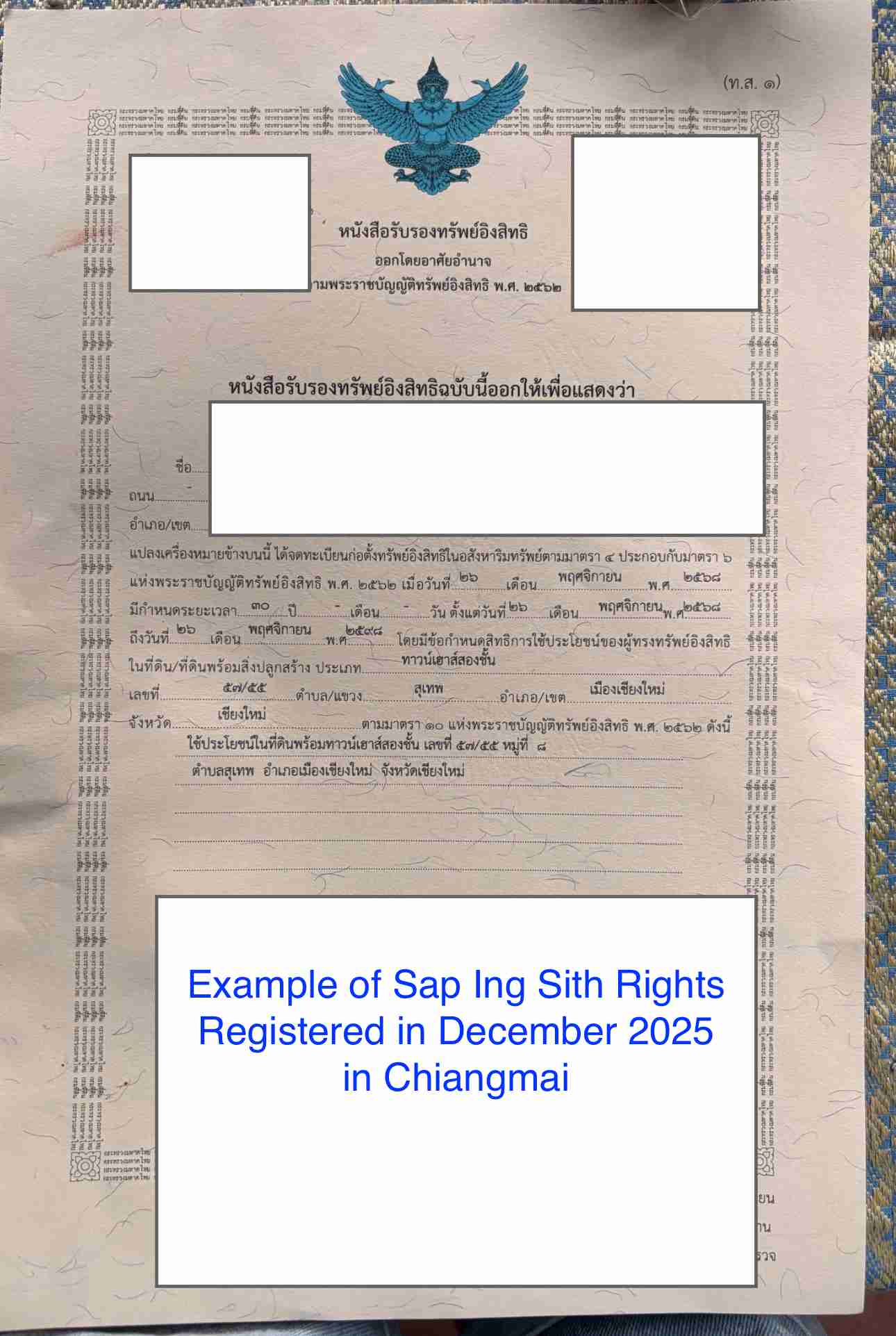
Enregistrement des droits Sap-Ing-Sith à Chiangmai en novembre/décembre 2025.
La procédure a duré environ 10 jours. Le nom de l'étranger figure au verso du titre de propriété.
Le Sap-Ing-Sith en Thaïlande est-il un droit personnel ou un droit réel ?
La classification juridique de Sap-Ing-Sith reste un sujet de débat important parmi les universitaires thaïlandais en droit. Les législateurs souhaitaient créer un “ droit personnel spécial ” qui ne serait pas comme les autres droits. Cependant, de nombreux experts affirment que celui-ci présente des caractéristiques clés d’un droit réel. C’est parce qu’il implique le contrôle sur des biens, affecte des tiers, nécessite une inscription et peut être transféré. Cette controverse sur la classification a des implications pratiques. Si ces droits sont considérés comme des droits personnels, ils ne peuvent pas être transférés automatiquement lorsque le propriétaire change. Ils pourraient offrir une protection limitée contre des acheteurs ultérieurs. Si ces droits sont classés comme des droits réels, ils offriraient une protection plus solide aux tiers et une meilleure valeur commerciale.
Il s'agit peut-être d'une question technique pour les juristes. Cependant, elle peut avoir des conséquences concrètes. Les rédacteurs (notamment ceux du Bureau de la politique fiscale) n'ont pas cherché à créer un nouveau type de droit réel. Ils ont clairement défini le Sap-Ing-Sith comme un droit personnel particulier. Ce choix visait à éviter les problèmes juridiques liés à l'ajout de nouveaux droits réels au droit civil thaïlandais. Article 1298 du Code civil et commercial, un droit réel doit être établi par une loi. Le Code permet à une autre loi de créer un droit réel, et la loi Sap-Ing-Sith ne précise jamais quel type de droit il crée, de sorte que cette question est encore à discuter plutôt qu’à trancher.
Bien que la propriété puisse être transmise, héritée et hypothéquée, la loi en limite certains pouvoirs. Les droits d'exclusion sont prévus par la loi et figurent à l'article 11 de la loi Sap-Ing-Sith. Ces droits appartiennent au propriétaire du bien immobilier et non au détenteur, ce qui confirme leur nature de droits personnels. Les droits réels sont opposables à tous. Cependant, la loi Sap-Ing-Sith ne fonctionne pas toujours de cette manière, notamment lorsque la qualité pour agir se limite à la notification au propriétaire.
Dans une thèse de Natthaphong Wongto a présenté son mémoire à l'université de Thamasat en 2021.. L'auteur soulève des doutes quant à la manière dont les effets pratiques brouillent la frontière entre droits personnels et droits réels, notamment aux alentours des pages 81 à 85 :
Sap-Ing-Sith fonctionne davantage comme un véritable droit dans la pratique, parce que:
- Elle confère un contrôle sur les biens immobiliers similaire à celui de la propriété.
- Il permet l'héritage, l'hypothèque et le transfert.
- Il est enregistré au bureau du cadastre.
- Cela limite les droits du propriétaire sans son consentement.
Bien que les rédacteurs aient voulu conférer un droit personnel, nous estimons que celui-ci ressemble davantage à un droit réel. Sa structure et ses effets juridiques confirment cette opinion. Cela crée des confusion et des incertitudes juridiques dans la pratique.
Les règles fixées par la loi Sap-Ing-Sith s’appliquent aux terrains possédant des titres de propriété valides. Elles s’appliquent également aux bâtiments situés sur ces terrains ainsi qu’aux unités immobilières telles que définies par la loi sur les condominiums. Seuls les propriétaires peuvent créer ces droits pour autrui. Ils doivent s’enregistrer auprès du bureau foncier local. Le bureau délivrera alors un certificat attestant cette transaction. Il importe de noter que les terrains soumis à une inscription Sap-Ing-Sith ne peuvent pas être divisés ou regroupés, le maintien de l’intégrité des limites originelles des biens. Veuillez noter que l’inscription produit un certificat Sap-Ing-Sith distinct avec un Garuda bleu, délivré en deux exemplaires, l’un pour le propriétaire et l’autre conservé au bureau foncier (article 5).

La loi Sap-Ing-Sith en Thaïlande a un impact considérable. Elle ouvre la voie à davantage d'investissements étrangers dans l'immobilier.
Comprendre les avantages du Sap-Ing-Sith en Thaïlande est essentiel pour les investisseurs potentiels. Ce système offre une nouvelle approche de la gestion des droits de propriété et crée un cadre juridique permettant aux étrangers d'investir dans l'immobilier thaïlandais.
Contexte historique en Thaïlande
Le La loi Sap-Ing-Sith a été introduite le 8 février 2019.. Il répondait aux limites fixées par le Code foncier thaïlandais. Ce code n’autorise généralement pas aux étrangers de posséder des terres en Thaïlande. L’Assemblée législative nationale thaïlandaise a créé cette loi afin d’attirer l’investissement étranger dans le secteur immobilier. Elle est entrée en vigueur le 27 octobre 2019. Cette modification de la loi témoigne d’une nouvelle attitude envers l’investissement étranger sur le marché immobilier thaïlandais. Elle souligne une tendance à davantage d’ouverture. De telles réformes sont essentielles pour renforcer l’attractivité de la Thaïlande en tant que destination pour les expatriés et les investisseurs étrangers.
L'utilisation du Sap-Ing-Sith en Thaïlande permet aux investisseurs étrangers de bénéficier d'un avantage concurrentiel sur le marché immobilier. Grâce à ce système, les étrangers peuvent désormais acquérir des biens immobiliers sans être soumis aux restrictions des lois traditionnelles sur la propriété.
Cadre juridique entourant le Sap-Ing-Sith
Les lois relatives aux Sap-Ing-Sith se trouvent principalement dans la loi Sap-Ing-Sith. Le Code civil et commercial intervient ici pour une seule raison : Article 1298 Il stipule que les droits réels ne peuvent être créés que par le biais du Code ou d’une autre loi, et la Loi Sap-Ing-Sith est la seule autre loi en jeu, bien qu’elle ne désigne jamais ce droit comme un droit réel (voir la question relative à la classification ci-dessus). Les articles 1383 à 1387 du Code sont parfois cités en lien avec la Loi Sap-Ing-Sith et n’ont rien à voir avec elle : les articles 1383 à 1386 régissent la prescription acquise et l’article 1387 ouvre le droit des servitudes. Cette structure juridique explique les droits des titulaires de la Loi Sap-Ing-Sith. Elle garantit qu’ils peuvent utiliser efficacement leurs biens. L’acte décrit les étapes et les règles de l’enregistrement et du transfert. Il fournit un guide clair aux étrangers qui souhaitent acheter un bien immobilier en Thaïlande.
Comparés aux droits de propriété traditionnels, les Certificat Sap-Ing-Sith Il présente plusieurs avantages distincts. Le Sap-Ing-Sith se distingue d’un bail classique. Un bail classique limite généralement les modifications de la propriété. Cependant, le Sap-Ing-Sith permet au propriétaire de procéder à des modifications sans avoir besoin de l’autorisation du propriétaire. Il permet également de transférer les droits à une autre partie. Cela vous offre davantage de flexibilité que les contrats de bail classiques. Ce nouveau droit de propriété peut également servir de garantie pour un prêt hypothécaire. Cela le rend plus attrayant pour les investisseurs étrangers qui souhaitent investir dans l’immobilier en Thaïlande. Nous avons écrit un article à propos des différences entre le Sap-Ing-Sith, le bail et l'usufruit en Thaïlande.
Droits et obligations des détenteurs de Sap-Ing-Sith
Droits et devoirs du détenteur du Sap-Ing-Sith :
Le titulaire du Sap-Ing-Sith peut utiliser librement la propriété. Il doit se conformer à l'usage indiqué sur le certificat du Bureau du cadastre. Il peut également céder ou vendre librement ses droits à un tiers sans l'accord du propriétaire. Ces droits peuvent servir de garantie pour un prêt hypothécaire. Autre avantage important : la transmission successorale, conformément aux lois sur la succession. Le titulaire peut également effectuer des modifications ou des rénovations sur la propriété sans le consentement du propriétaire foncier.
Lorsque le droit expire, le titulaire doit restituer la propriété dans l’état dans lequel elle se trouve à ce moment-là, sauf si le propriétaire et le titulaire conviennent autrement (article 15), et les bâtiments que le titulaire a aménagés, agrandis ou construits passent au propriétaire à moins qu’ils ne conviennent autrement (article 11, paragraphe 2 ; cela ne s’applique pas à un bien en copropriété). Le titulaire assume la pleine responsabilité de la propriété, tout comme un propriétaire réel. Cela ne comprend pas son recouvrement auprès de tiers non autorisés ni sa protection contre des interventions illégales.
Droits et devoirs du propriétaire :
Le paragraphe 2 de l’article 9 de la loi Sap-Ing-Sith est explicite à cet égard : la restriction prévue au paragraphe 1 n’affecte pas le droit du propriétaire de céder la propriété à une autre personne ou d’utiliser le bien en garantie d’une dette par hypothèque ou en vertu de la loi sur les garanties commerciales. Ainsi, le propriétaire foncier peut vendre, céder ou hypothéquer sans le consentement du détenteur de la Sap-Ing-Sith. Cela ne constitue pas une entrave à votre protection, car la Sap-Ing-Sith est inscrite sur le titre de propriété et s’étend avec le bien : un acheteur prend possession de la propriété sous votre droit pendant toute la durée de ce dernier. Dans le cas où un client souhaite disposer de plus que ce que prévoit la loi, nous restreignons la liberté de vendre ou de céder la propriété par contrat, dans un addendum soumis au registre foncier.
Limitations de propriété du propriétaire foncier
Une fois un Sap-Ing-Sith enregistré, le propriétaire ne peut créer aucun autre droit réel sur le bien, tel qu’un usufruit, une servitude ou une superficies, à moins que le titulaire du Sap-Ing-Sith n’accorde son consentement écrit (article 9, paragraphe 1). La vente et la hypothèque restent ouvertes au propriétaire en vertu de l’article 9, paragraphe 2. Le propriétaire ne peut pas résilier le droit avant l’expiration de la période de validité, sauf si le propriétaire est également le titulaire, et même alors pas si cela porte préjudice à une tierce personne qui a acquis le droit pour un prix, en toute bonne foi, et l’a enregistré en toute bonne foi (article 14). Et pendant toute la durée de validité du droit, le bien ne peut pas être divisé en plusieurs parcelles ou fusionné avec un autre bien (article 8).
Réalités procédurales de l'héritage et de la défense juridique
Bien que le Sap-Ing-Sith en Thaïlande soit un droit héréditaire, son transfert à un héritier auprès du Bureau du cadastre n'est pas automatique. La procédure requiert la désignation d'un administrateur de succession. Ceci nécessite généralement une décision de justice thaïlandaise pour nommer un gestionnaire. Concernant la protection juridique du bien, le détenteur dispose de droits similaires à ceux d'un propriétaire. Le propriétaire initial conserve le droit de récupérer son bien si celui-ci est occupé illégalement. Il a également le droit de faire cesser toute atteinte à ce droit. Le détenteur est légalement tenu d'informer immédiatement le propriétaire de toute atteinte à ce droit.
En quoi le Sap-Ing-Sith en Thaïlande se compare-t-il aux contrats d'usufruit et de bail ?
Principales différences avec les autres droits de propriété
Dans le cas de la propriété usufructuaire en Thaïlande, une personne peut utiliser et profiter d’un bien qui appartient à une autre personne. Cela est similaire à la notion de Sap-Ing-Sith. Cependant, la différence essentielle réside dans les droits conférés. La propriété usufructuaire donne le droit d’utiliser un bien pendant toute la vie ou pendant un certain temps. Toutefois, le propriétaire ne peut pas l’utiliser comme garantie pour une hypothèque. La notion de Sap-Ing-Sith en Thaïlande offre des avantages financiers supplémentaires. Cela en fait un choix plus avantageux pour les étrangers qui souhaitent améliorer leurs droits immobiliers et leurs plans financiers. Le reste du terme de Sap-Ing-Sith peut également être vendu par le propriétaire.
| Caractéristique | Sap-Ing-Sith | Usufruit |
|---|---|---|
| Droits de propriété | Pas de propriété ; un droit d’utilisation enregistré et transférable, dont la classification comme un droit réel fait l’objet de débats | Aucune propriété, utilisation et avantage seulement |
| Transférabilité | Le droit lui-même peut être vendu, hypothéqué et hérité (article 12 de la loi). | Le droit lui-même ne peut être vendu et il expire lorsque l’usufruitier décède (CIC, article 1418), mais à moins que le document ne précise autrement, l’usufruitier peut transférer le droit. exercice du droit à une tierce personne (article 1422 du Code de droit canonique) |
| Inscription | Doit être enregistré au bureau foncier | Doit être enregistré au bureau foncier |
| Durée | Durée déterminée, maximum 30 ans, sans option de résiliation et sans renouvellement statutaire (article 4 de la loi) | Pour la durée de la jouissance par l’usufruitier, ou pour une durée déterminée allant jusqu’à 30 ans (article 1418 du Code civil, lu conjointement avec l’article 1403, paragraphe 3) |
| Sécurité | Une protection juridique renforcée | Moins sécurisé, mais sûr si enregistré. |
| Cas d'utilisation typique | Baux à long terme, protection des investissements | droits d'usage familial ou personnel |
L'analyse comparative du bail emphytéotique et du contrat Sap-Ing-Sith révèle des avantages et des inconvénients distincts. Les baux emphytéotiques sont souvent limités à des durées plus courtes et peuvent ne pas offrir la flexibilité nécessaire à une planification à long terme. Les locataires disposent de certains droits dans le cadre d'un bail emphytéotique standard. Ils peuvent notamment faire cesser toute utilisation illégale du bien.
Cependant, ils ne peuvent pas apporter de modifications ou d'améliorations majeures. En revanche, le Sap-Ing-Sith confère des droits plus étendus, similaires à ceux d'un propriétaire foncier. Ces droits incluent le droit d'effectuer des modifications et d'utiliser le terrain pour des prêts. Toutefois, en Thaïlande, le Sap-Ing-Sith peut impliquer des procédures juridiques et des exigences d'enregistrement plus complexes. La clé réside dans la rédaction des contrats. Il est important de faire appel à un cabinet d'avocats : cela vous offre davantage de droits et de flexibilité.
L'acquisition du Sap-Ing-Sith implique une procédure d'enregistrement en deux étapes auprès du Département du cadastre. Dans un premier temps, le propriétaire doit officiellement enregistrer le Sap-Ing-Sith pour le bien concerné. Ensuite, le transfert des droits à l'autre partie doit être enregistré afin de formaliser légalement la transaction. Si le terrain est grevé d'une hypothèque, l'autorisation du créancier hypothécaire est requise. Cette autorisation est indispensable pour finaliser la procédure d'enregistrement et se conformer à la loi sur le Sap-Ing-Sith.
Frais d'inscription obligatoires et frais de transaction
L'établissement d'un Sap-Ing-Sith implique le paiement de frais fixes et de droits calculés en pourcentage, à verser au Département du cadastre. Les frais d'inscription initiaux s'élèvent à 20 000 THB par demande. Le certificat officiel de Sap-Ing-Sith coûte 10 000 THB par exemplaire.
Si le titulaire souhaite utiliser ce droit en garantie, il devra payer une taxe d’inscription hypothécaire. Cette taxe représente 1% du montant de la hypothèque. Transfert des frais de transfert 2% du montant déclaré lorsque le transfert a pour objet une contrepartie, ou 1 000 bahts par transaction lorsque ce n’est pas le cas, ce qui inclut le transfert par héritage. Le transfert des frais de transfert est de 20 000 bahts. Ces tarifs sont fixés par le règlement ministériel prescrivant les frais et dépenses liés à Sap-Ing-Sith B.E. 2563, adopté en vertu des articles 16 et 17 de la loi (Journal officiel du royaume 137, partie 96 Kor, page 18, 18 novembre 2020), et ils sont les mêmes que les tarifs maximum figurant dans l’annexe de la loi elle-même. Ni la loi ni le règlement ne prévoient de frais périodiques ou annuels pour le titulaire. Le paragraphe 3 de l’article 16 stipule que les frais collectés, après que le Département des Terres a retenu 5%, deviennent des recettes de la municipalité, de l’organisation administrative du sous-district, de Bangkok, de Pattaya City ou d’une autre autorité locale pour la zone, mais ne précise pas où ces frais ponctuels doivent être versés et n’est pas une charge à supporter par le titulaire. La taxation annuelle des biens immobiliers relève d’une autre réglementation prévue par la loi sur la taxe foncière et immobilière et n’est pas une taxe Sap-Ing-Sith.
Clause de renouvellement du Sap-Ing-Sith en Thaïlande
Le plafond de 30 ans et le “ mythe de la renouvelabilité ”
Les investisseurs doivent faire la distinction entre les promesses contractuelles et les droits réels enregistrés. En vertu de la loi Sap-Ing-Sith, La durée maximale est un plafond légal absolu de 30 ans.. Le Code ne contient aucune disposition relative à la renouvellement automatique ou à l’extension des contrats. La décision du Tribunal suprême 4655/2566 montre comment les tribunaux traitent une tentative de franchir la limite légale de 30 ans : une promesse de renouvellement, faite au départ pour contourner cette limite, est nulle et non avenue, et la Cour refuse de la considérer comme une obligation personnelle entre les parties.
Sur cette base, une telle clause ne devrait pas être invoquée contre un propriétaire ultérieur ou contre le propriétaire initial. Toute prolongation après la période initiale nécessite une nouvelle convention. Vous devez également vous enregistrer à nouveau auprès du bureau foncier lorsque la période initiale prend fin. Contrairement au bail, la loi Sap-Ing-Sith, B.E. 2562 (2019) ne prévoit pas de renouvellement. Cela signifie que pour continuer le droit après les 30 premières années, il faut un nouvel accord avec le propriétaire foncier.
La décision de la Cour suprême 4655/2566 est une affaire de bail décidée en vertu de l’article 540 du Code civil et commercial, et son raisonnement est ici appliqué à Sap-Ing-Sith par analogie. Le propriétaire foncier et le locataire ont signé un bail de 30 ans et, le même jour, le propriétaire foncier a promis de le renouveler à nouveau pour une durée de 30 ans chacun, avec le loyer pour les neufantièmes années payé en avance selon les conditions initiales. La Cour a considéré que cela montrait une intention claire de contourner la limite de 30 ans, de sorte que les promesses de renouvellement étaient nulles et non avenues, et elle a refusé de les considérer comme un droit personnel applicable entre les deux parties, car cela violerait l’article 540. Lorsque les 30 premières années se sont terminées, le locataire a été expulsé et a été condamné à payer des dommages-intérêts pour son séjour. À notre avis, une clause de renouvellement incluse dans un accord Sap-Ing-Sith dès le départ aurait très probablement abouti à un résultat similaire, et elle ne devrait pas être invoquée.
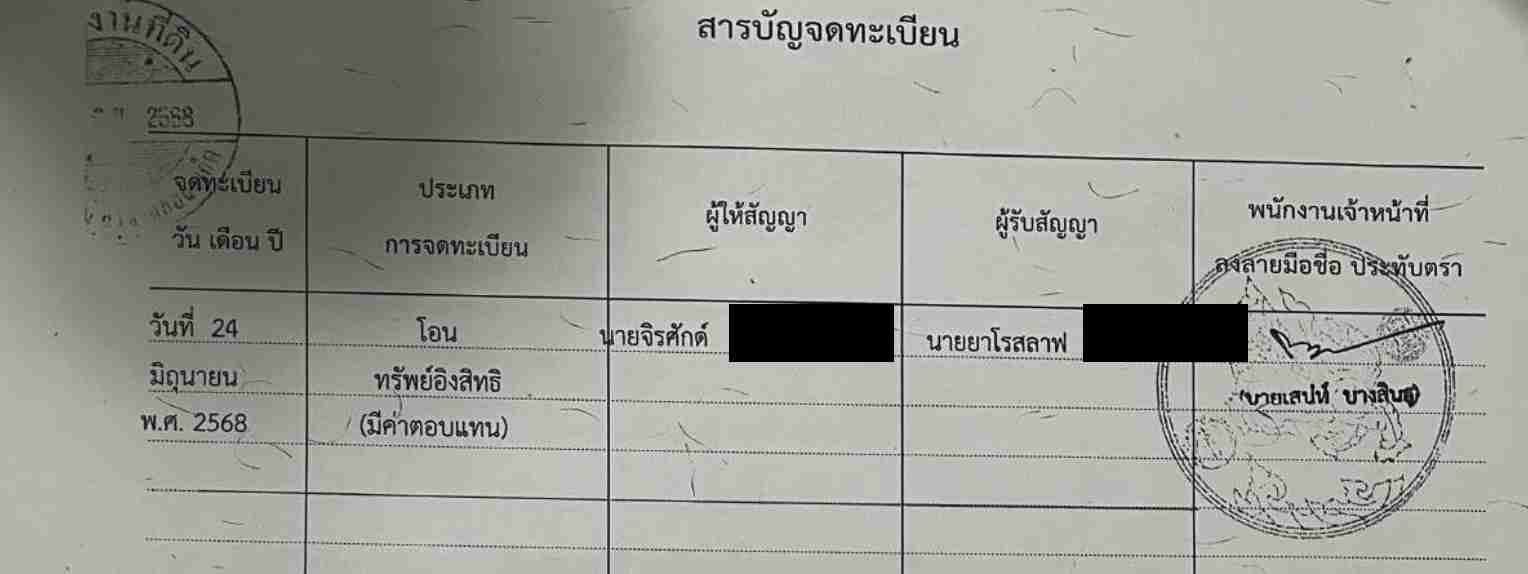
Voici un exemple d'enregistrement Sap-Ing-Sith effectué en juin 2025 par ThaiLawOnline.
Les contrats sont très importants lorsqu'il s'agit de baux, d'usufruits, de superficies ou de Sap-Ing-Sith en Thaïlande.
Stratégie pratique :
Ils ne créent pas de droit réel affectant les autres. Cependant, ils peuvent néanmoins constituer des obligations contractuelles entre les parties initiales. Une stratégie consiste à ajouter un “ clause de sauvegarde » .“avantage réciproque”Cette clause exige que le propriétaire négocie de bonne foi. Elle s’applique si le propriétaire a apporté des améliorations significatives. Cela permet de réparer les dommages, même si une exécution spécifique n’est pas possible. Ceci est complexe en théorie et nous avons un article à ce sujet. accords réciproques ici.
Voici quelques décisions clés de la Cour suprême qui ont contribué à façonner la compréhension des accords de réciprocité spéciaux :
- Décision de la Cour suprême 1135/2506 (1963) : Dans cette affaire, le locataire a payé au propriétaire 10 000 bahts pour le coût de la construction de l’appartement, en échange d’un bail de six ans et dix mois. La Cour a décidé que ce n’était pas un contrat réciproque classique, mais un contrat spécial qui restait en vigueur jusqu’à la fin de la période contractuelle, même sans enregistrement. Cette décision a établi que la contribution substantielle et significative du locataire pouvait créer un contrat avec des dispositions spécifiques.
- Décision de la Cour suprême 412/2511 (1968) : Cette décision concernait un contrat dans lequel le constructeur d’un bien immobilier avait le droit de le louer. Le tribunal considéra cela comme une convention particulière. Elle différait d’un bail classique. Ce contrat n’avait pas besoin d’être enregistré pour être valable pendant une période plus longue, onze ans dans ce cas. Mais la partie relative au bail suivait encore le droit des baux habituels : lorsque le constructeur, en tant que locataire, ne versait pas les loyers, le propriétaire foncier avait le droit de résilier le contrat en vertu de l’article 560, et le constructeur perdait alors.
- Décision de la Cour suprême 2759/2534 (1991) : Une convention de location obligeait le locataire à construire un parking. Le locataire devait céder la propriété au propriétaire. Cela était considéré comme un accord réciproque. Mais elle protégeait le locataire uniquement pendant la durée effectivement convenue, soit un an puis un mois par mois, de sorte que l’avis écrit du propriétaire mettait fin à cette période et le locataire devait payer des dommages-intérêts pour le séjour. Une location spéciale réciproque ne prolongait pas la durée convenue.
- Arrêt n° 8534/2542 (1999) de la Cour suprême : Un accord portant sur la construction d’un terrain loué et le transfert de propriété à ce dernier a été considéré comme un accord exécutoire. Ceci est valable même en l’absence d’enregistrement et pour une durée supérieure à trois ans.
Droits de propriété alternatifs en Thaïlande
Contrats de location en Thaïlande Le bail représente une méthode courante permettant aux étrangers d'accéder aux droits de propriété. Ces contrats confèrent au locataire le droit d'utiliser un bien pendant une durée déterminée en échange d'un loyer. Toutefois, il est essentiel de noter que les contrats de bail n'offrent pas les mêmes droits étendus que les contrats d'usufruit. Les locataires sont généralement soumis à des restrictions quant aux modifications qu'ils peuvent apporter au bien. Ils ne peuvent pas nécessairement en tirer profit comme le ferait un usufruitier.
Accords d'usufruit en Thaïlande offrir une alternative attrayante aux personnes qui recherchent des droits plus complets sur la propriété. Un usufruit donne au titulaire le droit d’utiliser et de profiter de la propriété d’autrui pendant un certain temps. Cela ne change pas le propriétaire de la propriété. Cela permet au usufruitier d’utiliser la propriété, de conserver les bénéfices qu’elle rapporte et de la gérer efficacement. Les lois relatives à l’usufruit en Thaïlande protègent les droits du titulaire. C’est pourquoi c’est une bonne option pour les étrangers qui souhaitent investir dans l’immobilier.
Analyse comparative : Sap-Ing-Sith vs. Bail vs. Usufruit
Lors de l'évaluation du Sap-Ing-Sith, contrats de bail, La distinction entre usufruit et usufruitage est notable. Le Sap-Ing-Sith peut être donné à une autre personne sans le consentement du propriétaire. Il peut également servir de garantie pour une hypothèque. Le usufruit, en revanche, ne peut pas être hypothéqué et le droit lui-même ne peut pas être vendu ; l’usufructuaire peut céder l’exercice de ce droit à une tierce personne en vertu de l’article 1422 du CCC, mais il prend fin lorsque l’usufructuaire initial décède. Les contrats de bail ont souvent des durées plus courtes et peuvent manquer de la flexibilité à long terme requise pour la planification stratégique. Le Sap-Ing-Sith offre un cadre plus favorable. Il aide les investisseurs étrangers à protéger leurs intérêts sur le marché immobilier thaïlandais.
L'avenir du Sap-Ing-Sith en Thaïlande
La loi Sap-Ing-Sith marque une grande évolution dans la manière dont la Thaïlande accueille les investisseurs étrangers dans le secteur immobilier. Cette nouvelle réglementation devrait stimuler les investissements étrangers. Elle offre un cadre juridique permettant aux non-nationaux d’acheter et de vendre des biens immobiliers plus facilement. Les perspectives de rendements plus élevés sur leurs investissements dans les condominiums et autres biens immobiliers grâce à la loi Sap-Ing-Sith sont prometteuses. Cela montre un avenir prometteur pour les investisseurs étrangers sur le marché immobilier thaïlandais.
Les changements économiques peuvent grandement influer sur l’attractivité de Sap-Ing-Sith en tant que bien immobilier pour les investisseurs étrangers. Les changements dans l’économie thaïlandaise peuvent modifier la manière dont les investisseurs perçoivent les choses. Cela peut affecter la demande immobilière et la popularité de Sap-Ing-Sith. Une économie robuste entraîne souvent une hausse de l’intérêt pour les biens immobiliers, ce qui augmente les prix et accroît la concurrence pour les droits de propriété. D’un autre côté, lors de périodes de ralentissement économique, la demande immobilière peut diminuer. Cela peut inciter les investisseurs à repenser leurs stratégies sur le marché thaïlandais.
L’ouverture continue du marché immobilier thaïlandais, illustrée par la loi Sap-Ing-Sith, est une bonne nouvelle pour les investisseurs étrangers. La Thaïlande apporte des changements continus pour simplifier la propriété immobilière. Ces réformes visent également à améliorer les droits des non-nationaux. Cela montre l’engagement de la Thaïlande à attirer l’investissement étranger. Le gouvernement cherche à améliorer l’économie en investissant dans le secteur immobilier. La loi Sap-Ing-Sith influencera probablement les politiques futures. Ce groupe stimulera également la croissance du secteur immobilier.
Les contrats de Sap-Ing-Sith et les contrats de location permettent à des ressortissants non thaïlandais d’utiliser des biens immobiliers en Thaïlande. Cependant, il existe des différences importantes entre eux. Un bail traditionnel confère des droits similaires à ceux d’un locataire. Le locataire n’a généralement pas de contrôle sur le bien immobilier. Le bail exige souvent des négociations pour sa renouvellement. En revanche, le Sap-Ing-Sith en Thaïlande offre davantage de contrôle. Il permet au propriétaire de modifier ou de construire sur le bien immobilier. De plus, les propriétaires de Sap-Ing-Sith peuvent utiliser leurs droits comme garantie pour une hypothèque. Cela leur confère un avantage financier que les contrats de location classiques ne permettent pas.
Évolutions et réformes récentes
Situation au mois d'août 2026 : aucune des deux réformes n'est légale. En juin 2024, le ministère des Finances a proposé deux changements au gouvernement actuel ; le ministère de l’Intérieur a été chargé d’étudier ces propositions. La première était d’allonger les durées des baux pour les étrangers de 30 ans à 99 ans. La deuxième était d’augmenter le plafond de la propriété étrangère dans un immeuble de condominiums de 49% à 75%, le pourcentage supérieur à 49% n’ayant pas de droit de vote lors des assemblées de la personne morale, afin que les propriétaires thaïlandais conservent le contrôle des décisions de gestion.
Deux ans plus tard, aucun projet de loi d’amendement n’a été adopté par le Parlement et rien n’a été publié dans la Royal Gazette. Les limites applicables restent inchangées : 30 ans pour un bail enregistré, 30 ans pour un Sap-Ing-Sith en vertu de l’article 4 de la loi, et 49% de la superficie combinée de toutes les unités d’un immeuble de copropriété pour les propriétaires étrangers en vertu de la Loi sur les copropriétés. Traitez toute offre de vente qui vous propose une durée de 99 ans aujourd’hui comme une proposition vendue sous forme de produit. Et notez que si cette prolongation de 99 ans est jamais mise en œuvre, elle sera très probablement rédigée pour les baux : s’il s’agit d’une prolongation jusqu’à Sap-Ing-Sith, qui dispose lui aussi d’une limite de 30 ans dans sa propre loi statutaire, cela reste une question ouverte et ne doit pas être pris en considération lors de la planification d’une acquisition.
FAQ sur Sap-Ing-Sith en Thaïlande
Que signifie Sap-Ing-Sith dans le contexte des droits de propriété en Thaïlande ?
Le Sap-Ing-Sith est un nouveau type de droit de propriété en Thaïlande. Il permet aux étrangers d'investir dans l'immobilier et leur confère des droits similaires à ceux d'un propriétaire. Il leur accorde le droit d'utiliser un bien immobilier conformément aux termes d'un contrat écrit et enregistré. Cependant, ce droit est limité dans le temps.
Comment Sap-Ing-Sith encourage-t-il les étrangers à investir dans l'immobilier en Thaïlande ?
Le Sap-Ing-Sith offre aux étrangers un cadre légal clair pour investir dans l'immobilier. Il leur permet d'utiliser et de bénéficier de biens immobiliers. Toutefois, le Code foncier thaïlandais ne leur permet pas d'acquérir directement de terrains.
Quelles sont les caractéristiques principales d'un accord Sap-Ing-Sith ?
Les principales caractéristiques d'un accord Sap-Ing-Sith comprennent le droit d'utiliser un bien immobilier pour une durée maximale de 30 ans. Il octroie également plusieurs droits supplémentaires, généralement réservés aux propriétaires. Il permet aussi des modifications ou des ajouts. L'accord doit être établi par écrit et enregistré auprès du service du cadastre.
Le Sap-Ing-Sith peut-il être établi sur n'importe quel type de terrain en Thaïlande ?
Sap-Ing-Sith peut être établi sur terre avec un chanote ou titre foncier valide. La propriété doit être clairement définie et enregistrée auprès du service foncier.
Quels droits bénéficie un détenteur de Sap-Ing-Sith ?
Un titulaire d’un titre Sap-Ing-Sith aura le droit d’utiliser le bien conformément à ce qui est stipulé dans l’accord. Il pourra également apporter des modifications ou des améliorations. Il sera tenu responsable de la propriété de la même manière qu’un propriétaire. Deux droits de propriété restent à la propriété foncière en vertu de l’article 11 de la loi : le droit de récupérer le bien de la personne qui en détient sans droit et le droit d’empêcher toute ingérence illégale par d’autres. Le titulaire doit en informer immédiatement le propriétaire si l’un de ces deux événements survient.
Que devient la propriété à la fin de l'accord Sap-Ing-Sith ?
À l'issue du contrat Sap-Ing-Sith, le titulaire doit restituer le bien dans le même état qu'à la fin du contrat, sauf en cas de modifications ou d'ajouts convenus pendant la durée de celui-ci.
Existe-t-il des restrictions concernant les types de constructions qui peuvent être érigées sur les parcelles de terrain relevant du Sap-Ing-Sith en Thaïlande ?
Les bâtiments construits sur des terrains loués dans le cadre du programme Sap-Ing-Sith doivent respecter les règles stipulées dans l'accord. Ils doivent également se conformer à la réglementation du département foncier.
Le projet Sap-Ing-Sith requiert-il le consentement d'une entreprise ou d'un propriétaire foncier thaïlandais ?
Vous devez obtenir l'accord du propriétaire foncier ou de l'autorité compétente. Cet accord doit être établi par écrit et enregistré auprès du service du cadastre pour être valable.
En quoi le Sap-Ing-Sith diffère-t-il de la propriété traditionnelle en Thaïlande ?
Sap-Ing-Sith offre une utilisation et une gestion du sol plus flexibles. Il le fait en séparant un droit de propriété transférable, hypothécable et héréditaire de la propriété pour une durée maximale de 30 ans (articles 4 et 12). La propriété elle-même reste avec le propriétaire, de sorte qu’un étranger qui ne peut pas posséder un bien immobilier peut néanmoins conserver ce droit.
Comment fonctionne l'enregistrement du Sap-Ing-Sith ?
Certains services fonciers procèdent en deux étapes. Dans un premier temps, ils établissent un document appelé Tor Kor 16, qui détaille les droits fondamentaux. Environ 5 à 10 jours plus tard, le titulaire reçoit son titre de propriété officiel bleu (garuda) portant son nom au verso. Il est conseillé de faire rédiger des contrats complémentaires par un cabinet d'avocats spécialisé en droit immobilier thaïlandais.
Témoignages sur Sap-Ing-Sith
Nous avons des témoignages sur Facebook, notre site web et par e-mail, mais celui-ci provient d'un client satisfait qui a publié un message sur Facebook. Réalisé en 2024.
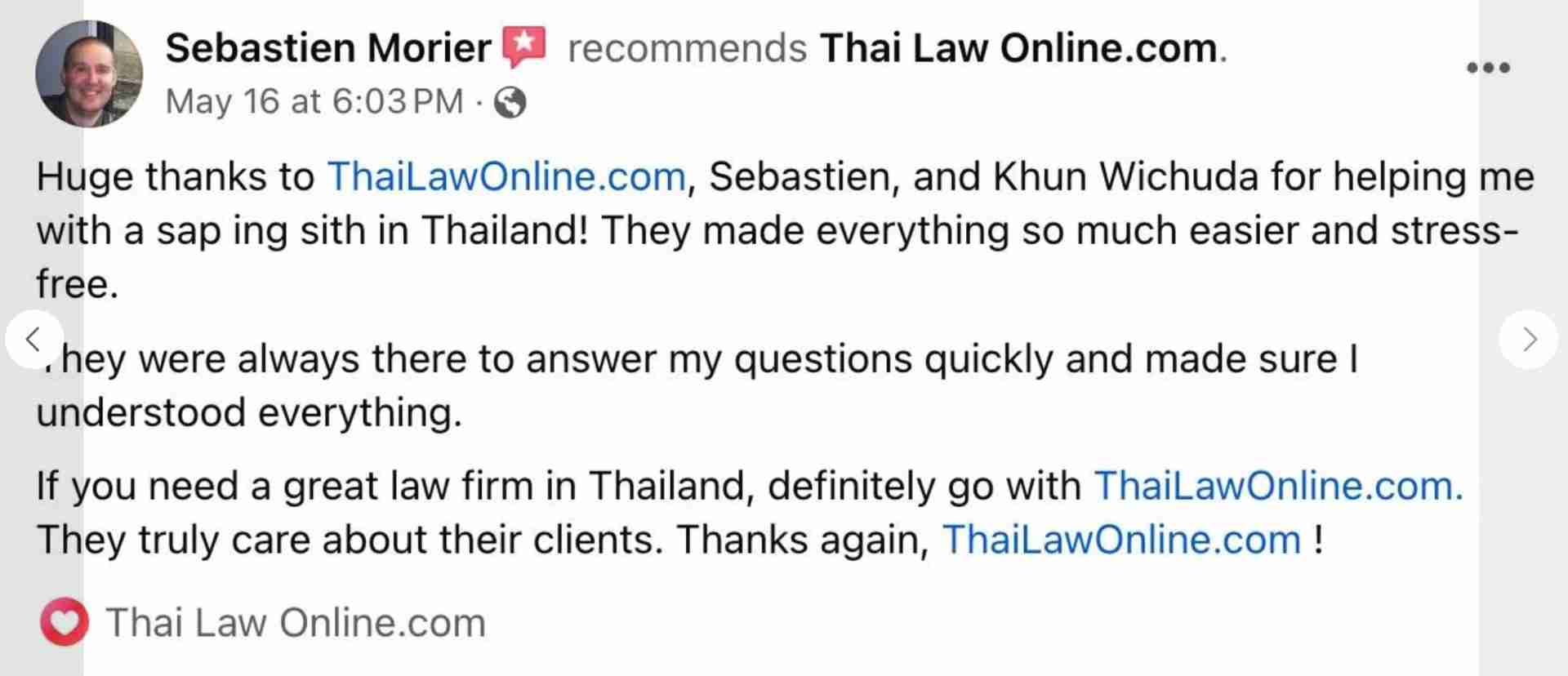
Je remercie sincèrement le temps, les efforts et l’attention que vous avez consacrés à la conduite de ce processus ; cela signifie beaucoup pour moi.
Bonjour Sébastien et Khun Wichuda,
Je voulais juste envoyer un petit message à Merci à vous deux pour votre aide et votre soutien. concernant l'achat du terrain. J'aurais dû écrire plus tôt, mais j'ai été très occupé ces derniers temps.
Je remercie sincèrement le temps, les efforts et l’attention que vous avez consacrés à la conduite de ce processus ; cela signifie beaucoup pour moi.
Mises à jour juridiques 2026
Modifications récentes :
- Inscription numériqueCertains bureaux fonciers acceptent désormais les demandes préliminaires en ligne.
- Surveillance accrue: Des vérifications plus approfondies des antécédents des prête-noms étrangers en lien avec des problèmes liés aux personnes désignées (Cela a commencé vers 2024)
ThaiLawOnline rédige pour vous un contrat vous garantissant des droits optimaux pour votre Sap-Ing Sith en Thaïlande. Nous avons enregistré les premiers Sap-Ing Sith à Chiang Mai, Koh Phang Ngan, Krabi, Prachuap Khiri Khan et dans d'autres provinces thaïlandaises. Nous sommes l'un des rares cabinets d'avocats en Thaïlande à avoir enregistré plus d'une douzaine de Sap-Ing Sith dans plus de 10 provinces.
Liens :
Rédigé pour cette révision, le projet de loi Sap-Ing-Sith B.E. 2562 a été lu en thaïlandais intégralement ; les dix-sept articles ainsi que le barème des frais sont inclus dans le texte, ainsi que le règlement ministériel fixant les frais et les dépenses liés à Sap-Ing-Sith B.E. 2563 (Journal officiel du royaume, volume 137, partie 96 Kor, page 18, 18 novembre 2020). Trois corrections ont été apportées. La section relative aux frais indique un droit d’accise au taux d’un pourcentage et un droit annuel périodique calculé sur la valeur d’évaluation ; aucun de ces deux éléments n’apparaît dans le projet de loi ou dans le règlement, qui impose uniquement des frais ponctuels, et cette section omet les deux charges les plus importantes, la taxe de transfert et la taxe d’annulation, qui sont désormais indiquées ci-dessus. La date de publication est fixée à 26 avril 2019, date de l’approbation royale ; la publication a eu lieu le 30 avril 2019 et l’article 2 met en vigueur la loi 180 jours plus tard. Et deux limites figuraient dans la section 4 : le droit ne peut être créé sur une partie d'un titre, et lorsque la propriété est hypothéquée ou porte un autre droit enregistré, le consentement écrit de ce titulaire est requis. Ce que cette critique ne couvre pas, dit plutôt qu'implicitement. L’affirmation selon laquelle l’Assemblée législative nationale a adopté la loi le 8 février 2019 n’est pas contenue dans le texte de la loi et n’a pas été vérifiée. La réglementation ministérielle relative aux demandes, aux annulations et aux actes juridiques existe dans nos sources mais n’a pas été lue ici. Les témoignages, les études de cas, le registre d’enregistrement propre à l’entreprise et les comparaisons avec les contrats de location et d’usufruit sont des déclarations commerciales, et non juridiques. Le traitement de la décision du Tribunal suprême 4655/2566 n’a pas été modifié dans cette révision ; voir la revue de l’affaire qui suit.
Les articles sont réécrits en thaïlandais le 4 octobre 2026 : 3, 5, 9, 11, 12, 14 et 15. Correction : l’annulation anticipée n’est ouverte que pour un propriétaire qui est également le titulaire (article 14) ; la propriété revient à son état initial à la fin, et non à son état original (article 15) ; l’enregistrement délivre un certificat, et non un nouveau titre de propriété (article 5) ; les passages relatifs à savoir si le droit est réel ou personnel ne s’opposent plus les uns aux autres. Les références aux décisions judiciaires examinées : 17 septembre 2026. Les décisions de la Cour suprême citées sur cette page ont été vérifiées par rapport au texte thaïlandais et cinq d’entre elles ont été lues intégralement pour leur disposition. L’article sur la décision 4655/2566 contenait une interprétation erronée quant à savoir si une promesse de renouvellement survivait en tant qu’obligation personnelle entre les parties ; la Cour a considéré que de telles promesses étaient nulles et n’ont pas été traitées comme telles, et le passage qui en fait mention, avec son application à Sap-Ing-Sith, est conservé comme analogie de l’entreprise. Les décisions 412/2511 et 2759/2534 sont désormais décrites avec leurs résultats, toutes deux allant à l’encontre du locataire. Un détail qui n’était pas mentionné dans la décision 1135/2506 a été supprimé. Une autre décision de bail a été supprimée de la liste car aucune copie de celle-ci n’a pu être trouvée dans aucune des sources que nous possédons, et un cas que nous ne pouvons pas lire n’est pas cité. La décision 8534/2542 est restée publiée.
Actualités juridiques thaïlandaises, gratuites par courriel
Des informations claires et concises sur les changements législatifs thaïlandais concernant les étrangers : propriété, visas, mariage, affaires et testaments. Un court courriel par mois, envoyé par un cabinet d’avocats établi depuis 2006. Zéro spam, désabonnement possible à tout moment.