


Révisé par ThaiLawOnline, un cabinet d'avocats thaïlandais agréé exerçant en Thaïlande depuis 2006. Avocate thaïlandaise responsable : Wichuda Atthamethakon, LL.M., licence du barreau thaïlandais 3149/2556.
Dernière mise à jour :
Imaginez ceci : Vous êtes en sortie avec des amis à Bangkok lorsque la police arrive pour un contrôle de routine. Ils demandent un test de dépistage de drogue. Savez-vous ce qui se passe ensuite en vertu des lois thaïlandaises sur les drogues ? Quelques secondes d’hésitation pourraient changer le cours de votre vie entière. L’approche thaïlandaise en matière de répression des drogues est fondamentalement différente de celle des pays occidentaux, et ses conséquences peuvent être catastrophiques. Comprendre les lois thaïlandaises sur les drogues n’est pas facultatif pour quiconque vit, travaille ou voyage dans le royaume, c’est une protection essentielle.
Le Code des stupéfiants de la Thaïlande B.E. 2564 (2021) impose certaines des peines les plus sévères d’Asie du Sud-Est. Depuis juin 2024, la quantité de méthamphétamine présumée détenue pour consommation personnelle est d’un comprimé au lieu de cinq, de sorte qu’une personne qui en transporte une poignée sort désormais de cette présomption. Le cannabis, qui a été brièvement dépénalisé, a été reclassé comme substance strictement contrôlée. Les ressortissants étrangers s’exposent à l’ expulsion, à des interdictions de retour à vie et à des saisies de biens, en plus des peines pénales. La peine de mort demeure une possibilité réelle pour les trafiquants à grande échelle. Ce guide complet expose tout ce que vous devez savoir sur les lois thaïlandaises en matière de drogue, les changements récents, les procédures d’arrestation et vos options juridiques.
Table des matières
Comprendre le système de classification des drogues en Thaïlande
Le cadre réglementaire thaïlandais en matière de drogues est codifié dans le Code des stupéfiants B.E. 2564 (2021). Cette législation divise les substances contrôlées en cinq catégories distinctes, chacune ayant ses propres sanctions, ses propres restrictions de fabrication et ses propres exceptions médicales. Le système de classification est complexe car il tente de concilier les préoccupations en matière de santé publique avec les applications médicales et de recherche limitées. La compréhension de la catégorie à laquelle une substance appartient est cruciale car elle détermine si vous êtes passible d’amendes, d’emprisonnement ou de la peine de mort.
substances de catégorie I sont considérées comme les plus dangereuses et n'ont aucune application médicale en Thaïlande. Il s'agit notamment de l'héroïne (diacétylmorphine), de la méthamphétamine (sous forme de cristaux et de comprimés), de la MDMA (ecstasy) et du LSD. La possession, la distribution ou la fabrication de drogues de catégorie I sont passibles des peines les plus sévères prévues par la législation thaïlandaise sur les stupéfiants, pouvant aller jusqu'à la peine de mort pour les grandes quantités.
substances de catégorie II ont une valeur médicale limitée mais sont très restreintes. Cette catégorie comprend la cocaïne, la morphine, la codeïne, la méthadone et l’opium. Ces substances peuvent être utilisées dans les hôpitaux ou dans des installations de recherche sous réserve d’une licence stricte. Le commerce non autorisé de ces substances est interdit par l’article 91 et l’article 146 prévoit une peine d’emprisonnement allant jusqu’à dix ans et une amende n’excédant pas 1 000 000 bahts, portée à un à quinze ans et de 100 000 à 1 500 000 bahts lorsque l’une des circonstances aggravantes s’applique.
Catégorie III couvre les préparations médicinales contenant des substances de catégorie II mais formulées pour une distribution médicale légitime. Il s'agit de produits pharmaceutiques comme les sirops contre la toux à base de codéine ou les analgésiques à base de morphine. La vente ou la possession non autorisée en vue de la distribution est passible de poursuites pénales, bien que la possession personnelle de médicaments sur ordonnance soit légale.
précurseurs chimiques de catégorie IV sont les matières premières utilisées pour la fabrication de drogues illégales. Il s'agit notamment de l'anhydride acétique (utilisé pour la fabrication de l'héroïne), le chlorure d'acétyle et d'autres précurseurs. La législation thaïlandaise en matière de stupéfiants criminalise la possession, la vente et l'importation de précurseurs chimiques sans autorisation. Ces informations sont essentielles pour comprendre l'ensemble de la chaîne d'approvisionnement ciblée par les autorités.
Catégorie V incluait auparavant le cannabis, mais son statut légal a radicalement changé en 2024-2025. Aujourd'hui, les champignons psilocybes (champignons magiques) et les extraits de delta-8/delta-10 THC y sont classés. Le cannabis lui-même a été retiré de ce système de catégories et est désormais soumis à une autorisation médicale uniquement. Ce récent changement représente une évolution majeure dans l'application de la législation thaïlandaise sur les stupéfiants.
| Catégorie de stupéfiant | Substances clés | Usage médical en Thaïlande | Gravité de la sanction |
|---|---|---|---|
| Catégorie I | Héroïne, méthamphétamine, MDMA, LSD | Aucun | s.145 : jusqu’à 15 ans / 1,5 M de THB ; aggravé de 2 à 20 ans / 0,2 à 2 M ; chef de réseau ou atteinte à la sécurité de l’État : de 5 ans à la perpétuité / 0,5 à 5 M, ou la peine de mort |
| Catégorie II | Cocaïne, morphine, codéine, méthadone, opium | Limité (hôpitaux seulement) | s.146 : jusqu’à 10 ans / 1 M de THB ; aggravé de 1 à 15 ans / 0,1 à 1,5 M |
| Catégorie III | Préparations médicinales contenant de la catégorie II | Oui (réglementé) | s.147 : jusqu’à 3 ans / 300 000 THB, sans niveau aggravé |
| Catégorie IV | Produits chimiques précurseurs (anhydride acétique, etc.) | Usage industriel uniquement | s.146 : jusqu’à 10 ans / 1M THB. Le niveau 1-15 ans ne concerne que la catégorie II |
| Catégorie V | Champignons psilocybes, extraits illégaux de THC | Aucun | s.148 : jusqu’à 5 ans / 500 000 THB ; aggravé de 1 à 15 ans / 0,1 à 1,5 M |
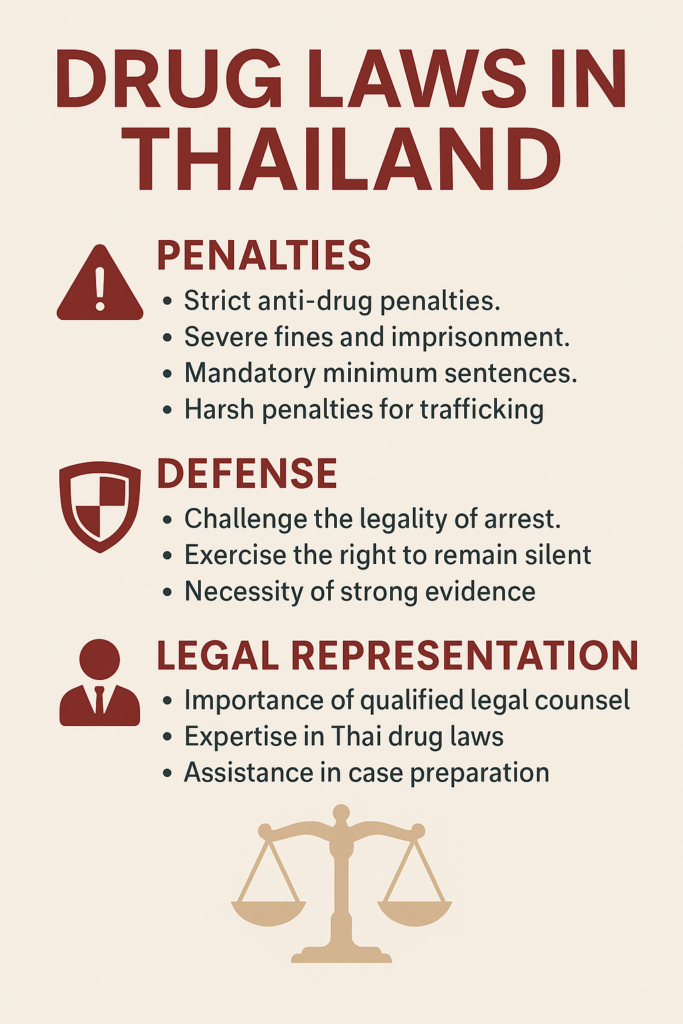
[Infographie : thailand-drug-laws-infographic-thailawonline.png]
Sanctions pour possession de drogue en Thaïlande
Les peines encourues pour possession de stupéfiants en Thaïlande varient considérablement selon la catégorie de substance et la quantité. Les tribunaux thaïlandais présument que les quantités importantes indiquent une intention de distribution, ce qui alourdit considérablement les peines. Même de petites quantités peuvent faire l'objet de poursuites sévères si la police soupçonne une intention de vente.
possession de catégorie I est traité par le Code des stupéfiants. L’article 107 n’est pas une disposition pénale : c’est l’article en vertu duquel le ministre de la Santé publique fixe les quantités qui font naître une présomption quant à la raison pour laquelle une drogue était détenue. Pour les petites quantités indiquant un usage personnel, les peines vont jusqu’à 2 ans d’emprisonnement et une amende de 40 000 bahts thaïlandais (environ 1 100 USD). La règle connue familièrement sous le nom de “ règle de la seule pilule ” fonctionne à l’inverse de la façon dont on la décrit habituellement. Le règlement ministériel relatif aux quantités de stupéfiants et de substances psychotropes présumées détenues pour consommation (n° 2) B.E. 2567, publié dans la Gazette royale vol. 141 partie 38 Kor le 17 juin 2024, prévoit que la méthamphétamine, dans une quantité “ ne dépassant pas une unité de dosage, ou un poids net ne dépassant pas cent milligrammes, ou, en cas de flocons, de poudre ou de cristaux, un poids net ne dépassant pas vingt milligrammes ”, est présumée détenue pour consommation. Un comprimé se trouve donc à l’intérieur de la présomption d’usage personnel et non à l’extérieur, et cette présomption ouvre la voie du traitement au lieu d’y faire obstacle. Ce qui a changé en 2024, c’est l’étendue de ce seuil : le règlement initial du 9 février 2024 le fixait à cinq unités de dosage et l’amendement de juin l’a réduit à une, de sorte qu’une personne transportant trois comprimés, qui aurait autrefois bénéficié de la présomption, n’en bénéficie plus. Perdre la présomption n’équivaut pas à être présumé vendeur. Cela signifie que l’accusation doit prouver la finalité, et en vertu de l’article 145 du Code, la gradation dépend de la conduite et du rôle plutôt que de la quantité.
possession de catégorie II se divise de la même manière. Possession pour consommation relève de l’article 107 et la peine est celle de l’article 164 : la même peine d’emprisonnement n’excédant pas deux ans, ou une amende n’excédant pas 40 000 bahts, ou les deux. La possession pour tout autre motif relève de l’article 91, et l’article 146 fixe la peine à emprisonnement n’excédant pas dix ans et amende n’excédant pas 1 000 000 bahts. Lorsque l’acte est commis à des fins commerciales, entraîne une propagation dans le public, consiste en une cession à une personne de moins de dix-huit ans ou dans un lieu éducatif, religieux ou gouvernemental, ou implique la force ou une arme, l’article 146, paragraphe deux, la porte à de un à quinze ans et de 100 000 à 1 500 000 Baht, et ce deuxième paragraphe s’applique uniquement à la catégorie II. Le Code ne fixe aucun seuil de 100 grammes ni aucune sanction propre à une substance pour la cocaïne ou toute autre drogue: il ne nomme aucune substance, c’est pourquoi les chiffres qui ont circulé pour certaines drogues ne reposent sur aucun article.
Catégorie III est l’exception, et la différence passe facilement inaperçue. L’article 92 interdit la production, l’importation, l’exportation ou la cession de un stupéfiant de catégorie III sans licence, et il ne prévoit pas l’interdiction de la simple possession, c’est pourquoi un patient qui détient une préparation à base de codéine prescrite ne commet pas d’infraction à ce titre. En cas de violation de l’article 92, l’article 147 fixe la peine à emprisonnement n’excédant pas trois ans et amende n’excédant pas 300 000 Baht, sans niveau aggravé.
précurseurs chimiques de catégorie IV sont regroupés avec la catégorie II à l’article 91, et ils sont passibles de la même peine en vertu de l’article 146, paragraphe 1 : emprisonnement n’excédant pas dix ans et amende n’excédant pas 1 000 000 bahts. C’est le chiffre le plus souvent sous-estimé dans les guides, avec un facteur de deux pour la peine de prison et de dix pour l’amende. Le niveau aggravé de l’article 146, paragraphe deux, est expressément limité à la catégorie II, de sorte qu’une infraction de catégorie IV ne peut pas y être soumise.
Catégorie V relève de l’article 93 et la peine est celle de l’article 148 : emprisonnement d'une durée maximale de cinq ans et une amende maximale de 500 000 bahts, portée à de un à quinze ans et de 100 000 à 1 500 000 Baht lorsque l’un des six éléments aggravants s’applique. L’aggravation ne dépend pas du poids. Le Code ne prévoit aucune limite de dix kilogrammes ; le plafond de 1 500 000 bahts s’applique à la catégorie aggravée, qui est atteinte par le trafic, la distribution de la drogue au public, la fourniture à un mineur, la fourniture près d’une école, d’un lieu de culte ou d’un bureau gouvernemental, ou par la force ou les armes. La possession pour consommation est de nouveau régie par les articles 107 et 164.
| Catégorie | Possession à des fins de consommation | Sanction applicable | Possession pour tout autre motif |
|---|---|---|---|
| Catégorie I | s.107 et s.164 | Jusqu'à 2 ans ou jusqu'à 40 000 THB, ou les deux | s.90 et s.145 : jusqu'à 15 ans et jusqu'à 1 500 000 THB |
| Catégorie II | s.107 et s.164 | Jusqu'à 2 ans ou jusqu'à 40 000 THB, ou les deux | s.91 et s.146 : jusqu'à 10 ans et jusqu'à 1 000 000 THB |
| Catégorie III | Pas une infraction : l’article 92 n’interdit pas la possession | Aucune à ce titre | s.92 et s.147, pour la production, l’importation, l’exportation ou la cession : jusqu’à 3 ans et jusqu’à 300 000 THB |
| Catégorie IV | Non couvert par l’article 107 | Aucune à ce titre | s.91 et s.146 : jusqu'à 10 ans et jusqu'à 1 000 000 THB |
| Catégorie V | s.107 et s.164 | Jusqu'à 2 ans ou jusqu'à 40 000 THB, ou les deux | s.93 et s.148 : jusqu'à 5 ans et jusqu'à 500 000 THB |
Sanctions liées au trafic et à la production de stupéfiants
Les lois thaïlandaises sur les drogues imposent les peines les plus sévères pour le trafic et la production de drogues. Ces infractions peuvent entraîner des peines de plusieurs décennies et incluent la peine de mort. Une distinction clé en Thaïlande est que le “ trafic ” comprend non seulement la vente, mais également tout transfert de drogue à une autre personne. Partager un joint avec un ami, distribuer des pilules lors d’une fête ou vendre à un agent infiltré constituent tous un trafic au regard de la loi.
trafic de catégorie I est interdit par article 90 du Code des stupéfiants, mais la peine est prévue à l' article 145, et la différence importe car c’est dans l'article 145 que se situe le classement. Le Code a modifié la base de ce classement, et c’est la chose la plus importante à comprendre aujourd’hui au sujet des peines prononcées en Thaïlande pour les infractions liées à la drogue. Le Cour suprême, statuant en Grande Chambre dans l’arrêt n° 272/2565, l’a dit expressément : l’ancienne loi sur les stupéfiants B.E. 2522 aggravait la peine en tenant la seule quantité de drogue pour déterminante, tandis que l’article 145 du Code l’aggrave en fonction de la conduite de l’auteur dans la commission de l’infraction et de son rôle dans celle-ci, et ne retient plus la quantité comme critère, bien qu’une quantité plus importante puisse encore constituer une preuve de cette conduite et de ce rôle. La loi portant mise en vigueur du Code a abrogé la loi de 1979 par son article 4. Les chiffres concernant la quantité indiqués ci-dessous doivent donc être interprétés comme des éléments de preuve que le tribunal peut prendre en considération, et non comme des seuils déterminant l’infraction. Toutefois, des facteurs aggravants peuvent considérablement allonger ces peines. Conformément à l’article 145, si vous vendez à des mineurs, distribuez des produits près d’écoles ou de temples, utilisez des armes ou exercez des activités de distribution commerciale, les peines peuvent aller jusqu’à l’emprisonnement à perpétuité ou la peine de mort. Dans le cas de trafic de catégorie I à grande échelle (quantités indiquant des opérations de distribution importantes), les tribunaux imposent fréquemment des peines d’emprisonnement à perpétuité ou la peine de mort, suivies par la confiscation d’actifs d’un montant de 5 millions de bahts ou plus.
trafic de catégorie II relève des articles 91 et 146. La peine de base est emprisonnement n’excédant pas dix ans et amende n’excédant pas 1 000 000 bahts; lorsque l’une des six circonstances aggravantes visées au paragraphe deux s’applique, il devient de un à quinze ans et de 100 000 à 1 500 000 Baht. L’importation n’est pas classée séparément. L’article 91 énumère ensemble la production, l’importation, l’exportation, la cession et la possession, de sorte que toute importation est sanctionnée en vertu de la même disposition que toute autre opération, les circonstances aggravantes s’appliquant si le comportement y correspond. Il n’existe pas de niveaux distincts pour la cocaïne, la morphine ou l’opium en tant que tels, car le Code ne désigne pas les substances.
trafic de catégorie III consiste en la production, l’importation, l’exportation ou la cession sans licence d’une préparation pharmaceutique au sens de l’article 92. L’article 147 fixe la peine à emprisonnement n’excédant pas trois ans et amende n’excédant pas 300 000 Baht. C’est tout : il n’existe pas de niveau aggravé et aucune voie vers la prison à perpétuité à ce titre.
précurseurs chimiques de catégorie IV relèvent de l’article 91, avec la catégorie II, de sorte que la peine est celle de l’article 146, paragraphe 1 : emprisonnement n’excédant pas dix ans et amende n’excédant pas 1 000 000 bahts. Le niveau aggravé allant de un à quinze ans s'applique uniquement à la catégorie II ; il n'est donc pas applicable aux infractions de la catégorie IV, quelle que soit la taille de l'opération.
trafic de catégorie V (psilocybine et extraits illicites de THC) relève des articles 93 et 148 : emprisonnement d'une durée maximale de cinq ans et une amende maximale de 500 000 bahts, et de un à quinze ans, avec entre 100 000 et 1 500 000 bahts lorsqu’une circonstance aggravante s’applique. Là encore, l’aggravation tient au comportement et non au poids, et le Code ne contient aucun seuil de dix kilogrammes.
La production et la culture de drogues sont considérées comme des infractions de trafic dans la plupart des cas. La culture du pavot, la fabrication de méthamphétamine ou l'exploitation d'un laboratoire clandestin de drogue entraînent les mêmes peines sévères que le trafic du produit fini. Dans certains cas, la réclusion à perpétuité ou la peine capitale est prononcée lorsque l'ampleur des faits est qualifiée de trafic majeur.
| Catégorie | Sanction de base | Niveau aggravé, si le Code en prévoit un | Niveau le plus élevé et ce qui permet de l’atteindre |
|---|---|---|---|
| Catégorie I (s.90, s.145) | Jusqu’à 15 ans et jusqu’à 1 500 000 THB | 2 à 20 ans et 200 000 à 2 000 000 THB | De 5 ans à la prison à perpétuité et de 500 000 à 5 000 000 THB, ou la mort: chef de réseau, directeur ou responsable, ou un impact sur la sécurité de l’État ou la sécurité publique |
| Catégorie II (s.91, s.146) | Jusqu’à 10 ans et jusqu’à 1 000 000 THB | 1 à 15 ans et 100 000 à 1 500 000 THB | Aucun. L’article 146 ne prévoit aucun niveau de peine capitale |
| Catégorie III (s.92, s.147) | Jusqu’à 3 ans et jusqu’à 300 000 THB | Aucun. L’article 147 ne prévoit aucun niveau aggravé | Aucun |
| Catégorie IV (s.91, s.146) | Jusqu’à 10 ans et jusqu’à 1 000 000 THB | Aucun. Le niveau aggravé prévu à l’article 146, paragraphe 2, ne concerne que la catégorie II. | Aucun |
| Catégorie V (s.93, s.148) | Jusqu’à 5 ans et jusqu’à 500 000 THB | 1 à 15 ans et 100 000 à 1 500 000 THB | Aucun. L’article 148 ne prévoit aucun niveau de peine capitale |
Que se passe-t-il lorsqu'un étranger est arrêté pour une infraction liée à la drogue en Thaïlande ?
Le processus qui va de l’arrestation au procès pour les infractions liées à la drogue en Thaïlande est fondamentalement différent de celui des systèmes de justice pénale occidentaux. La qualité d’étranger crée des complications supplémentaires, notamment la barrière de la langue, des procédures juridiques peu familières et la possibilité d’une procédure internationale d’ extradition. Comprendre chaque phase : détention policière, enquête, mise en détention provisoire, bail, et procès, est essentiel pour protéger vos droits.
Phase de police (0-48 heures)
La police thaïlandaise dispose d’une large compétence pour fouiller des personnes, des véhicules et des domiciles lorsqu’elle a des “ soupçons raisonnables ” d’infractions liées à la drogue. Contrairement à de nombreux pays occidentaux, la législation thaïlandaise autorise les perquisitions sans mandat lors des enquêtes sur la drogue si la police invoque l’urgence. Les tests d’urine sur place sont courants. Si votre test est positif, la police vous arrêtera sur place. Durant la période initiale de détention de 48 heures, vous serez détenu au commissariat de police. La police peut vous interroger hors la présence d’un avocat, et les protections du “ droit de garder le silence ” de nombreux pays occidentaux sont plus faibles en Thaïlande. Vous avez le droit de demander l’assistance d’un avocat et de contacter votre ambassade, mais la police n’est pas tenue d’honorer immédiatement ces demandes. Votre ambassade peut informer votre famille et fournir une liste d’avocats anglophones, mais elle ne peut pas intervenir dans le processus pénal ni obtenir votre libération. Ne signez aucun document sans la présence d’un avocat et d’un interprète. De nombreux aveux obtenus lors de cette phase sont irrecevables en justice en raison d’erreurs de procédure ; ne faites donc jamais de déclaration spontanée à la police.
Enquête et détention provisoire (du jour 3 au jour 84)
Après 48 heures, la police doit vous présenter devant un juge. Si le procureur estime qu'il existe des motifs probables, le juge approuvera un mandat de dépôt pour la poursuite de l'enquête. En vertu des lois thaïlandaises sur les stupéfiants, les juges peuvent approuver des extensions de détention par blocs de 12 jours, pour un total maximal de 84 jours. Pendant la période de détention provisoire, votre équipe de défense peut effectuer des tests médico-légaux indépendants sur les échantillons de drogues, interroger des témoins et examiner les éléments de preuve. Cette période est critique car l'analyse par un laboratoire indépendant contredit souvent les conclusions de la police concernant la pureté, le poids et la composition chimique de la drogue. Un échantillon que la police prétend peser 1 kilogramme peut s'avérer nettement plus léger lors d'un test indépendant, ce qui peut faire requalifier les charges de trafic en possession. Les barrières linguistiques sont importantes durant cette phase ; veillez à ce que votre avocat prévoie des interprètes bilingues pour tous les interrogatoires de police et les procédures judiciaires.
Le problème de la caution et du risque de fuite
En cas d’infractions mineures liées à la drogue (possession de catégorie III, IV ou V), une mise en liberté sous caution (dite “ caution au poste ”) peut être obtenue directement au commissariat. En cas d’accusations graves impliquant des substances de catégorie I ou II, ou de toute accusation de trafic, les décisions sur la caution sont prises par le tribunal pénal. Les juges thaïlandais considèrent les étrangers comme présentant automatiquement un risque de fuite. Pour obtenir la mise en liberté, vous devez généralement fournir des garanties substantielles : titres fonciers thaïlandais (terrains ou condominiums), des sommes en espèces à titre de caution allant de 500 000 à 2 millions de bahts, ou une preuve d’emploi stable et d’attaches familiales en Thaïlande. De nombreux étrangers ne peuvent pas remplir ces conditions et restent en détention provisoire pendant des semaines ou des mois jusqu’au procès. Votre avocat peut négocier le montant de la caution, présenter des témoignages de moralité et plaider pour des conditions de mise en liberté sous caution qui n’exigent pas de garanties financières impossibles.
Procès et condamnation
Les procès pénaux thaïlandais se déroulent devant des juges professionnels, et non devant des jurys. Les procès se déroulent en thaï et tous les actes judiciaires sont rédigés en thaï. Aux termes de l’article 227, alinéa 2, du Code de procédure pénale, l’accusation doit prouver la culpabilité au-delà de tout doute raisonnable. Toutefois, les tribunaux thaïlandais sont moins exigeants que les tribunaux occidentaux en matière de preuves indirectes. La possession d’accessoires liés à la drogue, les dépositions de témoins et les rapports de police sont souvent jugés suffisants comme corroboration, même sans preuve scientifique. Un plaidoyer de culpabilité exige toujours une preuve corroborante en droit thaïlandais des stupéfiants si la peine dépasse 5 ans. Les stratégies de défense doivent comprendre la contestation de la légalité des perquisitions, la remise en cause de la chaîne de garde des preuves, la contestation de l’analyse de pureté et la présentation de circonstances atténuantes telles que le traitement de la toxicomanie, les difficultés familiales ou la qualité de primo-délinquant. L’appel doit être interjeté dans un délai de 30 jours. La procédure d’appel dure de 12 à 24 mois et le taux d’infirmation est faible (environ 5 à 10 % des condamnations sont infirmées).
Modifications récentes des lois thaïlandaises sur les stupéfiants (2024-2026)
Reclassement du cannabis
Le 26 juin 2025, la notification du ministère de la Santé publique relative aux plantes contrôlées B.E. 2568 a soumis la vente de fleurs de cannabis à une ordonnance. Le cannabis n’a pas été réinscrit sur la liste des stupéfiants de la catégorie 5 ; il en avait été retiré en juin 2022. Le cannabis médical est disponible uniquement dans les cliniques agréées sur prescription médicale et uniquement pour des affections spécifiques (douleur chronique, épilepsie, effets secondaires de la chimiothérapie et quelques autres). Tout produit à base de cannabis dont la teneur en THC dépasse 0,2% est une substance contrôlée. Fumer en public est interdit et peut entraîner des amendes allant jusqu’à 25 000 bahts. Le cannabis a été retiré de la liste des stupéfiants de la catégorie 5 par la notification du ministère de la Santé publique du 9 juin 2022, prise en vertu de l’article 29, deuxième alinéa, du Code des stupéfiants, de sorte que les sanctions de la catégorie V décrites ci-dessus ne s’appliquent pas à lui. Il est désormais contrôlé comme herbe plutôt que comme stupéfiant, conformément à la notification du ministère de la Santé publique relative aux herbes contrôlées B.E. 2568, et notre guide sur le cannabis examine cette notification clause par clause. L’exportation de cannabis est absolument interdite, même pour les produits de qualité médicale, et entraînera des poursuites pour trafic. Aucune vente aux personnes de moins de 20 ans, aux femmes enceintes ou aux femmes qui allaitent. C’est l’une des modifications les plus importantes apportées aux lois thaïlandaises sur les drogues ces dernières années, et elle a pris au dépourvu de nombreux résidents de longue durée et nomades numériques.
La règle du comprimé unique pour la méthamphétamine
En 2024, la Thaïlande a réduit la quantité de méthamphétamine présumée détenue pour usage personnel, et le nom populaire de cette modification la décrit à l’envers. Le règlement du 9 février 2024 avait fixé le chiffre à cinq unités de dosage. Le règlement ministériel relatif aux quantités de stupéfiants et de substances psychotropes présumées détenues pour consommation (n° 2) B.E. 2567, publié dans la Gazette royale vol. 141 partie 38 Kor le 17 juin 2024, l’a ramené à une : la méthamphétamine “ n’excédant pas une unité de dosage, ou un poids net ne dépassant pas cent milligrammes, ou, en cas de flocons, de poudre ou de cristaux, un poids net ne dépassant pas vingt milligrammes ” est présumée détenue pour consommation. Ainsi, un seul comprimé bénéficie toujours de la présomption et de la voie du traitement qui en découle ; ce qui a disparu, c’est la présomption pour la personne qui en transporte deux, trois ou quatre. Une personne au-dessus du seuil n’est pas pour autant présumée être un vendeur, et le Code gradue l’infraction selon la conduite et le rôle plutôt que selon la quantité. Cette politique vise à dissuader l’usage occasionnel et la distribution à petite échelle, mais elle a créé de graves injustices pour les toxicomanes, désormais traités en délinquants plutôt qu’en candidats à un traitement.
Contrôles numériques et descentes dans les lieux de vie nocturne
L'application moderne de la législation thaïlandaise en matière de stupéfiants repose de plus en plus sur la surveillance numérique. La police surveille les applications de messagerie cryptée, les transactions en cryptomonnaie et les virements bancaires internationaux afin de déceler d'éventuelles activités liées au trafic de drogue. Les applications de livraison (Grab, Line, services de livraison de repas) sont analysées pour détecter toute activité suspecte. Les descentes dans les lieux de vie nocturne sont devenues plus fréquentes et plus intensives, avec des contrôles d'urine à grande échelle dans les boîtes de nuit, les bars et lors de fêtes privées. La police utilise des drones pour surveiller les quartiers connus pour être des zones de trafic de drogue. Ces méthodes de répression numériques et technologiques rendent la dissimulation beaucoup plus difficile, et les preuves stockées dans le cloud (messages WhatsApp, publications sur les réseaux sociaux, relevés de virements) sont désormais recevables devant les tribunaux thaïlandais.
Défenses légales en cas d'poursuites pour infractions liées à la drogue en Thaïlande
Malgré la rigueur des lois thaïlandaises sur les drogues, des moyens de défense efficaces existent. Les tribunaux thaïlandais reconnaissent les protections constitutionnelles contre les perquisitions et saisies illégales, la provocation policière, les erreurs de procédure et l’insuffisance des preuves. Pour constituer une solide défense, il faut un avocat qualifié bilingue qui maîtrise à la fois le droit thaïlandais et les normes internationales en matière de procédure pénale.
Contester les perquisitions illégales
Les perquisitions sans mandat en Thaïlande nécessitent des “ circonstances urgentes ” ou un mandat délivré par un juge. Si la police ne dispose ni de l’un ni de l’autre, les preuves peuvent être écartées. Les tribunaux thaïlandais ont acquitté des accusés poursuivis pour vente de cannabis lorsque la perquisition initiale ayant permis de découvrir la drogue avait été effectuée sans mandat et sans circonstances urgentes suffisantes. Le fait que la police ait affirmé avoir senti une odeur de drogue depuis l’extérieur de la résidence n’a pas été jugé suffisant pour justifier l’enfoncement de la porte. Si votre arrestation résulte d’une perquisition illégale, votre avocat devrait déposer une requête en exclusion de toutes les preuves issues de cette perquisition.
Moyen de défense fondé sur la provocation policière
Les tribunaux thaïlandais reconnaissent la provocation policière comme un moyen de défense valable contre les accusations en matière de drogue. Les opérations d’infiltration en ligne, où des agents infiltrés se font passer pour des acheteurs sur les réseaux sociaux ou dans des applications de rencontres, sont de plus en plus fréquentes. Si la police vous a incité à commettre une infraction que vous n’auriez pas commise autrement, les tribunaux peuvent abandonner les poursuites. Des acquittements pour trafic ont été prononcés lorsque les agents de police avaient “ fait pression avec insistance ” sur le prévenu pour qu’il se procure de la drogue après un premier refus. Une défense fondée sur la provocation policière exige de documenter les communications ayant précédé l’infraction alléguée.
Chaîne de possession et erreurs de procédure
Les preuves relatives aux stupéfiants doivent être dûment documentées, de la saisie à l'analyse en laboratoire. Si la police n'a pas respecté la chaîne de possession des preuves, si le sac contenant les preuves ne comporte pas les scellés ou signatures requis, ou si des interprètes étaient absents lors des étapes cruciales, les preuves peuvent être irrecevables. Les erreurs de procédure sont fréquentes dans les affaires de stupéfiants en Thaïlande et peuvent parfois entraîner un acquittement si elles sont particulièrement graves.
Litiges relatifs à la quantité et à la pureté
Les tests de dépistage de drogue effectués par la police sont souvent peu fiables. Pendant la période de détention provisoire de 84 jours, votre avocat peut faire réaliser des analyses médico-légales indépendantes sur les stupéfiants saisis. L'analyse de pureté peut réduire considérablement les peines. Par exemple, un échantillon que la police prétend contenir 1 kilogramme d'héroïne pure pourrait en réalité ne contenir que 500 grammes d'héroïne mélangée à des produits de coupe. Les accusations de trafic fondées sur des seuils de poids dépendent du calcul de la pureté. Un échantillon de 200 grammes d'une pureté de 50% (soit 100 grammes purs) pourrait ne pas atteindre le seuil minimal passible de la peine capitale, tandis que le même échantillon d'une pureté de 95% le dépasserait. Les analyses indépendantes constituent l'un de vos meilleurs atouts en matière de défense.
Le parcours de réadaptation
Le Code des stupéfiants de 2021 prévoit une option de réadaptation pour certains délinquants. Les délinquants qui commettent une première infraction et qui sont pris en possession de petites quantités pour usage personnel peuvent demander un traitement obligatoire au lieu de subir une procédure pénale. En pratique, nous avons observé que les peines pour possession de méthamphétamine à usage personnel ont été réduites ou suspendues lorsque le prévenu a accepté un traitement. Une prescription médicale valide constitue également une défense contre une accusation de possession de médicaments soumis à réglementation. La voie de réadaptation n’est toutefois pas disponible pour toute personne accusée de possession pour la vente, mais un seul comprimé de méthamphétamine ne fait pas entrer une personne dans cette catégorie : une seule dose relève de la quantité présumée détenue pour la consommation, et c’est de cette constatation que dépend la voie du traitement. Toutefois, pour d’autres catégories et circonstances, cette option demeure viable.
Grâces royales
Le système de grâce royale thaïlandais permet aux délinquants condamnés de demander une réduction ou une commutation de peine. Ces demandes sont généralement accordées lors des fêtes royales importantes (anniversaire du roi, anniversaire de la couronnement) ou à la discrétion du roi. Une grâce royale peut faire passer une peine de mort en prison à perpétuité, réduire une peine de 20 ans à 10 ans ou permettre une libération anticipée. Bien que ce ne soit pas une stratégie de défense garantie, le maintien d’une bonne conduite pendant le procès et l’incarcération vous rend plus susceptible d’obtenir une grâce.
Risques particuliers pour les ressortissants étrangers
Les étrangers condamnés pour infraction à la législation thaïlandaise sur les stupéfiants s'exposent à des conséquences spécifiques, au-delà de la simple peine d'emprisonnement. L'expulsion est quasi automatique après la condamnation. Suite à une expulsion, la Thaïlande impose généralement une interdiction de séjour à vie, rendant tout voyage ultérieur impossible. Même les touristes condamnés pour simple possession de stupéfiants sont interdits de territoire à vie. Votre condamnation pénale est inscrite à votre casier judiciaire international et peut compliquer vos démarches pour voyager, trouver un emploi ou immigrer dans d'autres pays. La saisie des avoirs est une pratique courante : la police peut saisir votre appartement, vos véhicules, vos cryptomonnaies et vos comptes bancaires à l'étranger s'ils sont soupçonnés d'être liés au trafic de stupéfiants. Les banques coopèrent de plus en plus avec les autorités thaïlandaises pour le gel des comptes étrangers. De nombreux étrangers ont perdu des centaines de milliers de dollars d'actifs en attendant leur procès.
Les transfèrements de détenus sont possibles si vous souhaitez purger votre peine dans votre pays d’origine. Cependant, vous devez purger au moins un tiers de votre peine (ou 4 ans, selon la durée la plus longue) en Thaïlande avant de pouvoir être transféré. La Thaïlande extrade rarement des ressortissants thaïlandais pour qu’ils soient jugés à l’étranger, mais extrade presque toujours des étrangers vers leur pays d’origine si la demande est faite dans le cadre de traités bilatéraux. Peine de mort : bien que les exécutions soient rares (la dernière exécution en Thaïlande a eu lieu en 2018), les condamnations à mort sont toujours prononcées. Un trafiquant malaisien a été condamné à mort en mars 2025 pour trafic d’héroïne, ce qui montre que la peine capitale est toujours bien appliquée dans le cadre des lois thaïlandaises sur les drogues. Aucune traduction n’est fournie d’office par le tribunal ; vous devez payer vos propres interprètes, ce qui peut coûter de 1 000 à 2 000 bahts par heure et atteindre rapidement des dizaines de milliers lors d’un long procès.
Médicaments sur ordonnance : ce que les expatriés doivent savoir
L'un des pièges les plus dangereux de la législation thaïlandaise sur les drogues concerne les médicaments délivrés sur ordonnance légitimes. De nombreux médicaments contre le TDAH, en particulier ceux contenant des sels d'amphétamine (Adderall, Dexedrine, Desoxyn), sont classés comme stupéfiants de catégorie I en Thaïlande. Cela signifie qu'ils sont totalement interdits, un point c'est tout. Avoir une ordonnance de son pays d'origine n'offre aucune protection juridique. Apporter de l'Adderall en Thaïlande équivaut légalement à apporter de l'héroïne. La possession peut entraîner des peines pour trafic de 4 à 15 ans, même si l'on dispose d'une ordonnance de la DEA américaine. Le méthylphénidate (Ritalin, Concerta) est parfois autorisé avec l'approbation de la FDA thaïlandaise, mais cette approbation n'est pas automatique.
D'autres médicaments peuvent poser problème, notamment les benzodiazépines sur ordonnance (Valium, Xanax), certains somnifères (Ambien) et certains analgésiques contenant des opioïdes. Avant de voyager en Thaïlande avec des médicaments sur ordonnance, vous devez vous assurer de leur légalité. Ne vous fiez pas aux informations en ligne ; consultez directement la FDA thaïlandaise ou votre avocat.
Liste de contrôle pour voyager avec des médicaments :
- Consultez le Code des stupéfiants officiel de Thaïlande ou le site web de l'Agence thaïlandaise des produits alimentaires et médicamenteux (FDA) avant d'emballer des médicaments.
- Obtenez une lettre détaillée de votre médecin prescripteur décrivant votre diagnostic, votre médicament, la posologie et la durée du traitement.
- Pour les médicaments soumis à restrictions, demandez un permis d'importation auprès de la FDA thaïlandaise, via son bureau à Bangkok (délai de 2 à 4 semaines).
- Conservez tous les médicaments dans leurs flacons d'origine étiquetés avec votre nom et le dosage clairement visibles.
- Indiquer les médicaments à la douane et apporter votre lettre du médecin et votre autorisation de la FDA en tout temps.
- Ne jamais transférer de médicaments dans des contenants non étiquetés ni les partager avec d'autres personnes.
- Envisagez d'obtenir une ordonnance thaïlandaise une fois arrivé en Thaïlande, de nombreuses affections pouvant être traitées avec des médicaments approuvés en Thaïlande.
Thaïlande vs. pays voisins : comparaison des sanctions liées à la drogue
Les peines en matière de drogue en Thaïlande sont parmi les plus sévères d’Asie du Sud-Est, mais les pays voisins offrent des profils de risque différents. Comprendre les peines comparatives peut vous aider à prendre des décisions en matière de voyage.
| Pays | possession personnelle | Peine pour trafic | Peine de mort | Statut du cannabis | Option de réadaptation |
|---|---|---|---|---|---|
| Thaïlande | De 2 ans maximum pour la possession à des fins de consommation (s.164) | Jusqu’à 15 ans (niveau de base) pour la catégorie I, jusqu’à la perpétuité ou la peine de mort au plus haut niveau (s.145) | Oui (exécution rare) | Réservé au secteur médical (depuis 2025) | Oui, et le Code oblige les tribunaux à le préférer (art. 165). |
| Malaisie | 2 à 6 mois ou amende | 15 à 40 ans ou perpétuité | Oui (exécution courante) | Illégal | Non |
| Singapour | Jusqu'à 10 ans | 20 ans à perpétuité | Oui (obligatoire pour ≥ 15 g d’héroïne) | Illégal | Non |
| Cambodge | 2 à 10 ans | 5 à 20 ans | Non | Illégal (rarement appliqué) | Non |
| Vietnam | Jusqu'à 5 ans | 3 à 20 ans ou perpétuité | Oui (pour les grandes quantités) | Illégal | Non |
Questions fréquentes sur la législation thaïlandaise en matière de stupéfiants
Les étrangers peuvent-ils être condamnés à mort pour des infractions liées à la drogue en Thaïlande ?
Oui. Même si les exécutions sont rares (la dernière exécution en Thaïlande remonte à 2018), des condamnations à mort sont toujours prononcées, y compris contre des ressortissants étrangers. Un trafiquant malaisien a été condamné à mort en mars 2025 pour trafic d’héroïne. Selon les lois thaïlandaises sur les drogues, les condamnations à mort sont le plus souvent prononcées pour le trafic de catégorie I portant sur de grandes quantités (en pratique, des opérations importantes, bien que le Code atteigne le niveau de la peine capitale selon le rôle de l’auteur et non selon le poids) ou pour le trafic assorti de circonstances aggravantes comme la vente à des mineurs. Les condamnations à mort sont souvent commuées en réclusion à perpétuité par grâce royale, mais cette commutation n’est pas automatique. L’existence de la peine de mort pour les infractions liées à la drogue reste un facteur de risque sérieux qui ne doit pas être minimisé.
Le cannabis est-il légal en Thaïlande en 2026 ?
Uniquement à usage médical avec prescription d’une clinique agréée. Les ventes à des fins récréatives sont totalement interdites depuis mi-2025. Les extraits de THC supérieurs à 0,2% sont classés comme substances contrôlées en vertu des lois thaïlandaises sur les drogues et sont passibles de sanctions pénales. Le fait de fumer du cannabis en public peut entraîner des amendes allant jusqu’à 25 000 bahts thaïlandais. Le cannabis n’est plus considéré comme une substance stupéfiante de catégorie 5 ; les sanctions prévues par le Code des stupéfiants ne s’appliquent donc pas à lui : le ministère de la Santé publique a retiré le cannabis de la liste de catégorie 5 en juin 2022 et il est désormais réglementé comme une plante contrôlée. Notre guide du cannabis détaille les règles actuelles. Sortir du cannabis de Thaïlande est strictement illégal et entraînera des poursuites pour trafic. Le cannabis médical est disponible uniquement dans le cadre de conditions spécifiques (douleurs chroniques, épilepsie, effets secondaires de la chimiothérapie) par des cliniques agréées. Ne présumez pas que le cannabis reste dépénalisé ; la réclassification de 2025 a été spectaculaire et permanente.
Que se passe-t-il si je suis contrôlé positif aux drogues lors d'une descente dans une boîte de nuit thaïlandaise ?
Un test urinaire positif peut entraîner des poursuites immédiates en vertu de la législation thaïlandaise sur les stupéfiants. La police est habilitée à effectuer des tests de dépistage de drogue sur place si elle a des soupçons raisonnables de consommation de stupéfiants. Vous avez le droit de refuser le test, mais ce refus peut être utilisé comme preuve de culpabilité devant un tribunal. Si votre test est positif, la police vous arrêtera sur les lieux et vous conduira au poste de police. Vous serez probablement détenu pendant 48 heures pour les formalités initiales. Ne consentez pas à un interrogatoire sans la présence d'un avocat. Contactez votre ambassade et demandez immédiatement une liste d'avocats anglophones. De nombreux tests de dépistage de drogue effectués en boîte de nuit ne sont pas fiables et peuvent être contestés par des tests indépendants pendant la période de détention provisoire, mais cela nécessite une représentation légale immédiate.
Puis-je emporter mes médicaments contre le TDAH sur ordonnance en Thaïlande ?
La plupart des médicaments contre le TDAH contenant de l’amphétamine (Adderall, Dexedrine) sont classés comme stupéfiants de catégorie I en Thaïlande et sont STRICTEMENT INTERDITS, quelle que soit la prescription délivrée dans votre pays d’origine. L’infraction dépend de la raison pour laquelle ils sont détenus : la possession à des fins de consommation relève de l’article 164, une peine d’emprisonnement n’excédant pas deux ans ou une amende n’excédant pas 40 000 bahts, ou les deux, tandis que la possession pour tout autre motif relève de l’article 145, jusqu’à quinze ans d’emprisonnement et jusqu’à 1 500 000 bahts d’amende. Le méthylphénidate (Ritalin, Concerta) peut être autorisé avec une autorisation et une documentation appropriées de la FDA thaïlandaise, mais l’autorisation n’est pas automatique. Avant de voyager en Thaïlande avec un médicament contre le TDAH, contactez la FDA thaïlandaise ou un avocat spécialiste pour une confirmation. Ne présumez pas que votre prescription délivrée dans votre pays d’origine offre une protection juridique. Pensez à arrêter le traitement contre le TDAH pendant votre séjour en Thaïlande ou à obtenir une prescription thaïlandaise auprès d’un psychiatre thaïlandais dès votre arrivée. De nombreux expatriés parviennent à vivre sans médicaments contre le TDAH pendant leurs séjours prolongés en Thaïlande.
Combien de temps la police thaïlandaise peut-elle me détenir sans m'inculper ?
La détention provisoire sans inculpation est limitée à 48 heures. Passé ce délai, la police doit vous présenter devant un juge. Si celui-ci ordonne une détention provisoire pour la poursuite de l'enquête, vous pouvez être détenu par périodes de 12 jours, jusqu'à un maximum de 84 jours. Durant cette période, vos droits de communication sont limités ; vous pouvez toutefois demander à contacter votre avocat et votre ambassade. Au terme des 84 jours, soit une inculpation doit être prononcée, soit vous devez être libéré. En pratique, de nombreuses affaires de stupéfiants donnent lieu à des poursuites avant l'expiration de ce délai de 84 jours. Votre avocat peut déposer une demande de mise en liberté sous caution lors de toute audience de détention provisoire et négocier une libération sous caution ou sur parole.
Les tribunaux thaïlandais spécialisés dans les affaires de drogue proposent-ils des accords de plaidoyer négociés ?
Non. Les procureurs thaïlandais ne disposent pas de pouvoirs de négociation de peine comparables à ceux des États-Unis. La législation thaïlandaise en matière de stupéfiants ne prévoit aucun mécanisme formel de réduction des charges en échange d'un plaidoyer de culpabilité. Toutefois, des négociations en vue d'une réduction des charges peuvent avoir lieu avec la police pendant la phase d'enquête (avant l'inculpation). Un plaidoyer de culpabilité et des preuves de coopération constituent des circonstances atténuantes majeures lors du prononcé de la peine, et les juges peuvent réduire les peines en fonction de la coopération et de la reconnaissance de responsabilité. Collaborer avec votre avocat pour négocier avec la police pendant la phase d'enquête peut permettre d'obtenir une réduction des charges ou une recommandation de réadaptation plutôt que des poursuites.
Quel est le parcours de réadaptation des auteurs d'infractions liées à la drogue en Thaïlande ?
En vertu du Code des stupéfiants de 2021, les délinquants commettant une première infraction et ayant en possession de petites quantités pour usage personnel peuvent demander un traitement obligatoire plutôt que d’être poursuivis pénalement. Cette voie de réadaptation propose des conseils et un traitement contre la toxicomanie au lieu de sanctions pénales. Cette voie n’est toutefois pas disponible si vous êtes accusé de possession à des fins de vente. Le fait d’être en possession de plus d’un comprimé de méthamphétamine ne vous place pas à lui seul dans cette catégorie : cela supprime la présomption que la drogue était détenue pour la consommation, et l’accusation doit alors prouver la finalité de la détention. Pour bénéficier d’une réadaptation, vous devez démontrer une consommation personnelle de petites quantités, un statut de première infraction et votre volonté de suivre un programme de traitement approuvé par le gouvernement. Même avec une réadaptation, vous pouvez être confronté à des conséquences civiles telles que des tests de drogue obligatoires pendant plusieurs années. La réadaptation offre une voie pour éviter un casier judiciaire permanent, ce qui est précieux pour l’emploi et l’immigration.
Comment ThaiLawOnline peut vous aider
ThaiLawOnline fournit des services juridiques experts aux expatriés et aux ressortissants thaïlandais en Thaïlande depuis 20 ans. Notre droit pénal en Thaïlande équipe comprend des avocats possédant des décennies d'expérience, spécialement en tant qu' avocat spécialisé dans la défense des affaires de drogue en Thaïlande . Nous connaissons parfaitement la législation thaïlandaise en matière de stupéfiants et savons comment gérer les situations complexes à l'intersection entre la procédure pénale thaïlandaise et le droit international applicable aux ressortissants étrangers.
Lorsqu’on vous arrête pour des infractions liées à la drogue, le temps est crucial. Nos avocats peuvent vous représenter immédiatement au poste de police, en veillant à ce que vous ne signiez pas d’aveux sans examen juridique, que vos droits de garder le silence et d’être assisté d’un avocat soient protégés, et que les erreurs de procédure soient consignées pour être utilisées ensuite dans la défense. Durant les phases d’enquête et de détention provisoire, nous effectuons des analyses médico-légales indépendantes, interrogeons les témoins et élaborons des stratégies de défense complètes. Nous connaissons la voie de la réhabilitation et pouvons déterminer si vous êtes éligible à un traitement plutôt qu’à des poursuites. Nous négocions avec les procureurs et les juges, présentons des éléments atténuants et défendons vigoureusement vos droits devant les tribunaux thaïlandais.
Nous assurons toutes les communications en anglais, en français et en thaï, éliminant ainsi les barrières linguistiques. Nous collaborons avec des cabinets d'avocats internationaux et des spécialistes de l'extradition si une expulsion ou un transfert international s'avère nécessaire. Nous gérons les questions de saisie d'actifs et œuvrons à protéger vos biens contre toute confiscation. Que vous soyez accusé de simple possession pour usage personnel ou d'accusations graves de trafic, notre objectif est de minimiser les sanctions, d'explorer les possibilités de réhabilitation et de protéger vos intérêts à long terme en Thaïlande et à l'international.
Dernière révision : 5 septembre 2026. Chaque chiffre de pénalité figurant sur cette page a été lu en regard de Code des stupéfiants B.E. 2564 lui-même, d’après sa publication dans la Gazette royale du 8 novembre 2021 (volume 138, partie 73 Kor, page 1), qui contient la loi portant mise en vigueur du Code ainsi que le Code qui lui est annexé. Les articles lus intégralement sont les interdictions, ss.90 à 93 (Catégories I, II et IV, III et V), art. 104 (consommation) et art. 107 (possession à des fins de consommation et présomption de quantité), ainsi que les sanctions applicables, art. 145 à 148, art. 162, art. 164 et art. 165, qui demande au tribunal de privilégier le traitement plutôt que la peine et de fixer la peine de chaque prévenu individuellement. Chaque chiffre des trois tableaux de pénalités et dans neuf paragraphes était incorrect à l’égard de ces sections et toutes ces erreurs ont été remplacées. Les erreurs allaient dans les deux sens : la catégorie IV était publiée à cinq ans et 100 000 bahts alors que l’article 146 prévoit dix ans et 1 000 000, et le trafic de catégorie III était présenté comme pouvant aller jusqu’à la réclusion à perpétuité alors que l’article 147 le plafonne à trois ans et 300 000. Deux points que la page exposait déjà correctement ont été conservés et méritent d’être cités : son exposé de s.145 et de la décision de la Grande Chambre de la Cour suprême 272/2565, selon lequel le Code gradue l’infraction en fonction de la conduite et du rôle de l’auteur plutôt que de la quantité, et son exposé de la présomption d’une unité de dosage prévue par le règlement ministériel du 17 juin 2024.
Ce que cette vérification ne couvre pas, dit franchement. Le Code ne désigne pas les substances : la répartition des drogues entre les catégories est fixée par des règlements ministériels et des notifications pris en application du Code, et ceux-ci n’ont pas lu ici, de sorte que les listes de substances du tableau de classification ne sont pas vérifiées. Ni le règlement du 17 juin 2024 sur la présomption de quantité ni la notification sur les plantes contrôlées concernant le cannabis n’ont été relus pour cette révision ; la position sur le cannabis est exposée d’après notre propre guide sur le cannabis, qui a été vérifié au regard de cette notification le 4 septembre 2026. Rien de ce que cette page indique sur les délais d’arrestation et de détention provisoire, la pratique de la libération sous caution, les taux d’appel, l’expulsion et les interdictions de retour, la procédure d’importation de médicaments sur ordonnance ou les sanctions de la Malaisie, de Singapour, du Cambodge et du Vietnam n’a été vérifié, et les comparaisons avec l’étranger en particulier relèvent du contexte plutôt que d’un droit dont nous pouvons nous porter garants.
Points critiques concernant la législation thaïlandaise sur les drogues
- La Thaïlande classe les drogues en 5 catégories , les sanctions allant de l'amende à la peine de mort. Déterminer la catégorie applicable à une substance est la première étape de l'évaluation du risque juridique.
- La “ règle de la seule pilule ” pour la méthamphétamine fonctionne à l’inverse de son surnom : une unité de dosage, 100 mg, ou 20 mg de cristal, est la quantité présumée détenue pour consommation, et en juin 2024 ce seuil a été réduit de cinq unités de dosage à une.
- Le cannabis est réservé à un usage médical depuis 2025. En vertu de la législation thaïlandaise sur les stupéfiants, l'usage récréatif n'est plus toléré et est passible de peines de 2 à 10 ans de prison.
- Les étrangers risquent l'expulsion, l'interdiction de territoire à vie et la saisie de leurs biens. En plus des sanctions pénales, votre appartement, vos véhicules et vos comptes bancaires à l'étranger peuvent être saisis.
- Les médicaments couramment prescrits pour le TDAH (Adderall) sont des stupéfiants de catégorie I. En Thaïlande, votre ordonnance de votre pays d'origine ne vous offre aucune protection légale.
- Des défenses efficaces existent : Les contestations de perquisition illégale, la provocation policière, la contestation de la pureté du produit et les programmes de réhabilitation peuvent réduire considérablement les peines si vous agissez rapidement.
- Le parcours de réhabilitation élimine la peine de prison pour les auteurs d’infractions qualifiantes, mais n’est pas disponible pour les infractions de “ possession à des fins de vente ”.
- L'accès immédiat à un avocat bilingue est votre protection la plus importante. Après votre arrestation, ne signez rien et ne faites aucune déclaration sans la présence d'un avocat.
Actualités juridiques thaïlandaises, gratuites par courriel
Des mises à jour en anglais simple sur les changements législatifs thaïlandais concernant les étrangers : propriété, visas, mariage, affaires et testaments. Un court courriel par mois, envoyé par un cabinet d’avocats établi depuis 2006. Zéro spam, désabonnement possible à tout moment.