


Dernière mise à jour :
Révisé par ThaiLawOnline, un cabinet d'avocats thaïlandais agréé exerçant en Thaïlande depuis 2006. Avocate thaïlandaise en charge du dossier : Wichuda Atthamethakon, LL.M., licence du barreau thaïlandais 3149/2556.
Réponse courte : La Thaïlande n'a pas de tribunal des successions distinct ni d'exécuteur testamentaire agissant de sa propre initiative. Un tribunal provincial ordinaire nomme un administrateur de succession (administrateur de la succession), et tant qu'une telle ordonnance n'existe pas, personne ne peut toucher à un compte bancaire thaïlandais, transférer un condominium ou réimmatriculer une voiture, même s'il y a un testament nommant un exécuteur testamentaire. Une nomination simple et non contestée prend généralement trois à six mois du dépôt jusqu'à une décision de justice exécutoire. Les successions contestées, les héritiers introuvables ou les documents qui doivent être légalisés à l'étranger prennent considérablement plus de temps.
Les échéances dont personne ne parle : l'administrateur doit commencer l'inventaire de la succession dans 15 jours, terminez l'administration et la comptabilité dans les un an, et la créance d'un héritier sur la succession est prescrite un an après qu'ils ont su la mort. Aller au tableau des échéances.
Si le décès vient de se produire, commencez par Que faire lorsqu'un étranger décède en Thaïlande. Si le testament a été établi à l'étranger, voir l'homologation d'un testament étranger en Thaïlande. Cette page est la procédure judiciaire thaïlandaise elle-même.
La procédure successorale en Thaïlande n'est pas celle que vous connaissez
Le terme “ probate ” suscite des attentes que le droit thaïlandais ne comble pas, et la majeure partie de la frustration ressentie par les familles provient de ce décalage.
Il n'y a pas de greffe des successions ni de tribunal des successions. Les questions successorales sont soumises à la cour provinciale ordinaire compétente, et ce que fait le tribunal ne consiste pas à “ homologuer le testament ” au sens anglais du terme. Il nomme une personne : l'administrateur de la succession. Cette nomination est ce que chaque banque, bureau de la publicité foncière et bureau des transports attend.
Crucialment, le tribunal doit nommer un administrateur même lorsqu'il existe un testament valide désignant un exécuteur testamentaire. L'article 1712 de la Code civil et commercial permet à un testament de désigner un administrateur, par le testateur ou par une personne nommée par le testament pour faire ce choix, mais la désignation ne vaut pas nomination. La personne nommée doit tout de même faire une requête, et le tribunal doit tout de même rendre une ordonnance. Ce que le testament vous garantit, c'est une audience brève et non contestée au lieu d'un long débat sur la personne qui devrait exercer ces fonctions.
Quel tribunal, exactement ?
Presque toutes les pages en anglais sur les successions en Thaïlande, y compris une version antérieure de celle-ci, vous disent de déposer la demande “ là où le défunt avait son domicile, ou là où se trouvent les actifs ”. Ce “ ou ” n'est pas la loi, et il envoie les familles devant le mauvais tribunal.
Section 4 quater de Code de procédure civile établit une hiérarchie en deux étapes :
- La juridiction du lieu où le défunt avait son domicile au moment du décès. C'est la règle. Elle s'applique même lorsque chaque actif de la succession se trouve dans une province différente.
- Le tribunal du lieu où se trouvent les biens de la succession, mais uniquement lorsque le défunt avait Non domicile dans le Royaume.
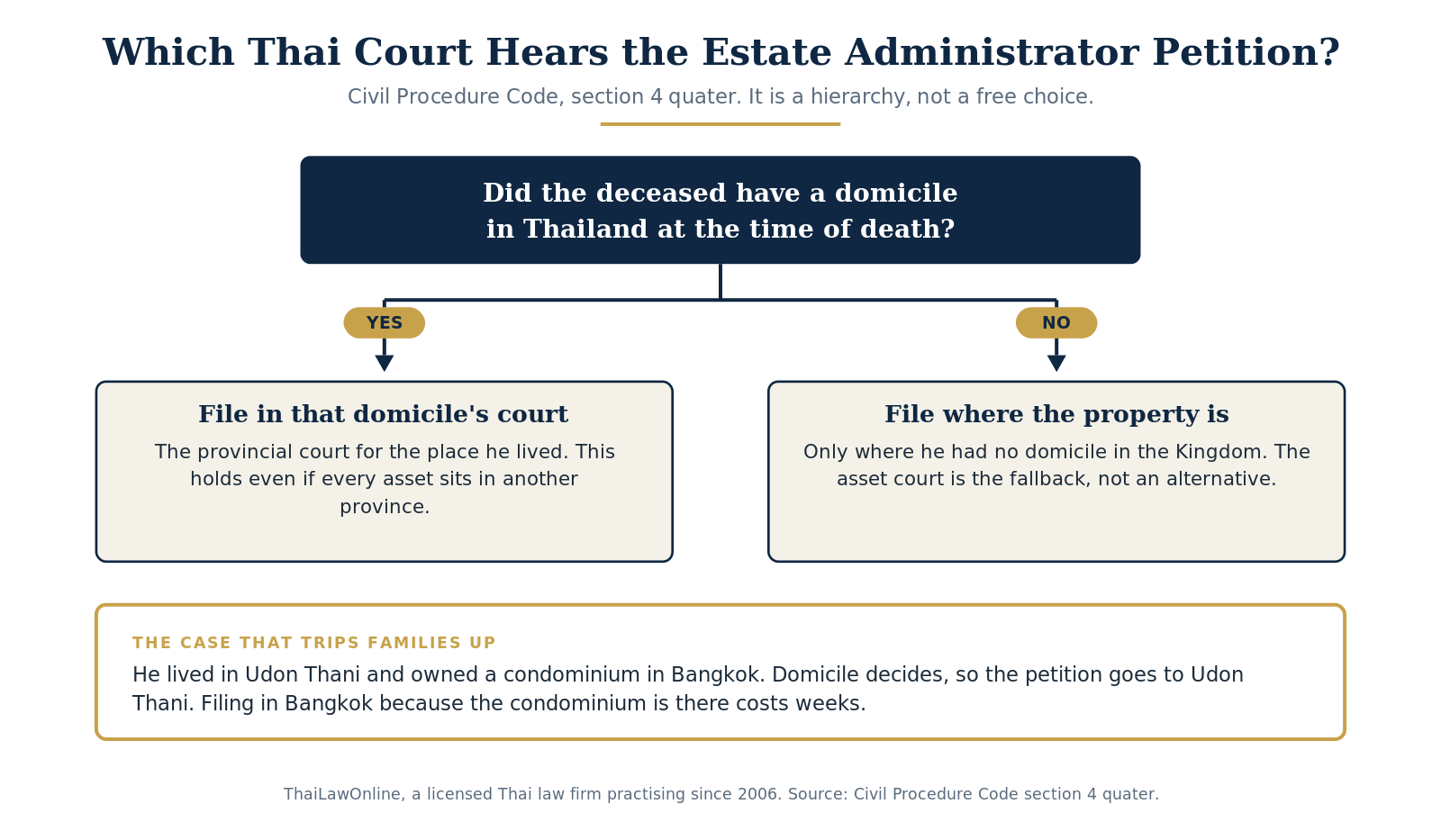
Prenez le cas qui se présente le plus souvent dans notre pratique. Un étranger retraité a vécu pendant quinze ans à Udon Thani et possédait un seul appartement en copropriété à Bangkok. La famille suppose Bangkok, parce que c'est là que se trouve l'actif. Section 4 quater dit Udon Thani, car c'est là qu'il était domicilié. Déposer à Bangkok ne détruit généralement pas l'affaire, mais le tribunal peut la rejeter, et la famille perd les semaines nécessaires pour se désister et redéposer dans la bonne province.
La seconde branche saisit la situation inverse : un étranger qui possédait un condominium thaïlandais mais vivait réellement à l'étranger et n'avait aucun domicile en Thaïlande. Là, le tribunal des avoirs a raison, et il a raison parce que il n'y a pas de domicile à désigner, non pas que la famille l'ait préféré.
One practical warning. Domicile is a question of fact, and Thai courts look at where the person actually lived, not at what a visa or a lease says. Where a foreigner split the year between two provinces, or between Thailand and a home country, expect the court to want evidence: the house registration book, immigration records, utility accounts, and the address the person used with banks and hospitals. Assemble that before filing rather than after.
Quand avez-vous réellement besoin d'une ordonnance du tribunal ?
Chaque fois qu'un actif se trouve dans un registre contrôlé par une personne officielle. En pratique, cela signifie presque tout ce qui vaut la peine d'être possédé.
| Actif | Une décision de justice est-elle nécessaire ? | Pourquoi |
|---|---|---|
| Terrain, maison, copropriété | Oui | Le bureau de la conservation foncière n'enregistrera pas de transmission sans celui-ci |
| comptes bancaires thaïlandais | Oui | Gelé sur avis de décès ; délivré uniquement à l'administrateur désigné |
| Véhicules immatriculés | Oui | Le Département des transports terrestres exige la commande |
| Parts sociales | Oui | Nécessaire avant que le registre des actions et les dépôts auprès du DBD ne puissent être corrigés |
| Obligations et titres d'État | Oui | Le bureau d'enregistrement exige la commande |
| Effets personnels, argent liquide, effets personnels | Généralement non | Pas de registre, les héritiers les gèrent donc entre eux |
| Assurance-vie avec bénéficiaire désigné | Non | Versé au bénéficiaire désigné et exclu de la succession. Lorsque la police ne désigne personne et est payable simplement à “ mes héritiers ”, l'article 897 intègre la somme dans la succession, ce qui signifie également que les créanciers du défunt peuvent y avoir accès |
Qui peut être administrateur de succession ?
L'article 1713 indique qui peut faire une requête : un héritier, toute personne intéressée ou le ministère public, dans les cas qu'il énumère, lesquels comprennent l'absence des héritiers, leur présence à l'étranger ou leur minorité, l'incapacité ou le refus d'agir d'un administrateur ou d'un héritier, ou la défaillance de la désignation d'un testament pour une raison quelconque.
L'article 1718 précise ensuite qui ne peut pas être nommé, et la formulation est plus restrictive que ne le suggèrent les résumés habituels :
- une personne qui n'a pas atteint la majorité légale (notant qu'il s'agit de la majorité, et non simplement de l'âge de 20 ans, la majorité pouvant également être atteinte par le mariage);
- une personne aliénée, ou une personne que le tribunal a déclarée telle quasi- incompétent ;
- une personne déclarée en faillite par un tribunal.
Rien n'y exclut un étranger. Un conjoint étranger, un enfant adulte ou un frère ou une sœur peut être nommé et l'est régulièrement. Vous lirez sur plusieurs sites concurrents que le requérant “ doit être âgé d'au moins vingt ans ”. Il s'agit d'une paraphrase, et non de l'article, qui omet entièrement le volet de la quasi-incompétence.
L'administrateur n'est pas non plus obligé d'être un héritier, et le cumul de ces deux rôles est tout à fait normal en Thaïlande : le conjoint survivant est très souvent l'un et l'autre. La Cour suprême s'est penchée à plusieurs reprises sur ce que permet ce double rôle. Dans Dika 44/2568 la cour a jugé qu'un administrateur transférant des biens de la succession à lui-même en sa qualité d'héritier n'est pas nul pour cette seule raison, et ce dans Dika 4746/2568 Il est admis que le consentement tacite des héritiers peut valider l'acquisition de l'administrateur.
Une fois nommé, l'article 1719 confère à l'administrateur le droit et le devoir de faire le nécessaire pour donner effet aux instructions expresses ou implicites du testament, d'administrer la succession en général et de la distribuer. Il s'agit d'une véritable fonction fiduciaire, et non d'une formalité, c'est pourquoi les délais ci-dessous ont de l'importance. Cette fonction confère également un pouvoir réel sur les actifs : dans Dika 5902/2567 le tribunal s'est prononcé sur un administrateur hypothéquant des biens de la succession, ce qui rappelle que les héritiers qui ignorent un administrateur pendant un an pourraient constater que la succession a changé d'aspect.
Choisir un administrateur, et non pas simplement s'en qualifier
L'éligibilité est la moitié la plus facile. Les familles nous posent une question plus difficile : lequel d'entre nous devrait réellement faire cela ? Quatre règles décident de la plupart de ces choix, et aucune d'elles n'apparaît sur les pages concurrentes.
Vous pouvez être deux ou plus à siéger ensemble, et une majorité décide alors. Les tribunaux thaïlandais nomment souvent des co-administrateurs, en particulier dans les familles recomposées où un conjoint thaïlandais et les enfants adultes d'un mariage précédent souhaitent tous deux participer à la gestion de la succession. L'article 1726 régit la suite des événements : lorsqu'il y a plusieurs administrateurs, leurs fonctions sont exercées par vote majoritaire, à moins que le testament n'en dispose autrement. En cas d'égalité, toute personne intéressée peut s'adresser au tribunal, et c'est ce dernier qui tranche. Deux coadministrateurs qui se brouillent créent donc une situation de blocage par conception, et chaque décision contestée donne lieu à une saisine du tribunal. Si vous prévoyez des tensions, nommez-en trois, ou nommez-en un seul et donnez aux autres un droit à l'information à la place.
L'administrateur n'est pas payé. L'article 1721 est direct : un administrateur est pas ayant droit à une rémunération sur la succession, à moins que le testament ne le permette, ou qu'une majorité des héritiers ne le permette. Les familles supposent généralement que le frère ou la sœur qui fait le travail y a droit à quelque chose. Ce n'est pas le cas, à moins que quelqu'un ne l'autorise, et l'endroit le plus propre pour le dire est le testament.
Un inventaire défectueux peut coûter son poste à l'administrateur. L'article 1731 permet au tribunal de décharger un administrateur lorsqu'aucun inventaire n'est dressé dans les délais et formes prescrits, ou lorsque le tribunal juge l'inventaire insuffisant pour cause de négligence grave, de malhonnêteté ou d'incapacité manifeste. C'est ce qui donne toute leur mordante aux délais de 15 jours et d'un mois indiqués ci-dessous. Nommer un parent qui n'est pas doué pour les formalités administratives représente un risque bien réel, et non de convenance sociale.
Être en Thaïlande importe plus que la nationalité. Rien dans le Code n'exige la résidence, mais l'administrateur est la personne qui se présente devant le fondé de pouvoir de la banque, le bureau foncier et le bureau des transports, souvent à plusieurs reprises. Un administrateur résidant à l'étranger fonctionne, et nous en gérons beaucoup, mais prévoyez un budget pour les procurations, les frais de coursier et au moins un voyage.
Les délais légaux
C'est la partie qui n'est presque jamais écrite en anglais, et celle qui pose le plus souvent problème des années plus tard.
| Date limite | Ce que cela demande | Section |
|---|---|---|
| 15 jours | L'administrateur doit commencer l'inventaire de la succession. Le délai court à compter du décès s'il connaissait déjà sa désignation en vertu du testament, à compter du jour où il entre en fonction lorsque le tribunal l'a désigné, et autrement à compter du jour où il accepte la fonction. | 1728 |
| Un mois | L'inventaire doit être Terminé. Il doit être fait en présence de au moins deux témoins qui ont eux-mêmes un intérêt dans la succession, et toute personne incapable d'être témoin d'un testament en vertu de l'article 1670 ne peut y assister. Le tribunal peut prolonger ce délai d'un mois, mais uniquement sur demande présentée avant l'expiration du mois. | 1729 |
| Décharge | If no inventory is made in due time and form, or the court finds it unsatisfactory on grounds of gross negligence, dishonesty or obvious incapability, the court may discharge the administrator. | 1731 |
| One year | The administrator must complete the administration and the account of administration and distribution, running from the dates in section 1728, unless the testator, a majority of the heirs or the court fixes a different period. | 1732 |
| 10 days | Approval of the accounts, or any release from liability, is only valid if the accounts were delivered to the heirs, with the supporting documents, at least ten days in advance. | 1733 |
| One year | An heir’s claim to the estate is barred one year after the heir knew, or ought to have known, of the death. A legatee’s claim under a will runs one year from learning of the right. | 1754 |
| One year | A creditor of the deceased must sue the estate within one year of knowing, or of when the creditor ought to have known, of the death, even where the underlying debt had longer to run. Subject to section 193/27, the ordinary prescription of the debt is cut down to that year. | 1754 para 3 |
| Before distribution completes | An interested person can apply to remove an administrator for neglect of duty or other proper cause, but only before the distribution is finished. An administrator may also resign, with the court’s permission and for proper cause. | 1727 |
| Five years | Longstop: heirs cannot bring proceedings about the administration more than five years after the administration ends. | 1733 |
| Ten years | Absolute longstop on succession actions: in no case may a claim be brought more than ten years after the death. | 1754 para 4 |
Two practical consequences. First, the 15-day inventory is routinely missed, because families are still arranging a funeral and the appointment has not even been made. The realistic reading is that the clock runs from when the administrator takes office, which is why the appointment date matters. Second, the one-year bar in section 1754 is the one that actually destroys claims: a family abroad assumes there is no hurry, and there is. We have written up a recent decision on exactly that in Réclamations successions en Thaïlande après un an, Dika 284/2569.
What if the year has already passed?
Most pages state the one-year bar and stop there, which is the harshest possible half of the rule and sends families away who still have a claim. Three provisions qualify it, and you should check all three before accepting that a claim is dead.
Section 1755: not everybody can raise the bar. The one-year prescription may be set up only by an heir, by a person entitled to exercise an heir’s rights, or by an administrator of the estate. A stranger sitting on estate property cannot hide behind it. If the person you are arguing with is a neighbour, a tenant, a business partner or anyone else outside that list, the year is not their defence to run.
Section 1748: possession changes the answer. An heir who is in possession of undivided estate property may demand its partition even after the section 1754 period has expired. The same section adds that the right to demand partition cannot be excluded by juristic act for more than ten years at a time. This matters most for the family living in the house: occupation of the property is not a reason the claim lapsed, it is a reason the claim survives.
Section 1754 paragraph 4: ten years is the real outer wall. No succession action may be brought more than ten years after the death, whatever the heir knew and when. So the honest position is a two-tier one. Inside one year of knowledge, you are safe. Between one and ten years, you need section 1755 or section 1748 or an argument about when you knew. After ten years, the door is shut.
The knowledge point deserves its own line, because it wins cases. The year runs from when the heir knew, or ought to have known, of the death, not from the death. A child who learned of a parent’s death two years later starts the clock on the day of learning, provided nothing put them on notice earlier. Get the evidence of that date into writing early, because it will be attacked.
A second clock runs against the administrator, and it is five years. Section 1733 paragraph 2 stops an heir suing about the administration more than five years after the administration ends. Three points decide how that bar actually works, and the Supreme Court has settled all three. In Dika 2715/2562 the court held that only heirs and the administrator can raise this five-year bar; a third party, such as someone who bought estate property from the administrator, cannot. In Dika 2160/2562 it fixed the starting point: the administration ends when the last estate asset is disposed of or registered, so the five years runs from that day and not from the day the heir discovered the problem. And in Dika 2239/2559 it held that the five year bar is written for an administration carried out normally, and does not apply at all where the administrator administered the estate unlawfully or improperly, or embezzled, misappropriated or concealed it without the heirs knowing. Put together: an heir who was kept in the dark is usually in a better position under section 1733 than the calendar suggests.
Two related traps. A guardian cannot renounce an inheritance on a minor heir’s behalf without the court, which the Supreme Court confirmed in Dika 1649/2567, so a renunciation made informally years ago may not have worked at all. And half-siblings are statutory heirs in their own class, as Dika 2742/2545 confirms, so an heir list drawn up from one household’s memory is often short.
The Process, Step by Step
| Étape | Ce qui se produit | Temps typique |
|---|---|---|
| 1. Jurisdiction | Identify the correct provincial court under Civil Procedure Code section 4 quater: the court for the deceased’s domicile at death, and only where there was no Thai domicile, the court where the estate property sits. | Immédiat |
| 2. Documents | Death certificate, the will if any, proof of the relationship of each heir, house registration and ID or passports, the asset list with supporting title documents. Foreign documents need certified translation and legalisation. | The long pole. 2 to 12 weeks, at the top of that range when documents come from abroad |
| 3. Petition | Petition drafted, heirs’ consents obtained where possible. Consents from all heirs are what keep a hearing short. | 1 to 2 weeks |
| 4. Filing and scheduling | Filed with the court, which sets a hearing date. | 4 to 8 weeks to the hearing date, by province |
| 5. Public notice | The court requires notice so that anyone with a competing claim can appear. | Runs inside the period at stage 4 |
| 6. Hearing | Usually short and uncontested where there is a will and the heirs agree. The petitioner normally attends. | One appearance |
| 7. Order | The court appoints the administrator. | Same day to a few weeks for the written order |
| 8. Appeal window and certificate | An appeal period runs; afterwards the court issues a certificate that no appeal was filed. Banks and the Land Office generally want this certificate, not just the order. | About 30 days plus issuing time |
| 9. Inventory and administration | Inventory within 15 days of taking office, then collecting assets, paying debts, dealing with the banks and registries. | Weeks to months |
| 10. Distribution and discharge | Distribution under section 1750, then accounts to the heirs and discharge. | Within the one-year limit in section 1732, accounts under section 1733 |
Step 8 is the one that surprises people. Getting the order is not the end: most institutions want the certificate of no appeal before they will act, so budget another month after the hearing before the bank actually pays out.
On distribution, section 1750 is worth knowing. Distribution can be made by the heirs each taking possession of their portions, or by selling the estate and dividing the proceeds. If instead the heirs distribute by agreement, that agreement cannot be enforced unless there is written evidence signed by the party to be held liable, or their agent. The Supreme Court worked through the deed-or-occupation distinction in Dika 4273/2568. Family agreements about who gets what should be written and signed, not settled over a meal.
How Long Does Probate Take in Thailand?
Three to six months from filing to a usable court order where there is a Thai will, the heirs agree, and the documents are already in hand. Four to eight months without a will. Add one to three months on the front if foreign documents must be translated and legalised before you can file, and a year or more if anyone contests the appointment. Then add roughly one month after the hearing for the certificate of no appeal, which most banks want before releasing funds.
These are the firm’s own figures, corrected on 7 August 2026. They replace an earlier estimate on this page.
| Caractéristique | Straightforward case | Complex case |
|---|---|---|
| Total estimated timeline | 3 à 6 mois | 8 to 24 months |
| Court processing | 2 to 4 months | 6 to 18 months |
| Asset transfers | 1 to 2 months | 2 to 6 months |
| Estimated legal fees | 50,000 to 150,000 THB | 200,000 THB and up |
| Key characteristics | No disputes between heirs, a clear will if any, and all documents readily available. | Disputed will, missing heirs, creditor claims, or assets in multiple jurisdictions. |
| Frais de justice | A small flat court fee (200 THB for the petition, plus minor delivery and announcement costs), which we pay on your behalf as part of our service | If the estate is disputed and monetary claims are litigated, ad valorem court fees apply to the contested amount (2%, capped by statute); the appointment petition itself remains a small flat fee |
Two levers move that number, and neither of them is the court. The first is whether the documents proving who the heirs are exist, in the right form, translated and legalised. That is where the months go, and it is entirely front-loadable while the family is still arranging the funeral. The second is the court’s own calendar, which varies by province: a Bangkok list and an upcountry list do not run at the same speed, and nobody can shorten either.
Documents, Legalisation and the 2027 Apostille Change
Foreign documents are the long pole in every probate timetable on this page, so a change to how they are certified is a change to your timetable.
Thailand is joining the Apostille Convention, and the date is 28 February 2027. Thailand deposited its instrument of accession to the 1961 Hague Apostille Convention on 30 June 2026, and the Convention enters into force for Thailand on 28 February 2027. You will still find competing pages stating flatly that Thailand is not a party and that full legalisation is therefore essential. That was true when they wrote it and it stops being true on that date.
Ce que cela signifie en pratique :
- Filing before 28 February 2027: nothing changes. Foreign death, birth and marriage certificates still go through the issuing country’s authentication chain and then Thai embassy or consular legalisation, and the Thai translation still goes to the Ministry of Foreign Affairs. Our guide pour la légalisation des documents sets out the route and the current waiting times.
- Filing after that date: a single apostille from the issuing country’s competent authority should replace the consular leg for documents from the other contracting states. That removes weeks from stage 2 of the table above.
- If the death is recent and the estate is not urgent, this is worth a conversation rather than an assumption. Waiting is rarely the right answer, because the section 1754 year is running, but a family already twelve months into gathering paperwork from three countries may reasonably time the final push around the change.
Thai-side documents are unaffected. So is the requirement for certified Thai translation, which the apostille does not remove. If you need documents notarised inside Thailand, see services notariaux en Thaïlande.
What Does It Cost?
Three separate things, and they are usually quoted as one, which is why estimates online vary so wildly.
| Composant | Typical range | Notes |
|---|---|---|
| Court fees and disbursements | 200 THB petition fee, plus publication, service and delivery costs | The appointment petition is a small flat fee. Ad valorem fees (2%, capped by statute) apply only if monetary claims are litigated. |
| Translation and legalisation | Per document, and the largest surprise line for a cross-border family | Driven by how many foreign documents you need and from how many countries. Expected to fall for apostille-country documents after 28 February 2027. |
| Legal fees, uncontested | 50,000 to 150,000 THB | Clear heirs, documents available, no dispute. |
| Legal fees, contested or complex | 200,000 THB and up | Disputed will, missing heirs, creditor claims, or assets across jurisdictions. |
We quote probate individually rather than as a flat fee, because an uncontested single-account estate and a contested estate with land in three provinces are not the same job. What we can commit to is the sequence: a first consultation at 2 000 THB par heure, and after it a written quote for the whole matter before any work starts. Our published frais juridiques ET Tarification ils sont en ligne.
For comparison, a Thai will costs 3 900 THB. It does not avoid the court, but it converts a contested factual enquiry into a short administrative hearing, and it is the cheapest thing in this entire process by two orders of magnitude. See ce que coûte un testament en Thaïlande.
Points That Only Affect Foreign Families
- A foreign will does not skip the Thai court. It can be recognised, but the executor it names has no power over Thai assets until a Thai court appoints them. See vérification d'un testament étranger ET comment un testament thaïlandais et un testament étranger peuvent fonctionner ensemble.
- Proving heirship across borders is evidence, not law. Foreign marriage and birth certificates work, provided the issuing authority certifies them and a translator translates them. Get them early; legalisation takes weeks, at least until February 2027.
- A foreign heir cannot keep land. Land must be disposed of within the period the authorities allow, though a foreigner is not prohibited from owning the building. A condominium can be kept if the building’s 49% foreign quota allows it. See Un étranger peut-il hériter de terres en Thaïlande ? ET Héritage d'un bien en tant qu'héritier étranger.
- The bank is a separate negotiation. An administrator with the order and the certificate still has to satisfy the branch. See comptes bancaires thaïlandais for how the banks handle identity and authority.
- You do not necessarily have to be here. Much of the preparation runs under a power of attorney, though the petitioner normally attends the hearing. If you have never been in a Thai courtroom, read Ce qu'il faut savoir avant de se présenter devant un tribunal en Thaïlande d'abord.
- Inheritance tax is a separate question from probate. It applies above a threshold and to specified asset classes. See impôt sur les successions en Thaïlande.
What If There Is No Will?
The estate still devolves on the heirs at the moment of death under section 1599, but who those heirs are is now the court’s problem rather than the testator’s decision. Section 1629 sets six classes of statutory heirs in order, and section 1635 gives the surviving spouse a share alongside them that varies with which class exists.
That is where intestate estates lose their months: the court has to be satisfied about family composition, and in a blended or cross-border family that can mean tracking down children from an earlier marriage in another country. What happens in detail is set out in Mourir sans testament en Thaïlande and in our inheritance law guide.
The comparison is stark enough to be worth stating plainly: a Thai will does not avoid the court, but it converts a contested factual enquiry into a short administrative hearing. See rédiger un testament thaïlandais, or start from our free Modèle de testament thaïlandais.
Questions fréquentes
Combien de temps dure une procédure de succession en Thaïlande ?
Three to six months to a usable court order where there is a Thai will, the heirs agree and the documents are to hand. Four to eight months without a will. Add one to three months if documents must be translated and legalised abroad before filing, and a year or more if the appointment is contested. Budget roughly another month after the hearing for the certificate of no appeal, which most banks want before releasing funds.
Which court do I file in for an estate administrator in Thailand?
The provincial court for the place where the deceased was domiciled at the time of death. Civil Procedure Code section 4 quater makes this a hierarchy, not a choice: only where the deceased had no domicile in the Kingdom do you file where the estate property is situated. A man who lived in Udon Thani and owned a Bangkok condominium is an Udon Thani filing, not a Bangkok one.
Can two people be estate administrators at the same time?
Yes, and Thai courts appoint co-administrators regularly, particularly in blended families. Section 1726 then decides how they act: by majority vote, unless the will provides otherwise. On a tie, any interested person may apply to the court and the court decides. Two co-administrators who disagree therefore deadlock, so consider appointing three, or one with information rights for the others.
Does the estate administrator get paid?
Not by default. Section 1721 says an administrator is not entitled to remuneration out of the estate unless the will permits it or a majority of the heirs permit it. If you want the family member who does the work to be paid, say so in the will, or obtain the heirs’ agreement in writing.
The one year has passed. Is my inheritance claim dead?
Not necessarily. Three provisions qualify the section 1754 bar. Section 1755 means only an heir, a person entitled to exercise an heir’s rights, or an estate administrator can raise the one-year prescription at all. Section 1748 lets an heir who is in possession of undivided estate property demand partition even after the year has run. And the year runs from when you knew or ought to have known of the death, not from the death itself. The absolute outer limit is ten years from the death under section 1754 paragraph 4.
How long do I have to sue the estate administrator?
Five years from the end of the administration, under section 1733 paragraph 2, which is a separate clock from the one-year bar in section 1754. The Supreme Court has held that the administration ends when the last estate asset is disposed of or registered (Dika 2160/2562), that only heirs and the administrator can raise this bar and not a third party who bought estate property (Dika 2715/2562), and that the five year bar does not apply at all where the administrator administered the estate unlawfully, or embezzled, misappropriated or concealed it without the heirs knowing (Dika 2239/2559).
Will the apostille change anything for my probate case?
Yes, from 28 February 2027. Thailand deposited its accession to the 1961 Apostille Convention on 30 June 2026 and the Convention enters into force for Thailand eight months later, on 28 February 2027. Until then, foreign documents still need the full legalisation chain. After it, a single apostille from the issuing country should replace the consular leg, which removes weeks from the document stage. Certified Thai translation is still required either way.
Is there a probate court in Thailand?
No. There is no separate probate court and no probate registry. The ordinary provincial court with jurisdiction under Civil Procedure Code section 4 quater hears the petition and appoints an estate administrator.
Do I need a court order if there is a will?
Yes. A will may designate an administrator under section 1712, but designation is not appointment. The named person must still petition and the court must still order. What the will does is make the hearing short and uncontested.
Un étranger peut-il être administrateur de succession en Thaïlande ?
Yes. Section 1718 excludes only a person who has not attained legal majority, a person of unsound mind or declared quasi-incompetent, and a person adjudged bankrupt. Nationality is not a disqualification, and foreign spouses and children are appointed routinely. The administrator does not have to be an heir, and may equally be one: in Thailand the surviving spouse is commonly both.
What are the estate administrator’s deadlines?
The inventory must be started within 15 days (section 1728), counted from taking office for a court-appointed administrator, or from the death for one who already knew of an appointment under the will, and finished within one month, before at least two witnesses who are themselves interested in the estate, with any extension applied for before that month expires (section 1729). The administration and accounts must be completed within one year (section 1732), and accounts must reach the heirs with supporting documents at least ten days before they are approved (section 1733). Section 1731 lets the court discharge an administrator who fails on the inventory.
Can an estate administrator be removed?
Yes, by two routes. Under section 1727 any interested person may apply to the court to remove an administrator for neglect of duty or other proper cause, but the application must be made before the distribution of the estate is complete. Separately, section 1731 allows the court to discharge an administrator where the inventory is not made in due time and form, or is unsatisfactory through gross negligence, dishonesty or obvious incapability. An administrator may also resign for proper cause with the court’s permission.
What assets can be transferred without a court order?
Only assets that sit in no official register: household goods, personal effects and cash in hand. Land, condominiums, bank accounts, registered vehicles, company shares and government securities all require the order. Life insurance paid to a named beneficiary is outside the estate and needs no order; a policy payable simply to “my heirs” falls into the estate under section 897.
Can heirs just agree who gets what?
They can distribute by each taking possession of their portions, or by selling and dividing the proceeds, under section 1750. But if they distribute by agreement instead, that agreement is unenforceable unless there is written evidence signed by the party to be held liable or their agent. Put family agreements in writing and sign them.
What does probate cost in Thailand?
Court fees are small: 200 THB for the appointment petition plus publication and service costs. Translation and legalisation is charged per document and is often the largest surprise for a cross-border family. Legal fees run 50,000 to 150,000 THB for an uncontested estate and 200,000 THB and up where the will is disputed, heirs are missing, or assets sit in several jurisdictions. A first consultation is 2,000 THB per hour and produces a written quote for the whole matter before any work begins.
Try It Yourself First, Free
Vous n'avez rien à réserver pour commencer. Ceux-ci s'exécutent dans votre navigateur, et vous ne nous payez que si vous décidez de faire appel à un avocat.
- Legal health check for expats, which flags the documents a family in Thailand is usually missing.
- Free Thai will template, if the person who has died was not the only one in the family without a will.
- Our Supreme Court decision library, checked against more than 77,000 decisions.
Comment nous aidons
We handle Thai probate for families who are frequently not in Thailand: identifying the right court under section 4 quater, assembling and legalising the documents, drafting the petition and heirs’ consents, appearing at the hearing, obtaining the certificate of no appeal, and then the part that actually matters to the family, dealing with the banks, the Land Office, the Department of Land Transport and any company shares. Where property has to move afterwards, see transfert de propriété en Thaïlande.
If the death is recent, the useful first step is a consultation at 2 000 THB par heure so that someone tells you which documents to start collecting now, because that is what sets the timetable. Contactez-nous in English, French or Thai, or réserver une consultation.
E-mail : info@thailawonline.com | Téléphone: +66 87 225 1340 (anglais et français), +66 87 414 9288 (thaï et anglais).
This page states the position as at September 2026 and is general information, not advice on your estate. Statutory references are to the Thai Civil and Commercial Code unless the text says Civil Procedure Code. Timescales are our practical experience, not guarantees; court schedules vary by province.
Guides associés
- What to do when a foreigner dies in Thailand, the first-week checklist
- Inheritance law in Thailand, the full guide
- Dying without a will in Thailand
- Our will drafting service
- What to know before going to court in Thailand
- comptes bancaires thaïlandais, which an administrator must deal with before any balance is released
- Legalisation of documents in Thailand
- Impôt sur les successions en Thaïlande
La dernière révision : 27 septembre 2026. Civil and Commercial Code sections 897, 1599, 1629, 1635, 1670, 1712, 1713, 1718, 1719, 1721, 1726 to 1729, 1731 to 1733, 1748, 1750, 1754 and 1755 and Supreme Court decisions 2742/2545, 2239/2559, 2160/2562, 2715/2562, 1649/2567, 5902/2567, 44/2568, 4273/2568, 4746/2568 and 284/2569 were read in Thai. Re-checked on 5 October 2026: sections 1728 and 1729 re-read in Thai against the deadline table, which is correct; no change made.
Actualités juridiques thaïlandaises, gratuites par courriel
Des informations claires et concises sur les changements législatifs thaïlandais concernant les étrangers : propriété, visas, mariage, affaires et testaments. Un court courriel par mois, envoyé par un cabinet d’avocats établi depuis 2006. Zéro spam, désabonnement possible à tout moment.